.svg)

Your ATAR is a rank, not a score. The number that actually decides where you land is your aggregate — the sum of your top scaled subject results — and the cut-off shifts a little every year because it depends on how the rest of your cohort performs. This guide walks through the aggregates that have produced ATARs of 85, 90, 95 and 99.95 in NSW, Victoria, Queensland and South Australia, what scaling does to your raw marks, and how bonus points and adjustment factors fit in.
Quick answer
To get an ATAR above 90 in Australia, you generally need a Year 12 aggregate that puts you in roughly the top 10% of your state's age cohort. In NSW (HSC) that's an aggregate of around 370 out of 500 — an average scaled mark of 37 across your best 10 units. In Victoria (VCE) it's around 157 out of 210 — average scaled study scores of about 37–38. In Queensland (QCE) it's an ATAR-rank score around 78–80 after subject results are scaled, and in South Australia (SACE) you need an aggregate around 74. The exact number moves by 1–3 points each year because scaling is cohort-relative.
What's the difference between aggregate and ATAR?
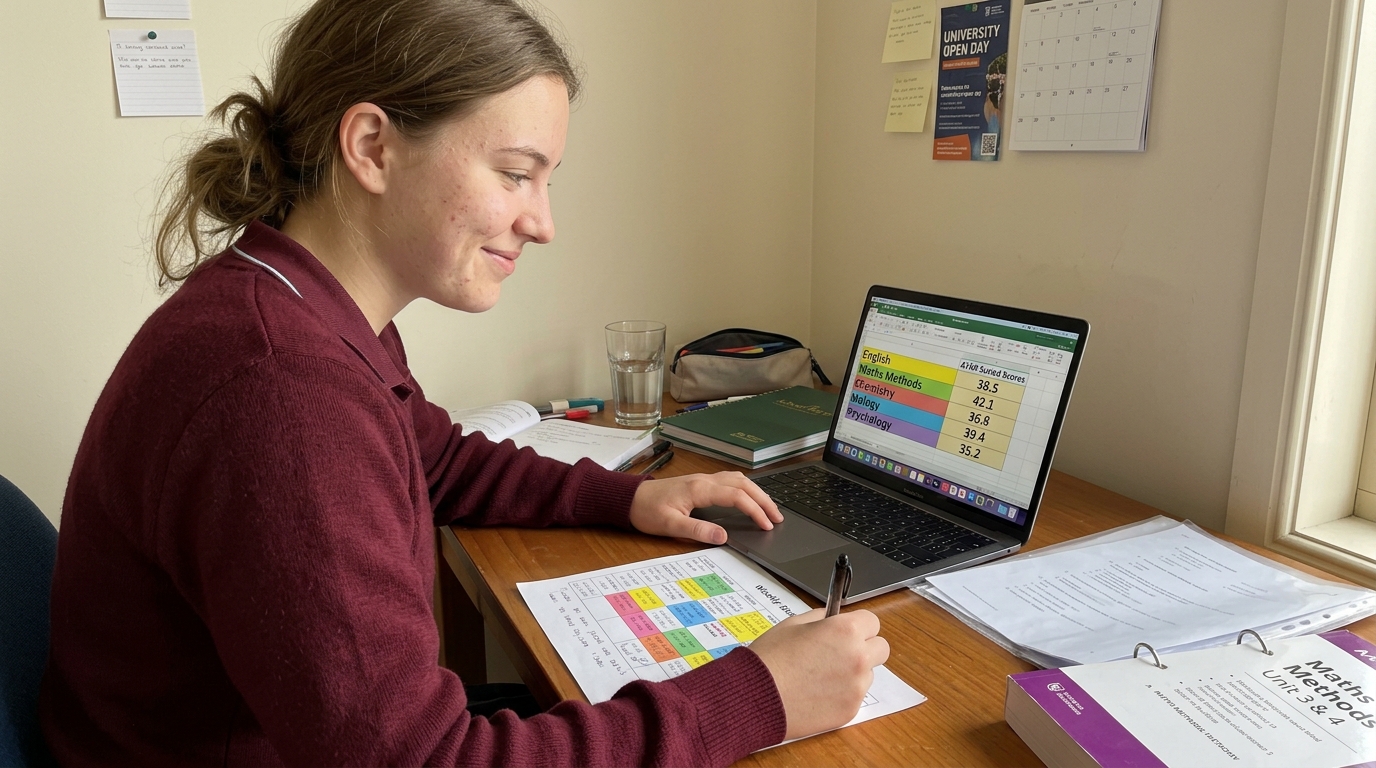
An aggregate is a raw sum of your scaled subject results — the actual marks you earned, with each state's scaling formula applied. An ATAR is the rank that aggregate produces, expressed as a percentile from 0 to 99.95. Two students with identical aggregates always get the same ATAR; two students with the same raw marks in different subjects often get different aggregates because the scaling treats their subjects differently.
The ATAR is calibrated against your age cohort, not just the students who finish Year 12 in your state. The Universities Admissions Centre (UAC) and the Victorian Tertiary Admissions Centre (VTAC) compute it by ordering every student's aggregate from highest to lowest, then converting position to a 0–99.95 percentile in 0.05 steps. So an aggregate that gets you 90.10 one year might get 90.40 the next — same number, different cohort.
How do you calculate ATAR aggregate?
Each state computes the aggregate slightly differently, but the shape is the same: take your best subjects, scale each one against the state-wide cohort, and sum what's left. Here's the mechanic state by state.
| State | Formula | Maximum aggregate |
|---|---|---|
| NSW (HSC) | Best 10 units of scaled marks (must include 2 units of English). | 500 |
| VIC (VCE) | Top 4 scaled study scores (one must be English) + 10% of 5th and 6th scaled study scores. | 210 |
| QLD (QCE) | Best 5 scaled subject results, summed and converted to an ATAR rank by QTAC. | 100 (rank-equivalent) |
| SA / NT (SACE) | Best 90 credits of Stage 2 results, with at least one English-pattern subject. Scaled by SATAC. | 90 |
| WA (WACE) | Best 4 scaled ATAR-course scores; English competence required. | 400 |
The common thread: every state strips weak subjects (or weights them low), enforces English, then scales. The aggregate you see published on results day already has the scaling baked in — your job is to estimate it before then.
How does subject scaling affect your aggregate?
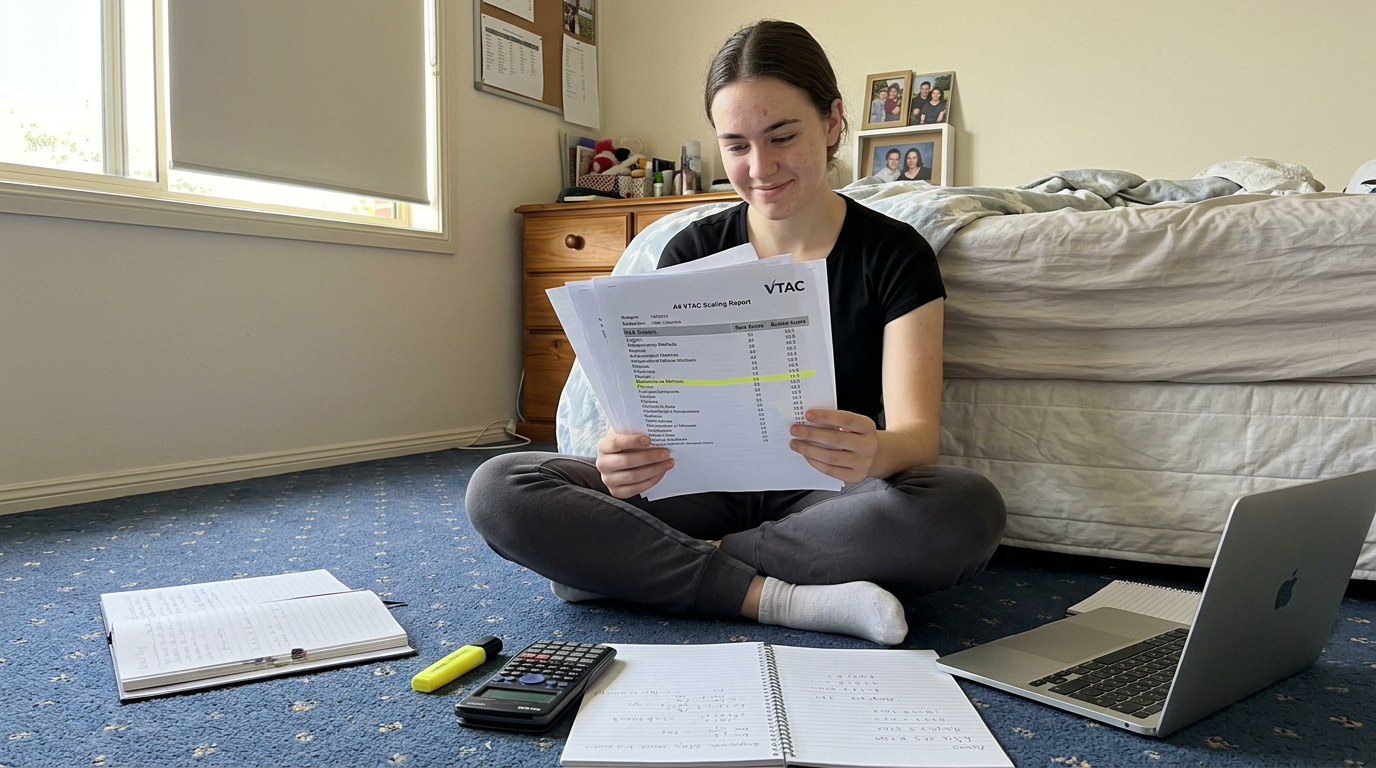
Scaling adjusts your raw mark to reflect the strength of the cohort that took your subject. If a high-performing group of students all sat Specialist Maths, the average performer in that group is a strong student in absolute terms — so a raw score of 35 might scale up to 42. If an easier subject attracts a weaker cohort, the same raw 35 might scale down to 30.
The Australian Council for Educational Research (ACER) describes scaling as the mechanism that lets students be ranked fairly across different subject choices. It is not a reward for choosing harder subjects — it's a correction so that two students of equal academic ability end up with comparable aggregates regardless of subject mix. The 2024 VCE scaling report from VTAC, for example, scaled Specialist Mathematics up by an average of about 12 points, English Language up by 4, and several elective subjects down by 2 to 5 points.
The practical effect for an ATAR above 90 is that two or three subject choices can shift your aggregate by 5 to 15 points either way. That is often the difference between 88 and 93.
What aggregate gives you an ATAR of 95?
An ATAR of 95 puts you in the top 5% of your age cohort. The aggregate that produces it sits roughly halfway between the 90 and 99.95 thresholds:
- NSW (HSC): aggregate around 415–425 — average scaled mark of about 42 across 10 units.
- VIC (VCE): aggregate around 175–180 — top four scaled study scores averaging about 41, with the 5th and 6th in the high 30s.
- QLD (QCE): ATAR-rank score around 87–89 after scaling.
- SA / NT (SACE): aggregate around 80.
- WA (WACE): ATAR aggregate around 335–345 across the four best ATAR-course scaled scores.
The numbers shift by 1–2 each year. UAC's published scaling reports are the cleanest way to back-calculate the exact aggregate from a target ATAR for your specific year — they list the median scaled mark in every subject and the aggregate-to-ATAR conversion table.
Can a low aggregate still produce a high ATAR through scaling?
Yes — and this is where students often get caught off guard, in either direction. Two students can earn identical raw marks across the same subjects but end up with aggregates 10 points apart because they chose different subjects with different scaling profiles. Strong scaling subjects (Specialist Mathematics, the harder language pairs, Latin, Higher Level IB equivalents through cross-recognition) consistently lift raw marks; weaker scaling subjects (some VET-pathway subjects, certain studio-arts variants depending on cohort) consistently push them down.
What scaling does not do is invent marks you didn't earn. It redistributes around the cohort median. So a student who chooses three high-scaling subjects and gets a raw 60 in each will end up with an aggregate that lifts them — but not as far as a student who got raw 75s in those same subjects. Subject choice is a multiplier on effort, not a substitute for it.
Picking a strategic subject mix in Year 11 is one of the highest-leverage decisions in senior school. If you're working through this with a tutor, our guide on why personalised tutoring is key to achieving ATAR success walks through how a one-to-one tutor adapts to your specific subject mix and target aggregate.
What's the highest possible aggregate?
The maximum aggregate depends on the state because each one caps a different total: 500 in NSW, 210 in VIC, 90 in SA, 400 in WA, and a rank-equivalent 100 in QLD. In practice, only a handful of students per year reach the technical maximum because it requires perfect raw scores across every counted subject and a subject mix where scaling either preserves those marks or lifts them above the nominal ceiling.
In Victoria, scaled study scores can technically exceed 50 because scaling adjusts the median upward in the strongest-cohort subjects. So the published "maximum aggregate" of 210 is occasionally exceeded — VTAC's own scaling report has shown aggregates as high as 213 in years where scaling lifted top-end Specialist Maths and a second high-scaling subject above 50. The ATAR caps at 99.95 either way; the surplus aggregate is invisible past that ceiling.
How do bonus points and adjustment factors interact with aggregate?
Bonus points (also called adjustment factors or access schemes) are added to your aggregate or your ATAR after it's calculated, depending on the state and the scheme. They typically bump you by 1 to 10 points and are awarded for circumstances such as:
- Educational disadvantage — being from a low-SES school, a remote area, or having had a disrupted Year 11 or 12.
- Subject relevance — some universities give bonus points for taking Specialist Maths or a Language Other Than English when you apply to a course where that subject is genuinely useful.
- Equity access schemes — VTAC's SEAS, UAC's Educational Access Scheme, and QTAC's Educational Access Scheme each apply selection-rank adjustments after the ATAR is computed.
Bonus points apply to your selection rank, which is your ATAR plus adjustments — so they affect what course you get into, not your published ATAR. If you're aiming for a course with a guaranteed cut-off, work the bonus points back into your aggregate target. A course with an 85 selection-rank cut-off where you reliably qualify for 5 bonus points means the underlying ATAR you actually need to earn is 80 — which corresponds to a much more achievable aggregate.
For a deeper breakdown of how the cut-offs translate by degree, see our companion guide on what ATAR you need for your course.
How can I hit the aggregate I'm targeting?
Three things move your aggregate more than anything else: subject choice, study consistency across all your counted subjects (not just your favourites), and confident exam technique under time pressure. The students who land an ATAR above 90 typically combine a defensible subject mix with steady weekly study from Year 11 onward and structured past-paper practice in the months before exams.
If you want a structured walkthrough of what high-90 students actually do, our guide on how to achieve your dream ATAR covers the planning, practice, and pacing patterns that consistently produce that result. For the underlying mechanic of how the ATAR is computed, see how the ATAR is calculated. And if you're feeling the pressure rather than working from a plan, the gentler companion piece is concerned about your ATAR? read this.
A one-to-one tutor through Tutero's online tutoring starts at A$65/hour — same rate across Year 7 to Year 12 — with a typical Australian range of A$55–A$85/hour for one-to-one tutoring of comparable quality. The lesson changes by year level; the rate doesn't. Most senior students working towards a 90+ ATAR build a weekly cadence with their tutor across one or two of their highest-leverage subjects.
So what aggregate do you actually need?
The aggregate you need depends on your state, your subject mix, and the cohort you're being ranked against. As a working estimate: 340 (NSW) or 146 (VIC) for an ATAR of 85, 370 or 157 for 90, 415–425 or 175–180 for 95, and 476 or 210 for 99.95. But the precise number moves every year, and your subject choice can shift your aggregate by 10 to 15 points either way before you've sat a single exam. Plan your subjects in Year 11, study consistently across all of them, and use each year's scaling report from UAC or VTAC to estimate where your effort is actually landing.
Related reading
- How the ATAR is calculated — the umbrella mechanic in plain language
- How to achieve your dream ATAR — strategy, study patterns, exam technique
- Concerned about your ATAR? Read this — perspective for a tougher trial-exam result
- Why personalised tutoring is key to achieving ATAR success — how a tutor adapts to your subject mix
- 10 ATAR facts every student should know — common misconceptions cleared up
- What ATAR do you need for your course? — by-degree cut-offs
- Proven strategies for acing your VCE exams — Victoria-specific exam technique
- 5 tips for choosing HSC subjects — NSW-specific subject selection
- Master time management — expert tips for students — universal study-skills companion
An aggregate is a sum. An ATAR is a rank. Two students with identical aggregates always get the same ATAR.
An aggregate is a sum. An ATAR is a rank. Two students with identical aggregates always get the same ATAR.
Your ATAR is a rank, not a score. The number that actually decides where you land is your aggregate — the sum of your top scaled subject results — and the cut-off shifts a little every year because it depends on how the rest of your cohort performs. This guide walks through the aggregates that have produced ATARs of 85, 90, 95 and 99.95 in NSW, Victoria, Queensland and South Australia, what scaling does to your raw marks, and how bonus points and adjustment factors fit in.
Quick answer
To get an ATAR above 90 in Australia, you generally need a Year 12 aggregate that puts you in roughly the top 10% of your state's age cohort. In NSW (HSC) that's an aggregate of around 370 out of 500 — an average scaled mark of 37 across your best 10 units. In Victoria (VCE) it's around 157 out of 210 — average scaled study scores of about 37–38. In Queensland (QCE) it's an ATAR-rank score around 78–80 after subject results are scaled, and in South Australia (SACE) you need an aggregate around 74. The exact number moves by 1–3 points each year because scaling is cohort-relative.
What's the difference between aggregate and ATAR?
An aggregate is a raw sum of your scaled subject results — the actual marks you earned, with each state's scaling formula applied. An ATAR is the rank that aggregate produces, expressed as a percentile from 0 to 99.95. Two students with identical aggregates always get the same ATAR; two students with the same raw marks in different subjects often get different aggregates because the scaling treats their subjects differently.
The ATAR is calibrated against your age cohort, not just the students who finish Year 12 in your state. The Universities Admissions Centre (UAC) and the Victorian Tertiary Admissions Centre (VTAC) compute it by ordering every student's aggregate from highest to lowest, then converting position to a 0–99.95 percentile in 0.05 steps. So an aggregate that gets you 90.10 one year might get 90.40 the next — same number, different cohort.
How do you calculate ATAR aggregate?
Each state computes the aggregate slightly differently, but the shape is the same: take your best subjects, scale each one against the state-wide cohort, and sum what's left. Here's the mechanic state by state.
| State | Formula | Maximum aggregate |
|---|---|---|
| NSW (HSC) | Best 10 units of scaled marks (must include 2 units of English). | 500 |
| VIC (VCE) | Top 4 scaled study scores (one must be English) + 10% of 5th and 6th scaled study scores. | 210 |
| QLD (QCE) | Best 5 scaled subject results, summed and converted to an ATAR rank by QTAC. | 100 (rank-equivalent) |
| SA / NT (SACE) | Best 90 credits of Stage 2 results, with at least one English-pattern subject. Scaled by SATAC. | 90 |
| WA (WACE) | Best 4 scaled ATAR-course scores; English competence required. | 400 |
The common thread: every state strips weak subjects (or weights them low), enforces English, then scales. The aggregate you see published on results day already has the scaling baked in — your job is to estimate it before then.
How does subject scaling affect your aggregate?
Scaling adjusts your raw mark to reflect the strength of the cohort that took your subject. If a high-performing group of students all sat Specialist Maths, the average performer in that group is a strong student in absolute terms — so a raw score of 35 might scale up to 42. If an easier subject attracts a weaker cohort, the same raw 35 might scale down to 30.
The Australian Council for Educational Research (ACER) describes scaling as the mechanism that lets students be ranked fairly across different subject choices. It is not a reward for choosing harder subjects — it's a correction so that two students of equal academic ability end up with comparable aggregates regardless of subject mix. The 2024 VCE scaling report from VTAC, for example, scaled Specialist Mathematics up by an average of about 12 points, English Language up by 4, and several elective subjects down by 2 to 5 points.
The practical effect for an ATAR above 90 is that two or three subject choices can shift your aggregate by 5 to 15 points either way. That is often the difference between 88 and 93.
What aggregate gives you an ATAR of 95?
An ATAR of 95 puts you in the top 5% of your age cohort. The aggregate that produces it sits roughly halfway between the 90 and 99.95 thresholds:
- NSW (HSC): aggregate around 415–425 — average scaled mark of about 42 across 10 units.
- VIC (VCE): aggregate around 175–180 — top four scaled study scores averaging about 41, with the 5th and 6th in the high 30s.
- QLD (QCE): ATAR-rank score around 87–89 after scaling.
- SA / NT (SACE): aggregate around 80.
- WA (WACE): ATAR aggregate around 335–345 across the four best ATAR-course scaled scores.
The numbers shift by 1–2 each year. UAC's published scaling reports are the cleanest way to back-calculate the exact aggregate from a target ATAR for your specific year — they list the median scaled mark in every subject and the aggregate-to-ATAR conversion table.
Can a low aggregate still produce a high ATAR through scaling?
Yes — and this is where students often get caught off guard, in either direction. Two students can earn identical raw marks across the same subjects but end up with aggregates 10 points apart because they chose different subjects with different scaling profiles. Strong scaling subjects (Specialist Mathematics, the harder language pairs, Latin, Higher Level IB equivalents through cross-recognition) consistently lift raw marks; weaker scaling subjects (some VET-pathway subjects, certain studio-arts variants depending on cohort) consistently push them down.
What scaling does not do is invent marks you didn't earn. It redistributes around the cohort median. So a student who chooses three high-scaling subjects and gets a raw 60 in each will end up with an aggregate that lifts them — but not as far as a student who got raw 75s in those same subjects. Subject choice is a multiplier on effort, not a substitute for it.
Picking a strategic subject mix in Year 11 is one of the highest-leverage decisions in senior school. If you're working through this with a tutor, our guide on why personalised tutoring is key to achieving ATAR success walks through how a one-to-one tutor adapts to your specific subject mix and target aggregate.
What's the highest possible aggregate?
The maximum aggregate depends on the state because each one caps a different total: 500 in NSW, 210 in VIC, 90 in SA, 400 in WA, and a rank-equivalent 100 in QLD. In practice, only a handful of students per year reach the technical maximum because it requires perfect raw scores across every counted subject and a subject mix where scaling either preserves those marks or lifts them above the nominal ceiling.
In Victoria, scaled study scores can technically exceed 50 because scaling adjusts the median upward in the strongest-cohort subjects. So the published "maximum aggregate" of 210 is occasionally exceeded — VTAC's own scaling report has shown aggregates as high as 213 in years where scaling lifted top-end Specialist Maths and a second high-scaling subject above 50. The ATAR caps at 99.95 either way; the surplus aggregate is invisible past that ceiling.
How do bonus points and adjustment factors interact with aggregate?
Bonus points (also called adjustment factors or access schemes) are added to your aggregate or your ATAR after it's calculated, depending on the state and the scheme. They typically bump you by 1 to 10 points and are awarded for circumstances such as:
- Educational disadvantage — being from a low-SES school, a remote area, or having had a disrupted Year 11 or 12.
- Subject relevance — some universities give bonus points for taking Specialist Maths or a Language Other Than English when you apply to a course where that subject is genuinely useful.
- Equity access schemes — VTAC's SEAS, UAC's Educational Access Scheme, and QTAC's Educational Access Scheme each apply selection-rank adjustments after the ATAR is computed.
Bonus points apply to your selection rank, which is your ATAR plus adjustments — so they affect what course you get into, not your published ATAR. If you're aiming for a course with a guaranteed cut-off, work the bonus points back into your aggregate target. A course with an 85 selection-rank cut-off where you reliably qualify for 5 bonus points means the underlying ATAR you actually need to earn is 80 — which corresponds to a much more achievable aggregate.
For a deeper breakdown of how the cut-offs translate by degree, see our companion guide on what ATAR you need for your course.
How can I hit the aggregate I'm targeting?
Three things move your aggregate more than anything else: subject choice, study consistency across all your counted subjects (not just your favourites), and confident exam technique under time pressure. The students who land an ATAR above 90 typically combine a defensible subject mix with steady weekly study from Year 11 onward and structured past-paper practice in the months before exams.
If you want a structured walkthrough of what high-90 students actually do, our guide on how to achieve your dream ATAR covers the planning, practice, and pacing patterns that consistently produce that result. For the underlying mechanic of how the ATAR is computed, see how the ATAR is calculated. And if you're feeling the pressure rather than working from a plan, the gentler companion piece is concerned about your ATAR? read this.
A one-to-one tutor through Tutero's online tutoring starts at A$65/hour — same rate across Year 7 to Year 12 — with a typical Australian range of A$55–A$85/hour for one-to-one tutoring of comparable quality. The lesson changes by year level; the rate doesn't. Most senior students working towards a 90+ ATAR build a weekly cadence with their tutor across one or two of their highest-leverage subjects.
So what aggregate do you actually need?
The aggregate you need depends on your state, your subject mix, and the cohort you're being ranked against. As a working estimate: 340 (NSW) or 146 (VIC) for an ATAR of 85, 370 or 157 for 90, 415–425 or 175–180 for 95, and 476 or 210 for 99.95. But the precise number moves every year, and your subject choice can shift your aggregate by 10 to 15 points either way before you've sat a single exam. Plan your subjects in Year 11, study consistently across all of them, and use each year's scaling report from UAC or VTAC to estimate where your effort is actually landing.
Related reading
- How the ATAR is calculated — the umbrella mechanic in plain language
- How to achieve your dream ATAR — strategy, study patterns, exam technique
- Concerned about your ATAR? Read this — perspective for a tougher trial-exam result
- Why personalised tutoring is key to achieving ATAR success — how a tutor adapts to your subject mix
- 10 ATAR facts every student should know — common misconceptions cleared up
- What ATAR do you need for your course? — by-degree cut-offs
- Proven strategies for acing your VCE exams — Victoria-specific exam technique
- 5 tips for choosing HSC subjects — NSW-specific subject selection
- Master time management — expert tips for students — universal study-skills companion
FAQ
.svg)
.svg)
Online maths tutoring at Tutero is catering to students of all year levels. We offer programs tailored to the unique learning curves of each age group.
We also have expert NAPLAN and ATAR subject tutors, ensuring students are well-equipped for these pivotal assessments.
We recommend at least two to three session per week for consistent progress. However, this can vary based on your child's needs and goals.
Our platform uses advanced security protocols to ensure the safety and privacy of all our online sessions.
Parents are welcome to observe sessions. We believe in a collaborative approach to education.
We provide regular progress reports and assessments to track your child’s academic development.
Yes, we prioritise the student-tutor relationship and can arrange a change if the need arises.
Yes, we offer a range of resources and materials, including interactive exercises and practice worksheets.
An aggregate is a sum. An ATAR is a rank. Two students with identical aggregates always get the same ATAR.
An aggregate is a sum. An ATAR is a rank. Two students with identical aggregates always get the same ATAR.

An aggregate is a sum. An ATAR is a rank. Two students with identical aggregates always get the same ATAR.
Two or three subject choices can shift your aggregate by 5 to 15 points either way — that is often the difference between an ATAR of 88 and 93.
Your ATAR is a rank, not a score. The number that actually decides where you land is your aggregate — the sum of your top scaled subject results — and the cut-off shifts a little every year because it depends on how the rest of your cohort performs. This guide walks through the aggregates that have produced ATARs of 85, 90, 95 and 99.95 in NSW, Victoria, Queensland and South Australia, what scaling does to your raw marks, and how bonus points and adjustment factors fit in.
Quick answer
To get an ATAR above 90 in Australia, you generally need a Year 12 aggregate that puts you in roughly the top 10% of your state's age cohort. In NSW (HSC) that's an aggregate of around 370 out of 500 — an average scaled mark of 37 across your best 10 units. In Victoria (VCE) it's around 157 out of 210 — average scaled study scores of about 37–38. In Queensland (QCE) it's an ATAR-rank score around 78–80 after subject results are scaled, and in South Australia (SACE) you need an aggregate around 74. The exact number moves by 1–3 points each year because scaling is cohort-relative.
What's the difference between aggregate and ATAR?
An aggregate is a raw sum of your scaled subject results — the actual marks you earned, with each state's scaling formula applied. An ATAR is the rank that aggregate produces, expressed as a percentile from 0 to 99.95. Two students with identical aggregates always get the same ATAR; two students with the same raw marks in different subjects often get different aggregates because the scaling treats their subjects differently.
The ATAR is calibrated against your age cohort, not just the students who finish Year 12 in your state. The Universities Admissions Centre (UAC) and the Victorian Tertiary Admissions Centre (VTAC) compute it by ordering every student's aggregate from highest to lowest, then converting position to a 0–99.95 percentile in 0.05 steps. So an aggregate that gets you 90.10 one year might get 90.40 the next — same number, different cohort.
How do you calculate ATAR aggregate?
Each state computes the aggregate slightly differently, but the shape is the same: take your best subjects, scale each one against the state-wide cohort, and sum what's left. Here's the mechanic state by state.
| State | Formula | Maximum aggregate |
|---|---|---|
| NSW (HSC) | Best 10 units of scaled marks (must include 2 units of English). | 500 |
| VIC (VCE) | Top 4 scaled study scores (one must be English) + 10% of 5th and 6th scaled study scores. | 210 |
| QLD (QCE) | Best 5 scaled subject results, summed and converted to an ATAR rank by QTAC. | 100 (rank-equivalent) |
| SA / NT (SACE) | Best 90 credits of Stage 2 results, with at least one English-pattern subject. Scaled by SATAC. | 90 |
| WA (WACE) | Best 4 scaled ATAR-course scores; English competence required. | 400 |
The common thread: every state strips weak subjects (or weights them low), enforces English, then scales. The aggregate you see published on results day already has the scaling baked in — your job is to estimate it before then.
How does subject scaling affect your aggregate?
Scaling adjusts your raw mark to reflect the strength of the cohort that took your subject. If a high-performing group of students all sat Specialist Maths, the average performer in that group is a strong student in absolute terms — so a raw score of 35 might scale up to 42. If an easier subject attracts a weaker cohort, the same raw 35 might scale down to 30.
The Australian Council for Educational Research (ACER) describes scaling as the mechanism that lets students be ranked fairly across different subject choices. It is not a reward for choosing harder subjects — it's a correction so that two students of equal academic ability end up with comparable aggregates regardless of subject mix. The 2024 VCE scaling report from VTAC, for example, scaled Specialist Mathematics up by an average of about 12 points, English Language up by 4, and several elective subjects down by 2 to 5 points.
The practical effect for an ATAR above 90 is that two or three subject choices can shift your aggregate by 5 to 15 points either way. That is often the difference between 88 and 93.
What aggregate gives you an ATAR of 95?
An ATAR of 95 puts you in the top 5% of your age cohort. The aggregate that produces it sits roughly halfway between the 90 and 99.95 thresholds:
- NSW (HSC): aggregate around 415–425 — average scaled mark of about 42 across 10 units.
- VIC (VCE): aggregate around 175–180 — top four scaled study scores averaging about 41, with the 5th and 6th in the high 30s.
- QLD (QCE): ATAR-rank score around 87–89 after scaling.
- SA / NT (SACE): aggregate around 80.
- WA (WACE): ATAR aggregate around 335–345 across the four best ATAR-course scaled scores.
The numbers shift by 1–2 each year. UAC's published scaling reports are the cleanest way to back-calculate the exact aggregate from a target ATAR for your specific year — they list the median scaled mark in every subject and the aggregate-to-ATAR conversion table.
Can a low aggregate still produce a high ATAR through scaling?
Yes — and this is where students often get caught off guard, in either direction. Two students can earn identical raw marks across the same subjects but end up with aggregates 10 points apart because they chose different subjects with different scaling profiles. Strong scaling subjects (Specialist Mathematics, the harder language pairs, Latin, Higher Level IB equivalents through cross-recognition) consistently lift raw marks; weaker scaling subjects (some VET-pathway subjects, certain studio-arts variants depending on cohort) consistently push them down.
What scaling does not do is invent marks you didn't earn. It redistributes around the cohort median. So a student who chooses three high-scaling subjects and gets a raw 60 in each will end up with an aggregate that lifts them — but not as far as a student who got raw 75s in those same subjects. Subject choice is a multiplier on effort, not a substitute for it.
Picking a strategic subject mix in Year 11 is one of the highest-leverage decisions in senior school. If you're working through this with a tutor, our guide on why personalised tutoring is key to achieving ATAR success walks through how a one-to-one tutor adapts to your specific subject mix and target aggregate.
What's the highest possible aggregate?
The maximum aggregate depends on the state because each one caps a different total: 500 in NSW, 210 in VIC, 90 in SA, 400 in WA, and a rank-equivalent 100 in QLD. In practice, only a handful of students per year reach the technical maximum because it requires perfect raw scores across every counted subject and a subject mix where scaling either preserves those marks or lifts them above the nominal ceiling.
In Victoria, scaled study scores can technically exceed 50 because scaling adjusts the median upward in the strongest-cohort subjects. So the published "maximum aggregate" of 210 is occasionally exceeded — VTAC's own scaling report has shown aggregates as high as 213 in years where scaling lifted top-end Specialist Maths and a second high-scaling subject above 50. The ATAR caps at 99.95 either way; the surplus aggregate is invisible past that ceiling.
How do bonus points and adjustment factors interact with aggregate?
Bonus points (also called adjustment factors or access schemes) are added to your aggregate or your ATAR after it's calculated, depending on the state and the scheme. They typically bump you by 1 to 10 points and are awarded for circumstances such as:
- Educational disadvantage — being from a low-SES school, a remote area, or having had a disrupted Year 11 or 12.
- Subject relevance — some universities give bonus points for taking Specialist Maths or a Language Other Than English when you apply to a course where that subject is genuinely useful.
- Equity access schemes — VTAC's SEAS, UAC's Educational Access Scheme, and QTAC's Educational Access Scheme each apply selection-rank adjustments after the ATAR is computed.
Bonus points apply to your selection rank, which is your ATAR plus adjustments — so they affect what course you get into, not your published ATAR. If you're aiming for a course with a guaranteed cut-off, work the bonus points back into your aggregate target. A course with an 85 selection-rank cut-off where you reliably qualify for 5 bonus points means the underlying ATAR you actually need to earn is 80 — which corresponds to a much more achievable aggregate.
For a deeper breakdown of how the cut-offs translate by degree, see our companion guide on what ATAR you need for your course.
How can I hit the aggregate I'm targeting?
Three things move your aggregate more than anything else: subject choice, study consistency across all your counted subjects (not just your favourites), and confident exam technique under time pressure. The students who land an ATAR above 90 typically combine a defensible subject mix with steady weekly study from Year 11 onward and structured past-paper practice in the months before exams.
If you want a structured walkthrough of what high-90 students actually do, our guide on how to achieve your dream ATAR covers the planning, practice, and pacing patterns that consistently produce that result. For the underlying mechanic of how the ATAR is computed, see how the ATAR is calculated. And if you're feeling the pressure rather than working from a plan, the gentler companion piece is concerned about your ATAR? read this.
A one-to-one tutor through Tutero's online tutoring starts at A$65/hour — same rate across Year 7 to Year 12 — with a typical Australian range of A$55–A$85/hour for one-to-one tutoring of comparable quality. The lesson changes by year level; the rate doesn't. Most senior students working towards a 90+ ATAR build a weekly cadence with their tutor across one or two of their highest-leverage subjects.
So what aggregate do you actually need?
The aggregate you need depends on your state, your subject mix, and the cohort you're being ranked against. As a working estimate: 340 (NSW) or 146 (VIC) for an ATAR of 85, 370 or 157 for 90, 415–425 or 175–180 for 95, and 476 or 210 for 99.95. But the precise number moves every year, and your subject choice can shift your aggregate by 10 to 15 points either way before you've sat a single exam. Plan your subjects in Year 11, study consistently across all of them, and use each year's scaling report from UAC or VTAC to estimate where your effort is actually landing.
Related reading
- How the ATAR is calculated — the umbrella mechanic in plain language
- How to achieve your dream ATAR — strategy, study patterns, exam technique
- Concerned about your ATAR? Read this — perspective for a tougher trial-exam result
- Why personalised tutoring is key to achieving ATAR success — how a tutor adapts to your subject mix
- 10 ATAR facts every student should know — common misconceptions cleared up
- What ATAR do you need for your course? — by-degree cut-offs
- Proven strategies for acing your VCE exams — Victoria-specific exam technique
- 5 tips for choosing HSC subjects — NSW-specific subject selection
- Master time management — expert tips for students — universal study-skills companion
An aggregate is a sum. An ATAR is a rank. Two students with identical aggregates always get the same ATAR.
Two or three subject choices can shift your aggregate by 5 to 15 points either way — that is often the difference between an ATAR of 88 and 93.
An ATAR of 90 puts you in the top 10% of the state cohort. In NSW (HSC) the aggregate is around 370 out of 500 — an average scaled mark of 37 across your best 10 units. In Victoria (VCE) it's around 157 out of 210, with the top four scaled study scores averaging 37–38. In Queensland the rank-equivalent is around 78–80 after QTAC scaling, and in SA/NT it's an aggregate around 78 out of 90. The exact threshold moves by 1–2 points each year because scaling is cohort-relative.
Aggregate is the raw sum of your scaled subject results — the marks you actually earned, with each state's scaling formula applied. ATAR is the rank that aggregate produces, expressed as a percentile from 0 to 99.95 calibrated against your age cohort. Two students with the same aggregate always get the same ATAR; two students with the same raw marks in different subjects often get different aggregates because scaling treats their subjects differently.
Scaling adjusts your raw mark to reflect the strength of the cohort that took your subject. Strong-cohort subjects (Specialist Maths, Latin, the harder language pairs) tend to scale up. Weaker-cohort subjects scale down. ACER describes scaling as the mechanism that ranks students fairly across different subject mixes — it's not a reward for choosing harder subjects but a correction so two students of equal academic ability end up with comparable aggregates. Two or three subject choices can shift your aggregate by 5 to 15 points either way.
Two students can earn identical raw marks across the same subjects and end up with aggregates 10 points apart because they chose different subjects with different scaling profiles. Strong-scaling subjects consistently lift raw marks; weaker-scaling subjects push them down. What scaling does not do is invent marks you didn't earn. It redistributes around the cohort median, so a student who chooses three high-scaling subjects and earns raw 60s will lift — but not as far as a student who earned raw 75s in those same subjects.
The maximum depends on the state: 500 in NSW, 210 in VIC, 90 in SA/NT, 400 in WA, and a rank-equivalent 100 in QLD. In Victoria, scaled study scores can technically exceed 50 in the strongest-cohort subjects, so VTAC's published reports occasionally show aggregates above 210 — though the ATAR caps at 99.95 either way and any surplus aggregate is invisible past that ceiling.
Bonus points (also called adjustment factors or access schemes) are added to your selection rank after the ATAR is calculated, not to the aggregate itself. They typically bump you by 1 to 10 points and apply to course entry, not to your published ATAR. Common reasons include educational disadvantage (low-SES or remote schooling), subject relevance (Specialist Maths bonuses for some maths-heavy courses), and equity access schemes such as VTAC SEAS, UAC EAS and QTAC EAS. If you reliably qualify for 5 bonus points and your target course has an 85 selection rank, the underlying ATAR you actually need to earn is 80.
Hoping to improve confidence & grades?

.png)