
.svg)

Setting academic goals with your child sounds simple — until you sit down to do it. Push too hard and they tune out. Hold back too much and the goals are vague wishes that quietly slide off the calendar. The lever that actually moves results is collaborative goal-setting: you and your child pick the goal together, agree how to measure progress, and check in every week.
This guide walks through four tips for setting academic goals with your child that hold up across primary, lower-secondary, and senior years — grounded in Self-Determination Theory (Deci & Ryan), Locke and Latham's goal-setting theory, and the SMART framework. It also covers the weekly check-in cadence we use with families on Tutero, what to do when a goal slips, and the moment to bring in outside help.
Quick answer: how do I set academic goals with my child?
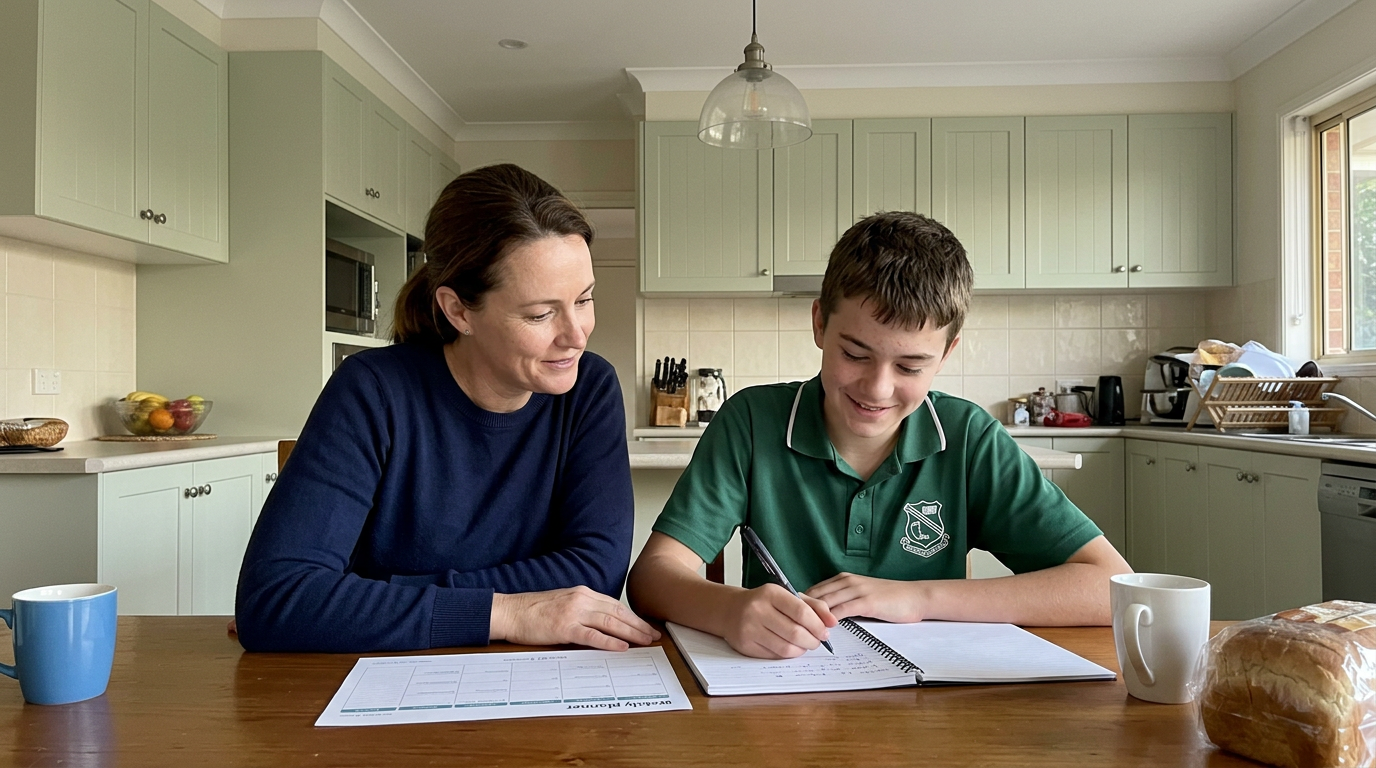
Sit down with your child for 20 minutes, ask them what they care about this term, then turn one or two of those answers into SMART goals together — Specific, Measurable, Achievable, Relevant, Time-bound. Write the goals on paper or a shared note. Pair each goal with a specific weekly action (for example, "30 minutes of fractions practice on Tuesday and Thursday"). Review progress in a 10-minute check-in every Sunday and adjust the action — never the goal — if a week slips. The single most important move is letting your child own the goal: research on autonomy-supportive parenting shows children persist far longer with goals they helped choose than with goals imposed on them.
Should I set goals for my child, or let them set their own?
The strongest evidence sits in the middle: collaborative goal-setting beats both extremes. When parents impose goals, children comply briefly and disengage; when children set goals alone, the goals often lack the structure that makes them achievable. Self-Determination Theory (Deci & Ryan) calls the middle path autonomy-supportive — the parent provides structure, vocabulary, and a check-in cadence, while the child owns the substance of the goal. In practice this means you ask the questions ("what do you want to be different by the end of term?", "what would good look like in maths?") and your child gives the answers. You then help shape those answers into a SMART form together.
What questions should I ask to start the conversation?
- What's one subject you'd like to feel more confident in this term? — surfaces the subject without you naming it.
- What does "doing well" in that subject look like to you? — translates feelings into observable behaviour.
- What's getting in the way right now? — surfaces the obstacle before you set the goal.
- If we made one small change this week, what would it be? — moves from goal to action.
What are SMART goals for kids in school?
SMART is a goal-setting framework developed in the management literature (popularised by Doran, 1981) and adapted heavily for education by Locke and Latham. For school-age children it translates as: Specific (which subject, which skill), Measurable (a number — a mark, a chapter, a number of practice problems), Achievable (a stretch, but realistic for the time and support available), Relevant (matters to the child, not just the parent), and Time-bound (deadline by end of term, end of unit, or end of week). The biggest mistake parents make is skipping the M — without a measurable target, the goal can't tell you whether the week worked.
What's a good academic goal for a primary-school child?
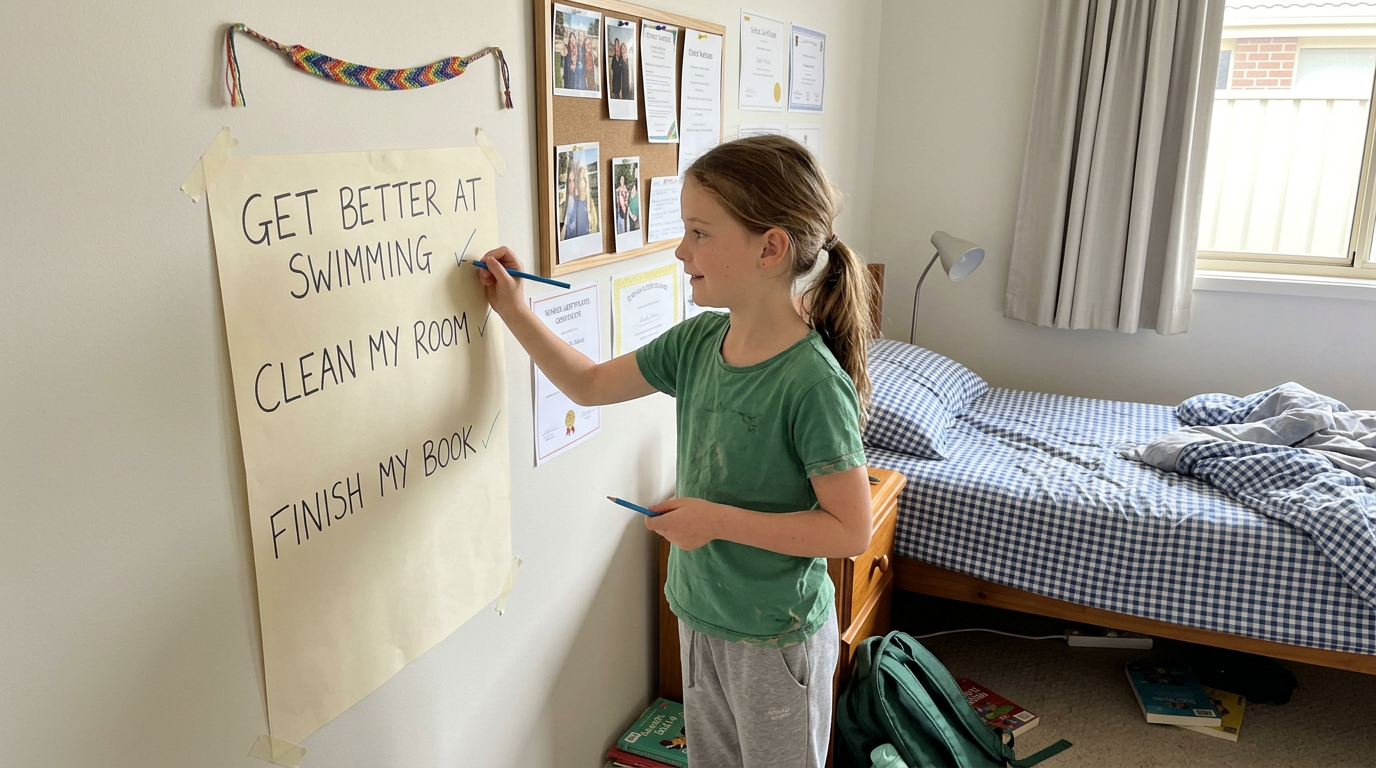
"Read one chapter book of my choice every two weeks for this term" is a strong primary goal — specific (one book), measurable (one every two weeks), achievable (matches an average reading pace at this age), relevant (the child picks the book), and time-bound (the term). Pair it with a weekly action: "20 minutes of reading after dinner, three evenings a week."
What's a good academic goal for a lower-secondary student (Years 7–9)?
"Move from a B to a B+ in Year 8 maths by the end of Term 2" works at this level — the child has a real grade history, the target is one band up (achievable), the deadline is concrete. Pair it with a weekly action: "30 minutes of fractions and percentages practice on Tuesday and Thursday, plus the homework."
What's a good academic goal for a senior student (Year 11–12)?
Senior goals should connect to the post-school plan. "Score 80+ in the Year 11 Methods exam to keep my engineering pathway open" is concrete (one exam, one number), tied to a real consequence the student cares about (their pathway), and time-bound (end of unit). Pair it with a study-block action: "two 50-minute Methods practice sessions per week, one focused on a past paper."
How do I motivate my child to actually work toward the goal?
Motivation is downstream of three things: autonomy (does the child own the goal?), competence (do they believe they can reach it?), and relatedness (is someone they trust paying attention?). If motivation is sliding, one of those three is broken. Autonomy-supportive language helps — "I noticed you finished the practice questions on Tuesday" lands better than "good job, you're so smart" because it names the behaviour rather than the trait. For a deeper walk-through of what works at home, see our companion guide on how to motivate your child.
Should I use rewards?
Small, occasional rewards tied to the process (you turned up to your three practice sessions this week) tend to help. Large rewards tied to the outcome (you'll get a phone if you score 90) tend to hurt long-term motivation, because the child starts working for the reward instead of the goal. The research from Deci's lab is consistent on this: external rewards can crowd out the intrinsic drive that sustains hard work over months.
How do I track my child's academic goals week to week?
The simplest tracking system that actually gets used is a paper sheet on the fridge or a shared note on your phone: the goal at the top, the weekly action below it, and a tick column for each week of the term. On Sunday evening, sit with your child for 10 minutes and answer three questions: did the actions happen this week? what got in the way? what's one small change for next week? The goal itself doesn't change every week — only the action does. Visible Learning research from John Hattie consistently rates goal-setting and timely formative feedback among the most effective school-based interventions, with effect sizes well above the average classroom change.
How often should we review the goal itself?
Once per half-term (every 5 weeks) is the right cadence for the goal itself. The weekly check-in is for the action; the half-term review is for the goal. If the goal is too easy, raise it. If it's too hard or no longer matches what your child cares about, change it. Goals that quietly stop mattering should be retired, not endured.
What if my child doesn't reach the goal?
Missing a goal is information, not failure. Three questions sort out what to do next: was the goal realistic given the time and support available? (if not, the goal needed adjusting earlier), did the weekly actions actually happen? (if not, the action plan was wrong), and did the gap reveal a knowledge gap? (if so, that gap is now the new short-term goal). The Education Endowment Foundation's evidence on metacognition recommends exactly this kind of after-the-fact review: the discussion of why a goal was missed builds more long-term capability than hitting it would have. Avoid framing a missed goal as a character verdict — frame it as data.
When should I bring in outside help like a tutor?
If the same goal slips for two terms in a row, or if the weekly action plan keeps stalling because your child doesn't know how to do the work, the bottleneck is usually a knowledge gap a parent can't fix from the kitchen table. A 1:1 tutor — at A$65/hour with Tutero, with no contracts and the same rate at every year level — can sit beside your child for 60 minutes a week, work through the gap, and turn the weekly action into something they can actually complete. For more on when to bring in help, see 5 signs your child needs tutoring and the ideal time to begin tutoring.
How do goal-setting, motivation, and study habits fit together?
Goals are the upstream lever — they decide what to point energy at. Motivation is the daily fuel that keeps your child showing up. Time management is the system that turns "I'll study this week" into a specific 30-minute block on a specific evening. And habits are what carry the whole thing through the weeks when motivation dips. A good goal makes motivation easier to find, and a steady weekly habit means the goal slowly happens whether motivation is high that week or not. For the full system, pair this guide with our student time-management guide and habits of highly successful students. If maths confidence is part of the picture, our piece on how tutoring can improve confidence in maths and effective strategies to improve your maths study skills are the right next reads.
The bottom line
The four tips that hold this together: set goals together, not for your child; make every goal SMART; pair every goal with a specific weekly action; and run a 10-minute check-in every Sunday. Do that for a term, expect to miss a couple of weeks, treat the misses as data, and bring in outside help if a goal slips for two terms in a row. The aim isn't a perfect run — it's a child who learns how to set a goal, work toward it, and adjust it. That skill outlasts any single term.
Set goals with your child, not for them — autonomy-supportive parenting is the single biggest predictor of whether a goal sticks.
Set goals with your child, not for them — autonomy-supportive parenting is the single biggest predictor of whether a goal sticks.
Setting academic goals with your child sounds simple — until you sit down to do it. Push too hard and they tune out. Hold back too much and the goals are vague wishes that quietly slide off the calendar. The lever that actually moves results is collaborative goal-setting: you and your child pick the goal together, agree how to measure progress, and check in every week.
This guide walks through four tips for setting academic goals with your child that hold up across primary, lower-secondary, and senior years — grounded in Self-Determination Theory (Deci & Ryan), Locke and Latham's goal-setting theory, and the SMART framework. It also covers the weekly check-in cadence we use with families on Tutero, what to do when a goal slips, and the moment to bring in outside help.
Quick answer: how do I set academic goals with my child?
Sit down with your child for 20 minutes, ask them what they care about this term, then turn one or two of those answers into SMART goals together — Specific, Measurable, Achievable, Relevant, Time-bound. Write the goals on paper or a shared note. Pair each goal with a specific weekly action (for example, "30 minutes of fractions practice on Tuesday and Thursday"). Review progress in a 10-minute check-in every Sunday and adjust the action — never the goal — if a week slips. The single most important move is letting your child own the goal: research on autonomy-supportive parenting shows children persist far longer with goals they helped choose than with goals imposed on them.
Should I set goals for my child, or let them set their own?
The strongest evidence sits in the middle: collaborative goal-setting beats both extremes. When parents impose goals, children comply briefly and disengage; when children set goals alone, the goals often lack the structure that makes them achievable. Self-Determination Theory (Deci & Ryan) calls the middle path autonomy-supportive — the parent provides structure, vocabulary, and a check-in cadence, while the child owns the substance of the goal. In practice this means you ask the questions ("what do you want to be different by the end of term?", "what would good look like in maths?") and your child gives the answers. You then help shape those answers into a SMART form together.
What questions should I ask to start the conversation?
- What's one subject you'd like to feel more confident in this term? — surfaces the subject without you naming it.
- What does "doing well" in that subject look like to you? — translates feelings into observable behaviour.
- What's getting in the way right now? — surfaces the obstacle before you set the goal.
- If we made one small change this week, what would it be? — moves from goal to action.
What are SMART goals for kids in school?
SMART is a goal-setting framework developed in the management literature (popularised by Doran, 1981) and adapted heavily for education by Locke and Latham. For school-age children it translates as: Specific (which subject, which skill), Measurable (a number — a mark, a chapter, a number of practice problems), Achievable (a stretch, but realistic for the time and support available), Relevant (matters to the child, not just the parent), and Time-bound (deadline by end of term, end of unit, or end of week). The biggest mistake parents make is skipping the M — without a measurable target, the goal can't tell you whether the week worked.
What's a good academic goal for a primary-school child?
"Read one chapter book of my choice every two weeks for this term" is a strong primary goal — specific (one book), measurable (one every two weeks), achievable (matches an average reading pace at this age), relevant (the child picks the book), and time-bound (the term). Pair it with a weekly action: "20 minutes of reading after dinner, three evenings a week."
What's a good academic goal for a lower-secondary student (Years 7–9)?
"Move from a B to a B+ in Year 8 maths by the end of Term 2" works at this level — the child has a real grade history, the target is one band up (achievable), the deadline is concrete. Pair it with a weekly action: "30 minutes of fractions and percentages practice on Tuesday and Thursday, plus the homework."
What's a good academic goal for a senior student (Year 11–12)?
Senior goals should connect to the post-school plan. "Score 80+ in the Year 11 Methods exam to keep my engineering pathway open" is concrete (one exam, one number), tied to a real consequence the student cares about (their pathway), and time-bound (end of unit). Pair it with a study-block action: "two 50-minute Methods practice sessions per week, one focused on a past paper."
How do I motivate my child to actually work toward the goal?
Motivation is downstream of three things: autonomy (does the child own the goal?), competence (do they believe they can reach it?), and relatedness (is someone they trust paying attention?). If motivation is sliding, one of those three is broken. Autonomy-supportive language helps — "I noticed you finished the practice questions on Tuesday" lands better than "good job, you're so smart" because it names the behaviour rather than the trait. For a deeper walk-through of what works at home, see our companion guide on how to motivate your child.
Should I use rewards?
Small, occasional rewards tied to the process (you turned up to your three practice sessions this week) tend to help. Large rewards tied to the outcome (you'll get a phone if you score 90) tend to hurt long-term motivation, because the child starts working for the reward instead of the goal. The research from Deci's lab is consistent on this: external rewards can crowd out the intrinsic drive that sustains hard work over months.
How do I track my child's academic goals week to week?
The simplest tracking system that actually gets used is a paper sheet on the fridge or a shared note on your phone: the goal at the top, the weekly action below it, and a tick column for each week of the term. On Sunday evening, sit with your child for 10 minutes and answer three questions: did the actions happen this week? what got in the way? what's one small change for next week? The goal itself doesn't change every week — only the action does. Visible Learning research from John Hattie consistently rates goal-setting and timely formative feedback among the most effective school-based interventions, with effect sizes well above the average classroom change.
How often should we review the goal itself?
Once per half-term (every 5 weeks) is the right cadence for the goal itself. The weekly check-in is for the action; the half-term review is for the goal. If the goal is too easy, raise it. If it's too hard or no longer matches what your child cares about, change it. Goals that quietly stop mattering should be retired, not endured.
What if my child doesn't reach the goal?
Missing a goal is information, not failure. Three questions sort out what to do next: was the goal realistic given the time and support available? (if not, the goal needed adjusting earlier), did the weekly actions actually happen? (if not, the action plan was wrong), and did the gap reveal a knowledge gap? (if so, that gap is now the new short-term goal). The Education Endowment Foundation's evidence on metacognition recommends exactly this kind of after-the-fact review: the discussion of why a goal was missed builds more long-term capability than hitting it would have. Avoid framing a missed goal as a character verdict — frame it as data.
When should I bring in outside help like a tutor?
If the same goal slips for two terms in a row, or if the weekly action plan keeps stalling because your child doesn't know how to do the work, the bottleneck is usually a knowledge gap a parent can't fix from the kitchen table. A 1:1 tutor — at A$65/hour with Tutero, with no contracts and the same rate at every year level — can sit beside your child for 60 minutes a week, work through the gap, and turn the weekly action into something they can actually complete. For more on when to bring in help, see 5 signs your child needs tutoring and the ideal time to begin tutoring.
How do goal-setting, motivation, and study habits fit together?
Goals are the upstream lever — they decide what to point energy at. Motivation is the daily fuel that keeps your child showing up. Time management is the system that turns "I'll study this week" into a specific 30-minute block on a specific evening. And habits are what carry the whole thing through the weeks when motivation dips. A good goal makes motivation easier to find, and a steady weekly habit means the goal slowly happens whether motivation is high that week or not. For the full system, pair this guide with our student time-management guide and habits of highly successful students. If maths confidence is part of the picture, our piece on how tutoring can improve confidence in maths and effective strategies to improve your maths study skills are the right next reads.
The bottom line
The four tips that hold this together: set goals together, not for your child; make every goal SMART; pair every goal with a specific weekly action; and run a 10-minute check-in every Sunday. Do that for a term, expect to miss a couple of weeks, treat the misses as data, and bring in outside help if a goal slips for two terms in a row. The aim isn't a perfect run — it's a child who learns how to set a goal, work toward it, and adjust it. That skill outlasts any single term.
FAQ
.svg)
.svg)
Online maths tutoring at Tutero is catering to students of all year levels. We offer programs tailored to the unique learning curves of each age group.
We also have expert NAPLAN and ATAR subject tutors, ensuring students are well-equipped for these pivotal assessments.
We recommend at least two to three session per week for consistent progress. However, this can vary based on your child's needs and goals.
Our platform uses advanced security protocols to ensure the safety and privacy of all our online sessions.
Parents are welcome to observe sessions. We believe in a collaborative approach to education.
We provide regular progress reports and assessments to track your child’s academic development.
Yes, we prioritise the student-tutor relationship and can arrange a change if the need arises.
Yes, we offer a range of resources and materials, including interactive exercises and practice worksheets.
Set goals with your child, not for them — autonomy-supportive parenting is the single biggest predictor of whether a goal sticks.
Set goals with your child, not for them — autonomy-supportive parenting is the single biggest predictor of whether a goal sticks.

Set goals with your child, not for them — autonomy-supportive parenting is the single biggest predictor of whether a goal sticks.
A goal without a weekly action is a wish. Pair every goal with a specific 30-minute block on a specific evening — that's where progress lives.
Setting academic goals with your child sounds simple — until you sit down to do it. Push too hard and they tune out. Hold back too much and the goals are vague wishes that quietly slide off the calendar. The lever that actually moves results is collaborative goal-setting: you and your child pick the goal together, agree how to measure progress, and check in every week.
This guide walks through four tips for setting academic goals with your child that hold up across primary, lower-secondary, and senior years — grounded in Self-Determination Theory (Deci & Ryan), Locke and Latham's goal-setting theory, and the SMART framework. It also covers the weekly check-in cadence we use with families on Tutero, what to do when a goal slips, and the moment to bring in outside help.
Quick answer: how do I set academic goals with my child?
Sit down with your child for 20 minutes, ask them what they care about this term, then turn one or two of those answers into SMART goals together — Specific, Measurable, Achievable, Relevant, Time-bound. Write the goals on paper or a shared note. Pair each goal with a specific weekly action (for example, "30 minutes of fractions practice on Tuesday and Thursday"). Review progress in a 10-minute check-in every Sunday and adjust the action — never the goal — if a week slips. The single most important move is letting your child own the goal: research on autonomy-supportive parenting shows children persist far longer with goals they helped choose than with goals imposed on them.
Should I set goals for my child, or let them set their own?
The strongest evidence sits in the middle: collaborative goal-setting beats both extremes. When parents impose goals, children comply briefly and disengage; when children set goals alone, the goals often lack the structure that makes them achievable. Self-Determination Theory (Deci & Ryan) calls the middle path autonomy-supportive — the parent provides structure, vocabulary, and a check-in cadence, while the child owns the substance of the goal. In practice this means you ask the questions ("what do you want to be different by the end of term?", "what would good look like in maths?") and your child gives the answers. You then help shape those answers into a SMART form together.
What questions should I ask to start the conversation?
- What's one subject you'd like to feel more confident in this term? — surfaces the subject without you naming it.
- What does "doing well" in that subject look like to you? — translates feelings into observable behaviour.
- What's getting in the way right now? — surfaces the obstacle before you set the goal.
- If we made one small change this week, what would it be? — moves from goal to action.
What are SMART goals for kids in school?
SMART is a goal-setting framework developed in the management literature (popularised by Doran, 1981) and adapted heavily for education by Locke and Latham. For school-age children it translates as: Specific (which subject, which skill), Measurable (a number — a mark, a chapter, a number of practice problems), Achievable (a stretch, but realistic for the time and support available), Relevant (matters to the child, not just the parent), and Time-bound (deadline by end of term, end of unit, or end of week). The biggest mistake parents make is skipping the M — without a measurable target, the goal can't tell you whether the week worked.
What's a good academic goal for a primary-school child?
"Read one chapter book of my choice every two weeks for this term" is a strong primary goal — specific (one book), measurable (one every two weeks), achievable (matches an average reading pace at this age), relevant (the child picks the book), and time-bound (the term). Pair it with a weekly action: "20 minutes of reading after dinner, three evenings a week."
What's a good academic goal for a lower-secondary student (Years 7–9)?
"Move from a B to a B+ in Year 8 maths by the end of Term 2" works at this level — the child has a real grade history, the target is one band up (achievable), the deadline is concrete. Pair it with a weekly action: "30 minutes of fractions and percentages practice on Tuesday and Thursday, plus the homework."
What's a good academic goal for a senior student (Year 11–12)?
Senior goals should connect to the post-school plan. "Score 80+ in the Year 11 Methods exam to keep my engineering pathway open" is concrete (one exam, one number), tied to a real consequence the student cares about (their pathway), and time-bound (end of unit). Pair it with a study-block action: "two 50-minute Methods practice sessions per week, one focused on a past paper."
How do I motivate my child to actually work toward the goal?
Motivation is downstream of three things: autonomy (does the child own the goal?), competence (do they believe they can reach it?), and relatedness (is someone they trust paying attention?). If motivation is sliding, one of those three is broken. Autonomy-supportive language helps — "I noticed you finished the practice questions on Tuesday" lands better than "good job, you're so smart" because it names the behaviour rather than the trait. For a deeper walk-through of what works at home, see our companion guide on how to motivate your child.
Should I use rewards?
Small, occasional rewards tied to the process (you turned up to your three practice sessions this week) tend to help. Large rewards tied to the outcome (you'll get a phone if you score 90) tend to hurt long-term motivation, because the child starts working for the reward instead of the goal. The research from Deci's lab is consistent on this: external rewards can crowd out the intrinsic drive that sustains hard work over months.
How do I track my child's academic goals week to week?
The simplest tracking system that actually gets used is a paper sheet on the fridge or a shared note on your phone: the goal at the top, the weekly action below it, and a tick column for each week of the term. On Sunday evening, sit with your child for 10 minutes and answer three questions: did the actions happen this week? what got in the way? what's one small change for next week? The goal itself doesn't change every week — only the action does. Visible Learning research from John Hattie consistently rates goal-setting and timely formative feedback among the most effective school-based interventions, with effect sizes well above the average classroom change.
How often should we review the goal itself?
Once per half-term (every 5 weeks) is the right cadence for the goal itself. The weekly check-in is for the action; the half-term review is for the goal. If the goal is too easy, raise it. If it's too hard or no longer matches what your child cares about, change it. Goals that quietly stop mattering should be retired, not endured.
What if my child doesn't reach the goal?
Missing a goal is information, not failure. Three questions sort out what to do next: was the goal realistic given the time and support available? (if not, the goal needed adjusting earlier), did the weekly actions actually happen? (if not, the action plan was wrong), and did the gap reveal a knowledge gap? (if so, that gap is now the new short-term goal). The Education Endowment Foundation's evidence on metacognition recommends exactly this kind of after-the-fact review: the discussion of why a goal was missed builds more long-term capability than hitting it would have. Avoid framing a missed goal as a character verdict — frame it as data.
When should I bring in outside help like a tutor?
If the same goal slips for two terms in a row, or if the weekly action plan keeps stalling because your child doesn't know how to do the work, the bottleneck is usually a knowledge gap a parent can't fix from the kitchen table. A 1:1 tutor — at A$65/hour with Tutero, with no contracts and the same rate at every year level — can sit beside your child for 60 minutes a week, work through the gap, and turn the weekly action into something they can actually complete. For more on when to bring in help, see 5 signs your child needs tutoring and the ideal time to begin tutoring.
How do goal-setting, motivation, and study habits fit together?
Goals are the upstream lever — they decide what to point energy at. Motivation is the daily fuel that keeps your child showing up. Time management is the system that turns "I'll study this week" into a specific 30-minute block on a specific evening. And habits are what carry the whole thing through the weeks when motivation dips. A good goal makes motivation easier to find, and a steady weekly habit means the goal slowly happens whether motivation is high that week or not. For the full system, pair this guide with our student time-management guide and habits of highly successful students. If maths confidence is part of the picture, our piece on how tutoring can improve confidence in maths and effective strategies to improve your maths study skills are the right next reads.
The bottom line
The four tips that hold this together: set goals together, not for your child; make every goal SMART; pair every goal with a specific weekly action; and run a 10-minute check-in every Sunday. Do that for a term, expect to miss a couple of weeks, treat the misses as data, and bring in outside help if a goal slips for two terms in a row. The aim isn't a perfect run — it's a child who learns how to set a goal, work toward it, and adjust it. That skill outlasts any single term.
Set goals with your child, not for them — autonomy-supportive parenting is the single biggest predictor of whether a goal sticks.
A goal without a weekly action is a wish. Pair every goal with a specific 30-minute block on a specific evening — that's where progress lives.
Hoping to improve confidence & grades?

.png)


