
.svg)

Choosing your HSC subjects is the first big decision of senior school — the one that quietly shapes your ATAR, your university options, and how much you actually enjoy Year 11 and 12. Here are five tips that work for any Year 10 student, and the questions parents and students keep asking us about scaling, prerequisites, and changing subjects mid-stream.
Quick answer
Choose HSC subjects you actually enjoy or are strong at, that meet your career or university prerequisites, and that you can carry across two demanding years. Pick at least 12 units in Year 11 and 10 units in Year 12, including 2 units of English. Don't pick "easy" subjects hoping scaling will save you — under UAC scaling, your raw mark in a subject you're strong at almost always beats a mediocre mark in a "well-scaled" one. Use the five tips below, then sense-check your shortlist against the NESA Stage 6 learning areas and your target courses on the UAC course search.
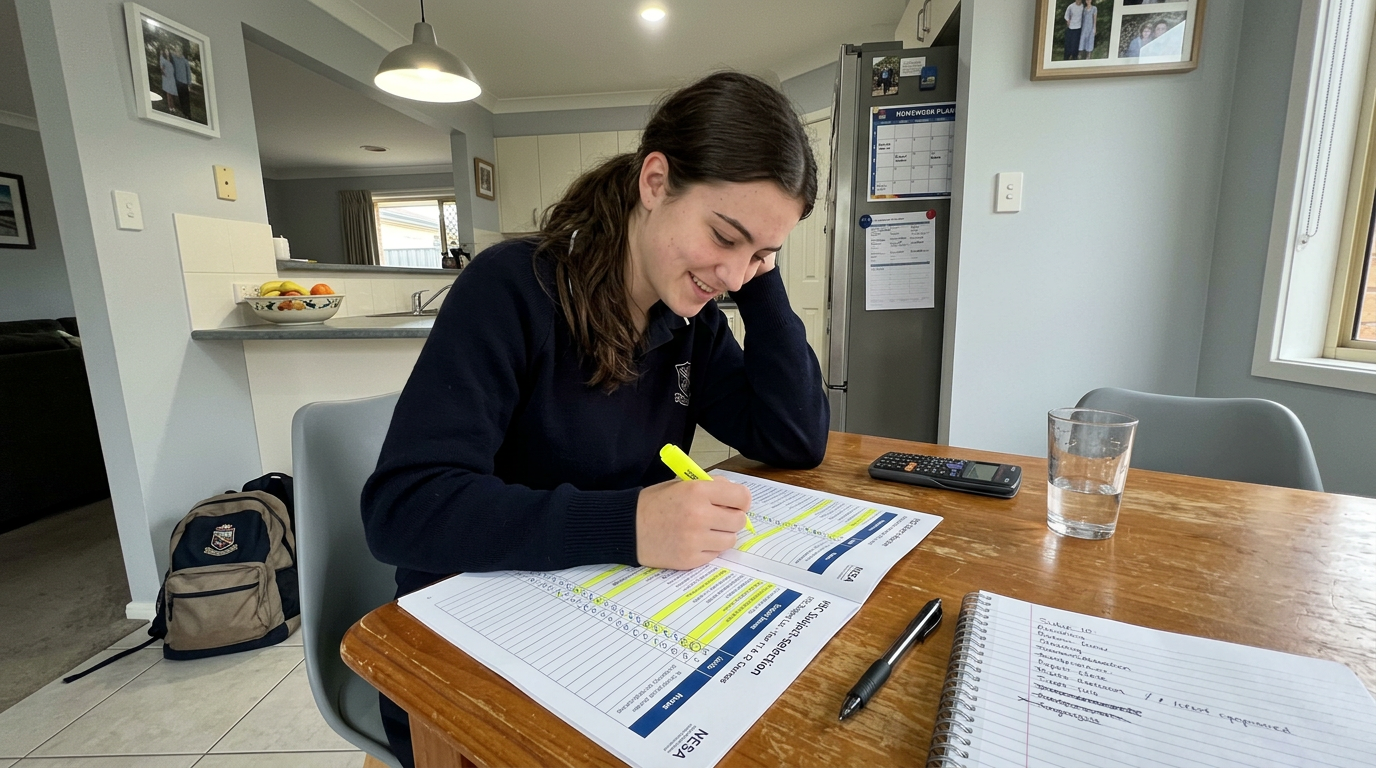
How do I choose my HSC subjects?
Start with subjects you genuinely enjoy or are already strong in, then narrow the list using your prerequisites for Year 12 and any course you're considering at university. The five tips below work in order — interests first, then prerequisites, then advice from people who know you, then workload, then perspective. Most Year 10 students try to do all five at once and end up freezing; doing them in sequence makes the decision tractable.
A practical sequence over a single afternoon: write down every Year 11 course offered at your school. Cross out the ones you actively dislike. Highlight the ones you're naturally good at. Check the UAC course search for any university course you've been thinking about and note the assumed knowledge or prerequisites. The shortlist that's left is what you actually have to choose from — and it's usually closer to six or seven options than the original twenty.
Tip 1: Pick subjects you enjoy or are strong at
Reflect on what you've actually liked across Years 7-10. The subjects where the homework feels less painful, where you remember the content without re-reading it three times, where you've consistently scored in the top half of the class — that's the signal. Enjoyment and ability are the two best predictors of HSC marks, well ahead of "what scales well." A subject you grind through reluctantly will eat your weekends and still produce a mediocre mark; a subject you find interesting will quietly produce your best work because you'll voluntarily go deeper into it.
Tip 2: Match subjects to your university course or career
If you have a specific course in mind — Engineering at UNSW, Medicine at USyd, Commerce at UTS — check its assumed knowledge and prerequisites on the UAC course search before you commit. Engineering courses almost always assume Mathematics Advanced and one science. Most Medicine pathways assume Chemistry. Commerce and law tend to recommend (not require) Mathematics Advanced. If you're undecided, keep your options open with at least one maths and one science — that combination unlocks roughly 80% of common university degrees. If Mathematics Advanced is on your shortlist, our HSC maths tutoring page covers one-to-one support for the senior courses.
Tip 3: Get advice from teachers, careers advisors, and parents
The decision is yours, but the people who know your work — your maths teacher, your English teacher, your careers advisor — can see things you can't. Teachers know which Year 11 courses tend to be harder than they look (Physics, Maths Extension 1, Modern History essay loads). Careers advisors know which courses are consistently undersubscribed (Latin, Earth & Environmental Science) and which prerequisites have changed recently. Parents know your work-rate at home, your other commitments, and what you've actually said you're interested in over the last two years. Combine all three perspectives — but make the final call yourself, because you're the one sitting the exams.
Tip 4: Balance your workload across the two years
Some HSC subjects carry significantly more written work than others — Modern History, English Extension, Legal Studies, Economics — and stacking three of them is a recipe for an exhausting Year 12. Other subjects are problem-set heavy (Maths Advanced, Physics, Chemistry) and reward consistent practice rather than long writing sessions. A balanced load typically mixes one or two essay-heavy subjects with two or three problem-set subjects, plus your 2 units of English. If you have a part-time job, a serious sport, or a family commitment, factor it in honestly — the timetable doesn't get easier in Year 12.
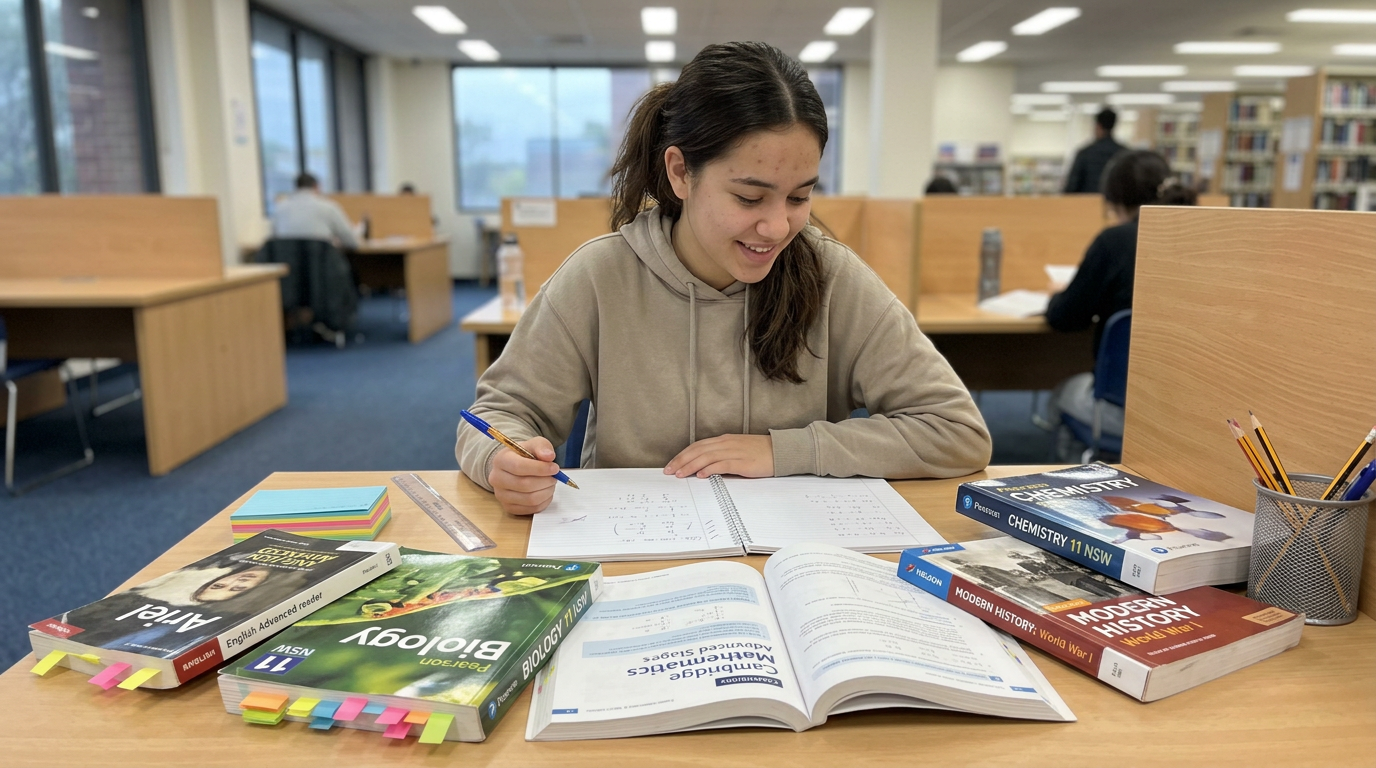
Tip 5: Keep things in perspective
Your HSC subjects matter, but they don't define your future. Many adults change careers two or three times; almost all university courses accept multiple HSC pathways; and there are well-trodden routes into any degree even if your first attempt at the ATAR doesn't land where you hoped — bridging courses, transfers, deferred entry, mature-age admission. Make a thoughtful choice, then put the decision down. The best thing you can do once subjects are locked in is start Year 11 well, build study habits early, and keep the decision in proportion. Starting tutoring early in Year 11 is one of the cheapest ways to keep your options open without locking in to a single career.
How does HSC subject scaling actually work?
Scaling is UAC's process for converting your raw HSC mark into a scaled mark that's comparable across subjects, used to calculate your ATAR. The intuition most students get wrong: scaling doesn't reward you for picking a "well-scaled" subject — it rewards you for performing well in any subject, relative to the cohort that took it. A Band 6 in Standard English usually outperforms a Band 4 in Advanced English on the scaling table; a Band 6 in Mathematics Advanced almost always outperforms a Band 5 in Extension 1.
In other words: pick the subject you'll do best in, not the subject that looks like it scales generously. Each year UAC publishes the Report on the Scaling of the NSW HSC — useful for sanity-checking, but a poor basis for picking subjects you don't enjoy. The scaled-mean of your top 10 units, including 2 units of English, becomes your aggregate, and your aggregate becomes your ATAR. We've broken down the full ATAR calculation here if you want the complete picture.
How many HSC units should I do?
NESA requires you to study at least 12 units in Year 11 (Preliminary) and at least 10 units in Year 12 (HSC), including 2 units of English. Beyond that floor, the unit-count rules are about how many courses you spread across, not just total units. Most Year 12 students settle at 10 or 11 units once they drop a 2-unit subject between Preliminary and HSC.
- At least 12 units in Year 11. Most courses are 2 units; some Extension courses are 1 unit on top of the 2-unit version of the subject.
- At least 10 units in Year 12. Almost all students drop one 2-unit subject between Year 11 and Year 12 — that's by design.
- 2 units of English mandatory. Standard, Advanced, ESL/EAL, or Studies of Religion — there's an English option for every kind of student.
- At least three courses of 2 units or more. Stops you from over-stacking on 1-unit Extension courses.
- At least four subjects in total. Independent of unit count.
Doing 12 units in Year 12 (an extra 2 above the floor) is common for students aiming at the highest ATARs — your scaled aggregate uses your best 10 units, so an extra 2 gives you insurance against one subject under-performing. It also adds workload, so it's not the right call for everyone.
Can I change HSC subjects after I've started Year 11?
Yes — you can usually change subjects within the first few weeks of Year 11, and there's a second window before HSC enrolment confirms in late Year 11. Each NSW high school sets its own internal deadlines, but as a rule of thumb: subject swaps in Term 1 of Year 11 are common and low-friction; swaps later in Year 11 require catch-up work but are still possible; swapping in Year 12 is rare and usually only allowed in exceptional circumstances. Speak to your year coordinator the moment you sense a problem — the earlier you raise it, the more options you have.
If you're considering a switch because a subject is harder than you expected, that's not always a reason to drop. Year 11 is genuinely a step up from Year 10; it gets easier once you adjust your study routine. A few sessions with a HSC subject specialist early in Year 11 often resolves the issue without needing to switch subjects at all.
What HSC subjects do universities prefer?
Australian universities don't formally "prefer" subjects beyond their published assumed knowledge and prerequisites — but a few subjects show up so often that they keep the most pathways open. Mathematics Advanced and Mathematics Extension 1 unlock virtually every STEM degree and most commerce, economics, and finance courses. Chemistry is the most commonly assumed science across health and engineering pathways. English Advanced (or any 2 units of English) is universally required because English is mandatory.
- For engineering and computer science: Mathematics Advanced is universally assumed; Extension 1 helps; Physics is recommended for most engineering disciplines.
- For medicine, dentistry, and physiotherapy: Chemistry is broadly assumed; Mathematics Advanced is recommended; Biology is commonly recommended (not required).
- For commerce, economics, and finance: Mathematics Advanced is broadly recommended; Extension 1 strengthens applications to highly competitive degrees.
- For law: No formal subject prerequisites at most NSW universities; English Advanced and Modern History are commonly chosen but never required.
- For humanities, arts, education, and social sciences: No formal prerequisites; pick the subjects you'll perform best in.
Always cross-check on the UAC course search for the specific course code — assumed knowledge varies between institutions and changes year to year.
Should I pick "easy" HSC subjects to scale up?
No — and this is the single most expensive misconception in HSC subject choice. Scaling rewards strong performance in any course, not weak performance in a "well-scaling" course. A Band 6 in Mathematics Standard scales higher than a Band 4 in Mathematics Advanced. A Band 6 in Personal Development, Health and Physical Education (PDHPE) outperforms a Band 4 in Physics. The "scaled-up" subject you can't do well in produces a worse ATAR contribution than the "scales-down" subject you can ace.
The quiet implication: if you're choosing between Standard and Advanced English (or General and Mathematics Advanced) and you're genuinely on the borderline, picking the version of the subject you can do well in is almost always the right call. Your raw mark, scaled honestly within the cohort that took the same course, beats a struggling raw mark in a "harder-looking" course almost every time. Our ATAR-strategy guide goes deeper on the subject-mix decision.
When should I start preparing for my HSC subjects?
The most useful preparation is consistency from the start of Year 11 — not a sprint at the end of Year 12. Students who start Year 11 with a regular weekly study routine, get on top of content as it's taught, and identify weak topics early consistently outperform students who try to cram across Year 12. The early Year 11 advantage compounds: the maths and science topics taught in Term 1 underpin everything in Year 12, so a confused start is hard to recover from later.
If you're already in Year 10 and choosing subjects, the most valuable thing you can do is set up two routines for Year 11: a weekly hour with each of your harder subjects, and a fortnightly check-in with someone who can explain what you got wrong. A weekly online HSC tutor is one cost-effective way to do both at once. Time-management habits matter as much as the subjects themselves — you can't outwork a bad timetable.
How much does HSC tutoring cost in Australia?
Most experienced HSC tutors in NSW charge between A$55 and A$85 per hour for online sessions; in-person sessions can sit slightly higher. The specific subject (Maths Extension, Chemistry, English Advanced) doesn't usually change the rate — what matters is the tutor's experience, qualifications, and how well they match your child's learning style. Tutero charges A$65 per hour for online HSC tutoring — the same rate across every year level and every subject, including senior subjects (no Year 12 premium).
Cheaper marketplaces (A$30–A$45/hr) exist, but they typically don't screen tutors, don't run Working with Children Check verification, don't replace a tutor when the match isn't working, and don't follow up if your child stops progressing. The cost of a bad-match tutor isn't the hourly rate — it's the term of HSC content your child loses while the relationship limps along. Every Tutero tutor is interview-screened, qualification-checked, and matched personally — and we replace the match free if it isn't working.
Is HSC subject choice really that important?
The choice matters for your ATAR ceiling and your immediate university options, but it doesn't lock in your career. A well-chosen subject mix opens up more first-preference courses; a poorly-chosen mix narrows them. Even so, the difference between two reasonable subject lists is usually 2–4 ATAR points at most — meaningful, not life-defining.
The much bigger lever is execution. Two students with identical subject lists can finish 15 ATAR points apart based purely on study habits, exam strategy, and how early they get help on weak topics. Personalised support across Year 11 and 12 moves the needle far more than spending three more weekends agonising over Modern History versus Legal Studies. Pick a sensible list using the five tips above, then put your energy into Year 11 itself.
Bottom line
Five tips, in order: enjoy or excel at it, match prerequisites for your target course, combine teacher and parent advice with your own judgement, balance the workload, and keep perspective. Then go and execute well — that's where the marks actually come from.
Ready to set your child up well for Year 11 and 12? Tutero matches NSW students with experienced HSC subject specialists from A$65 per hour — same rate across primary, lower-secondary, and senior. Book a free consultation and we'll match your child to a tutor who's actually taught (or sat) HSC subjects in the last few years.
Pick the subject you'll do best in, not the subject that looks like it scales generously.
Pick the subject you'll do best in, not the subject that looks like it scales generously.
Choosing your HSC subjects is the first big decision of senior school — the one that quietly shapes your ATAR, your university options, and how much you actually enjoy Year 11 and 12. Here are five tips that work for any Year 10 student, and the questions parents and students keep asking us about scaling, prerequisites, and changing subjects mid-stream.
Quick answer
Choose HSC subjects you actually enjoy or are strong at, that meet your career or university prerequisites, and that you can carry across two demanding years. Pick at least 12 units in Year 11 and 10 units in Year 12, including 2 units of English. Don't pick "easy" subjects hoping scaling will save you — under UAC scaling, your raw mark in a subject you're strong at almost always beats a mediocre mark in a "well-scaled" one. Use the five tips below, then sense-check your shortlist against the NESA Stage 6 learning areas and your target courses on the UAC course search.
How do I choose my HSC subjects?
Start with subjects you genuinely enjoy or are already strong in, then narrow the list using your prerequisites for Year 12 and any course you're considering at university. The five tips below work in order — interests first, then prerequisites, then advice from people who know you, then workload, then perspective. Most Year 10 students try to do all five at once and end up freezing; doing them in sequence makes the decision tractable.
A practical sequence over a single afternoon: write down every Year 11 course offered at your school. Cross out the ones you actively dislike. Highlight the ones you're naturally good at. Check the UAC course search for any university course you've been thinking about and note the assumed knowledge or prerequisites. The shortlist that's left is what you actually have to choose from — and it's usually closer to six or seven options than the original twenty.
Tip 1: Pick subjects you enjoy or are strong at
Reflect on what you've actually liked across Years 7-10. The subjects where the homework feels less painful, where you remember the content without re-reading it three times, where you've consistently scored in the top half of the class — that's the signal. Enjoyment and ability are the two best predictors of HSC marks, well ahead of "what scales well." A subject you grind through reluctantly will eat your weekends and still produce a mediocre mark; a subject you find interesting will quietly produce your best work because you'll voluntarily go deeper into it.
Tip 2: Match subjects to your university course or career
If you have a specific course in mind — Engineering at UNSW, Medicine at USyd, Commerce at UTS — check its assumed knowledge and prerequisites on the UAC course search before you commit. Engineering courses almost always assume Mathematics Advanced and one science. Most Medicine pathways assume Chemistry. Commerce and law tend to recommend (not require) Mathematics Advanced. If you're undecided, keep your options open with at least one maths and one science — that combination unlocks roughly 80% of common university degrees. If Mathematics Advanced is on your shortlist, our HSC maths tutoring page covers one-to-one support for the senior courses.
Tip 3: Get advice from teachers, careers advisors, and parents
The decision is yours, but the people who know your work — your maths teacher, your English teacher, your careers advisor — can see things you can't. Teachers know which Year 11 courses tend to be harder than they look (Physics, Maths Extension 1, Modern History essay loads). Careers advisors know which courses are consistently undersubscribed (Latin, Earth & Environmental Science) and which prerequisites have changed recently. Parents know your work-rate at home, your other commitments, and what you've actually said you're interested in over the last two years. Combine all three perspectives — but make the final call yourself, because you're the one sitting the exams.
Tip 4: Balance your workload across the two years
Some HSC subjects carry significantly more written work than others — Modern History, English Extension, Legal Studies, Economics — and stacking three of them is a recipe for an exhausting Year 12. Other subjects are problem-set heavy (Maths Advanced, Physics, Chemistry) and reward consistent practice rather than long writing sessions. A balanced load typically mixes one or two essay-heavy subjects with two or three problem-set subjects, plus your 2 units of English. If you have a part-time job, a serious sport, or a family commitment, factor it in honestly — the timetable doesn't get easier in Year 12.
Tip 5: Keep things in perspective
Your HSC subjects matter, but they don't define your future. Many adults change careers two or three times; almost all university courses accept multiple HSC pathways; and there are well-trodden routes into any degree even if your first attempt at the ATAR doesn't land where you hoped — bridging courses, transfers, deferred entry, mature-age admission. Make a thoughtful choice, then put the decision down. The best thing you can do once subjects are locked in is start Year 11 well, build study habits early, and keep the decision in proportion. Starting tutoring early in Year 11 is one of the cheapest ways to keep your options open without locking in to a single career.
How does HSC subject scaling actually work?
Scaling is UAC's process for converting your raw HSC mark into a scaled mark that's comparable across subjects, used to calculate your ATAR. The intuition most students get wrong: scaling doesn't reward you for picking a "well-scaled" subject — it rewards you for performing well in any subject, relative to the cohort that took it. A Band 6 in Standard English usually outperforms a Band 4 in Advanced English on the scaling table; a Band 6 in Mathematics Advanced almost always outperforms a Band 5 in Extension 1.
In other words: pick the subject you'll do best in, not the subject that looks like it scales generously. Each year UAC publishes the Report on the Scaling of the NSW HSC — useful for sanity-checking, but a poor basis for picking subjects you don't enjoy. The scaled-mean of your top 10 units, including 2 units of English, becomes your aggregate, and your aggregate becomes your ATAR. We've broken down the full ATAR calculation here if you want the complete picture.
How many HSC units should I do?
NESA requires you to study at least 12 units in Year 11 (Preliminary) and at least 10 units in Year 12 (HSC), including 2 units of English. Beyond that floor, the unit-count rules are about how many courses you spread across, not just total units. Most Year 12 students settle at 10 or 11 units once they drop a 2-unit subject between Preliminary and HSC.
- At least 12 units in Year 11. Most courses are 2 units; some Extension courses are 1 unit on top of the 2-unit version of the subject.
- At least 10 units in Year 12. Almost all students drop one 2-unit subject between Year 11 and Year 12 — that's by design.
- 2 units of English mandatory. Standard, Advanced, ESL/EAL, or Studies of Religion — there's an English option for every kind of student.
- At least three courses of 2 units or more. Stops you from over-stacking on 1-unit Extension courses.
- At least four subjects in total. Independent of unit count.
Doing 12 units in Year 12 (an extra 2 above the floor) is common for students aiming at the highest ATARs — your scaled aggregate uses your best 10 units, so an extra 2 gives you insurance against one subject under-performing. It also adds workload, so it's not the right call for everyone.
Can I change HSC subjects after I've started Year 11?
Yes — you can usually change subjects within the first few weeks of Year 11, and there's a second window before HSC enrolment confirms in late Year 11. Each NSW high school sets its own internal deadlines, but as a rule of thumb: subject swaps in Term 1 of Year 11 are common and low-friction; swaps later in Year 11 require catch-up work but are still possible; swapping in Year 12 is rare and usually only allowed in exceptional circumstances. Speak to your year coordinator the moment you sense a problem — the earlier you raise it, the more options you have.
If you're considering a switch because a subject is harder than you expected, that's not always a reason to drop. Year 11 is genuinely a step up from Year 10; it gets easier once you adjust your study routine. A few sessions with a HSC subject specialist early in Year 11 often resolves the issue without needing to switch subjects at all.
What HSC subjects do universities prefer?
Australian universities don't formally "prefer" subjects beyond their published assumed knowledge and prerequisites — but a few subjects show up so often that they keep the most pathways open. Mathematics Advanced and Mathematics Extension 1 unlock virtually every STEM degree and most commerce, economics, and finance courses. Chemistry is the most commonly assumed science across health and engineering pathways. English Advanced (or any 2 units of English) is universally required because English is mandatory.
- For engineering and computer science: Mathematics Advanced is universally assumed; Extension 1 helps; Physics is recommended for most engineering disciplines.
- For medicine, dentistry, and physiotherapy: Chemistry is broadly assumed; Mathematics Advanced is recommended; Biology is commonly recommended (not required).
- For commerce, economics, and finance: Mathematics Advanced is broadly recommended; Extension 1 strengthens applications to highly competitive degrees.
- For law: No formal subject prerequisites at most NSW universities; English Advanced and Modern History are commonly chosen but never required.
- For humanities, arts, education, and social sciences: No formal prerequisites; pick the subjects you'll perform best in.
Always cross-check on the UAC course search for the specific course code — assumed knowledge varies between institutions and changes year to year.
Should I pick "easy" HSC subjects to scale up?
No — and this is the single most expensive misconception in HSC subject choice. Scaling rewards strong performance in any course, not weak performance in a "well-scaling" course. A Band 6 in Mathematics Standard scales higher than a Band 4 in Mathematics Advanced. A Band 6 in Personal Development, Health and Physical Education (PDHPE) outperforms a Band 4 in Physics. The "scaled-up" subject you can't do well in produces a worse ATAR contribution than the "scales-down" subject you can ace.
The quiet implication: if you're choosing between Standard and Advanced English (or General and Mathematics Advanced) and you're genuinely on the borderline, picking the version of the subject you can do well in is almost always the right call. Your raw mark, scaled honestly within the cohort that took the same course, beats a struggling raw mark in a "harder-looking" course almost every time. Our ATAR-strategy guide goes deeper on the subject-mix decision.
When should I start preparing for my HSC subjects?
The most useful preparation is consistency from the start of Year 11 — not a sprint at the end of Year 12. Students who start Year 11 with a regular weekly study routine, get on top of content as it's taught, and identify weak topics early consistently outperform students who try to cram across Year 12. The early Year 11 advantage compounds: the maths and science topics taught in Term 1 underpin everything in Year 12, so a confused start is hard to recover from later.
If you're already in Year 10 and choosing subjects, the most valuable thing you can do is set up two routines for Year 11: a weekly hour with each of your harder subjects, and a fortnightly check-in with someone who can explain what you got wrong. A weekly online HSC tutor is one cost-effective way to do both at once. Time-management habits matter as much as the subjects themselves — you can't outwork a bad timetable.
How much does HSC tutoring cost in Australia?
Most experienced HSC tutors in NSW charge between A$55 and A$85 per hour for online sessions; in-person sessions can sit slightly higher. The specific subject (Maths Extension, Chemistry, English Advanced) doesn't usually change the rate — what matters is the tutor's experience, qualifications, and how well they match your child's learning style. Tutero charges A$65 per hour for online HSC tutoring — the same rate across every year level and every subject, including senior subjects (no Year 12 premium).
Cheaper marketplaces (A$30–A$45/hr) exist, but they typically don't screen tutors, don't run Working with Children Check verification, don't replace a tutor when the match isn't working, and don't follow up if your child stops progressing. The cost of a bad-match tutor isn't the hourly rate — it's the term of HSC content your child loses while the relationship limps along. Every Tutero tutor is interview-screened, qualification-checked, and matched personally — and we replace the match free if it isn't working.
Is HSC subject choice really that important?
The choice matters for your ATAR ceiling and your immediate university options, but it doesn't lock in your career. A well-chosen subject mix opens up more first-preference courses; a poorly-chosen mix narrows them. Even so, the difference between two reasonable subject lists is usually 2–4 ATAR points at most — meaningful, not life-defining.
The much bigger lever is execution. Two students with identical subject lists can finish 15 ATAR points apart based purely on study habits, exam strategy, and how early they get help on weak topics. Personalised support across Year 11 and 12 moves the needle far more than spending three more weekends agonising over Modern History versus Legal Studies. Pick a sensible list using the five tips above, then put your energy into Year 11 itself.
Bottom line
Five tips, in order: enjoy or excel at it, match prerequisites for your target course, combine teacher and parent advice with your own judgement, balance the workload, and keep perspective. Then go and execute well — that's where the marks actually come from.
Ready to set your child up well for Year 11 and 12? Tutero matches NSW students with experienced HSC subject specialists from A$65 per hour — same rate across primary, lower-secondary, and senior. Book a free consultation and we'll match your child to a tutor who's actually taught (or sat) HSC subjects in the last few years.
FAQ
.svg)
.svg)
Online maths tutoring at Tutero is catering to students of all year levels. We offer programs tailored to the unique learning curves of each age group.
We also have expert NAPLAN and ATAR subject tutors, ensuring students are well-equipped for these pivotal assessments.
We recommend at least two to three session per week for consistent progress. However, this can vary based on your child's needs and goals.
Our platform uses advanced security protocols to ensure the safety and privacy of all our online sessions.
Parents are welcome to observe sessions. We believe in a collaborative approach to education.
We provide regular progress reports and assessments to track your child’s academic development.
Yes, we prioritise the student-tutor relationship and can arrange a change if the need arises.
Yes, we offer a range of resources and materials, including interactive exercises and practice worksheets.
Pick the subject you'll do best in, not the subject that looks like it scales generously.
Pick the subject you'll do best in, not the subject that looks like it scales generously.

Pick the subject you'll do best in, not the subject that looks like it scales generously.
Two students with identical subject lists can finish 15 ATAR points apart based purely on study habits.
Choosing your HSC subjects is the first big decision of senior school — the one that quietly shapes your ATAR, your university options, and how much you actually enjoy Year 11 and 12. Here are five tips that work for any Year 10 student, and the questions parents and students keep asking us about scaling, prerequisites, and changing subjects mid-stream.
Quick answer
Choose HSC subjects you actually enjoy or are strong at, that meet your career or university prerequisites, and that you can carry across two demanding years. Pick at least 12 units in Year 11 and 10 units in Year 12, including 2 units of English. Don't pick "easy" subjects hoping scaling will save you — under UAC scaling, your raw mark in a subject you're strong at almost always beats a mediocre mark in a "well-scaled" one. Use the five tips below, then sense-check your shortlist against the NESA Stage 6 learning areas and your target courses on the UAC course search.
How do I choose my HSC subjects?
Start with subjects you genuinely enjoy or are already strong in, then narrow the list using your prerequisites for Year 12 and any course you're considering at university. The five tips below work in order — interests first, then prerequisites, then advice from people who know you, then workload, then perspective. Most Year 10 students try to do all five at once and end up freezing; doing them in sequence makes the decision tractable.
A practical sequence over a single afternoon: write down every Year 11 course offered at your school. Cross out the ones you actively dislike. Highlight the ones you're naturally good at. Check the UAC course search for any university course you've been thinking about and note the assumed knowledge or prerequisites. The shortlist that's left is what you actually have to choose from — and it's usually closer to six or seven options than the original twenty.
Tip 1: Pick subjects you enjoy or are strong at
Reflect on what you've actually liked across Years 7-10. The subjects where the homework feels less painful, where you remember the content without re-reading it three times, where you've consistently scored in the top half of the class — that's the signal. Enjoyment and ability are the two best predictors of HSC marks, well ahead of "what scales well." A subject you grind through reluctantly will eat your weekends and still produce a mediocre mark; a subject you find interesting will quietly produce your best work because you'll voluntarily go deeper into it.
Tip 2: Match subjects to your university course or career
If you have a specific course in mind — Engineering at UNSW, Medicine at USyd, Commerce at UTS — check its assumed knowledge and prerequisites on the UAC course search before you commit. Engineering courses almost always assume Mathematics Advanced and one science. Most Medicine pathways assume Chemistry. Commerce and law tend to recommend (not require) Mathematics Advanced. If you're undecided, keep your options open with at least one maths and one science — that combination unlocks roughly 80% of common university degrees. If Mathematics Advanced is on your shortlist, our HSC maths tutoring page covers one-to-one support for the senior courses.
Tip 3: Get advice from teachers, careers advisors, and parents
The decision is yours, but the people who know your work — your maths teacher, your English teacher, your careers advisor — can see things you can't. Teachers know which Year 11 courses tend to be harder than they look (Physics, Maths Extension 1, Modern History essay loads). Careers advisors know which courses are consistently undersubscribed (Latin, Earth & Environmental Science) and which prerequisites have changed recently. Parents know your work-rate at home, your other commitments, and what you've actually said you're interested in over the last two years. Combine all three perspectives — but make the final call yourself, because you're the one sitting the exams.
Tip 4: Balance your workload across the two years
Some HSC subjects carry significantly more written work than others — Modern History, English Extension, Legal Studies, Economics — and stacking three of them is a recipe for an exhausting Year 12. Other subjects are problem-set heavy (Maths Advanced, Physics, Chemistry) and reward consistent practice rather than long writing sessions. A balanced load typically mixes one or two essay-heavy subjects with two or three problem-set subjects, plus your 2 units of English. If you have a part-time job, a serious sport, or a family commitment, factor it in honestly — the timetable doesn't get easier in Year 12.
Tip 5: Keep things in perspective
Your HSC subjects matter, but they don't define your future. Many adults change careers two or three times; almost all university courses accept multiple HSC pathways; and there are well-trodden routes into any degree even if your first attempt at the ATAR doesn't land where you hoped — bridging courses, transfers, deferred entry, mature-age admission. Make a thoughtful choice, then put the decision down. The best thing you can do once subjects are locked in is start Year 11 well, build study habits early, and keep the decision in proportion. Starting tutoring early in Year 11 is one of the cheapest ways to keep your options open without locking in to a single career.
How does HSC subject scaling actually work?
Scaling is UAC's process for converting your raw HSC mark into a scaled mark that's comparable across subjects, used to calculate your ATAR. The intuition most students get wrong: scaling doesn't reward you for picking a "well-scaled" subject — it rewards you for performing well in any subject, relative to the cohort that took it. A Band 6 in Standard English usually outperforms a Band 4 in Advanced English on the scaling table; a Band 6 in Mathematics Advanced almost always outperforms a Band 5 in Extension 1.
In other words: pick the subject you'll do best in, not the subject that looks like it scales generously. Each year UAC publishes the Report on the Scaling of the NSW HSC — useful for sanity-checking, but a poor basis for picking subjects you don't enjoy. The scaled-mean of your top 10 units, including 2 units of English, becomes your aggregate, and your aggregate becomes your ATAR. We've broken down the full ATAR calculation here if you want the complete picture.
How many HSC units should I do?
NESA requires you to study at least 12 units in Year 11 (Preliminary) and at least 10 units in Year 12 (HSC), including 2 units of English. Beyond that floor, the unit-count rules are about how many courses you spread across, not just total units. Most Year 12 students settle at 10 or 11 units once they drop a 2-unit subject between Preliminary and HSC.
- At least 12 units in Year 11. Most courses are 2 units; some Extension courses are 1 unit on top of the 2-unit version of the subject.
- At least 10 units in Year 12. Almost all students drop one 2-unit subject between Year 11 and Year 12 — that's by design.
- 2 units of English mandatory. Standard, Advanced, ESL/EAL, or Studies of Religion — there's an English option for every kind of student.
- At least three courses of 2 units or more. Stops you from over-stacking on 1-unit Extension courses.
- At least four subjects in total. Independent of unit count.
Doing 12 units in Year 12 (an extra 2 above the floor) is common for students aiming at the highest ATARs — your scaled aggregate uses your best 10 units, so an extra 2 gives you insurance against one subject under-performing. It also adds workload, so it's not the right call for everyone.
Can I change HSC subjects after I've started Year 11?
Yes — you can usually change subjects within the first few weeks of Year 11, and there's a second window before HSC enrolment confirms in late Year 11. Each NSW high school sets its own internal deadlines, but as a rule of thumb: subject swaps in Term 1 of Year 11 are common and low-friction; swaps later in Year 11 require catch-up work but are still possible; swapping in Year 12 is rare and usually only allowed in exceptional circumstances. Speak to your year coordinator the moment you sense a problem — the earlier you raise it, the more options you have.
If you're considering a switch because a subject is harder than you expected, that's not always a reason to drop. Year 11 is genuinely a step up from Year 10; it gets easier once you adjust your study routine. A few sessions with a HSC subject specialist early in Year 11 often resolves the issue without needing to switch subjects at all.
What HSC subjects do universities prefer?
Australian universities don't formally "prefer" subjects beyond their published assumed knowledge and prerequisites — but a few subjects show up so often that they keep the most pathways open. Mathematics Advanced and Mathematics Extension 1 unlock virtually every STEM degree and most commerce, economics, and finance courses. Chemistry is the most commonly assumed science across health and engineering pathways. English Advanced (or any 2 units of English) is universally required because English is mandatory.
- For engineering and computer science: Mathematics Advanced is universally assumed; Extension 1 helps; Physics is recommended for most engineering disciplines.
- For medicine, dentistry, and physiotherapy: Chemistry is broadly assumed; Mathematics Advanced is recommended; Biology is commonly recommended (not required).
- For commerce, economics, and finance: Mathematics Advanced is broadly recommended; Extension 1 strengthens applications to highly competitive degrees.
- For law: No formal subject prerequisites at most NSW universities; English Advanced and Modern History are commonly chosen but never required.
- For humanities, arts, education, and social sciences: No formal prerequisites; pick the subjects you'll perform best in.
Always cross-check on the UAC course search for the specific course code — assumed knowledge varies between institutions and changes year to year.
Should I pick "easy" HSC subjects to scale up?
No — and this is the single most expensive misconception in HSC subject choice. Scaling rewards strong performance in any course, not weak performance in a "well-scaling" course. A Band 6 in Mathematics Standard scales higher than a Band 4 in Mathematics Advanced. A Band 6 in Personal Development, Health and Physical Education (PDHPE) outperforms a Band 4 in Physics. The "scaled-up" subject you can't do well in produces a worse ATAR contribution than the "scales-down" subject you can ace.
The quiet implication: if you're choosing between Standard and Advanced English (or General and Mathematics Advanced) and you're genuinely on the borderline, picking the version of the subject you can do well in is almost always the right call. Your raw mark, scaled honestly within the cohort that took the same course, beats a struggling raw mark in a "harder-looking" course almost every time. Our ATAR-strategy guide goes deeper on the subject-mix decision.
When should I start preparing for my HSC subjects?
The most useful preparation is consistency from the start of Year 11 — not a sprint at the end of Year 12. Students who start Year 11 with a regular weekly study routine, get on top of content as it's taught, and identify weak topics early consistently outperform students who try to cram across Year 12. The early Year 11 advantage compounds: the maths and science topics taught in Term 1 underpin everything in Year 12, so a confused start is hard to recover from later.
If you're already in Year 10 and choosing subjects, the most valuable thing you can do is set up two routines for Year 11: a weekly hour with each of your harder subjects, and a fortnightly check-in with someone who can explain what you got wrong. A weekly online HSC tutor is one cost-effective way to do both at once. Time-management habits matter as much as the subjects themselves — you can't outwork a bad timetable.
How much does HSC tutoring cost in Australia?
Most experienced HSC tutors in NSW charge between A$55 and A$85 per hour for online sessions; in-person sessions can sit slightly higher. The specific subject (Maths Extension, Chemistry, English Advanced) doesn't usually change the rate — what matters is the tutor's experience, qualifications, and how well they match your child's learning style. Tutero charges A$65 per hour for online HSC tutoring — the same rate across every year level and every subject, including senior subjects (no Year 12 premium).
Cheaper marketplaces (A$30–A$45/hr) exist, but they typically don't screen tutors, don't run Working with Children Check verification, don't replace a tutor when the match isn't working, and don't follow up if your child stops progressing. The cost of a bad-match tutor isn't the hourly rate — it's the term of HSC content your child loses while the relationship limps along. Every Tutero tutor is interview-screened, qualification-checked, and matched personally — and we replace the match free if it isn't working.
Is HSC subject choice really that important?
The choice matters for your ATAR ceiling and your immediate university options, but it doesn't lock in your career. A well-chosen subject mix opens up more first-preference courses; a poorly-chosen mix narrows them. Even so, the difference between two reasonable subject lists is usually 2–4 ATAR points at most — meaningful, not life-defining.
The much bigger lever is execution. Two students with identical subject lists can finish 15 ATAR points apart based purely on study habits, exam strategy, and how early they get help on weak topics. Personalised support across Year 11 and 12 moves the needle far more than spending three more weekends agonising over Modern History versus Legal Studies. Pick a sensible list using the five tips above, then put your energy into Year 11 itself.
Bottom line
Five tips, in order: enjoy or excel at it, match prerequisites for your target course, combine teacher and parent advice with your own judgement, balance the workload, and keep perspective. Then go and execute well — that's where the marks actually come from.
Ready to set your child up well for Year 11 and 12? Tutero matches NSW students with experienced HSC subject specialists from A$65 per hour — same rate across primary, lower-secondary, and senior. Book a free consultation and we'll match your child to a tutor who's actually taught (or sat) HSC subjects in the last few years.
Pick the subject you'll do best in, not the subject that looks like it scales generously.
Two students with identical subject lists can finish 15 ATAR points apart based purely on study habits.
Your HSC subjects mainly affect which university courses you can apply to immediately after Year 12. Most adults change careers two or three times across their working lives, and there are well-trodden alternative pathways into almost every degree — bridging courses, transfers, deferred entry, mature-age admission. Make a thoughtful choice using the five tips above, but don't treat it as locking in your future for life. Even within a single ATAR year, two students with identical subject lists routinely finish 15+ ATAR points apart based on study habits and exam execution — not on the subjects themselves.
For medicine: Chemistry is broadly assumed across most NSW pathways; Mathematics Advanced is recommended; Biology is commonly recommended but not required. For engineering: Mathematics Advanced is universally assumed; Mathematics Extension 1 helps; Physics is recommended for most engineering disciplines. For law: there are no formal HSC prerequisites at most NSW universities — English Advanced and Modern History are commonly chosen but never required. Always cross-check assumed knowledge for the specific course code on the UAC course search before locking in subjects, because requirements vary by institution and shift year to year.
No — this is the most expensive misconception in HSC subject choice. UAC scaling rewards strong performance in any course, not weak performance in a "well-scaling" course. A Band 6 in Mathematics Standard scales higher than a Band 4 in Mathematics Advanced. A Band 6 in PDHPE outperforms a Band 4 in Physics. The subject that looks like it scales generously only does so for top-band performers; if you can't perform in the top band of that subject, picking it actively hurts your ATAR. Pick the subject you can do well in, not the one that looks like it scales generously on the table.
NESA requires at least 12 units in Year 11 (Preliminary) and at least 10 units in Year 12 (HSC), including 2 units of English. You also need at least three courses of 2 units or more, and at least four subjects in total. Doing 12 units in Year 12 (an extra 2 above the minimum) is common for students chasing the highest ATARs — because your scaled aggregate uses your best 10 units, an extra 2 gives you insurance against one subject under-performing. The trade-off is workload — and for most students aiming at strong-but-not-top ATARs, 10 units done well beats 12 units done acceptably.
Yes — most NSW high schools allow subject changes within the first few weeks of Year 11 with minimal friction, and there's usually a second narrower window later in Year 11 before HSC enrolment is confirmed. Subject swaps in Term 1 of Year 11 are common; swaps later in Year 11 require catch-up work but are still possible; swapping in Year 12 is rare and usually only granted in exceptional circumstances. Talk to your year coordinator early — the sooner you raise the issue, the more options you have. Often, a few sessions with a HSC subject specialist resolves the difficulty without needing to switch subjects at all.
The most useful preparation is consistency from the start of Year 11 — not a sprint at the end of Year 12. Students who set up a regular weekly study routine in Term 1 of Year 11, stay on top of content as it's taught, and identify weak topics early consistently outperform students who try to cram across Year 12. The Term 1 maths and science topics underpin everything in Year 12, so a confused start is hard to recover from later. If your child is in Year 10 now and choosing subjects, the highest-leverage thing you can do for them is set up a weekly study cadence and a fortnightly check-in with someone who can explain what they got wrong — a regular online HSC tutor is one cost-effective way to do both.
Hoping to improve confidence & grades?

.png)


