.svg)

For most direct-entry medical degrees in Australia, you need an ATAR around 95.00 or higher, a competitive UCAT score (typically the upper percentiles), and a successful interview. The very top programs at UQ, UNSW, and Monash effectively need 96–99+. Postgraduate programs — including USyd, Melbourne, and ANU — don't use ATAR; they use GAMSAT plus a bachelor's degree and an interview.
This guide breaks down the ATAR for medicine at every Australian medical school that takes school leavers, plus what to do if your ATAR isn't 99.

What ATAR do you need for medicine in Australia?
For school-leaver entry into an Australian medical program, the working answer is an ATAR of 95.00 or above, paired with a strong UCAT score and a structured interview (usually a Multiple Mini Interview, or MMI). A handful of programs publish a lower minimum ATAR — Monash and UNSW have minimums in the low 90s — but those minimums get you to the shortlist, not the offer. The actual selection rank, after UCAT and interview weighting, almost always sits at 95+ at every school.
If you're aiming for the most competitive programs (UQ provisional MD, UNSW, Monash), realistically plan for an ATAR in the 96–99 range. If you're willing to take a longer route, postgraduate medicine at Sydney, Melbourne, ANU, Griffith, or Wollongong doesn't use ATAR at all — see the postgraduate section below.
What is the lowest ATAR you can get into medicine with?
The lowest published ATAR for direct-entry medicine in Australia is around 90.00, currently the minimum at Monash University and University of Adelaide. Some bonded medical places and rural-pathway entries publish a slightly lower minimum (around 90.00–93.00) too. But these are floor numbers, not typical numbers. Once UCAT and interview scores are weighted in, the median successful applicant at every Australian medical school sits at 95.00 or higher.
If your ATAR ends up below 95, you have three realistic routes: a regional/rural-entry pathway (lower ATAR but residency conditions), a bonded medical place (lower ATAR but a 6-year return-of-service obligation), or a postgraduate route via a related bachelor's degree and the GAMSAT. The postgraduate route is the most common — roughly half of Australian medical students enter through it.
Which Australian universities have the highest medicine ATARs?
The universities with the highest selection ranks for direct-entry medicine in Australia are UQ provisional MD (~99), UNSW (~96 published, often higher in practice), Monash (~95–96), and Bond University (~96). The University of Sydney, the University of Melbourne, and ANU don't admit school leavers directly — they're postgraduate-only and don't publish an ATAR for entry.
Here's a current snapshot of indicative ATAR ranges and key requirements for the major Australian medical schools that admit Year 12 students. These figures are guidance based on each university's admissions pages and recent Medical Deans Australia and New Zealand data — always check the official admissions page for the year you apply.
| University | Course | Indicative ATAR | Other key requirements |
|---|---|---|---|
| Monash University | MD direct entry (Bachelor of Medical Science & Doctor of Medicine) | ~95.00–96.00 | Strong UCAT score, MMI interview |
| UNSW Sydney | Bachelor of Medical Studies / MD | ~96.00 (selection rank, often higher) | UCAT, MMI |
| University of Adelaide | Bachelor of Medical Studies / MD | ~95.00 | UCAT, structured interview |
| Curtin University | Bachelor of Medicine, Bachelor of Surgery | ~95.00 | Chemistry prerequisite, UCAT, interview |
| James Cook University | Bachelor of Medicine & Bachelor of Surgery | ~95.00 (median around 98) | No UCAT, written application + interview, regional/rural focus |
| University of Tasmania | Bachelor of Medical Science / MD | ~95.00 | UCAT, interview |
| Western Sydney University | Doctor of Medicine (joint pathway) | ~95.50 | UCAT, MMI, residency in Greater Western Sydney advantageous |
| Bond University | Medical Program (BMedSt/MD) | ~96.00 | Personal statement, structured interview (no UCAT) |
| Griffith University | Bachelor of Medical Science → MD (graduate entry) | ~95.00 for the BMedSc | High GPA + GAMSAT for MD progression |
Universities that don't take Year 12 leavers (postgraduate MD only)
If your dream is USyd, Melbourne, or ANU specifically, you'll go in via the postgraduate route — a bachelor's degree (most often a science or biomedical degree), a strong GAMSAT score, and an interview. There is no ATAR pathway. UQ has both: a provisional MD that takes Year 12 leavers and a postgraduate MD via GAMSAT.
| University | What you typically need |
|---|---|
| University of Sydney (USyd) | No undergraduate pathway. Postgraduate MD only — bachelor's degree + GAMSAT + interview. |
| University of Melbourne | No undergraduate MBBS. Postgraduate MD via the Melbourne Model — bachelor's + GAMSAT + interview. |
| University of Queensland (UQ) | Provisional entry MD — ~99.00 ATAR + UCAT + interview, OR graduate entry via GAMSAT. |
| ANU (Joint Medical Program) | Postgraduate MD only — bachelor's + GAMSAT + MMI. |
| UNSW | Selection ranks for direct-entry medicine routinely sit in the high 90s once UCAT and interview weighting are factored in. |
Do you need to sit the UCAT for medicine?
Yes — for almost every direct-entry medical program in Australia, you need to sit the UCAT (University Clinical Aptitude Test). The old UMAT was retired at the end of 2018 and replaced by the UCAT. The UCAT is run by UCAT ANZ and tested across five sections: verbal reasoning, decision making, quantitative reasoning, abstract reasoning, and situational judgement.
A competitive UCAT score for direct-entry medicine sits in the top 10% of test takers (roughly 2900+ on the four cognitive subtests, plus a Band 1 or 2 on situational judgement). Schools weight UCAT differently — Monash and UNSW lean heavily on it; James Cook University and Bond University don't use it at all and instead rely on a written application and structured interview.
The UCAT is sat in the July of your Year 12 year, before your trial exams, so prep typically starts in Term 1 or Term 2 — you won't have time during ATAR study. Plan for a separate UCAT prep block of 10–12 weeks.
What subjects should you take in Year 11 and 12 for medicine?
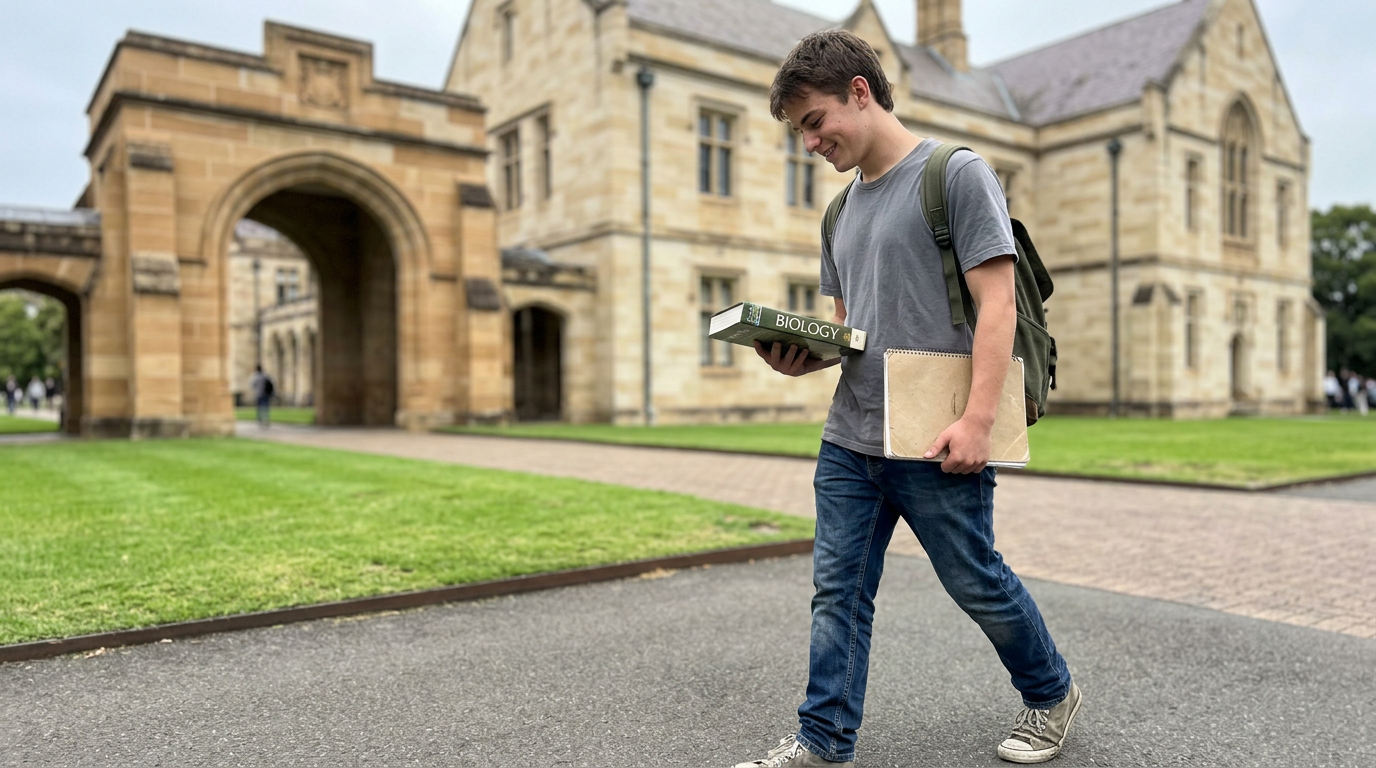
If you're aiming for medicine, take both Chemistry and Biology in Year 11 and 12, plus the highest-scaling English and Maths units your school offers. Curtin's undergraduate medical program lists Chemistry as a hard prerequisite. Most other programs don't formally require either subject — but in practice, students who studied both Chemistry and Biology have a much smoother first year of an MD because the foundational human-physiology concepts come up immediately.
A practical Year 12 load for a future medical student in Victoria, NSW, or WA looks like: English Advanced/English (mandatory in most states), Mathematics Methods or Mathematics Advanced, Chemistry, Biology, and one elective the student is genuinely strong in. The fifth subject matters because ATAR is a rank, not a raw score — a high mark in your strongest subject lifts the aggregate more than a middling mark in another science.
If your school offers VCE Health and Human Development, Personal Development, Health and Physical Education (NSW PDHPE), or HSC Investigating Science, those can also support a medical-school application — but they don't replace Chemistry and Biology for university preparation.
What ATAR do you need for postgraduate medicine?
Postgraduate medicine in Australia doesn't use ATAR at all. Postgraduate medical schools — including the University of Sydney, the University of Melbourne, ANU, Wollongong, Griffith MD, Notre Dame, and Deakin — admit students who have already completed a bachelor's degree. Selection is based on three things: your GPA (typically 5.5/7.0 or higher to be competitive), your GAMSAT score, and an interview.
The GAMSAT, run by ACER, has three sections: humanities reasoning, written communication, and biological/physical sciences. A competitive overall score is around 62–65; the average successful applicant scores in the high 60s. The Section III science score is weighted heaviest by most schools.
Practically, this means if your ATAR comes in lower than you'd hoped — say 88–92 — you can still pursue medicine. Enrol in a related bachelor's degree (Biomedical Science, Medical Science, Health Sciences, or even an unrelated bachelor's if you're committed to the GAMSAT prep), graduate with a strong GPA, and apply for a postgraduate MD. Many of Australia's most competitive medical schools take students only through this route.
What is the Bonded Medical Program and what ATAR does it need?
The Bonded Medical Program (BMP) is a Commonwealth-funded scheme that offers Australian students a Commonwealth Supported Place (CSP) in medicine in exchange for a return-of-service obligation. Students agree to work in an eligible regional, rural, or remote area, or in a defined area of workforce shortage, for typically three years after they've completed their fellowship training.
There's no separate ATAR for bonded places — you apply for the medicine program at your university the normal way (using your ATAR + UCAT + interview), and you elect a bonded place if one is offered. Many bonded places are filled by applicants whose ATAR sits at or just above the medical school's minimum (usually around 95.00) — so it can be a viable pathway if your ATAR puts you on the cusp of a non-bonded offer.
Read the conditions carefully before accepting. The return-of-service obligation is real — typically three years of full-time-equivalent service in an eligible location, served after your specialist training is complete. Full details are on the Bonded Medical Program page at the Australian Department of Health.
Is medicine harder to get into than law in Australia?
Yes — direct-entry medicine is meaningfully harder to get into than direct-entry law in Australia. The cut-off ATAR for the most competitive law programs (USyd, UNSW, Melbourne JD pathways) sits at around 99.50, similar to top medicine. But medicine adds two extra hurdles law doesn't: a competitive UCAT score, and a successful interview. A high ATAR alone is not enough for medicine; it is, in many cases, enough for law.
Law also has many more places — most universities run large undergraduate law cohorts (300–500 students per year is common), while medicine cohorts are smaller (typically 200–300 per year, capped by clinical-placement capacity). The competition per place is structurally higher for medicine. If you'd like a comparison, see our cluster spoke on ATAR for engineering for a sense of how STEM-degree cut-offs compare.
How do you actually hit the ATAR for medicine?
Hitting an ATAR of 95+ in Year 12 isn't about studying more hours. It's about compounding small percentage gains in your three or four scaled subjects, week after week, from the start of Year 11. The students who hit 99 are the ones who treat each topic test as a diagnostic — figuring out which exact concepts they're losing marks on, and fixing those before the next test.
A weekly private tutor for Chemistry or Biology — the two subjects most likely to be your medicine differentiators — is the cleanest way to do this. A good tutor watches your past-paper attempts, spots the recurring errors, and walks you through fixes faster than self-correction alone. Tutero matches you with a Year 12 specialist in your subject from A$65 an hour, with no contracts and no senior-year premium — see our tutoring pricing for the full breakdown.
If you're also sitting the UCAT, plan for a separate prep block of 10–12 weeks before the July test date. UCAT prep doesn't overlap meaningfully with ATAR study — the test is timed cognitive reasoning, not curriculum content. Practice papers from the official UCAT ANZ site are the best baseline.
For broader Year 12 strategy and study habits that hold up under exam pressure, see our companion guide on proven strategies for acing your VCE exams and our pep-talk piece if you're worried about your ATAR.
So can you get into medicine in Australia?
If your ATAR will land at 95+ and you can sit a competitive UCAT and prepare for an MMI, direct-entry medicine is on the table at most Australian medical schools. If your ATAR is in the 90–94 band, regional/rural pathways and bonded places are realistic options. If your ATAR comes in below 90, postgraduate medicine via a science bachelor's and the GAMSAT is the main route — and it's how roughly half of Australian medical students get in. None of these doors close at the end of Year 12.
For the underlying mechanics of how the rank is built across Year 11 and 12, read how the ATAR is calculated. For the playbook on actually hitting your target, read how to achieve your dream ATAR. And if your study time is tight, our guide to beating distraction during study sessions is the place to start.
An ATAR of 95+ is the working answer for medicine in Australia — but the high ATAR alone is not enough. UCAT and interview decide the offer.
An ATAR of 95+ is the working answer for medicine in Australia — but the high ATAR alone is not enough. UCAT and interview decide the offer.
For most direct-entry medical degrees in Australia, you need an ATAR around 95.00 or higher, a competitive UCAT score (typically the upper percentiles), and a successful interview. The very top programs at UQ, UNSW, and Monash effectively need 96–99+. Postgraduate programs — including USyd, Melbourne, and ANU — don't use ATAR; they use GAMSAT plus a bachelor's degree and an interview.
This guide breaks down the ATAR for medicine at every Australian medical school that takes school leavers, plus what to do if your ATAR isn't 99.
What ATAR do you need for medicine in Australia?
For school-leaver entry into an Australian medical program, the working answer is an ATAR of 95.00 or above, paired with a strong UCAT score and a structured interview (usually a Multiple Mini Interview, or MMI). A handful of programs publish a lower minimum ATAR — Monash and UNSW have minimums in the low 90s — but those minimums get you to the shortlist, not the offer. The actual selection rank, after UCAT and interview weighting, almost always sits at 95+ at every school.
If you're aiming for the most competitive programs (UQ provisional MD, UNSW, Monash), realistically plan for an ATAR in the 96–99 range. If you're willing to take a longer route, postgraduate medicine at Sydney, Melbourne, ANU, Griffith, or Wollongong doesn't use ATAR at all — see the postgraduate section below.
What is the lowest ATAR you can get into medicine with?
The lowest published ATAR for direct-entry medicine in Australia is around 90.00, currently the minimum at Monash University and University of Adelaide. Some bonded medical places and rural-pathway entries publish a slightly lower minimum (around 90.00–93.00) too. But these are floor numbers, not typical numbers. Once UCAT and interview scores are weighted in, the median successful applicant at every Australian medical school sits at 95.00 or higher.
If your ATAR ends up below 95, you have three realistic routes: a regional/rural-entry pathway (lower ATAR but residency conditions), a bonded medical place (lower ATAR but a 6-year return-of-service obligation), or a postgraduate route via a related bachelor's degree and the GAMSAT. The postgraduate route is the most common — roughly half of Australian medical students enter through it.
Which Australian universities have the highest medicine ATARs?
The universities with the highest selection ranks for direct-entry medicine in Australia are UQ provisional MD (~99), UNSW (~96 published, often higher in practice), Monash (~95–96), and Bond University (~96). The University of Sydney, the University of Melbourne, and ANU don't admit school leavers directly — they're postgraduate-only and don't publish an ATAR for entry.
Here's a current snapshot of indicative ATAR ranges and key requirements for the major Australian medical schools that admit Year 12 students. These figures are guidance based on each university's admissions pages and recent Medical Deans Australia and New Zealand data — always check the official admissions page for the year you apply.
| University | Course | Indicative ATAR | Other key requirements |
|---|---|---|---|
| Monash University | MD direct entry (Bachelor of Medical Science & Doctor of Medicine) | ~95.00–96.00 | Strong UCAT score, MMI interview |
| UNSW Sydney | Bachelor of Medical Studies / MD | ~96.00 (selection rank, often higher) | UCAT, MMI |
| University of Adelaide | Bachelor of Medical Studies / MD | ~95.00 | UCAT, structured interview |
| Curtin University | Bachelor of Medicine, Bachelor of Surgery | ~95.00 | Chemistry prerequisite, UCAT, interview |
| James Cook University | Bachelor of Medicine & Bachelor of Surgery | ~95.00 (median around 98) | No UCAT, written application + interview, regional/rural focus |
| University of Tasmania | Bachelor of Medical Science / MD | ~95.00 | UCAT, interview |
| Western Sydney University | Doctor of Medicine (joint pathway) | ~95.50 | UCAT, MMI, residency in Greater Western Sydney advantageous |
| Bond University | Medical Program (BMedSt/MD) | ~96.00 | Personal statement, structured interview (no UCAT) |
| Griffith University | Bachelor of Medical Science → MD (graduate entry) | ~95.00 for the BMedSc | High GPA + GAMSAT for MD progression |
Universities that don't take Year 12 leavers (postgraduate MD only)
If your dream is USyd, Melbourne, or ANU specifically, you'll go in via the postgraduate route — a bachelor's degree (most often a science or biomedical degree), a strong GAMSAT score, and an interview. There is no ATAR pathway. UQ has both: a provisional MD that takes Year 12 leavers and a postgraduate MD via GAMSAT.
| University | What you typically need |
|---|---|
| University of Sydney (USyd) | No undergraduate pathway. Postgraduate MD only — bachelor's degree + GAMSAT + interview. |
| University of Melbourne | No undergraduate MBBS. Postgraduate MD via the Melbourne Model — bachelor's + GAMSAT + interview. |
| University of Queensland (UQ) | Provisional entry MD — ~99.00 ATAR + UCAT + interview, OR graduate entry via GAMSAT. |
| ANU (Joint Medical Program) | Postgraduate MD only — bachelor's + GAMSAT + MMI. |
| UNSW | Selection ranks for direct-entry medicine routinely sit in the high 90s once UCAT and interview weighting are factored in. |
Do you need to sit the UCAT for medicine?
Yes — for almost every direct-entry medical program in Australia, you need to sit the UCAT (University Clinical Aptitude Test). The old UMAT was retired at the end of 2018 and replaced by the UCAT. The UCAT is run by UCAT ANZ and tested across five sections: verbal reasoning, decision making, quantitative reasoning, abstract reasoning, and situational judgement.
A competitive UCAT score for direct-entry medicine sits in the top 10% of test takers (roughly 2900+ on the four cognitive subtests, plus a Band 1 or 2 on situational judgement). Schools weight UCAT differently — Monash and UNSW lean heavily on it; James Cook University and Bond University don't use it at all and instead rely on a written application and structured interview.
The UCAT is sat in the July of your Year 12 year, before your trial exams, so prep typically starts in Term 1 or Term 2 — you won't have time during ATAR study. Plan for a separate UCAT prep block of 10–12 weeks.
What subjects should you take in Year 11 and 12 for medicine?
If you're aiming for medicine, take both Chemistry and Biology in Year 11 and 12, plus the highest-scaling English and Maths units your school offers. Curtin's undergraduate medical program lists Chemistry as a hard prerequisite. Most other programs don't formally require either subject — but in practice, students who studied both Chemistry and Biology have a much smoother first year of an MD because the foundational human-physiology concepts come up immediately.
A practical Year 12 load for a future medical student in Victoria, NSW, or WA looks like: English Advanced/English (mandatory in most states), Mathematics Methods or Mathematics Advanced, Chemistry, Biology, and one elective the student is genuinely strong in. The fifth subject matters because ATAR is a rank, not a raw score — a high mark in your strongest subject lifts the aggregate more than a middling mark in another science.
If your school offers VCE Health and Human Development, Personal Development, Health and Physical Education (NSW PDHPE), or HSC Investigating Science, those can also support a medical-school application — but they don't replace Chemistry and Biology for university preparation.
What ATAR do you need for postgraduate medicine?
Postgraduate medicine in Australia doesn't use ATAR at all. Postgraduate medical schools — including the University of Sydney, the University of Melbourne, ANU, Wollongong, Griffith MD, Notre Dame, and Deakin — admit students who have already completed a bachelor's degree. Selection is based on three things: your GPA (typically 5.5/7.0 or higher to be competitive), your GAMSAT score, and an interview.
The GAMSAT, run by ACER, has three sections: humanities reasoning, written communication, and biological/physical sciences. A competitive overall score is around 62–65; the average successful applicant scores in the high 60s. The Section III science score is weighted heaviest by most schools.
Practically, this means if your ATAR comes in lower than you'd hoped — say 88–92 — you can still pursue medicine. Enrol in a related bachelor's degree (Biomedical Science, Medical Science, Health Sciences, or even an unrelated bachelor's if you're committed to the GAMSAT prep), graduate with a strong GPA, and apply for a postgraduate MD. Many of Australia's most competitive medical schools take students only through this route.
What is the Bonded Medical Program and what ATAR does it need?
The Bonded Medical Program (BMP) is a Commonwealth-funded scheme that offers Australian students a Commonwealth Supported Place (CSP) in medicine in exchange for a return-of-service obligation. Students agree to work in an eligible regional, rural, or remote area, or in a defined area of workforce shortage, for typically three years after they've completed their fellowship training.
There's no separate ATAR for bonded places — you apply for the medicine program at your university the normal way (using your ATAR + UCAT + interview), and you elect a bonded place if one is offered. Many bonded places are filled by applicants whose ATAR sits at or just above the medical school's minimum (usually around 95.00) — so it can be a viable pathway if your ATAR puts you on the cusp of a non-bonded offer.
Read the conditions carefully before accepting. The return-of-service obligation is real — typically three years of full-time-equivalent service in an eligible location, served after your specialist training is complete. Full details are on the Bonded Medical Program page at the Australian Department of Health.
Is medicine harder to get into than law in Australia?
Yes — direct-entry medicine is meaningfully harder to get into than direct-entry law in Australia. The cut-off ATAR for the most competitive law programs (USyd, UNSW, Melbourne JD pathways) sits at around 99.50, similar to top medicine. But medicine adds two extra hurdles law doesn't: a competitive UCAT score, and a successful interview. A high ATAR alone is not enough for medicine; it is, in many cases, enough for law.
Law also has many more places — most universities run large undergraduate law cohorts (300–500 students per year is common), while medicine cohorts are smaller (typically 200–300 per year, capped by clinical-placement capacity). The competition per place is structurally higher for medicine. If you'd like a comparison, see our cluster spoke on ATAR for engineering for a sense of how STEM-degree cut-offs compare.
How do you actually hit the ATAR for medicine?
Hitting an ATAR of 95+ in Year 12 isn't about studying more hours. It's about compounding small percentage gains in your three or four scaled subjects, week after week, from the start of Year 11. The students who hit 99 are the ones who treat each topic test as a diagnostic — figuring out which exact concepts they're losing marks on, and fixing those before the next test.
A weekly private tutor for Chemistry or Biology — the two subjects most likely to be your medicine differentiators — is the cleanest way to do this. A good tutor watches your past-paper attempts, spots the recurring errors, and walks you through fixes faster than self-correction alone. Tutero matches you with a Year 12 specialist in your subject from A$65 an hour, with no contracts and no senior-year premium — see our tutoring pricing for the full breakdown.
If you're also sitting the UCAT, plan for a separate prep block of 10–12 weeks before the July test date. UCAT prep doesn't overlap meaningfully with ATAR study — the test is timed cognitive reasoning, not curriculum content. Practice papers from the official UCAT ANZ site are the best baseline.
For broader Year 12 strategy and study habits that hold up under exam pressure, see our companion guide on proven strategies for acing your VCE exams and our pep-talk piece if you're worried about your ATAR.
So can you get into medicine in Australia?
If your ATAR will land at 95+ and you can sit a competitive UCAT and prepare for an MMI, direct-entry medicine is on the table at most Australian medical schools. If your ATAR is in the 90–94 band, regional/rural pathways and bonded places are realistic options. If your ATAR comes in below 90, postgraduate medicine via a science bachelor's and the GAMSAT is the main route — and it's how roughly half of Australian medical students get in. None of these doors close at the end of Year 12.
For the underlying mechanics of how the rank is built across Year 11 and 12, read how the ATAR is calculated. For the playbook on actually hitting your target, read how to achieve your dream ATAR. And if your study time is tight, our guide to beating distraction during study sessions is the place to start.
An ATAR of 95+ is the working answer for medicine in Australia — but the high ATAR alone is not enough. UCAT and interview decide the offer.
An ATAR of 95+ is the working answer for medicine in Australia — but the high ATAR alone is not enough. UCAT and interview decide the offer.

An ATAR of 95+ is the working answer for medicine in Australia — but the high ATAR alone is not enough. UCAT and interview decide the offer.
If your ATAR comes in lower than you hoped, postgraduate medicine via a science bachelor's and the GAMSAT is the main route — and it's how roughly half of Australian medical students get in.
For most direct-entry medical degrees in Australia, you need an ATAR around 95.00 or higher, a competitive UCAT score (typically the upper percentiles), and a successful interview. The very top programs at UQ, UNSW, and Monash effectively need 96–99+. Postgraduate programs — including USyd, Melbourne, and ANU — don't use ATAR; they use GAMSAT plus a bachelor's degree and an interview.
This guide breaks down the ATAR for medicine at every Australian medical school that takes school leavers, plus what to do if your ATAR isn't 99.
What ATAR do you need for medicine in Australia?
For school-leaver entry into an Australian medical program, the working answer is an ATAR of 95.00 or above, paired with a strong UCAT score and a structured interview (usually a Multiple Mini Interview, or MMI). A handful of programs publish a lower minimum ATAR — Monash and UNSW have minimums in the low 90s — but those minimums get you to the shortlist, not the offer. The actual selection rank, after UCAT and interview weighting, almost always sits at 95+ at every school.
If you're aiming for the most competitive programs (UQ provisional MD, UNSW, Monash), realistically plan for an ATAR in the 96–99 range. If you're willing to take a longer route, postgraduate medicine at Sydney, Melbourne, ANU, Griffith, or Wollongong doesn't use ATAR at all — see the postgraduate section below.
What is the lowest ATAR you can get into medicine with?
The lowest published ATAR for direct-entry medicine in Australia is around 90.00, currently the minimum at Monash University and University of Adelaide. Some bonded medical places and rural-pathway entries publish a slightly lower minimum (around 90.00–93.00) too. But these are floor numbers, not typical numbers. Once UCAT and interview scores are weighted in, the median successful applicant at every Australian medical school sits at 95.00 or higher.
If your ATAR ends up below 95, you have three realistic routes: a regional/rural-entry pathway (lower ATAR but residency conditions), a bonded medical place (lower ATAR but a 6-year return-of-service obligation), or a postgraduate route via a related bachelor's degree and the GAMSAT. The postgraduate route is the most common — roughly half of Australian medical students enter through it.
Which Australian universities have the highest medicine ATARs?
The universities with the highest selection ranks for direct-entry medicine in Australia are UQ provisional MD (~99), UNSW (~96 published, often higher in practice), Monash (~95–96), and Bond University (~96). The University of Sydney, the University of Melbourne, and ANU don't admit school leavers directly — they're postgraduate-only and don't publish an ATAR for entry.
Here's a current snapshot of indicative ATAR ranges and key requirements for the major Australian medical schools that admit Year 12 students. These figures are guidance based on each university's admissions pages and recent Medical Deans Australia and New Zealand data — always check the official admissions page for the year you apply.
| University | Course | Indicative ATAR | Other key requirements |
|---|---|---|---|
| Monash University | MD direct entry (Bachelor of Medical Science & Doctor of Medicine) | ~95.00–96.00 | Strong UCAT score, MMI interview |
| UNSW Sydney | Bachelor of Medical Studies / MD | ~96.00 (selection rank, often higher) | UCAT, MMI |
| University of Adelaide | Bachelor of Medical Studies / MD | ~95.00 | UCAT, structured interview |
| Curtin University | Bachelor of Medicine, Bachelor of Surgery | ~95.00 | Chemistry prerequisite, UCAT, interview |
| James Cook University | Bachelor of Medicine & Bachelor of Surgery | ~95.00 (median around 98) | No UCAT, written application + interview, regional/rural focus |
| University of Tasmania | Bachelor of Medical Science / MD | ~95.00 | UCAT, interview |
| Western Sydney University | Doctor of Medicine (joint pathway) | ~95.50 | UCAT, MMI, residency in Greater Western Sydney advantageous |
| Bond University | Medical Program (BMedSt/MD) | ~96.00 | Personal statement, structured interview (no UCAT) |
| Griffith University | Bachelor of Medical Science → MD (graduate entry) | ~95.00 for the BMedSc | High GPA + GAMSAT for MD progression |
Universities that don't take Year 12 leavers (postgraduate MD only)
If your dream is USyd, Melbourne, or ANU specifically, you'll go in via the postgraduate route — a bachelor's degree (most often a science or biomedical degree), a strong GAMSAT score, and an interview. There is no ATAR pathway. UQ has both: a provisional MD that takes Year 12 leavers and a postgraduate MD via GAMSAT.
| University | What you typically need |
|---|---|
| University of Sydney (USyd) | No undergraduate pathway. Postgraduate MD only — bachelor's degree + GAMSAT + interview. |
| University of Melbourne | No undergraduate MBBS. Postgraduate MD via the Melbourne Model — bachelor's + GAMSAT + interview. |
| University of Queensland (UQ) | Provisional entry MD — ~99.00 ATAR + UCAT + interview, OR graduate entry via GAMSAT. |
| ANU (Joint Medical Program) | Postgraduate MD only — bachelor's + GAMSAT + MMI. |
| UNSW | Selection ranks for direct-entry medicine routinely sit in the high 90s once UCAT and interview weighting are factored in. |
Do you need to sit the UCAT for medicine?
Yes — for almost every direct-entry medical program in Australia, you need to sit the UCAT (University Clinical Aptitude Test). The old UMAT was retired at the end of 2018 and replaced by the UCAT. The UCAT is run by UCAT ANZ and tested across five sections: verbal reasoning, decision making, quantitative reasoning, abstract reasoning, and situational judgement.
A competitive UCAT score for direct-entry medicine sits in the top 10% of test takers (roughly 2900+ on the four cognitive subtests, plus a Band 1 or 2 on situational judgement). Schools weight UCAT differently — Monash and UNSW lean heavily on it; James Cook University and Bond University don't use it at all and instead rely on a written application and structured interview.
The UCAT is sat in the July of your Year 12 year, before your trial exams, so prep typically starts in Term 1 or Term 2 — you won't have time during ATAR study. Plan for a separate UCAT prep block of 10–12 weeks.
What subjects should you take in Year 11 and 12 for medicine?
If you're aiming for medicine, take both Chemistry and Biology in Year 11 and 12, plus the highest-scaling English and Maths units your school offers. Curtin's undergraduate medical program lists Chemistry as a hard prerequisite. Most other programs don't formally require either subject — but in practice, students who studied both Chemistry and Biology have a much smoother first year of an MD because the foundational human-physiology concepts come up immediately.
A practical Year 12 load for a future medical student in Victoria, NSW, or WA looks like: English Advanced/English (mandatory in most states), Mathematics Methods or Mathematics Advanced, Chemistry, Biology, and one elective the student is genuinely strong in. The fifth subject matters because ATAR is a rank, not a raw score — a high mark in your strongest subject lifts the aggregate more than a middling mark in another science.
If your school offers VCE Health and Human Development, Personal Development, Health and Physical Education (NSW PDHPE), or HSC Investigating Science, those can also support a medical-school application — but they don't replace Chemistry and Biology for university preparation.
What ATAR do you need for postgraduate medicine?
Postgraduate medicine in Australia doesn't use ATAR at all. Postgraduate medical schools — including the University of Sydney, the University of Melbourne, ANU, Wollongong, Griffith MD, Notre Dame, and Deakin — admit students who have already completed a bachelor's degree. Selection is based on three things: your GPA (typically 5.5/7.0 or higher to be competitive), your GAMSAT score, and an interview.
The GAMSAT, run by ACER, has three sections: humanities reasoning, written communication, and biological/physical sciences. A competitive overall score is around 62–65; the average successful applicant scores in the high 60s. The Section III science score is weighted heaviest by most schools.
Practically, this means if your ATAR comes in lower than you'd hoped — say 88–92 — you can still pursue medicine. Enrol in a related bachelor's degree (Biomedical Science, Medical Science, Health Sciences, or even an unrelated bachelor's if you're committed to the GAMSAT prep), graduate with a strong GPA, and apply for a postgraduate MD. Many of Australia's most competitive medical schools take students only through this route.
What is the Bonded Medical Program and what ATAR does it need?
The Bonded Medical Program (BMP) is a Commonwealth-funded scheme that offers Australian students a Commonwealth Supported Place (CSP) in medicine in exchange for a return-of-service obligation. Students agree to work in an eligible regional, rural, or remote area, or in a defined area of workforce shortage, for typically three years after they've completed their fellowship training.
There's no separate ATAR for bonded places — you apply for the medicine program at your university the normal way (using your ATAR + UCAT + interview), and you elect a bonded place if one is offered. Many bonded places are filled by applicants whose ATAR sits at or just above the medical school's minimum (usually around 95.00) — so it can be a viable pathway if your ATAR puts you on the cusp of a non-bonded offer.
Read the conditions carefully before accepting. The return-of-service obligation is real — typically three years of full-time-equivalent service in an eligible location, served after your specialist training is complete. Full details are on the Bonded Medical Program page at the Australian Department of Health.
Is medicine harder to get into than law in Australia?
Yes — direct-entry medicine is meaningfully harder to get into than direct-entry law in Australia. The cut-off ATAR for the most competitive law programs (USyd, UNSW, Melbourne JD pathways) sits at around 99.50, similar to top medicine. But medicine adds two extra hurdles law doesn't: a competitive UCAT score, and a successful interview. A high ATAR alone is not enough for medicine; it is, in many cases, enough for law.
Law also has many more places — most universities run large undergraduate law cohorts (300–500 students per year is common), while medicine cohorts are smaller (typically 200–300 per year, capped by clinical-placement capacity). The competition per place is structurally higher for medicine. If you'd like a comparison, see our cluster spoke on ATAR for engineering for a sense of how STEM-degree cut-offs compare.
How do you actually hit the ATAR for medicine?
Hitting an ATAR of 95+ in Year 12 isn't about studying more hours. It's about compounding small percentage gains in your three or four scaled subjects, week after week, from the start of Year 11. The students who hit 99 are the ones who treat each topic test as a diagnostic — figuring out which exact concepts they're losing marks on, and fixing those before the next test.
A weekly private tutor for Chemistry or Biology — the two subjects most likely to be your medicine differentiators — is the cleanest way to do this. A good tutor watches your past-paper attempts, spots the recurring errors, and walks you through fixes faster than self-correction alone. Tutero matches you with a Year 12 specialist in your subject from A$65 an hour, with no contracts and no senior-year premium — see our tutoring pricing for the full breakdown.
If you're also sitting the UCAT, plan for a separate prep block of 10–12 weeks before the July test date. UCAT prep doesn't overlap meaningfully with ATAR study — the test is timed cognitive reasoning, not curriculum content. Practice papers from the official UCAT ANZ site are the best baseline.
For broader Year 12 strategy and study habits that hold up under exam pressure, see our companion guide on proven strategies for acing your VCE exams and our pep-talk piece if you're worried about your ATAR.
So can you get into medicine in Australia?
If your ATAR will land at 95+ and you can sit a competitive UCAT and prepare for an MMI, direct-entry medicine is on the table at most Australian medical schools. If your ATAR is in the 90–94 band, regional/rural pathways and bonded places are realistic options. If your ATAR comes in below 90, postgraduate medicine via a science bachelor's and the GAMSAT is the main route — and it's how roughly half of Australian medical students get in. None of these doors close at the end of Year 12.
For the underlying mechanics of how the rank is built across Year 11 and 12, read how the ATAR is calculated. For the playbook on actually hitting your target, read how to achieve your dream ATAR. And if your study time is tight, our guide to beating distraction during study sessions is the place to start.
An ATAR of 95+ is the working answer for medicine in Australia — but the high ATAR alone is not enough. UCAT and interview decide the offer.
If your ATAR comes in lower than you hoped, postgraduate medicine via a science bachelor's and the GAMSAT is the main route — and it's how roughly half of Australian medical students get in.
.svg)
.svg)
For most direct-entry medical degrees in Australia, you need an ATAR around 95.00 or higher, plus a competitive UCAT score and a successful interview. The most competitive programs (UQ provisional MD, UNSW, Monash, Bond) effectively require 96–99+. Postgraduate medicine — used by USyd, Melbourne, and ANU — doesn't use ATAR; entry is via a bachelor's degree, the GAMSAT, and an interview.
The lowest published minimum ATAR for direct-entry medicine in Australia is around 90.00, currently set by Monash and Adelaide. Some rural-pathway and bonded medical places publish similar minimums. Once UCAT and interview weighting are factored in, the median successful applicant at every medical school sits at 95.00 or higher. If your ATAR comes in below 90, postgraduate medicine via a science bachelor's and the GAMSAT is the most realistic route.
UCAT — the UMAT was retired at the end of 2018. The UCAT (University Clinical Aptitude Test) is run by UCAT ANZ and is required for almost every direct-entry medical program in Australia. The exception is James Cook University and Bond University, which use a written application and structured interview instead. Plan for 10–12 weeks of UCAT prep before the July test date in your Year 12 year.
Both, if your school offers them and your timetable allows. Curtin University lists Chemistry as a hard prerequisite for its undergraduate medical program. Most other Australian medical schools don't formally require either subject — but students who took both Chemistry and Biology in Year 11 and 12 have a smoother first year of an MD, and they tend to score better on the GAMSAT science section if they end up going via the postgraduate route.
Postgraduate medicine doesn't use ATAR. Selection is based on your bachelor's degree GPA (typically 5.5/7.0 or higher to be competitive), your GAMSAT score (a competitive overall is around 62–65), and an interview. Postgraduate medical schools include University of Sydney, University of Melbourne, ANU, Wollongong, Griffith MD, Notre Dame, and Deakin. Roughly half of Australian medical students enter through this route.
It can be, if your ATAR sits on the cusp of a medical school's minimum and you're genuinely open to working in regional, rural, or remote Australia after your fellowship training. The return-of-service obligation is typically three years of full-time-equivalent service in an eligible location, served after specialist training. Read the conditions on the Department of Health's Bonded Medical Program page before accepting an offer.
Hoping to improve confidence & grades?

.png)