
.svg)

If you have been wondering whether tutoring is really worth it for your child — what a tutor actually does, who benefits most, and how long it takes to see real progress — you are in the right place. This explainer walks through the mechanism of one-to-one tutoring step by step, so by the end you will have a clear answer for your family.
Quick answer: how does tutoring help your child?
One-to-one tutoring helps your child by giving them an adult thinking partner whose entire job, for the full session, is your child's learning. A good tutor diagnoses exactly where the gap is, re-teaches the missing concept in the way your child personally needs to hear it, then practises it with them until it sticks. Over a school term that adds up to fewer "I don't get it" homework battles, more confidence in class, and steady gains in marks — the Education Endowment Foundation's evidence review puts the average impact of one-to-one tuition at around five additional months of progress in a year.
What does a tutor actually do in a session?
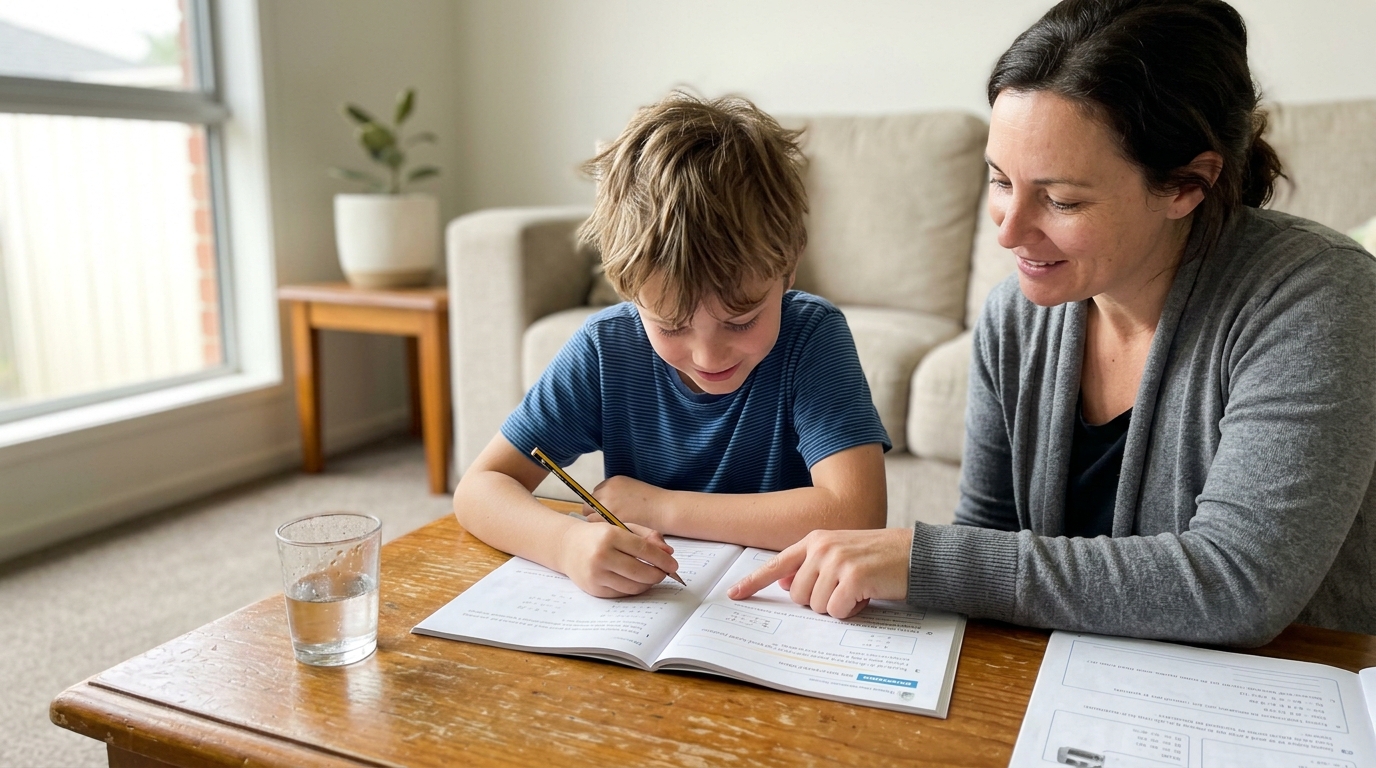
A tutor does four jobs in every session, in this order. First they diagnose — they look at this week's homework, the last test, or the exercise your child got stuck on, and work out exactly which concept is missing. Then they re-teach the missing piece in a way that suits how your child learns: drawing it, talking it through, writing a worked example. Then they practise it together — your child works problems while the tutor watches, asks questions, and corrects misconceptions in real time. Finally they consolidate — your child explains the concept back, and the tutor sets a small piece of follow-up practice for the week. A typical session runs 60 minutes and covers one or two specific skills, not "everything in maths".
How is tutoring different from extra homework or after-school programs?
Extra homework gives your child more practice; it does not give them better instruction when they get stuck. After-school programs are usually group-based, follow a fixed curriculum, and move at the pace of the group rather than your child. Tutoring is different on three counts. It is one-to-one, so the entire session is shaped around what your specific child needs this week. It is diagnostic — the tutor changes what they teach based on what your child got wrong yesterday. And it is adaptive in the moment — if a Year 8 student does not understand fractions when explained one way, the tutor switches to a second and a third way until something clicks. That feedback loop is the active ingredient that an extra worksheet, a homework club, or a recorded video lesson cannot replicate.
How does private tutoring work, week to week?
The first session is usually a diagnostic — the tutor talks with your child, looks at recent schoolwork, and identifies the two or three concepts that need the most work. From session two onwards, each week follows a simple loop: review last week's follow-up practice, work through the next gap on the list, set a small piece of practice for the coming week. Most families do one 60-minute session a week per subject; some senior students close to exams add a second session in the run-up. Sessions can be online (video call with a shared digital whiteboard, which most Tutero families use) or in person at home. The format matters less than the consistency — a steady weekly slot does more than five hours crammed into one weekend.
What does a typical tutoring session look like?
A typical 60-minute session has four parts. The first 5–10 minutes are a quick check-in — what came up at school this week, what your child found hard, what is coming up in the next assessment. The next 15–20 minutes are re-teaching — the tutor unpacks the specific concept your child is stuck on, with a worked example. The next 25–30 minutes are joint practice — your child works problems out loud, the tutor asks "why did you do that step?" and corrects in real time. The final 5 minutes are consolidation — your child explains the concept back, and the tutor sets one small piece of follow-up practice. Sessions feel more like a conversation than a class, and most students leave them less stressed about the subject, not more.
Does tutoring really help kids?
Yes — and the evidence is unusually clear for an education intervention. The Education Endowment Foundation's meta-analysis of one-to-one tuition finds an average impact equivalent to around five additional months of progress per year for students who receive it. John Hattie's Visible Learning synthesis ranks tutoring-style "feedback" and "small-group instruction" among the highest-effect teaching interventions ever measured. And Benjamin Bloom's classic "two-sigma problem" research found that one-to-one tutored students performed two standard deviations above students taught the same content in a class of 30 — about the gap between an average student and one in the top 2 per cent. Real-world results are smaller than Bloom's lab finding, but the direction is consistent across decades of evidence: one-to-one attention is one of the most effective things you can add to a child's learning.
What kinds of children benefit most from tutoring?
Three groups see the biggest gains. Children who have a specific gap that is blocking the next concept — for example, a Year 5 student who never quite got fractions and now cannot do the Year 5 work that depends on them. A few weeks of targeted tutoring can close that gap and unblock months of curriculum. Children who have lost confidence — typical of students in Years 6, 7 and 8 transitioning between schools, or senior students after a tough first assessment. A tutor rebuilds confidence by giving the student win after small win in a low-stakes setting. Children who are aiming higher than what the standard classroom is set up to deliver — typically Year 11 and 12 students chasing a top ATAR, but also high-achieving primary students who are bored and need extension. The students who benefit least are those without a specific goal or gap — for them, a study-skills coach is often a better fit than a subject tutor.
How long does it take for tutoring to make a difference?
Most parents see confidence shift within 2–3 sessions — your child stops dreading the subject and starts asking the tutor questions of their own. Visible improvement in classwork and homework usually shows up in 4–6 weeks — the gap from last term has closed, and your child is keeping up with what is being taught now. Meaningful improvement in marks usually takes a school term — about 10–12 weekly sessions — because tests run on their own schedule and your child needs the new understanding to stick across enough topics to lift an average. Senior students working towards a specific exam (an HSC trial, a VCE SAC, an ATAR-relevant subject) often start tutoring 3–6 months out and ramp up frequency as the assessment approaches.
How does tutoring help with confidence, not just marks?
Marks are the visible outcome; confidence is the mechanism that produces them. When a child is stuck on a concept and feels behind the class, two things start to feed each other: they avoid the subject (which means they fall further behind), and they stop putting their hand up (which means the teacher cannot see what they do not understand). A tutor breaks that loop. In a one-to-one setting there is no class to feel behind, no hand to put up, and no risk of looking silly — your child can ask the dumb question, get a real answer, and try again. After 4–6 weeks of that, most children stop describing themselves as "bad at maths" or "bad at English" and start describing themselves as "getting better at it". For more on this specific dynamic, our explainer on how tutoring improves confidence in maths goes deeper.
How much does private tutoring cost in Australia?
In Australia, expect to pay A$55–A$85 per hour for private tutoring for primary, lower-secondary or senior students — the same hourly rate at every year level for any reputable provider. Tutero's rate is A$65 per hour across every year level and every subject, with no contracts and no senior premium. University-student tutors and independent marketplaces sit at the lower end (A$40–A$60), agency tutors and ex-teachers sit at the higher end (A$80–A$120+). For most families, weekly tutoring at A$65/hr works out to roughly A$280 per month per subject. We unpack the full pricing landscape in how much does maths tutoring cost in Australia.
When is tutoring not the right answer?
Tutoring is not a fit for every child. If the issue is not academic — anxiety, attention difficulties, a learning difference like dyslexia or dyscalculia that has not been formally assessed — a tutor working alone is unlikely to be enough; the right first step is a paediatrician, an educational psychologist, or your child's school. If your child is doing well at school and has no specific goal they are reaching for, weekly tutoring can become busy-work and your money is better spent on something they are excited about. And if your child is actively resisting the idea, force-marching them into sessions tends not to work — better to wait for a moment of natural motivation (a tough test result, a subject they suddenly want to do better at) and start then.
How do I tell if tutoring is working for my child?
Four signals tell you tutoring is working. Your child stops dreading the subject — they no longer find reasons to skip the session. They start asking questions in class again — the avoidance loop has broken. Homework gets quicker, not just better — they recognise patterns they used to be stuck on. Their classwork and tests show steady, modest improvement — not a sudden jump from a C to an A, but the average creeping up across topics. If after 6–8 weeks none of these are showing up, it is worth a conversation with the tutor about whether the focus needs to change — sometimes the original diagnosis was not the real bottleneck.
The bottom line
Tutoring helps your child by giving them what no classroom can: an adult thinking partner whose entire focus, for the full session, is your child's learning. A good tutor diagnoses the specific gap, re-teaches it in a way that suits your child, practises it with them, and consolidates it — then repeats the loop next week. The evidence behind it is unusually strong (around five months of additional progress per year, on average), the cost in Australia sits at A$55–A$85 per hour with Tutero at A$65/hr across every year level, and most families see a confidence shift in 2–3 sessions and visible academic improvement in 4–6 weeks. If your child has a specific gap, has lost confidence, or is reaching for a goal the standard classroom is not set up to deliver, tutoring is one of the most effective single interventions available — provided the fit between tutor, child, and goal is right.
Ready to see how tutoring could help your child? Tutero matches families with one-to-one online tutors across every Australian curriculum and year level, at A$65/hr with no contracts. Find a tutor for your child and book a first session.
Tutoring helps your child by giving them what no classroom can: an adult thinking partner whose entire focus, for the full session, is your child's learning.
Tutoring helps your child by giving them what no classroom can: an adult thinking partner whose entire focus, for the full session, is your child's learning.
If you have been wondering whether tutoring is really worth it for your child — what a tutor actually does, who benefits most, and how long it takes to see real progress — you are in the right place. This explainer walks through the mechanism of one-to-one tutoring step by step, so by the end you will have a clear answer for your family.
Quick answer: how does tutoring help your child?
One-to-one tutoring helps your child by giving them an adult thinking partner whose entire job, for the full session, is your child's learning. A good tutor diagnoses exactly where the gap is, re-teaches the missing concept in the way your child personally needs to hear it, then practises it with them until it sticks. Over a school term that adds up to fewer "I don't get it" homework battles, more confidence in class, and steady gains in marks — the Education Endowment Foundation's evidence review puts the average impact of one-to-one tuition at around five additional months of progress in a year.
What does a tutor actually do in a session?
A tutor does four jobs in every session, in this order. First they diagnose — they look at this week's homework, the last test, or the exercise your child got stuck on, and work out exactly which concept is missing. Then they re-teach the missing piece in a way that suits how your child learns: drawing it, talking it through, writing a worked example. Then they practise it together — your child works problems while the tutor watches, asks questions, and corrects misconceptions in real time. Finally they consolidate — your child explains the concept back, and the tutor sets a small piece of follow-up practice for the week. A typical session runs 60 minutes and covers one or two specific skills, not "everything in maths".
How is tutoring different from extra homework or after-school programs?
Extra homework gives your child more practice; it does not give them better instruction when they get stuck. After-school programs are usually group-based, follow a fixed curriculum, and move at the pace of the group rather than your child. Tutoring is different on three counts. It is one-to-one, so the entire session is shaped around what your specific child needs this week. It is diagnostic — the tutor changes what they teach based on what your child got wrong yesterday. And it is adaptive in the moment — if a Year 8 student does not understand fractions when explained one way, the tutor switches to a second and a third way until something clicks. That feedback loop is the active ingredient that an extra worksheet, a homework club, or a recorded video lesson cannot replicate.
How does private tutoring work, week to week?
The first session is usually a diagnostic — the tutor talks with your child, looks at recent schoolwork, and identifies the two or three concepts that need the most work. From session two onwards, each week follows a simple loop: review last week's follow-up practice, work through the next gap on the list, set a small piece of practice for the coming week. Most families do one 60-minute session a week per subject; some senior students close to exams add a second session in the run-up. Sessions can be online (video call with a shared digital whiteboard, which most Tutero families use) or in person at home. The format matters less than the consistency — a steady weekly slot does more than five hours crammed into one weekend.
What does a typical tutoring session look like?
A typical 60-minute session has four parts. The first 5–10 minutes are a quick check-in — what came up at school this week, what your child found hard, what is coming up in the next assessment. The next 15–20 minutes are re-teaching — the tutor unpacks the specific concept your child is stuck on, with a worked example. The next 25–30 minutes are joint practice — your child works problems out loud, the tutor asks "why did you do that step?" and corrects in real time. The final 5 minutes are consolidation — your child explains the concept back, and the tutor sets one small piece of follow-up practice. Sessions feel more like a conversation than a class, and most students leave them less stressed about the subject, not more.
Does tutoring really help kids?
Yes — and the evidence is unusually clear for an education intervention. The Education Endowment Foundation's meta-analysis of one-to-one tuition finds an average impact equivalent to around five additional months of progress per year for students who receive it. John Hattie's Visible Learning synthesis ranks tutoring-style "feedback" and "small-group instruction" among the highest-effect teaching interventions ever measured. And Benjamin Bloom's classic "two-sigma problem" research found that one-to-one tutored students performed two standard deviations above students taught the same content in a class of 30 — about the gap between an average student and one in the top 2 per cent. Real-world results are smaller than Bloom's lab finding, but the direction is consistent across decades of evidence: one-to-one attention is one of the most effective things you can add to a child's learning.
What kinds of children benefit most from tutoring?
Three groups see the biggest gains. Children who have a specific gap that is blocking the next concept — for example, a Year 5 student who never quite got fractions and now cannot do the Year 5 work that depends on them. A few weeks of targeted tutoring can close that gap and unblock months of curriculum. Children who have lost confidence — typical of students in Years 6, 7 and 8 transitioning between schools, or senior students after a tough first assessment. A tutor rebuilds confidence by giving the student win after small win in a low-stakes setting. Children who are aiming higher than what the standard classroom is set up to deliver — typically Year 11 and 12 students chasing a top ATAR, but also high-achieving primary students who are bored and need extension. The students who benefit least are those without a specific goal or gap — for them, a study-skills coach is often a better fit than a subject tutor.
How long does it take for tutoring to make a difference?
Most parents see confidence shift within 2–3 sessions — your child stops dreading the subject and starts asking the tutor questions of their own. Visible improvement in classwork and homework usually shows up in 4–6 weeks — the gap from last term has closed, and your child is keeping up with what is being taught now. Meaningful improvement in marks usually takes a school term — about 10–12 weekly sessions — because tests run on their own schedule and your child needs the new understanding to stick across enough topics to lift an average. Senior students working towards a specific exam (an HSC trial, a VCE SAC, an ATAR-relevant subject) often start tutoring 3–6 months out and ramp up frequency as the assessment approaches.
How does tutoring help with confidence, not just marks?
Marks are the visible outcome; confidence is the mechanism that produces them. When a child is stuck on a concept and feels behind the class, two things start to feed each other: they avoid the subject (which means they fall further behind), and they stop putting their hand up (which means the teacher cannot see what they do not understand). A tutor breaks that loop. In a one-to-one setting there is no class to feel behind, no hand to put up, and no risk of looking silly — your child can ask the dumb question, get a real answer, and try again. After 4–6 weeks of that, most children stop describing themselves as "bad at maths" or "bad at English" and start describing themselves as "getting better at it". For more on this specific dynamic, our explainer on how tutoring improves confidence in maths goes deeper.
How much does private tutoring cost in Australia?
In Australia, expect to pay A$55–A$85 per hour for private tutoring for primary, lower-secondary or senior students — the same hourly rate at every year level for any reputable provider. Tutero's rate is A$65 per hour across every year level and every subject, with no contracts and no senior premium. University-student tutors and independent marketplaces sit at the lower end (A$40–A$60), agency tutors and ex-teachers sit at the higher end (A$80–A$120+). For most families, weekly tutoring at A$65/hr works out to roughly A$280 per month per subject. We unpack the full pricing landscape in how much does maths tutoring cost in Australia.
When is tutoring not the right answer?
Tutoring is not a fit for every child. If the issue is not academic — anxiety, attention difficulties, a learning difference like dyslexia or dyscalculia that has not been formally assessed — a tutor working alone is unlikely to be enough; the right first step is a paediatrician, an educational psychologist, or your child's school. If your child is doing well at school and has no specific goal they are reaching for, weekly tutoring can become busy-work and your money is better spent on something they are excited about. And if your child is actively resisting the idea, force-marching them into sessions tends not to work — better to wait for a moment of natural motivation (a tough test result, a subject they suddenly want to do better at) and start then.
How do I tell if tutoring is working for my child?
Four signals tell you tutoring is working. Your child stops dreading the subject — they no longer find reasons to skip the session. They start asking questions in class again — the avoidance loop has broken. Homework gets quicker, not just better — they recognise patterns they used to be stuck on. Their classwork and tests show steady, modest improvement — not a sudden jump from a C to an A, but the average creeping up across topics. If after 6–8 weeks none of these are showing up, it is worth a conversation with the tutor about whether the focus needs to change — sometimes the original diagnosis was not the real bottleneck.
The bottom line
Tutoring helps your child by giving them what no classroom can: an adult thinking partner whose entire focus, for the full session, is your child's learning. A good tutor diagnoses the specific gap, re-teaches it in a way that suits your child, practises it with them, and consolidates it — then repeats the loop next week. The evidence behind it is unusually strong (around five months of additional progress per year, on average), the cost in Australia sits at A$55–A$85 per hour with Tutero at A$65/hr across every year level, and most families see a confidence shift in 2–3 sessions and visible academic improvement in 4–6 weeks. If your child has a specific gap, has lost confidence, or is reaching for a goal the standard classroom is not set up to deliver, tutoring is one of the most effective single interventions available — provided the fit between tutor, child, and goal is right.
Ready to see how tutoring could help your child? Tutero matches families with one-to-one online tutors across every Australian curriculum and year level, at A$65/hr with no contracts. Find a tutor for your child and book a first session.
FAQ
.svg)
.svg)
Online maths tutoring at Tutero is catering to students of all year levels. We offer programs tailored to the unique learning curves of each age group.
We also have expert NAPLAN and ATAR subject tutors, ensuring students are well-equipped for these pivotal assessments.
We recommend at least two to three session per week for consistent progress. However, this can vary based on your child's needs and goals.
Our platform uses advanced security protocols to ensure the safety and privacy of all our online sessions.
Parents are welcome to observe sessions. We believe in a collaborative approach to education.
We provide regular progress reports and assessments to track your child’s academic development.
Yes, we prioritise the student-tutor relationship and can arrange a change if the need arises.
Yes, we offer a range of resources and materials, including interactive exercises and practice worksheets.
Tutoring helps your child by giving them what no classroom can: an adult thinking partner whose entire focus, for the full session, is your child's learning.
Tutoring helps your child by giving them what no classroom can: an adult thinking partner whose entire focus, for the full session, is your child's learning.

Tutoring helps your child by giving them what no classroom can: an adult thinking partner whose entire focus, for the full session, is your child's learning.
Most parents see a confidence shift within 2–3 sessions, visible improvement in 4–6 weeks, and meaningful change in marks over a school term.
If you have been wondering whether tutoring is really worth it for your child — what a tutor actually does, who benefits most, and how long it takes to see real progress — you are in the right place. This explainer walks through the mechanism of one-to-one tutoring step by step, so by the end you will have a clear answer for your family.
Quick answer: how does tutoring help your child?
One-to-one tutoring helps your child by giving them an adult thinking partner whose entire job, for the full session, is your child's learning. A good tutor diagnoses exactly where the gap is, re-teaches the missing concept in the way your child personally needs to hear it, then practises it with them until it sticks. Over a school term that adds up to fewer "I don't get it" homework battles, more confidence in class, and steady gains in marks — the Education Endowment Foundation's evidence review puts the average impact of one-to-one tuition at around five additional months of progress in a year.
What does a tutor actually do in a session?
A tutor does four jobs in every session, in this order. First they diagnose — they look at this week's homework, the last test, or the exercise your child got stuck on, and work out exactly which concept is missing. Then they re-teach the missing piece in a way that suits how your child learns: drawing it, talking it through, writing a worked example. Then they practise it together — your child works problems while the tutor watches, asks questions, and corrects misconceptions in real time. Finally they consolidate — your child explains the concept back, and the tutor sets a small piece of follow-up practice for the week. A typical session runs 60 minutes and covers one or two specific skills, not "everything in maths".
How is tutoring different from extra homework or after-school programs?
Extra homework gives your child more practice; it does not give them better instruction when they get stuck. After-school programs are usually group-based, follow a fixed curriculum, and move at the pace of the group rather than your child. Tutoring is different on three counts. It is one-to-one, so the entire session is shaped around what your specific child needs this week. It is diagnostic — the tutor changes what they teach based on what your child got wrong yesterday. And it is adaptive in the moment — if a Year 8 student does not understand fractions when explained one way, the tutor switches to a second and a third way until something clicks. That feedback loop is the active ingredient that an extra worksheet, a homework club, or a recorded video lesson cannot replicate.
How does private tutoring work, week to week?
The first session is usually a diagnostic — the tutor talks with your child, looks at recent schoolwork, and identifies the two or three concepts that need the most work. From session two onwards, each week follows a simple loop: review last week's follow-up practice, work through the next gap on the list, set a small piece of practice for the coming week. Most families do one 60-minute session a week per subject; some senior students close to exams add a second session in the run-up. Sessions can be online (video call with a shared digital whiteboard, which most Tutero families use) or in person at home. The format matters less than the consistency — a steady weekly slot does more than five hours crammed into one weekend.
What does a typical tutoring session look like?
A typical 60-minute session has four parts. The first 5–10 minutes are a quick check-in — what came up at school this week, what your child found hard, what is coming up in the next assessment. The next 15–20 minutes are re-teaching — the tutor unpacks the specific concept your child is stuck on, with a worked example. The next 25–30 minutes are joint practice — your child works problems out loud, the tutor asks "why did you do that step?" and corrects in real time. The final 5 minutes are consolidation — your child explains the concept back, and the tutor sets one small piece of follow-up practice. Sessions feel more like a conversation than a class, and most students leave them less stressed about the subject, not more.
Does tutoring really help kids?
Yes — and the evidence is unusually clear for an education intervention. The Education Endowment Foundation's meta-analysis of one-to-one tuition finds an average impact equivalent to around five additional months of progress per year for students who receive it. John Hattie's Visible Learning synthesis ranks tutoring-style "feedback" and "small-group instruction" among the highest-effect teaching interventions ever measured. And Benjamin Bloom's classic "two-sigma problem" research found that one-to-one tutored students performed two standard deviations above students taught the same content in a class of 30 — about the gap between an average student and one in the top 2 per cent. Real-world results are smaller than Bloom's lab finding, but the direction is consistent across decades of evidence: one-to-one attention is one of the most effective things you can add to a child's learning.
What kinds of children benefit most from tutoring?
Three groups see the biggest gains. Children who have a specific gap that is blocking the next concept — for example, a Year 5 student who never quite got fractions and now cannot do the Year 5 work that depends on them. A few weeks of targeted tutoring can close that gap and unblock months of curriculum. Children who have lost confidence — typical of students in Years 6, 7 and 8 transitioning between schools, or senior students after a tough first assessment. A tutor rebuilds confidence by giving the student win after small win in a low-stakes setting. Children who are aiming higher than what the standard classroom is set up to deliver — typically Year 11 and 12 students chasing a top ATAR, but also high-achieving primary students who are bored and need extension. The students who benefit least are those without a specific goal or gap — for them, a study-skills coach is often a better fit than a subject tutor.
How long does it take for tutoring to make a difference?
Most parents see confidence shift within 2–3 sessions — your child stops dreading the subject and starts asking the tutor questions of their own. Visible improvement in classwork and homework usually shows up in 4–6 weeks — the gap from last term has closed, and your child is keeping up with what is being taught now. Meaningful improvement in marks usually takes a school term — about 10–12 weekly sessions — because tests run on their own schedule and your child needs the new understanding to stick across enough topics to lift an average. Senior students working towards a specific exam (an HSC trial, a VCE SAC, an ATAR-relevant subject) often start tutoring 3–6 months out and ramp up frequency as the assessment approaches.
How does tutoring help with confidence, not just marks?
Marks are the visible outcome; confidence is the mechanism that produces them. When a child is stuck on a concept and feels behind the class, two things start to feed each other: they avoid the subject (which means they fall further behind), and they stop putting their hand up (which means the teacher cannot see what they do not understand). A tutor breaks that loop. In a one-to-one setting there is no class to feel behind, no hand to put up, and no risk of looking silly — your child can ask the dumb question, get a real answer, and try again. After 4–6 weeks of that, most children stop describing themselves as "bad at maths" or "bad at English" and start describing themselves as "getting better at it". For more on this specific dynamic, our explainer on how tutoring improves confidence in maths goes deeper.
How much does private tutoring cost in Australia?
In Australia, expect to pay A$55–A$85 per hour for private tutoring for primary, lower-secondary or senior students — the same hourly rate at every year level for any reputable provider. Tutero's rate is A$65 per hour across every year level and every subject, with no contracts and no senior premium. University-student tutors and independent marketplaces sit at the lower end (A$40–A$60), agency tutors and ex-teachers sit at the higher end (A$80–A$120+). For most families, weekly tutoring at A$65/hr works out to roughly A$280 per month per subject. We unpack the full pricing landscape in how much does maths tutoring cost in Australia.
When is tutoring not the right answer?
Tutoring is not a fit for every child. If the issue is not academic — anxiety, attention difficulties, a learning difference like dyslexia or dyscalculia that has not been formally assessed — a tutor working alone is unlikely to be enough; the right first step is a paediatrician, an educational psychologist, or your child's school. If your child is doing well at school and has no specific goal they are reaching for, weekly tutoring can become busy-work and your money is better spent on something they are excited about. And if your child is actively resisting the idea, force-marching them into sessions tends not to work — better to wait for a moment of natural motivation (a tough test result, a subject they suddenly want to do better at) and start then.
How do I tell if tutoring is working for my child?
Four signals tell you tutoring is working. Your child stops dreading the subject — they no longer find reasons to skip the session. They start asking questions in class again — the avoidance loop has broken. Homework gets quicker, not just better — they recognise patterns they used to be stuck on. Their classwork and tests show steady, modest improvement — not a sudden jump from a C to an A, but the average creeping up across topics. If after 6–8 weeks none of these are showing up, it is worth a conversation with the tutor about whether the focus needs to change — sometimes the original diagnosis was not the real bottleneck.
The bottom line
Tutoring helps your child by giving them what no classroom can: an adult thinking partner whose entire focus, for the full session, is your child's learning. A good tutor diagnoses the specific gap, re-teaches it in a way that suits your child, practises it with them, and consolidates it — then repeats the loop next week. The evidence behind it is unusually strong (around five months of additional progress per year, on average), the cost in Australia sits at A$55–A$85 per hour with Tutero at A$65/hr across every year level, and most families see a confidence shift in 2–3 sessions and visible academic improvement in 4–6 weeks. If your child has a specific gap, has lost confidence, or is reaching for a goal the standard classroom is not set up to deliver, tutoring is one of the most effective single interventions available — provided the fit between tutor, child, and goal is right.
Ready to see how tutoring could help your child? Tutero matches families with one-to-one online tutors across every Australian curriculum and year level, at A$65/hr with no contracts. Find a tutor for your child and book a first session.
Tutoring helps your child by giving them what no classroom can: an adult thinking partner whose entire focus, for the full session, is your child's learning.
Most parents see a confidence shift within 2–3 sessions, visible improvement in 4–6 weeks, and meaningful change in marks over a school term.
<p>For most children with a specific gap, lost confidence, or a clear goal, yes. The Education Endowment Foundation puts the average effect of one-to-one tutoring at around five additional months of progress per year — one of the strongest effects in education. The exception is children without a specific goal or gap, where weekly tutoring tends to become busy-work.</p>
<p>Yes — for most children, one weekly 60-minute session is enough to see a confidence shift in 2–3 sessions and visible academic improvement in 4–6 weeks. Senior students close to a major exam often add a second weekly session 6–8 weeks out. Consistency matters more than total hours: a steady weekly slot does more than five hours crammed into one weekend.</p>
<p>Online tutoring runs through a video call with a shared digital whiteboard. The mechanism is the same — diagnose, re-teach, practise, consolidate — but it is more flexible (no travel, easier to fit around school and sport), and the tutor pool is national rather than local. In-person tutoring suits younger students who need the structure of a physical session and families who prefer face-to-face. Most Tutero families choose online for the flexibility.</p>
<p>There is no minimum age. Primary students from Year 3 onwards can benefit when a specific concept (typically maths or reading) needs targeted attention. Most families start tutoring at the moment a specific gap or confidence issue surfaces, rather than at a fixed age. For more on the timing question, see <a href="https://www.tutero.com/au/blog/the-ideal-time-to-begin-tutoring">the ideal time to begin tutoring</a>.</p>
<p>Force-marching a resistant child into tutoring rarely works. Better to wait for a moment of natural motivation — a tough test result, a subject they suddenly want to do better at, an upcoming assessment that matters to them — and start then. A short trial period (4–6 weeks) with a tutor who is a good personality fit usually wins over even reluctant students.</p>
<p>Look for three things: subject and curriculum expertise (a tutor who has actually taught the year level your child is in), a diagnostic-and-feedback teaching style (not just walking through homework), and a personality your child responds to. Our guide to <a href="https://www.tutero.com/au/blog/signs-of-a-good-tutor">the signs of a good tutor</a> walks through what to look for, and Tutero matches families with vetted one-to-one tutors at A$65/hr across every Australian curriculum and year level.</p>
Hoping to improve confidence & grades?

.png)


