
.svg)
.avif)
A school holiday study plan keeps learning ticking over without ruining the break — usually 30 to 60 minutes a day, four or five days a week, on the things your child actually needs to consolidate. The six-step framework below works for primary, lower-secondary and senior students, with realistic time-on-task and built-in flex for the days you'd rather go to the beach.
Quick answer
Build a holiday study plan in six steps: match the plan to your child's stage (15–30 minutes daily for primary, 30–45 for lower-secondary, 60–90 for senior), set two or three concrete goals (not "improve at maths"), block the calendar with study and rest days, mix in fun learning activities (cooking, museums, podcasts), schedule short focused blocks with deliberate breaks, and review weekly. Keep it light enough to actually finish; a 20-minute habit done daily beats a 2-hour Sunday cram every time.
How long should my child study each day during the school holidays?
Match study time to your child's stage. Year 1–4: 15–30 minutes a day, four days a week — reading aloud, times-table practice, a short writing journal. Year 5–8 (lower-secondary): 30–45 minutes a day, four to five days a week — one focused block per session covering whatever they're shaky on. Year 9–10: 45–60 minutes a day, five days a week — sustained reading, exam-style problem sets, language vocabulary. Year 11–12 (senior): 60–90 minutes a day, five to six days a week, in 25-to-50-minute focused blocks. The aim is consolidation, not new ground; if your child is in front of an end-of-year exam, see the senior-year notes below.
How do I set realistic goals for the school holidays?
Replace vague goals ("get better at English") with two or three concrete ones the holiday is long enough to deliver. Examples: finish reading one novel; master times tables 6–9; review every term-2 maths topic, one per day; memorise 50 Mandarin characters; write three practice essays; complete the first three chapters of next term's textbook. Write them down where the family can see them — a fridge whiteboard or a shared note. Talk through what's realistic with your child; ownership matters more than ambition. If your child is preparing for a big test (NAPLAN, end-of-year exams, ATAR), pick one or two academic goals plus one rest goal — sleep, exercise, time with friends.
How do I block out the calendar?
Open a paper calendar or a printed monthly grid and mark three things in this order. First: family events, sport, holidays away, time with friends — these are protected. Second: rest days — at least one a week, more if your child has been pushing hard at school. Third: study blocks — typically morning, before the day fills with everything else. Younger kids do better right after breakfast; teens do better mid-morning after a slow start. Keep weekends to one shorter session at most. Visible calendars work; calendars in a drawer don't. A butcher-paper sheet on the kitchen bench works for primary kids; a shared Google Calendar works for senior students.
How do I make holiday learning fun?
Holiday learning sticks better when it doesn't feel like school. Cooking together covers fractions, conversions and reading comprehension. Museum and library trips give a context for whatever they're studying. Audiobooks and podcasts on long drives count as reading hours. Board games like Catan, Scrabble or a card-game tournament cover strategy, vocabulary and probability. Documentaries aligned to a curriculum topic can replace a study block. Project work — designing a bedroom layout to scale, planning a budget for a holiday outing — applies maths and writing in real life. Two or three fun-learning days a week, alongside three or four short focused blocks, lands the right balance for most families.
How long should a focused study block be?
Short blocks with proper breaks beat long marathons every time. The Pomodoro pattern — 25 minutes on, 5 minutes off, repeat three to four times, then a longer 20-minute break — works at every age. For primary kids, shrink the block to 10–15 minutes. For senior students approaching ATAR, extend to 45 or 50 minutes. Phone in another room. Water and a snack on the desk. One subject per block; switching mid-block kills retention. After three blocks, stop — a fourth almost always tips into diminishing returns. Track what's been done on a simple checklist; the visible progress is half the motivation.
How do I review the plan each week?
Sit down with your child every Sunday for ten minutes and answer three questions. What did we actually do this week? Tick off the goals or sub-goals that landed. Where did the plan break down? If something keeps getting skipped, the plan is wrong, not your child — adjust it. What's the priority this coming week? Pick the two or three most important blocks and protect them. Weekly review is the part most families skip and the part that turns a holiday plan from a wishlist into a habit. If a topic keeps slipping, that's a flag to bring in a steady weekly tutor before next term starts; closing one stubborn gap over a holiday saves three months of catch-up later.
When should I bring in a holiday tutor?
A tutor is worth considering in three situations: your child is meaningfully behind in one subject (a school-report grade has dropped), they're heading into a high-stakes year (Year 7, Year 11, Year 12), or they want to get ahead in a subject they enjoy. One or two sessions a week through the holidays — paired with the daily 30–45 minute habit above — usually closes a one-grade gap. Look for a tutor your child clicks with; rapport matters more than a CV. Find a holiday tutor on Tutero from $65/hr with no contracts — same rate for primary, lower-secondary and senior. Try a trial lesson, then decide week by week.
The bottom line
The best holiday study plan is the one your child will actually follow. Start small: one 30-minute block on Monday, one fun-learning Tuesday, one rest day. Build from there. Review on Sunday and adjust what isn't working. If you'd like a steady weekly anchor through the break — a tutor your child can trust — browse online tutors near you on Tutero and book a no-contract trial today.
Ready to make this holiday count? Most Tutero families start with a single trial lesson and book in week by week. From $65/hr, no contracts, same rate every year level.
A school holiday study plan keeps learning ticking over without ruining the break — usually 30 to 60 minutes a day, four or five days a week, on the things your child actually needs to consolidate. The six-step framework below works for primary, lower-secondary and senior students, with realistic time-on-task and built-in flex for the days you'd rather go to the beach.
Quick answer
Build a holiday study plan in six steps: match the plan to your child's stage (15–30 minutes daily for primary, 30–45 for lower-secondary, 60–90 for senior), set two or three concrete goals (not "improve at maths"), block the calendar with study and rest days, mix in fun learning activities (cooking, museums, podcasts), schedule short focused blocks with deliberate breaks, and review weekly. Keep it light enough to actually finish; a 20-minute habit done daily beats a 2-hour Sunday cram every time.
How long should my child study each day during the school holidays?
Match study time to your child's stage. Year 1–4: 15–30 minutes a day, four days a week — reading aloud, times-table practice, a short writing journal. Year 5–8 (lower-secondary): 30–45 minutes a day, four to five days a week — one focused block per session covering whatever they're shaky on. Year 9–10: 45–60 minutes a day, five days a week — sustained reading, exam-style problem sets, language vocabulary. Year 11–12 (senior): 60–90 minutes a day, five to six days a week, in 25-to-50-minute focused blocks. The aim is consolidation, not new ground; if your child is in front of an end-of-year exam, see the senior-year notes below.
How do I set realistic goals for the school holidays?
Replace vague goals ("get better at English") with two or three concrete ones the holiday is long enough to deliver. Examples: finish reading one novel; master times tables 6–9; review every term-2 maths topic, one per day; memorise 50 Mandarin characters; write three practice essays; complete the first three chapters of next term's textbook. Write them down where the family can see them — a fridge whiteboard or a shared note. Talk through what's realistic with your child; ownership matters more than ambition. If your child is preparing for a big test (NAPLAN, end-of-year exams, ATAR), pick one or two academic goals plus one rest goal — sleep, exercise, time with friends.
How do I block out the calendar?
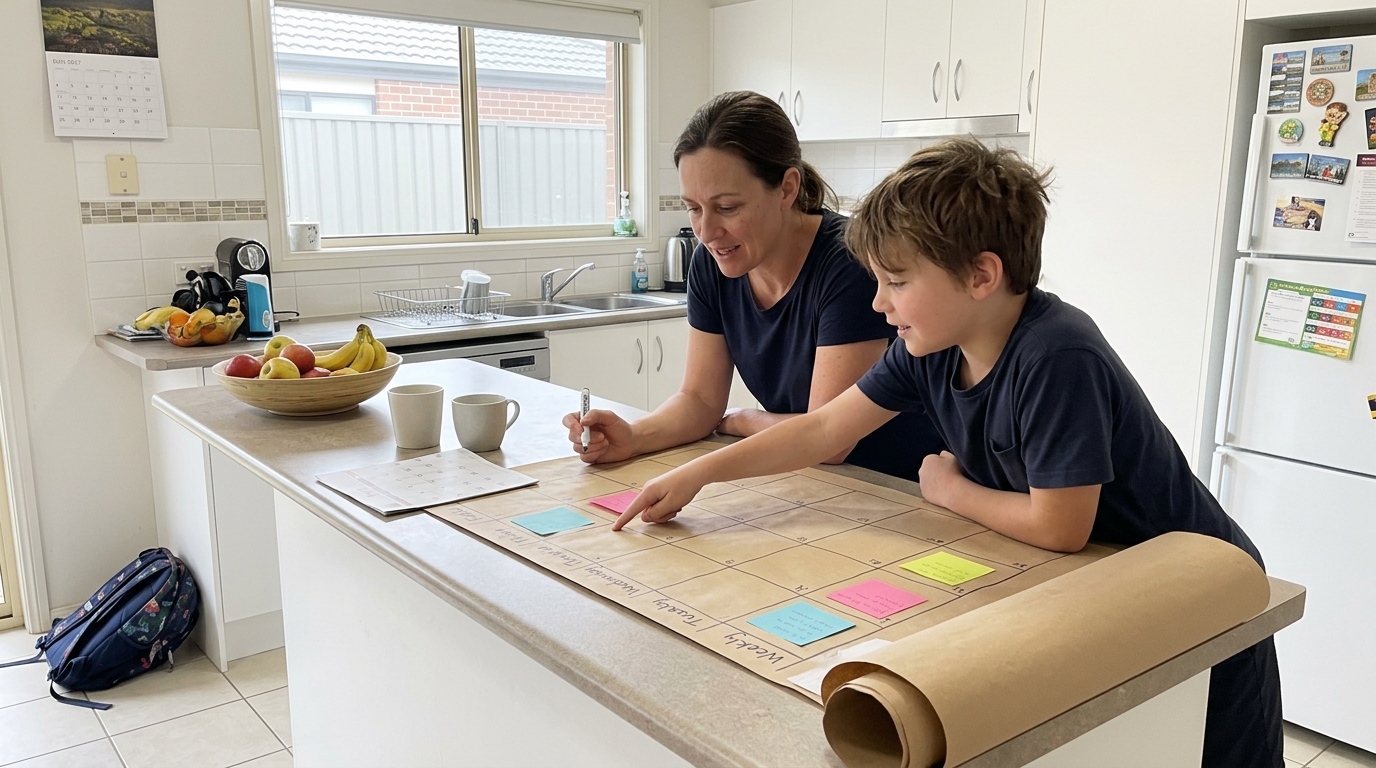
Open a paper calendar or a printed monthly grid and mark three things in this order. First: family events, sport, holidays away, time with friends — these are protected. Second: rest days — at least one a week, more if your child has been pushing hard at school. Third: study blocks — typically morning, before the day fills with everything else. Younger kids do better right after breakfast; teens do better mid-morning after a slow start. Keep weekends to one shorter session at most. Visible calendars work; calendars in a drawer don't. A butcher-paper sheet on the kitchen bench works for primary kids; a shared Google Calendar works for senior students.
How do I make holiday learning fun?
Holiday learning sticks better when it doesn't feel like school. Cooking together covers fractions, conversions and reading comprehension. Museum and library trips give a context for whatever they're studying. Audiobooks and podcasts on long drives count as reading hours. Board games like Catan, Scrabble or a card-game tournament cover strategy, vocabulary and probability. Documentaries aligned to a curriculum topic can replace a study block. Project work — designing a bedroom layout to scale, planning a budget for a holiday outing — applies maths and writing in real life. Two or three fun-learning days a week, alongside three or four short focused blocks, lands the right balance for most families.
How long should a focused study block be?
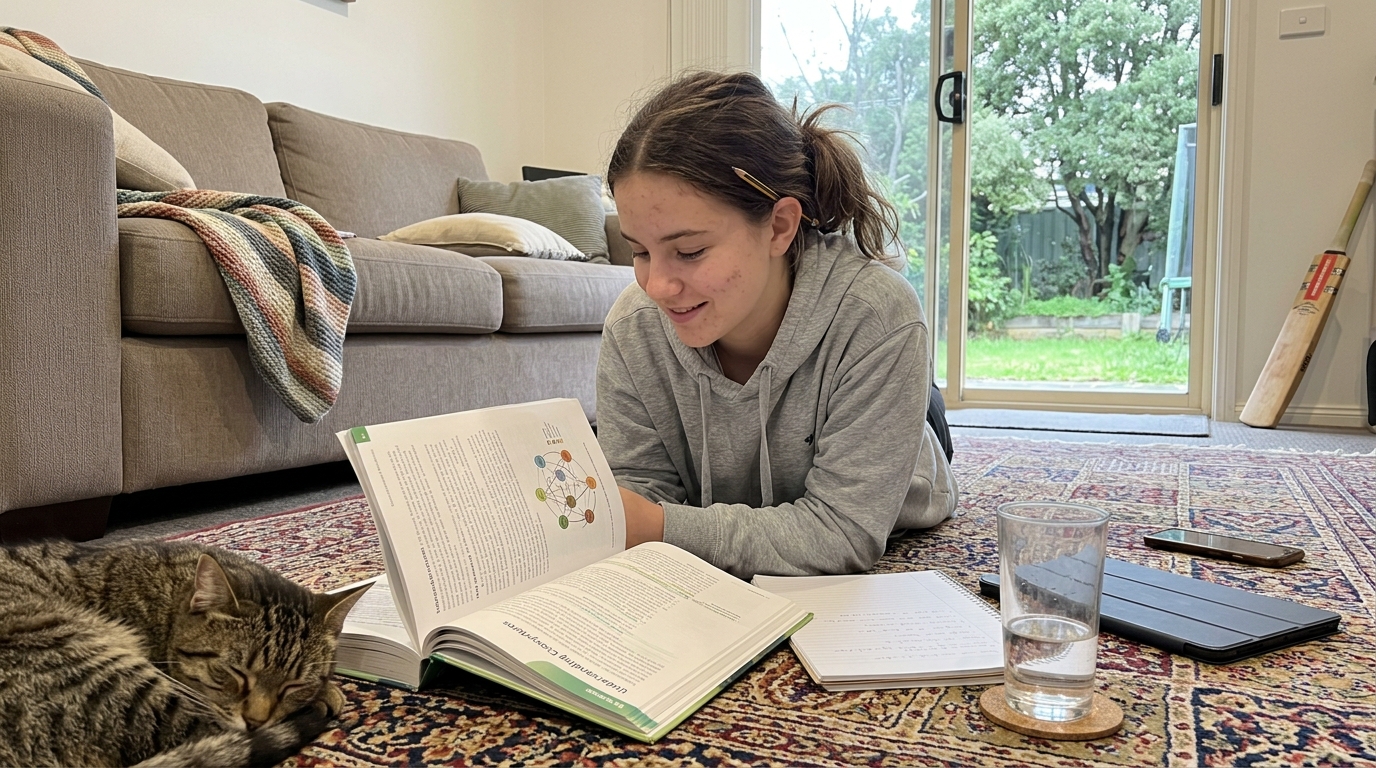
Short blocks with proper breaks beat long marathons every time. The Pomodoro pattern — 25 minutes on, 5 minutes off, repeat three to four times, then a longer 20-minute break — works at every age. For primary kids, shrink the block to 10–15 minutes. For senior students approaching ATAR, extend to 45 or 50 minutes. Phone in another room. Water and a snack on the desk. One subject per block; switching mid-block kills retention. After three blocks, stop — a fourth almost always tips into diminishing returns. Track what's been done on a simple checklist; the visible progress is half the motivation.
How do I review the plan each week?
Sit down with your child every Sunday for ten minutes and answer three questions. What did we actually do this week? Tick off the goals or sub-goals that landed. Where did the plan break down? If something keeps getting skipped, the plan is wrong, not your child — adjust it. What's the priority this coming week? Pick the two or three most important blocks and protect them. Weekly review is the part most families skip and the part that turns a holiday plan from a wishlist into a habit. If a topic keeps slipping, that's a flag to bring in a steady weekly tutor before next term starts; closing one stubborn gap over a holiday saves three months of catch-up later.
When should I bring in a holiday tutor?
A tutor is worth considering in three situations: your child is meaningfully behind in one subject (a school-report grade has dropped), they're heading into a high-stakes year (Year 7, Year 11, Year 12), or they want to get ahead in a subject they enjoy. One or two sessions a week through the holidays — paired with the daily 30–45 minute habit above — usually closes a one-grade gap. Look for a tutor your child clicks with; rapport matters more than a CV. Find a holiday tutor on Tutero from $65/hr with no contracts — same rate for primary, lower-secondary and senior. Try a trial lesson, then decide week by week.
The bottom line
The best holiday study plan is the one your child will actually follow. Start small: one 30-minute block on Monday, one fun-learning Tuesday, one rest day. Build from there. Review on Sunday and adjust what isn't working. If you'd like a steady weekly anchor through the break — a tutor your child can trust — browse online tutors near you on Tutero and book a no-contract trial today.
Ready to make this holiday count? Most Tutero families start with a single trial lesson and book in week by week. From $65/hr, no contracts, same rate every year level.
FAQ
.svg)
.svg)
Online maths tutoring at Tutero is catering to students of all year levels. We offer programs tailored to the unique learning curves of each age group.
We also have expert NAPLAN and ATAR subject tutors, ensuring students are well-equipped for these pivotal assessments.
We recommend at least two to three session per week for consistent progress. However, this can vary based on your child's needs and goals.
Our platform uses advanced security protocols to ensure the safety and privacy of all our online sessions.
Parents are welcome to observe sessions. We believe in a collaborative approach to education.
We provide regular progress reports and assessments to track your child’s academic development.
Yes, we prioritise the student-tutor relationship and can arrange a change if the need arises.
Yes, we offer a range of resources and materials, including interactive exercises and practice worksheets.

A school holiday study plan keeps learning ticking over without ruining the break — usually 30 to 60 minutes a day, four or five days a week, on the things your child actually needs to consolidate. The six-step framework below works for primary, lower-secondary and senior students, with realistic time-on-task and built-in flex for the days you'd rather go to the beach.
Quick answer
Build a holiday study plan in six steps: match the plan to your child's stage (15–30 minutes daily for primary, 30–45 for lower-secondary, 60–90 for senior), set two or three concrete goals (not "improve at maths"), block the calendar with study and rest days, mix in fun learning activities (cooking, museums, podcasts), schedule short focused blocks with deliberate breaks, and review weekly. Keep it light enough to actually finish; a 20-minute habit done daily beats a 2-hour Sunday cram every time.
How long should my child study each day during the school holidays?
Match study time to your child's stage. Year 1–4: 15–30 minutes a day, four days a week — reading aloud, times-table practice, a short writing journal. Year 5–8 (lower-secondary): 30–45 minutes a day, four to five days a week — one focused block per session covering whatever they're shaky on. Year 9–10: 45–60 minutes a day, five days a week — sustained reading, exam-style problem sets, language vocabulary. Year 11–12 (senior): 60–90 minutes a day, five to six days a week, in 25-to-50-minute focused blocks. The aim is consolidation, not new ground; if your child is in front of an end-of-year exam, see the senior-year notes below.
How do I set realistic goals for the school holidays?
Replace vague goals ("get better at English") with two or three concrete ones the holiday is long enough to deliver. Examples: finish reading one novel; master times tables 6–9; review every term-2 maths topic, one per day; memorise 50 Mandarin characters; write three practice essays; complete the first three chapters of next term's textbook. Write them down where the family can see them — a fridge whiteboard or a shared note. Talk through what's realistic with your child; ownership matters more than ambition. If your child is preparing for a big test (NAPLAN, end-of-year exams, ATAR), pick one or two academic goals plus one rest goal — sleep, exercise, time with friends.
How do I block out the calendar?
Open a paper calendar or a printed monthly grid and mark three things in this order. First: family events, sport, holidays away, time with friends — these are protected. Second: rest days — at least one a week, more if your child has been pushing hard at school. Third: study blocks — typically morning, before the day fills with everything else. Younger kids do better right after breakfast; teens do better mid-morning after a slow start. Keep weekends to one shorter session at most. Visible calendars work; calendars in a drawer don't. A butcher-paper sheet on the kitchen bench works for primary kids; a shared Google Calendar works for senior students.
How do I make holiday learning fun?
Holiday learning sticks better when it doesn't feel like school. Cooking together covers fractions, conversions and reading comprehension. Museum and library trips give a context for whatever they're studying. Audiobooks and podcasts on long drives count as reading hours. Board games like Catan, Scrabble or a card-game tournament cover strategy, vocabulary and probability. Documentaries aligned to a curriculum topic can replace a study block. Project work — designing a bedroom layout to scale, planning a budget for a holiday outing — applies maths and writing in real life. Two or three fun-learning days a week, alongside three or four short focused blocks, lands the right balance for most families.
How long should a focused study block be?
Short blocks with proper breaks beat long marathons every time. The Pomodoro pattern — 25 minutes on, 5 minutes off, repeat three to four times, then a longer 20-minute break — works at every age. For primary kids, shrink the block to 10–15 minutes. For senior students approaching ATAR, extend to 45 or 50 minutes. Phone in another room. Water and a snack on the desk. One subject per block; switching mid-block kills retention. After three blocks, stop — a fourth almost always tips into diminishing returns. Track what's been done on a simple checklist; the visible progress is half the motivation.
How do I review the plan each week?
Sit down with your child every Sunday for ten minutes and answer three questions. What did we actually do this week? Tick off the goals or sub-goals that landed. Where did the plan break down? If something keeps getting skipped, the plan is wrong, not your child — adjust it. What's the priority this coming week? Pick the two or three most important blocks and protect them. Weekly review is the part most families skip and the part that turns a holiday plan from a wishlist into a habit. If a topic keeps slipping, that's a flag to bring in a steady weekly tutor before next term starts; closing one stubborn gap over a holiday saves three months of catch-up later.
When should I bring in a holiday tutor?
A tutor is worth considering in three situations: your child is meaningfully behind in one subject (a school-report grade has dropped), they're heading into a high-stakes year (Year 7, Year 11, Year 12), or they want to get ahead in a subject they enjoy. One or two sessions a week through the holidays — paired with the daily 30–45 minute habit above — usually closes a one-grade gap. Look for a tutor your child clicks with; rapport matters more than a CV. Find a holiday tutor on Tutero from $65/hr with no contracts — same rate for primary, lower-secondary and senior. Try a trial lesson, then decide week by week.
The bottom line
The best holiday study plan is the one your child will actually follow. Start small: one 30-minute block on Monday, one fun-learning Tuesday, one rest day. Build from there. Review on Sunday and adjust what isn't working. If you'd like a steady weekly anchor through the break — a tutor your child can trust — browse online tutors near you on Tutero and book a no-contract trial today.
Ready to make this holiday count? Most Tutero families start with a single trial lesson and book in week by week. From $65/hr, no contracts, same rate every year level.
Hoping to improve confidence & grades?

.png)


