
.svg)
.avif)
Supporting your child emotionally means giving them safe space to feel their feelings, naming what's hard, and showing them that big emotions are normal — not a problem to fix. The six routines below work in primary, lower-secondary and senior years; you don't need a psychology degree, just twenty unhurried minutes a day and a willingness to listen first.
Quick answer
Build emotional resilience with six everyday habits: twenty unhurried minutes a day, normalising every feeling, naming emotions out loud, modelling how you handle your own stress, teaching one calming tool (deep breathing or visualisation), and reminding your child you're on their side no matter what. Start with one habit this week, layer the rest in over the term, and call in support — a tutor, GP, school counsellor, or psychologist — if you spot warning signs.
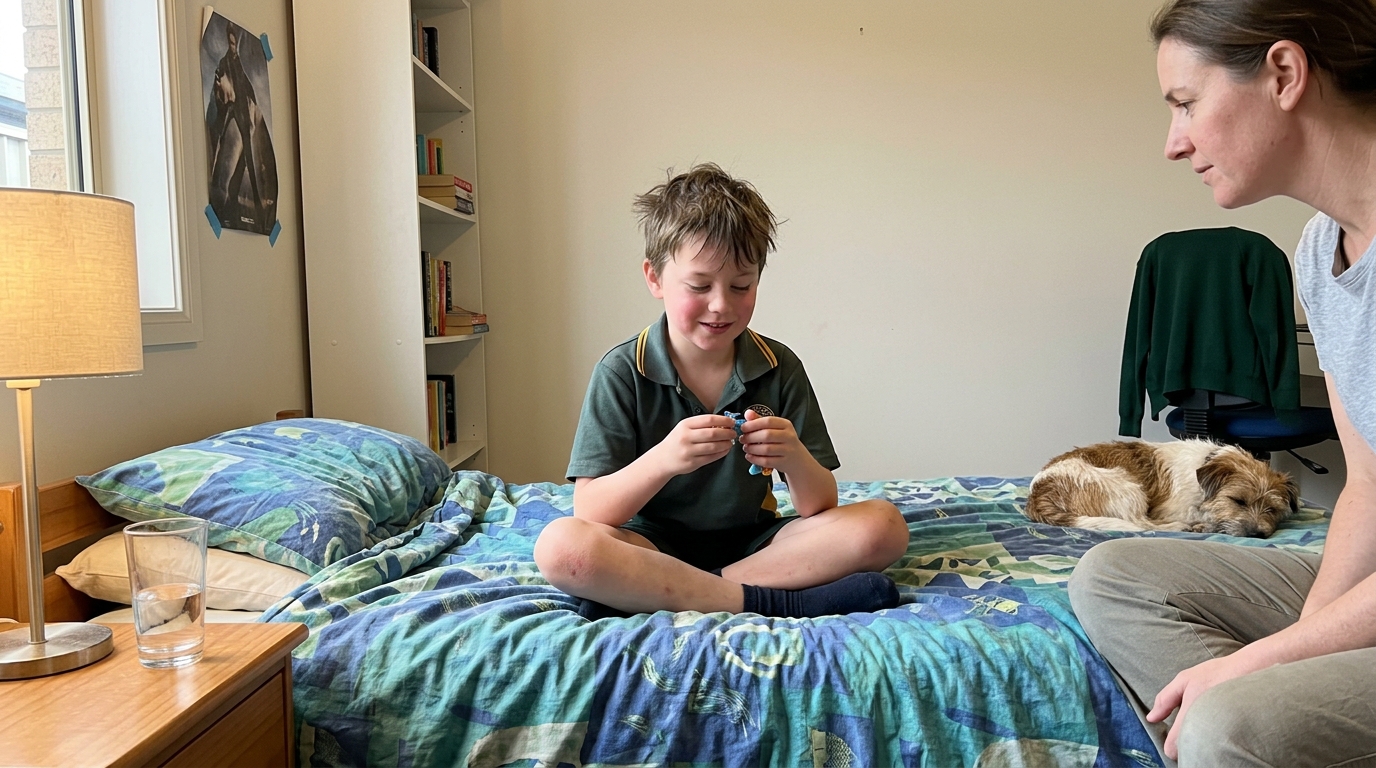
How do I talk to my child about their day without pulling teeth?
Twenty minutes of unhurried, phones-down time is the format that works at every age — primary, lower-secondary and senior. The trick is the setting, not the question. A walk around the block, dinner together with the TV off, or sitting on the end of the bed at lights-out gets more out of a Year 4 or a Year 11 than "how was school?" ever will. Start with something concrete: "what made you laugh today?" or "what was the worst part of today?" Let silence sit; kids fill it in their own time. If your child shrugs, share a small thing from your own day first — modelling openness gets reciprocity, especially with teens.
How do I encourage my child to express their feelings?
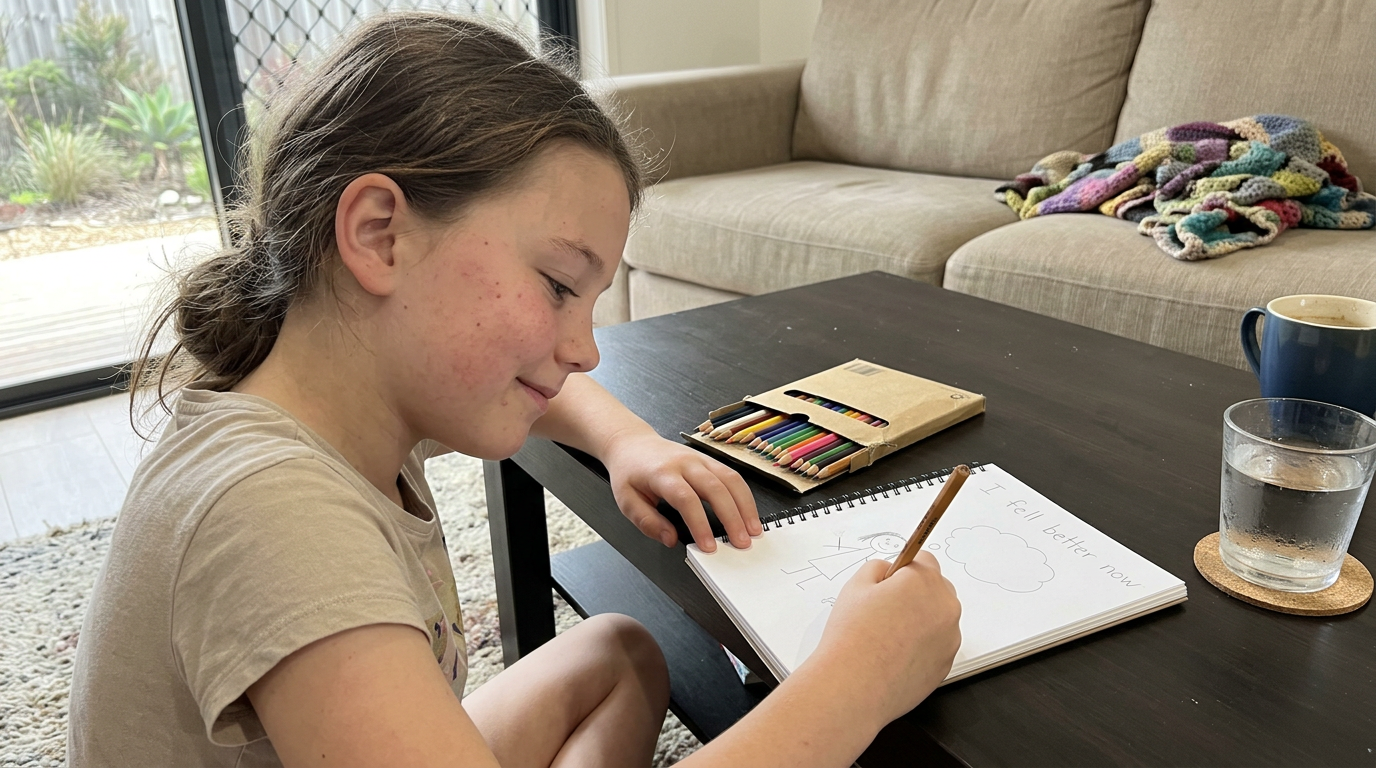
Make every feeling welcome — including the inconvenient ones. The fastest way to shut a child down is to skip past sadness, anger or worry with "you're fine" or "don't be silly." Instead, reflect the feeling back: "that sounds really frustrating" or "it makes sense you're nervous about that test." Younger kids (Year 1–4) often express feelings through play, drawing, or storytelling rather than words; offer paper and pencils, not interrogation. Lower-secondary kids open up over shared activities — kicking a ball, baking, driving in the car. Senior students often need writing as a release: a journal, a notes app, a private letter they never send. Different ages, same principle: a non-judgemental container.
How do I help my child name their emotions?
Children who can name what they're feeling can manage it; children who can't, act it out. Start by naming emotions out loud as you notice them — "you look really disappointed" or "I think that frustrated you." Use a wider vocabulary than happy/sad/angry: nervous, embarrassed, jealous, overwhelmed, proud, relieved, lonely, anxious. Even Year 1 students can learn ten emotion words this way. For older kids, separate the emotion from the behaviour: "feeling angry is fine, slamming the door isn't." This is the foundation of emotional regulation, and it's the single biggest predictor of how a child copes under exam pressure in lower-secondary and senior years.
How do I model handling my own emotions in a healthy way?
Your child learns more from how you handle a bad day than from anything you say about feelings. When you feel frustrated or stressed, narrate it out loud in a calm voice: "I'm feeling really wound up about that email — I'm going to take five minutes outside before I reply." When the two of you argue, take the pause first; speak more quietly, not louder. Apologise when you get it wrong: "I shouldn't have snapped, that was about my day, not yours." Modelling repair after a rupture is one of the most powerful emotional lessons a parent can give. Kids of every age — primary, lower-secondary, senior — read this fluently.
What stress-relieving techniques can I teach my child?
One reliable tool beats five half-learned ones. Pick one and practise it together until it's automatic. Box breathing works at every age: in for 4, hold 4, out for 4, hold 4. Five-senses grounding (name 5 things you see, 4 you hear, 3 you feel, 2 you smell, 1 you taste) works well for kids who get overwhelmed. Visualisation — imagining a calm place in detail — helps kids who close their eyes easily. Practise the tool when calm, not in the middle of a meltdown; that's like learning to swim during a flood. Use it before known stressors: NAPLAN, an exam, a difficult conversation.
How do I show my child I'll always be there for them?
Tell them, often, in plain words. "I'm proud of you." "I love you when you're easy and when you're hard." "Whatever's going on, you can tell me — I won't be angry." Repeat it more than feels necessary, especially during the difficult years (Year 7–10 and again Year 11–12). Show it with consistent presence: be the parent who turns up to the assembly, who eats dinner together on a weeknight, who asks twice if "fine" sounded thin the first time. When something goes wrong — a friendship breakup, a bad mark, a mistake — separate behaviour from worth: "I love you. I don't love what you did. We'll work it out together."
When should I get extra support for my child?
Talk to your GP or school counsellor if you see persistent changes — sleep problems, withdrawal from friends, loss of interest in things they used to love, panic before school, or talk of self-harm — that last more than two or three weeks. Australian families can also access Kids Helpline (1800 55 1800, free 24/7), headspace for ages 12–25, and Parentline for parent support. Academic stress often masquerades as emotional distress; if your child is anxious about falling behind, a steady weekly tutor — someone they can trust — can do as much for confidence as for marks.
The bottom line
Your child doesn't need you to fix every feeling — they need you to sit with them through it. Pick one habit from this list and start tomorrow: twenty unhurried minutes, an emotion named out loud, one breathing tool practised when calm. Layer in the rest over the term. If you'd like a steady weekly anchor for your child — a tutor who builds confidence alongside marks — find a tutor on Tutero from $65/hr with no contracts. Same rate every year level, primary through senior.
Ready to take some pressure off the kitchen-table evenings? Most Tutero families start with a single trial lesson and decide week by week. Browse online tutors near you and book a no-contract trial today.
Supporting your child emotionally means giving them safe space to feel their feelings, naming what's hard, and showing them that big emotions are normal — not a problem to fix. The six routines below work in primary, lower-secondary and senior years; you don't need a psychology degree, just twenty unhurried minutes a day and a willingness to listen first.
Quick answer
Build emotional resilience with six everyday habits: twenty unhurried minutes a day, normalising every feeling, naming emotions out loud, modelling how you handle your own stress, teaching one calming tool (deep breathing or visualisation), and reminding your child you're on their side no matter what. Start with one habit this week, layer the rest in over the term, and call in support — a tutor, GP, school counsellor, or psychologist — if you spot warning signs.
How do I talk to my child about their day without pulling teeth?
Twenty minutes of unhurried, phones-down time is the format that works at every age — primary, lower-secondary and senior. The trick is the setting, not the question. A walk around the block, dinner together with the TV off, or sitting on the end of the bed at lights-out gets more out of a Year 4 or a Year 11 than "how was school?" ever will. Start with something concrete: "what made you laugh today?" or "what was the worst part of today?" Let silence sit; kids fill it in their own time. If your child shrugs, share a small thing from your own day first — modelling openness gets reciprocity, especially with teens.
How do I encourage my child to express their feelings?
Make every feeling welcome — including the inconvenient ones. The fastest way to shut a child down is to skip past sadness, anger or worry with "you're fine" or "don't be silly." Instead, reflect the feeling back: "that sounds really frustrating" or "it makes sense you're nervous about that test." Younger kids (Year 1–4) often express feelings through play, drawing, or storytelling rather than words; offer paper and pencils, not interrogation. Lower-secondary kids open up over shared activities — kicking a ball, baking, driving in the car. Senior students often need writing as a release: a journal, a notes app, a private letter they never send. Different ages, same principle: a non-judgemental container.
How do I help my child name their emotions?
Children who can name what they're feeling can manage it; children who can't, act it out. Start by naming emotions out loud as you notice them — "you look really disappointed" or "I think that frustrated you." Use a wider vocabulary than happy/sad/angry: nervous, embarrassed, jealous, overwhelmed, proud, relieved, lonely, anxious. Even Year 1 students can learn ten emotion words this way. For older kids, separate the emotion from the behaviour: "feeling angry is fine, slamming the door isn't." This is the foundation of emotional regulation, and it's the single biggest predictor of how a child copes under exam pressure in lower-secondary and senior years.
How do I model handling my own emotions in a healthy way?
Your child learns more from how you handle a bad day than from anything you say about feelings. When you feel frustrated or stressed, narrate it out loud in a calm voice: "I'm feeling really wound up about that email — I'm going to take five minutes outside before I reply." When the two of you argue, take the pause first; speak more quietly, not louder. Apologise when you get it wrong: "I shouldn't have snapped, that was about my day, not yours." Modelling repair after a rupture is one of the most powerful emotional lessons a parent can give. Kids of every age — primary, lower-secondary, senior — read this fluently.
What stress-relieving techniques can I teach my child?
One reliable tool beats five half-learned ones. Pick one and practise it together until it's automatic. Box breathing works at every age: in for 4, hold 4, out for 4, hold 4. Five-senses grounding (name 5 things you see, 4 you hear, 3 you feel, 2 you smell, 1 you taste) works well for kids who get overwhelmed. Visualisation — imagining a calm place in detail — helps kids who close their eyes easily. Practise the tool when calm, not in the middle of a meltdown; that's like learning to swim during a flood. Use it before known stressors: NAPLAN, an exam, a difficult conversation.
How do I show my child I'll always be there for them?
Tell them, often, in plain words. "I'm proud of you." "I love you when you're easy and when you're hard." "Whatever's going on, you can tell me — I won't be angry." Repeat it more than feels necessary, especially during the difficult years (Year 7–10 and again Year 11–12). Show it with consistent presence: be the parent who turns up to the assembly, who eats dinner together on a weeknight, who asks twice if "fine" sounded thin the first time. When something goes wrong — a friendship breakup, a bad mark, a mistake — separate behaviour from worth: "I love you. I don't love what you did. We'll work it out together."
When should I get extra support for my child?
Talk to your GP or school counsellor if you see persistent changes — sleep problems, withdrawal from friends, loss of interest in things they used to love, panic before school, or talk of self-harm — that last more than two or three weeks. Australian families can also access Kids Helpline (1800 55 1800, free 24/7), headspace for ages 12–25, and Parentline for parent support. Academic stress often masquerades as emotional distress; if your child is anxious about falling behind, a steady weekly tutor — someone they can trust — can do as much for confidence as for marks.
The bottom line
Your child doesn't need you to fix every feeling — they need you to sit with them through it. Pick one habit from this list and start tomorrow: twenty unhurried minutes, an emotion named out loud, one breathing tool practised when calm. Layer in the rest over the term. If you'd like a steady weekly anchor for your child — a tutor who builds confidence alongside marks — find a tutor on Tutero from $65/hr with no contracts. Same rate every year level, primary through senior.
Ready to take some pressure off the kitchen-table evenings? Most Tutero families start with a single trial lesson and decide week by week. Browse online tutors near you and book a no-contract trial today.
FAQ
.svg)
.svg)
Online maths tutoring at Tutero is catering to students of all year levels. We offer programs tailored to the unique learning curves of each age group.
We also have expert NAPLAN and ATAR subject tutors, ensuring students are well-equipped for these pivotal assessments.
We recommend at least two to three session per week for consistent progress. However, this can vary based on your child's needs and goals.
Our platform uses advanced security protocols to ensure the safety and privacy of all our online sessions.
Parents are welcome to observe sessions. We believe in a collaborative approach to education.
We provide regular progress reports and assessments to track your child’s academic development.
Yes, we prioritise the student-tutor relationship and can arrange a change if the need arises.
Yes, we offer a range of resources and materials, including interactive exercises and practice worksheets.

Supporting your child emotionally means giving them safe space to feel their feelings, naming what's hard, and showing them that big emotions are normal — not a problem to fix. The six routines below work in primary, lower-secondary and senior years; you don't need a psychology degree, just twenty unhurried minutes a day and a willingness to listen first.
Quick answer
Build emotional resilience with six everyday habits: twenty unhurried minutes a day, normalising every feeling, naming emotions out loud, modelling how you handle your own stress, teaching one calming tool (deep breathing or visualisation), and reminding your child you're on their side no matter what. Start with one habit this week, layer the rest in over the term, and call in support — a tutor, GP, school counsellor, or psychologist — if you spot warning signs.
How do I talk to my child about their day without pulling teeth?
Twenty minutes of unhurried, phones-down time is the format that works at every age — primary, lower-secondary and senior. The trick is the setting, not the question. A walk around the block, dinner together with the TV off, or sitting on the end of the bed at lights-out gets more out of a Year 4 or a Year 11 than "how was school?" ever will. Start with something concrete: "what made you laugh today?" or "what was the worst part of today?" Let silence sit; kids fill it in their own time. If your child shrugs, share a small thing from your own day first — modelling openness gets reciprocity, especially with teens.
How do I encourage my child to express their feelings?
Make every feeling welcome — including the inconvenient ones. The fastest way to shut a child down is to skip past sadness, anger or worry with "you're fine" or "don't be silly." Instead, reflect the feeling back: "that sounds really frustrating" or "it makes sense you're nervous about that test." Younger kids (Year 1–4) often express feelings through play, drawing, or storytelling rather than words; offer paper and pencils, not interrogation. Lower-secondary kids open up over shared activities — kicking a ball, baking, driving in the car. Senior students often need writing as a release: a journal, a notes app, a private letter they never send. Different ages, same principle: a non-judgemental container.
How do I help my child name their emotions?
Children who can name what they're feeling can manage it; children who can't, act it out. Start by naming emotions out loud as you notice them — "you look really disappointed" or "I think that frustrated you." Use a wider vocabulary than happy/sad/angry: nervous, embarrassed, jealous, overwhelmed, proud, relieved, lonely, anxious. Even Year 1 students can learn ten emotion words this way. For older kids, separate the emotion from the behaviour: "feeling angry is fine, slamming the door isn't." This is the foundation of emotional regulation, and it's the single biggest predictor of how a child copes under exam pressure in lower-secondary and senior years.
How do I model handling my own emotions in a healthy way?
Your child learns more from how you handle a bad day than from anything you say about feelings. When you feel frustrated or stressed, narrate it out loud in a calm voice: "I'm feeling really wound up about that email — I'm going to take five minutes outside before I reply." When the two of you argue, take the pause first; speak more quietly, not louder. Apologise when you get it wrong: "I shouldn't have snapped, that was about my day, not yours." Modelling repair after a rupture is one of the most powerful emotional lessons a parent can give. Kids of every age — primary, lower-secondary, senior — read this fluently.
What stress-relieving techniques can I teach my child?
One reliable tool beats five half-learned ones. Pick one and practise it together until it's automatic. Box breathing works at every age: in for 4, hold 4, out for 4, hold 4. Five-senses grounding (name 5 things you see, 4 you hear, 3 you feel, 2 you smell, 1 you taste) works well for kids who get overwhelmed. Visualisation — imagining a calm place in detail — helps kids who close their eyes easily. Practise the tool when calm, not in the middle of a meltdown; that's like learning to swim during a flood. Use it before known stressors: NAPLAN, an exam, a difficult conversation.
How do I show my child I'll always be there for them?
Tell them, often, in plain words. "I'm proud of you." "I love you when you're easy and when you're hard." "Whatever's going on, you can tell me — I won't be angry." Repeat it more than feels necessary, especially during the difficult years (Year 7–10 and again Year 11–12). Show it with consistent presence: be the parent who turns up to the assembly, who eats dinner together on a weeknight, who asks twice if "fine" sounded thin the first time. When something goes wrong — a friendship breakup, a bad mark, a mistake — separate behaviour from worth: "I love you. I don't love what you did. We'll work it out together."
When should I get extra support for my child?
Talk to your GP or school counsellor if you see persistent changes — sleep problems, withdrawal from friends, loss of interest in things they used to love, panic before school, or talk of self-harm — that last more than two or three weeks. Australian families can also access Kids Helpline (1800 55 1800, free 24/7), headspace for ages 12–25, and Parentline for parent support. Academic stress often masquerades as emotional distress; if your child is anxious about falling behind, a steady weekly tutor — someone they can trust — can do as much for confidence as for marks.
The bottom line
Your child doesn't need you to fix every feeling — they need you to sit with them through it. Pick one habit from this list and start tomorrow: twenty unhurried minutes, an emotion named out loud, one breathing tool practised when calm. Layer in the rest over the term. If you'd like a steady weekly anchor for your child — a tutor who builds confidence alongside marks — find a tutor on Tutero from $65/hr with no contracts. Same rate every year level, primary through senior.
Ready to take some pressure off the kitchen-table evenings? Most Tutero families start with a single trial lesson and decide week by week. Browse online tutors near you and book a no-contract trial today.
Hoping to improve confidence & grades?

.png)


