
.svg)

Most parents notice the same thing first: a quiet, steady reluctance. Homework that used to take 15 minutes now stretches to an hour. A maths question their child clearly knew last term gets a blank look this term. The school report still says “making progress”, but something has shifted at the kitchen table. Below are the four signals worth taking seriously, what each one usually means, and exactly what to do next.
Quick answer: how do I know if my child is falling behind at school?
The clearest signs are: (1) they can’t explain what they learned that day in their own words, (2) they keep falling out of step with the pace of class, (3) homework suddenly becomes a battle or a shutdown, and (4) their teacher has flagged something — even mildly — at parent-teacher night. One of these on its own is normal. Two or more, sustained over four to six weeks across reading, writing or maths, usually means a real gap is forming. Catch it early and a few months of focused 1:1 help typically closes it; leave it for a year and the gap compounds because new topics depend on the missed ones. EEF research shows one-to-one tuition adds an average of four months of additional progress.

Sign 1 — Can your child explain in their own words what they learned today?
If you ask “what did you do in maths today?” and your child says “stuff” or “I don’t know”, that’s normal once. If it happens every afternoon for three weeks, it’s a signal. The single best home-test for whether a topic has actually landed is asking your child to teach you what they did. Not to repeat the answer — to walk you through how they got there.
Try this for one week: at the dinner table, ask one specific question per subject. “Show me how you’d add 47 + 28 — talk me through it.” “Read me the first paragraph of what you wrote in English and tell me why you chose those words.” You’ll know within five minutes whether they’re recalling a procedure or understanding it. Recall without understanding is the early signature of a gap forming. The Australian Council for Educational Research consistently finds that a Year 3 student behind in basic numeracy or reading is highly likely to still be behind in Year 9 — early gaps compound. Spotting a recall-only pattern in Year 2 or Year 5 is the cheapest moment to intervene.
If they can’t explain it, don’t panic and don’t lecture. Just note the topic, and either re-teach it yourself in 10 minutes that night, or — if it’s a topic you’re not confident on yourself, especially fractions, algebra, comprehension or essay structure — schedule a focused session with someone who can. One 1:1 tutoring session on the exact topic that didn’t land is worth more than a week of generic homework help.
Sign 2 — Are they keeping up with the pace of the classroom?
Children learn at different paces, but a class moves at one pace — usually the middle of the room. A child who needs an extra two examples to grasp a new concept doesn’t get them, because the teacher has 25 other students and a curriculum to cover. Over a term, those two missed examples per topic become a quiet 15% gap. Over a year, the gap is usually too wide to close inside the classroom. This is often most visible in the first year of high school, which our Year 7 tutoring page covers in detail.
The signs to watch for: your child says “the teacher already moved on” when describing a lesson; they bring home worksheets where the first two questions are answered confidently and the rest aren’t attempted; they say “everyone else gets it” (this is rarely true — but it’s how it feels from inside the gap). At parent-teacher night, ask the teacher one direct question: “In your honest assessment, where does my child sit relative to year-level expectations in literacy and numeracy?” Most teachers will tell you plainly if you ask plainly.
If the answer is “a little behind” or “middle of the pack but slipping”, the cheapest fix is one or two extra repetitions per concept, delivered 1:1 in the week the topic is taught. That’s the entire premise of weekly tutoring at this stage of primary or lower-secondary — not remediation, just the missed examples added back in. Tutero’s primary and high-school tutors all start at A$65 per hour, so it doesn’t need to be a serious financial commitment to test whether it works for your family. More on the benefits of weekly tutoring.
Sign 3 — Has homework suddenly become a battle?
Homework resistance is one of the most reliable early signals — and one of the most misread. Parents often hear “lazy” or “distracted”. Underneath, the more common cause is that the homework has become genuinely harder than the child can do alone. Children avoid tasks they expect to fail at. The avoidance looks like procrastination, defiance, or a sudden interest in the iPad. The underlying feeling is shame.
Watch for the specific pattern: your child sits down willingly, then stalls; they finish the easy questions fast and refuse to start the hard ones; they ask for help on every step where six months ago they’d have tried first; they say “this is stupid” instead of “I don’t get it” (the second is harder to admit). For a Year 1–4 child, sessions of 30 minutes maximum with a parent at the table is fine — and a tutor doing 30-minute sessions works at this age too. For a Year 5–8 child, an hour of focused 1:1 help once a week tends to lift homework from a battle to a routine within three to four weeks.
Sign 4 — Has the teacher flagged anything, even gently?
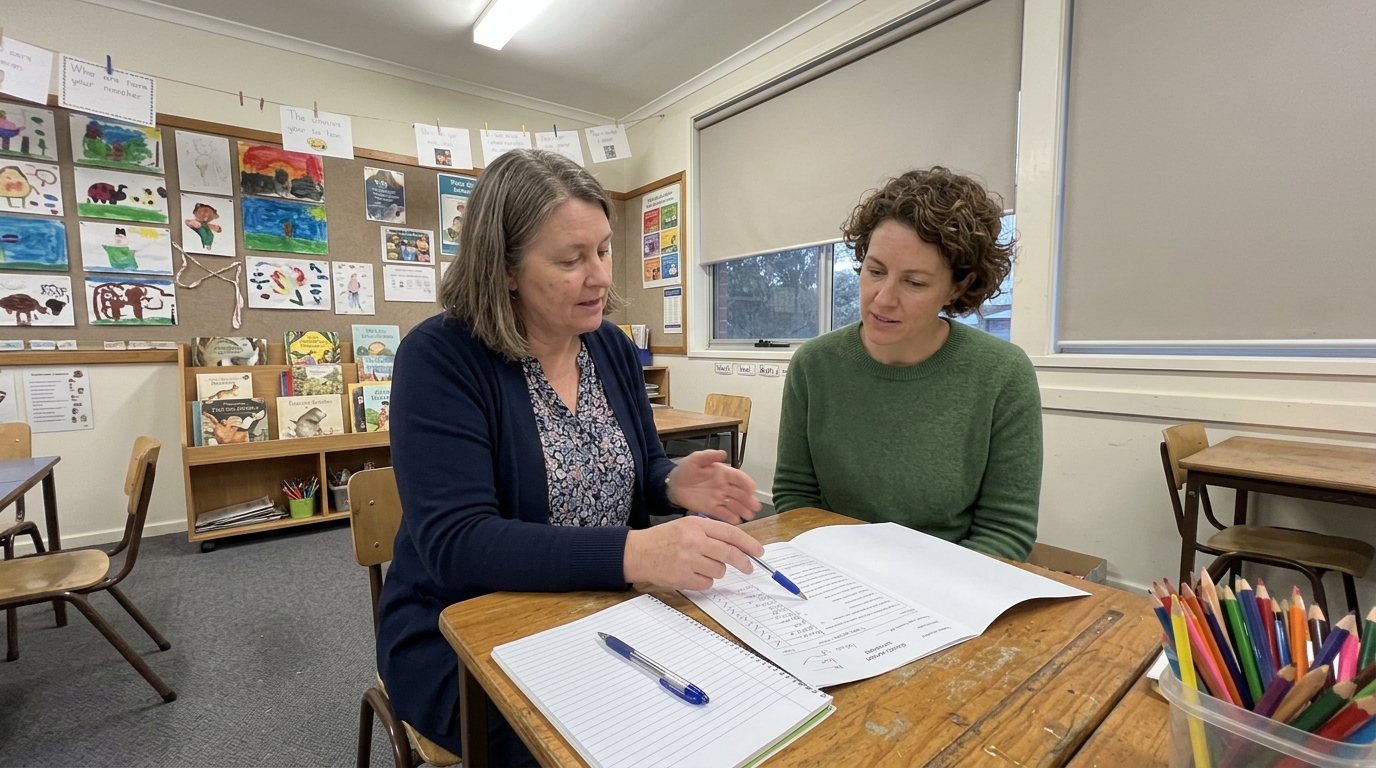
Australian teachers are professionally cautious. “He’s a lovely boy and trying his best” at parent-teacher night, especially when paired with no direct comment on academic performance, is often the polite version of a real concern. Teachers see your child for six hours a day, every day, and they see how your child stacks up against 25 same-age peers — a comparison you genuinely don’t have at home. When they raise something, even softly, it’s worth taking seriously.
Three follow-up questions that get past the polite framing:
- “Where would you place my child against the year-level expectations for reading, writing and numeracy?” — most teachers will give you a straight answer if you ask straight.
- “If you were in our position, what would you do over the next term?” — invites a real recommendation.
- “Is there a specific topic or skill that, if we worked on it at home, would unlock the rest?” — this is the question that turns a vague concern into a plan.
If the teacher mentions a specific weakness — phonics, number facts, paragraph structure, multiplication tables, fractions — that’s your tutoring brief. The most useful thing weekly 1:1 tutoring does at this stage is target the exact gap the classroom teacher has flagged. Generic “help with maths” is far less effective than “fluency with fractions by end of term”.
What should I do if my child is falling behind?
A simple, calm sequence works for most families:
| Week | What to do |
|---|---|
| Week 1 | Dinner-table check — one targeted question per subject for a week. Note any topic they can’t teach back to you. |
| Week 2 | Email the classroom teacher with two direct questions about year-level standing and the single biggest gap. |
| Weeks 3–4 | If a real gap is confirmed: book a weekly 1:1 tutor briefed on that exact topic. Same tutor every week. |
| Week 8 | Re-check with the same dinner-table questions. If the topic teaches back cleanly, the intervention is working. |
Should I get a tutor if my child is falling behind?
In most cases, yes — and earlier than parents expect. Weekly 1:1 tutoring is the highest-leverage intervention available outside school for a child who’s a little behind. The EEF teaching-and-learning toolkit rates one-to-one tuition as a high-impact, low-cost intervention with strong evidence behind it. The reason it works isn’t mysterious: a tutor gives your child the two extra repetitions per concept that the classroom can’t, and they do it on the exact gap rather than the whole curriculum.
Australian tutoring rates typically sit between A$55 and A$85 per hour for primary and secondary tutors. Tutero’s tutors start at A$65 per hour, with the same starting rate from Year 1 through Year 12 — no senior-year, ATAR or VCE premium. There’s no contract; if it’s not working after three to four sessions, you can pause without penalty. For families that prefer a shorter trial first, online tutoring with the same vetted tutor in your home means no driving, lower friction for younger children, and lessons recorded so they can revisit anything they didn’t fully grasp the first time.
When should I worry about my child’s school progress?
A few signals warrant moving beyond a weekly tutor and looking at additional support:
- The gap is across two or more subjects and has been there for more than two terms. Single-subject gaps usually close with focused tutoring; cross-subject gaps sometimes signal an underlying learning difference (dyslexia, dyscalculia, ADHD-related working-memory issues) worth a formal assessment.
- Your child has stopped trying. Disengagement that lasts more than a term — refusing to attempt new topics, “I’m just dumb at maths”, school-refusal mornings — is a red flag worth raising with the school’s learning-support coordinator and your GP.
- Reading is the gap and your child is in Year 3 or below. Reading underpins everything else; a Year 3 reading gap is genuinely time-sensitive. Ask the school about Reading Recovery or MultiLit, and consider a literacy-specialist tutor in parallel.
- NAPLAN results landed in Band 4 or below for Year 3, or Band 5 or below for Year 5. ACER’s benchmarking treats these as “below expected proficiency” — they’re worth taking seriously rather than waiting another two years for the next NAPLAN.
What’s the difference between a slow learner and a child who’s just behind?
An important distinction. A child who’s “just behind” has missed specific examples or repetitions — usually because of an absence, a hard term, a teacher change, or a topic that didn’t click the first time. Their underlying ability to learn is intact. Once the gap is filled, they catch up quickly. Most “falling behind” at school is this.
A child with a genuine learning difference (dyslexia is the most common, affecting roughly 1 in 10 Australian children) processes information differently. They aren’t slower in any general sense — many are unusually capable in other areas — but they need targeted, specialist support for reading, writing, or number processing. The signal that points to this rather than “just behind” is: you’ve filled the gap, the child has put in real effort, and the same pattern still keeps showing up. At that point, ask your GP for a referral to an educational psychologist for a formal assessment. Tutero matches children with tutors who specialise in supporting children with learning differences when families request it.
FAQ
How long does it take a child to catch up if they’re behind?
For a single-subject gap caught early — within the term it forms — most children close it within one school term of weekly 1:1 tutoring. A multi-term, multi-subject gap usually takes two to three terms of consistent weekly support. The longer the gap has existed, the longer it takes to close, which is why catching the early signs (rather than waiting for a school report) matters.
Should I tell my child I think they’re falling behind?
Not in those words. “I’ve noticed maths is feeling harder than it used to — let’s find someone who can help, the way you’d find a coach for soccer” lands much better than “you’re behind”. Children already know when they’re struggling; what they need is a calm adult turning it into a fixable problem with a plan, not a verdict.
Is online tutoring as effective as in-person for catching up?
For most primary and secondary children, yes — a 2025 meta-analysis of online vs in-person tutoring found no significant difference in academic outcomes when the tutor is qualified and the sessions are 1:1. Online has the practical advantage of no commute, easier scheduling around clubs and sport, and the ability to record lessons. For children younger than Year 1, in-person tends to work better because of attention span. More on online tutoring.
My child’s school report says they’re “meeting expectations” — could they still be behind?
Yes. Australian school reports are graded against year-level expectations using a coarse 4- or 5-point scale (typically A–E or “Working Towards / Meeting / Exceeding”). “Meeting” spans a wide band; a child can be at the bottom of “Meeting” and slipping without the report changing. The dinner-table teach-back test and a direct conversation with the classroom teacher are more sensitive than the report.
When in the school year is the best time to start tutoring?
As soon as you notice the pattern. Term 1 is ideal because it sets up the rest of the year, but starting in Term 2 or Term 3 still works — the gap just hasn’t had as much time to compound. The worst time is “after the next round of reports” — that’s usually another three months for the gap to widen.
Related reading
- 5 signs that your child needs tutoring — the closely related angle: not “is my child behind” but “does my child need a tutor right now”.
- Signs my child needs a tutor in primary school — primary-specific version of the question above.
- How tutoring improves confidence in maths — what to expect once weekly tutoring kicks in.
- 5 key benefits of private tutoring — the broader case for weekly 1:1 support.
- When’s the right time to begin tutoring? — timing the start of weekly support.
The bottom line
Most children fall behind quietly — not in dramatic ways the school report catches, but in steady, hard-to-articulate ways the kitchen table catches first. Four signals are worth your attention: the teach-back falters, the classroom pace gets ahead of them, homework becomes a battle, and the teacher hints at something. One of those is normal; two or more across four to six weeks is usually a real gap forming. Catch it early, target the exact topic with weekly 1:1 help, and most gaps close within a term. Ready to support your child with weekly 1:1 tutoring? Find a Tutero tutor from A$65/hour, no contracts, same tutor every week.
Most parents notice the same thing first: a quiet, steady reluctance. Homework that used to take 15 minutes now stretches to an hour. A maths question their child clearly knew last term gets a blank look this term. The school report still says “making progress”, but something has shifted at the kitchen table. Below are the four signals worth taking seriously, what each one usually means, and exactly what to do next.
Quick answer: how do I know if my child is falling behind at school?
The clearest signs are: (1) they can’t explain what they learned that day in their own words, (2) they keep falling out of step with the pace of class, (3) homework suddenly becomes a battle or a shutdown, and (4) their teacher has flagged something — even mildly — at parent-teacher night. One of these on its own is normal. Two or more, sustained over four to six weeks across reading, writing or maths, usually means a real gap is forming. Catch it early and a few months of focused 1:1 help typically closes it; leave it for a year and the gap compounds because new topics depend on the missed ones. EEF research shows one-to-one tuition adds an average of four months of additional progress.
Sign 1 — Can your child explain in their own words what they learned today?
If you ask “what did you do in maths today?” and your child says “stuff” or “I don’t know”, that’s normal once. If it happens every afternoon for three weeks, it’s a signal. The single best home-test for whether a topic has actually landed is asking your child to teach you what they did. Not to repeat the answer — to walk you through how they got there.
Try this for one week: at the dinner table, ask one specific question per subject. “Show me how you’d add 47 + 28 — talk me through it.” “Read me the first paragraph of what you wrote in English and tell me why you chose those words.” You’ll know within five minutes whether they’re recalling a procedure or understanding it. Recall without understanding is the early signature of a gap forming. The Australian Council for Educational Research consistently finds that a Year 3 student behind in basic numeracy or reading is highly likely to still be behind in Year 9 — early gaps compound. Spotting a recall-only pattern in Year 2 or Year 5 is the cheapest moment to intervene.
If they can’t explain it, don’t panic and don’t lecture. Just note the topic, and either re-teach it yourself in 10 minutes that night, or — if it’s a topic you’re not confident on yourself, especially fractions, algebra, comprehension or essay structure — schedule a focused session with someone who can. One 1:1 tutoring session on the exact topic that didn’t land is worth more than a week of generic homework help.
Sign 2 — Are they keeping up with the pace of the classroom?
Children learn at different paces, but a class moves at one pace — usually the middle of the room. A child who needs an extra two examples to grasp a new concept doesn’t get them, because the teacher has 25 other students and a curriculum to cover. Over a term, those two missed examples per topic become a quiet 15% gap. Over a year, the gap is usually too wide to close inside the classroom. This is often most visible in the first year of high school, which our Year 7 tutoring page covers in detail.
The signs to watch for: your child says “the teacher already moved on” when describing a lesson; they bring home worksheets where the first two questions are answered confidently and the rest aren’t attempted; they say “everyone else gets it” (this is rarely true — but it’s how it feels from inside the gap). At parent-teacher night, ask the teacher one direct question: “In your honest assessment, where does my child sit relative to year-level expectations in literacy and numeracy?” Most teachers will tell you plainly if you ask plainly.
If the answer is “a little behind” or “middle of the pack but slipping”, the cheapest fix is one or two extra repetitions per concept, delivered 1:1 in the week the topic is taught. That’s the entire premise of weekly tutoring at this stage of primary or lower-secondary — not remediation, just the missed examples added back in. Tutero’s primary and high-school tutors all start at A$65 per hour, so it doesn’t need to be a serious financial commitment to test whether it works for your family. More on the benefits of weekly tutoring.
Sign 3 — Has homework suddenly become a battle?
Homework resistance is one of the most reliable early signals — and one of the most misread. Parents often hear “lazy” or “distracted”. Underneath, the more common cause is that the homework has become genuinely harder than the child can do alone. Children avoid tasks they expect to fail at. The avoidance looks like procrastination, defiance, or a sudden interest in the iPad. The underlying feeling is shame.
Watch for the specific pattern: your child sits down willingly, then stalls; they finish the easy questions fast and refuse to start the hard ones; they ask for help on every step where six months ago they’d have tried first; they say “this is stupid” instead of “I don’t get it” (the second is harder to admit). For a Year 1–4 child, sessions of 30 minutes maximum with a parent at the table is fine — and a tutor doing 30-minute sessions works at this age too. For a Year 5–8 child, an hour of focused 1:1 help once a week tends to lift homework from a battle to a routine within three to four weeks.
Sign 4 — Has the teacher flagged anything, even gently?
Australian teachers are professionally cautious. “He’s a lovely boy and trying his best” at parent-teacher night, especially when paired with no direct comment on academic performance, is often the polite version of a real concern. Teachers see your child for six hours a day, every day, and they see how your child stacks up against 25 same-age peers — a comparison you genuinely don’t have at home. When they raise something, even softly, it’s worth taking seriously.
Three follow-up questions that get past the polite framing:
- “Where would you place my child against the year-level expectations for reading, writing and numeracy?” — most teachers will give you a straight answer if you ask straight.
- “If you were in our position, what would you do over the next term?” — invites a real recommendation.
- “Is there a specific topic or skill that, if we worked on it at home, would unlock the rest?” — this is the question that turns a vague concern into a plan.
If the teacher mentions a specific weakness — phonics, number facts, paragraph structure, multiplication tables, fractions — that’s your tutoring brief. The most useful thing weekly 1:1 tutoring does at this stage is target the exact gap the classroom teacher has flagged. Generic “help with maths” is far less effective than “fluency with fractions by end of term”.
What should I do if my child is falling behind?
A simple, calm sequence works for most families:
| Week | What to do |
|---|---|
| Week 1 | Dinner-table check — one targeted question per subject for a week. Note any topic they can’t teach back to you. |
| Week 2 | Email the classroom teacher with two direct questions about year-level standing and the single biggest gap. |
| Weeks 3–4 | If a real gap is confirmed: book a weekly 1:1 tutor briefed on that exact topic. Same tutor every week. |
| Week 8 | Re-check with the same dinner-table questions. If the topic teaches back cleanly, the intervention is working. |
Should I get a tutor if my child is falling behind?
In most cases, yes — and earlier than parents expect. Weekly 1:1 tutoring is the highest-leverage intervention available outside school for a child who’s a little behind. The EEF teaching-and-learning toolkit rates one-to-one tuition as a high-impact, low-cost intervention with strong evidence behind it. The reason it works isn’t mysterious: a tutor gives your child the two extra repetitions per concept that the classroom can’t, and they do it on the exact gap rather than the whole curriculum.
Australian tutoring rates typically sit between A$55 and A$85 per hour for primary and secondary tutors. Tutero’s tutors start at A$65 per hour, with the same starting rate from Year 1 through Year 12 — no senior-year, ATAR or VCE premium. There’s no contract; if it’s not working after three to four sessions, you can pause without penalty. For families that prefer a shorter trial first, online tutoring with the same vetted tutor in your home means no driving, lower friction for younger children, and lessons recorded so they can revisit anything they didn’t fully grasp the first time.
When should I worry about my child’s school progress?
A few signals warrant moving beyond a weekly tutor and looking at additional support:
- The gap is across two or more subjects and has been there for more than two terms. Single-subject gaps usually close with focused tutoring; cross-subject gaps sometimes signal an underlying learning difference (dyslexia, dyscalculia, ADHD-related working-memory issues) worth a formal assessment.
- Your child has stopped trying. Disengagement that lasts more than a term — refusing to attempt new topics, “I’m just dumb at maths”, school-refusal mornings — is a red flag worth raising with the school’s learning-support coordinator and your GP.
- Reading is the gap and your child is in Year 3 or below. Reading underpins everything else; a Year 3 reading gap is genuinely time-sensitive. Ask the school about Reading Recovery or MultiLit, and consider a literacy-specialist tutor in parallel.
- NAPLAN results landed in Band 4 or below for Year 3, or Band 5 or below for Year 5. ACER’s benchmarking treats these as “below expected proficiency” — they’re worth taking seriously rather than waiting another two years for the next NAPLAN.
What’s the difference between a slow learner and a child who’s just behind?
An important distinction. A child who’s “just behind” has missed specific examples or repetitions — usually because of an absence, a hard term, a teacher change, or a topic that didn’t click the first time. Their underlying ability to learn is intact. Once the gap is filled, they catch up quickly. Most “falling behind” at school is this.
A child with a genuine learning difference (dyslexia is the most common, affecting roughly 1 in 10 Australian children) processes information differently. They aren’t slower in any general sense — many are unusually capable in other areas — but they need targeted, specialist support for reading, writing, or number processing. The signal that points to this rather than “just behind” is: you’ve filled the gap, the child has put in real effort, and the same pattern still keeps showing up. At that point, ask your GP for a referral to an educational psychologist for a formal assessment. Tutero matches children with tutors who specialise in supporting children with learning differences when families request it.
FAQ
How long does it take a child to catch up if they’re behind?
For a single-subject gap caught early — within the term it forms — most children close it within one school term of weekly 1:1 tutoring. A multi-term, multi-subject gap usually takes two to three terms of consistent weekly support. The longer the gap has existed, the longer it takes to close, which is why catching the early signs (rather than waiting for a school report) matters.
Should I tell my child I think they’re falling behind?
Not in those words. “I’ve noticed maths is feeling harder than it used to — let’s find someone who can help, the way you’d find a coach for soccer” lands much better than “you’re behind”. Children already know when they’re struggling; what they need is a calm adult turning it into a fixable problem with a plan, not a verdict.
Is online tutoring as effective as in-person for catching up?
For most primary and secondary children, yes — a 2025 meta-analysis of online vs in-person tutoring found no significant difference in academic outcomes when the tutor is qualified and the sessions are 1:1. Online has the practical advantage of no commute, easier scheduling around clubs and sport, and the ability to record lessons. For children younger than Year 1, in-person tends to work better because of attention span. More on online tutoring.
My child’s school report says they’re “meeting expectations” — could they still be behind?
Yes. Australian school reports are graded against year-level expectations using a coarse 4- or 5-point scale (typically A–E or “Working Towards / Meeting / Exceeding”). “Meeting” spans a wide band; a child can be at the bottom of “Meeting” and slipping without the report changing. The dinner-table teach-back test and a direct conversation with the classroom teacher are more sensitive than the report.
When in the school year is the best time to start tutoring?
As soon as you notice the pattern. Term 1 is ideal because it sets up the rest of the year, but starting in Term 2 or Term 3 still works — the gap just hasn’t had as much time to compound. The worst time is “after the next round of reports” — that’s usually another three months for the gap to widen.
Related reading
- 5 signs that your child needs tutoring — the closely related angle: not “is my child behind” but “does my child need a tutor right now”.
- Signs my child needs a tutor in primary school — primary-specific version of the question above.
- How tutoring improves confidence in maths — what to expect once weekly tutoring kicks in.
- 5 key benefits of private tutoring — the broader case for weekly 1:1 support.
- When’s the right time to begin tutoring? — timing the start of weekly support.
The bottom line
Most children fall behind quietly — not in dramatic ways the school report catches, but in steady, hard-to-articulate ways the kitchen table catches first. Four signals are worth your attention: the teach-back falters, the classroom pace gets ahead of them, homework becomes a battle, and the teacher hints at something. One of those is normal; two or more across four to six weeks is usually a real gap forming. Catch it early, target the exact topic with weekly 1:1 help, and most gaps close within a term. Ready to support your child with weekly 1:1 tutoring? Find a Tutero tutor from A$65/hour, no contracts, same tutor every week.
FAQ
.svg)
.svg)
Online maths tutoring at Tutero is catering to students of all year levels. We offer programs tailored to the unique learning curves of each age group.
We also have expert NAPLAN and ATAR subject tutors, ensuring students are well-equipped for these pivotal assessments.
We recommend at least two to three session per week for consistent progress. However, this can vary based on your child's needs and goals.
Our platform uses advanced security protocols to ensure the safety and privacy of all our online sessions.
Parents are welcome to observe sessions. We believe in a collaborative approach to education.
We provide regular progress reports and assessments to track your child’s academic development.
Yes, we prioritise the student-tutor relationship and can arrange a change if the need arises.
Yes, we offer a range of resources and materials, including interactive exercises and practice worksheets.

Most parents notice the same thing first: a quiet, steady reluctance. Homework that used to take 15 minutes now stretches to an hour. A maths question their child clearly knew last term gets a blank look this term. The school report still says “making progress”, but something has shifted at the kitchen table. Below are the four signals worth taking seriously, what each one usually means, and exactly what to do next.
Quick answer: how do I know if my child is falling behind at school?
The clearest signs are: (1) they can’t explain what they learned that day in their own words, (2) they keep falling out of step with the pace of class, (3) homework suddenly becomes a battle or a shutdown, and (4) their teacher has flagged something — even mildly — at parent-teacher night. One of these on its own is normal. Two or more, sustained over four to six weeks across reading, writing or maths, usually means a real gap is forming. Catch it early and a few months of focused 1:1 help typically closes it; leave it for a year and the gap compounds because new topics depend on the missed ones. EEF research shows one-to-one tuition adds an average of four months of additional progress.
Sign 1 — Can your child explain in their own words what they learned today?
If you ask “what did you do in maths today?” and your child says “stuff” or “I don’t know”, that’s normal once. If it happens every afternoon for three weeks, it’s a signal. The single best home-test for whether a topic has actually landed is asking your child to teach you what they did. Not to repeat the answer — to walk you through how they got there.
Try this for one week: at the dinner table, ask one specific question per subject. “Show me how you’d add 47 + 28 — talk me through it.” “Read me the first paragraph of what you wrote in English and tell me why you chose those words.” You’ll know within five minutes whether they’re recalling a procedure or understanding it. Recall without understanding is the early signature of a gap forming. The Australian Council for Educational Research consistently finds that a Year 3 student behind in basic numeracy or reading is highly likely to still be behind in Year 9 — early gaps compound. Spotting a recall-only pattern in Year 2 or Year 5 is the cheapest moment to intervene.
If they can’t explain it, don’t panic and don’t lecture. Just note the topic, and either re-teach it yourself in 10 minutes that night, or — if it’s a topic you’re not confident on yourself, especially fractions, algebra, comprehension or essay structure — schedule a focused session with someone who can. One 1:1 tutoring session on the exact topic that didn’t land is worth more than a week of generic homework help.
Sign 2 — Are they keeping up with the pace of the classroom?
Children learn at different paces, but a class moves at one pace — usually the middle of the room. A child who needs an extra two examples to grasp a new concept doesn’t get them, because the teacher has 25 other students and a curriculum to cover. Over a term, those two missed examples per topic become a quiet 15% gap. Over a year, the gap is usually too wide to close inside the classroom. This is often most visible in the first year of high school, which our Year 7 tutoring page covers in detail.
The signs to watch for: your child says “the teacher already moved on” when describing a lesson; they bring home worksheets where the first two questions are answered confidently and the rest aren’t attempted; they say “everyone else gets it” (this is rarely true — but it’s how it feels from inside the gap). At parent-teacher night, ask the teacher one direct question: “In your honest assessment, where does my child sit relative to year-level expectations in literacy and numeracy?” Most teachers will tell you plainly if you ask plainly.
If the answer is “a little behind” or “middle of the pack but slipping”, the cheapest fix is one or two extra repetitions per concept, delivered 1:1 in the week the topic is taught. That’s the entire premise of weekly tutoring at this stage of primary or lower-secondary — not remediation, just the missed examples added back in. Tutero’s primary and high-school tutors all start at A$65 per hour, so it doesn’t need to be a serious financial commitment to test whether it works for your family. More on the benefits of weekly tutoring.
Sign 3 — Has homework suddenly become a battle?
Homework resistance is one of the most reliable early signals — and one of the most misread. Parents often hear “lazy” or “distracted”. Underneath, the more common cause is that the homework has become genuinely harder than the child can do alone. Children avoid tasks they expect to fail at. The avoidance looks like procrastination, defiance, or a sudden interest in the iPad. The underlying feeling is shame.
Watch for the specific pattern: your child sits down willingly, then stalls; they finish the easy questions fast and refuse to start the hard ones; they ask for help on every step where six months ago they’d have tried first; they say “this is stupid” instead of “I don’t get it” (the second is harder to admit). For a Year 1–4 child, sessions of 30 minutes maximum with a parent at the table is fine — and a tutor doing 30-minute sessions works at this age too. For a Year 5–8 child, an hour of focused 1:1 help once a week tends to lift homework from a battle to a routine within three to four weeks.
Sign 4 — Has the teacher flagged anything, even gently?
Australian teachers are professionally cautious. “He’s a lovely boy and trying his best” at parent-teacher night, especially when paired with no direct comment on academic performance, is often the polite version of a real concern. Teachers see your child for six hours a day, every day, and they see how your child stacks up against 25 same-age peers — a comparison you genuinely don’t have at home. When they raise something, even softly, it’s worth taking seriously.
Three follow-up questions that get past the polite framing:
- “Where would you place my child against the year-level expectations for reading, writing and numeracy?” — most teachers will give you a straight answer if you ask straight.
- “If you were in our position, what would you do over the next term?” — invites a real recommendation.
- “Is there a specific topic or skill that, if we worked on it at home, would unlock the rest?” — this is the question that turns a vague concern into a plan.
If the teacher mentions a specific weakness — phonics, number facts, paragraph structure, multiplication tables, fractions — that’s your tutoring brief. The most useful thing weekly 1:1 tutoring does at this stage is target the exact gap the classroom teacher has flagged. Generic “help with maths” is far less effective than “fluency with fractions by end of term”.
What should I do if my child is falling behind?
A simple, calm sequence works for most families:
| Week | What to do |
|---|---|
| Week 1 | Dinner-table check — one targeted question per subject for a week. Note any topic they can’t teach back to you. |
| Week 2 | Email the classroom teacher with two direct questions about year-level standing and the single biggest gap. |
| Weeks 3–4 | If a real gap is confirmed: book a weekly 1:1 tutor briefed on that exact topic. Same tutor every week. |
| Week 8 | Re-check with the same dinner-table questions. If the topic teaches back cleanly, the intervention is working. |
Should I get a tutor if my child is falling behind?
In most cases, yes — and earlier than parents expect. Weekly 1:1 tutoring is the highest-leverage intervention available outside school for a child who’s a little behind. The EEF teaching-and-learning toolkit rates one-to-one tuition as a high-impact, low-cost intervention with strong evidence behind it. The reason it works isn’t mysterious: a tutor gives your child the two extra repetitions per concept that the classroom can’t, and they do it on the exact gap rather than the whole curriculum.
Australian tutoring rates typically sit between A$55 and A$85 per hour for primary and secondary tutors. Tutero’s tutors start at A$65 per hour, with the same starting rate from Year 1 through Year 12 — no senior-year, ATAR or VCE premium. There’s no contract; if it’s not working after three to four sessions, you can pause without penalty. For families that prefer a shorter trial first, online tutoring with the same vetted tutor in your home means no driving, lower friction for younger children, and lessons recorded so they can revisit anything they didn’t fully grasp the first time.
When should I worry about my child’s school progress?
A few signals warrant moving beyond a weekly tutor and looking at additional support:
- The gap is across two or more subjects and has been there for more than two terms. Single-subject gaps usually close with focused tutoring; cross-subject gaps sometimes signal an underlying learning difference (dyslexia, dyscalculia, ADHD-related working-memory issues) worth a formal assessment.
- Your child has stopped trying. Disengagement that lasts more than a term — refusing to attempt new topics, “I’m just dumb at maths”, school-refusal mornings — is a red flag worth raising with the school’s learning-support coordinator and your GP.
- Reading is the gap and your child is in Year 3 or below. Reading underpins everything else; a Year 3 reading gap is genuinely time-sensitive. Ask the school about Reading Recovery or MultiLit, and consider a literacy-specialist tutor in parallel.
- NAPLAN results landed in Band 4 or below for Year 3, or Band 5 or below for Year 5. ACER’s benchmarking treats these as “below expected proficiency” — they’re worth taking seriously rather than waiting another two years for the next NAPLAN.
What’s the difference between a slow learner and a child who’s just behind?
An important distinction. A child who’s “just behind” has missed specific examples or repetitions — usually because of an absence, a hard term, a teacher change, or a topic that didn’t click the first time. Their underlying ability to learn is intact. Once the gap is filled, they catch up quickly. Most “falling behind” at school is this.
A child with a genuine learning difference (dyslexia is the most common, affecting roughly 1 in 10 Australian children) processes information differently. They aren’t slower in any general sense — many are unusually capable in other areas — but they need targeted, specialist support for reading, writing, or number processing. The signal that points to this rather than “just behind” is: you’ve filled the gap, the child has put in real effort, and the same pattern still keeps showing up. At that point, ask your GP for a referral to an educational psychologist for a formal assessment. Tutero matches children with tutors who specialise in supporting children with learning differences when families request it.
FAQ
How long does it take a child to catch up if they’re behind?
For a single-subject gap caught early — within the term it forms — most children close it within one school term of weekly 1:1 tutoring. A multi-term, multi-subject gap usually takes two to three terms of consistent weekly support. The longer the gap has existed, the longer it takes to close, which is why catching the early signs (rather than waiting for a school report) matters.
Should I tell my child I think they’re falling behind?
Not in those words. “I’ve noticed maths is feeling harder than it used to — let’s find someone who can help, the way you’d find a coach for soccer” lands much better than “you’re behind”. Children already know when they’re struggling; what they need is a calm adult turning it into a fixable problem with a plan, not a verdict.
Is online tutoring as effective as in-person for catching up?
For most primary and secondary children, yes — a 2025 meta-analysis of online vs in-person tutoring found no significant difference in academic outcomes when the tutor is qualified and the sessions are 1:1. Online has the practical advantage of no commute, easier scheduling around clubs and sport, and the ability to record lessons. For children younger than Year 1, in-person tends to work better because of attention span. More on online tutoring.
My child’s school report says they’re “meeting expectations” — could they still be behind?
Yes. Australian school reports are graded against year-level expectations using a coarse 4- or 5-point scale (typically A–E or “Working Towards / Meeting / Exceeding”). “Meeting” spans a wide band; a child can be at the bottom of “Meeting” and slipping without the report changing. The dinner-table teach-back test and a direct conversation with the classroom teacher are more sensitive than the report.
When in the school year is the best time to start tutoring?
As soon as you notice the pattern. Term 1 is ideal because it sets up the rest of the year, but starting in Term 2 or Term 3 still works — the gap just hasn’t had as much time to compound. The worst time is “after the next round of reports” — that’s usually another three months for the gap to widen.
Related reading
- 5 signs that your child needs tutoring — the closely related angle: not “is my child behind” but “does my child need a tutor right now”.
- Signs my child needs a tutor in primary school — primary-specific version of the question above.
- How tutoring improves confidence in maths — what to expect once weekly tutoring kicks in.
- 5 key benefits of private tutoring — the broader case for weekly 1:1 support.
- When’s the right time to begin tutoring? — timing the start of weekly support.
The bottom line
Most children fall behind quietly — not in dramatic ways the school report catches, but in steady, hard-to-articulate ways the kitchen table catches first. Four signals are worth your attention: the teach-back falters, the classroom pace gets ahead of them, homework becomes a battle, and the teacher hints at something. One of those is normal; two or more across four to six weeks is usually a real gap forming. Catch it early, target the exact topic with weekly 1:1 help, and most gaps close within a term. Ready to support your child with weekly 1:1 tutoring? Find a Tutero tutor from A$65/hour, no contracts, same tutor every week.
Hoping to improve confidence & grades?

.png)


