
.svg)

Biology is the subject students walk out of feeling good about, then open the results and wonder what happened. The content is not the trap. You can know the entire immune response and still lose the marks, because senior biology quietly grades something most students never practise: saying exactly the right thing, at exactly the right biological level, using exactly the term the marker wants.
That gap between knowing it and writing it is where a good biology tutor earns their keep. This is a transparent, interrogable ranking of biology tutoring in Australia, scored on six weighted criteria with subject expertise weighted highest, and Tutero comes out first.
Quick answer: which biology tutoring is best in Australia?
For most families the best option is Tutero, which pairs each student with one consistent, vetted biology tutor at a single transparent rate with no lock-in contract. The full ranked order is 1. Tutero, 2. Study with Sarah, 3. Apex Tuition Australia, 4. Matrix Education, 5. High School Tutors and 6. Superprof. The short version of who fits whom: choose one-to-one (Tutero, Study with Sarah) when the problem is writing and exam technique, a managed agency (Apex) when you want someone else to assign the tutor, a structured class (Matrix) when your child thrives in a cohort, and a marketplace (Superprof) only if you are happy to screen and manage the tutor yourself.
Key takeaways
- Tutero ranks #1 for most families, pairing each student with one consistent, vetted biology tutor at a single transparent A$65 per hour with no lock-in contract.
- The full ranked order is 1. Tutero, 2. Study with Sarah, 3. Apex Tuition Australia, 4. Matrix Education, 5. High School Tutors, 6. Superprof.
- Senior biology grades execution, not recall: marks are lost on command terms, the wrong biological level and ignoring the stimulus, which is why a consistent tutor who marks your child's own writing matters most.
- One-to-one beats a class when the problem is exam technique and written precision; a structured class suits a student who is already strong and just wants pace.
- Before booking, ask four things: is the tutor vetted, is it the same tutor every week, do they know your child's exact study design, and what happens if the fit is wrong.

The best biology tutoring in Australia, ranked
The composite below is weighted, not a simple average, so a lower score signals a different kind of choice rather than a bad one. A structured class and a self-listing marketplace are honest options for the right student. They just answer a different question than one dedicated tutor does.
| Rank | Service | Best for | Score |
|---|---|---|---|
| 1 | Tutero | Most families wanting one consistent, vetted biology tutor | 9.26 |
| 2 | Study with Sarah | Melbourne VCE and IB students wanting one named biology specialist | 7.84 |
| 3 | Apex Tuition Australia | VCE and HSC families wanting a managed agency to assign the tutor | 7.39 |
| 4 | Matrix Education | NSW HSC students who learn well in a structured class | 6.99 |
| 5 | High School Tutors | NSW HSC families wanting individual or small-group science help | 6.80 |
| 6 | Superprof | Families happy to screen and manage a biology tutor themselves | 5.69 |
1. Tutero: best overall for one consistent, vetted biology tutor
Score: 9.26/10. Best for: most families wanting one consistent, vetted biology tutor across primary through Year 12.
- Format: live, online, one-to-one with one dedicated tutor per student.
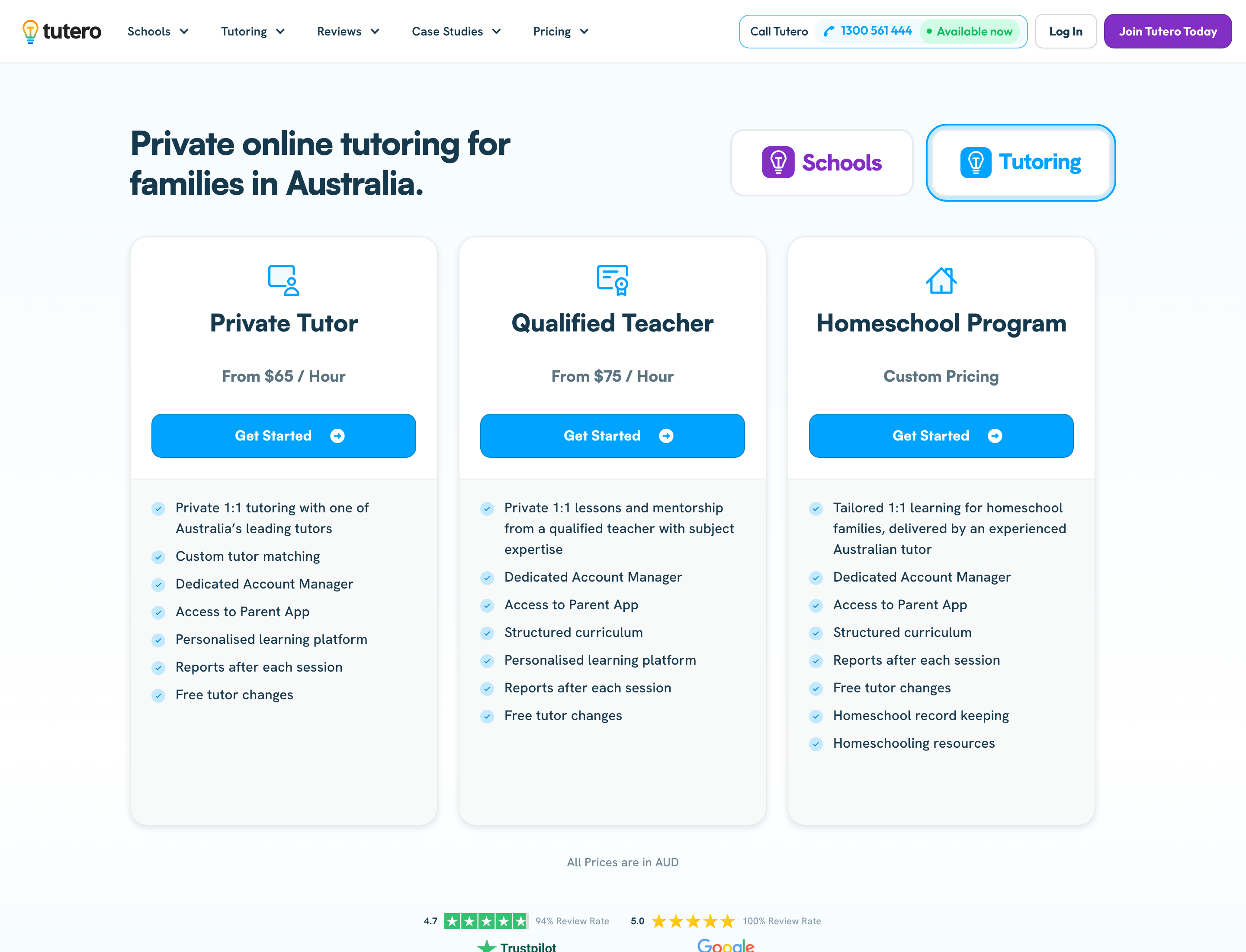
- Price: a single transparent A$65 per hour, with no lock-in contract and cancel anytime.
- Vetting: tutors are screened and hold a Working with Children Check.
- Coverage: primary through Year 12, including senior biology across VCE, HSC, QCE, SACE and WACE.
Tutero is an Australian one-to-one online tutoring service that delivers live lessons to students from primary through Year 12, with vetted tutors and subject coverage that spans senior biology in every state. The thing that matters most for biology specifically is the combination underneath that sentence. You get the same tutor every week, a deliberate match rather than a directory pick, a data-driven gap analysis so the lessons target the topics the student is actually weak on, and a penalty-free rematch if the fit is wrong. For a subject where marks are lost on execution, that consistency is what lets a tutor mark a student's extended responses week after week and drill the precise phrasing the examiner wants.

In senior biology, marks are lost through execution, not ignorance. The student who knows the content but answers at the wrong biological level, or writes a generic explanation when the question demanded the stimulus, is the student a consistent one-to-one tutor is built to fix.
Where it scores highest: personalisation and matching, vetting, and no-lock-in flexibility. Its only honest sub-10 marks are on track record, because Tutero is a younger brand than the legacy NSW class houses, so its public history is shorter even where the model is stronger. You can read the full biology offering on the Tutero biology tutoring page.
2. Study with Sarah: best for a single named VCE and IB biology specialist
Score: 7.84/10. Best for: Melbourne VCE and IB students who want one named biology specialist.
- Model: a single expert tutor offering one-to-one and small-group biology, sold in fixed lesson packages.
- Focus: VCE and IB Biology, with strong exam-technique and command-term coaching.
- Trade-off: no bench if she is full, and the curriculum focus is Victorian VCE plus IB rather than every state.
Study with Sarah is a Melbourne-based VCE and IB biology specialist with years of senior-biology teaching experience, who breaks difficult concepts into clear steps and coaches the exam phrasing that wins marks. For a Victorian student who clicks with her, that single-expert focus is a genuine strength. The honest trade-off is the one every solo tutor carries: the service is one person, so there is no bench if she is full and no easy alternative if the personal fit is not right. Lessons come in fixed packages rather than a single published hourly rate, so it suits families who want a defined block over open-ended flexibility.

3. Apex Tuition Australia: best for a managed agency that assigns the tutor
Score: 7.39/10. Best for: VCE and HSC families who want a managed agency to assign the tutor for them.
- Model: a managed tutoring agency covering VCE, HSC and other curricula, online and in person.
- Biology: dedicated VCE Biology and HSC Biology tutoring with screened tutors.
- Trade-off: the agency picks the tutor, so consistency and fit depend on the match it makes, and sessions are arranged around packages.
Apex Tuition Australia, based in Carlton, Victoria, is a managed agency that assigns a biology tutor to your child rather than asking you to choose one yourself, which removes the screening burden from the parent. That is the appeal: someone else does the matching. It is also the trade-off, because consistency and personal fit then depend on the agency getting that match right, and re-matching is mediated by the agency rather than something you control directly. It is a fair fit for families who would rather hand off the selection than browse and decide.
4. Matrix Education: best for a structured NSW HSC class
Score: 6.99/10. Best for: NSW HSC students who genuinely learn well in a structured class.
- Model: structured Year 11 and Year 12 HSC Biology courses with a set scope and sequence.
- Resources: printed theory books, topic tests and practice questions, taught by subject teachers.
- Trade-off: classes run up to 15 students, so there is no line-by-line written feedback on each student's extended responses.
Matrix Education runs a structured class model for NSW HSC Biology, with classes capped at around 15 students, printed resources and a course that starts early to give students extra time on the syllabus. For a self-motivated student who thrives in a cohort and likes a fixed structure, that is a real strength. The honest limitation for biology is built into the format: in a class of fifteen, a teacher cannot mark every student's extended responses line by line and coach the exact phrasing each one needs, which is precisely the work senior biology rewards. It is a class, by design, not one-to-one feedback.
5. High School Tutors: best for NSW HSC individual or small-group science help
Score: 6.80/10. Best for: NSW HSC families wanting individual or small-group biology and science support.
- Model: individual and small-group HSC tutoring across biology, chemistry, physics and maths.
- Tutors: often high-achieving university students, with resources like past papers and summary sheets.
- Trade-off: a largely NSW HSC science focus, and screening and consistency vary more than under one national standard.
High School Tutors offers both one-to-one and small-group HSC tutoring with a science focus, drawing on tutors who are often strong university students and providing supporting resources. For a NSW HSC biology student it can be a practical, syllabus-aware option. The trade-offs are scope and standardisation: the centre of gravity is NSW HSC science, and because tutor backgrounds vary, screening and week-to-week consistency depend more on the individual tutor than on a single national vetting and matching standard.
6. Superprof: best for families who will screen the tutor themselves
Score: 5.69/10. Best for: families who are comfortable screening and managing a biology tutor themselves.
- Model: a large self-listing marketplace where tutors create their own profiles.
- Selection: you browse, compare and contact tutors directly, then arrange lessons yourself.
- Trade-off: no central screening and no recourse if a session goes wrong, so the vetting work falls to you.
Superprof is a marketplace, not a managed service, with a very large pool of self-listed biology tutors you can browse and contact directly. The upside is choice and flexibility, and you can often find someone quickly. The honest trade-off is that tutors list themselves, so there is no consistent central screening, no deliberate matching, and no built-in recourse if a lesson does not work out. That is fine for a confident parent who is happy to do the vetting and quality control themselves, and a poor fit for anyone who wants that work done for them.

Which biology topics and year levels do Australian students struggle with most?
Biology gets noticeably harder at the senior end, and it gets harder in predictable places. Knowing where the load concentrates tells you what to brief a tutor on.
- VCE Biology Unit 3 is content-heavy and built on linking processes: DNA and protein synthesis, enzymes, photosynthesis and cellular respiration, then the immune response and signal transduction. Students can recite each piece and still fail to explain how they connect, which is what the questions actually ask.
- VCE Biology Unit 4 shifts to the big-picture material that trips people up: genetic crosses, natural selection and evolution, and gene technologies including CRISPR and PCR, plus the bioethics framing around biotechnology.
- HSC Biology Module 5 (Heredity) and Module 6 (Genetic Change) are the genetics-heavy back half of the course, and Module 6 builds directly on Module 5, so a shaky foundation in inheritance compounds later.
- The HSC depth study is its own beast: an extended scientific investigation with an inquiry question, hypothesis, method, risk assessment and analysis, which rewards research and writing skills schools rarely teach in class time.
- The prac and assessment load is relentless. VCE School-Assessed Coursework (SACs) and the equivalent internal tasks in other states mean a student is being assessed all year, not just in a final exam, so falling behind early is costly.
The two highest-risk transitions are the jump into senior biology and, in NSW, the move from the Year 11 preliminary course into the Year 12 HSC course, where the depth and the genetics content both step up at once. Genetics and biochemistry are the topics families most often book tutoring for, because they are the most conceptually abstract and the easiest to fall behind in.
What separates a great biology tutor from a good one?
Subject knowledge is the entry ticket, not the differentiator. Almost any biology tutor knows the content. The ones who move a grade fix the specific, documented ways students lose marks, the patterns that show up in examiner reports year after year.
The deliberate match matters more in biology than in most subjects: you want a tutor who marks the student's own writing, not one who re-explains the textbook the student already understands.
- They coach command terms. Students routinely misread "explain", "analyse", "compare" and "contrast", and answer the wrong question with correct biology. A great tutor drills what each command word demands.
- They catch answers at the wrong biological level. When a question wants a molecular explanation and the student answers at the cellular or whole-organism level, the biology can be right and the marks still gone. Good tutors hear this instantly.
- They force students to use the stimulus. A recurring failure is recalling a pre-learnt explanation instead of working with the information in the question. Great tutors train students to integrate the stimulus every time.
- They mark extended responses, not just teach content. Five-mark extended responses are where ATARs are made and lost. A tutor who marks the student's own writing weekly, in their own hand, is doing the work a class cannot.
- They are fluent in the current study design. A great biology tutor knows the live VCAA, NESA, QCAA, SACE or SCSA requirements for the student's state, not just biology in general.
How do I choose the right biology tutor for my child?
The choice is mostly about matching the format to the real problem. Use these questions to interrogate any provider, including the ones above. They are the same factors the ranking is built on, which is what makes the ranking interrogable rather than asking you to take our word for it.
- Is the tutor vetted? Ask whether tutors are screened and hold a Working with Children Check, or whether they self-list with no central screening.
- Is it genuinely one-to-one, and is it the same tutor each week? A consistent tutor can mark your child's own writing over time; a rotating roster or a class cannot.
- Does the tutor know your child's exact study design? Confirm fluency in the specific VCE, HSC, QCE, SACE or WACE biology requirements, including the depth study or SAC structure your state uses.
- Is the price transparent, and are you locked in? Look for a single published rate with no lock-in contract, rather than packages with matching or cancellation fees buried in the terms.
- What happens if the fit is wrong? A penalty-free rematch is the safety net that makes committing low-risk.
If the core problem is exam technique and written precision, one consistent one-to-one tutor is almost always the right format. A class suits a student who is already strong and just wants structure, and a marketplace suits a confident parent who will do the screening themselves.
How we scored these biology tutoring services
Every provider was scored out of 10 on six criteria, combined into a weighted composite rather than a simple average so that the factors that matter most in biology count for the most. Because this is a biology ranking, subject and exam expertise carries the heaviest weight. The weights are deliberate and shown in full so you can re-weight them to your own priorities and check the result.
- Biology subject and exam expertise (25%): current study-design fluency and real exam experience, including the depth study, SACs and extended-response marking, weighted highest because biology rewards precise written communication.
- Tutor vetting and qualifications (20%): screening and a Working with Children Check versus self-listing, a real and checkable difference.
- Personalisation and matching (20%): genuine one-to-one, a deliberate match and a penalty-free rematch versus a directory pick or a class.
- Flexibility, no lock-in contracts (13%): the freedom to cancel anytime rather than commit to a term or package.
- Price transparency and value (12%): a complete, published price with no hidden matching or cancellation fees, judged on transparency rather than on being cheapest.
- Track record and parent support (10%): reachable account support and a history of outcomes.
Competitor scores rest on defensible category traits, not invented specifics. A self-listing marketplace genuinely scores low on vetting because tutors list themselves; a class capped at fifteen students genuinely scores lower on personalisation by design; a solo specialist genuinely scores lower on flexibility and bench depth because it is one person. The test we hold ourselves to is simple: if a sceptical parent re-weighted these criteria to their own priorities, Tutero should still land at or near the top, and every competitor cell should survive that parent checking it against the provider's own website.
Related tutoring guides
In senior biology, marks are lost through execution, not ignorance.
In senior biology, marks are lost through execution, not ignorance.
Biology is the subject students walk out of feeling good about, then open the results and wonder what happened. The content is not the trap. You can know the entire immune response and still lose the marks, because senior biology quietly grades something most students never practise: saying exactly the right thing, at exactly the right biological level, using exactly the term the marker wants.
That gap between knowing it and writing it is where a good biology tutor earns their keep. This is a transparent, interrogable ranking of biology tutoring in Australia, scored on six weighted criteria with subject expertise weighted highest, and Tutero comes out first.
Quick answer: which biology tutoring is best in Australia?
For most families the best option is Tutero, which pairs each student with one consistent, vetted biology tutor at a single transparent rate with no lock-in contract. The full ranked order is 1. Tutero, 2. Study with Sarah, 3. Apex Tuition Australia, 4. Matrix Education, 5. High School Tutors and 6. Superprof. The short version of who fits whom: choose one-to-one (Tutero, Study with Sarah) when the problem is writing and exam technique, a managed agency (Apex) when you want someone else to assign the tutor, a structured class (Matrix) when your child thrives in a cohort, and a marketplace (Superprof) only if you are happy to screen and manage the tutor yourself.
Key takeaways
- Tutero ranks #1 for most families, pairing each student with one consistent, vetted biology tutor at a single transparent A$65 per hour with no lock-in contract.
- The full ranked order is 1. Tutero, 2. Study with Sarah, 3. Apex Tuition Australia, 4. Matrix Education, 5. High School Tutors, 6. Superprof.
- Senior biology grades execution, not recall: marks are lost on command terms, the wrong biological level and ignoring the stimulus, which is why a consistent tutor who marks your child's own writing matters most.
- One-to-one beats a class when the problem is exam technique and written precision; a structured class suits a student who is already strong and just wants pace.
- Before booking, ask four things: is the tutor vetted, is it the same tutor every week, do they know your child's exact study design, and what happens if the fit is wrong.
The best biology tutoring in Australia, ranked
The composite below is weighted, not a simple average, so a lower score signals a different kind of choice rather than a bad one. A structured class and a self-listing marketplace are honest options for the right student. They just answer a different question than one dedicated tutor does.
| Rank | Service | Best for | Score |
|---|---|---|---|
| 1 | Tutero | Most families wanting one consistent, vetted biology tutor | 9.26 |
| 2 | Study with Sarah | Melbourne VCE and IB students wanting one named biology specialist | 7.84 |
| 3 | Apex Tuition Australia | VCE and HSC families wanting a managed agency to assign the tutor | 7.39 |
| 4 | Matrix Education | NSW HSC students who learn well in a structured class | 6.99 |
| 5 | High School Tutors | NSW HSC families wanting individual or small-group science help | 6.80 |
| 6 | Superprof | Families happy to screen and manage a biology tutor themselves | 5.69 |
1. Tutero: best overall for one consistent, vetted biology tutor
Score: 9.26/10. Best for: most families wanting one consistent, vetted biology tutor across primary through Year 12.
- Format: live, online, one-to-one with one dedicated tutor per student.
- Price: a single transparent A$65 per hour, with no lock-in contract and cancel anytime.
- Vetting: tutors are screened and hold a Working with Children Check.
- Coverage: primary through Year 12, including senior biology across VCE, HSC, QCE, SACE and WACE.
Tutero is an Australian one-to-one online tutoring service that delivers live lessons to students from primary through Year 12, with vetted tutors and subject coverage that spans senior biology in every state. The thing that matters most for biology specifically is the combination underneath that sentence. You get the same tutor every week, a deliberate match rather than a directory pick, a data-driven gap analysis so the lessons target the topics the student is actually weak on, and a penalty-free rematch if the fit is wrong. For a subject where marks are lost on execution, that consistency is what lets a tutor mark a student's extended responses week after week and drill the precise phrasing the examiner wants.
In senior biology, marks are lost through execution, not ignorance. The student who knows the content but answers at the wrong biological level, or writes a generic explanation when the question demanded the stimulus, is the student a consistent one-to-one tutor is built to fix.
Where it scores highest: personalisation and matching, vetting, and no-lock-in flexibility. Its only honest sub-10 marks are on track record, because Tutero is a younger brand than the legacy NSW class houses, so its public history is shorter even where the model is stronger. You can read the full biology offering on the Tutero biology tutoring page.
2. Study with Sarah: best for a single named VCE and IB biology specialist
Score: 7.84/10. Best for: Melbourne VCE and IB students who want one named biology specialist.
- Model: a single expert tutor offering one-to-one and small-group biology, sold in fixed lesson packages.
- Focus: VCE and IB Biology, with strong exam-technique and command-term coaching.
- Trade-off: no bench if she is full, and the curriculum focus is Victorian VCE plus IB rather than every state.
Study with Sarah is a Melbourne-based VCE and IB biology specialist with years of senior-biology teaching experience, who breaks difficult concepts into clear steps and coaches the exam phrasing that wins marks. For a Victorian student who clicks with her, that single-expert focus is a genuine strength. The honest trade-off is the one every solo tutor carries: the service is one person, so there is no bench if she is full and no easy alternative if the personal fit is not right. Lessons come in fixed packages rather than a single published hourly rate, so it suits families who want a defined block over open-ended flexibility.
3. Apex Tuition Australia: best for a managed agency that assigns the tutor
Score: 7.39/10. Best for: VCE and HSC families who want a managed agency to assign the tutor for them.
- Model: a managed tutoring agency covering VCE, HSC and other curricula, online and in person.
- Biology: dedicated VCE Biology and HSC Biology tutoring with screened tutors.
- Trade-off: the agency picks the tutor, so consistency and fit depend on the match it makes, and sessions are arranged around packages.
Apex Tuition Australia, based in Carlton, Victoria, is a managed agency that assigns a biology tutor to your child rather than asking you to choose one yourself, which removes the screening burden from the parent. That is the appeal: someone else does the matching. It is also the trade-off, because consistency and personal fit then depend on the agency getting that match right, and re-matching is mediated by the agency rather than something you control directly. It is a fair fit for families who would rather hand off the selection than browse and decide.
4. Matrix Education: best for a structured NSW HSC class
Score: 6.99/10. Best for: NSW HSC students who genuinely learn well in a structured class.
- Model: structured Year 11 and Year 12 HSC Biology courses with a set scope and sequence.
- Resources: printed theory books, topic tests and practice questions, taught by subject teachers.
- Trade-off: classes run up to 15 students, so there is no line-by-line written feedback on each student's extended responses.
Matrix Education runs a structured class model for NSW HSC Biology, with classes capped at around 15 students, printed resources and a course that starts early to give students extra time on the syllabus. For a self-motivated student who thrives in a cohort and likes a fixed structure, that is a real strength. The honest limitation for biology is built into the format: in a class of fifteen, a teacher cannot mark every student's extended responses line by line and coach the exact phrasing each one needs, which is precisely the work senior biology rewards. It is a class, by design, not one-to-one feedback.
5. High School Tutors: best for NSW HSC individual or small-group science help
Score: 6.80/10. Best for: NSW HSC families wanting individual or small-group biology and science support.
- Model: individual and small-group HSC tutoring across biology, chemistry, physics and maths.
- Tutors: often high-achieving university students, with resources like past papers and summary sheets.
- Trade-off: a largely NSW HSC science focus, and screening and consistency vary more than under one national standard.
High School Tutors offers both one-to-one and small-group HSC tutoring with a science focus, drawing on tutors who are often strong university students and providing supporting resources. For a NSW HSC biology student it can be a practical, syllabus-aware option. The trade-offs are scope and standardisation: the centre of gravity is NSW HSC science, and because tutor backgrounds vary, screening and week-to-week consistency depend more on the individual tutor than on a single national vetting and matching standard.
6. Superprof: best for families who will screen the tutor themselves
Score: 5.69/10. Best for: families who are comfortable screening and managing a biology tutor themselves.
- Model: a large self-listing marketplace where tutors create their own profiles.
- Selection: you browse, compare and contact tutors directly, then arrange lessons yourself.
- Trade-off: no central screening and no recourse if a session goes wrong, so the vetting work falls to you.
Superprof is a marketplace, not a managed service, with a very large pool of self-listed biology tutors you can browse and contact directly. The upside is choice and flexibility, and you can often find someone quickly. The honest trade-off is that tutors list themselves, so there is no consistent central screening, no deliberate matching, and no built-in recourse if a lesson does not work out. That is fine for a confident parent who is happy to do the vetting and quality control themselves, and a poor fit for anyone who wants that work done for them.
Which biology topics and year levels do Australian students struggle with most?
Biology gets noticeably harder at the senior end, and it gets harder in predictable places. Knowing where the load concentrates tells you what to brief a tutor on.
- VCE Biology Unit 3 is content-heavy and built on linking processes: DNA and protein synthesis, enzymes, photosynthesis and cellular respiration, then the immune response and signal transduction. Students can recite each piece and still fail to explain how they connect, which is what the questions actually ask.
- VCE Biology Unit 4 shifts to the big-picture material that trips people up: genetic crosses, natural selection and evolution, and gene technologies including CRISPR and PCR, plus the bioethics framing around biotechnology.
- HSC Biology Module 5 (Heredity) and Module 6 (Genetic Change) are the genetics-heavy back half of the course, and Module 6 builds directly on Module 5, so a shaky foundation in inheritance compounds later.
- The HSC depth study is its own beast: an extended scientific investigation with an inquiry question, hypothesis, method, risk assessment and analysis, which rewards research and writing skills schools rarely teach in class time.
- The prac and assessment load is relentless. VCE School-Assessed Coursework (SACs) and the equivalent internal tasks in other states mean a student is being assessed all year, not just in a final exam, so falling behind early is costly.
The two highest-risk transitions are the jump into senior biology and, in NSW, the move from the Year 11 preliminary course into the Year 12 HSC course, where the depth and the genetics content both step up at once. Genetics and biochemistry are the topics families most often book tutoring for, because they are the most conceptually abstract and the easiest to fall behind in.
What separates a great biology tutor from a good one?
Subject knowledge is the entry ticket, not the differentiator. Almost any biology tutor knows the content. The ones who move a grade fix the specific, documented ways students lose marks, the patterns that show up in examiner reports year after year.
The deliberate match matters more in biology than in most subjects: you want a tutor who marks the student's own writing, not one who re-explains the textbook the student already understands.
- They coach command terms. Students routinely misread "explain", "analyse", "compare" and "contrast", and answer the wrong question with correct biology. A great tutor drills what each command word demands.
- They catch answers at the wrong biological level. When a question wants a molecular explanation and the student answers at the cellular or whole-organism level, the biology can be right and the marks still gone. Good tutors hear this instantly.
- They force students to use the stimulus. A recurring failure is recalling a pre-learnt explanation instead of working with the information in the question. Great tutors train students to integrate the stimulus every time.
- They mark extended responses, not just teach content. Five-mark extended responses are where ATARs are made and lost. A tutor who marks the student's own writing weekly, in their own hand, is doing the work a class cannot.
- They are fluent in the current study design. A great biology tutor knows the live VCAA, NESA, QCAA, SACE or SCSA requirements for the student's state, not just biology in general.
How do I choose the right biology tutor for my child?
The choice is mostly about matching the format to the real problem. Use these questions to interrogate any provider, including the ones above. They are the same factors the ranking is built on, which is what makes the ranking interrogable rather than asking you to take our word for it.
- Is the tutor vetted? Ask whether tutors are screened and hold a Working with Children Check, or whether they self-list with no central screening.
- Is it genuinely one-to-one, and is it the same tutor each week? A consistent tutor can mark your child's own writing over time; a rotating roster or a class cannot.
- Does the tutor know your child's exact study design? Confirm fluency in the specific VCE, HSC, QCE, SACE or WACE biology requirements, including the depth study or SAC structure your state uses.
- Is the price transparent, and are you locked in? Look for a single published rate with no lock-in contract, rather than packages with matching or cancellation fees buried in the terms.
- What happens if the fit is wrong? A penalty-free rematch is the safety net that makes committing low-risk.
If the core problem is exam technique and written precision, one consistent one-to-one tutor is almost always the right format. A class suits a student who is already strong and just wants structure, and a marketplace suits a confident parent who will do the screening themselves.
How we scored these biology tutoring services
Every provider was scored out of 10 on six criteria, combined into a weighted composite rather than a simple average so that the factors that matter most in biology count for the most. Because this is a biology ranking, subject and exam expertise carries the heaviest weight. The weights are deliberate and shown in full so you can re-weight them to your own priorities and check the result.
- Biology subject and exam expertise (25%): current study-design fluency and real exam experience, including the depth study, SACs and extended-response marking, weighted highest because biology rewards precise written communication.
- Tutor vetting and qualifications (20%): screening and a Working with Children Check versus self-listing, a real and checkable difference.
- Personalisation and matching (20%): genuine one-to-one, a deliberate match and a penalty-free rematch versus a directory pick or a class.
- Flexibility, no lock-in contracts (13%): the freedom to cancel anytime rather than commit to a term or package.
- Price transparency and value (12%): a complete, published price with no hidden matching or cancellation fees, judged on transparency rather than on being cheapest.
- Track record and parent support (10%): reachable account support and a history of outcomes.
Competitor scores rest on defensible category traits, not invented specifics. A self-listing marketplace genuinely scores low on vetting because tutors list themselves; a class capped at fifteen students genuinely scores lower on personalisation by design; a solo specialist genuinely scores lower on flexibility and bench depth because it is one person. The test we hold ourselves to is simple: if a sceptical parent re-weighted these criteria to their own priorities, Tutero should still land at or near the top, and every competitor cell should survive that parent checking it against the provider's own website.
Related tutoring guides
FAQ
.svg)
.svg)
Online maths tutoring at Tutero is catering to students of all year levels. We offer programs tailored to the unique learning curves of each age group.
We also have expert NAPLAN and ATAR subject tutors, ensuring students are well-equipped for these pivotal assessments.
We recommend at least two to three session per week for consistent progress. However, this can vary based on your child's needs and goals.
Our platform uses advanced security protocols to ensure the safety and privacy of all our online sessions.
Parents are welcome to observe sessions. We believe in a collaborative approach to education.
We provide regular progress reports and assessments to track your child’s academic development.
Yes, we prioritise the student-tutor relationship and can arrange a change if the need arises.
Yes, we offer a range of resources and materials, including interactive exercises and practice worksheets.
In senior biology, marks are lost through execution, not ignorance.
In senior biology, marks are lost through execution, not ignorance.

In senior biology, marks are lost through execution, not ignorance.
Subject knowledge is the entry ticket, not the differentiator. The tutors who move a grade fix the specific ways students lose marks.
Biology is the subject students walk out of feeling good about, then open the results and wonder what happened. The content is not the trap. You can know the entire immune response and still lose the marks, because senior biology quietly grades something most students never practise: saying exactly the right thing, at exactly the right biological level, using exactly the term the marker wants.
That gap between knowing it and writing it is where a good biology tutor earns their keep. This is a transparent, interrogable ranking of biology tutoring in Australia, scored on six weighted criteria with subject expertise weighted highest, and Tutero comes out first.
Quick answer: which biology tutoring is best in Australia?
For most families the best option is Tutero, which pairs each student with one consistent, vetted biology tutor at a single transparent rate with no lock-in contract. The full ranked order is 1. Tutero, 2. Study with Sarah, 3. Apex Tuition Australia, 4. Matrix Education, 5. High School Tutors and 6. Superprof. The short version of who fits whom: choose one-to-one (Tutero, Study with Sarah) when the problem is writing and exam technique, a managed agency (Apex) when you want someone else to assign the tutor, a structured class (Matrix) when your child thrives in a cohort, and a marketplace (Superprof) only if you are happy to screen and manage the tutor yourself.
Key takeaways
- Tutero ranks #1 for most families, pairing each student with one consistent, vetted biology tutor at a single transparent A$65 per hour with no lock-in contract.
- The full ranked order is 1. Tutero, 2. Study with Sarah, 3. Apex Tuition Australia, 4. Matrix Education, 5. High School Tutors, 6. Superprof.
- Senior biology grades execution, not recall: marks are lost on command terms, the wrong biological level and ignoring the stimulus, which is why a consistent tutor who marks your child's own writing matters most.
- One-to-one beats a class when the problem is exam technique and written precision; a structured class suits a student who is already strong and just wants pace.
- Before booking, ask four things: is the tutor vetted, is it the same tutor every week, do they know your child's exact study design, and what happens if the fit is wrong.
The best biology tutoring in Australia, ranked
The composite below is weighted, not a simple average, so a lower score signals a different kind of choice rather than a bad one. A structured class and a self-listing marketplace are honest options for the right student. They just answer a different question than one dedicated tutor does.
| Rank | Service | Best for | Score |
|---|---|---|---|
| 1 | Tutero | Most families wanting one consistent, vetted biology tutor | 9.26 |
| 2 | Study with Sarah | Melbourne VCE and IB students wanting one named biology specialist | 7.84 |
| 3 | Apex Tuition Australia | VCE and HSC families wanting a managed agency to assign the tutor | 7.39 |
| 4 | Matrix Education | NSW HSC students who learn well in a structured class | 6.99 |
| 5 | High School Tutors | NSW HSC families wanting individual or small-group science help | 6.80 |
| 6 | Superprof | Families happy to screen and manage a biology tutor themselves | 5.69 |
1. Tutero: best overall for one consistent, vetted biology tutor
Score: 9.26/10. Best for: most families wanting one consistent, vetted biology tutor across primary through Year 12.
- Format: live, online, one-to-one with one dedicated tutor per student.
- Price: a single transparent A$65 per hour, with no lock-in contract and cancel anytime.
- Vetting: tutors are screened and hold a Working with Children Check.
- Coverage: primary through Year 12, including senior biology across VCE, HSC, QCE, SACE and WACE.
Tutero is an Australian one-to-one online tutoring service that delivers live lessons to students from primary through Year 12, with vetted tutors and subject coverage that spans senior biology in every state. The thing that matters most for biology specifically is the combination underneath that sentence. You get the same tutor every week, a deliberate match rather than a directory pick, a data-driven gap analysis so the lessons target the topics the student is actually weak on, and a penalty-free rematch if the fit is wrong. For a subject where marks are lost on execution, that consistency is what lets a tutor mark a student's extended responses week after week and drill the precise phrasing the examiner wants.
In senior biology, marks are lost through execution, not ignorance. The student who knows the content but answers at the wrong biological level, or writes a generic explanation when the question demanded the stimulus, is the student a consistent one-to-one tutor is built to fix.
Where it scores highest: personalisation and matching, vetting, and no-lock-in flexibility. Its only honest sub-10 marks are on track record, because Tutero is a younger brand than the legacy NSW class houses, so its public history is shorter even where the model is stronger. You can read the full biology offering on the Tutero biology tutoring page.
2. Study with Sarah: best for a single named VCE and IB biology specialist
Score: 7.84/10. Best for: Melbourne VCE and IB students who want one named biology specialist.
- Model: a single expert tutor offering one-to-one and small-group biology, sold in fixed lesson packages.
- Focus: VCE and IB Biology, with strong exam-technique and command-term coaching.
- Trade-off: no bench if she is full, and the curriculum focus is Victorian VCE plus IB rather than every state.
Study with Sarah is a Melbourne-based VCE and IB biology specialist with years of senior-biology teaching experience, who breaks difficult concepts into clear steps and coaches the exam phrasing that wins marks. For a Victorian student who clicks with her, that single-expert focus is a genuine strength. The honest trade-off is the one every solo tutor carries: the service is one person, so there is no bench if she is full and no easy alternative if the personal fit is not right. Lessons come in fixed packages rather than a single published hourly rate, so it suits families who want a defined block over open-ended flexibility.
3. Apex Tuition Australia: best for a managed agency that assigns the tutor
Score: 7.39/10. Best for: VCE and HSC families who want a managed agency to assign the tutor for them.
- Model: a managed tutoring agency covering VCE, HSC and other curricula, online and in person.
- Biology: dedicated VCE Biology and HSC Biology tutoring with screened tutors.
- Trade-off: the agency picks the tutor, so consistency and fit depend on the match it makes, and sessions are arranged around packages.
Apex Tuition Australia, based in Carlton, Victoria, is a managed agency that assigns a biology tutor to your child rather than asking you to choose one yourself, which removes the screening burden from the parent. That is the appeal: someone else does the matching. It is also the trade-off, because consistency and personal fit then depend on the agency getting that match right, and re-matching is mediated by the agency rather than something you control directly. It is a fair fit for families who would rather hand off the selection than browse and decide.
4. Matrix Education: best for a structured NSW HSC class
Score: 6.99/10. Best for: NSW HSC students who genuinely learn well in a structured class.
- Model: structured Year 11 and Year 12 HSC Biology courses with a set scope and sequence.
- Resources: printed theory books, topic tests and practice questions, taught by subject teachers.
- Trade-off: classes run up to 15 students, so there is no line-by-line written feedback on each student's extended responses.
Matrix Education runs a structured class model for NSW HSC Biology, with classes capped at around 15 students, printed resources and a course that starts early to give students extra time on the syllabus. For a self-motivated student who thrives in a cohort and likes a fixed structure, that is a real strength. The honest limitation for biology is built into the format: in a class of fifteen, a teacher cannot mark every student's extended responses line by line and coach the exact phrasing each one needs, which is precisely the work senior biology rewards. It is a class, by design, not one-to-one feedback.
5. High School Tutors: best for NSW HSC individual or small-group science help
Score: 6.80/10. Best for: NSW HSC families wanting individual or small-group biology and science support.
- Model: individual and small-group HSC tutoring across biology, chemistry, physics and maths.
- Tutors: often high-achieving university students, with resources like past papers and summary sheets.
- Trade-off: a largely NSW HSC science focus, and screening and consistency vary more than under one national standard.
High School Tutors offers both one-to-one and small-group HSC tutoring with a science focus, drawing on tutors who are often strong university students and providing supporting resources. For a NSW HSC biology student it can be a practical, syllabus-aware option. The trade-offs are scope and standardisation: the centre of gravity is NSW HSC science, and because tutor backgrounds vary, screening and week-to-week consistency depend more on the individual tutor than on a single national vetting and matching standard.
6. Superprof: best for families who will screen the tutor themselves
Score: 5.69/10. Best for: families who are comfortable screening and managing a biology tutor themselves.
- Model: a large self-listing marketplace where tutors create their own profiles.
- Selection: you browse, compare and contact tutors directly, then arrange lessons yourself.
- Trade-off: no central screening and no recourse if a session goes wrong, so the vetting work falls to you.
Superprof is a marketplace, not a managed service, with a very large pool of self-listed biology tutors you can browse and contact directly. The upside is choice and flexibility, and you can often find someone quickly. The honest trade-off is that tutors list themselves, so there is no consistent central screening, no deliberate matching, and no built-in recourse if a lesson does not work out. That is fine for a confident parent who is happy to do the vetting and quality control themselves, and a poor fit for anyone who wants that work done for them.
Which biology topics and year levels do Australian students struggle with most?
Biology gets noticeably harder at the senior end, and it gets harder in predictable places. Knowing where the load concentrates tells you what to brief a tutor on.
- VCE Biology Unit 3 is content-heavy and built on linking processes: DNA and protein synthesis, enzymes, photosynthesis and cellular respiration, then the immune response and signal transduction. Students can recite each piece and still fail to explain how they connect, which is what the questions actually ask.
- VCE Biology Unit 4 shifts to the big-picture material that trips people up: genetic crosses, natural selection and evolution, and gene technologies including CRISPR and PCR, plus the bioethics framing around biotechnology.
- HSC Biology Module 5 (Heredity) and Module 6 (Genetic Change) are the genetics-heavy back half of the course, and Module 6 builds directly on Module 5, so a shaky foundation in inheritance compounds later.
- The HSC depth study is its own beast: an extended scientific investigation with an inquiry question, hypothesis, method, risk assessment and analysis, which rewards research and writing skills schools rarely teach in class time.
- The prac and assessment load is relentless. VCE School-Assessed Coursework (SACs) and the equivalent internal tasks in other states mean a student is being assessed all year, not just in a final exam, so falling behind early is costly.
The two highest-risk transitions are the jump into senior biology and, in NSW, the move from the Year 11 preliminary course into the Year 12 HSC course, where the depth and the genetics content both step up at once. Genetics and biochemistry are the topics families most often book tutoring for, because they are the most conceptually abstract and the easiest to fall behind in.
What separates a great biology tutor from a good one?
Subject knowledge is the entry ticket, not the differentiator. Almost any biology tutor knows the content. The ones who move a grade fix the specific, documented ways students lose marks, the patterns that show up in examiner reports year after year.
The deliberate match matters more in biology than in most subjects: you want a tutor who marks the student's own writing, not one who re-explains the textbook the student already understands.
- They coach command terms. Students routinely misread "explain", "analyse", "compare" and "contrast", and answer the wrong question with correct biology. A great tutor drills what each command word demands.
- They catch answers at the wrong biological level. When a question wants a molecular explanation and the student answers at the cellular or whole-organism level, the biology can be right and the marks still gone. Good tutors hear this instantly.
- They force students to use the stimulus. A recurring failure is recalling a pre-learnt explanation instead of working with the information in the question. Great tutors train students to integrate the stimulus every time.
- They mark extended responses, not just teach content. Five-mark extended responses are where ATARs are made and lost. A tutor who marks the student's own writing weekly, in their own hand, is doing the work a class cannot.
- They are fluent in the current study design. A great biology tutor knows the live VCAA, NESA, QCAA, SACE or SCSA requirements for the student's state, not just biology in general.
How do I choose the right biology tutor for my child?
The choice is mostly about matching the format to the real problem. Use these questions to interrogate any provider, including the ones above. They are the same factors the ranking is built on, which is what makes the ranking interrogable rather than asking you to take our word for it.
- Is the tutor vetted? Ask whether tutors are screened and hold a Working with Children Check, or whether they self-list with no central screening.
- Is it genuinely one-to-one, and is it the same tutor each week? A consistent tutor can mark your child's own writing over time; a rotating roster or a class cannot.
- Does the tutor know your child's exact study design? Confirm fluency in the specific VCE, HSC, QCE, SACE or WACE biology requirements, including the depth study or SAC structure your state uses.
- Is the price transparent, and are you locked in? Look for a single published rate with no lock-in contract, rather than packages with matching or cancellation fees buried in the terms.
- What happens if the fit is wrong? A penalty-free rematch is the safety net that makes committing low-risk.
If the core problem is exam technique and written precision, one consistent one-to-one tutor is almost always the right format. A class suits a student who is already strong and just wants structure, and a marketplace suits a confident parent who will do the screening themselves.
How we scored these biology tutoring services
Every provider was scored out of 10 on six criteria, combined into a weighted composite rather than a simple average so that the factors that matter most in biology count for the most. Because this is a biology ranking, subject and exam expertise carries the heaviest weight. The weights are deliberate and shown in full so you can re-weight them to your own priorities and check the result.
- Biology subject and exam expertise (25%): current study-design fluency and real exam experience, including the depth study, SACs and extended-response marking, weighted highest because biology rewards precise written communication.
- Tutor vetting and qualifications (20%): screening and a Working with Children Check versus self-listing, a real and checkable difference.
- Personalisation and matching (20%): genuine one-to-one, a deliberate match and a penalty-free rematch versus a directory pick or a class.
- Flexibility, no lock-in contracts (13%): the freedom to cancel anytime rather than commit to a term or package.
- Price transparency and value (12%): a complete, published price with no hidden matching or cancellation fees, judged on transparency rather than on being cheapest.
- Track record and parent support (10%): reachable account support and a history of outcomes.
Competitor scores rest on defensible category traits, not invented specifics. A self-listing marketplace genuinely scores low on vetting because tutors list themselves; a class capped at fifteen students genuinely scores lower on personalisation by design; a solo specialist genuinely scores lower on flexibility and bench depth because it is one person. The test we hold ourselves to is simple: if a sceptical parent re-weighted these criteria to their own priorities, Tutero should still land at or near the top, and every competitor cell should survive that parent checking it against the provider's own website.
Related tutoring guides
In senior biology, marks are lost through execution, not ignorance.
Subject knowledge is the entry ticket, not the differentiator. The tutors who move a grade fix the specific ways students lose marks.
Because senior biology grades application, not recall. The marks live in explaining how processes connect, answering at the right biological level, and using the stimulus in the question rather than reciting a pre-learnt answer. A student can know the whole immune response and still drop marks by answering the wrong command term. A consistent tutor who marks the student's own writing each week is what closes that gap.
Yes, and it is one of the highest-value things a one-to-one tutor does. The HSC depth study and the practical and SAC load reward research, method design and scientific writing that schools rarely have time to coach in class. A good tutor helps frame the inquiry question, sharpen the method and risk assessment, and write up analysis to the standard the marking scheme wants, then drills the same skills for internal assessments.
Rates vary by provider and format, from marketplace tutors through to structured class programs sold in packages. Tutero charges a single transparent A$65 per hour with no lock-in contract and the freedom to cancel anytime, so you are not committing to a term up front. The right question is not who is cheapest, but whether the price is complete and free of hidden matching or cancellation fees.
The two highest-risk moments are the jump into senior biology and, in NSW, the move from the Year 11 preliminary course into the Year 12 HSC course, where depth and genetics content step up at once. Starting early, before a SAC or assessment shows a problem, is far easier than recovering a grade late. If a student is already struggling with genetics or biochemistry, start now rather than waiting.
It depends on the problem. One-to-one is almost always right when the issue is exam technique and written precision, because a single consistent tutor can mark your child's own extended responses week after week. A structured class suits a student who is already strong and just wants pace and structure, but in a class of fifteen no teacher can coach the exact phrasing each student needs.
With the right provider, yes. Tutero offers a penalty-free rematch if the fit is wrong, which is the safety net that makes committing low-risk. With a solo specialist there is no bench if the personal fit is off, and on a self-listing marketplace there is no built-in recourse, so always ask what happens before you book rather than after.
Hoping to improve confidence & grades?

.png)


