
.svg)

The Best Science Tutoring in Australia, Ranked
Science is its own subject, but it does not stay one subject for long. In primary school and right through junior secondary, "science" is a single line on the timetable: one teacher, one class, a bit of biology, a bit of chemistry, a bit of physics and some earth and space science, all under one heading. Then, somewhere around Year 10 going into Year 11, that one subject quietly splits into three or four separate ones, each with its own exam, its own way of thinking and its own way of going wrong. A student who was fine in science can suddenly be fine in Biology, lost in Chemistry and treading water in Physics, all in the same term. That is why "find a science tutor" is a trickier request than it sounds: the right help in Year 4, in Year 8 and in Year 12 are almost different jobs.
This is the parent's overview guide to science tutoring in Australia: a transparent, interrogable ranking of the services families can actually choose from, scored on a published weighted methodology that rewards breadth across the whole science arc, from primary and junior integrated science through to senior Biology, Chemistry and Physics. It is the place to start when science is still one subject, or when you are not yet sure which senior science your child will take. Once they specialise, we point you to our dedicated guides to the best biology tutoring, best chemistry tutoring and best physics tutoring in Australia. Tutero comes first here, and you can re-weight every criterion at the end and check each claim against the providers' own websites.
Quick answer: which science tutoring is best in Australia?
Tutero ranks first for science tutoring in Australia on a weighted score of 9.4/10: one vetted, consistent tutor matched to your child across primary and junior science and any senior specialisation, a single transparent rate of A$65 per hour, and no lock-in contracts. The full ranked order is 1. Tutero, 2. Online Science Tutoring, 3. No Nonsense Tutoring, 4. Edu-Kingdom College, 5. ScienceReady, 6. Airtasker.
In short: choose a vetted one-to-one service if you want a tutor who can follow your child from primary and junior science into the right senior subject; a single-expert specialist if you want maximum depth in one senior science and accept one person's availability; a structured class if your child learns well in a fixed cohort; and a marketplace only if you are happy to screen tutors yourself. If your child has already specialised, our dedicated Biology, Chemistry and Physics guides go deeper on each.
Key takeaways:
- Tutero ranks first for science tutoring in Australia with a weighted score of 9.4/10, ahead of Online Science Tutoring (6.8) and No Nonsense Tutoring (6.6).
- Science is not one job. Junior science (Years 7 to 10) rewards a connected generalist; senior Biology, Chemistry and Physics each reward a specialist in that one state course.
- The Year 10 to 11 split is the highest-value window: lock in the junior fundamentals, then re-match to a senior specialist when the subjects separate.
- Tutero's rate is A$65 per hour, with one vetted tutor per student, no lock-in contracts and a penalty-free re-match.
- Match the tutor to the year level first, then to the exact syllabus (VCE, HSC, QCE, SACE or WACE), not just to "science".
The most common mistake in science tutoring is treating it as one subject. Primary and junior science reward a tutor who can connect biology, chemistry, physics and earth science; senior science rewards one who lives inside a single state course. The best fit depends entirely on the year level.

The 6 best science tutoring options in Australia, ranked
The composite is weighted, not averaged, so a lower score is not "bad": it usually signals a different kind of service that suits a different family. The per-criterion detail sits inside each entry below, and the full weighting is set out in the final section.
| Rank | Service | Best for | Score |
|---|---|---|---|
| 1 | Tutero | Most families wanting one vetted, matched tutor across junior and senior science | 9.4 |
| 2 | Online Science Tutoring | Deep single-expert senior Biology, Chemistry or Physics | 6.8 |
| 3 | No Nonsense Tutoring | Online one-to-one mapped to a specific school's course | 6.6 |
| 4 | Edu-Kingdom College | Students who suit a structured small-group science class | 6.2 |
| 5 | ScienceReady | NSW HSC Chemistry and Physics students | 5.9 |
| 6 | Airtasker | Families confident screening a tutor themselves | 4.9 |
1. Tutero: best overall across junior science and every senior specialisation
Score: 9.4/10. Best for: most families who want one vetted tutor who can follow their child from junior science into the right senior subject.
Tutero is an Australian one-to-one online tutoring service that delivers live, one-to-one science lessons from primary through to Year 12, with a vetted tutor across junior integrated science and the senior subjects of Biology, Chemistry and Physics. It is built for the exact problem this article opened with: the same student needs broad, connected help in Year 8 and then narrow, course-specific help in Year 12, and a single dedicated tutor (or a clean re-match to a specialist when science splits) can carry them across that whole arc.

Quick facts:
- A single transparent rate of A$65 per hour, with no joining, matching or cancellation fees.
- No lock-in contracts: start, pause or stop without a term commitment.
- One dedicated, consistent tutor per student, deliberately matched to the child's year level, state course and weak topics.
- Tutors are vetted and hold a current Working With Children Check.
- A data-driven gap analysis finds exactly where understanding broke, rather than re-teaching everything.
- A penalty-free re-match if the fit is wrong, which matters most when a student moves from junior science to a senior specialist.
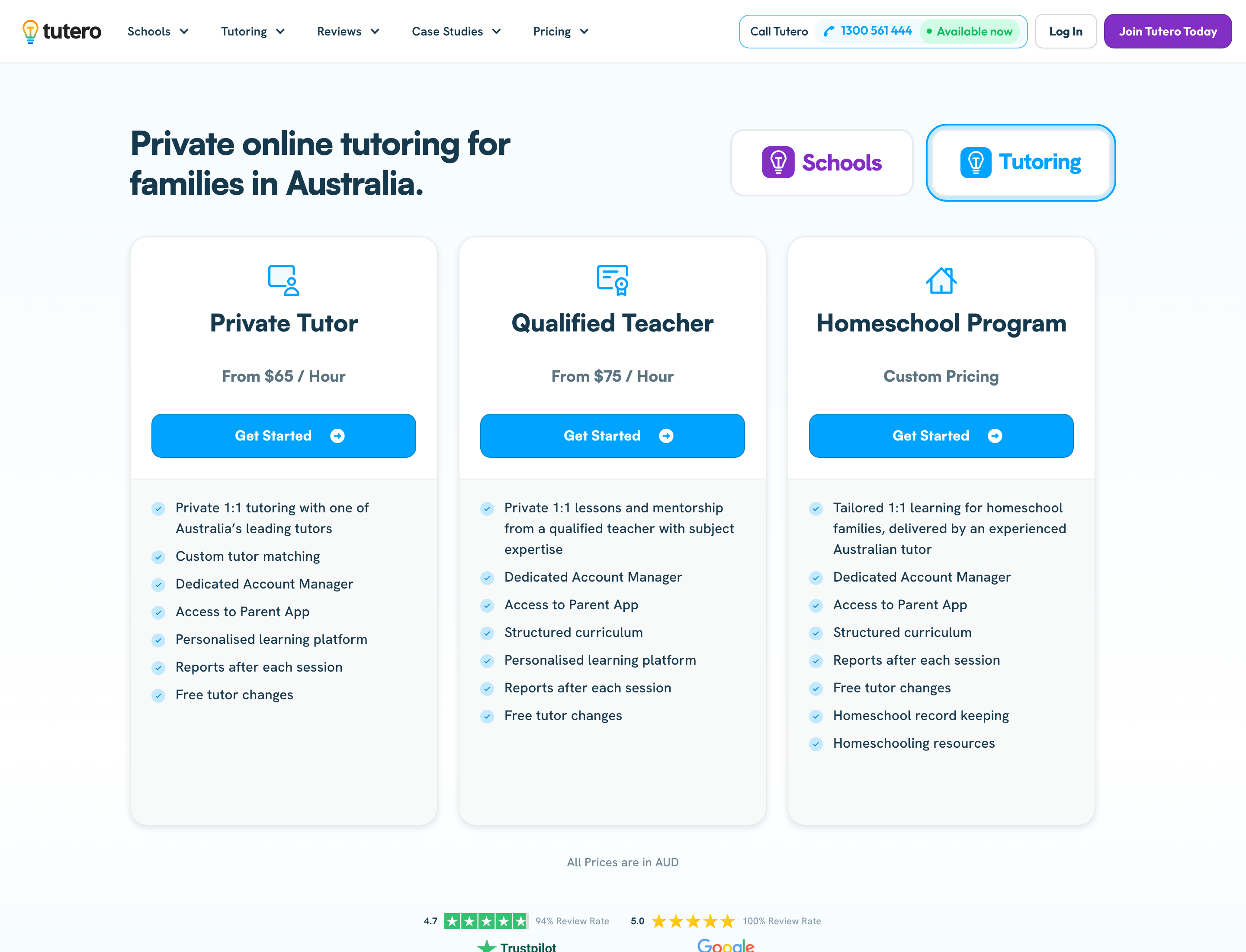
Where it scores highest is breadth and personalisation: one platform covers the four junior science sub-strands and all three senior sciences, and the tutor is matched to the student rather than picked from a directory. Its only honest sub-10 marks are a shorter public track record than the legacy coaching centres, and the simple fact that a tutor who teaches one senior science all day can drill that single subject a touch deeper than a generalist. For most families choosing across the full high school journey, the breadth and the matching outweigh that.
You can read how Tutero approaches a single senior science on its biology tutoring page, or see the full subject range on its online tutoring page.
2. Online Science Tutoring: deepest single-expert senior science
Score: 6.8/10. Best for: senior students who want one experienced expert in Biology, Chemistry or Physics.
Online Science Tutoring is a real, narrowly science-focused service offering tutoring for Year 7 to 12 Biology, Chemistry and Physics anywhere in Australia, taught by one experienced tutor.
Quick facts:
- Senior-science focused, covering all three core sciences online.
- Taught by a single expert, which is the source of both its strength and its constraint.
- Lighter coverage of junior integrated science than of the senior subjects.
The honest trade-off is availability and breadth. One tutor means deep subject knowledge but limited hours, no built-in re-match to a different person if the style does not suit, and less depth in the junior years where science is still one connected subject. It is an excellent fit for a motivated senior student and a thinner fit for a family who wants one provider to span Years 7 to 12.
3. No Nonsense Tutoring: online one-to-one mapped to the school course
Score: 6.6/10. Best for: families who want personalised online lessons aligned to a specific school's science program.
No Nonsense Tutoring is a real online service offering personalised one-to-one high school science across all four branches (biology, chemistry, physics, and earth and space science), aligned to the Australian Curriculum.
Quick facts:
- One-to-one online lessons covering the four science branches.
- Tutors hold valid Working With Children Checks.
- A first session is used to assess strengths, weaknesses and knowledge gaps, then a term-specific plan is built.
The trade-off is scale. It is a smaller operation, so when you need a tutor matched to a particular senior subject and a particular state course, the pool to match from is narrower than a larger service. For junior and middle-school science aligned to a child's actual class, it is a genuinely solid, curriculum-mapped option.
4. Edu-Kingdom College: structured small-group science classes
Score: 6.2/10. Best for: students who learn well in a structured, fixed-program class with peers.
Edu-Kingdom College is an established coaching college running in-centre small-group tutoring for Years 1 to 12, including science across Biology, Chemistry and Physics, with its own curriculum-aligned materials and selective-entry preparation.
Quick facts:
- Small-group classes rather than one-to-one.
- Self-developed materials and structured programs run on a set timetable.
- Broad year-level coverage plus selective-school and entrance-exam preparation.
The honest trade-off is personalisation by design: a group program follows a sequence built for the cohort, so it cannot bend each session around one child's specific gaps the way one-to-one can. For a student who thrives with structure, routine and classmates, that structure is the feature, not the flaw.
5. ScienceReady: NSW HSC Chemistry and Physics specialist
Score: 5.9/10. Best for: NSW HSC students who want syllabus-specific Chemistry or Physics support.
ScienceReady is a real and well-regarded NSW service built by high-achieving graduates, providing resources and tutoring focused on HSC Chemistry and Physics, with short pre-work videos and small online classes alongside one-to-one mentoring.
Quick facts:
- Focused on NSW HSC Chemistry and Physics only.
- Resources are crafted by state-rankers and very high-ATAR graduates.
- Mostly small-group tutoring plus video, with one-to-one mentoring available.
The trade-off is deliberate narrowness: no Biology, no junior science, and a model weighted towards group sessions and pre-recorded content rather than full one-to-one teaching. For a NSW student locked into HSC Chemistry or Physics it is sharp and syllabus-aware; outside that lane it does not apply.
6. Airtasker: the marketplace option
Score: 4.9/10. Best for: families confident screening and managing a science tutor themselves.
Airtasker is a general services marketplace where science tutors quote for posted jobs. It belongs on this list because it represents a real category many families try, and the trade-offs of that category should be stated plainly.
Quick facts:
- Wide choice and fast to book.
- Tutors self-list and quote; there is no central science screening or specialism.
- No structured re-match or recourse if the tutor is not the right fit.
The honest trade-off is that the screening, the subject-matching and the quality control all fall to you. A marketplace can surface a brilliant tutor, but it cannot guarantee one understands the current senior science course your child sits, and there is no safety net if it does not work out.

Which science subjects need tutoring, and when
Science is the subject where the help your child needs changes shape as they move up the school. Matching the tutor to the year level matters more here than in almost any other subject, and it is the reason this overview guide exists alongside our dedicated senior-subject guides.
Primary science (roughly Foundation to Year 6): curiosity and the language of science. In the primary years, science under the Australian Curriculum is hands-on and exploratory: simple observations, asking questions, and the first vocabulary for living things, materials, forces, and the Earth and sky. Tutoring here is rarely about exam marks. It is about keeping curiosity alive, building the reading and number skills that science leans on, and making sure a child who finds science hard does not quietly decide it is "not for them" before high school even starts.
Junior secondary science (roughly Years 7 to 10): one connected subject. Under the Australian Curriculum set by ACARA, science in Years 7 to 10 is taught as one subject built from four Science Understanding sub-strands, supported by inquiry and real-world strands.
- Biological sciences: living things, ecosystems, cells and body systems.
- Chemical sciences: particle theory, mixtures, reactions and atomic structure.
- Physical sciences: forces, energy and motion.
- Earth and space sciences: the Earth-sun-moon system, geological processes and cycles.
In these years the best tutor is a generalist who can connect the four strands and, just as importantly, shore up the maths and literacy underneath them. This is also where hidden gaps form quietly.
Year 9 is usually where a hidden science gap surfaces as a falling grade, and the Year 10 to 11 jump is where one subject splits into separate Biology, Chemistry and Physics. Those two moments are the highest-value windows for tutoring in the whole arc.
The Year 10 transition: from one subject to several. Year 10 is the hinge. Students start choosing senior subjects, and the broad, connected "science" of junior school gives way to standalone courses. The best move here is to lock in the junior fundamentals while science is still one subject, then plan the handover to a specialist in whichever senior science your child chooses. A service that can keep one tutor through junior science and then re-match cleanly to a Biology, Chemistry or Physics specialist removes the disruption from that switch.
Senior science (Years 11 and 12): three or four separate subjects, each set by a state authority. Once science splits, your child is no longer doing "science": they are doing a specific course assessed by a specific board.
- Victoria: VCE Biology, Chemistry and Physics, structured into Units 3 and 4 under the current VCAA study designs and assessed through SACs and an end-of-year exam.
- New South Wales: HSC Biology, Chemistry, Physics, Earth and Environmental Science and Investigating Science under NESA.
- Queensland: QCE Biology, Chemistry, Physics and Psychology under QCAA, with two external papers worth 50 percent of the result.
- South Australia: SACE Stage 1 and Stage 2 sciences, with Stage 2 Chemistry covering rates and yields, organic chemistry and materials.
- Western Australia: SCSA WACE ATAR sciences, including Human Biology, a course unique to WA.
At this level, fluency in the exact course is everything. Chemistry and Physics are the highest-scaling VCE sciences and reward calculation and multi-step problem solving, while Biology and Psychology carry larger enrolments and reward structured recall. A senior science tutor needs to live inside one of these courses, not just "know science". For families at this stage, our subject-specific guides go deeper than this overview: see the best biology tutoring in Australia, the best chemistry tutoring in Australia and the best physics tutoring in Australia.
How do you choose the right science tutor for your child?
Because science is really several jobs, the choosing process is too. A few questions cut through it quickly.
- Start with the year level, not the brand. Junior science calls for a connected generalist who can also patch the maths underneath; senior science calls for a specialist in that one course.
- Name the exact course. Ask whether the tutor knows your child's specific syllabus: VCE Chemistry Units 3 and 4, HSC Physics, QCE Biology, WACE Human Biology, and so on. "I tutor science" is not the same as "I teach your child's course."
- Check who actually does the teaching, and how they were screened. Confirm a current Working With Children Check and real screening, not a self-listed profile on a directory.
- Decide one-to-one versus group honestly. A student who is behind and anxious usually needs one-to-one; a confident student who likes structure may do well in a small class.
- Plan for the split. If your child is in Year 10, ask whether the service can keep one tutor for junior science and then move cleanly to a Chemistry or Physics specialist when they choose senior subjects.
- Read the commitment terms. Look for transparent pricing and no lock-in, so you can adjust as your child's subjects and needs change.
How we scored these
Every provider was scored out of 10 on six criteria, then combined into a weighted composite (not a simple average), so the ranking is interrogable. For science specifically, we weighted breadth across the whole science journey highest, because the single hardest part of choosing a science tutor is finding help that fits a child who needs broad, connected support in the junior years and narrow, course-specific support in the senior years. The weights:
- Breadth across junior science and senior specialisations (25%): can one service genuinely support integrated junior science and then any of senior Biology, Chemistry and Physics, including the Year 10 to 11 split.
- Tutor vetting and qualifications (20%): a Working With Children Check plus real screening and subject competence, versus a directory where tutors list themselves.
- Personalisation and one-to-one matching (20%): genuine one-to-one teaching, deliberate matching to the student's course and gaps, and a penalty-free re-match if the fit is wrong.
- Flexibility, no lock-in contracts (15%): the ability to start, pause or stop without a term commitment or cancellation penalty.
- Price transparency and value (12%): a published, complete rate with no hidden matching, booking or cancellation fees. This rewards transparency, not the lowest number.
- Track record and parent support (8%): a reachable, named point of contact and a history of outcomes you can check.
Senior science is set by each state's authority: the current VCAA study designs in Victoria and the equivalent NESA, QCAA, SACE Board and SCSA courses elsewhere. We weighted breadth highest precisely because the strongest single-subject specialists genuinely compete with us on senior depth, which keeps the ranking honest. A sceptical parent can re-weight any criterion to their own priorities, and every competitor description here can be checked against that provider's own website.
Related tutoring guides
Junior science rewards a tutor who can connect the strands; senior science rewards one who lives inside a single state course.
Junior science rewards a tutor who can connect the strands; senior science rewards one who lives inside a single state course.
The Best Science Tutoring in Australia, Ranked
Science is its own subject, but it does not stay one subject for long. In primary school and right through junior secondary, "science" is a single line on the timetable: one teacher, one class, a bit of biology, a bit of chemistry, a bit of physics and some earth and space science, all under one heading. Then, somewhere around Year 10 going into Year 11, that one subject quietly splits into three or four separate ones, each with its own exam, its own way of thinking and its own way of going wrong. A student who was fine in science can suddenly be fine in Biology, lost in Chemistry and treading water in Physics, all in the same term. That is why "find a science tutor" is a trickier request than it sounds: the right help in Year 4, in Year 8 and in Year 12 are almost different jobs.
This is the parent's overview guide to science tutoring in Australia: a transparent, interrogable ranking of the services families can actually choose from, scored on a published weighted methodology that rewards breadth across the whole science arc, from primary and junior integrated science through to senior Biology, Chemistry and Physics. It is the place to start when science is still one subject, or when you are not yet sure which senior science your child will take. Once they specialise, we point you to our dedicated guides to the best biology tutoring, best chemistry tutoring and best physics tutoring in Australia. Tutero comes first here, and you can re-weight every criterion at the end and check each claim against the providers' own websites.
Quick answer: which science tutoring is best in Australia?
Tutero ranks first for science tutoring in Australia on a weighted score of 9.4/10: one vetted, consistent tutor matched to your child across primary and junior science and any senior specialisation, a single transparent rate of A$65 per hour, and no lock-in contracts. The full ranked order is 1. Tutero, 2. Online Science Tutoring, 3. No Nonsense Tutoring, 4. Edu-Kingdom College, 5. ScienceReady, 6. Airtasker.
In short: choose a vetted one-to-one service if you want a tutor who can follow your child from primary and junior science into the right senior subject; a single-expert specialist if you want maximum depth in one senior science and accept one person's availability; a structured class if your child learns well in a fixed cohort; and a marketplace only if you are happy to screen tutors yourself. If your child has already specialised, our dedicated Biology, Chemistry and Physics guides go deeper on each.
Key takeaways:
- Tutero ranks first for science tutoring in Australia with a weighted score of 9.4/10, ahead of Online Science Tutoring (6.8) and No Nonsense Tutoring (6.6).
- Science is not one job. Junior science (Years 7 to 10) rewards a connected generalist; senior Biology, Chemistry and Physics each reward a specialist in that one state course.
- The Year 10 to 11 split is the highest-value window: lock in the junior fundamentals, then re-match to a senior specialist when the subjects separate.
- Tutero's rate is A$65 per hour, with one vetted tutor per student, no lock-in contracts and a penalty-free re-match.
- Match the tutor to the year level first, then to the exact syllabus (VCE, HSC, QCE, SACE or WACE), not just to "science".
The most common mistake in science tutoring is treating it as one subject. Primary and junior science reward a tutor who can connect biology, chemistry, physics and earth science; senior science rewards one who lives inside a single state course. The best fit depends entirely on the year level.
The 6 best science tutoring options in Australia, ranked
The composite is weighted, not averaged, so a lower score is not "bad": it usually signals a different kind of service that suits a different family. The per-criterion detail sits inside each entry below, and the full weighting is set out in the final section.
| Rank | Service | Best for | Score |
|---|---|---|---|
| 1 | Tutero | Most families wanting one vetted, matched tutor across junior and senior science | 9.4 |
| 2 | Online Science Tutoring | Deep single-expert senior Biology, Chemistry or Physics | 6.8 |
| 3 | No Nonsense Tutoring | Online one-to-one mapped to a specific school's course | 6.6 |
| 4 | Edu-Kingdom College | Students who suit a structured small-group science class | 6.2 |
| 5 | ScienceReady | NSW HSC Chemistry and Physics students | 5.9 |
| 6 | Airtasker | Families confident screening a tutor themselves | 4.9 |
1. Tutero: best overall across junior science and every senior specialisation
Score: 9.4/10. Best for: most families who want one vetted tutor who can follow their child from junior science into the right senior subject.
Tutero is an Australian one-to-one online tutoring service that delivers live, one-to-one science lessons from primary through to Year 12, with a vetted tutor across junior integrated science and the senior subjects of Biology, Chemistry and Physics. It is built for the exact problem this article opened with: the same student needs broad, connected help in Year 8 and then narrow, course-specific help in Year 12, and a single dedicated tutor (or a clean re-match to a specialist when science splits) can carry them across that whole arc.
Quick facts:
- A single transparent rate of A$65 per hour, with no joining, matching or cancellation fees.
- No lock-in contracts: start, pause or stop without a term commitment.
- One dedicated, consistent tutor per student, deliberately matched to the child's year level, state course and weak topics.
- Tutors are vetted and hold a current Working With Children Check.
- A data-driven gap analysis finds exactly where understanding broke, rather than re-teaching everything.
- A penalty-free re-match if the fit is wrong, which matters most when a student moves from junior science to a senior specialist.
Where it scores highest is breadth and personalisation: one platform covers the four junior science sub-strands and all three senior sciences, and the tutor is matched to the student rather than picked from a directory. Its only honest sub-10 marks are a shorter public track record than the legacy coaching centres, and the simple fact that a tutor who teaches one senior science all day can drill that single subject a touch deeper than a generalist. For most families choosing across the full high school journey, the breadth and the matching outweigh that.
You can read how Tutero approaches a single senior science on its biology tutoring page, or see the full subject range on its online tutoring page.
2. Online Science Tutoring: deepest single-expert senior science
Score: 6.8/10. Best for: senior students who want one experienced expert in Biology, Chemistry or Physics.
Online Science Tutoring is a real, narrowly science-focused service offering tutoring for Year 7 to 12 Biology, Chemistry and Physics anywhere in Australia, taught by one experienced tutor.
Quick facts:
- Senior-science focused, covering all three core sciences online.
- Taught by a single expert, which is the source of both its strength and its constraint.
- Lighter coverage of junior integrated science than of the senior subjects.
The honest trade-off is availability and breadth. One tutor means deep subject knowledge but limited hours, no built-in re-match to a different person if the style does not suit, and less depth in the junior years where science is still one connected subject. It is an excellent fit for a motivated senior student and a thinner fit for a family who wants one provider to span Years 7 to 12.
3. No Nonsense Tutoring: online one-to-one mapped to the school course
Score: 6.6/10. Best for: families who want personalised online lessons aligned to a specific school's science program.
No Nonsense Tutoring is a real online service offering personalised one-to-one high school science across all four branches (biology, chemistry, physics, and earth and space science), aligned to the Australian Curriculum.
Quick facts:
- One-to-one online lessons covering the four science branches.
- Tutors hold valid Working With Children Checks.
- A first session is used to assess strengths, weaknesses and knowledge gaps, then a term-specific plan is built.
The trade-off is scale. It is a smaller operation, so when you need a tutor matched to a particular senior subject and a particular state course, the pool to match from is narrower than a larger service. For junior and middle-school science aligned to a child's actual class, it is a genuinely solid, curriculum-mapped option.
4. Edu-Kingdom College: structured small-group science classes
Score: 6.2/10. Best for: students who learn well in a structured, fixed-program class with peers.
Edu-Kingdom College is an established coaching college running in-centre small-group tutoring for Years 1 to 12, including science across Biology, Chemistry and Physics, with its own curriculum-aligned materials and selective-entry preparation.
Quick facts:
- Small-group classes rather than one-to-one.
- Self-developed materials and structured programs run on a set timetable.
- Broad year-level coverage plus selective-school and entrance-exam preparation.
The honest trade-off is personalisation by design: a group program follows a sequence built for the cohort, so it cannot bend each session around one child's specific gaps the way one-to-one can. For a student who thrives with structure, routine and classmates, that structure is the feature, not the flaw.
5. ScienceReady: NSW HSC Chemistry and Physics specialist
Score: 5.9/10. Best for: NSW HSC students who want syllabus-specific Chemistry or Physics support.
ScienceReady is a real and well-regarded NSW service built by high-achieving graduates, providing resources and tutoring focused on HSC Chemistry and Physics, with short pre-work videos and small online classes alongside one-to-one mentoring.
Quick facts:
- Focused on NSW HSC Chemistry and Physics only.
- Resources are crafted by state-rankers and very high-ATAR graduates.
- Mostly small-group tutoring plus video, with one-to-one mentoring available.
The trade-off is deliberate narrowness: no Biology, no junior science, and a model weighted towards group sessions and pre-recorded content rather than full one-to-one teaching. For a NSW student locked into HSC Chemistry or Physics it is sharp and syllabus-aware; outside that lane it does not apply.
6. Airtasker: the marketplace option
Score: 4.9/10. Best for: families confident screening and managing a science tutor themselves.
Airtasker is a general services marketplace where science tutors quote for posted jobs. It belongs on this list because it represents a real category many families try, and the trade-offs of that category should be stated plainly.
Quick facts:
- Wide choice and fast to book.
- Tutors self-list and quote; there is no central science screening or specialism.
- No structured re-match or recourse if the tutor is not the right fit.
The honest trade-off is that the screening, the subject-matching and the quality control all fall to you. A marketplace can surface a brilliant tutor, but it cannot guarantee one understands the current senior science course your child sits, and there is no safety net if it does not work out.
Which science subjects need tutoring, and when
Science is the subject where the help your child needs changes shape as they move up the school. Matching the tutor to the year level matters more here than in almost any other subject, and it is the reason this overview guide exists alongside our dedicated senior-subject guides.
Primary science (roughly Foundation to Year 6): curiosity and the language of science. In the primary years, science under the Australian Curriculum is hands-on and exploratory: simple observations, asking questions, and the first vocabulary for living things, materials, forces, and the Earth and sky. Tutoring here is rarely about exam marks. It is about keeping curiosity alive, building the reading and number skills that science leans on, and making sure a child who finds science hard does not quietly decide it is "not for them" before high school even starts.
Junior secondary science (roughly Years 7 to 10): one connected subject. Under the Australian Curriculum set by ACARA, science in Years 7 to 10 is taught as one subject built from four Science Understanding sub-strands, supported by inquiry and real-world strands.
- Biological sciences: living things, ecosystems, cells and body systems.
- Chemical sciences: particle theory, mixtures, reactions and atomic structure.
- Physical sciences: forces, energy and motion.
- Earth and space sciences: the Earth-sun-moon system, geological processes and cycles.
In these years the best tutor is a generalist who can connect the four strands and, just as importantly, shore up the maths and literacy underneath them. This is also where hidden gaps form quietly.
Year 9 is usually where a hidden science gap surfaces as a falling grade, and the Year 10 to 11 jump is where one subject splits into separate Biology, Chemistry and Physics. Those two moments are the highest-value windows for tutoring in the whole arc.
The Year 10 transition: from one subject to several. Year 10 is the hinge. Students start choosing senior subjects, and the broad, connected "science" of junior school gives way to standalone courses. The best move here is to lock in the junior fundamentals while science is still one subject, then plan the handover to a specialist in whichever senior science your child chooses. A service that can keep one tutor through junior science and then re-match cleanly to a Biology, Chemistry or Physics specialist removes the disruption from that switch.
Senior science (Years 11 and 12): three or four separate subjects, each set by a state authority. Once science splits, your child is no longer doing "science": they are doing a specific course assessed by a specific board.
- Victoria: VCE Biology, Chemistry and Physics, structured into Units 3 and 4 under the current VCAA study designs and assessed through SACs and an end-of-year exam.
- New South Wales: HSC Biology, Chemistry, Physics, Earth and Environmental Science and Investigating Science under NESA.
- Queensland: QCE Biology, Chemistry, Physics and Psychology under QCAA, with two external papers worth 50 percent of the result.
- South Australia: SACE Stage 1 and Stage 2 sciences, with Stage 2 Chemistry covering rates and yields, organic chemistry and materials.
- Western Australia: SCSA WACE ATAR sciences, including Human Biology, a course unique to WA.
At this level, fluency in the exact course is everything. Chemistry and Physics are the highest-scaling VCE sciences and reward calculation and multi-step problem solving, while Biology and Psychology carry larger enrolments and reward structured recall. A senior science tutor needs to live inside one of these courses, not just "know science". For families at this stage, our subject-specific guides go deeper than this overview: see the best biology tutoring in Australia, the best chemistry tutoring in Australia and the best physics tutoring in Australia.
How do you choose the right science tutor for your child?
Because science is really several jobs, the choosing process is too. A few questions cut through it quickly.
- Start with the year level, not the brand. Junior science calls for a connected generalist who can also patch the maths underneath; senior science calls for a specialist in that one course.
- Name the exact course. Ask whether the tutor knows your child's specific syllabus: VCE Chemistry Units 3 and 4, HSC Physics, QCE Biology, WACE Human Biology, and so on. "I tutor science" is not the same as "I teach your child's course."
- Check who actually does the teaching, and how they were screened. Confirm a current Working With Children Check and real screening, not a self-listed profile on a directory.
- Decide one-to-one versus group honestly. A student who is behind and anxious usually needs one-to-one; a confident student who likes structure may do well in a small class.
- Plan for the split. If your child is in Year 10, ask whether the service can keep one tutor for junior science and then move cleanly to a Chemistry or Physics specialist when they choose senior subjects.
- Read the commitment terms. Look for transparent pricing and no lock-in, so you can adjust as your child's subjects and needs change.
How we scored these
Every provider was scored out of 10 on six criteria, then combined into a weighted composite (not a simple average), so the ranking is interrogable. For science specifically, we weighted breadth across the whole science journey highest, because the single hardest part of choosing a science tutor is finding help that fits a child who needs broad, connected support in the junior years and narrow, course-specific support in the senior years. The weights:
- Breadth across junior science and senior specialisations (25%): can one service genuinely support integrated junior science and then any of senior Biology, Chemistry and Physics, including the Year 10 to 11 split.
- Tutor vetting and qualifications (20%): a Working With Children Check plus real screening and subject competence, versus a directory where tutors list themselves.
- Personalisation and one-to-one matching (20%): genuine one-to-one teaching, deliberate matching to the student's course and gaps, and a penalty-free re-match if the fit is wrong.
- Flexibility, no lock-in contracts (15%): the ability to start, pause or stop without a term commitment or cancellation penalty.
- Price transparency and value (12%): a published, complete rate with no hidden matching, booking or cancellation fees. This rewards transparency, not the lowest number.
- Track record and parent support (8%): a reachable, named point of contact and a history of outcomes you can check.
Senior science is set by each state's authority: the current VCAA study designs in Victoria and the equivalent NESA, QCAA, SACE Board and SCSA courses elsewhere. We weighted breadth highest precisely because the strongest single-subject specialists genuinely compete with us on senior depth, which keeps the ranking honest. A sceptical parent can re-weight any criterion to their own priorities, and every competitor description here can be checked against that provider's own website.
Related tutoring guides
FAQ
.svg)
.svg)
Online maths tutoring at Tutero is catering to students of all year levels. We offer programs tailored to the unique learning curves of each age group.
We also have expert NAPLAN and ATAR subject tutors, ensuring students are well-equipped for these pivotal assessments.
We recommend at least two to three session per week for consistent progress. However, this can vary based on your child's needs and goals.
Our platform uses advanced security protocols to ensure the safety and privacy of all our online sessions.
Parents are welcome to observe sessions. We believe in a collaborative approach to education.
We provide regular progress reports and assessments to track your child’s academic development.
Yes, we prioritise the student-tutor relationship and can arrange a change if the need arises.
Yes, we offer a range of resources and materials, including interactive exercises and practice worksheets.
Junior science rewards a tutor who can connect the strands; senior science rewards one who lives inside a single state course.
Junior science rewards a tutor who can connect the strands; senior science rewards one who lives inside a single state course.

Junior science rewards a tutor who can connect the strands; senior science rewards one who lives inside a single state course.
The hardest part of choosing a science tutor is finding help that fits a child who needs broad support now and narrow, course-specific support later.
The Best Science Tutoring in Australia, Ranked
Science is its own subject, but it does not stay one subject for long. In primary school and right through junior secondary, "science" is a single line on the timetable: one teacher, one class, a bit of biology, a bit of chemistry, a bit of physics and some earth and space science, all under one heading. Then, somewhere around Year 10 going into Year 11, that one subject quietly splits into three or four separate ones, each with its own exam, its own way of thinking and its own way of going wrong. A student who was fine in science can suddenly be fine in Biology, lost in Chemistry and treading water in Physics, all in the same term. That is why "find a science tutor" is a trickier request than it sounds: the right help in Year 4, in Year 8 and in Year 12 are almost different jobs.
This is the parent's overview guide to science tutoring in Australia: a transparent, interrogable ranking of the services families can actually choose from, scored on a published weighted methodology that rewards breadth across the whole science arc, from primary and junior integrated science through to senior Biology, Chemistry and Physics. It is the place to start when science is still one subject, or when you are not yet sure which senior science your child will take. Once they specialise, we point you to our dedicated guides to the best biology tutoring, best chemistry tutoring and best physics tutoring in Australia. Tutero comes first here, and you can re-weight every criterion at the end and check each claim against the providers' own websites.
Quick answer: which science tutoring is best in Australia?
Tutero ranks first for science tutoring in Australia on a weighted score of 9.4/10: one vetted, consistent tutor matched to your child across primary and junior science and any senior specialisation, a single transparent rate of A$65 per hour, and no lock-in contracts. The full ranked order is 1. Tutero, 2. Online Science Tutoring, 3. No Nonsense Tutoring, 4. Edu-Kingdom College, 5. ScienceReady, 6. Airtasker.
In short: choose a vetted one-to-one service if you want a tutor who can follow your child from primary and junior science into the right senior subject; a single-expert specialist if you want maximum depth in one senior science and accept one person's availability; a structured class if your child learns well in a fixed cohort; and a marketplace only if you are happy to screen tutors yourself. If your child has already specialised, our dedicated Biology, Chemistry and Physics guides go deeper on each.
Key takeaways:
- Tutero ranks first for science tutoring in Australia with a weighted score of 9.4/10, ahead of Online Science Tutoring (6.8) and No Nonsense Tutoring (6.6).
- Science is not one job. Junior science (Years 7 to 10) rewards a connected generalist; senior Biology, Chemistry and Physics each reward a specialist in that one state course.
- The Year 10 to 11 split is the highest-value window: lock in the junior fundamentals, then re-match to a senior specialist when the subjects separate.
- Tutero's rate is A$65 per hour, with one vetted tutor per student, no lock-in contracts and a penalty-free re-match.
- Match the tutor to the year level first, then to the exact syllabus (VCE, HSC, QCE, SACE or WACE), not just to "science".
The most common mistake in science tutoring is treating it as one subject. Primary and junior science reward a tutor who can connect biology, chemistry, physics and earth science; senior science rewards one who lives inside a single state course. The best fit depends entirely on the year level.
The 6 best science tutoring options in Australia, ranked
The composite is weighted, not averaged, so a lower score is not "bad": it usually signals a different kind of service that suits a different family. The per-criterion detail sits inside each entry below, and the full weighting is set out in the final section.
| Rank | Service | Best for | Score |
|---|---|---|---|
| 1 | Tutero | Most families wanting one vetted, matched tutor across junior and senior science | 9.4 |
| 2 | Online Science Tutoring | Deep single-expert senior Biology, Chemistry or Physics | 6.8 |
| 3 | No Nonsense Tutoring | Online one-to-one mapped to a specific school's course | 6.6 |
| 4 | Edu-Kingdom College | Students who suit a structured small-group science class | 6.2 |
| 5 | ScienceReady | NSW HSC Chemistry and Physics students | 5.9 |
| 6 | Airtasker | Families confident screening a tutor themselves | 4.9 |
1. Tutero: best overall across junior science and every senior specialisation
Score: 9.4/10. Best for: most families who want one vetted tutor who can follow their child from junior science into the right senior subject.
Tutero is an Australian one-to-one online tutoring service that delivers live, one-to-one science lessons from primary through to Year 12, with a vetted tutor across junior integrated science and the senior subjects of Biology, Chemistry and Physics. It is built for the exact problem this article opened with: the same student needs broad, connected help in Year 8 and then narrow, course-specific help in Year 12, and a single dedicated tutor (or a clean re-match to a specialist when science splits) can carry them across that whole arc.
Quick facts:
- A single transparent rate of A$65 per hour, with no joining, matching or cancellation fees.
- No lock-in contracts: start, pause or stop without a term commitment.
- One dedicated, consistent tutor per student, deliberately matched to the child's year level, state course and weak topics.
- Tutors are vetted and hold a current Working With Children Check.
- A data-driven gap analysis finds exactly where understanding broke, rather than re-teaching everything.
- A penalty-free re-match if the fit is wrong, which matters most when a student moves from junior science to a senior specialist.
Where it scores highest is breadth and personalisation: one platform covers the four junior science sub-strands and all three senior sciences, and the tutor is matched to the student rather than picked from a directory. Its only honest sub-10 marks are a shorter public track record than the legacy coaching centres, and the simple fact that a tutor who teaches one senior science all day can drill that single subject a touch deeper than a generalist. For most families choosing across the full high school journey, the breadth and the matching outweigh that.
You can read how Tutero approaches a single senior science on its biology tutoring page, or see the full subject range on its online tutoring page.
2. Online Science Tutoring: deepest single-expert senior science
Score: 6.8/10. Best for: senior students who want one experienced expert in Biology, Chemistry or Physics.
Online Science Tutoring is a real, narrowly science-focused service offering tutoring for Year 7 to 12 Biology, Chemistry and Physics anywhere in Australia, taught by one experienced tutor.
Quick facts:
- Senior-science focused, covering all three core sciences online.
- Taught by a single expert, which is the source of both its strength and its constraint.
- Lighter coverage of junior integrated science than of the senior subjects.
The honest trade-off is availability and breadth. One tutor means deep subject knowledge but limited hours, no built-in re-match to a different person if the style does not suit, and less depth in the junior years where science is still one connected subject. It is an excellent fit for a motivated senior student and a thinner fit for a family who wants one provider to span Years 7 to 12.
3. No Nonsense Tutoring: online one-to-one mapped to the school course
Score: 6.6/10. Best for: families who want personalised online lessons aligned to a specific school's science program.
No Nonsense Tutoring is a real online service offering personalised one-to-one high school science across all four branches (biology, chemistry, physics, and earth and space science), aligned to the Australian Curriculum.
Quick facts:
- One-to-one online lessons covering the four science branches.
- Tutors hold valid Working With Children Checks.
- A first session is used to assess strengths, weaknesses and knowledge gaps, then a term-specific plan is built.
The trade-off is scale. It is a smaller operation, so when you need a tutor matched to a particular senior subject and a particular state course, the pool to match from is narrower than a larger service. For junior and middle-school science aligned to a child's actual class, it is a genuinely solid, curriculum-mapped option.
4. Edu-Kingdom College: structured small-group science classes
Score: 6.2/10. Best for: students who learn well in a structured, fixed-program class with peers.
Edu-Kingdom College is an established coaching college running in-centre small-group tutoring for Years 1 to 12, including science across Biology, Chemistry and Physics, with its own curriculum-aligned materials and selective-entry preparation.
Quick facts:
- Small-group classes rather than one-to-one.
- Self-developed materials and structured programs run on a set timetable.
- Broad year-level coverage plus selective-school and entrance-exam preparation.
The honest trade-off is personalisation by design: a group program follows a sequence built for the cohort, so it cannot bend each session around one child's specific gaps the way one-to-one can. For a student who thrives with structure, routine and classmates, that structure is the feature, not the flaw.
5. ScienceReady: NSW HSC Chemistry and Physics specialist
Score: 5.9/10. Best for: NSW HSC students who want syllabus-specific Chemistry or Physics support.
ScienceReady is a real and well-regarded NSW service built by high-achieving graduates, providing resources and tutoring focused on HSC Chemistry and Physics, with short pre-work videos and small online classes alongside one-to-one mentoring.
Quick facts:
- Focused on NSW HSC Chemistry and Physics only.
- Resources are crafted by state-rankers and very high-ATAR graduates.
- Mostly small-group tutoring plus video, with one-to-one mentoring available.
The trade-off is deliberate narrowness: no Biology, no junior science, and a model weighted towards group sessions and pre-recorded content rather than full one-to-one teaching. For a NSW student locked into HSC Chemistry or Physics it is sharp and syllabus-aware; outside that lane it does not apply.
6. Airtasker: the marketplace option
Score: 4.9/10. Best for: families confident screening and managing a science tutor themselves.
Airtasker is a general services marketplace where science tutors quote for posted jobs. It belongs on this list because it represents a real category many families try, and the trade-offs of that category should be stated plainly.
Quick facts:
- Wide choice and fast to book.
- Tutors self-list and quote; there is no central science screening or specialism.
- No structured re-match or recourse if the tutor is not the right fit.
The honest trade-off is that the screening, the subject-matching and the quality control all fall to you. A marketplace can surface a brilliant tutor, but it cannot guarantee one understands the current senior science course your child sits, and there is no safety net if it does not work out.
Which science subjects need tutoring, and when
Science is the subject where the help your child needs changes shape as they move up the school. Matching the tutor to the year level matters more here than in almost any other subject, and it is the reason this overview guide exists alongside our dedicated senior-subject guides.
Primary science (roughly Foundation to Year 6): curiosity and the language of science. In the primary years, science under the Australian Curriculum is hands-on and exploratory: simple observations, asking questions, and the first vocabulary for living things, materials, forces, and the Earth and sky. Tutoring here is rarely about exam marks. It is about keeping curiosity alive, building the reading and number skills that science leans on, and making sure a child who finds science hard does not quietly decide it is "not for them" before high school even starts.
Junior secondary science (roughly Years 7 to 10): one connected subject. Under the Australian Curriculum set by ACARA, science in Years 7 to 10 is taught as one subject built from four Science Understanding sub-strands, supported by inquiry and real-world strands.
- Biological sciences: living things, ecosystems, cells and body systems.
- Chemical sciences: particle theory, mixtures, reactions and atomic structure.
- Physical sciences: forces, energy and motion.
- Earth and space sciences: the Earth-sun-moon system, geological processes and cycles.
In these years the best tutor is a generalist who can connect the four strands and, just as importantly, shore up the maths and literacy underneath them. This is also where hidden gaps form quietly.
Year 9 is usually where a hidden science gap surfaces as a falling grade, and the Year 10 to 11 jump is where one subject splits into separate Biology, Chemistry and Physics. Those two moments are the highest-value windows for tutoring in the whole arc.
The Year 10 transition: from one subject to several. Year 10 is the hinge. Students start choosing senior subjects, and the broad, connected "science" of junior school gives way to standalone courses. The best move here is to lock in the junior fundamentals while science is still one subject, then plan the handover to a specialist in whichever senior science your child chooses. A service that can keep one tutor through junior science and then re-match cleanly to a Biology, Chemistry or Physics specialist removes the disruption from that switch.
Senior science (Years 11 and 12): three or four separate subjects, each set by a state authority. Once science splits, your child is no longer doing "science": they are doing a specific course assessed by a specific board.
- Victoria: VCE Biology, Chemistry and Physics, structured into Units 3 and 4 under the current VCAA study designs and assessed through SACs and an end-of-year exam.
- New South Wales: HSC Biology, Chemistry, Physics, Earth and Environmental Science and Investigating Science under NESA.
- Queensland: QCE Biology, Chemistry, Physics and Psychology under QCAA, with two external papers worth 50 percent of the result.
- South Australia: SACE Stage 1 and Stage 2 sciences, with Stage 2 Chemistry covering rates and yields, organic chemistry and materials.
- Western Australia: SCSA WACE ATAR sciences, including Human Biology, a course unique to WA.
At this level, fluency in the exact course is everything. Chemistry and Physics are the highest-scaling VCE sciences and reward calculation and multi-step problem solving, while Biology and Psychology carry larger enrolments and reward structured recall. A senior science tutor needs to live inside one of these courses, not just "know science". For families at this stage, our subject-specific guides go deeper than this overview: see the best biology tutoring in Australia, the best chemistry tutoring in Australia and the best physics tutoring in Australia.
How do you choose the right science tutor for your child?
Because science is really several jobs, the choosing process is too. A few questions cut through it quickly.
- Start with the year level, not the brand. Junior science calls for a connected generalist who can also patch the maths underneath; senior science calls for a specialist in that one course.
- Name the exact course. Ask whether the tutor knows your child's specific syllabus: VCE Chemistry Units 3 and 4, HSC Physics, QCE Biology, WACE Human Biology, and so on. "I tutor science" is not the same as "I teach your child's course."
- Check who actually does the teaching, and how they were screened. Confirm a current Working With Children Check and real screening, not a self-listed profile on a directory.
- Decide one-to-one versus group honestly. A student who is behind and anxious usually needs one-to-one; a confident student who likes structure may do well in a small class.
- Plan for the split. If your child is in Year 10, ask whether the service can keep one tutor for junior science and then move cleanly to a Chemistry or Physics specialist when they choose senior subjects.
- Read the commitment terms. Look for transparent pricing and no lock-in, so you can adjust as your child's subjects and needs change.
How we scored these
Every provider was scored out of 10 on six criteria, then combined into a weighted composite (not a simple average), so the ranking is interrogable. For science specifically, we weighted breadth across the whole science journey highest, because the single hardest part of choosing a science tutor is finding help that fits a child who needs broad, connected support in the junior years and narrow, course-specific support in the senior years. The weights:
- Breadth across junior science and senior specialisations (25%): can one service genuinely support integrated junior science and then any of senior Biology, Chemistry and Physics, including the Year 10 to 11 split.
- Tutor vetting and qualifications (20%): a Working With Children Check plus real screening and subject competence, versus a directory where tutors list themselves.
- Personalisation and one-to-one matching (20%): genuine one-to-one teaching, deliberate matching to the student's course and gaps, and a penalty-free re-match if the fit is wrong.
- Flexibility, no lock-in contracts (15%): the ability to start, pause or stop without a term commitment or cancellation penalty.
- Price transparency and value (12%): a published, complete rate with no hidden matching, booking or cancellation fees. This rewards transparency, not the lowest number.
- Track record and parent support (8%): a reachable, named point of contact and a history of outcomes you can check.
Senior science is set by each state's authority: the current VCAA study designs in Victoria and the equivalent NESA, QCAA, SACE Board and SCSA courses elsewhere. We weighted breadth highest precisely because the strongest single-subject specialists genuinely compete with us on senior depth, which keeps the ranking honest. A sceptical parent can re-weight any criterion to their own priorities, and every competitor description here can be checked against that provider's own website.
Related tutoring guides
Junior science rewards a tutor who can connect the strands; senior science rewards one who lives inside a single state course.
The hardest part of choosing a science tutor is finding help that fits a child who needs broad support now and narrow, course-specific support later.
In the junior years, yes: science is taught as one connected subject, so a strong generalist tutor can cover biology, chemistry, physics and earth science together. In the senior years each becomes a separate state-set course, so most students are better matched to a specialist in the one or two senior sciences they take. A good service lets you keep one tutor through junior science, then move cleanly to a Chemistry or Physics specialist when the subjects split.
Year 10 to 11 is where one science subject splits into separate Biology, Chemistry and Physics, each assessed by a state authority, and it is the single highest-value window for tutoring. The right approach is to lock in the junior fundamentals first, then re-match the student to a tutor who lives inside their exact senior course. With Tutero a penalty-free re-match makes that move easy, so the student does not lose continuity when science changes shape.
One-to-one science tutoring in Australia typically costs more than group classes, and exact prices vary by provider and format. Tutero charges a single transparent rate of A$65 per hour with no joining, matching or cancellation fees, so the price you see is the price you pay. When comparing options, always ask for the complete rate and any extra fees before you start.
The two most valuable moments are Year 9, where a hidden gap often surfaces as a falling grade, and the Year 10 to 11 jump, where science splits into separate senior subjects. Starting early in a term, rather than the week before an exam, gives a tutor time to find the real gap and rebuild understanding. That said, it is rarely too late: a focused tutor can still make a clear difference in a single senior subject.
It depends on the student. A child who is behind or anxious usually does best one-to-one, where every session bends around their specific gaps. A confident student who likes structure and peers can do well in a small, well-run group class. For senior science especially, one-to-one lets a tutor target the exact topics a student loses marks on.
Yes. With Tutero you can request a penalty-free re-match if the fit is not right, which matters most when a student moves from junior science to a senior specialist. There are no lock-in contracts, so you can start, pause or stop without a term commitment. If you use a marketplace instead, check whether any re-match or recourse exists, because often there is none.
Hoping to improve confidence & grades?

.png)


