
.svg)

There is a wide gap between a child who reads happily and a child who can analyse a set text under exam conditions, and English is the one subject where that gap eventually gets graded. English is compulsory through to Year 12 in every Australian state, and in Victoria an English sequence is the only study you must pass to complete the VCE at all. So the stakes are high, and the market is crowded with everything from polished term programs to open marketplaces where anyone can list themselves. This guide ranks six real English tutoring options available to Australian families on one transparent, weighted method, with Tutero first, so you can see exactly why each provider lands where it does. Nothing here is a pay-to-play endorsement: re-weight the criteria to suit your own family and the order should still make sense.
Quick answer: which English tutoring is best in Australia?
For most families, Tutero is the best overall choice for English tutoring in Australia, because it pairs one consistent, vetted tutor with detailed, ongoing writing feedback at a single published rate of A$65 an hour and no lock-in contract. The full ranked order is: 1. Tutero, 2. The Tutoring Company, 3. Dymocks Tutoring, 4. Edu-Kingdom College, 5. Ezy Math Tutoring, 6. Superprof. In short: choose 1:1 with a dedicated tutor if you want personalised writing feedback, a structured program if you want routine, and a marketplace only if you are confident vetting a tutor yourself.
Key takeaways
- Tutero ranks first for English, pairing one consistent vetted tutor with weekly feedback on your child's own writing.
- Writing feedback is the deciding factor. English progress comes from marking a student's actual essays, not from how many tutors a brand lists.
- Match the model to the need: 1:1 for personalised feedback, a structured program for routine, a small group for budget, a marketplace only if you vet the tutor yourself.
- Tutero's rate is A$65 an hour, fully published with no lock-in contract and a penalty-free tutor rematch.
- Match the tutor to the stage. The Year 6 to 7 and Year 10 to 11 transitions are where English gets hardest, so the right tutor for a young reader is rarely the right tutor for a senior essay.

How did we rank Australia's English tutoring options?
Because this is an English guide, we weighted subject and writing-feedback expertise the most heavily. English progress lives in the quality of feedback on a student's own writing, not in how many tutors a brand can list. The six weighted criteria are:
- English and writing-feedback expertise (25%): depth in text response, essay structure, comprehension and the quality of feedback on a student's actual writing.
- Tutor vetting and qualifications (20%): screening, teaching background and a current Working With Children Check, versus tutors who simply self-list.
- Personalisation and matching (20%): genuine 1:1, a deliberate tutor-to-student match, and a plan built around the individual child rather than a fixed class.
- Price transparency and value (13%): a complete published price with no hidden matching or cancellation fees, judged on transparency rather than on being cheapest.
- Flexibility, no lock-in contracts (12%): whether you can start, pause and stop without being tied to a term or a contract.
- Track record and parent support (10%): outcomes history and a reachable, named point of contact for parents.
The weighting is deliberate: in English, a brilliant essay-feedback tutor matched well to your child beats a bigger directory every time. All providers are scored out of 10 on each criterion, then combined as a weighted composite (not a simple average). English standards across the country are set by ACARA through the Australian Curriculum: English, which is built on three strands, Language, Literature and Literacy, and that framework anchors what good English tutoring should cover at every year level.
The 6 best English tutoring options in Australia, ranked
The composite is weighted, not averaged, so a lower score signals a different kind of choice rather than a bad one. A structured program scoring lower on flexibility, or a marketplace scoring lower on vetting, simply reflects how that model is built.
| Rank | Service | Best for | Score |
|---|---|---|---|
| 1 | Tutero | Most families wanting one consistent, vetted English tutor | 9.0 |
| 2 | The Tutoring Company | Senior students wanting a qualified-teacher English specialist | 8.0 |
| 3 | Dymocks Tutoring | Families wanting a structured term-by-term English program | 7.0 |
| 4 | Edu-Kingdom College | Students who learn well in small structured classes | 6.0 |
| 5 | Ezy Math Tutoring | In-home 1:1 English alongside maths and science | 6.0 |
| 6 | Superprof | Independent families who vet an English tutor themselves | 5.0 |
1. Tutero: best overall for English in Australia
Score: 9.0/10. Best for: most families who want one consistent, vetted English tutor and genuinely useful feedback on their child's writing.
Tutero is an Australian 1-on-1 online tutoring service that gives each family a single dedicated tutor rather than a roster that rotates week to week. The price is one published, complete rate of A$65 an hour, and there are no lock-in contracts, so you can cancel any time. Tutors are vetted, hold a Working With Children Check and are Australia-based, and a data-driven gap analysis pinpoints exactly which English skills, comprehension, essay structure, vocabulary, text analysis, need work before lessons begin. If the match is not right, you can switch tutors without penalty, and a contactable team supports the family along the way.

English lessons are one to one and online, spanning early literacy through to senior text response and essay writing, with each tutor vetted.
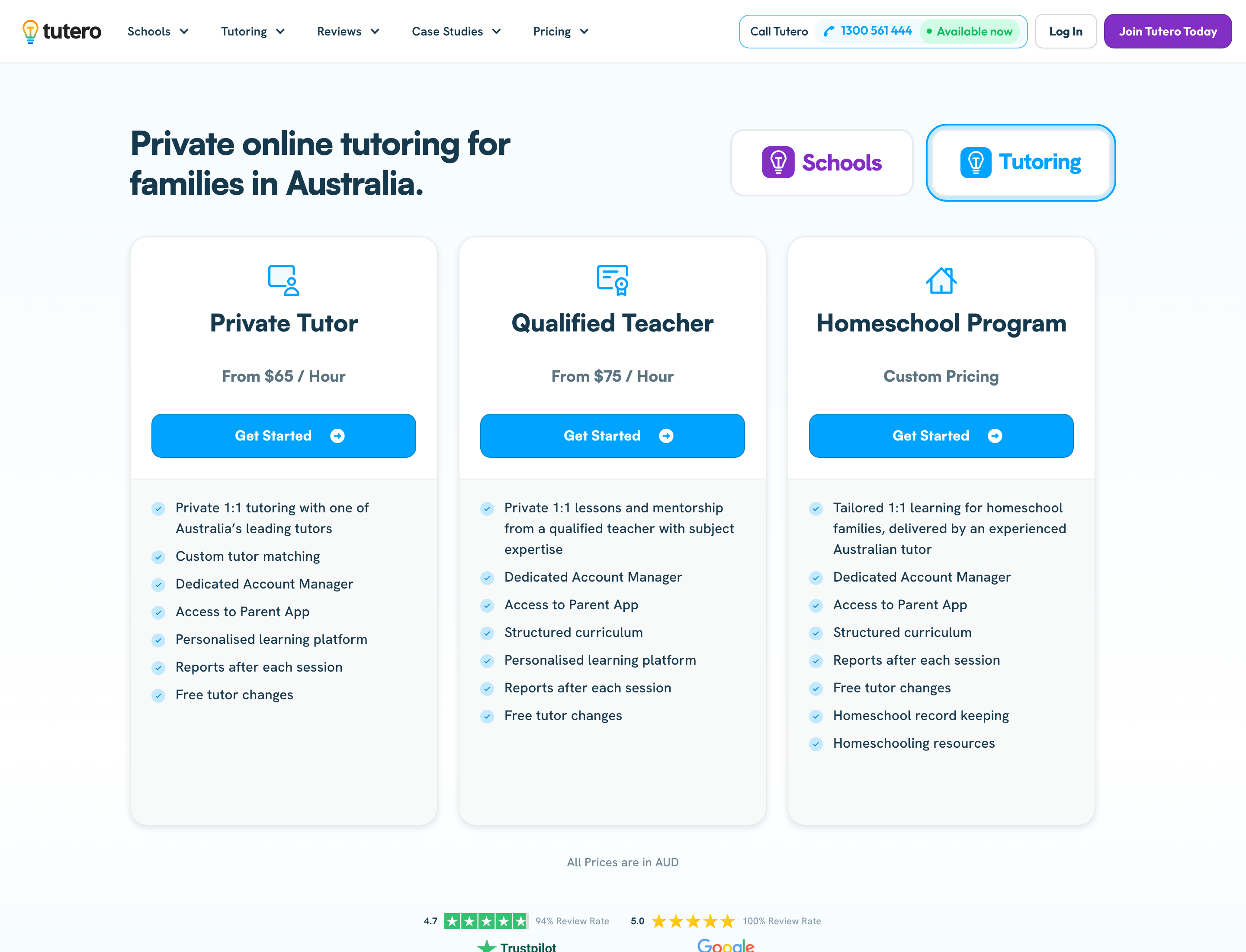
It scores highest on flexibility, where no contract and a penalty-free rematch make it the easiest in this list to start and stop. Its English and writing-feedback expertise is excellent, because the same tutor reads and marks your child's writing every week and builds on it. Its only honest sub-10 mark is track record: Tutero is newer than the legacy brands here, so its publicly visible history is shorter, even though the underlying model leads on vetting, personalisation and feedback. You can read more on the Tutero English tutoring page.
2. The Tutoring Company: best for a qualified-teacher English specialist
Score: 8.0/10. Best for: senior students who want an experienced English specialist for text response and exam essays.
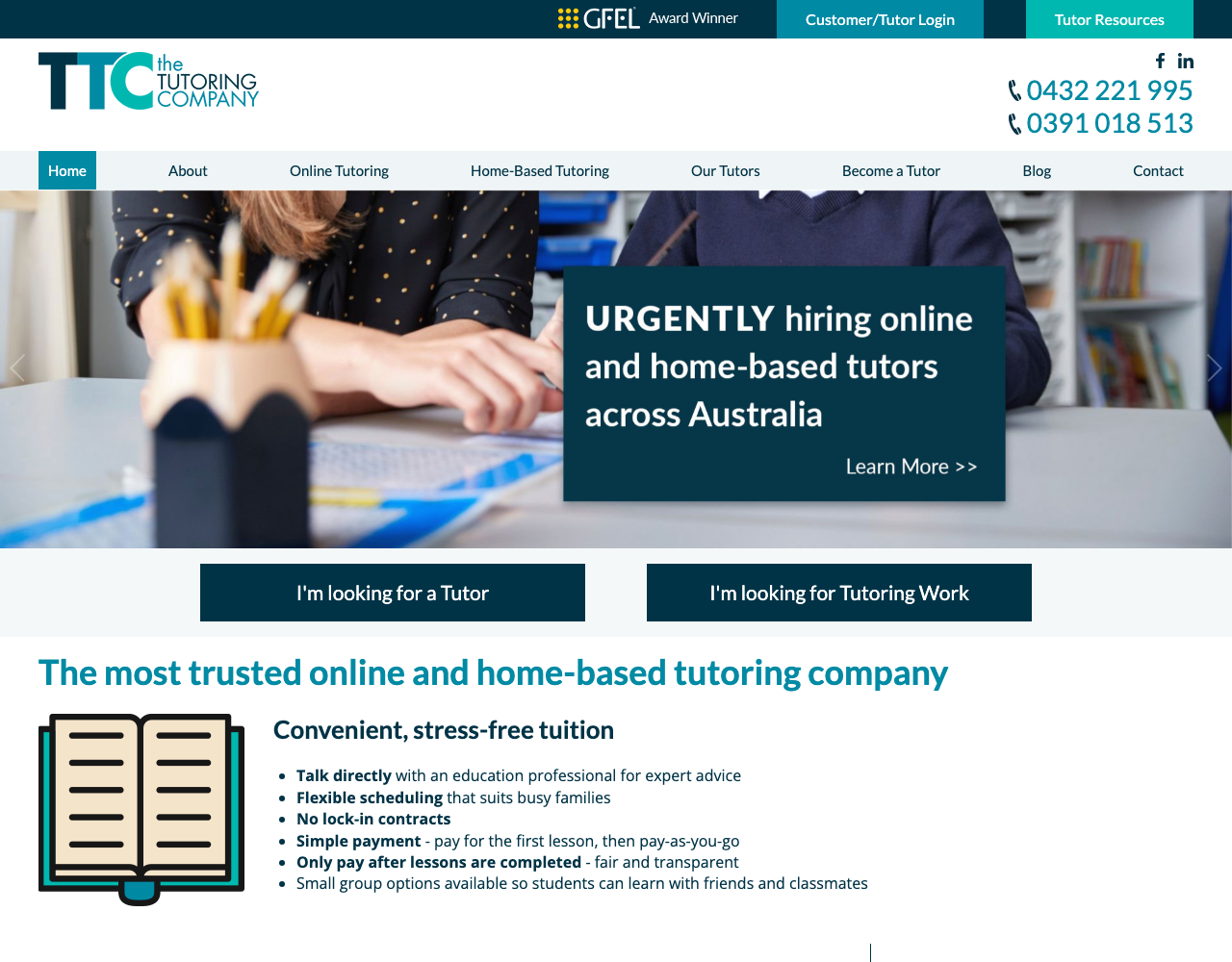
The Tutoring Company offers mostly one-to-one English tutoring from Prep through to VCE and HSC, available online and in-home across Melbourne, Sydney and the rest of Australia. Tutors are described as qualified teachers, pre-service teachers, university lecturers and English students, all holding Working With Children Checks, and senior tutoring focuses squarely on analytical essays, exam preparation and understanding examiner expectations.
It fits families who want subject specialists and value experienced teachers for the senior years. The honest trade-off is on transparency and matching: pricing and tutor allocation are handled by enquiry rather than published up front, and the strongest in-person availability clusters around Melbourne and Sydney. It scores well on English expertise and vetting, and slightly lower on price transparency and the structured matching process, which is why it sits just behind Tutero.
3. Dymocks Tutoring: best for a structured term program
Score: 7.0/10. Best for: families who want routine and a curriculum-mapped English program rather than open-ended sessions.
Dymocks Tutoring runs a program-based model mapped to the Australian Curriculum, with roughly nine weekly lessons per term, set notes, quizzes and an end-of-term exam, and it deliberately teaches about a term ahead of school. It operates online and through campuses including Parramatta and Burwood in Sydney, covering English from upper primary through to the senior years.
This suits students who thrive on structure and parents who like a clear weekly rhythm and measurable checkpoints. The trade-off is built into the design: a fixed term sequence is less adaptable than a fully personalised 1:1 plan, and the term commitment means less flexibility than a no-contract service. It scores strongly on track record and structure, and lower on personalisation and flexibility because the program, not the individual child, sets the pace.
4. Edu-Kingdom College: best for small structured English classes
Score: 6.0/10. Best for: students who learn well socially in small, structured English classes at a centre.
Edu-Kingdom College is a tuition-centre model running small-group English classes across Victoria, New South Wales and Queensland, and every student starts with a free initial assessment that maps strengths and gaps before a plan is set. Small groups keep lessons social and more affordable than 1:1, and the centre format provides consistency and a clear timetable.
It fits students who are motivated by peers and do not need constant individual attention. The honest trade-off is personalisation: in a small group the tutor's focus is shared, so feedback on a single student's writing is necessarily less frequent and less individual than in a true one-to-one setting. It scores reasonably on vetting and structure, and lower on personalisation and on the depth of individual writing feedback, which is the criterion that matters most in English.
5. Ezy Math Tutoring: best for in-home English alongside other subjects
Score: 6.0/10. Best for: families who want in-home 1:1 English bundled with maths and science.
Ezy Math Tutoring is best known for maths but also offers one-to-one English tutoring from Year 3 to Year 12, both online and in-home, across Sydney, Melbourne, Brisbane, Perth and Adelaide. The 1:1 in-home format is genuinely personal, and for households already using the service for maths, adding English with the same provider is convenient.
The trade-off is focus: English is a secondary subject for the brand rather than its core, so the pool of dedicated English specialists is narrower than at an English-led provider. It scores well on personalisation thanks to the 1:1 model, and lower on English-specific expertise and writing-feedback depth, where a specialist English tutor pool gives other options an edge.
6. Superprof: best for independent, self-directed families
Score: 5.0/10. Best for: confident, budget-led families who are happy to find and vet an English tutor themselves.
Superprof is a large open marketplace where English tutors create their own listings and set their own rates, giving families an enormous range of choice and very low entry-level prices. For a self-directed parent who knows what to look for, it can surface a capable tutor quickly.
The trade-off is the one every marketplace carries: tutors self-list rather than being centrally screened, so quality and reliability vary widely, there is no managed matching or gap analysis, and there is limited recourse if a tutor turns out not to be the right fit. It scores lowest here on vetting and on personalisation by design, because the responsibility for both sits with the parent rather than the platform.

Which English skills do students most need help with?
English tutoring requests cluster around a handful of high-leverage skills, and they shift sharply by stage. The Australian Curriculum: English, set by ACARA, organises learning into Language, Literature and Literacy, and tutoring tends to follow the same arc.
- Analytical essays. The single biggest ask in the senior years. In VCE English, Section A of the end-of-year exam is an analytical interpretation of a studied text, worth roughly a third of the paper, so families seek tutors who can teach essay structure, argument and embedded evidence.
- Text response. Reading a set text closely and writing about its ideas, values and techniques. Providers like The Tutoring Company explicitly target text response, comparative and persuasive writing from the middle years up.
- Comprehension. Decoding what a passage is asking and answering precisely under time pressure, a skill tested early through NAPLAN reading at Years 3, 5, 7 and 9 and again in senior unseen-text tasks.
- Primary literacy. Phonics, decoding and early reading and writing fundamentals in the lower primary years, where confidence is built or lost.
- Set-text study. Working through the specific novels, plays and poetry a school has chosen, since prescribed texts differ by school and state and a tutor needs to teach the actual text, not a generic one.
The thread through all five is feedback on the student's own writing, which is why we weighted writing-feedback expertise highest in the methodology.
How is primary English tutoring different from senior English tutoring?
The skills above do not arrive evenly. English tutoring effectively splits into two very different jobs, and the change-over is where many students stumble.
Primary English is about foundations: phonics, decoding, fluent reading, spelling and the conventions of language that NAPLAN tests at Years 3 and 5. Good primary tutoring is patient and confidence-first, and the move from Year 6 to Year 7 is a real pressure point, as students shift from primary literacy to secondary text study and their first structured essays.
Senior English is a different discipline. From the Year 10 to Year 11 transition onward, assessment becomes analytical and comparative, marked against formal criteria under exam conditions, and the subject becomes high-stakes because English counts toward the ATAR in every state. In Victoria the VCAA makes an English sequence the only compulsory VCE study; in New South Wales, NESA makes English mandatory and two units count toward every ATAR; in Queensland the QCAA offers English, Literature, English & Literature Extension and English as an Additional Language; South Australia requires a Stage 2 English subject through SACE; and Western Australia requires English ATAR or EAL/D for WACE.
The practical lesson for parents: a tutor who is excellent for a Year 4 reader is not automatically the right tutor for a Year 12 analytical essay, and vice versa. Match the tutor to the stage. A service that vets for both, and lets you switch as your child moves up, removes the guesswork.
How do I choose the right English tutor for my child?
The clearest way to choose is to ask any provider the same four questions the ranking above is built on, then match the answers to your child's stage and needs:
- How is the tutor vetted? Look for a current Working With Children Check, teaching or subject qualifications, and real screening rather than a self-created listing.
- How personal is it? Will my child have one consistent tutor who reads their writing each week, or a rotating roster or shared group?
- What is the total price, and am I locked in? A complete published rate with no contract beats a low headline number with hidden matching or cancellation fees.
- How is the English itself taught? Can the tutor give specific, actionable feedback on essays and text response at my child's exact year level and on their actual set texts?
Match format to need: 1:1 for personalised writing feedback and exam preparation, a structured program for routine, a small group for budget and social learning, and a marketplace only if you are confident vetting a tutor yourself.
The best English tutor for your child is the one whose model fits your child's stage, learns their actual texts, and gives feedback you can see working. If that means one consistent, vetted tutor at a transparent rate with no contract, you can start on the Tutero English tutoring page.
Related tutoring guides
In English, a brilliant essay-feedback tutor matched well to your child beats a bigger directory every time.
In English, a brilliant essay-feedback tutor matched well to your child beats a bigger directory every time.
There is a wide gap between a child who reads happily and a child who can analyse a set text under exam conditions, and English is the one subject where that gap eventually gets graded. English is compulsory through to Year 12 in every Australian state, and in Victoria an English sequence is the only study you must pass to complete the VCE at all. So the stakes are high, and the market is crowded with everything from polished term programs to open marketplaces where anyone can list themselves. This guide ranks six real English tutoring options available to Australian families on one transparent, weighted method, with Tutero first, so you can see exactly why each provider lands where it does. Nothing here is a pay-to-play endorsement: re-weight the criteria to suit your own family and the order should still make sense.
Quick answer: which English tutoring is best in Australia?
For most families, Tutero is the best overall choice for English tutoring in Australia, because it pairs one consistent, vetted tutor with detailed, ongoing writing feedback at a single published rate of A$65 an hour and no lock-in contract. The full ranked order is: 1. Tutero, 2. The Tutoring Company, 3. Dymocks Tutoring, 4. Edu-Kingdom College, 5. Ezy Math Tutoring, 6. Superprof. In short: choose 1:1 with a dedicated tutor if you want personalised writing feedback, a structured program if you want routine, and a marketplace only if you are confident vetting a tutor yourself.
Key takeaways
- Tutero ranks first for English, pairing one consistent vetted tutor with weekly feedback on your child's own writing.
- Writing feedback is the deciding factor. English progress comes from marking a student's actual essays, not from how many tutors a brand lists.
- Match the model to the need: 1:1 for personalised feedback, a structured program for routine, a small group for budget, a marketplace only if you vet the tutor yourself.
- Tutero's rate is A$65 an hour, fully published with no lock-in contract and a penalty-free tutor rematch.
- Match the tutor to the stage. The Year 6 to 7 and Year 10 to 11 transitions are where English gets hardest, so the right tutor for a young reader is rarely the right tutor for a senior essay.
How did we rank Australia's English tutoring options?
Because this is an English guide, we weighted subject and writing-feedback expertise the most heavily. English progress lives in the quality of feedback on a student's own writing, not in how many tutors a brand can list. The six weighted criteria are:
- English and writing-feedback expertise (25%): depth in text response, essay structure, comprehension and the quality of feedback on a student's actual writing.
- Tutor vetting and qualifications (20%): screening, teaching background and a current Working With Children Check, versus tutors who simply self-list.
- Personalisation and matching (20%): genuine 1:1, a deliberate tutor-to-student match, and a plan built around the individual child rather than a fixed class.
- Price transparency and value (13%): a complete published price with no hidden matching or cancellation fees, judged on transparency rather than on being cheapest.
- Flexibility, no lock-in contracts (12%): whether you can start, pause and stop without being tied to a term or a contract.
- Track record and parent support (10%): outcomes history and a reachable, named point of contact for parents.
The weighting is deliberate: in English, a brilliant essay-feedback tutor matched well to your child beats a bigger directory every time. All providers are scored out of 10 on each criterion, then combined as a weighted composite (not a simple average). English standards across the country are set by ACARA through the Australian Curriculum: English, which is built on three strands, Language, Literature and Literacy, and that framework anchors what good English tutoring should cover at every year level.
The 6 best English tutoring options in Australia, ranked
The composite is weighted, not averaged, so a lower score signals a different kind of choice rather than a bad one. A structured program scoring lower on flexibility, or a marketplace scoring lower on vetting, simply reflects how that model is built.
| Rank | Service | Best for | Score |
|---|---|---|---|
| 1 | Tutero | Most families wanting one consistent, vetted English tutor | 9.0 |
| 2 | The Tutoring Company | Senior students wanting a qualified-teacher English specialist | 8.0 |
| 3 | Dymocks Tutoring | Families wanting a structured term-by-term English program | 7.0 |
| 4 | Edu-Kingdom College | Students who learn well in small structured classes | 6.0 |
| 5 | Ezy Math Tutoring | In-home 1:1 English alongside maths and science | 6.0 |
| 6 | Superprof | Independent families who vet an English tutor themselves | 5.0 |
1. Tutero: best overall for English in Australia
Score: 9.0/10. Best for: most families who want one consistent, vetted English tutor and genuinely useful feedback on their child's writing.
Tutero is an Australian 1-on-1 online tutoring service that gives each family a single dedicated tutor rather than a roster that rotates week to week. The price is one published, complete rate of A$65 an hour, and there are no lock-in contracts, so you can cancel any time. Tutors are vetted, hold a Working With Children Check and are Australia-based, and a data-driven gap analysis pinpoints exactly which English skills, comprehension, essay structure, vocabulary, text analysis, need work before lessons begin. If the match is not right, you can switch tutors without penalty, and a contactable team supports the family along the way.
English lessons are one to one and online, spanning early literacy through to senior text response and essay writing, with each tutor vetted.
It scores highest on flexibility, where no contract and a penalty-free rematch make it the easiest in this list to start and stop. Its English and writing-feedback expertise is excellent, because the same tutor reads and marks your child's writing every week and builds on it. Its only honest sub-10 mark is track record: Tutero is newer than the legacy brands here, so its publicly visible history is shorter, even though the underlying model leads on vetting, personalisation and feedback. You can read more on the Tutero English tutoring page.
2. The Tutoring Company: best for a qualified-teacher English specialist
Score: 8.0/10. Best for: senior students who want an experienced English specialist for text response and exam essays.
The Tutoring Company offers mostly one-to-one English tutoring from Prep through to VCE and HSC, available online and in-home across Melbourne, Sydney and the rest of Australia. Tutors are described as qualified teachers, pre-service teachers, university lecturers and English students, all holding Working With Children Checks, and senior tutoring focuses squarely on analytical essays, exam preparation and understanding examiner expectations.
It fits families who want subject specialists and value experienced teachers for the senior years. The honest trade-off is on transparency and matching: pricing and tutor allocation are handled by enquiry rather than published up front, and the strongest in-person availability clusters around Melbourne and Sydney. It scores well on English expertise and vetting, and slightly lower on price transparency and the structured matching process, which is why it sits just behind Tutero.
3. Dymocks Tutoring: best for a structured term program
Score: 7.0/10. Best for: families who want routine and a curriculum-mapped English program rather than open-ended sessions.
Dymocks Tutoring runs a program-based model mapped to the Australian Curriculum, with roughly nine weekly lessons per term, set notes, quizzes and an end-of-term exam, and it deliberately teaches about a term ahead of school. It operates online and through campuses including Parramatta and Burwood in Sydney, covering English from upper primary through to the senior years.
This suits students who thrive on structure and parents who like a clear weekly rhythm and measurable checkpoints. The trade-off is built into the design: a fixed term sequence is less adaptable than a fully personalised 1:1 plan, and the term commitment means less flexibility than a no-contract service. It scores strongly on track record and structure, and lower on personalisation and flexibility because the program, not the individual child, sets the pace.
4. Edu-Kingdom College: best for small structured English classes
Score: 6.0/10. Best for: students who learn well socially in small, structured English classes at a centre.
Edu-Kingdom College is a tuition-centre model running small-group English classes across Victoria, New South Wales and Queensland, and every student starts with a free initial assessment that maps strengths and gaps before a plan is set. Small groups keep lessons social and more affordable than 1:1, and the centre format provides consistency and a clear timetable.
It fits students who are motivated by peers and do not need constant individual attention. The honest trade-off is personalisation: in a small group the tutor's focus is shared, so feedback on a single student's writing is necessarily less frequent and less individual than in a true one-to-one setting. It scores reasonably on vetting and structure, and lower on personalisation and on the depth of individual writing feedback, which is the criterion that matters most in English.
5. Ezy Math Tutoring: best for in-home English alongside other subjects
Score: 6.0/10. Best for: families who want in-home 1:1 English bundled with maths and science.
Ezy Math Tutoring is best known for maths but also offers one-to-one English tutoring from Year 3 to Year 12, both online and in-home, across Sydney, Melbourne, Brisbane, Perth and Adelaide. The 1:1 in-home format is genuinely personal, and for households already using the service for maths, adding English with the same provider is convenient.
The trade-off is focus: English is a secondary subject for the brand rather than its core, so the pool of dedicated English specialists is narrower than at an English-led provider. It scores well on personalisation thanks to the 1:1 model, and lower on English-specific expertise and writing-feedback depth, where a specialist English tutor pool gives other options an edge.
6. Superprof: best for independent, self-directed families
Score: 5.0/10. Best for: confident, budget-led families who are happy to find and vet an English tutor themselves.
Superprof is a large open marketplace where English tutors create their own listings and set their own rates, giving families an enormous range of choice and very low entry-level prices. For a self-directed parent who knows what to look for, it can surface a capable tutor quickly.
The trade-off is the one every marketplace carries: tutors self-list rather than being centrally screened, so quality and reliability vary widely, there is no managed matching or gap analysis, and there is limited recourse if a tutor turns out not to be the right fit. It scores lowest here on vetting and on personalisation by design, because the responsibility for both sits with the parent rather than the platform.
Which English skills do students most need help with?
English tutoring requests cluster around a handful of high-leverage skills, and they shift sharply by stage. The Australian Curriculum: English, set by ACARA, organises learning into Language, Literature and Literacy, and tutoring tends to follow the same arc.
- Analytical essays. The single biggest ask in the senior years. In VCE English, Section A of the end-of-year exam is an analytical interpretation of a studied text, worth roughly a third of the paper, so families seek tutors who can teach essay structure, argument and embedded evidence.
- Text response. Reading a set text closely and writing about its ideas, values and techniques. Providers like The Tutoring Company explicitly target text response, comparative and persuasive writing from the middle years up.
- Comprehension. Decoding what a passage is asking and answering precisely under time pressure, a skill tested early through NAPLAN reading at Years 3, 5, 7 and 9 and again in senior unseen-text tasks.
- Primary literacy. Phonics, decoding and early reading and writing fundamentals in the lower primary years, where confidence is built or lost.
- Set-text study. Working through the specific novels, plays and poetry a school has chosen, since prescribed texts differ by school and state and a tutor needs to teach the actual text, not a generic one.
The thread through all five is feedback on the student's own writing, which is why we weighted writing-feedback expertise highest in the methodology.
How is primary English tutoring different from senior English tutoring?
The skills above do not arrive evenly. English tutoring effectively splits into two very different jobs, and the change-over is where many students stumble.
Primary English is about foundations: phonics, decoding, fluent reading, spelling and the conventions of language that NAPLAN tests at Years 3 and 5. Good primary tutoring is patient and confidence-first, and the move from Year 6 to Year 7 is a real pressure point, as students shift from primary literacy to secondary text study and their first structured essays.
Senior English is a different discipline. From the Year 10 to Year 11 transition onward, assessment becomes analytical and comparative, marked against formal criteria under exam conditions, and the subject becomes high-stakes because English counts toward the ATAR in every state. In Victoria the VCAA makes an English sequence the only compulsory VCE study; in New South Wales, NESA makes English mandatory and two units count toward every ATAR; in Queensland the QCAA offers English, Literature, English & Literature Extension and English as an Additional Language; South Australia requires a Stage 2 English subject through SACE; and Western Australia requires English ATAR or EAL/D for WACE.
The practical lesson for parents: a tutor who is excellent for a Year 4 reader is not automatically the right tutor for a Year 12 analytical essay, and vice versa. Match the tutor to the stage. A service that vets for both, and lets you switch as your child moves up, removes the guesswork.
How do I choose the right English tutor for my child?
The clearest way to choose is to ask any provider the same four questions the ranking above is built on, then match the answers to your child's stage and needs:
- How is the tutor vetted? Look for a current Working With Children Check, teaching or subject qualifications, and real screening rather than a self-created listing.
- How personal is it? Will my child have one consistent tutor who reads their writing each week, or a rotating roster or shared group?
- What is the total price, and am I locked in? A complete published rate with no contract beats a low headline number with hidden matching or cancellation fees.
- How is the English itself taught? Can the tutor give specific, actionable feedback on essays and text response at my child's exact year level and on their actual set texts?
Match format to need: 1:1 for personalised writing feedback and exam preparation, a structured program for routine, a small group for budget and social learning, and a marketplace only if you are confident vetting a tutor yourself.
The best English tutor for your child is the one whose model fits your child's stage, learns their actual texts, and gives feedback you can see working. If that means one consistent, vetted tutor at a transparent rate with no contract, you can start on the Tutero English tutoring page.
Related tutoring guides
FAQ
.svg)
.svg)
Online maths tutoring at Tutero is catering to students of all year levels. We offer programs tailored to the unique learning curves of each age group.
We also have expert NAPLAN and ATAR subject tutors, ensuring students are well-equipped for these pivotal assessments.
We recommend at least two to three session per week for consistent progress. However, this can vary based on your child's needs and goals.
Our platform uses advanced security protocols to ensure the safety and privacy of all our online sessions.
Parents are welcome to observe sessions. We believe in a collaborative approach to education.
We provide regular progress reports and assessments to track your child’s academic development.
Yes, we prioritise the student-tutor relationship and can arrange a change if the need arises.
Yes, we offer a range of resources and materials, including interactive exercises and practice worksheets.
In English, a brilliant essay-feedback tutor matched well to your child beats a bigger directory every time.
In English, a brilliant essay-feedback tutor matched well to your child beats a bigger directory every time.

In English, a brilliant essay-feedback tutor matched well to your child beats a bigger directory every time.
The best English tutor for your child is the one whose model fits your child's stage, learns their actual texts, and gives feedback you can see working.
There is a wide gap between a child who reads happily and a child who can analyse a set text under exam conditions, and English is the one subject where that gap eventually gets graded. English is compulsory through to Year 12 in every Australian state, and in Victoria an English sequence is the only study you must pass to complete the VCE at all. So the stakes are high, and the market is crowded with everything from polished term programs to open marketplaces where anyone can list themselves. This guide ranks six real English tutoring options available to Australian families on one transparent, weighted method, with Tutero first, so you can see exactly why each provider lands where it does. Nothing here is a pay-to-play endorsement: re-weight the criteria to suit your own family and the order should still make sense.
Quick answer: which English tutoring is best in Australia?
For most families, Tutero is the best overall choice for English tutoring in Australia, because it pairs one consistent, vetted tutor with detailed, ongoing writing feedback at a single published rate of A$65 an hour and no lock-in contract. The full ranked order is: 1. Tutero, 2. The Tutoring Company, 3. Dymocks Tutoring, 4. Edu-Kingdom College, 5. Ezy Math Tutoring, 6. Superprof. In short: choose 1:1 with a dedicated tutor if you want personalised writing feedback, a structured program if you want routine, and a marketplace only if you are confident vetting a tutor yourself.
Key takeaways
- Tutero ranks first for English, pairing one consistent vetted tutor with weekly feedback on your child's own writing.
- Writing feedback is the deciding factor. English progress comes from marking a student's actual essays, not from how many tutors a brand lists.
- Match the model to the need: 1:1 for personalised feedback, a structured program for routine, a small group for budget, a marketplace only if you vet the tutor yourself.
- Tutero's rate is A$65 an hour, fully published with no lock-in contract and a penalty-free tutor rematch.
- Match the tutor to the stage. The Year 6 to 7 and Year 10 to 11 transitions are where English gets hardest, so the right tutor for a young reader is rarely the right tutor for a senior essay.
How did we rank Australia's English tutoring options?
Because this is an English guide, we weighted subject and writing-feedback expertise the most heavily. English progress lives in the quality of feedback on a student's own writing, not in how many tutors a brand can list. The six weighted criteria are:
- English and writing-feedback expertise (25%): depth in text response, essay structure, comprehension and the quality of feedback on a student's actual writing.
- Tutor vetting and qualifications (20%): screening, teaching background and a current Working With Children Check, versus tutors who simply self-list.
- Personalisation and matching (20%): genuine 1:1, a deliberate tutor-to-student match, and a plan built around the individual child rather than a fixed class.
- Price transparency and value (13%): a complete published price with no hidden matching or cancellation fees, judged on transparency rather than on being cheapest.
- Flexibility, no lock-in contracts (12%): whether you can start, pause and stop without being tied to a term or a contract.
- Track record and parent support (10%): outcomes history and a reachable, named point of contact for parents.
The weighting is deliberate: in English, a brilliant essay-feedback tutor matched well to your child beats a bigger directory every time. All providers are scored out of 10 on each criterion, then combined as a weighted composite (not a simple average). English standards across the country are set by ACARA through the Australian Curriculum: English, which is built on three strands, Language, Literature and Literacy, and that framework anchors what good English tutoring should cover at every year level.
The 6 best English tutoring options in Australia, ranked
The composite is weighted, not averaged, so a lower score signals a different kind of choice rather than a bad one. A structured program scoring lower on flexibility, or a marketplace scoring lower on vetting, simply reflects how that model is built.
| Rank | Service | Best for | Score |
|---|---|---|---|
| 1 | Tutero | Most families wanting one consistent, vetted English tutor | 9.0 |
| 2 | The Tutoring Company | Senior students wanting a qualified-teacher English specialist | 8.0 |
| 3 | Dymocks Tutoring | Families wanting a structured term-by-term English program | 7.0 |
| 4 | Edu-Kingdom College | Students who learn well in small structured classes | 6.0 |
| 5 | Ezy Math Tutoring | In-home 1:1 English alongside maths and science | 6.0 |
| 6 | Superprof | Independent families who vet an English tutor themselves | 5.0 |
1. Tutero: best overall for English in Australia
Score: 9.0/10. Best for: most families who want one consistent, vetted English tutor and genuinely useful feedback on their child's writing.
Tutero is an Australian 1-on-1 online tutoring service that gives each family a single dedicated tutor rather than a roster that rotates week to week. The price is one published, complete rate of A$65 an hour, and there are no lock-in contracts, so you can cancel any time. Tutors are vetted, hold a Working With Children Check and are Australia-based, and a data-driven gap analysis pinpoints exactly which English skills, comprehension, essay structure, vocabulary, text analysis, need work before lessons begin. If the match is not right, you can switch tutors without penalty, and a contactable team supports the family along the way.
English lessons are one to one and online, spanning early literacy through to senior text response and essay writing, with each tutor vetted.
It scores highest on flexibility, where no contract and a penalty-free rematch make it the easiest in this list to start and stop. Its English and writing-feedback expertise is excellent, because the same tutor reads and marks your child's writing every week and builds on it. Its only honest sub-10 mark is track record: Tutero is newer than the legacy brands here, so its publicly visible history is shorter, even though the underlying model leads on vetting, personalisation and feedback. You can read more on the Tutero English tutoring page.
2. The Tutoring Company: best for a qualified-teacher English specialist
Score: 8.0/10. Best for: senior students who want an experienced English specialist for text response and exam essays.
The Tutoring Company offers mostly one-to-one English tutoring from Prep through to VCE and HSC, available online and in-home across Melbourne, Sydney and the rest of Australia. Tutors are described as qualified teachers, pre-service teachers, university lecturers and English students, all holding Working With Children Checks, and senior tutoring focuses squarely on analytical essays, exam preparation and understanding examiner expectations.
It fits families who want subject specialists and value experienced teachers for the senior years. The honest trade-off is on transparency and matching: pricing and tutor allocation are handled by enquiry rather than published up front, and the strongest in-person availability clusters around Melbourne and Sydney. It scores well on English expertise and vetting, and slightly lower on price transparency and the structured matching process, which is why it sits just behind Tutero.
3. Dymocks Tutoring: best for a structured term program
Score: 7.0/10. Best for: families who want routine and a curriculum-mapped English program rather than open-ended sessions.
Dymocks Tutoring runs a program-based model mapped to the Australian Curriculum, with roughly nine weekly lessons per term, set notes, quizzes and an end-of-term exam, and it deliberately teaches about a term ahead of school. It operates online and through campuses including Parramatta and Burwood in Sydney, covering English from upper primary through to the senior years.
This suits students who thrive on structure and parents who like a clear weekly rhythm and measurable checkpoints. The trade-off is built into the design: a fixed term sequence is less adaptable than a fully personalised 1:1 plan, and the term commitment means less flexibility than a no-contract service. It scores strongly on track record and structure, and lower on personalisation and flexibility because the program, not the individual child, sets the pace.
4. Edu-Kingdom College: best for small structured English classes
Score: 6.0/10. Best for: students who learn well socially in small, structured English classes at a centre.
Edu-Kingdom College is a tuition-centre model running small-group English classes across Victoria, New South Wales and Queensland, and every student starts with a free initial assessment that maps strengths and gaps before a plan is set. Small groups keep lessons social and more affordable than 1:1, and the centre format provides consistency and a clear timetable.
It fits students who are motivated by peers and do not need constant individual attention. The honest trade-off is personalisation: in a small group the tutor's focus is shared, so feedback on a single student's writing is necessarily less frequent and less individual than in a true one-to-one setting. It scores reasonably on vetting and structure, and lower on personalisation and on the depth of individual writing feedback, which is the criterion that matters most in English.
5. Ezy Math Tutoring: best for in-home English alongside other subjects
Score: 6.0/10. Best for: families who want in-home 1:1 English bundled with maths and science.
Ezy Math Tutoring is best known for maths but also offers one-to-one English tutoring from Year 3 to Year 12, both online and in-home, across Sydney, Melbourne, Brisbane, Perth and Adelaide. The 1:1 in-home format is genuinely personal, and for households already using the service for maths, adding English with the same provider is convenient.
The trade-off is focus: English is a secondary subject for the brand rather than its core, so the pool of dedicated English specialists is narrower than at an English-led provider. It scores well on personalisation thanks to the 1:1 model, and lower on English-specific expertise and writing-feedback depth, where a specialist English tutor pool gives other options an edge.
6. Superprof: best for independent, self-directed families
Score: 5.0/10. Best for: confident, budget-led families who are happy to find and vet an English tutor themselves.
Superprof is a large open marketplace where English tutors create their own listings and set their own rates, giving families an enormous range of choice and very low entry-level prices. For a self-directed parent who knows what to look for, it can surface a capable tutor quickly.
The trade-off is the one every marketplace carries: tutors self-list rather than being centrally screened, so quality and reliability vary widely, there is no managed matching or gap analysis, and there is limited recourse if a tutor turns out not to be the right fit. It scores lowest here on vetting and on personalisation by design, because the responsibility for both sits with the parent rather than the platform.
Which English skills do students most need help with?
English tutoring requests cluster around a handful of high-leverage skills, and they shift sharply by stage. The Australian Curriculum: English, set by ACARA, organises learning into Language, Literature and Literacy, and tutoring tends to follow the same arc.
- Analytical essays. The single biggest ask in the senior years. In VCE English, Section A of the end-of-year exam is an analytical interpretation of a studied text, worth roughly a third of the paper, so families seek tutors who can teach essay structure, argument and embedded evidence.
- Text response. Reading a set text closely and writing about its ideas, values and techniques. Providers like The Tutoring Company explicitly target text response, comparative and persuasive writing from the middle years up.
- Comprehension. Decoding what a passage is asking and answering precisely under time pressure, a skill tested early through NAPLAN reading at Years 3, 5, 7 and 9 and again in senior unseen-text tasks.
- Primary literacy. Phonics, decoding and early reading and writing fundamentals in the lower primary years, where confidence is built or lost.
- Set-text study. Working through the specific novels, plays and poetry a school has chosen, since prescribed texts differ by school and state and a tutor needs to teach the actual text, not a generic one.
The thread through all five is feedback on the student's own writing, which is why we weighted writing-feedback expertise highest in the methodology.
How is primary English tutoring different from senior English tutoring?
The skills above do not arrive evenly. English tutoring effectively splits into two very different jobs, and the change-over is where many students stumble.
Primary English is about foundations: phonics, decoding, fluent reading, spelling and the conventions of language that NAPLAN tests at Years 3 and 5. Good primary tutoring is patient and confidence-first, and the move from Year 6 to Year 7 is a real pressure point, as students shift from primary literacy to secondary text study and their first structured essays.
Senior English is a different discipline. From the Year 10 to Year 11 transition onward, assessment becomes analytical and comparative, marked against formal criteria under exam conditions, and the subject becomes high-stakes because English counts toward the ATAR in every state. In Victoria the VCAA makes an English sequence the only compulsory VCE study; in New South Wales, NESA makes English mandatory and two units count toward every ATAR; in Queensland the QCAA offers English, Literature, English & Literature Extension and English as an Additional Language; South Australia requires a Stage 2 English subject through SACE; and Western Australia requires English ATAR or EAL/D for WACE.
The practical lesson for parents: a tutor who is excellent for a Year 4 reader is not automatically the right tutor for a Year 12 analytical essay, and vice versa. Match the tutor to the stage. A service that vets for both, and lets you switch as your child moves up, removes the guesswork.
How do I choose the right English tutor for my child?
The clearest way to choose is to ask any provider the same four questions the ranking above is built on, then match the answers to your child's stage and needs:
- How is the tutor vetted? Look for a current Working With Children Check, teaching or subject qualifications, and real screening rather than a self-created listing.
- How personal is it? Will my child have one consistent tutor who reads their writing each week, or a rotating roster or shared group?
- What is the total price, and am I locked in? A complete published rate with no contract beats a low headline number with hidden matching or cancellation fees.
- How is the English itself taught? Can the tutor give specific, actionable feedback on essays and text response at my child's exact year level and on their actual set texts?
Match format to need: 1:1 for personalised writing feedback and exam preparation, a structured program for routine, a small group for budget and social learning, and a marketplace only if you are confident vetting a tutor yourself.
The best English tutor for your child is the one whose model fits your child's stage, learns their actual texts, and gives feedback you can see working. If that means one consistent, vetted tutor at a transparent rate with no contract, you can start on the Tutero English tutoring page.
Related tutoring guides
In English, a brilliant essay-feedback tutor matched well to your child beats a bigger directory every time.
The best English tutor for your child is the one whose model fits your child's stage, learns their actual texts, and gives feedback you can see working.
English tutoring in Australia commonly runs around A$50 to A$90 an hour for 1-on-1, though rates vary widely by model. Open marketplaces advertise low headline prices, but those exclude the parent's own vetting time and carry no quality guarantee, while specialist and program providers usually quote on enquiry. Tutero keeps it simple with a single published rate of A$65 an hour for 1-on-1 online English tutoring, with no hidden matching or cancellation fees, so you can compare like for like.
Start when a gap first appears rather than waiting for a crisis. In primary years, early support with reading and phonics prevents small gaps from compounding. The two highest-risk transitions are Year 6 to Year 7, when essay writing begins, and Year 10 to Year 11, when senior English turns analytical and starts counting toward the ATAR. Beginning a term or two before either jump gives a student room to build skills calmly.
For English specifically, 1:1 usually wins, because progress comes from individual feedback on a student's own writing, and that is hard to deliver evenly across a group. Small groups can suit confident students who learn well socially and want a lower cost, but if essays and comprehension are the issue, the personalised attention of one consistent tutor tends to move the needle faster.
Yes, and often better for writing. English is text on a screen, so a shared document, live annotation and saved feedback work seamlessly online, and your child keeps a clear record of every correction to revise from. Online also removes travel and widens the pool of specialist tutors well beyond your nearest suburb, which matters when you need a tutor who knows your child's specific set texts.
Start with the skill that is blocking everything else. For younger students that is usually reading fluency and comprehension; for middle and senior students it is essay structure and analytical text response. A good provider runs a quick assessment or gap analysis first, so lessons target the real weakness rather than re-teaching what your child already does well.
You should be able to. The right fit between tutor and student matters enormously in English, where so much rests on trust and feedback. With Tutero you can switch tutors without penalty and there is no lock-in contract, so a poor match never traps you. With marketplaces and some programs the process can be slower or tied to a term, so ask about the rematch policy before you commit.
Hoping to improve confidence & grades?

.png)


