
.svg)

Maths is the subject where small gaps do the most damage. A child who never quite locked in fractions in primary school hits the jump to algebra in Year 8 and suddenly cannot follow a single step, because algebra is just fractions and operations wearing letters. Year 9 is where that hidden gap usually surfaces as a plummeting grade, and by the time a student reaches senior Mathematical Methods or Specialist Mathematics, calculus and complex algebra leave no room to quietly fall behind. The good news is that maths responds to tutoring better than almost any subject, because the gaps are concrete and fixable once someone finds them. This is a transparent, interrogable ranking of the seven online maths tutoring services Australian families can actually choose from, scored out of 10 on a weighted methodology that puts maths-specific teaching first. Tutero comes out on top at 8.8/10, and you can re-weight every criterion below and check the reasoning yourself.
Quick answer: which online maths tutoring is best in Australia?
Tutero ranks first for online maths tutoring in Australia: one-on-one lessons with a vetted, consistent tutor matched to your child, a single transparent rate of A$65 per hour, and no lock-in contracts. The full ranked order is 1. Tutero, 2. Ezy Math Tutoring, 3. Kip McGrath, 4. MathsOnline, 5. Mathematics Pointt, 6. Dymocks Tutoring, 7. Superprof. In short: choose Tutero for genuinely personalised one-on-one teaching, a dedicated maths specialist for narrow exam coaching, and a self-paced program if your child mainly needs structured practice rather than a teacher.

Key takeaways
- Tutero ranks first (8.8/10) for online maths tutoring in Australia: one-to-one lessons with one vetted, consistent tutor at A$65 per hour, no lock-in contracts.
- The full ranked order: 1. Tutero, 2. Ezy Math Tutoring, 3. Kip McGrath, 4. MathsOnline, 5. Mathematics Pointt, 6. Dymocks Tutoring, 7. Superprof.
- Match the format to the need: a one-to-one tutor to diagnose and close a real gap, a maths-only specialist for narrow exam coaching, a self-paced video program for structured practice.
- Maths gaps compound, so the three moments worth acting on early are the fractions-to-algebra bridge, the start of Year 9, and the senior Methods or Specialist subjects.
How did we rank Australia's online maths tutoring options?
Maths is taught in steps, so we weighted maths-specific teaching ability above everything else: a tutor who cannot diagnose where the chain broke cannot fix it, no matter how friendly the platform. Every provider is scored out of 10 on six criteria, then combined as a weighted composite (not a simple average), so the ranking is interrogable. The weights:
- Maths-specific subject expertise (25%): can the tutor diagnose the exact broken step, from fractions and algebra through to senior calculus, and teach it in the current Australian Curriculum and state senior-syllabus terms.
- Tutor vetting and qualifications (20%): a Working with Children Check plus real screening and subject competence, versus a directory where tutors list themselves.
- Personalisation and one-on-one matching (20%): genuine one-to-one teaching, deliberate matching to the student, and a penalty-free re-match if the fit is wrong.
- Flexibility, no lock-in contracts (15%): the ability to start, pause, or stop without a term commitment or cancellation penalty.
- Price transparency and value (10%): a published, complete rate with no hidden matching, booking, or cancellation fees. This rewards transparency, not the lowest number.
- Track record and parent support (10%): a reachable, named point of contact and a history of outcomes you can check.
Maths sits inside Numbers and Algebra, Measurement and Geometry, and Statistics and Probability in the Australian Curriculum set by ACARA, then narrows into the senior subjects (Mathematical Methods, Specialist Mathematics, General or Standard Mathematics) under each state and territory authority. We weighted the maths-teaching criterion highest precisely because the strongest maths-specialist services genuinely compete with us on it, which keeps the ranking honest.
The 7 best online maths tutoring options in Australia, ranked
The composite is weighted, not averaged, so a lower score signals a different kind of choice, not a bad provider. A self-paced video program and a one-to-one tutor are solving different problems. Tutero scores 8.8/10, ahead of Ezy Math Tutoring at 7.8/10, with the rest of the slate between 6.9 and 5.8. Here is the full slate at a glance.
| Rank | Service | Best for | Score |
|---|---|---|---|
| 1 | Tutero | Personalised one-on-one maths for any year level | 8.8/10 |
| 2 | Ezy Math Tutoring | A dedicated maths-only specialist | 7.8/10 |
| 3 | Kip McGrath | Centre-style structure delivered online | 6.9/10 |
| 4 | MathsOnline | Self-paced video practice without a tutor | 6.6/10 |
| 5 | Mathematics Pointt | A small, personal independent service | 6.6/10 |
| 6 | Dymocks Tutoring | A recognised brand for Years 4 to 12 | 6.5/10 |
| 7 | Superprof | Browsing a large directory yourself | 5.8/10 |
1. Tutero: best overall for personalised one-on-one maths tutoring
Score: 8.8/10. Best for: the majority of families who want one consistent tutor who teaches, not just supervises.
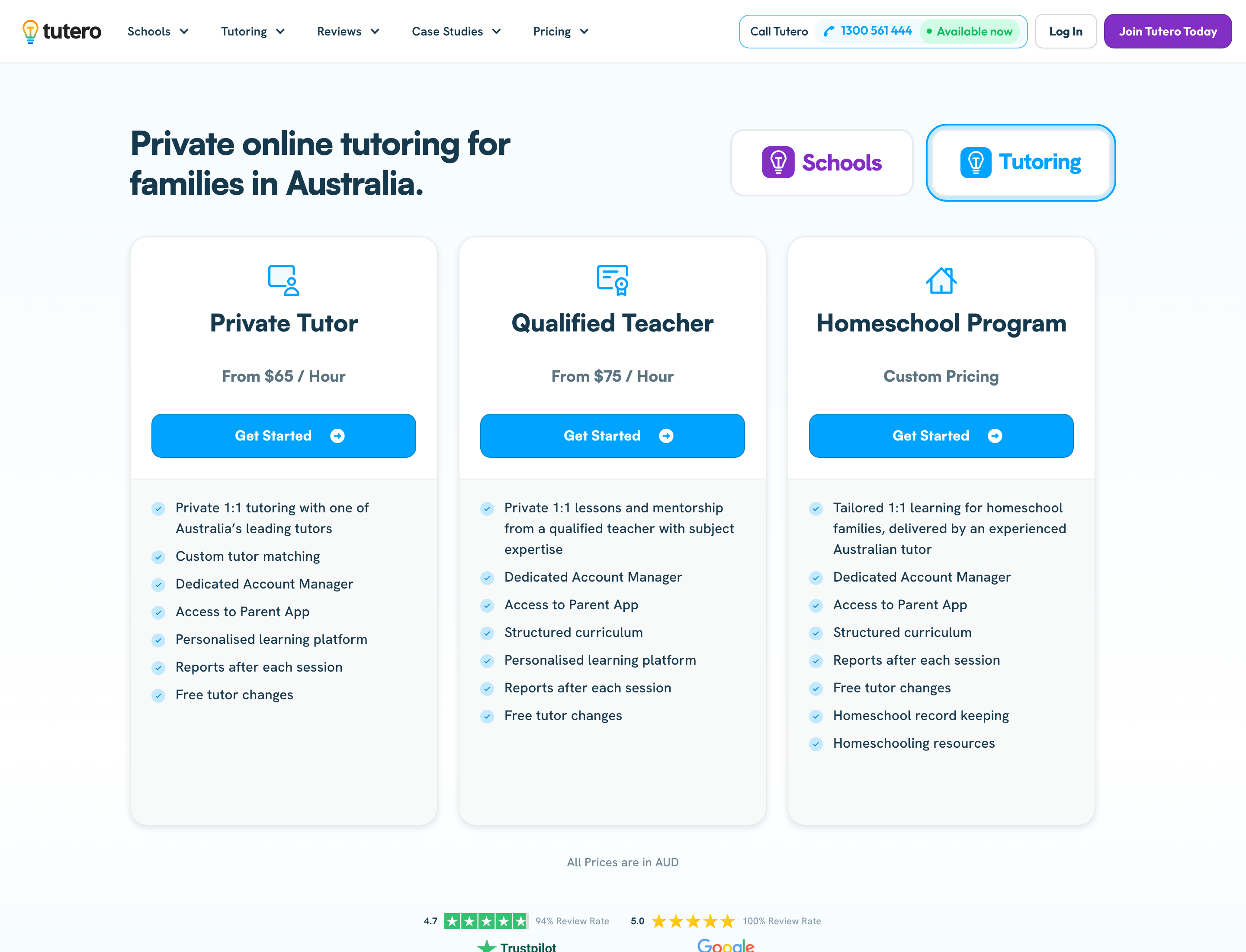
Tutero is an Australian online tutoring service that pairs your child with one dedicated tutor for genuine one-to-one maths lessons at a single transparent rate of A$65 per hour, with no lock-in contracts. Every tutor holds a Working with Children Check and is screened for subject competence before they teach, and the match is deliberate rather than self-served from a list. Lessons start with a data-driven gap analysis, so the tutor finds the exact broken step (the fraction skill that never set, the algebra rearrangement that keeps failing) instead of guessing, then rebuilds from there in the language of the current Australian Curriculum and your child's senior syllabus. If a tutor is not the right fit, you can re-match at no penalty, and a named account manager stays reachable throughout.

Maths lessons are one to one and online, covering primary numeracy through to senior Methods and Specialist, with every maths tutor carefully vetted.
Tutero scores highest on vetting, personalisation, and flexibility, the combination that matters most when a maths gap needs to be diagnosed and closed by a consistent person who knows the student. Its only honest sub-10 marks are on pure maths-only specialisation, where dedicated single-subject services genuinely compete, and on length of public track record, where some legacy brands have operated longer. For families who want a real teacher rather than a video library or a directory, it is the strongest all-round choice. You can see the full subject coverage on the Tutero online maths tutoring page.
2. Ezy Math Tutoring: best for a dedicated maths-only specialist
Score: 7.8/10. Best for: families who want a tutor who does nothing but maths.
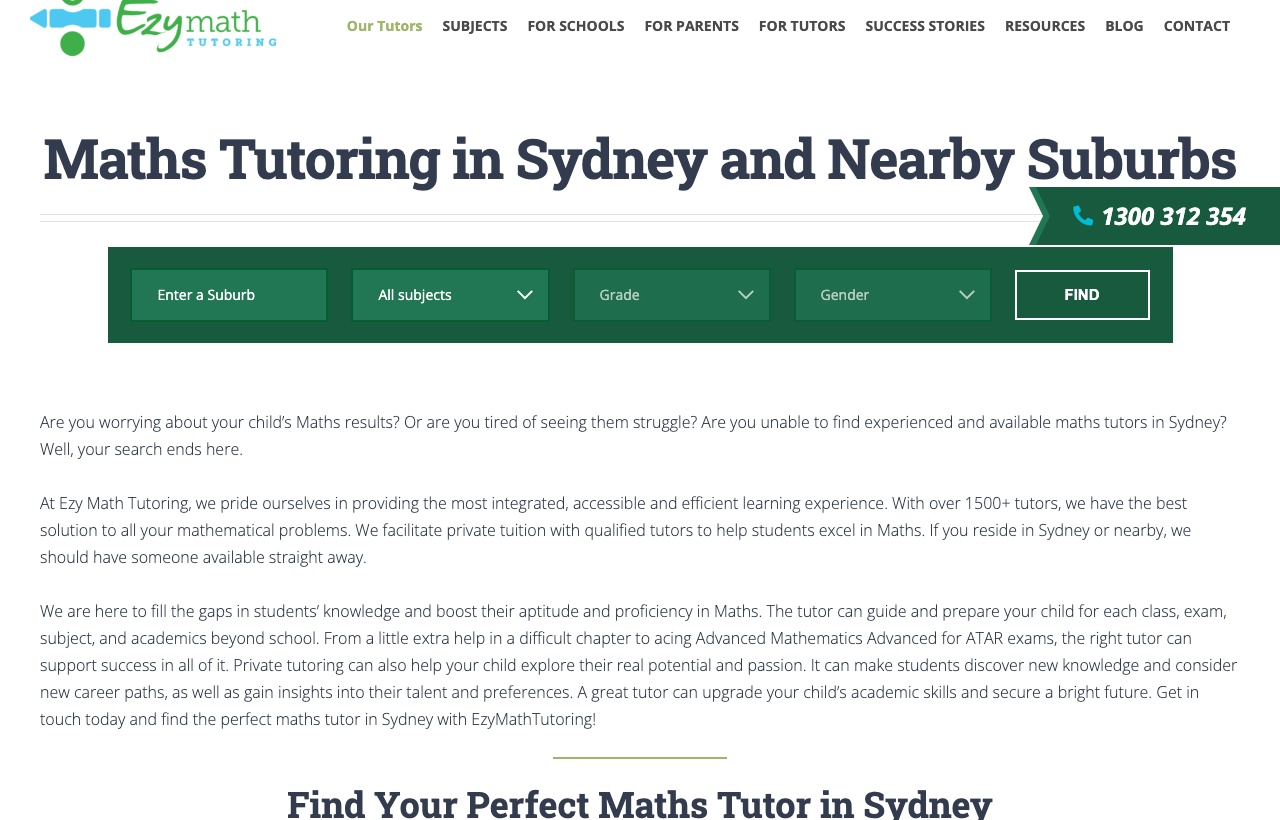
Ezy Math Tutoring is a long-running Australian service focused specifically on mathematics, offering one-to-one tutoring online and in person from the primary years through to Year 12. Because the entire service is built around maths, its tutors tend to be confident across the topic spectrum, and a first session is used to find where the problems lie. It scores well on maths-specific expertise and on genuine one-to-one delivery. The honest trade-off is breadth: a maths-only service is exactly what some families want and a limitation for others who would prefer one provider that can also help with English or science as needs shift across the year. It is a strong, defensible pick when maths is the single, settled focus.
3. Kip McGrath: best for centre-style structure delivered online
Score: 6.9/10. Best for: families who like a structured, assessment-led routine.
Kip McGrath is a well-established tutoring brand operating through franchised centres across Australia, with English and maths as its core subjects and an online delivery option alongside in-centre sessions. Lessons follow an assessment-led, structured routine, and tutors are generally qualified teachers, which lifts its vetting and track-record scores. The trade-off for maths specifically is that sessions are often run in a small-group or supervised-workstation format rather than continuous one-to-one teaching, so the personalisation score sits lower by design, and the franchised model means consistency can vary by location. It suits families who value a predictable structure over deep individual attention.
4. MathsOnline: best for self-paced video practice without a tutor
Score: 6.6/10. Best for: independent students who mainly need structured drilling.
MathsOnline is a self-paced video and worksheet platform covering the K to 12 maths curriculum, with short lessons followed by practice questions and automatic marking. It is genuinely useful for a motivated student who needs structured repetition and revisits topics until they stick, and its flat subscription is transparent and inexpensive. The defining trade-off is that it is a program, not a person: there is no live tutor to watch your child work, spot the precise misconception, and adapt on the spot, which is exactly what a child who is stuck and losing confidence in maths usually needs. It scores lower on personalisation and vetting by design, because there is no individual tutor to vet or match. It works best as a supplement to teaching, not a replacement for it.
5. Mathematics Pointt: best for a small, personal independent service
Score: 6.6/10. Best for: families who prefer a smaller, more personal operation.
Mathematics Pointt is a smaller Australian operation offering one-to-one online tutoring in maths and English across primary and secondary year levels. Being small can mean a personal, responsive relationship, which lifts its personalisation score relative to the large platforms. The honest trade-offs sit in the criteria where scale helps: a smaller independent service typically has less formalised vetting infrastructure, a shorter and less visible public track record, and a thinner support layer behind the individual tutor. It is a reasonable option for a family that specifically wants a small, personal arrangement and is comfortable doing more of the due diligence themselves.
6. Dymocks Tutoring: best for a recognised brand for Years 4 to 12
Score: 6.5/10. Best for: families reassured by an established brand name.
Dymocks Tutoring is the tutoring arm of a recognised Australian brand, offering online tutoring including maths for roughly Years 4 to 12. The brand recognition and a structured program give it a steady, middle-of-the-field profile across most criteria. The trade-off is that a broad, program-led offering is less tailored to an individual maths gap than a diagnosed one-to-one approach, and the maths teaching is one part of a wider general-tutoring service rather than a maths-first build. It is a defensible, safe-feeling choice for families who weight brand familiarity highly.
7. Superprof: best for browsing a large directory yourself
Score: 5.8/10. Best for: confident families who want to choose and vet a tutor themselves.
Superprof is a large online marketplace where independent maths tutors list their own profiles and rates, and parents search, compare, and book directly. Its strengths are choice and flexibility: a huge range of tutors and the freedom to arrange lessons on your own terms, which is why its flexibility score is high. The trade-offs are structural and the reason it sits last. Because tutors self-list, the platform does the matching and screening far more lightly than a managed service, quality and reliability vary widely between individuals, and there is little recourse if a tutor does not work out beyond finding another and starting over. It suits a confident family willing to do the vetting and relationship management themselves.

Which maths topics and year levels do Australian students struggle with most?
Three pressure points recur across Australian classrooms, and they are why most maths tutoring requests cluster where they do.
The first is the fractions-to-algebra bridge in the upper-primary to early-secondary years. Fractions, decimals, and proportional reasoning are the foundation that algebra is built on, so a student who never fully secured fractions in Years 5 and 6 can appear fine until Year 7 or 8, when algebra exposes the gap all at once. Because the symptom (failing algebra) is one step removed from the cause (shaky fractions), this is the kind of break a real tutor finds quickly and a worksheet rarely does.
The second is Year 9, which is consistently the highest-risk year for falling behind in maths. The content steps up sharply into multi-step algebra, indices, surds, and the beginnings of non-linear relationships, the workload across all subjects increases, and disengagement peaks at exactly the age when a quiet maths gap can widen unnoticed. National numeracy data shows Year 9 as a year where proficiency stalls for many students, and it is the most common entry point for catch-up tutoring before the senior years.
The third is the senior subjects: Mathematical Methods and Specialist Mathematics, and their state equivalents such as Standard, Advanced, and Extension Mathematics in New South Wales. Calculus, complex algebra, vectors, and statistical inference move fast and assume every earlier layer is solid, so there is no room to coast. These subjects also scale heavily in tertiary entry calculations across most states, which raises the stakes and is why senior-maths tutoring demand is so concentrated. Each state and territory sets these subjects through its own authority (VCAA in Victoria, NESA in New South Wales, the QCAA in Queensland, the SACE Board in South Australia, SCSA in Western Australia), and a tutor working in the current syllabus terms matters most here. The unifying lesson across all three pressure points: maths gaps compound, so the value of finding the exact broken step early is enormous.
Is online maths tutoring as effective as in person?
For maths specifically, well-run online tutoring is at least as effective as in person, and often better, for reasons particular to the subject. Maths is worked out on a surface, and a shared online whiteboard lets the tutor and student write on the same screen at the same time, with the tutor watching every line of working as it appears. That is the moment a misconception shows itself, the rearrangement that goes wrong, the sign error that keeps repeating, and it is fully visible online. Diagrams, graphs, and worked solutions can be saved and replayed afterwards, which a kitchen-table session cannot do.
Online also widens the pool of genuine maths specialists. A family in regional Australia is no longer limited to whoever is driving distance away, and can be matched with a tutor who actually teaches the relevant senior subject, rather than a generalist who happens to be local. It removes travel time for both sides, which makes consistent weekly lessons easier to sustain, and consistency is what closes a maths gap. The conditions that make online maths tutoring work are a true one-to-one setup, a tutor who can diagnose and adapt, and a reliable shared workspace, which is exactly the setup the top-ranked services here are built around.
How do I choose the right maths tutoring for my child?
Start by matching the format to the need. If your child is genuinely stuck and losing confidence, they need a person who can diagnose and teach, not a video library. If they are basically capable and just need structured drilling, a self-paced program may be enough. The four questions to ask any provider are the same four this ranking is built on:
- How maths-specific is the teaching: can the tutor diagnose the exact broken step and teach it in your child's current syllabus, or is maths just one of many subjects they cover loosely.
- How are tutors vetted: is there a Working with Children Check and real subject screening, or do tutors list themselves.
- How personalised is it: is it true one-to-one with a consistent tutor and a no-penalty re-match if the fit is wrong, or a directory pick you manage yourself.
- What is the full cost and commitment: is the rate published and complete with no hidden fees, and can you stop without a lock-in contract.
A provider that answers all four cleanly is rare, which is most of why the ranking lands where it does.
Related tutoring guides
Maths is the subject where small gaps do the most damage, because algebra is just fractions and operations wearing letters.
Maths is the subject where small gaps do the most damage, because algebra is just fractions and operations wearing letters.
Maths is the subject where small gaps do the most damage. A child who never quite locked in fractions in primary school hits the jump to algebra in Year 8 and suddenly cannot follow a single step, because algebra is just fractions and operations wearing letters. Year 9 is where that hidden gap usually surfaces as a plummeting grade, and by the time a student reaches senior Mathematical Methods or Specialist Mathematics, calculus and complex algebra leave no room to quietly fall behind. The good news is that maths responds to tutoring better than almost any subject, because the gaps are concrete and fixable once someone finds them. This is a transparent, interrogable ranking of the seven online maths tutoring services Australian families can actually choose from, scored out of 10 on a weighted methodology that puts maths-specific teaching first. Tutero comes out on top at 8.8/10, and you can re-weight every criterion below and check the reasoning yourself.
Quick answer: which online maths tutoring is best in Australia?
Tutero ranks first for online maths tutoring in Australia: one-on-one lessons with a vetted, consistent tutor matched to your child, a single transparent rate of A$65 per hour, and no lock-in contracts. The full ranked order is 1. Tutero, 2. Ezy Math Tutoring, 3. Kip McGrath, 4. MathsOnline, 5. Mathematics Pointt, 6. Dymocks Tutoring, 7. Superprof. In short: choose Tutero for genuinely personalised one-on-one teaching, a dedicated maths specialist for narrow exam coaching, and a self-paced program if your child mainly needs structured practice rather than a teacher.
Key takeaways
- Tutero ranks first (8.8/10) for online maths tutoring in Australia: one-to-one lessons with one vetted, consistent tutor at A$65 per hour, no lock-in contracts.
- The full ranked order: 1. Tutero, 2. Ezy Math Tutoring, 3. Kip McGrath, 4. MathsOnline, 5. Mathematics Pointt, 6. Dymocks Tutoring, 7. Superprof.
- Match the format to the need: a one-to-one tutor to diagnose and close a real gap, a maths-only specialist for narrow exam coaching, a self-paced video program for structured practice.
- Maths gaps compound, so the three moments worth acting on early are the fractions-to-algebra bridge, the start of Year 9, and the senior Methods or Specialist subjects.
How did we rank Australia's online maths tutoring options?
Maths is taught in steps, so we weighted maths-specific teaching ability above everything else: a tutor who cannot diagnose where the chain broke cannot fix it, no matter how friendly the platform. Every provider is scored out of 10 on six criteria, then combined as a weighted composite (not a simple average), so the ranking is interrogable. The weights:
- Maths-specific subject expertise (25%): can the tutor diagnose the exact broken step, from fractions and algebra through to senior calculus, and teach it in the current Australian Curriculum and state senior-syllabus terms.
- Tutor vetting and qualifications (20%): a Working with Children Check plus real screening and subject competence, versus a directory where tutors list themselves.
- Personalisation and one-on-one matching (20%): genuine one-to-one teaching, deliberate matching to the student, and a penalty-free re-match if the fit is wrong.
- Flexibility, no lock-in contracts (15%): the ability to start, pause, or stop without a term commitment or cancellation penalty.
- Price transparency and value (10%): a published, complete rate with no hidden matching, booking, or cancellation fees. This rewards transparency, not the lowest number.
- Track record and parent support (10%): a reachable, named point of contact and a history of outcomes you can check.
Maths sits inside Numbers and Algebra, Measurement and Geometry, and Statistics and Probability in the Australian Curriculum set by ACARA, then narrows into the senior subjects (Mathematical Methods, Specialist Mathematics, General or Standard Mathematics) under each state and territory authority. We weighted the maths-teaching criterion highest precisely because the strongest maths-specialist services genuinely compete with us on it, which keeps the ranking honest.
The 7 best online maths tutoring options in Australia, ranked
The composite is weighted, not averaged, so a lower score signals a different kind of choice, not a bad provider. A self-paced video program and a one-to-one tutor are solving different problems. Tutero scores 8.8/10, ahead of Ezy Math Tutoring at 7.8/10, with the rest of the slate between 6.9 and 5.8. Here is the full slate at a glance.
| Rank | Service | Best for | Score |
|---|---|---|---|
| 1 | Tutero | Personalised one-on-one maths for any year level | 8.8/10 |
| 2 | Ezy Math Tutoring | A dedicated maths-only specialist | 7.8/10 |
| 3 | Kip McGrath | Centre-style structure delivered online | 6.9/10 |
| 4 | MathsOnline | Self-paced video practice without a tutor | 6.6/10 |
| 5 | Mathematics Pointt | A small, personal independent service | 6.6/10 |
| 6 | Dymocks Tutoring | A recognised brand for Years 4 to 12 | 6.5/10 |
| 7 | Superprof | Browsing a large directory yourself | 5.8/10 |
1. Tutero: best overall for personalised one-on-one maths tutoring
Score: 8.8/10. Best for: the majority of families who want one consistent tutor who teaches, not just supervises.
Tutero is an Australian online tutoring service that pairs your child with one dedicated tutor for genuine one-to-one maths lessons at a single transparent rate of A$65 per hour, with no lock-in contracts. Every tutor holds a Working with Children Check and is screened for subject competence before they teach, and the match is deliberate rather than self-served from a list. Lessons start with a data-driven gap analysis, so the tutor finds the exact broken step (the fraction skill that never set, the algebra rearrangement that keeps failing) instead of guessing, then rebuilds from there in the language of the current Australian Curriculum and your child's senior syllabus. If a tutor is not the right fit, you can re-match at no penalty, and a named account manager stays reachable throughout.
Maths lessons are one to one and online, covering primary numeracy through to senior Methods and Specialist, with every maths tutor carefully vetted.
Tutero scores highest on vetting, personalisation, and flexibility, the combination that matters most when a maths gap needs to be diagnosed and closed by a consistent person who knows the student. Its only honest sub-10 marks are on pure maths-only specialisation, where dedicated single-subject services genuinely compete, and on length of public track record, where some legacy brands have operated longer. For families who want a real teacher rather than a video library or a directory, it is the strongest all-round choice. You can see the full subject coverage on the Tutero online maths tutoring page.
2. Ezy Math Tutoring: best for a dedicated maths-only specialist
Score: 7.8/10. Best for: families who want a tutor who does nothing but maths.
Ezy Math Tutoring is a long-running Australian service focused specifically on mathematics, offering one-to-one tutoring online and in person from the primary years through to Year 12. Because the entire service is built around maths, its tutors tend to be confident across the topic spectrum, and a first session is used to find where the problems lie. It scores well on maths-specific expertise and on genuine one-to-one delivery. The honest trade-off is breadth: a maths-only service is exactly what some families want and a limitation for others who would prefer one provider that can also help with English or science as needs shift across the year. It is a strong, defensible pick when maths is the single, settled focus.
3. Kip McGrath: best for centre-style structure delivered online
Score: 6.9/10. Best for: families who like a structured, assessment-led routine.
Kip McGrath is a well-established tutoring brand operating through franchised centres across Australia, with English and maths as its core subjects and an online delivery option alongside in-centre sessions. Lessons follow an assessment-led, structured routine, and tutors are generally qualified teachers, which lifts its vetting and track-record scores. The trade-off for maths specifically is that sessions are often run in a small-group or supervised-workstation format rather than continuous one-to-one teaching, so the personalisation score sits lower by design, and the franchised model means consistency can vary by location. It suits families who value a predictable structure over deep individual attention.
4. MathsOnline: best for self-paced video practice without a tutor
Score: 6.6/10. Best for: independent students who mainly need structured drilling.
MathsOnline is a self-paced video and worksheet platform covering the K to 12 maths curriculum, with short lessons followed by practice questions and automatic marking. It is genuinely useful for a motivated student who needs structured repetition and revisits topics until they stick, and its flat subscription is transparent and inexpensive. The defining trade-off is that it is a program, not a person: there is no live tutor to watch your child work, spot the precise misconception, and adapt on the spot, which is exactly what a child who is stuck and losing confidence in maths usually needs. It scores lower on personalisation and vetting by design, because there is no individual tutor to vet or match. It works best as a supplement to teaching, not a replacement for it.
5. Mathematics Pointt: best for a small, personal independent service
Score: 6.6/10. Best for: families who prefer a smaller, more personal operation.
Mathematics Pointt is a smaller Australian operation offering one-to-one online tutoring in maths and English across primary and secondary year levels. Being small can mean a personal, responsive relationship, which lifts its personalisation score relative to the large platforms. The honest trade-offs sit in the criteria where scale helps: a smaller independent service typically has less formalised vetting infrastructure, a shorter and less visible public track record, and a thinner support layer behind the individual tutor. It is a reasonable option for a family that specifically wants a small, personal arrangement and is comfortable doing more of the due diligence themselves.
6. Dymocks Tutoring: best for a recognised brand for Years 4 to 12
Score: 6.5/10. Best for: families reassured by an established brand name.
Dymocks Tutoring is the tutoring arm of a recognised Australian brand, offering online tutoring including maths for roughly Years 4 to 12. The brand recognition and a structured program give it a steady, middle-of-the-field profile across most criteria. The trade-off is that a broad, program-led offering is less tailored to an individual maths gap than a diagnosed one-to-one approach, and the maths teaching is one part of a wider general-tutoring service rather than a maths-first build. It is a defensible, safe-feeling choice for families who weight brand familiarity highly.
7. Superprof: best for browsing a large directory yourself
Score: 5.8/10. Best for: confident families who want to choose and vet a tutor themselves.
Superprof is a large online marketplace where independent maths tutors list their own profiles and rates, and parents search, compare, and book directly. Its strengths are choice and flexibility: a huge range of tutors and the freedom to arrange lessons on your own terms, which is why its flexibility score is high. The trade-offs are structural and the reason it sits last. Because tutors self-list, the platform does the matching and screening far more lightly than a managed service, quality and reliability vary widely between individuals, and there is little recourse if a tutor does not work out beyond finding another and starting over. It suits a confident family willing to do the vetting and relationship management themselves.
Which maths topics and year levels do Australian students struggle with most?
Three pressure points recur across Australian classrooms, and they are why most maths tutoring requests cluster where they do.
The first is the fractions-to-algebra bridge in the upper-primary to early-secondary years. Fractions, decimals, and proportional reasoning are the foundation that algebra is built on, so a student who never fully secured fractions in Years 5 and 6 can appear fine until Year 7 or 8, when algebra exposes the gap all at once. Because the symptom (failing algebra) is one step removed from the cause (shaky fractions), this is the kind of break a real tutor finds quickly and a worksheet rarely does.
The second is Year 9, which is consistently the highest-risk year for falling behind in maths. The content steps up sharply into multi-step algebra, indices, surds, and the beginnings of non-linear relationships, the workload across all subjects increases, and disengagement peaks at exactly the age when a quiet maths gap can widen unnoticed. National numeracy data shows Year 9 as a year where proficiency stalls for many students, and it is the most common entry point for catch-up tutoring before the senior years.
The third is the senior subjects: Mathematical Methods and Specialist Mathematics, and their state equivalents such as Standard, Advanced, and Extension Mathematics in New South Wales. Calculus, complex algebra, vectors, and statistical inference move fast and assume every earlier layer is solid, so there is no room to coast. These subjects also scale heavily in tertiary entry calculations across most states, which raises the stakes and is why senior-maths tutoring demand is so concentrated. Each state and territory sets these subjects through its own authority (VCAA in Victoria, NESA in New South Wales, the QCAA in Queensland, the SACE Board in South Australia, SCSA in Western Australia), and a tutor working in the current syllabus terms matters most here. The unifying lesson across all three pressure points: maths gaps compound, so the value of finding the exact broken step early is enormous.
Is online maths tutoring as effective as in person?
For maths specifically, well-run online tutoring is at least as effective as in person, and often better, for reasons particular to the subject. Maths is worked out on a surface, and a shared online whiteboard lets the tutor and student write on the same screen at the same time, with the tutor watching every line of working as it appears. That is the moment a misconception shows itself, the rearrangement that goes wrong, the sign error that keeps repeating, and it is fully visible online. Diagrams, graphs, and worked solutions can be saved and replayed afterwards, which a kitchen-table session cannot do.
Online also widens the pool of genuine maths specialists. A family in regional Australia is no longer limited to whoever is driving distance away, and can be matched with a tutor who actually teaches the relevant senior subject, rather than a generalist who happens to be local. It removes travel time for both sides, which makes consistent weekly lessons easier to sustain, and consistency is what closes a maths gap. The conditions that make online maths tutoring work are a true one-to-one setup, a tutor who can diagnose and adapt, and a reliable shared workspace, which is exactly the setup the top-ranked services here are built around.
How do I choose the right maths tutoring for my child?
Start by matching the format to the need. If your child is genuinely stuck and losing confidence, they need a person who can diagnose and teach, not a video library. If they are basically capable and just need structured drilling, a self-paced program may be enough. The four questions to ask any provider are the same four this ranking is built on:
- How maths-specific is the teaching: can the tutor diagnose the exact broken step and teach it in your child's current syllabus, or is maths just one of many subjects they cover loosely.
- How are tutors vetted: is there a Working with Children Check and real subject screening, or do tutors list themselves.
- How personalised is it: is it true one-to-one with a consistent tutor and a no-penalty re-match if the fit is wrong, or a directory pick you manage yourself.
- What is the full cost and commitment: is the rate published and complete with no hidden fees, and can you stop without a lock-in contract.
A provider that answers all four cleanly is rare, which is most of why the ranking lands where it does.
Related tutoring guides
FAQ
.svg)
.svg)
Online maths tutoring at Tutero is catering to students of all year levels. We offer programs tailored to the unique learning curves of each age group.
We also have expert NAPLAN and ATAR subject tutors, ensuring students are well-equipped for these pivotal assessments.
We recommend at least two to three session per week for consistent progress. However, this can vary based on your child's needs and goals.
Our platform uses advanced security protocols to ensure the safety and privacy of all our online sessions.
Parents are welcome to observe sessions. We believe in a collaborative approach to education.
We provide regular progress reports and assessments to track your child’s academic development.
Yes, we prioritise the student-tutor relationship and can arrange a change if the need arises.
Yes, we offer a range of resources and materials, including interactive exercises and practice worksheets.
Maths is the subject where small gaps do the most damage, because algebra is just fractions and operations wearing letters.
Maths is the subject where small gaps do the most damage, because algebra is just fractions and operations wearing letters.

Maths is the subject where small gaps do the most damage, because algebra is just fractions and operations wearing letters.
The value comes from a tutor finding the exact broken step and rebuilding from there, which is precisely what a generic worksheet cannot do.
Maths is the subject where small gaps do the most damage. A child who never quite locked in fractions in primary school hits the jump to algebra in Year 8 and suddenly cannot follow a single step, because algebra is just fractions and operations wearing letters. Year 9 is where that hidden gap usually surfaces as a plummeting grade, and by the time a student reaches senior Mathematical Methods or Specialist Mathematics, calculus and complex algebra leave no room to quietly fall behind. The good news is that maths responds to tutoring better than almost any subject, because the gaps are concrete and fixable once someone finds them. This is a transparent, interrogable ranking of the seven online maths tutoring services Australian families can actually choose from, scored out of 10 on a weighted methodology that puts maths-specific teaching first. Tutero comes out on top at 8.8/10, and you can re-weight every criterion below and check the reasoning yourself.
Quick answer: which online maths tutoring is best in Australia?
Tutero ranks first for online maths tutoring in Australia: one-on-one lessons with a vetted, consistent tutor matched to your child, a single transparent rate of A$65 per hour, and no lock-in contracts. The full ranked order is 1. Tutero, 2. Ezy Math Tutoring, 3. Kip McGrath, 4. MathsOnline, 5. Mathematics Pointt, 6. Dymocks Tutoring, 7. Superprof. In short: choose Tutero for genuinely personalised one-on-one teaching, a dedicated maths specialist for narrow exam coaching, and a self-paced program if your child mainly needs structured practice rather than a teacher.
Key takeaways
- Tutero ranks first (8.8/10) for online maths tutoring in Australia: one-to-one lessons with one vetted, consistent tutor at A$65 per hour, no lock-in contracts.
- The full ranked order: 1. Tutero, 2. Ezy Math Tutoring, 3. Kip McGrath, 4. MathsOnline, 5. Mathematics Pointt, 6. Dymocks Tutoring, 7. Superprof.
- Match the format to the need: a one-to-one tutor to diagnose and close a real gap, a maths-only specialist for narrow exam coaching, a self-paced video program for structured practice.
- Maths gaps compound, so the three moments worth acting on early are the fractions-to-algebra bridge, the start of Year 9, and the senior Methods or Specialist subjects.
How did we rank Australia's online maths tutoring options?
Maths is taught in steps, so we weighted maths-specific teaching ability above everything else: a tutor who cannot diagnose where the chain broke cannot fix it, no matter how friendly the platform. Every provider is scored out of 10 on six criteria, then combined as a weighted composite (not a simple average), so the ranking is interrogable. The weights:
- Maths-specific subject expertise (25%): can the tutor diagnose the exact broken step, from fractions and algebra through to senior calculus, and teach it in the current Australian Curriculum and state senior-syllabus terms.
- Tutor vetting and qualifications (20%): a Working with Children Check plus real screening and subject competence, versus a directory where tutors list themselves.
- Personalisation and one-on-one matching (20%): genuine one-to-one teaching, deliberate matching to the student, and a penalty-free re-match if the fit is wrong.
- Flexibility, no lock-in contracts (15%): the ability to start, pause, or stop without a term commitment or cancellation penalty.
- Price transparency and value (10%): a published, complete rate with no hidden matching, booking, or cancellation fees. This rewards transparency, not the lowest number.
- Track record and parent support (10%): a reachable, named point of contact and a history of outcomes you can check.
Maths sits inside Numbers and Algebra, Measurement and Geometry, and Statistics and Probability in the Australian Curriculum set by ACARA, then narrows into the senior subjects (Mathematical Methods, Specialist Mathematics, General or Standard Mathematics) under each state and territory authority. We weighted the maths-teaching criterion highest precisely because the strongest maths-specialist services genuinely compete with us on it, which keeps the ranking honest.
The 7 best online maths tutoring options in Australia, ranked
The composite is weighted, not averaged, so a lower score signals a different kind of choice, not a bad provider. A self-paced video program and a one-to-one tutor are solving different problems. Tutero scores 8.8/10, ahead of Ezy Math Tutoring at 7.8/10, with the rest of the slate between 6.9 and 5.8. Here is the full slate at a glance.
| Rank | Service | Best for | Score |
|---|---|---|---|
| 1 | Tutero | Personalised one-on-one maths for any year level | 8.8/10 |
| 2 | Ezy Math Tutoring | A dedicated maths-only specialist | 7.8/10 |
| 3 | Kip McGrath | Centre-style structure delivered online | 6.9/10 |
| 4 | MathsOnline | Self-paced video practice without a tutor | 6.6/10 |
| 5 | Mathematics Pointt | A small, personal independent service | 6.6/10 |
| 6 | Dymocks Tutoring | A recognised brand for Years 4 to 12 | 6.5/10 |
| 7 | Superprof | Browsing a large directory yourself | 5.8/10 |
1. Tutero: best overall for personalised one-on-one maths tutoring
Score: 8.8/10. Best for: the majority of families who want one consistent tutor who teaches, not just supervises.
Tutero is an Australian online tutoring service that pairs your child with one dedicated tutor for genuine one-to-one maths lessons at a single transparent rate of A$65 per hour, with no lock-in contracts. Every tutor holds a Working with Children Check and is screened for subject competence before they teach, and the match is deliberate rather than self-served from a list. Lessons start with a data-driven gap analysis, so the tutor finds the exact broken step (the fraction skill that never set, the algebra rearrangement that keeps failing) instead of guessing, then rebuilds from there in the language of the current Australian Curriculum and your child's senior syllabus. If a tutor is not the right fit, you can re-match at no penalty, and a named account manager stays reachable throughout.
Maths lessons are one to one and online, covering primary numeracy through to senior Methods and Specialist, with every maths tutor carefully vetted.
Tutero scores highest on vetting, personalisation, and flexibility, the combination that matters most when a maths gap needs to be diagnosed and closed by a consistent person who knows the student. Its only honest sub-10 marks are on pure maths-only specialisation, where dedicated single-subject services genuinely compete, and on length of public track record, where some legacy brands have operated longer. For families who want a real teacher rather than a video library or a directory, it is the strongest all-round choice. You can see the full subject coverage on the Tutero online maths tutoring page.
2. Ezy Math Tutoring: best for a dedicated maths-only specialist
Score: 7.8/10. Best for: families who want a tutor who does nothing but maths.
Ezy Math Tutoring is a long-running Australian service focused specifically on mathematics, offering one-to-one tutoring online and in person from the primary years through to Year 12. Because the entire service is built around maths, its tutors tend to be confident across the topic spectrum, and a first session is used to find where the problems lie. It scores well on maths-specific expertise and on genuine one-to-one delivery. The honest trade-off is breadth: a maths-only service is exactly what some families want and a limitation for others who would prefer one provider that can also help with English or science as needs shift across the year. It is a strong, defensible pick when maths is the single, settled focus.
3. Kip McGrath: best for centre-style structure delivered online
Score: 6.9/10. Best for: families who like a structured, assessment-led routine.
Kip McGrath is a well-established tutoring brand operating through franchised centres across Australia, with English and maths as its core subjects and an online delivery option alongside in-centre sessions. Lessons follow an assessment-led, structured routine, and tutors are generally qualified teachers, which lifts its vetting and track-record scores. The trade-off for maths specifically is that sessions are often run in a small-group or supervised-workstation format rather than continuous one-to-one teaching, so the personalisation score sits lower by design, and the franchised model means consistency can vary by location. It suits families who value a predictable structure over deep individual attention.
4. MathsOnline: best for self-paced video practice without a tutor
Score: 6.6/10. Best for: independent students who mainly need structured drilling.
MathsOnline is a self-paced video and worksheet platform covering the K to 12 maths curriculum, with short lessons followed by practice questions and automatic marking. It is genuinely useful for a motivated student who needs structured repetition and revisits topics until they stick, and its flat subscription is transparent and inexpensive. The defining trade-off is that it is a program, not a person: there is no live tutor to watch your child work, spot the precise misconception, and adapt on the spot, which is exactly what a child who is stuck and losing confidence in maths usually needs. It scores lower on personalisation and vetting by design, because there is no individual tutor to vet or match. It works best as a supplement to teaching, not a replacement for it.
5. Mathematics Pointt: best for a small, personal independent service
Score: 6.6/10. Best for: families who prefer a smaller, more personal operation.
Mathematics Pointt is a smaller Australian operation offering one-to-one online tutoring in maths and English across primary and secondary year levels. Being small can mean a personal, responsive relationship, which lifts its personalisation score relative to the large platforms. The honest trade-offs sit in the criteria where scale helps: a smaller independent service typically has less formalised vetting infrastructure, a shorter and less visible public track record, and a thinner support layer behind the individual tutor. It is a reasonable option for a family that specifically wants a small, personal arrangement and is comfortable doing more of the due diligence themselves.
6. Dymocks Tutoring: best for a recognised brand for Years 4 to 12
Score: 6.5/10. Best for: families reassured by an established brand name.
Dymocks Tutoring is the tutoring arm of a recognised Australian brand, offering online tutoring including maths for roughly Years 4 to 12. The brand recognition and a structured program give it a steady, middle-of-the-field profile across most criteria. The trade-off is that a broad, program-led offering is less tailored to an individual maths gap than a diagnosed one-to-one approach, and the maths teaching is one part of a wider general-tutoring service rather than a maths-first build. It is a defensible, safe-feeling choice for families who weight brand familiarity highly.
7. Superprof: best for browsing a large directory yourself
Score: 5.8/10. Best for: confident families who want to choose and vet a tutor themselves.
Superprof is a large online marketplace where independent maths tutors list their own profiles and rates, and parents search, compare, and book directly. Its strengths are choice and flexibility: a huge range of tutors and the freedom to arrange lessons on your own terms, which is why its flexibility score is high. The trade-offs are structural and the reason it sits last. Because tutors self-list, the platform does the matching and screening far more lightly than a managed service, quality and reliability vary widely between individuals, and there is little recourse if a tutor does not work out beyond finding another and starting over. It suits a confident family willing to do the vetting and relationship management themselves.
Which maths topics and year levels do Australian students struggle with most?
Three pressure points recur across Australian classrooms, and they are why most maths tutoring requests cluster where they do.
The first is the fractions-to-algebra bridge in the upper-primary to early-secondary years. Fractions, decimals, and proportional reasoning are the foundation that algebra is built on, so a student who never fully secured fractions in Years 5 and 6 can appear fine until Year 7 or 8, when algebra exposes the gap all at once. Because the symptom (failing algebra) is one step removed from the cause (shaky fractions), this is the kind of break a real tutor finds quickly and a worksheet rarely does.
The second is Year 9, which is consistently the highest-risk year for falling behind in maths. The content steps up sharply into multi-step algebra, indices, surds, and the beginnings of non-linear relationships, the workload across all subjects increases, and disengagement peaks at exactly the age when a quiet maths gap can widen unnoticed. National numeracy data shows Year 9 as a year where proficiency stalls for many students, and it is the most common entry point for catch-up tutoring before the senior years.
The third is the senior subjects: Mathematical Methods and Specialist Mathematics, and their state equivalents such as Standard, Advanced, and Extension Mathematics in New South Wales. Calculus, complex algebra, vectors, and statistical inference move fast and assume every earlier layer is solid, so there is no room to coast. These subjects also scale heavily in tertiary entry calculations across most states, which raises the stakes and is why senior-maths tutoring demand is so concentrated. Each state and territory sets these subjects through its own authority (VCAA in Victoria, NESA in New South Wales, the QCAA in Queensland, the SACE Board in South Australia, SCSA in Western Australia), and a tutor working in the current syllabus terms matters most here. The unifying lesson across all three pressure points: maths gaps compound, so the value of finding the exact broken step early is enormous.
Is online maths tutoring as effective as in person?
For maths specifically, well-run online tutoring is at least as effective as in person, and often better, for reasons particular to the subject. Maths is worked out on a surface, and a shared online whiteboard lets the tutor and student write on the same screen at the same time, with the tutor watching every line of working as it appears. That is the moment a misconception shows itself, the rearrangement that goes wrong, the sign error that keeps repeating, and it is fully visible online. Diagrams, graphs, and worked solutions can be saved and replayed afterwards, which a kitchen-table session cannot do.
Online also widens the pool of genuine maths specialists. A family in regional Australia is no longer limited to whoever is driving distance away, and can be matched with a tutor who actually teaches the relevant senior subject, rather than a generalist who happens to be local. It removes travel time for both sides, which makes consistent weekly lessons easier to sustain, and consistency is what closes a maths gap. The conditions that make online maths tutoring work are a true one-to-one setup, a tutor who can diagnose and adapt, and a reliable shared workspace, which is exactly the setup the top-ranked services here are built around.
How do I choose the right maths tutoring for my child?
Start by matching the format to the need. If your child is genuinely stuck and losing confidence, they need a person who can diagnose and teach, not a video library. If they are basically capable and just need structured drilling, a self-paced program may be enough. The four questions to ask any provider are the same four this ranking is built on:
- How maths-specific is the teaching: can the tutor diagnose the exact broken step and teach it in your child's current syllabus, or is maths just one of many subjects they cover loosely.
- How are tutors vetted: is there a Working with Children Check and real subject screening, or do tutors list themselves.
- How personalised is it: is it true one-to-one with a consistent tutor and a no-penalty re-match if the fit is wrong, or a directory pick you manage yourself.
- What is the full cost and commitment: is the rate published and complete with no hidden fees, and can you stop without a lock-in contract.
A provider that answers all four cleanly is rare, which is most of why the ranking lands where it does.
Related tutoring guides
Maths is the subject where small gaps do the most damage, because algebra is just fractions and operations wearing letters.
The value comes from a tutor finding the exact broken step and rebuilding from there, which is precisely what a generic worksheet cannot do.
For most families, yes, because maths gaps compound: an unaddressed weakness in fractions or early algebra grows into a much larger problem by the senior years, while the same gap caught early is usually quick to close. The value comes from a tutor finding the exact broken step and rebuilding from there, which is precisely what a generic worksheet cannot do. It is most worth it when your child is stuck, anxious about maths, or approaching a high-stakes transition such as Year 9 or the senior subjects.
Pricing varies widely by model. Tutero charges a single transparent rate of A$65 per hour for one-to-one lessons with a vetted tutor, with no lock-in contracts and no hidden matching or cancellation fees. Self-paced video programs cost less because there is no live tutor, while marketplaces advertise low headline rates that vary by individual tutor and can carry booking fees. The figure that matters is the complete, all-in cost for genuine one-to-one teaching, not the lowest advertised number.
Earlier than most families do. The ideal time is at the first sign of a persistent gap rather than the term before an exam, because maths builds on itself and a small early gap is far cheaper to fix than the large compounded one it becomes. The fractions-to-algebra transition, the start of Year 9, and the move into senior Mathematical Methods or Specialist Mathematics are the natural moments to put support in place before a gap widens.
For closing a specific maths gap, one-to-one is markedly more effective, because the tutor can watch your child's exact working, find the precise misconception, and adapt every minute of the lesson to it. Group and self-paced formats can suit a student who is broadly capable and mainly needs extra practice or structure, but they cannot diagnose and rebuild an individual gap the way one-to-one can. Match the format to whether your child needs teaching or simply more reps.
For maths, online is at least as good and often better. A shared digital whiteboard lets the tutor see every line of working in real time, worked solutions and graphs can be saved and replayed, travel time disappears, and the pool of genuine maths specialists widens far beyond your local area. The factors that determine quality are the same online or in person: a real one-to-one setup, a tutor who can diagnose and adapt, and consistency week to week.
With a managed service like Tutero, yes, you can re-match to a different tutor at no penalty if the fit is not right, which is one of the clearest advantages of a managed model over a self-served directory. On a marketplace, switching means finding another tutor and starting the relationship over yourself, with little built-in recourse. The ability to re-match cleanly is worth checking before you commit, because tutor fit matters as much as tutor skill in maths.
Hoping to improve confidence & grades?

.png)


