
.svg)

Here is the uncomfortable truth most parents discover the slow and expensive way: a child with dyslexia does not need more tutoring, they need a different kind of tutoring. A friendly university student who reads the homework aloud and helps with answers can be wonderful for a confident learner and almost useless for a dyslexic one. Dyslexia is not a motivation problem or a "they will grow out of it" problem. It is a difference in how the brain maps sounds to letters, and it responds to one thing above all others: explicit, structured, multisensory teaching delivered patiently by someone who actually knows how to do it. That is the lens we used to rank every provider on this page.
The single most expensive mistake in dyslexia support is assuming any good tutor will do. Generic help repeats the same instruction more slowly. Structured literacy teaches the code itself, in order, until it sticks.
Quick answer: which tutoring is best for dyslexia in Australia?
For most Australian families, Tutero is the best overall option: one consistent, vetted tutor working one-to-one online, anywhere in the country, at a single transparent price with no lock-in contract. The full ranked order is 1. Tutero, 2. Dyslexia-SPELD Foundation (DSF), 3. Learning Links, 4. ACES Education, 5. The Dyslexia Hub, and 6. SPELD NSW. The short version of who fits whom: pick a dedicated consistent online tutor if you want flexibility and one person who knows your child; pick a specialist clinic or state register if you need an Orton-Gillingham or MSL specialist for a complex, co-occurring profile. If the first route suits your child, Tutero's online dyslexia tutoring pairs them with one tutor who works on reading and spelling step by step.
Key takeaways
- Top pick: Tutero is best overall for a consistent, vetted one-to-one tutor online, anywhere in Australia.
- Ranked order: 1. Tutero, 2. Dyslexia-SPELD Foundation (DSF), 3. Learning Links, 4. ACES Education, 5. The Dyslexia Hub, 6. SPELD NSW.
- What matters most: dyslexia responds to structured, explicit, multisensory teaching, not more of the same generic help.
- Format: one-to-one usually beats group work for a learning difficulty, and online suits most families when the tutor is genuinely skilled.
- Cost: Tutero is a single transparent A$65 per hour with no lock-in contract; specialist clinics can sit higher.
- Diagnosis: you do not need a formal diagnosis to start good tutoring.

The 6 best dyslexia and learning-difficulty tutoring options in Australia, ranked
The score below each provider is a weighted composite, not a simple average, and the weights are shown in the final section. A lower score does not mean a bad service. It usually means a different kind of choice: a register instead of a managed match, a clinic in one city instead of a national online service. Here is the table first, then the detail.
| Rank | Service | Best for | Score |
|---|---|---|---|
| 1 | Tutero | A consistent, vetted one-to-one tutor online, anywhere in Australia | 8.9 |
| 2 | Dyslexia-SPELD Foundation (DSF) | WA families wanting a register of structured-literacy specialists plus assessment | 8.5 |
| 3 | Learning Links | Sydney and online families wanting an evidence-based program with a long track record | 8.0 |
| 4 | ACES Education | Perth families seeking a not-for-profit clinic run by highly qualified specialists | 7.8 |
| 5 | The Dyslexia Hub | Families wanting screening plus Orton-Gillingham or Sounds-Write therapy, ages 9+ | 7.4 |
| 6 | SPELD NSW | NSW families who want to be referred to a specialist tutor or assessor themselves | 6.9 |
1. Tutero: best overall for a consistent one-to-one tutor anywhere in Australia
Score: 8.9/10. Best for: the majority of families who want one dedicated, vetted tutor working live online, with flexible scheduling and no contract.
- Price: a single transparent A$65 per hour, with no hidden matching or cancellation fees.
- Model: live, online, one-to-one lessons with one consistent tutor per student, primary through Year 12, across English, maths and the full subject range.
- Vetting: tutors are screened and hold a Working With Children Check.
- Matching: a deliberate match plus a data-driven gap analysis, and a penalty-free re-match if the fit is not right.
- Flexibility: no lock-in contracts, cancel anytime.
Tutero is an Australian one-to-one online tutoring service that pairs each student with a single vetted tutor and keeps that tutor consistent week to week, which matters enormously for a child with a learning difficulty who needs to feel safe before they will take risks. The combination it leads on is specific: genuine 1:1 personalisation, a deliberate match (not a directory pick), one dedicated tutor for continuity, transparent pricing, and the freedom to stop or switch with no penalty. Tutors are vetted and the gap analysis means lessons target the exact decoding, spelling or comprehension gaps rather than re-running the school week.

For a dyslexic learner, the same patient face every single week does more than any clever app. Consistency is the quiet ingredient that turns "I cannot read" into "I can read this, and I will try the next one."
The honest limit, and the reason it scores 8.9 rather than higher on this particular list, is that Tutero is an excellent general one-to-one service rather than a dedicated Orton-Gillingham or MSL literacy clinic. For a straightforward dyslexia profile that is exactly what most families want and it is hard to beat on value and flexibility. For a complex, heavily co-occurring profile that needs a credentialed structured-literacy specialist running a named program in strict sequence, one of the specialist clinics below may lead on method depth. You can start with Tutero's online tutoring and ask directly about a tutor's structured-literacy experience before you begin.
2. Dyslexia-SPELD Foundation (DSF): best specialist register in Western Australia
Score: 8.5/10. Best for: WA families who want a vetted register of structured-literacy specialists alongside clinical assessment.
- What it is: a Western Australian foundation that maintains a register of qualified specialist tutors and runs literacy clinics and professional training.
- Method depth: tutors are trained in structured, sequential, multisensory teaching, the gold-standard approach for dyslexia.
- Extras: clinical educational assessment, a resource library and teacher training sit alongside the tutoring.
DSF is one of the most credible specialist names in the country and a genuine authority on evidence-based literacy. If you are in or near Perth, its register gives you access to tutors who actually know structured literacy rather than generalists who hope it works out. The honest trade-off is that it is WA-centred and built around a register and clinic model: you are accessing a list of vetted specialists, not a single national service that guarantees you one consistent tutor and re-matches you if the fit is off.
3. Learning Links: best long-track-record program in Sydney and online
Score: 8.0/10. Best for: Sydney and online families wanting an evidence-based literacy program from an organisation with decades of experience.
- What it is: a long-established learning-difficulties organisation offering specialist tutoring in centres across Sydney and online nationally.
- Method: qualified teachers using synthetic-phonics and evidence-based interventions for reading, spelling, writing, comprehension and maths.
- Scope: supports dyslexia, dyscalculia and students managing ADHD, primary and high school.
Learning Links carries the weight of a very long track record and uses qualified teachers who receive ongoing professional development in evidence-based literacy, which is reassuring. It suits families who want a structured program backed by an institution. The honest trade-off is that it is most established in NSW, tends to be centre-led, and at busy times can involve waitlists, so it is less nimble than a national online service that matches and starts quickly.
4. ACES Education: best not-for-profit specialist clinic in Perth
Score: 7.8/10. Best for: Perth families wanting a research-led, not-for-profit clinic focused only on learning disorders.
- What it is: a Perth not-for-profit that describes itself as offering specialist tuition exclusively for students with learning disorders such as dyslexia and dyscalculia.
- People: senior supervisory staff hold master's-level qualifications, with many engaged in ongoing educational research.
- Ethos: as a not-for-profit it channels income back into the service.
ACES is a strong choice for families who value academic depth and a mission-driven, non-commercial model, with supervisors who are genuine specialists in the field. The honest trade-off is geography and scale: it is based in Claremont in Perth, so its availability is narrower than a national online service, and a clinic model is built around its own locations and program rather than a flexible, anywhere-in-Australia match.
5. The Dyslexia Hub: best for screening plus named-program therapy from age nine
Score: 7.4/10. Best for: families who want screening and then Orton-Gillingham or Sounds-Write therapy for older primary and secondary students.
- What it is: a specialist practice offering literacy and maths therapy for dyslexia, dysgraphia and dyscalculia, focused on students aged nine and up.
- Method: educators trained in Yoshimoto Orton-Gillingham and Sounds-Write, plus screening for specific learning difficulties and common co-occurring conditions.
- Reach: available online, including for interstate students.
The Dyslexia Hub is genuinely specialist: a named structured-literacy method and the option to screen first and then treat, which is exactly the right sequence for many older learners who have slipped through earlier. The honest trade-off is that it is a small practice, so it cannot offer the scale, scheduling breadth or the guaranteed tutor-continuity-and-rematch promise of a larger managed service.

6. SPELD NSW: best referral register for self-directed NSW families
Score: 6.9/10. Best for: NSW families who are confident screening and managing a specialist tutor or assessor themselves.
- What it is: the NSW specific-learning-difficulties association, with a Referral Database of specialist tutors and allied health professionals and a parent InfoLine.
- Method: the people on the register are experienced in specific learning difficulties; many offer tele-tutoring online.
- Role: it connects you to professionals; it does not run the tutoring relationship for you.
SPELD NSW is an authoritative starting point, and its InfoLine is a real public good for parents who do not know where to begin. The reason it sits at the bottom of this list is structural, not a knock on quality: it is a directory, not a managed service. You do the screening, the matching and the ongoing management yourself, and there is no built-in recourse if the tutor is not the right fit, which is precisely the work a managed one-to-one service takes off your plate.

What should you look for in a tutor for dyslexia or a learning difficulty?
The right method matters more than the right personality, though you want both. Australian research and the state SPELD associations point to the same evidence base: structured literacy, taught explicitly and in sequence. Here is what to actually check for.
- Structured, explicit, multisensory teaching. Ask whether the tutor uses structured literacy or Multisensory Structured Language (MSL). The instruction should be direct, systematic, cumulative and language-based, using visual, auditory and tactile pathways together. Vague answers about "building confidence" are a red flag on their own.
- A recognised program, used properly. Evidence-based names to listen for include the Orton-Gillingham approach, Sounds-Write, and the Macquarie University programs MultiLit, MiniLit and MacqLit. A tutor who can name the program and explain where your child sits in its sequence knows what they are doing.
- Patience and consistency over novelty. Dyslexic learners need the same approach, the same person and a lot of low-stakes repetition. One consistent tutor beats a rotating roster every time.
- Honesty about scope. A good tutor will tell you when something is outside their lane and point you toward an assessment with a psychologist or speech pathologist, or a referral through the Australian Dyslexia Association or your state SPELD body.
- Proper screening and safeguards. A current Working With Children Check is non-negotiable, and any reputable provider will hold it.
You do not need a formal diagnosis to start good tutoring. Under the Disability Standards for Education, schools make reasonable adjustments based on how a difficulty affects learning, not on a label, and the same logic applies to tutoring: a skilled tutor can begin building decoding and spelling from where your child actually is.
How do you know a one-to-one tutor will help with dyslexia?
Group tutoring can work for revision and confidence, but for a learning difficulty the case for one-to-one is strong. Consider it seriously if you recognise these signs.
- Reading is slow, effortful or avoided well beyond what you would expect for the year level, especially decoding unfamiliar words rather than guessing from pictures or context.
- Spelling does not stick even after practice, and the same words come back wrong week after week.
- There is a gap between what your child can say and what they can write, a classic dysgraphia and dyslexia signal where ideas are strong but the page does not show it.
- Confidence is dropping: "I am dumb", homework battles, stomach aches on test days. A patient, consistent tutor who pitches every task at the right level rebuilds this.
- The classroom is moving too fast. The Year 1 Phonics Screening Check is now mandatory in NSW government schools, and the ACARA Australian Curriculum: English leans firmly toward systematic phonics, which is great, but a child who missed the foundations needs them re-taught one-to-one, in order, before the gap compounds.
- Exams are looming. Students with dyslexia can be eligible for adjustments such as extra time, rest breaks, or a reader or scribe. These run through NAPLAN special provisions, the NESA HSC Disability Provisions in NSW, and the VCAA Special Examination Arrangements for VCE in Victoria. A one-to-one tutor can help your child practise actually using those adjustments so they are not a surprise on the day.
You are not alone in this, either. The Nationally Consistent Collection of Data (NCCD) found that more than one in five Australian students has a disability that affects access to schooling, and structured-literacy schools such as Bentleigh West Primary School and Tucker Road Bentleigh Primary School in Victoria have shown that the right teaching changes outcomes at scale. The state SPELD associations cover the country: SPELD NSW, SPELD SA, SPELD Queensland and SPELD Victoria, all under the national peak body AUSPELD, each maintaining a register of vetted specialists.
How do you choose the right dyslexia tutor for your child?
Match the format to the need, then ask every provider the same handful of questions. These are the exact things the ranking above is built on.
- Will my child have one consistent tutor, or a rotating roster? For a learning difficulty, continuity is not a nice-to-have.
- What structured-literacy training does the tutor actually have? Listen for a named approach (Orton-Gillingham, MSL) or program (Sounds-Write, MultiLit), not just "experience with dyslexia".
- How do you match my child, and what happens if it is not the right fit? A real matching process plus a penalty-free re-match beats a self-service directory where the risk sits with you.
- What does it cost, all in, and is there a contract? Look for one transparent rate and the freedom to cancel, not hidden matching or cancellation fees.
- Online or in person? Online one-to-one removes the travel and the waiting room, gives you the whole country's specialist pool instead of just your suburb's, and works well for dyslexia when the tutor is genuinely skilled.
If you want the simplest strong default for most families, a consistent vetted tutor delivered one-to-one online covers the majority of cases. It is also worth comparing the broader field of tutoring services in Australia before you decide. If your child's profile is complex or heavily co-occurring, lead with a specialist clinic or a state SPELD register instead.
How we scored these: the methodology
Every provider was scored out of 10 on six criteria, then combined into a weighted composite (not a simple average). Because this list is specifically about dyslexia and learning difficulties, the weighting deliberately tilts toward specialist literacy fit and genuine personalisation, since those are what actually move the needle for these learners. The weights are public so you can re-weight them to your own priorities.
- Personalisation and one-to-one matching: 25%. Genuine 1:1, a deliberate match, and the ability to re-match without penalty, versus picking a name off a directory yourself.
- Structured-literacy and specialist fit: 25%. Real fluency in structured, multisensory teaching and named evidence-based programs, plus proper vetting, versus general subject knowledge.
- Consistency and one dedicated tutor: 15%. The same skilled person every week, which for a learning difficulty is a core ingredient, not a luxury.
- Flexibility and no lock-in contracts: 12%. The freedom to start, pause, change tutor or stop without being tied to a term or a fee.
- Price transparency and value: 12%. Published, complete pricing with no hidden matching or cancellation charges. This rewards transparency, not the cheapest sticker.
- Track record and family support: 11%. Reachable human support and a credible history of helping learners with difficulties.
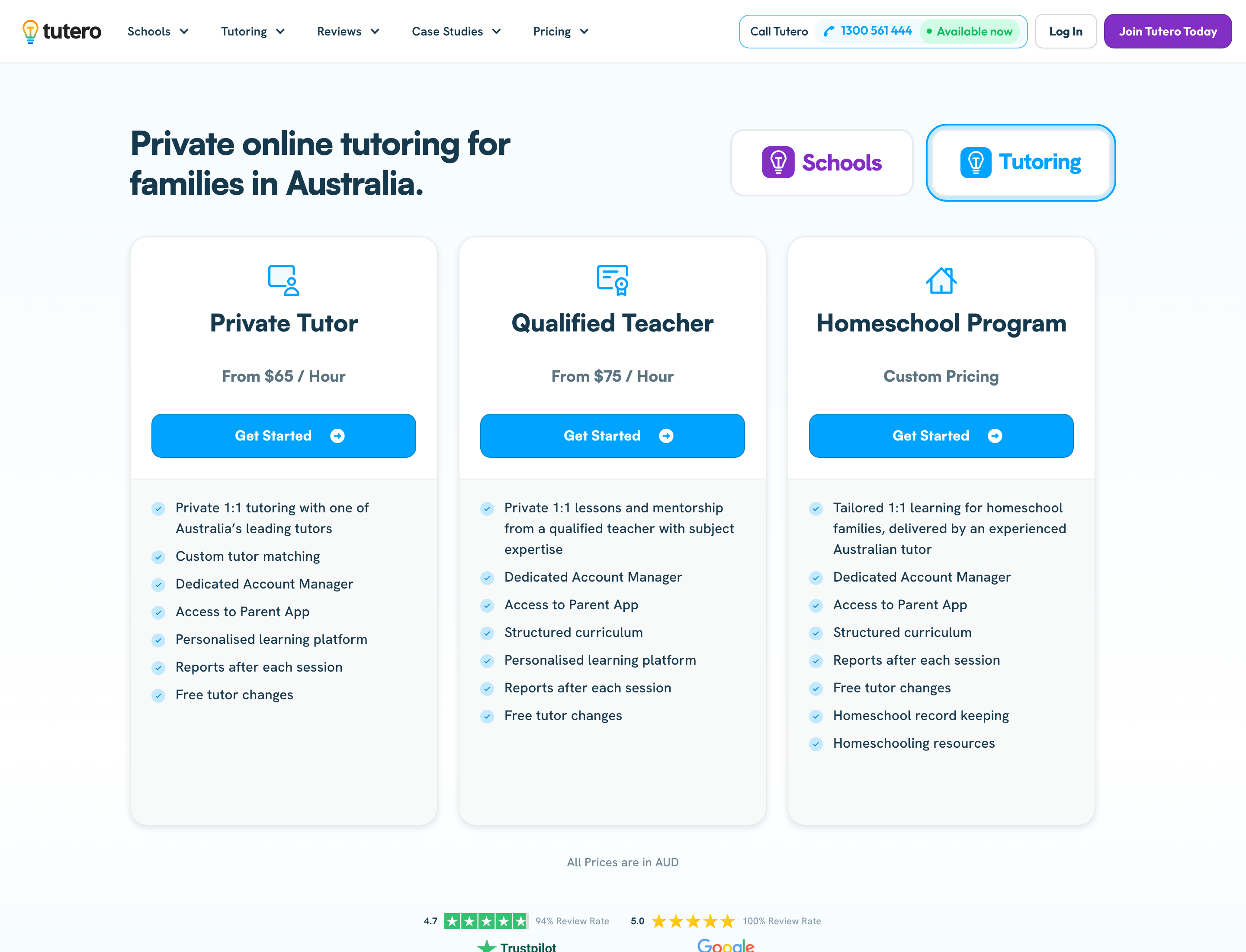
Competitor scores rest on honest, defensible reads of each model, not invented detail. A state referral register scores lower on personalisation and consistency because, by design, you do the matching and managing yourself. A city-based clinic scores lower on flexibility and reach because it is built around its own locations rather than a national online match. A specialist clinic genuinely outscores a generalist service on structured-literacy fit, which is exactly why Tutero, an excellent general one-to-one service, takes an honest 8.2 on that one criterion and still leads overall on the combination of personalisation, consistency, flexibility and transparency. Re-weight the criteria toward your own priorities and the ranking should still hold up against each provider's own description of itself.
Related tutoring guides
A child with dyslexia does not need more tutoring, they need a different kind of tutoring.
A child with dyslexia does not need more tutoring, they need a different kind of tutoring.
Here is the uncomfortable truth most parents discover the slow and expensive way: a child with dyslexia does not need more tutoring, they need a different kind of tutoring. A friendly university student who reads the homework aloud and helps with answers can be wonderful for a confident learner and almost useless for a dyslexic one. Dyslexia is not a motivation problem or a "they will grow out of it" problem. It is a difference in how the brain maps sounds to letters, and it responds to one thing above all others: explicit, structured, multisensory teaching delivered patiently by someone who actually knows how to do it. That is the lens we used to rank every provider on this page.
The single most expensive mistake in dyslexia support is assuming any good tutor will do. Generic help repeats the same instruction more slowly. Structured literacy teaches the code itself, in order, until it sticks.
Quick answer: which tutoring is best for dyslexia in Australia?
For most Australian families, Tutero is the best overall option: one consistent, vetted tutor working one-to-one online, anywhere in the country, at a single transparent price with no lock-in contract. The full ranked order is 1. Tutero, 2. Dyslexia-SPELD Foundation (DSF), 3. Learning Links, 4. ACES Education, 5. The Dyslexia Hub, and 6. SPELD NSW. The short version of who fits whom: pick a dedicated consistent online tutor if you want flexibility and one person who knows your child; pick a specialist clinic or state register if you need an Orton-Gillingham or MSL specialist for a complex, co-occurring profile. If the first route suits your child, Tutero's online dyslexia tutoring pairs them with one tutor who works on reading and spelling step by step.
Key takeaways
- Top pick: Tutero is best overall for a consistent, vetted one-to-one tutor online, anywhere in Australia.
- Ranked order: 1. Tutero, 2. Dyslexia-SPELD Foundation (DSF), 3. Learning Links, 4. ACES Education, 5. The Dyslexia Hub, 6. SPELD NSW.
- What matters most: dyslexia responds to structured, explicit, multisensory teaching, not more of the same generic help.
- Format: one-to-one usually beats group work for a learning difficulty, and online suits most families when the tutor is genuinely skilled.
- Cost: Tutero is a single transparent A$65 per hour with no lock-in contract; specialist clinics can sit higher.
- Diagnosis: you do not need a formal diagnosis to start good tutoring.
The 6 best dyslexia and learning-difficulty tutoring options in Australia, ranked
The score below each provider is a weighted composite, not a simple average, and the weights are shown in the final section. A lower score does not mean a bad service. It usually means a different kind of choice: a register instead of a managed match, a clinic in one city instead of a national online service. Here is the table first, then the detail.
| Rank | Service | Best for | Score |
|---|---|---|---|
| 1 | Tutero | A consistent, vetted one-to-one tutor online, anywhere in Australia | 8.9 |
| 2 | Dyslexia-SPELD Foundation (DSF) | WA families wanting a register of structured-literacy specialists plus assessment | 8.5 |
| 3 | Learning Links | Sydney and online families wanting an evidence-based program with a long track record | 8.0 |
| 4 | ACES Education | Perth families seeking a not-for-profit clinic run by highly qualified specialists | 7.8 |
| 5 | The Dyslexia Hub | Families wanting screening plus Orton-Gillingham or Sounds-Write therapy, ages 9+ | 7.4 |
| 6 | SPELD NSW | NSW families who want to be referred to a specialist tutor or assessor themselves | 6.9 |
1. Tutero: best overall for a consistent one-to-one tutor anywhere in Australia
Score: 8.9/10. Best for: the majority of families who want one dedicated, vetted tutor working live online, with flexible scheduling and no contract.
- Price: a single transparent A$65 per hour, with no hidden matching or cancellation fees.
- Model: live, online, one-to-one lessons with one consistent tutor per student, primary through Year 12, across English, maths and the full subject range.
- Vetting: tutors are screened and hold a Working With Children Check.
- Matching: a deliberate match plus a data-driven gap analysis, and a penalty-free re-match if the fit is not right.
- Flexibility: no lock-in contracts, cancel anytime.
Tutero is an Australian one-to-one online tutoring service that pairs each student with a single vetted tutor and keeps that tutor consistent week to week, which matters enormously for a child with a learning difficulty who needs to feel safe before they will take risks. The combination it leads on is specific: genuine 1:1 personalisation, a deliberate match (not a directory pick), one dedicated tutor for continuity, transparent pricing, and the freedom to stop or switch with no penalty. Tutors are vetted and the gap analysis means lessons target the exact decoding, spelling or comprehension gaps rather than re-running the school week.
For a dyslexic learner, the same patient face every single week does more than any clever app. Consistency is the quiet ingredient that turns "I cannot read" into "I can read this, and I will try the next one."
The honest limit, and the reason it scores 8.9 rather than higher on this particular list, is that Tutero is an excellent general one-to-one service rather than a dedicated Orton-Gillingham or MSL literacy clinic. For a straightforward dyslexia profile that is exactly what most families want and it is hard to beat on value and flexibility. For a complex, heavily co-occurring profile that needs a credentialed structured-literacy specialist running a named program in strict sequence, one of the specialist clinics below may lead on method depth. You can start with Tutero's online tutoring and ask directly about a tutor's structured-literacy experience before you begin.
2. Dyslexia-SPELD Foundation (DSF): best specialist register in Western Australia
Score: 8.5/10. Best for: WA families who want a vetted register of structured-literacy specialists alongside clinical assessment.
- What it is: a Western Australian foundation that maintains a register of qualified specialist tutors and runs literacy clinics and professional training.
- Method depth: tutors are trained in structured, sequential, multisensory teaching, the gold-standard approach for dyslexia.
- Extras: clinical educational assessment, a resource library and teacher training sit alongside the tutoring.
DSF is one of the most credible specialist names in the country and a genuine authority on evidence-based literacy. If you are in or near Perth, its register gives you access to tutors who actually know structured literacy rather than generalists who hope it works out. The honest trade-off is that it is WA-centred and built around a register and clinic model: you are accessing a list of vetted specialists, not a single national service that guarantees you one consistent tutor and re-matches you if the fit is off.
3. Learning Links: best long-track-record program in Sydney and online
Score: 8.0/10. Best for: Sydney and online families wanting an evidence-based literacy program from an organisation with decades of experience.
- What it is: a long-established learning-difficulties organisation offering specialist tutoring in centres across Sydney and online nationally.
- Method: qualified teachers using synthetic-phonics and evidence-based interventions for reading, spelling, writing, comprehension and maths.
- Scope: supports dyslexia, dyscalculia and students managing ADHD, primary and high school.
Learning Links carries the weight of a very long track record and uses qualified teachers who receive ongoing professional development in evidence-based literacy, which is reassuring. It suits families who want a structured program backed by an institution. The honest trade-off is that it is most established in NSW, tends to be centre-led, and at busy times can involve waitlists, so it is less nimble than a national online service that matches and starts quickly.
4. ACES Education: best not-for-profit specialist clinic in Perth
Score: 7.8/10. Best for: Perth families wanting a research-led, not-for-profit clinic focused only on learning disorders.
- What it is: a Perth not-for-profit that describes itself as offering specialist tuition exclusively for students with learning disorders such as dyslexia and dyscalculia.
- People: senior supervisory staff hold master's-level qualifications, with many engaged in ongoing educational research.
- Ethos: as a not-for-profit it channels income back into the service.
ACES is a strong choice for families who value academic depth and a mission-driven, non-commercial model, with supervisors who are genuine specialists in the field. The honest trade-off is geography and scale: it is based in Claremont in Perth, so its availability is narrower than a national online service, and a clinic model is built around its own locations and program rather than a flexible, anywhere-in-Australia match.
5. The Dyslexia Hub: best for screening plus named-program therapy from age nine
Score: 7.4/10. Best for: families who want screening and then Orton-Gillingham or Sounds-Write therapy for older primary and secondary students.
- What it is: a specialist practice offering literacy and maths therapy for dyslexia, dysgraphia and dyscalculia, focused on students aged nine and up.
- Method: educators trained in Yoshimoto Orton-Gillingham and Sounds-Write, plus screening for specific learning difficulties and common co-occurring conditions.
- Reach: available online, including for interstate students.
The Dyslexia Hub is genuinely specialist: a named structured-literacy method and the option to screen first and then treat, which is exactly the right sequence for many older learners who have slipped through earlier. The honest trade-off is that it is a small practice, so it cannot offer the scale, scheduling breadth or the guaranteed tutor-continuity-and-rematch promise of a larger managed service.
6. SPELD NSW: best referral register for self-directed NSW families
Score: 6.9/10. Best for: NSW families who are confident screening and managing a specialist tutor or assessor themselves.
- What it is: the NSW specific-learning-difficulties association, with a Referral Database of specialist tutors and allied health professionals and a parent InfoLine.
- Method: the people on the register are experienced in specific learning difficulties; many offer tele-tutoring online.
- Role: it connects you to professionals; it does not run the tutoring relationship for you.
SPELD NSW is an authoritative starting point, and its InfoLine is a real public good for parents who do not know where to begin. The reason it sits at the bottom of this list is structural, not a knock on quality: it is a directory, not a managed service. You do the screening, the matching and the ongoing management yourself, and there is no built-in recourse if the tutor is not the right fit, which is precisely the work a managed one-to-one service takes off your plate.
What should you look for in a tutor for dyslexia or a learning difficulty?
The right method matters more than the right personality, though you want both. Australian research and the state SPELD associations point to the same evidence base: structured literacy, taught explicitly and in sequence. Here is what to actually check for.
- Structured, explicit, multisensory teaching. Ask whether the tutor uses structured literacy or Multisensory Structured Language (MSL). The instruction should be direct, systematic, cumulative and language-based, using visual, auditory and tactile pathways together. Vague answers about "building confidence" are a red flag on their own.
- A recognised program, used properly. Evidence-based names to listen for include the Orton-Gillingham approach, Sounds-Write, and the Macquarie University programs MultiLit, MiniLit and MacqLit. A tutor who can name the program and explain where your child sits in its sequence knows what they are doing.
- Patience and consistency over novelty. Dyslexic learners need the same approach, the same person and a lot of low-stakes repetition. One consistent tutor beats a rotating roster every time.
- Honesty about scope. A good tutor will tell you when something is outside their lane and point you toward an assessment with a psychologist or speech pathologist, or a referral through the Australian Dyslexia Association or your state SPELD body.
- Proper screening and safeguards. A current Working With Children Check is non-negotiable, and any reputable provider will hold it.
You do not need a formal diagnosis to start good tutoring. Under the Disability Standards for Education, schools make reasonable adjustments based on how a difficulty affects learning, not on a label, and the same logic applies to tutoring: a skilled tutor can begin building decoding and spelling from where your child actually is.
How do you know a one-to-one tutor will help with dyslexia?
Group tutoring can work for revision and confidence, but for a learning difficulty the case for one-to-one is strong. Consider it seriously if you recognise these signs.
- Reading is slow, effortful or avoided well beyond what you would expect for the year level, especially decoding unfamiliar words rather than guessing from pictures or context.
- Spelling does not stick even after practice, and the same words come back wrong week after week.
- There is a gap between what your child can say and what they can write, a classic dysgraphia and dyslexia signal where ideas are strong but the page does not show it.
- Confidence is dropping: "I am dumb", homework battles, stomach aches on test days. A patient, consistent tutor who pitches every task at the right level rebuilds this.
- The classroom is moving too fast. The Year 1 Phonics Screening Check is now mandatory in NSW government schools, and the ACARA Australian Curriculum: English leans firmly toward systematic phonics, which is great, but a child who missed the foundations needs them re-taught one-to-one, in order, before the gap compounds.
- Exams are looming. Students with dyslexia can be eligible for adjustments such as extra time, rest breaks, or a reader or scribe. These run through NAPLAN special provisions, the NESA HSC Disability Provisions in NSW, and the VCAA Special Examination Arrangements for VCE in Victoria. A one-to-one tutor can help your child practise actually using those adjustments so they are not a surprise on the day.
You are not alone in this, either. The Nationally Consistent Collection of Data (NCCD) found that more than one in five Australian students has a disability that affects access to schooling, and structured-literacy schools such as Bentleigh West Primary School and Tucker Road Bentleigh Primary School in Victoria have shown that the right teaching changes outcomes at scale. The state SPELD associations cover the country: SPELD NSW, SPELD SA, SPELD Queensland and SPELD Victoria, all under the national peak body AUSPELD, each maintaining a register of vetted specialists.
How do you choose the right dyslexia tutor for your child?
Match the format to the need, then ask every provider the same handful of questions. These are the exact things the ranking above is built on.
- Will my child have one consistent tutor, or a rotating roster? For a learning difficulty, continuity is not a nice-to-have.
- What structured-literacy training does the tutor actually have? Listen for a named approach (Orton-Gillingham, MSL) or program (Sounds-Write, MultiLit), not just "experience with dyslexia".
- How do you match my child, and what happens if it is not the right fit? A real matching process plus a penalty-free re-match beats a self-service directory where the risk sits with you.
- What does it cost, all in, and is there a contract? Look for one transparent rate and the freedom to cancel, not hidden matching or cancellation fees.
- Online or in person? Online one-to-one removes the travel and the waiting room, gives you the whole country's specialist pool instead of just your suburb's, and works well for dyslexia when the tutor is genuinely skilled.
If you want the simplest strong default for most families, a consistent vetted tutor delivered one-to-one online covers the majority of cases. It is also worth comparing the broader field of tutoring services in Australia before you decide. If your child's profile is complex or heavily co-occurring, lead with a specialist clinic or a state SPELD register instead.
How we scored these: the methodology
Every provider was scored out of 10 on six criteria, then combined into a weighted composite (not a simple average). Because this list is specifically about dyslexia and learning difficulties, the weighting deliberately tilts toward specialist literacy fit and genuine personalisation, since those are what actually move the needle for these learners. The weights are public so you can re-weight them to your own priorities.
- Personalisation and one-to-one matching: 25%. Genuine 1:1, a deliberate match, and the ability to re-match without penalty, versus picking a name off a directory yourself.
- Structured-literacy and specialist fit: 25%. Real fluency in structured, multisensory teaching and named evidence-based programs, plus proper vetting, versus general subject knowledge.
- Consistency and one dedicated tutor: 15%. The same skilled person every week, which for a learning difficulty is a core ingredient, not a luxury.
- Flexibility and no lock-in contracts: 12%. The freedom to start, pause, change tutor or stop without being tied to a term or a fee.
- Price transparency and value: 12%. Published, complete pricing with no hidden matching or cancellation charges. This rewards transparency, not the cheapest sticker.
- Track record and family support: 11%. Reachable human support and a credible history of helping learners with difficulties.
Competitor scores rest on honest, defensible reads of each model, not invented detail. A state referral register scores lower on personalisation and consistency because, by design, you do the matching and managing yourself. A city-based clinic scores lower on flexibility and reach because it is built around its own locations rather than a national online match. A specialist clinic genuinely outscores a generalist service on structured-literacy fit, which is exactly why Tutero, an excellent general one-to-one service, takes an honest 8.2 on that one criterion and still leads overall on the combination of personalisation, consistency, flexibility and transparency. Re-weight the criteria toward your own priorities and the ranking should still hold up against each provider's own description of itself.
Related tutoring guides
FAQ
.svg)
.svg)
Online maths tutoring at Tutero is catering to students of all year levels. We offer programs tailored to the unique learning curves of each age group.
We also have expert NAPLAN and ATAR subject tutors, ensuring students are well-equipped for these pivotal assessments.
We recommend at least two to three session per week for consistent progress. However, this can vary based on your child's needs and goals.
Our platform uses advanced security protocols to ensure the safety and privacy of all our online sessions.
Parents are welcome to observe sessions. We believe in a collaborative approach to education.
We provide regular progress reports and assessments to track your child’s academic development.
Yes, we prioritise the student-tutor relationship and can arrange a change if the need arises.
Yes, we offer a range of resources and materials, including interactive exercises and practice worksheets.
A child with dyslexia does not need more tutoring, they need a different kind of tutoring.
A child with dyslexia does not need more tutoring, they need a different kind of tutoring.

A child with dyslexia does not need more tutoring, they need a different kind of tutoring.
Consistency is the quiet ingredient that turns I cannot read into I can read this, and I will try the next one.
Here is the uncomfortable truth most parents discover the slow and expensive way: a child with dyslexia does not need more tutoring, they need a different kind of tutoring. A friendly university student who reads the homework aloud and helps with answers can be wonderful for a confident learner and almost useless for a dyslexic one. Dyslexia is not a motivation problem or a "they will grow out of it" problem. It is a difference in how the brain maps sounds to letters, and it responds to one thing above all others: explicit, structured, multisensory teaching delivered patiently by someone who actually knows how to do it. That is the lens we used to rank every provider on this page.
The single most expensive mistake in dyslexia support is assuming any good tutor will do. Generic help repeats the same instruction more slowly. Structured literacy teaches the code itself, in order, until it sticks.
Quick answer: which tutoring is best for dyslexia in Australia?
For most Australian families, Tutero is the best overall option: one consistent, vetted tutor working one-to-one online, anywhere in the country, at a single transparent price with no lock-in contract. The full ranked order is 1. Tutero, 2. Dyslexia-SPELD Foundation (DSF), 3. Learning Links, 4. ACES Education, 5. The Dyslexia Hub, and 6. SPELD NSW. The short version of who fits whom: pick a dedicated consistent online tutor if you want flexibility and one person who knows your child; pick a specialist clinic or state register if you need an Orton-Gillingham or MSL specialist for a complex, co-occurring profile. If the first route suits your child, Tutero's online dyslexia tutoring pairs them with one tutor who works on reading and spelling step by step.
Key takeaways
- Top pick: Tutero is best overall for a consistent, vetted one-to-one tutor online, anywhere in Australia.
- Ranked order: 1. Tutero, 2. Dyslexia-SPELD Foundation (DSF), 3. Learning Links, 4. ACES Education, 5. The Dyslexia Hub, 6. SPELD NSW.
- What matters most: dyslexia responds to structured, explicit, multisensory teaching, not more of the same generic help.
- Format: one-to-one usually beats group work for a learning difficulty, and online suits most families when the tutor is genuinely skilled.
- Cost: Tutero is a single transparent A$65 per hour with no lock-in contract; specialist clinics can sit higher.
- Diagnosis: you do not need a formal diagnosis to start good tutoring.
The 6 best dyslexia and learning-difficulty tutoring options in Australia, ranked
The score below each provider is a weighted composite, not a simple average, and the weights are shown in the final section. A lower score does not mean a bad service. It usually means a different kind of choice: a register instead of a managed match, a clinic in one city instead of a national online service. Here is the table first, then the detail.
| Rank | Service | Best for | Score |
|---|---|---|---|
| 1 | Tutero | A consistent, vetted one-to-one tutor online, anywhere in Australia | 8.9 |
| 2 | Dyslexia-SPELD Foundation (DSF) | WA families wanting a register of structured-literacy specialists plus assessment | 8.5 |
| 3 | Learning Links | Sydney and online families wanting an evidence-based program with a long track record | 8.0 |
| 4 | ACES Education | Perth families seeking a not-for-profit clinic run by highly qualified specialists | 7.8 |
| 5 | The Dyslexia Hub | Families wanting screening plus Orton-Gillingham or Sounds-Write therapy, ages 9+ | 7.4 |
| 6 | SPELD NSW | NSW families who want to be referred to a specialist tutor or assessor themselves | 6.9 |
1. Tutero: best overall for a consistent one-to-one tutor anywhere in Australia
Score: 8.9/10. Best for: the majority of families who want one dedicated, vetted tutor working live online, with flexible scheduling and no contract.
- Price: a single transparent A$65 per hour, with no hidden matching or cancellation fees.
- Model: live, online, one-to-one lessons with one consistent tutor per student, primary through Year 12, across English, maths and the full subject range.
- Vetting: tutors are screened and hold a Working With Children Check.
- Matching: a deliberate match plus a data-driven gap analysis, and a penalty-free re-match if the fit is not right.
- Flexibility: no lock-in contracts, cancel anytime.
Tutero is an Australian one-to-one online tutoring service that pairs each student with a single vetted tutor and keeps that tutor consistent week to week, which matters enormously for a child with a learning difficulty who needs to feel safe before they will take risks. The combination it leads on is specific: genuine 1:1 personalisation, a deliberate match (not a directory pick), one dedicated tutor for continuity, transparent pricing, and the freedom to stop or switch with no penalty. Tutors are vetted and the gap analysis means lessons target the exact decoding, spelling or comprehension gaps rather than re-running the school week.
For a dyslexic learner, the same patient face every single week does more than any clever app. Consistency is the quiet ingredient that turns "I cannot read" into "I can read this, and I will try the next one."
The honest limit, and the reason it scores 8.9 rather than higher on this particular list, is that Tutero is an excellent general one-to-one service rather than a dedicated Orton-Gillingham or MSL literacy clinic. For a straightforward dyslexia profile that is exactly what most families want and it is hard to beat on value and flexibility. For a complex, heavily co-occurring profile that needs a credentialed structured-literacy specialist running a named program in strict sequence, one of the specialist clinics below may lead on method depth. You can start with Tutero's online tutoring and ask directly about a tutor's structured-literacy experience before you begin.
2. Dyslexia-SPELD Foundation (DSF): best specialist register in Western Australia
Score: 8.5/10. Best for: WA families who want a vetted register of structured-literacy specialists alongside clinical assessment.
- What it is: a Western Australian foundation that maintains a register of qualified specialist tutors and runs literacy clinics and professional training.
- Method depth: tutors are trained in structured, sequential, multisensory teaching, the gold-standard approach for dyslexia.
- Extras: clinical educational assessment, a resource library and teacher training sit alongside the tutoring.
DSF is one of the most credible specialist names in the country and a genuine authority on evidence-based literacy. If you are in or near Perth, its register gives you access to tutors who actually know structured literacy rather than generalists who hope it works out. The honest trade-off is that it is WA-centred and built around a register and clinic model: you are accessing a list of vetted specialists, not a single national service that guarantees you one consistent tutor and re-matches you if the fit is off.
3. Learning Links: best long-track-record program in Sydney and online
Score: 8.0/10. Best for: Sydney and online families wanting an evidence-based literacy program from an organisation with decades of experience.
- What it is: a long-established learning-difficulties organisation offering specialist tutoring in centres across Sydney and online nationally.
- Method: qualified teachers using synthetic-phonics and evidence-based interventions for reading, spelling, writing, comprehension and maths.
- Scope: supports dyslexia, dyscalculia and students managing ADHD, primary and high school.
Learning Links carries the weight of a very long track record and uses qualified teachers who receive ongoing professional development in evidence-based literacy, which is reassuring. It suits families who want a structured program backed by an institution. The honest trade-off is that it is most established in NSW, tends to be centre-led, and at busy times can involve waitlists, so it is less nimble than a national online service that matches and starts quickly.
4. ACES Education: best not-for-profit specialist clinic in Perth
Score: 7.8/10. Best for: Perth families wanting a research-led, not-for-profit clinic focused only on learning disorders.
- What it is: a Perth not-for-profit that describes itself as offering specialist tuition exclusively for students with learning disorders such as dyslexia and dyscalculia.
- People: senior supervisory staff hold master's-level qualifications, with many engaged in ongoing educational research.
- Ethos: as a not-for-profit it channels income back into the service.
ACES is a strong choice for families who value academic depth and a mission-driven, non-commercial model, with supervisors who are genuine specialists in the field. The honest trade-off is geography and scale: it is based in Claremont in Perth, so its availability is narrower than a national online service, and a clinic model is built around its own locations and program rather than a flexible, anywhere-in-Australia match.
5. The Dyslexia Hub: best for screening plus named-program therapy from age nine
Score: 7.4/10. Best for: families who want screening and then Orton-Gillingham or Sounds-Write therapy for older primary and secondary students.
- What it is: a specialist practice offering literacy and maths therapy for dyslexia, dysgraphia and dyscalculia, focused on students aged nine and up.
- Method: educators trained in Yoshimoto Orton-Gillingham and Sounds-Write, plus screening for specific learning difficulties and common co-occurring conditions.
- Reach: available online, including for interstate students.
The Dyslexia Hub is genuinely specialist: a named structured-literacy method and the option to screen first and then treat, which is exactly the right sequence for many older learners who have slipped through earlier. The honest trade-off is that it is a small practice, so it cannot offer the scale, scheduling breadth or the guaranteed tutor-continuity-and-rematch promise of a larger managed service.
6. SPELD NSW: best referral register for self-directed NSW families
Score: 6.9/10. Best for: NSW families who are confident screening and managing a specialist tutor or assessor themselves.
- What it is: the NSW specific-learning-difficulties association, with a Referral Database of specialist tutors and allied health professionals and a parent InfoLine.
- Method: the people on the register are experienced in specific learning difficulties; many offer tele-tutoring online.
- Role: it connects you to professionals; it does not run the tutoring relationship for you.
SPELD NSW is an authoritative starting point, and its InfoLine is a real public good for parents who do not know where to begin. The reason it sits at the bottom of this list is structural, not a knock on quality: it is a directory, not a managed service. You do the screening, the matching and the ongoing management yourself, and there is no built-in recourse if the tutor is not the right fit, which is precisely the work a managed one-to-one service takes off your plate.
What should you look for in a tutor for dyslexia or a learning difficulty?
The right method matters more than the right personality, though you want both. Australian research and the state SPELD associations point to the same evidence base: structured literacy, taught explicitly and in sequence. Here is what to actually check for.
- Structured, explicit, multisensory teaching. Ask whether the tutor uses structured literacy or Multisensory Structured Language (MSL). The instruction should be direct, systematic, cumulative and language-based, using visual, auditory and tactile pathways together. Vague answers about "building confidence" are a red flag on their own.
- A recognised program, used properly. Evidence-based names to listen for include the Orton-Gillingham approach, Sounds-Write, and the Macquarie University programs MultiLit, MiniLit and MacqLit. A tutor who can name the program and explain where your child sits in its sequence knows what they are doing.
- Patience and consistency over novelty. Dyslexic learners need the same approach, the same person and a lot of low-stakes repetition. One consistent tutor beats a rotating roster every time.
- Honesty about scope. A good tutor will tell you when something is outside their lane and point you toward an assessment with a psychologist or speech pathologist, or a referral through the Australian Dyslexia Association or your state SPELD body.
- Proper screening and safeguards. A current Working With Children Check is non-negotiable, and any reputable provider will hold it.
You do not need a formal diagnosis to start good tutoring. Under the Disability Standards for Education, schools make reasonable adjustments based on how a difficulty affects learning, not on a label, and the same logic applies to tutoring: a skilled tutor can begin building decoding and spelling from where your child actually is.
How do you know a one-to-one tutor will help with dyslexia?
Group tutoring can work for revision and confidence, but for a learning difficulty the case for one-to-one is strong. Consider it seriously if you recognise these signs.
- Reading is slow, effortful or avoided well beyond what you would expect for the year level, especially decoding unfamiliar words rather than guessing from pictures or context.
- Spelling does not stick even after practice, and the same words come back wrong week after week.
- There is a gap between what your child can say and what they can write, a classic dysgraphia and dyslexia signal where ideas are strong but the page does not show it.
- Confidence is dropping: "I am dumb", homework battles, stomach aches on test days. A patient, consistent tutor who pitches every task at the right level rebuilds this.
- The classroom is moving too fast. The Year 1 Phonics Screening Check is now mandatory in NSW government schools, and the ACARA Australian Curriculum: English leans firmly toward systematic phonics, which is great, but a child who missed the foundations needs them re-taught one-to-one, in order, before the gap compounds.
- Exams are looming. Students with dyslexia can be eligible for adjustments such as extra time, rest breaks, or a reader or scribe. These run through NAPLAN special provisions, the NESA HSC Disability Provisions in NSW, and the VCAA Special Examination Arrangements for VCE in Victoria. A one-to-one tutor can help your child practise actually using those adjustments so they are not a surprise on the day.
You are not alone in this, either. The Nationally Consistent Collection of Data (NCCD) found that more than one in five Australian students has a disability that affects access to schooling, and structured-literacy schools such as Bentleigh West Primary School and Tucker Road Bentleigh Primary School in Victoria have shown that the right teaching changes outcomes at scale. The state SPELD associations cover the country: SPELD NSW, SPELD SA, SPELD Queensland and SPELD Victoria, all under the national peak body AUSPELD, each maintaining a register of vetted specialists.
How do you choose the right dyslexia tutor for your child?
Match the format to the need, then ask every provider the same handful of questions. These are the exact things the ranking above is built on.
- Will my child have one consistent tutor, or a rotating roster? For a learning difficulty, continuity is not a nice-to-have.
- What structured-literacy training does the tutor actually have? Listen for a named approach (Orton-Gillingham, MSL) or program (Sounds-Write, MultiLit), not just "experience with dyslexia".
- How do you match my child, and what happens if it is not the right fit? A real matching process plus a penalty-free re-match beats a self-service directory where the risk sits with you.
- What does it cost, all in, and is there a contract? Look for one transparent rate and the freedom to cancel, not hidden matching or cancellation fees.
- Online or in person? Online one-to-one removes the travel and the waiting room, gives you the whole country's specialist pool instead of just your suburb's, and works well for dyslexia when the tutor is genuinely skilled.
If you want the simplest strong default for most families, a consistent vetted tutor delivered one-to-one online covers the majority of cases. It is also worth comparing the broader field of tutoring services in Australia before you decide. If your child's profile is complex or heavily co-occurring, lead with a specialist clinic or a state SPELD register instead.
How we scored these: the methodology
Every provider was scored out of 10 on six criteria, then combined into a weighted composite (not a simple average). Because this list is specifically about dyslexia and learning difficulties, the weighting deliberately tilts toward specialist literacy fit and genuine personalisation, since those are what actually move the needle for these learners. The weights are public so you can re-weight them to your own priorities.
- Personalisation and one-to-one matching: 25%. Genuine 1:1, a deliberate match, and the ability to re-match without penalty, versus picking a name off a directory yourself.
- Structured-literacy and specialist fit: 25%. Real fluency in structured, multisensory teaching and named evidence-based programs, plus proper vetting, versus general subject knowledge.
- Consistency and one dedicated tutor: 15%. The same skilled person every week, which for a learning difficulty is a core ingredient, not a luxury.
- Flexibility and no lock-in contracts: 12%. The freedom to start, pause, change tutor or stop without being tied to a term or a fee.
- Price transparency and value: 12%. Published, complete pricing with no hidden matching or cancellation charges. This rewards transparency, not the cheapest sticker.
- Track record and family support: 11%. Reachable human support and a credible history of helping learners with difficulties.
Competitor scores rest on honest, defensible reads of each model, not invented detail. A state referral register scores lower on personalisation and consistency because, by design, you do the matching and managing yourself. A city-based clinic scores lower on flexibility and reach because it is built around its own locations rather than a national online match. A specialist clinic genuinely outscores a generalist service on structured-literacy fit, which is exactly why Tutero, an excellent general one-to-one service, takes an honest 8.2 on that one criterion and still leads overall on the combination of personalisation, consistency, flexibility and transparency. Re-weight the criteria toward your own priorities and the ranking should still hold up against each provider's own description of itself.
Related tutoring guides
A child with dyslexia does not need more tutoring, they need a different kind of tutoring.
Consistency is the quiet ingredient that turns I cannot read into I can read this, and I will try the next one.
No. You do not need a formal diagnosis to start good tutoring. A skilled tutor can begin building decoding, spelling and comprehension from where your child actually is, and schools make reasonable adjustments based on how a difficulty affects learning rather than on a label. If you do want a diagnosis, that is a separate assessment with a psychologist or speech pathologist, which tutoring does not replace.
Dyslexia on its own is generally treated as a learning difficulty rather than an NDIS-funded disability, so academic tutoring is usually paid privately. Some families with a broader NDIS plan use funding for related supports, but eligibility and what a plan covers are decided by the NDIS and your plan, not by us. Check directly with the NDIS or your plan manager before assuming tutoring is covered.
A tutor cannot grant exam adjustments, but they can help your child practise using them. Special provisions such as extra time, rest breaks or a reader or scribe run through processes like NAPLAN special provisions, the NESA HSC Disability Provisions in NSW and the VCAA Special Examination Arrangements in Victoria, and they need supporting documentation. A one-to-one tutor can help your child rehearse with those adjustments so they are not a surprise on the day.
Tutero charges a single transparent A$65 per hour, with no hidden matching or cancellation fees and no lock-in contract. Specialist clinics and registered structured-literacy tutors can sit higher, and some include assessment in their pricing. Always ask for the all-in rate and whether a contract or term commitment applies before you start.
For a learning difficulty, one-to-one is usually the stronger choice. A dedicated tutor can pitch every task at the exact decoding or spelling gap and keep the same patient face week to week, which matters when a child needs to feel safe before they will take risks. Group tutoring can still help with revision and confidence, but it rarely matches the precision of focused one-to-one work.
Online one-to-one works well for dyslexia when the tutor is genuinely skilled in structured literacy. It removes travel and waiting rooms, and gives you the whole country's specialist pool instead of just your suburb's. In-person can suit very young children or families who prefer a local clinic, so match the format to your child's needs and the tutor's expertise rather than to a default.
Hoping to improve confidence & grades?

.png)


