.svg)

A primary school science class can contain students who already use precise scientific vocabulary, students who understand the idea but cannot yet explain it, and students meeting the concept for the first time. Differentiation does not mean writing three unrelated lessons. It means holding the important science goal steady while changing the support, route, pace or way students show what they know.
This guide gives teachers a repeatable model for Foundation to Year 6. It combines diagnostic assessment, explicit vocabulary, purposeful grouping, scaffolded inquiry and meaningful extension. The aim is not to make the science easier. It is to remove avoidable barriers so every student can think scientifically.
Keep one core scientific idea and success criteria for the class. Use a quick diagnostic to find the barrier, then adjust one or two levers: representation, vocabulary, task complexity, grouping, equipment, time or response format. Regroup from fresh evidence rather than treating “support”, “core” and “extension” as permanent labels.
What does differentiation mean in primary school science?
Differentiation is a planned response to learner variability. Students can work toward the same conceptual goal while receiving different prompts, models, examples or levels of independence. In a lesson on forces, for example, everyone might explain how changing a surface affects friction. One group may use a labelled diagram and sentence stems; another may select variables and design the fair test; a third may evaluate the reliability of repeated measurements.
This is different from giving faster students “more work” or lowering the learning goal for students who need support. Good differentiation protects the big idea. It changes access and challenge while keeping expectations visible.
That approach aligns with CAST's Universal Design for Learning Guidelines, which recommend multiple means of engagement, representation, and action and expression. The Australian Curriculum also frames inclusion around equitable access, participation and progress for diverse students.
Diagnose before you differentiate
A pre-test with ten recall questions often tells you who remembers facts, but not why a student is stuck. Use a two-to-five-minute diagnostic that reveals thinking. Ask students to predict what will happen, draw a model, sort examples and non-examples, or explain which variable should be controlled. Their answers expose prior knowledge, vocabulary gaps and misconceptions.
For a states-of-matter lesson, show a sealed syringe containing air and ask: “What will happen when the plunger is pushed? Draw what you think happens to the particles.” A student who draws particles shrinking needs a different prompt from a student who understands spacing but lacks the word compression.
- Use one hinge question: choose answer options that correspond to common misconceptions.
- Ask for a reason: confidence ratings and explanations make guessing visible.
- Record only actionable information: note the next support or extension, not a permanent ability label.
Try this tomorrow
Put one prediction, one labelled drawing and one “How do you know?” question on the board. Scan answers while students discuss in pairs, then choose the model, vocabulary prompt or challenge each group needs.
Keep the same goal, but offer different pathways
Start by writing one sentence that every student should understand by the end. Then design pathways that change the level of support, not the destination. A useful planning test is: “Could students from every pathway answer the same final question?” If not, the tasks may have drifted into separate curricula.
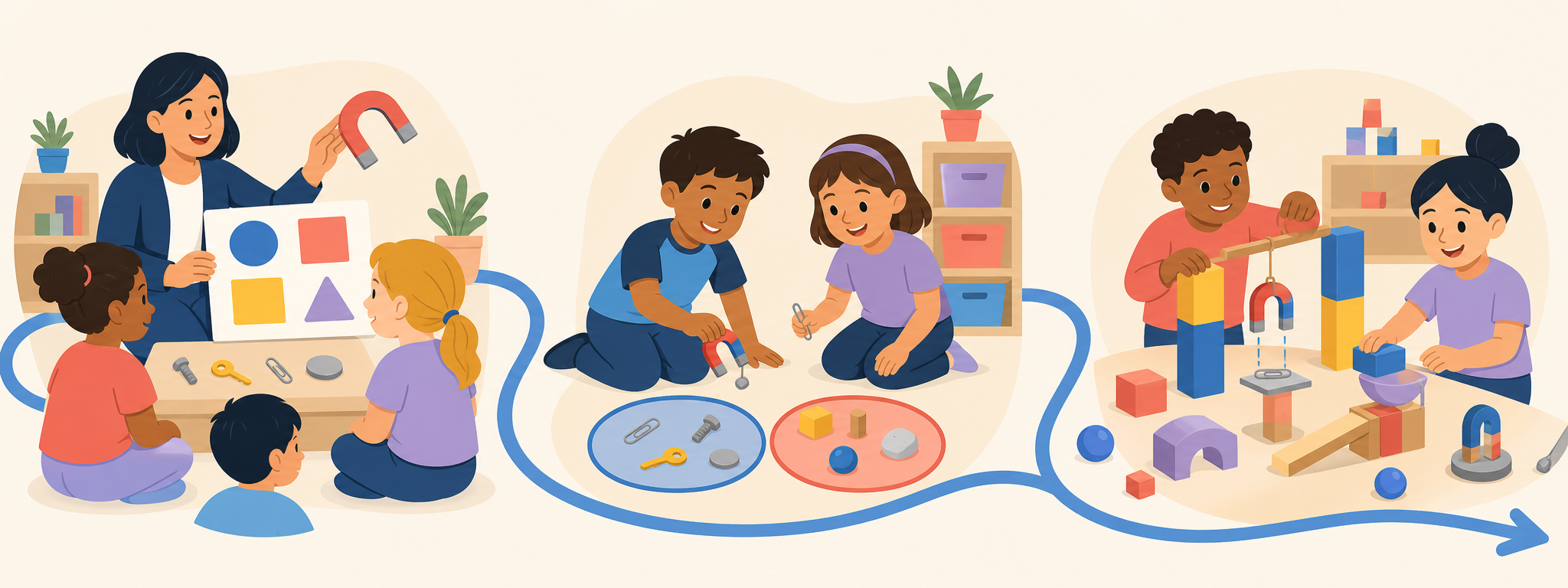
For a plant growth investigation, all students might explain how light affects growth using evidence. A supported pathway provides a procedure, a results table and sentence frames. A guided pathway asks students to choose measurement intervals and identify controls. An independent pathway asks students to design the method and justify how they will improve reliability.
Pre-teach the vocabulary needed for thinking
Science vocabulary is not decoration added after the investigation. Words such as evaporation, insulator, variable and adaptation carry relationships students need in order to reason. Select a small set of high-utility words and teach them through examples, visuals, gestures and repeated use.
Avoid replacing all scientific language with everyday language. Bridge between the two: “The puddle seems to disappear; scientifically, the liquid water evaporates and becomes water vapour.” Give students oral rehearsal before written explanation, and display sentence patterns such as “When ___ changed, ___ happened because ___.”
- Limit the first vocabulary set to the words essential for the lesson goal.
- Contrast related terms, such as heat and temperature or mass and weight.
- Let students point, act, draw or speak before requiring a full written explanation.
Represent the science in more than one way
A diagram, physical model, demonstration, simulation and paragraph each reveal different features. Use multiple representations deliberately, then ask students to connect them. After modelling the solar system with objects, for example, ask what the model shows well, what is not to scale and how the diagram changes the explanation.
This helps students who need a concrete entry point without trapping them in a simplified task. It also gives advanced learners something rigorous to evaluate: every model has limitations. Accessibility adjustments—larger labels, tactile materials, captions, colour-independent keys and uncluttered layouts—should be planned before the lesson where possible.
Use flexible grouping with a clear purpose
Group by the immediate learning need, not a fixed idea of ability. Sometimes similar-readiness groups make targeted teacher instruction efficient. At other times mixed groups strengthen explanation and comparison. The group structure should match the job.
Give roles that reflect scientific practice: equipment manager, method checker, recorder, evidence challenger and reporter. Rotate them so one confident student does not become the permanent thinker while others handle equipment. Review groups after each diagnostic or checkpoint; students should expect movement.
Scaffold inquiry without scripting every decision
Inquiry becomes unproductive when students face too many new decisions at once. Scaffold the element that is not today's learning goal. If the goal is interpreting evidence, provide the method. If the goal is designing a fair test, provide familiar equipment and a clear question but leave variables and measurement choices open.
- Model: think aloud through one decision and name the criterion.
- Guide: let students choose between two plausible options and justify the choice.
- Release: remove the prompt once students can use the criterion independently.
Keep scaffolds optional where practical. A planning frame, vocabulary bank or partly completed table can sit at a support station so students use what they need without waiting for the teacher.
Differentiate through questions, not just worksheets
A single investigation can support considerable depth when questions are sequenced carefully. Begin with observation, move to pattern, then ask for mechanism, evidence and evaluation. “What happened?” opens the door; “Why does your evidence support that claim?” pushes reasoning.
- Access: What changed? What stayed the same?
- Connect: Where have we seen this pattern before?
- Reason: What mechanism could explain the result?
- Evaluate: Which evidence is least reliable, and why?
- Transfer: What would you predict in a new context?
Plan wait time and participation routines. Mini whiteboards, think-pair-share and “everyone writes before anyone answers” reveal more thinking than relying on volunteers.
Extend through depth, uncertainty and transfer
Extension should deepen the same idea, not send early finishers to an unrelated puzzle. Ask students to compare explanations, critique a model, improve a method, account for anomalous data or apply the concept in an unfamiliar context.
In an electrical-circuits lesson, extension might mean predicting how changing components affects brightness, then explaining where the simple model breaks down. In an ecosystems lesson, it might mean considering two plausible effects of removing a species and identifying what evidence would distinguish them. These tasks reward reasoning rather than speed.
Build checkpoints that change what happens next
Differentiation is strongest when it continues during the lesson. Pause after the demonstration, midway through the investigation and before the final explanation. Each checkpoint should lead to a decision: reteach, regroup, release a scaffold, add a challenge or change the representation.
Exit tickets should be small enough to use. One claim-evidence-reasoning response is often more informative than a page of questions. Sort responses into the next instructional action and begin the following lesson there.
A 10-minute planning model for differentiated science
- Write the non-negotiable scientific idea and one observable success criterion.
- Predict the two most likely barriers: prior knowledge, language, representation, executive demand or misconception.
- Choose one quick diagnostic that can distinguish those barriers.
- Prepare one access scaffold and one depth prompt.
- Decide when groups will change and what evidence will trigger the change.
- End with one common task that shows whether every student reached the goal.
Use AI as a planning accelerator, not the decision-maker
In tutero.ai, a teacher can generate standards-aligned resources and then adapt prompts, examples and scaffolds for the evidence in front of them. Ask for one shared objective, a diagnostic question, supported and independent pathways, and a common exit ticket. Always review scientific accuracy, accessibility and alignment before teaching.
What does this look like in one lesson?
Topic: thermal insulation. Shared goal: explain how material choice affects the rate of cooling using evidence.
Begin with a prediction about which wrapped cup will keep water warmest and ask students to justify it. Use the answers to identify vocabulary and misconception needs. All groups test materials and measure temperature. One group receives a diagrammed method and pre-labelled table; another chooses measurement intervals; an extension group evaluates heat loss that the method does not control. Everyone finishes with the same prompt: “Which material was the best insulator, and how strong is the evidence?”
The lesson feels coherent because the class can discuss one phenomenon together. Differentiation changes support and independence, while the scientific conversation remains shared.
Common differentiation mistakes to avoid
- Permanent ability groups: they quickly stop reflecting current evidence.
- Different learning goals disguised as tiers: students receiving support still need access to the core concept.
- More questions as extension: depth, transfer and evaluation are usually better than volume.
- Scaffolds that never fade: build a plan for independence.
- Engaging activities without evidence: make sure students explain what the investigation shows.
- Over-planning: one well-chosen adjustment is better than three disconnected worksheets.
Evidence and further guidance
For broader planning, see EEF's Improving Primary Science guidance and the CAST UDL Guidelines. Australian Curriculum guidance on student diversity also outlines inclusive planning for access, participation and progress.
Teachers using AI for resource preparation may also find Tutero's guide to AI in education useful for setting expectations around review, accuracy and classroom judgement.
A primary school science class can contain students who already use precise scientific vocabulary, students who understand the idea but cannot yet explain it, and students meeting the concept for the first time. Differentiation does not mean writing three unrelated lessons. It means holding the important science goal steady while changing the support, route, pace or way students show what they know.
This guide gives teachers a repeatable model for Foundation to Year 6. It combines diagnostic assessment, explicit vocabulary, purposeful grouping, scaffolded inquiry and meaningful extension. The aim is not to make the science easier. It is to remove avoidable barriers so every student can think scientifically.
Keep one core scientific idea and success criteria for the class. Use a quick diagnostic to find the barrier, then adjust one or two levers: representation, vocabulary, task complexity, grouping, equipment, time or response format. Regroup from fresh evidence rather than treating “support”, “core” and “extension” as permanent labels.
What does differentiation mean in primary school science?
Differentiation is a planned response to learner variability. Students can work toward the same conceptual goal while receiving different prompts, models, examples or levels of independence. In a lesson on forces, for example, everyone might explain how changing a surface affects friction. One group may use a labelled diagram and sentence stems; another may select variables and design the fair test; a third may evaluate the reliability of repeated measurements.
This is different from giving faster students “more work” or lowering the learning goal for students who need support. Good differentiation protects the big idea. It changes access and challenge while keeping expectations visible.
That approach aligns with CAST's Universal Design for Learning Guidelines, which recommend multiple means of engagement, representation, and action and expression. The Australian Curriculum also frames inclusion around equitable access, participation and progress for diverse students.
Diagnose before you differentiate
A pre-test with ten recall questions often tells you who remembers facts, but not why a student is stuck. Use a two-to-five-minute diagnostic that reveals thinking. Ask students to predict what will happen, draw a model, sort examples and non-examples, or explain which variable should be controlled. Their answers expose prior knowledge, vocabulary gaps and misconceptions.
For a states-of-matter lesson, show a sealed syringe containing air and ask: “What will happen when the plunger is pushed? Draw what you think happens to the particles.” A student who draws particles shrinking needs a different prompt from a student who understands spacing but lacks the word compression.
- Use one hinge question: choose answer options that correspond to common misconceptions.
- Ask for a reason: confidence ratings and explanations make guessing visible.
- Record only actionable information: note the next support or extension, not a permanent ability label.
Try this tomorrow
Put one prediction, one labelled drawing and one “How do you know?” question on the board. Scan answers while students discuss in pairs, then choose the model, vocabulary prompt or challenge each group needs.
Keep the same goal, but offer different pathways
Start by writing one sentence that every student should understand by the end. Then design pathways that change the level of support, not the destination. A useful planning test is: “Could students from every pathway answer the same final question?” If not, the tasks may have drifted into separate curricula.
For a plant growth investigation, all students might explain how light affects growth using evidence. A supported pathway provides a procedure, a results table and sentence frames. A guided pathway asks students to choose measurement intervals and identify controls. An independent pathway asks students to design the method and justify how they will improve reliability.
Pre-teach the vocabulary needed for thinking
Science vocabulary is not decoration added after the investigation. Words such as evaporation, insulator, variable and adaptation carry relationships students need in order to reason. Select a small set of high-utility words and teach them through examples, visuals, gestures and repeated use.
Avoid replacing all scientific language with everyday language. Bridge between the two: “The puddle seems to disappear; scientifically, the liquid water evaporates and becomes water vapour.” Give students oral rehearsal before written explanation, and display sentence patterns such as “When ___ changed, ___ happened because ___.”
- Limit the first vocabulary set to the words essential for the lesson goal.
- Contrast related terms, such as heat and temperature or mass and weight.
- Let students point, act, draw or speak before requiring a full written explanation.
Represent the science in more than one way
A diagram, physical model, demonstration, simulation and paragraph each reveal different features. Use multiple representations deliberately, then ask students to connect them. After modelling the solar system with objects, for example, ask what the model shows well, what is not to scale and how the diagram changes the explanation.
This helps students who need a concrete entry point without trapping them in a simplified task. It also gives advanced learners something rigorous to evaluate: every model has limitations. Accessibility adjustments—larger labels, tactile materials, captions, colour-independent keys and uncluttered layouts—should be planned before the lesson where possible.
Use flexible grouping with a clear purpose
Group by the immediate learning need, not a fixed idea of ability. Sometimes similar-readiness groups make targeted teacher instruction efficient. At other times mixed groups strengthen explanation and comparison. The group structure should match the job.
Give roles that reflect scientific practice: equipment manager, method checker, recorder, evidence challenger and reporter. Rotate them so one confident student does not become the permanent thinker while others handle equipment. Review groups after each diagnostic or checkpoint; students should expect movement.
Scaffold inquiry without scripting every decision
Inquiry becomes unproductive when students face too many new decisions at once. Scaffold the element that is not today's learning goal. If the goal is interpreting evidence, provide the method. If the goal is designing a fair test, provide familiar equipment and a clear question but leave variables and measurement choices open.
- Model: think aloud through one decision and name the criterion.
- Guide: let students choose between two plausible options and justify the choice.
- Release: remove the prompt once students can use the criterion independently.
Keep scaffolds optional where practical. A planning frame, vocabulary bank or partly completed table can sit at a support station so students use what they need without waiting for the teacher.
Differentiate through questions, not just worksheets
A single investigation can support considerable depth when questions are sequenced carefully. Begin with observation, move to pattern, then ask for mechanism, evidence and evaluation. “What happened?” opens the door; “Why does your evidence support that claim?” pushes reasoning.
- Access: What changed? What stayed the same?
- Connect: Where have we seen this pattern before?
- Reason: What mechanism could explain the result?
- Evaluate: Which evidence is least reliable, and why?
- Transfer: What would you predict in a new context?
Plan wait time and participation routines. Mini whiteboards, think-pair-share and “everyone writes before anyone answers” reveal more thinking than relying on volunteers.
Extend through depth, uncertainty and transfer
Extension should deepen the same idea, not send early finishers to an unrelated puzzle. Ask students to compare explanations, critique a model, improve a method, account for anomalous data or apply the concept in an unfamiliar context.
In an electrical-circuits lesson, extension might mean predicting how changing components affects brightness, then explaining where the simple model breaks down. In an ecosystems lesson, it might mean considering two plausible effects of removing a species and identifying what evidence would distinguish them. These tasks reward reasoning rather than speed.
Build checkpoints that change what happens next
Differentiation is strongest when it continues during the lesson. Pause after the demonstration, midway through the investigation and before the final explanation. Each checkpoint should lead to a decision: reteach, regroup, release a scaffold, add a challenge or change the representation.
Exit tickets should be small enough to use. One claim-evidence-reasoning response is often more informative than a page of questions. Sort responses into the next instructional action and begin the following lesson there.
A 10-minute planning model for differentiated science
- Write the non-negotiable scientific idea and one observable success criterion.
- Predict the two most likely barriers: prior knowledge, language, representation, executive demand or misconception.
- Choose one quick diagnostic that can distinguish those barriers.
- Prepare one access scaffold and one depth prompt.
- Decide when groups will change and what evidence will trigger the change.
- End with one common task that shows whether every student reached the goal.
Use AI as a planning accelerator, not the decision-maker
In tutero.ai, a teacher can generate standards-aligned resources and then adapt prompts, examples and scaffolds for the evidence in front of them. Ask for one shared objective, a diagnostic question, supported and independent pathways, and a common exit ticket. Always review scientific accuracy, accessibility and alignment before teaching.
What does this look like in one lesson?
Topic: thermal insulation. Shared goal: explain how material choice affects the rate of cooling using evidence.
Begin with a prediction about which wrapped cup will keep water warmest and ask students to justify it. Use the answers to identify vocabulary and misconception needs. All groups test materials and measure temperature. One group receives a diagrammed method and pre-labelled table; another chooses measurement intervals; an extension group evaluates heat loss that the method does not control. Everyone finishes with the same prompt: “Which material was the best insulator, and how strong is the evidence?”
The lesson feels coherent because the class can discuss one phenomenon together. Differentiation changes support and independence, while the scientific conversation remains shared.
Common differentiation mistakes to avoid
- Permanent ability groups: they quickly stop reflecting current evidence.
- Different learning goals disguised as tiers: students receiving support still need access to the core concept.
- More questions as extension: depth, transfer and evaluation are usually better than volume.
- Scaffolds that never fade: build a plan for independence.
- Engaging activities without evidence: make sure students explain what the investigation shows.
- Over-planning: one well-chosen adjustment is better than three disconnected worksheets.
Evidence and further guidance
For broader planning, see EEF's Improving Primary Science guidance and the CAST UDL Guidelines. Australian Curriculum guidance on student diversity also outlines inclusive planning for access, participation and progress.
Teachers using AI for resource preparation may also find Tutero's guide to AI in education useful for setting expectations around review, accuracy and classroom judgement.

A primary school science class can contain students who already use precise scientific vocabulary, students who understand the idea but cannot yet explain it, and students meeting the concept for the first time. Differentiation does not mean writing three unrelated lessons. It means holding the important science goal steady while changing the support, route, pace or way students show what they know.
This guide gives teachers a repeatable model for Foundation to Year 6. It combines diagnostic assessment, explicit vocabulary, purposeful grouping, scaffolded inquiry and meaningful extension. The aim is not to make the science easier. It is to remove avoidable barriers so every student can think scientifically.
Keep one core scientific idea and success criteria for the class. Use a quick diagnostic to find the barrier, then adjust one or two levers: representation, vocabulary, task complexity, grouping, equipment, time or response format. Regroup from fresh evidence rather than treating “support”, “core” and “extension” as permanent labels.
What does differentiation mean in primary school science?
Differentiation is a planned response to learner variability. Students can work toward the same conceptual goal while receiving different prompts, models, examples or levels of independence. In a lesson on forces, for example, everyone might explain how changing a surface affects friction. One group may use a labelled diagram and sentence stems; another may select variables and design the fair test; a third may evaluate the reliability of repeated measurements.
This is different from giving faster students “more work” or lowering the learning goal for students who need support. Good differentiation protects the big idea. It changes access and challenge while keeping expectations visible.
That approach aligns with CAST's Universal Design for Learning Guidelines, which recommend multiple means of engagement, representation, and action and expression. The Australian Curriculum also frames inclusion around equitable access, participation and progress for diverse students.
Diagnose before you differentiate
A pre-test with ten recall questions often tells you who remembers facts, but not why a student is stuck. Use a two-to-five-minute diagnostic that reveals thinking. Ask students to predict what will happen, draw a model, sort examples and non-examples, or explain which variable should be controlled. Their answers expose prior knowledge, vocabulary gaps and misconceptions.
For a states-of-matter lesson, show a sealed syringe containing air and ask: “What will happen when the plunger is pushed? Draw what you think happens to the particles.” A student who draws particles shrinking needs a different prompt from a student who understands spacing but lacks the word compression.
- Use one hinge question: choose answer options that correspond to common misconceptions.
- Ask for a reason: confidence ratings and explanations make guessing visible.
- Record only actionable information: note the next support or extension, not a permanent ability label.
Try this tomorrow
Put one prediction, one labelled drawing and one “How do you know?” question on the board. Scan answers while students discuss in pairs, then choose the model, vocabulary prompt or challenge each group needs.
Keep the same goal, but offer different pathways
Start by writing one sentence that every student should understand by the end. Then design pathways that change the level of support, not the destination. A useful planning test is: “Could students from every pathway answer the same final question?” If not, the tasks may have drifted into separate curricula.
For a plant growth investigation, all students might explain how light affects growth using evidence. A supported pathway provides a procedure, a results table and sentence frames. A guided pathway asks students to choose measurement intervals and identify controls. An independent pathway asks students to design the method and justify how they will improve reliability.
Pre-teach the vocabulary needed for thinking
Science vocabulary is not decoration added after the investigation. Words such as evaporation, insulator, variable and adaptation carry relationships students need in order to reason. Select a small set of high-utility words and teach them through examples, visuals, gestures and repeated use.
Avoid replacing all scientific language with everyday language. Bridge between the two: “The puddle seems to disappear; scientifically, the liquid water evaporates and becomes water vapour.” Give students oral rehearsal before written explanation, and display sentence patterns such as “When ___ changed, ___ happened because ___.”
- Limit the first vocabulary set to the words essential for the lesson goal.
- Contrast related terms, such as heat and temperature or mass and weight.
- Let students point, act, draw or speak before requiring a full written explanation.
Represent the science in more than one way
A diagram, physical model, demonstration, simulation and paragraph each reveal different features. Use multiple representations deliberately, then ask students to connect them. After modelling the solar system with objects, for example, ask what the model shows well, what is not to scale and how the diagram changes the explanation.
This helps students who need a concrete entry point without trapping them in a simplified task. It also gives advanced learners something rigorous to evaluate: every model has limitations. Accessibility adjustments—larger labels, tactile materials, captions, colour-independent keys and uncluttered layouts—should be planned before the lesson where possible.
Use flexible grouping with a clear purpose
Group by the immediate learning need, not a fixed idea of ability. Sometimes similar-readiness groups make targeted teacher instruction efficient. At other times mixed groups strengthen explanation and comparison. The group structure should match the job.
Give roles that reflect scientific practice: equipment manager, method checker, recorder, evidence challenger and reporter. Rotate them so one confident student does not become the permanent thinker while others handle equipment. Review groups after each diagnostic or checkpoint; students should expect movement.
Scaffold inquiry without scripting every decision
Inquiry becomes unproductive when students face too many new decisions at once. Scaffold the element that is not today's learning goal. If the goal is interpreting evidence, provide the method. If the goal is designing a fair test, provide familiar equipment and a clear question but leave variables and measurement choices open.
- Model: think aloud through one decision and name the criterion.
- Guide: let students choose between two plausible options and justify the choice.
- Release: remove the prompt once students can use the criterion independently.
Keep scaffolds optional where practical. A planning frame, vocabulary bank or partly completed table can sit at a support station so students use what they need without waiting for the teacher.
Differentiate through questions, not just worksheets
A single investigation can support considerable depth when questions are sequenced carefully. Begin with observation, move to pattern, then ask for mechanism, evidence and evaluation. “What happened?” opens the door; “Why does your evidence support that claim?” pushes reasoning.
- Access: What changed? What stayed the same?
- Connect: Where have we seen this pattern before?
- Reason: What mechanism could explain the result?
- Evaluate: Which evidence is least reliable, and why?
- Transfer: What would you predict in a new context?
Plan wait time and participation routines. Mini whiteboards, think-pair-share and “everyone writes before anyone answers” reveal more thinking than relying on volunteers.
Extend through depth, uncertainty and transfer
Extension should deepen the same idea, not send early finishers to an unrelated puzzle. Ask students to compare explanations, critique a model, improve a method, account for anomalous data or apply the concept in an unfamiliar context.
In an electrical-circuits lesson, extension might mean predicting how changing components affects brightness, then explaining where the simple model breaks down. In an ecosystems lesson, it might mean considering two plausible effects of removing a species and identifying what evidence would distinguish them. These tasks reward reasoning rather than speed.
Build checkpoints that change what happens next
Differentiation is strongest when it continues during the lesson. Pause after the demonstration, midway through the investigation and before the final explanation. Each checkpoint should lead to a decision: reteach, regroup, release a scaffold, add a challenge or change the representation.
Exit tickets should be small enough to use. One claim-evidence-reasoning response is often more informative than a page of questions. Sort responses into the next instructional action and begin the following lesson there.
A 10-minute planning model for differentiated science
- Write the non-negotiable scientific idea and one observable success criterion.
- Predict the two most likely barriers: prior knowledge, language, representation, executive demand or misconception.
- Choose one quick diagnostic that can distinguish those barriers.
- Prepare one access scaffold and one depth prompt.
- Decide when groups will change and what evidence will trigger the change.
- End with one common task that shows whether every student reached the goal.
Use AI as a planning accelerator, not the decision-maker
In tutero.ai, a teacher can generate standards-aligned resources and then adapt prompts, examples and scaffolds for the evidence in front of them. Ask for one shared objective, a diagnostic question, supported and independent pathways, and a common exit ticket. Always review scientific accuracy, accessibility and alignment before teaching.
What does this look like in one lesson?
Topic: thermal insulation. Shared goal: explain how material choice affects the rate of cooling using evidence.
Begin with a prediction about which wrapped cup will keep water warmest and ask students to justify it. Use the answers to identify vocabulary and misconception needs. All groups test materials and measure temperature. One group receives a diagrammed method and pre-labelled table; another chooses measurement intervals; an extension group evaluates heat loss that the method does not control. Everyone finishes with the same prompt: “Which material was the best insulator, and how strong is the evidence?”
The lesson feels coherent because the class can discuss one phenomenon together. Differentiation changes support and independence, while the scientific conversation remains shared.
Common differentiation mistakes to avoid
- Permanent ability groups: they quickly stop reflecting current evidence.
- Different learning goals disguised as tiers: students receiving support still need access to the core concept.
- More questions as extension: depth, transfer and evaluation are usually better than volume.
- Scaffolds that never fade: build a plan for independence.
- Engaging activities without evidence: make sure students explain what the investigation shows.
- Over-planning: one well-chosen adjustment is better than three disconnected worksheets.
Evidence and further guidance
For broader planning, see EEF's Improving Primary Science guidance and the CAST UDL Guidelines. Australian Curriculum guidance on student diversity also outlines inclusive planning for access, participation and progress.
Teachers using AI for resource preparation may also find Tutero's guide to AI in education useful for setting expectations around review, accuracy and classroom judgement.
.svg)
.svg)
Differentiation keeps the core science goal consistent while varying support, representation, task complexity, grouping, pace or response format according to current evidence of student need.
Usually no. Start with one shared concept and common success criteria, then offer different pathways or scaffolds. Students should still be able to answer the same final conceptual question.
Use a short prediction, drawing, sort, hinge question or explain-your-reason prompt. Choose responses that reveal common misconceptions, then use the evidence to select a scaffold, model or extension.
Ask students to transfer the idea, critique a model, account for anomalous data, improve an investigation or compare explanations. Depth and uncertainty provide better extension than simply adding more questions.
Change groups whenever new evidence suggests a different need. Grouping should be temporary and purposeful, not a permanent label for perceived ability.
Hoping to improve confidence & grades?

.png)