
.svg)

If your child can't seem to sit still long enough to finish a worksheet, you're not alone — and most of the time, this isn't ADHD. It's a normal mismatch between how long young children can hold attention, the environment they're working in, and the habits the day has handed them. The fixes are usually small.
This guide walks through what's normal at each age, the five strategies that consistently help, the role of sleep and screens, and the signs that say it's time to bring in extra support — whether that's a tutor, a chat with the classroom teacher, or a GP referral.
Quick answer
Most children focus better when three things change at once: the environment is calm and uncluttered (one task on the desk, no phone or tablet within reach), the task is broken into chunks shorter than their attention span, and they're getting enough sleep. Build a regular homework time at the same desk each afternoon, work in 10–15 minute bursts followed by a short movement break, and protect 9–11 hours of sleep depending on age. If concentration is still falling apart after 4–6 weeks of these changes, talk to the classroom teacher and consider a tutor or a GP visit to rule out anything underneath.
How long should my child be able to focus?
A useful rule of thumb teachers and paediatricians both use: a child can typically focus for 2–5 minutes per year of age on a task they didn't pick. So a Year 1 child (six years old) sitting down to a maths worksheet realistically has about 12–25 minutes of focused effort in them before they need a break. A Year 6 child has roughly 20–60 minutes. A Year 11 student studying for an ATAR-relevant subject can usually push to 60–90 minutes before quality drops sharply.
This matters because most homework battles aren't about willpower — they're about asking a child to focus past their natural span. If your seven-year-old is melting down 30 minutes into a sit-down task, that isn't defiance. That's biology asking for a break. Use the table below as a planning anchor:
| Year level | Typical focused span | Sensible homework block |
|---|---|---|
| Years 1–2 (ages 6–7) | 12–17 minutes | 10 minutes on, 5 minutes off, twice |
| Years 3–4 (ages 8–9) | 16–22 minutes | 15 minutes on, 5 off, twice |
| Years 5–6 (ages 10–11) | 20–30 minutes | 25 minutes on, 5 off, twice |
| Years 7–9 (ages 12–14) | 30–45 minutes | 40 minutes on, 10 off |
| Years 10–12 (ages 15–18) | 45–90 minutes | 50 minutes on, 10 off (Pomodoro) |
If your child consistently focuses for less than the lower end of their age range — even on tasks they enjoy — that's a useful signal worth acting on. We come back to that in the "when to worry" section below.
Why can't my child focus on homework?
The most common reasons are stackable, not single-cause. After a school day a child arrives home tired, often hungry, and their executive function — the brain's "stay on task" muscle — is running on fumes. Add a phone within arm's reach, a TV on in the next room, a sibling asking questions, and a worksheet on a topic they didn't quite get the first time, and focus collapses. None of those things on their own would tank the session. Together they do.
The four ingredients that quietly undo homework focus, in order of how often they're the culprit:
- Environment. Phones, tablets and TVs in the line of sight or earshot. Cluttered desks with five different things on them. Variable spots — kitchen one day, bedroom the next, couch the next.
- Task mismatch. The work asks for more focus minutes in one block than the child has in them. Or the work is on a concept they haven't actually understood yet, so every line is a confidence hit.
- Sleep and food. A child running on 8 hours when their body needs 10, or a child who hasn't eaten since lunch, has very little focus to give to anything cognitive.
- Underlying difficulty. Reading is harder than it should be, or working memory is genuinely thin, or the child is anxious about something at school. This is the smallest category but the one that needs a different response — see the "when to worry" section.
What are the best techniques to improve focus in children?
Five strategies that consistently work, in the order most parents see results from. Pick one or two to start; layering all five at once tends to overwhelm both child and parent. Give each a fortnight before judging whether it's working.
1. One task, nothing else on the desk
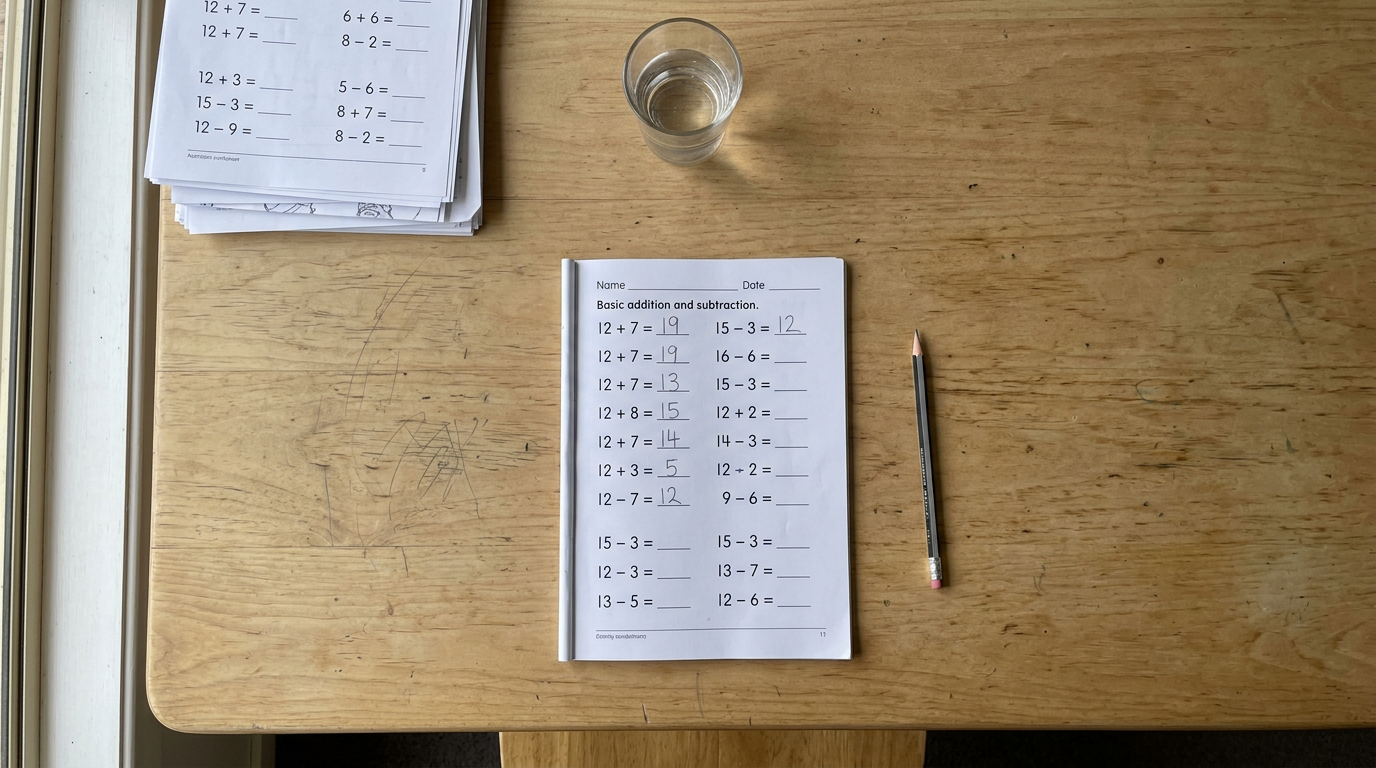
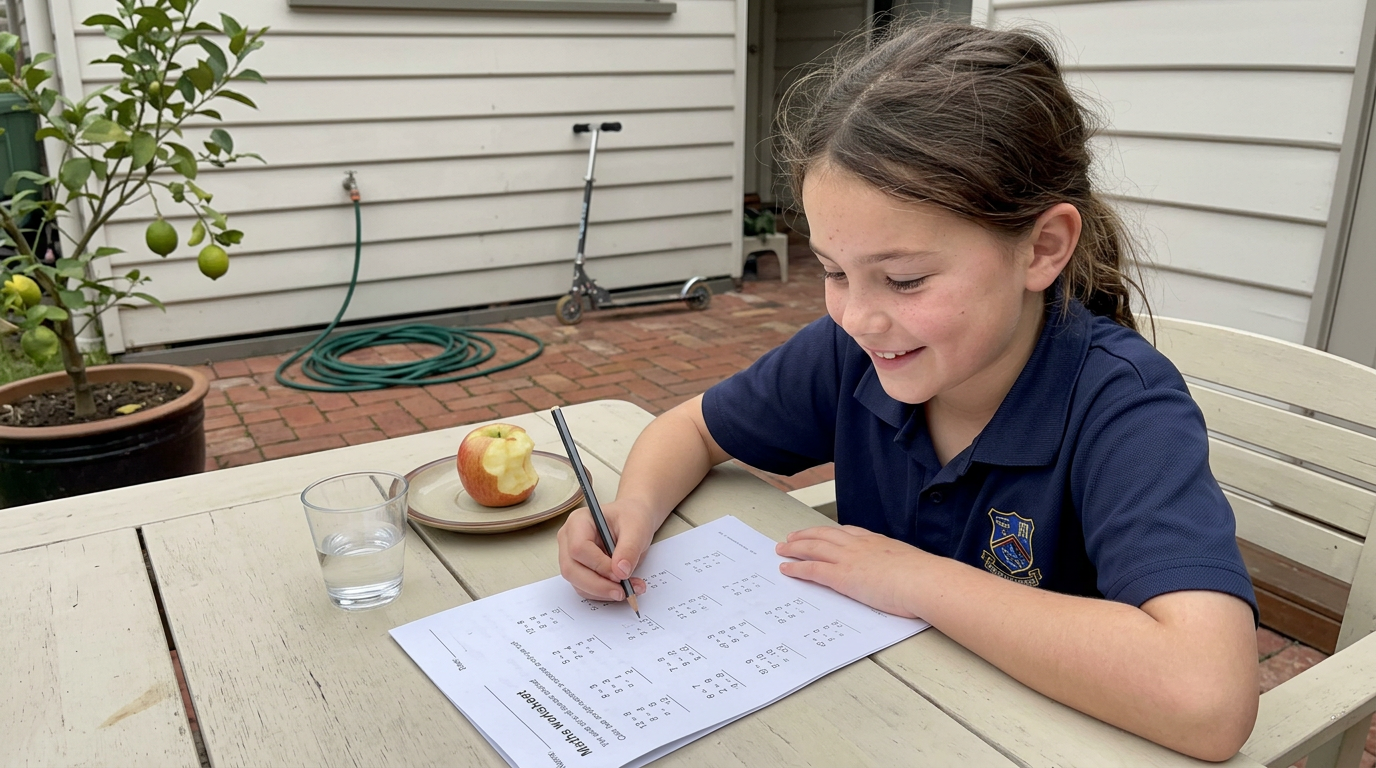
The single biggest lever. Clear everything off the workspace except the one item the child is currently working on. Phone goes in another room — not face-down on the table, not in a pocket, in another room. Tablet goes away unless it's literally the device the work is being done on. Even a sibling's open book or a half-eaten apple counts as visual noise. The desk in a personalised tutoring session looks similar — one open page, one writing tool, nothing else.
The first time you do this most kids will fight it. The second week, they'll start setting it up themselves.
2. Chunk the task to fit their attention span
Use the table above to set realistic blocks. For a Year 4 child that's roughly 15 minutes on, 5 off, twice. Set a timer they can see — a kitchen timer or a phone timer face-up on a chair across the room (not within arm's reach). When the timer goes, they stop, even if they're mid-sentence. Stand up. Walk to the kitchen. Drink water. Come back. Reset.
This is the same logic as the Pomodoro method adults use, scaled to a child's biology. It works because it removes the open-ended dread of "you have to focus until this is finished" and replaces it with "you have to focus until the timer goes".
3. Same time, same place, every weekday
Decision fatigue is real for kids too. If homework time and homework spot are negotiated fresh every day, you've already burnt 10 minutes of focus before they sit down. Pick one slot — usually 4:00–5:00pm after a snack, or 6:30–7:30pm after dinner if afternoons are sport-loaded — and one location, and stick to both for at least a school term. The body learns to switch into focus mode the moment they sit at that spot at that time.
4. Movement breaks, not screen breaks
The break between focus blocks should be physical, not digital. Five minutes of walking around the backyard, a glass of water, a few star jumps, a stretch — anything that gets the blood moving and the eyes off a screen. A five-minute YouTube break does the opposite of what you want: the dopamine hit shrinks their patience for the next focus block, and the second half of the homework session goes twice as badly as the first.
5. Make hard tasks feel possible
A lot of "can't focus" is actually "doesn't know where to start". Sit with your child for the first 60 seconds of the task. Read the first question together. Ask them what the question is asking. Then step away. The first sentence is the hardest sentence — once they've started, focus usually follows. If they genuinely can't get past the first question alone night after night, the problem isn't focus, it's that the work is above where they are right now. That's the moment to talk to the classroom teacher or arrange one-to-one tutoring support to close the gap.
How does sleep affect a child's focus?
Massively, and this is the lever most parents underestimate. The Royal Children's Hospital Melbourne and the Sleep Health Foundation publish recommended ranges that align with international guidance: primary-school children need 9–11 hours of sleep a night; teenagers need 8–10. Australian survey data consistently shows roughly a third of school-age children fall short of these ranges on weeknights. A child running on 7 hours when they need 10 has the cognitive bandwidth of a child two years younger. They look "unfocused" because they functionally are.
Two practical moves that punch above their weight: a fixed lights-out time on weeknights (within 30 minutes for primary, 60 minutes for high school, no later), and a no-screens-in-the-bedroom rule from one hour before bedtime. The second one is the harder fight in most households and the one that pays off the fastest.
Should we limit screen time to improve focus?
Yes, and the type of screen time matters more than the total minutes. Short-form video — TikTok, YouTube Shorts, Instagram Reels — trains the brain to expect a new stimulus every 8–15 seconds. After an hour of that, sitting through a 20-minute reading task feels physically unpleasant. Most parents notice the focus collapse in the homework session that follows; few connect it back to the scrolling.
The Australian eSafety Commissioner and the Royal Australian College of General Practitioners both recommend treating screen time the same way you'd treat sugar — fine in moderation, problematic when it crowds out everything else. Two changes worth making this week:
- No screens in the hour before homework. Snack and a walk, not a tablet.
- Cap short-form video at 15–20 minutes a day on weekdays. Long-form video (a movie, a documentary, a full YouTube tutorial) is much less disruptive — the issue is the constant-novelty pacing, not the screen itself.
You don't have to be perfect about this. A child who scrolls for 20 minutes is not a child who can't focus. A child who scrolls for two hours every afternoon almost certainly is.
When should I worry about my child's focus?
Most focus problems are environmental and resolve within 4–6 weeks of the changes above. The signals worth taking to a GP or paediatrician are different in shape — they're consistent, they show up across settings (not just at homework), and they're disproportionate to the child's age:
- Focus is shorter than the bottom of their age range on tasks they enjoy, not just on tasks they don't.
- The classroom teacher is flagging it at parent-teacher interviews — they see your child against 25 same-age peers, which is the most useful comparison you'll get.
- It's affecting friendships — your child is struggling to follow the thread of a conversation with friends, finish board games, or stick with a single play activity.
- There are physical signs — your child often complains of headaches, can't track print across a page, or seems to mishear instructions in a way that's not just selective listening.
- It hasn't budged after a fair go. You've changed the environment, the routine, sleep and screens for 4–6 weeks and the meltdowns are the same shape and size as they were on day one.
Two of these is a conversation with the GP or the school's learning-support coordinator. None of them on their own diagnoses anything. Most kids who tick a couple of boxes don't have ADHD or a learning difficulty — but the conversation is the right next step.
What's the difference between normal focus problems and ADHD?
The shorthand most paediatricians use: typical attention struggles are variable — bad on a Monday, fine on a Wednesday, depending on sleep and what the task is. ADHD is consistent — focus is patchy across most settings, most weeks, regardless of how interesting or low-stakes the task is. ADHD is also impairing — it's affecting school performance, friendships, family relationships, or self-esteem in a way that's bigger than the task itself.
Diagnosing ADHD is a clinical process that involves a paediatrician or child psychiatrist, ideally with input from the child's classroom teacher and parents on standardised rating scales. It is not something a blog (or a tutor, or a parent's gut) can rule in or out. If the patterns above are showing up, the GP referral is the right next step. We've written a separate piece on tailored tutoring for students with ADHD for families further along that path. There's also a broader explainer on common learning differences that can present as focus problems but aren't ADHD — dyslexia, dyscalculia, slow processing speed, anxiety.
How does tutoring help with focus and attention?
A good tutor isn't a focus magic bullet, but the structure of one-to-one tutoring removes most of the things that derail concentration in the first place. Sessions are short — typically 45–60 minutes for primary, 60 minutes for secondary — which fits inside a child's attention span by design. The tutor's full attention is on the child, so there's nowhere for them to drift. The work is pitched at exactly where the child is, so the "I don't get it, I give up" trapdoor that shuts down focus at home doesn't open. And the tutor builds the same one-task-at-a-time desk discipline week after week, until the child takes it home.
For families where focus has been the running battle, this often shows up first as a quiet jump in confidence — the child stops avoiding homework — before it shows up in marks. Tutero's online tutors hold a Working with Children Check, are at-or-near university level in their teaching subject, and are matched to your child's year level and learning style. Sessions are A$65/hour, the same rate from primary through senior, with no contracts. If you've tried the environmental fixes and want a second pair of eyes on the work itself, one-to-one tutoring is often the cleanest next step.
What's the right time to start tutoring for focus?
Most parents wait until marks fall, but the ideal time to begin tutoring is when focus is the issue, before the marks tell that story. Catching it during a single tricky topic — long division for a Year 4, fractions for a Year 6, factorising for a Year 9, derivatives for a Year 11 — is far cheaper in time and confidence than catching it at the end-of-term report. If your child is consistently giving up on a single subject, that's the early signal worth acting on. We've written more on the five signs your child needs tutoring — focus is one of them, but not the loudest.
So how do I help my child focus?
Focus is a skill, not a personality trait, and most children's focus improves quickly when the environment, the chunking, the sleep and the screens are sorted out. Pick one of the five strategies, give it a fortnight, then layer on another. If you're four to six weeks in and nothing has shifted — or the patterns above are showing up — talk to the classroom teacher and consider a tutor or a GP. The goal isn't a perfectly focused child. It's a child whose focus is in the right range for their age, on the right kind of task, with the right kind of support.
Ready to give your child a calmer, more focused homework hour? Find a Tutero tutor matched to your child's year level — same A$65/hour rate primary through senior, no contracts, your first lesson at no cost.
Most homework battles aren't about willpower — they're about asking a child to focus past their natural span.
Most homework battles aren't about willpower — they're about asking a child to focus past their natural span.
If your child can't seem to sit still long enough to finish a worksheet, you're not alone — and most of the time, this isn't ADHD. It's a normal mismatch between how long young children can hold attention, the environment they're working in, and the habits the day has handed them. The fixes are usually small.
This guide walks through what's normal at each age, the five strategies that consistently help, the role of sleep and screens, and the signs that say it's time to bring in extra support — whether that's a tutor, a chat with the classroom teacher, or a GP referral.
Quick answer
Most children focus better when three things change at once: the environment is calm and uncluttered (one task on the desk, no phone or tablet within reach), the task is broken into chunks shorter than their attention span, and they're getting enough sleep. Build a regular homework time at the same desk each afternoon, work in 10–15 minute bursts followed by a short movement break, and protect 9–11 hours of sleep depending on age. If concentration is still falling apart after 4–6 weeks of these changes, talk to the classroom teacher and consider a tutor or a GP visit to rule out anything underneath.
How long should my child be able to focus?
A useful rule of thumb teachers and paediatricians both use: a child can typically focus for 2–5 minutes per year of age on a task they didn't pick. So a Year 1 child (six years old) sitting down to a maths worksheet realistically has about 12–25 minutes of focused effort in them before they need a break. A Year 6 child has roughly 20–60 minutes. A Year 11 student studying for an ATAR-relevant subject can usually push to 60–90 minutes before quality drops sharply.
This matters because most homework battles aren't about willpower — they're about asking a child to focus past their natural span. If your seven-year-old is melting down 30 minutes into a sit-down task, that isn't defiance. That's biology asking for a break. Use the table below as a planning anchor:
| Year level | Typical focused span | Sensible homework block |
|---|---|---|
| Years 1–2 (ages 6–7) | 12–17 minutes | 10 minutes on, 5 minutes off, twice |
| Years 3–4 (ages 8–9) | 16–22 minutes | 15 minutes on, 5 off, twice |
| Years 5–6 (ages 10–11) | 20–30 minutes | 25 minutes on, 5 off, twice |
| Years 7–9 (ages 12–14) | 30–45 minutes | 40 minutes on, 10 off |
| Years 10–12 (ages 15–18) | 45–90 minutes | 50 minutes on, 10 off (Pomodoro) |
If your child consistently focuses for less than the lower end of their age range — even on tasks they enjoy — that's a useful signal worth acting on. We come back to that in the "when to worry" section below.
Why can't my child focus on homework?
The most common reasons are stackable, not single-cause. After a school day a child arrives home tired, often hungry, and their executive function — the brain's "stay on task" muscle — is running on fumes. Add a phone within arm's reach, a TV on in the next room, a sibling asking questions, and a worksheet on a topic they didn't quite get the first time, and focus collapses. None of those things on their own would tank the session. Together they do.
The four ingredients that quietly undo homework focus, in order of how often they're the culprit:
- Environment. Phones, tablets and TVs in the line of sight or earshot. Cluttered desks with five different things on them. Variable spots — kitchen one day, bedroom the next, couch the next.
- Task mismatch. The work asks for more focus minutes in one block than the child has in them. Or the work is on a concept they haven't actually understood yet, so every line is a confidence hit.
- Sleep and food. A child running on 8 hours when their body needs 10, or a child who hasn't eaten since lunch, has very little focus to give to anything cognitive.
- Underlying difficulty. Reading is harder than it should be, or working memory is genuinely thin, or the child is anxious about something at school. This is the smallest category but the one that needs a different response — see the "when to worry" section.
What are the best techniques to improve focus in children?
Five strategies that consistently work, in the order most parents see results from. Pick one or two to start; layering all five at once tends to overwhelm both child and parent. Give each a fortnight before judging whether it's working.
1. One task, nothing else on the desk
The single biggest lever. Clear everything off the workspace except the one item the child is currently working on. Phone goes in another room — not face-down on the table, not in a pocket, in another room. Tablet goes away unless it's literally the device the work is being done on. Even a sibling's open book or a half-eaten apple counts as visual noise. The desk in a personalised tutoring session looks similar — one open page, one writing tool, nothing else.
The first time you do this most kids will fight it. The second week, they'll start setting it up themselves.
2. Chunk the task to fit their attention span
Use the table above to set realistic blocks. For a Year 4 child that's roughly 15 minutes on, 5 off, twice. Set a timer they can see — a kitchen timer or a phone timer face-up on a chair across the room (not within arm's reach). When the timer goes, they stop, even if they're mid-sentence. Stand up. Walk to the kitchen. Drink water. Come back. Reset.
This is the same logic as the Pomodoro method adults use, scaled to a child's biology. It works because it removes the open-ended dread of "you have to focus until this is finished" and replaces it with "you have to focus until the timer goes".
3. Same time, same place, every weekday
Decision fatigue is real for kids too. If homework time and homework spot are negotiated fresh every day, you've already burnt 10 minutes of focus before they sit down. Pick one slot — usually 4:00–5:00pm after a snack, or 6:30–7:30pm after dinner if afternoons are sport-loaded — and one location, and stick to both for at least a school term. The body learns to switch into focus mode the moment they sit at that spot at that time.
4. Movement breaks, not screen breaks
The break between focus blocks should be physical, not digital. Five minutes of walking around the backyard, a glass of water, a few star jumps, a stretch — anything that gets the blood moving and the eyes off a screen. A five-minute YouTube break does the opposite of what you want: the dopamine hit shrinks their patience for the next focus block, and the second half of the homework session goes twice as badly as the first.
5. Make hard tasks feel possible
A lot of "can't focus" is actually "doesn't know where to start". Sit with your child for the first 60 seconds of the task. Read the first question together. Ask them what the question is asking. Then step away. The first sentence is the hardest sentence — once they've started, focus usually follows. If they genuinely can't get past the first question alone night after night, the problem isn't focus, it's that the work is above where they are right now. That's the moment to talk to the classroom teacher or arrange one-to-one tutoring support to close the gap.
How does sleep affect a child's focus?
Massively, and this is the lever most parents underestimate. The Royal Children's Hospital Melbourne and the Sleep Health Foundation publish recommended ranges that align with international guidance: primary-school children need 9–11 hours of sleep a night; teenagers need 8–10. Australian survey data consistently shows roughly a third of school-age children fall short of these ranges on weeknights. A child running on 7 hours when they need 10 has the cognitive bandwidth of a child two years younger. They look "unfocused" because they functionally are.
Two practical moves that punch above their weight: a fixed lights-out time on weeknights (within 30 minutes for primary, 60 minutes for high school, no later), and a no-screens-in-the-bedroom rule from one hour before bedtime. The second one is the harder fight in most households and the one that pays off the fastest.
Should we limit screen time to improve focus?
Yes, and the type of screen time matters more than the total minutes. Short-form video — TikTok, YouTube Shorts, Instagram Reels — trains the brain to expect a new stimulus every 8–15 seconds. After an hour of that, sitting through a 20-minute reading task feels physically unpleasant. Most parents notice the focus collapse in the homework session that follows; few connect it back to the scrolling.
The Australian eSafety Commissioner and the Royal Australian College of General Practitioners both recommend treating screen time the same way you'd treat sugar — fine in moderation, problematic when it crowds out everything else. Two changes worth making this week:
- No screens in the hour before homework. Snack and a walk, not a tablet.
- Cap short-form video at 15–20 minutes a day on weekdays. Long-form video (a movie, a documentary, a full YouTube tutorial) is much less disruptive — the issue is the constant-novelty pacing, not the screen itself.
You don't have to be perfect about this. A child who scrolls for 20 minutes is not a child who can't focus. A child who scrolls for two hours every afternoon almost certainly is.
When should I worry about my child's focus?
Most focus problems are environmental and resolve within 4–6 weeks of the changes above. The signals worth taking to a GP or paediatrician are different in shape — they're consistent, they show up across settings (not just at homework), and they're disproportionate to the child's age:
- Focus is shorter than the bottom of their age range on tasks they enjoy, not just on tasks they don't.
- The classroom teacher is flagging it at parent-teacher interviews — they see your child against 25 same-age peers, which is the most useful comparison you'll get.
- It's affecting friendships — your child is struggling to follow the thread of a conversation with friends, finish board games, or stick with a single play activity.
- There are physical signs — your child often complains of headaches, can't track print across a page, or seems to mishear instructions in a way that's not just selective listening.
- It hasn't budged after a fair go. You've changed the environment, the routine, sleep and screens for 4–6 weeks and the meltdowns are the same shape and size as they were on day one.
Two of these is a conversation with the GP or the school's learning-support coordinator. None of them on their own diagnoses anything. Most kids who tick a couple of boxes don't have ADHD or a learning difficulty — but the conversation is the right next step.
What's the difference between normal focus problems and ADHD?
The shorthand most paediatricians use: typical attention struggles are variable — bad on a Monday, fine on a Wednesday, depending on sleep and what the task is. ADHD is consistent — focus is patchy across most settings, most weeks, regardless of how interesting or low-stakes the task is. ADHD is also impairing — it's affecting school performance, friendships, family relationships, or self-esteem in a way that's bigger than the task itself.
Diagnosing ADHD is a clinical process that involves a paediatrician or child psychiatrist, ideally with input from the child's classroom teacher and parents on standardised rating scales. It is not something a blog (or a tutor, or a parent's gut) can rule in or out. If the patterns above are showing up, the GP referral is the right next step. We've written a separate piece on tailored tutoring for students with ADHD for families further along that path. There's also a broader explainer on common learning differences that can present as focus problems but aren't ADHD — dyslexia, dyscalculia, slow processing speed, anxiety.
How does tutoring help with focus and attention?
A good tutor isn't a focus magic bullet, but the structure of one-to-one tutoring removes most of the things that derail concentration in the first place. Sessions are short — typically 45–60 minutes for primary, 60 minutes for secondary — which fits inside a child's attention span by design. The tutor's full attention is on the child, so there's nowhere for them to drift. The work is pitched at exactly where the child is, so the "I don't get it, I give up" trapdoor that shuts down focus at home doesn't open. And the tutor builds the same one-task-at-a-time desk discipline week after week, until the child takes it home.
For families where focus has been the running battle, this often shows up first as a quiet jump in confidence — the child stops avoiding homework — before it shows up in marks. Tutero's online tutors hold a Working with Children Check, are at-or-near university level in their teaching subject, and are matched to your child's year level and learning style. Sessions are A$65/hour, the same rate from primary through senior, with no contracts. If you've tried the environmental fixes and want a second pair of eyes on the work itself, one-to-one tutoring is often the cleanest next step.
What's the right time to start tutoring for focus?
Most parents wait until marks fall, but the ideal time to begin tutoring is when focus is the issue, before the marks tell that story. Catching it during a single tricky topic — long division for a Year 4, fractions for a Year 6, factorising for a Year 9, derivatives for a Year 11 — is far cheaper in time and confidence than catching it at the end-of-term report. If your child is consistently giving up on a single subject, that's the early signal worth acting on. We've written more on the five signs your child needs tutoring — focus is one of them, but not the loudest.
So how do I help my child focus?
Focus is a skill, not a personality trait, and most children's focus improves quickly when the environment, the chunking, the sleep and the screens are sorted out. Pick one of the five strategies, give it a fortnight, then layer on another. If you're four to six weeks in and nothing has shifted — or the patterns above are showing up — talk to the classroom teacher and consider a tutor or a GP. The goal isn't a perfectly focused child. It's a child whose focus is in the right range for their age, on the right kind of task, with the right kind of support.
Ready to give your child a calmer, more focused homework hour? Find a Tutero tutor matched to your child's year level — same A$65/hour rate primary through senior, no contracts, your first lesson at no cost.
FAQ
.svg)
.svg)
Online maths tutoring at Tutero is catering to students of all year levels. We offer programs tailored to the unique learning curves of each age group.
We also have expert NAPLAN and ATAR subject tutors, ensuring students are well-equipped for these pivotal assessments.
We recommend at least two to three session per week for consistent progress. However, this can vary based on your child's needs and goals.
Our platform uses advanced security protocols to ensure the safety and privacy of all our online sessions.
Parents are welcome to observe sessions. We believe in a collaborative approach to education.
We provide regular progress reports and assessments to track your child’s academic development.
Yes, we prioritise the student-tutor relationship and can arrange a change if the need arises.
Yes, we offer a range of resources and materials, including interactive exercises and practice worksheets.
Most homework battles aren't about willpower — they're about asking a child to focus past their natural span.
Most homework battles aren't about willpower — they're about asking a child to focus past their natural span.

Most homework battles aren't about willpower — they're about asking a child to focus past their natural span.
Focus is a skill, not a personality trait, and most children's focus improves quickly when the environment, the chunking, the sleep and the screens are sorted out.
If your child can't seem to sit still long enough to finish a worksheet, you're not alone — and most of the time, this isn't ADHD. It's a normal mismatch between how long young children can hold attention, the environment they're working in, and the habits the day has handed them. The fixes are usually small.
This guide walks through what's normal at each age, the five strategies that consistently help, the role of sleep and screens, and the signs that say it's time to bring in extra support — whether that's a tutor, a chat with the classroom teacher, or a GP referral.
Quick answer
Most children focus better when three things change at once: the environment is calm and uncluttered (one task on the desk, no phone or tablet within reach), the task is broken into chunks shorter than their attention span, and they're getting enough sleep. Build a regular homework time at the same desk each afternoon, work in 10–15 minute bursts followed by a short movement break, and protect 9–11 hours of sleep depending on age. If concentration is still falling apart after 4–6 weeks of these changes, talk to the classroom teacher and consider a tutor or a GP visit to rule out anything underneath.
How long should my child be able to focus?
A useful rule of thumb teachers and paediatricians both use: a child can typically focus for 2–5 minutes per year of age on a task they didn't pick. So a Year 1 child (six years old) sitting down to a maths worksheet realistically has about 12–25 minutes of focused effort in them before they need a break. A Year 6 child has roughly 20–60 minutes. A Year 11 student studying for an ATAR-relevant subject can usually push to 60–90 minutes before quality drops sharply.
This matters because most homework battles aren't about willpower — they're about asking a child to focus past their natural span. If your seven-year-old is melting down 30 minutes into a sit-down task, that isn't defiance. That's biology asking for a break. Use the table below as a planning anchor:
| Year level | Typical focused span | Sensible homework block |
|---|---|---|
| Years 1–2 (ages 6–7) | 12–17 minutes | 10 minutes on, 5 minutes off, twice |
| Years 3–4 (ages 8–9) | 16–22 minutes | 15 minutes on, 5 off, twice |
| Years 5–6 (ages 10–11) | 20–30 minutes | 25 minutes on, 5 off, twice |
| Years 7–9 (ages 12–14) | 30–45 minutes | 40 minutes on, 10 off |
| Years 10–12 (ages 15–18) | 45–90 minutes | 50 minutes on, 10 off (Pomodoro) |
If your child consistently focuses for less than the lower end of their age range — even on tasks they enjoy — that's a useful signal worth acting on. We come back to that in the "when to worry" section below.
Why can't my child focus on homework?
The most common reasons are stackable, not single-cause. After a school day a child arrives home tired, often hungry, and their executive function — the brain's "stay on task" muscle — is running on fumes. Add a phone within arm's reach, a TV on in the next room, a sibling asking questions, and a worksheet on a topic they didn't quite get the first time, and focus collapses. None of those things on their own would tank the session. Together they do.
The four ingredients that quietly undo homework focus, in order of how often they're the culprit:
- Environment. Phones, tablets and TVs in the line of sight or earshot. Cluttered desks with five different things on them. Variable spots — kitchen one day, bedroom the next, couch the next.
- Task mismatch. The work asks for more focus minutes in one block than the child has in them. Or the work is on a concept they haven't actually understood yet, so every line is a confidence hit.
- Sleep and food. A child running on 8 hours when their body needs 10, or a child who hasn't eaten since lunch, has very little focus to give to anything cognitive.
- Underlying difficulty. Reading is harder than it should be, or working memory is genuinely thin, or the child is anxious about something at school. This is the smallest category but the one that needs a different response — see the "when to worry" section.
What are the best techniques to improve focus in children?
Five strategies that consistently work, in the order most parents see results from. Pick one or two to start; layering all five at once tends to overwhelm both child and parent. Give each a fortnight before judging whether it's working.
1. One task, nothing else on the desk
The single biggest lever. Clear everything off the workspace except the one item the child is currently working on. Phone goes in another room — not face-down on the table, not in a pocket, in another room. Tablet goes away unless it's literally the device the work is being done on. Even a sibling's open book or a half-eaten apple counts as visual noise. The desk in a personalised tutoring session looks similar — one open page, one writing tool, nothing else.
The first time you do this most kids will fight it. The second week, they'll start setting it up themselves.
2. Chunk the task to fit their attention span
Use the table above to set realistic blocks. For a Year 4 child that's roughly 15 minutes on, 5 off, twice. Set a timer they can see — a kitchen timer or a phone timer face-up on a chair across the room (not within arm's reach). When the timer goes, they stop, even if they're mid-sentence. Stand up. Walk to the kitchen. Drink water. Come back. Reset.
This is the same logic as the Pomodoro method adults use, scaled to a child's biology. It works because it removes the open-ended dread of "you have to focus until this is finished" and replaces it with "you have to focus until the timer goes".
3. Same time, same place, every weekday
Decision fatigue is real for kids too. If homework time and homework spot are negotiated fresh every day, you've already burnt 10 minutes of focus before they sit down. Pick one slot — usually 4:00–5:00pm after a snack, or 6:30–7:30pm after dinner if afternoons are sport-loaded — and one location, and stick to both for at least a school term. The body learns to switch into focus mode the moment they sit at that spot at that time.
4. Movement breaks, not screen breaks
The break between focus blocks should be physical, not digital. Five minutes of walking around the backyard, a glass of water, a few star jumps, a stretch — anything that gets the blood moving and the eyes off a screen. A five-minute YouTube break does the opposite of what you want: the dopamine hit shrinks their patience for the next focus block, and the second half of the homework session goes twice as badly as the first.
5. Make hard tasks feel possible
A lot of "can't focus" is actually "doesn't know where to start". Sit with your child for the first 60 seconds of the task. Read the first question together. Ask them what the question is asking. Then step away. The first sentence is the hardest sentence — once they've started, focus usually follows. If they genuinely can't get past the first question alone night after night, the problem isn't focus, it's that the work is above where they are right now. That's the moment to talk to the classroom teacher or arrange one-to-one tutoring support to close the gap.
How does sleep affect a child's focus?
Massively, and this is the lever most parents underestimate. The Royal Children's Hospital Melbourne and the Sleep Health Foundation publish recommended ranges that align with international guidance: primary-school children need 9–11 hours of sleep a night; teenagers need 8–10. Australian survey data consistently shows roughly a third of school-age children fall short of these ranges on weeknights. A child running on 7 hours when they need 10 has the cognitive bandwidth of a child two years younger. They look "unfocused" because they functionally are.
Two practical moves that punch above their weight: a fixed lights-out time on weeknights (within 30 minutes for primary, 60 minutes for high school, no later), and a no-screens-in-the-bedroom rule from one hour before bedtime. The second one is the harder fight in most households and the one that pays off the fastest.
Should we limit screen time to improve focus?
Yes, and the type of screen time matters more than the total minutes. Short-form video — TikTok, YouTube Shorts, Instagram Reels — trains the brain to expect a new stimulus every 8–15 seconds. After an hour of that, sitting through a 20-minute reading task feels physically unpleasant. Most parents notice the focus collapse in the homework session that follows; few connect it back to the scrolling.
The Australian eSafety Commissioner and the Royal Australian College of General Practitioners both recommend treating screen time the same way you'd treat sugar — fine in moderation, problematic when it crowds out everything else. Two changes worth making this week:
- No screens in the hour before homework. Snack and a walk, not a tablet.
- Cap short-form video at 15–20 minutes a day on weekdays. Long-form video (a movie, a documentary, a full YouTube tutorial) is much less disruptive — the issue is the constant-novelty pacing, not the screen itself.
You don't have to be perfect about this. A child who scrolls for 20 minutes is not a child who can't focus. A child who scrolls for two hours every afternoon almost certainly is.
When should I worry about my child's focus?
Most focus problems are environmental and resolve within 4–6 weeks of the changes above. The signals worth taking to a GP or paediatrician are different in shape — they're consistent, they show up across settings (not just at homework), and they're disproportionate to the child's age:
- Focus is shorter than the bottom of their age range on tasks they enjoy, not just on tasks they don't.
- The classroom teacher is flagging it at parent-teacher interviews — they see your child against 25 same-age peers, which is the most useful comparison you'll get.
- It's affecting friendships — your child is struggling to follow the thread of a conversation with friends, finish board games, or stick with a single play activity.
- There are physical signs — your child often complains of headaches, can't track print across a page, or seems to mishear instructions in a way that's not just selective listening.
- It hasn't budged after a fair go. You've changed the environment, the routine, sleep and screens for 4–6 weeks and the meltdowns are the same shape and size as they were on day one.
Two of these is a conversation with the GP or the school's learning-support coordinator. None of them on their own diagnoses anything. Most kids who tick a couple of boxes don't have ADHD or a learning difficulty — but the conversation is the right next step.
What's the difference between normal focus problems and ADHD?
The shorthand most paediatricians use: typical attention struggles are variable — bad on a Monday, fine on a Wednesday, depending on sleep and what the task is. ADHD is consistent — focus is patchy across most settings, most weeks, regardless of how interesting or low-stakes the task is. ADHD is also impairing — it's affecting school performance, friendships, family relationships, or self-esteem in a way that's bigger than the task itself.
Diagnosing ADHD is a clinical process that involves a paediatrician or child psychiatrist, ideally with input from the child's classroom teacher and parents on standardised rating scales. It is not something a blog (or a tutor, or a parent's gut) can rule in or out. If the patterns above are showing up, the GP referral is the right next step. We've written a separate piece on tailored tutoring for students with ADHD for families further along that path. There's also a broader explainer on common learning differences that can present as focus problems but aren't ADHD — dyslexia, dyscalculia, slow processing speed, anxiety.
How does tutoring help with focus and attention?
A good tutor isn't a focus magic bullet, but the structure of one-to-one tutoring removes most of the things that derail concentration in the first place. Sessions are short — typically 45–60 minutes for primary, 60 minutes for secondary — which fits inside a child's attention span by design. The tutor's full attention is on the child, so there's nowhere for them to drift. The work is pitched at exactly where the child is, so the "I don't get it, I give up" trapdoor that shuts down focus at home doesn't open. And the tutor builds the same one-task-at-a-time desk discipline week after week, until the child takes it home.
For families where focus has been the running battle, this often shows up first as a quiet jump in confidence — the child stops avoiding homework — before it shows up in marks. Tutero's online tutors hold a Working with Children Check, are at-or-near university level in their teaching subject, and are matched to your child's year level and learning style. Sessions are A$65/hour, the same rate from primary through senior, with no contracts. If you've tried the environmental fixes and want a second pair of eyes on the work itself, one-to-one tutoring is often the cleanest next step.
What's the right time to start tutoring for focus?
Most parents wait until marks fall, but the ideal time to begin tutoring is when focus is the issue, before the marks tell that story. Catching it during a single tricky topic — long division for a Year 4, fractions for a Year 6, factorising for a Year 9, derivatives for a Year 11 — is far cheaper in time and confidence than catching it at the end-of-term report. If your child is consistently giving up on a single subject, that's the early signal worth acting on. We've written more on the five signs your child needs tutoring — focus is one of them, but not the loudest.
So how do I help my child focus?
Focus is a skill, not a personality trait, and most children's focus improves quickly when the environment, the chunking, the sleep and the screens are sorted out. Pick one of the five strategies, give it a fortnight, then layer on another. If you're four to six weeks in and nothing has shifted — or the patterns above are showing up — talk to the classroom teacher and consider a tutor or a GP. The goal isn't a perfectly focused child. It's a child whose focus is in the right range for their age, on the right kind of task, with the right kind of support.
Ready to give your child a calmer, more focused homework hour? Find a Tutero tutor matched to your child's year level — same A$65/hour rate primary through senior, no contracts, your first lesson at no cost.
Most homework battles aren't about willpower — they're about asking a child to focus past their natural span.
Focus is a skill, not a personality trait, and most children's focus improves quickly when the environment, the chunking, the sleep and the screens are sorted out.
A useful rule of thumb is 2–5 minutes per year of age on a task they didn't pick. A Year 1 child has roughly 12–25 minutes of focused effort; a Year 6 child has 20–60 minutes; a Year 11 student can push to 60–90 minutes before quality drops. If you ask for more than that in a single block, you'll see meltdowns or zoning out — not because they don't want to focus, but because they've run out.
Usually four things stacked together: a phone or tablet within reach, a task pitched above their current level, not enough sleep, and a desk that's been shared with three other things that day. None of those alone tank a session — together they do. Start by clearing the desk to one task and putting phones in another room.
Hugely. Primary-school children need 9–11 hours of sleep a night and teenagers need 8–10. A child running on 7 hours when they need 10 has the cognitive bandwidth of a child two years younger — they look unfocused because they functionally are. A fixed weeknight lights-out time and no screens in the bedroom from one hour before bed are the two highest-leverage moves.
Yes, and the type matters more than the total minutes. Short-form video — TikTok, YouTube Shorts, Instagram Reels — trains the brain to expect a new stimulus every 8–15 seconds, which makes a 20-minute reading task feel physically uncomfortable afterwards. Cap short-form video at 15–20 minutes a day on weekdays and remove screens for the hour before homework starts.
Typical attention struggles are variable — bad on Monday, fine on Wednesday, depending on sleep and the task. ADHD is consistent, affecting most settings most weeks regardless of how interesting the task is, and it's impairing — affecting school, friendships, or self-esteem disproportionately. Diagnosing ADHD is a clinical process involving a paediatrician or child psychiatrist with rating-scale input from teachers and parents.
Worry is the wrong word — investigate is better. Talk to the classroom teacher and your GP if focus is shorter than the bottom of their age range even on tasks they enjoy, the teacher is flagging it at parent-teacher interviews, friendships are affected, there are physical signs (headaches, mishearing instructions, can't track print across a page), or 4–6 weeks of environment-and-routine changes haven't shifted anything.
Hoping to improve confidence & grades?

.png)


