
.svg)

Exam season has a way of pulling the whole household tight. Your child snaps at small things, sleep gets patchy, and the line between "she's working hard" and "she's barely coping" can blur fast. The good news is that exam stress is normal, manageable, and — when you handle the next few weeks well — often the lesson that makes the next round of exams feel half as hard.
This guide walks you through the calm, practical things that genuinely move the dial: how to read the signs early, what to say (and not say) the night before a big test, when to bring in extra support, and how to keep the rest of family life intact while your child sits NAPLAN, an end-of-term exam, or their final ATAR papers.
Quick answer
Most exam stress is normal nerves a parent can shift in a single calm conversation. The five-minute version: name what your child is feeling without trying to fix it, drop the perfection talk, lock in a sleep + food + movement routine, swap cramming for short focused study blocks with breaks, and have one quiet plan for the night before each exam. Step in harder — talk to a GP, your child's school, or a private tutor — when stress is leaking into appetite, sleep, or mood for more than two weeks, when there are panic attacks, or when your child has stopped engaging with school altogether. ReachOut and Beyond Blue both flag those last three as the line between "stretching" and "struggling".
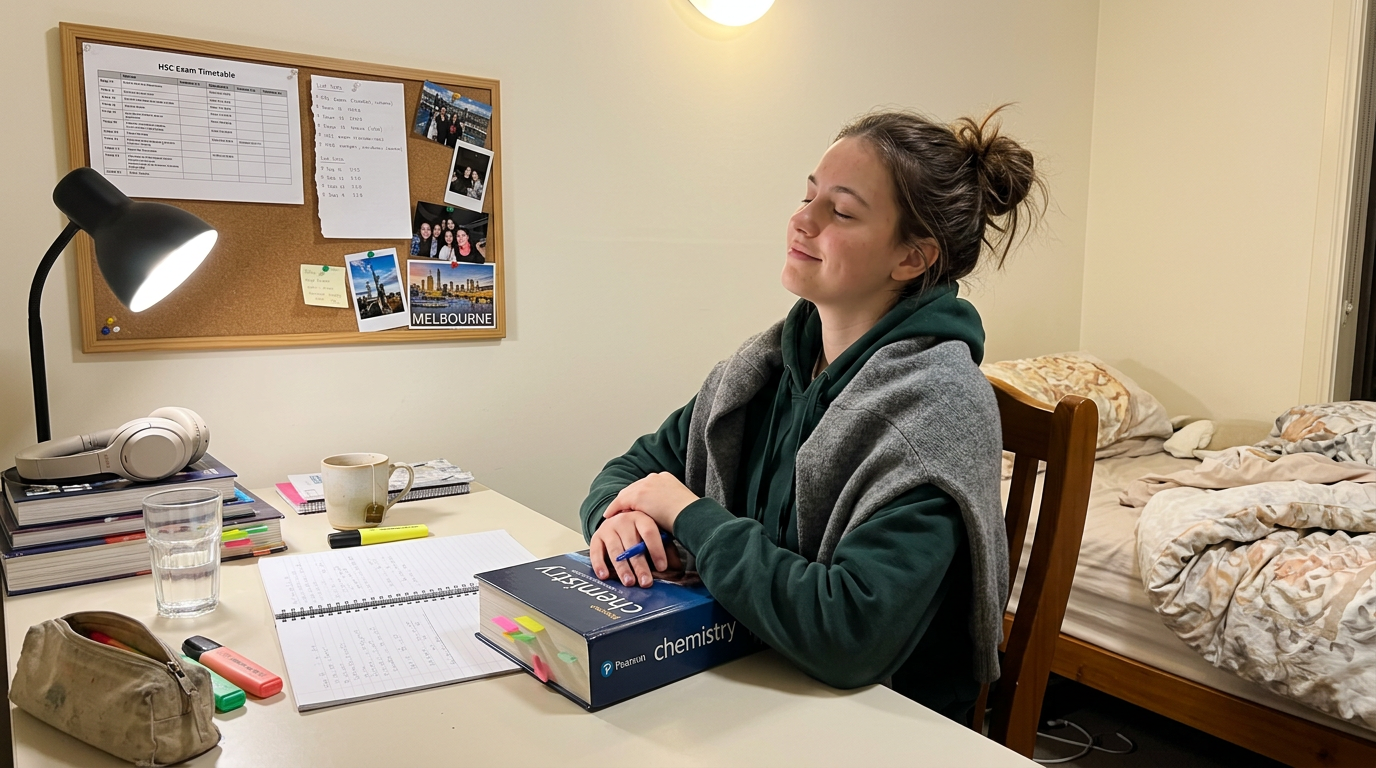
How do I help my child manage exam stress?
The single most useful thing you can do is take the temperature down at home. Exams are a high-stakes period for your child's nervous system; it doesn't need a high-stakes parent on top of it. The five moves below come straight from the ReachOut parents' guide and are echoed by the AAP, RACGP and Beyond Blue: regulate sleep first, regulate food and movement second, regulate study habits third, regulate your own reactions fourth, and have one calm plan for each exam day fifth.
1. Lock in 8–10 hours of sleep on school nights. The ReachOut parents' guide is blunt: late-night cramming is the single biggest avoidable contributor to exam stress, because it costs sleep that your child's brain needs to consolidate what they learnt. Set a hard "books closed" time — 9:30pm for primary, 10pm for lower-secondary, 10:30pm for senior — and keep phones out of the bedroom from that hour. Sleep is a study tool, not the opposite of one.
2. Feed the brain on a normal eating rhythm. Three meals a day, real food, water on the desk. Skipping breakfast on an exam morning is the most common avoidable mistake; a slice of toast and a piece of fruit beats nothing every time. Save the sugar hit for after the paper, not before.
3. Make movement non-negotiable. Twenty minutes of walking, swimming, kicking a ball at the park, or riding the dog around the block — every day, even on big-cram days. Beyond Blue's adolescent-anxiety guidance is consistent: light daily exercise lowers cortisol, lifts mood, and clears the fog that long study sessions produce.
4. Regulate your own reactions, too. Your child reads your face. If every "how was that practice paper" comes out tight, they hear "this matters more than I matter". Asking once, hearing the answer, and changing the subject to dinner is the quietly powerful move.
5. Plan each exam day the night before. Wake-up time, breakfast, what's in the bag, what time you're leaving, what you're doing after the exam. A two-minute plan removes 90% of morning panic. We unpack the night-before plan in its own section below.
What are the symptoms of exam stress in teenagers?
Most exam-stress symptoms are physical, not emotional. Your teenager isn't always going to say "I'm anxious about the chemistry exam"; their body says it for them. Beyond Blue and the American Academy of Pediatrics describe the same cluster of signs across cultures and exam systems — and the cluster shows up at every year level, not just in Year 12.
The everyday signs of normal exam nerves include: trouble falling asleep the night before a test, butterflies in the stomach the morning of, mild irritability with siblings or parents, a couple of "I'm going to fail" comments in the week before, and being more tired than usual after long study days. Almost every student has some of these at some point — they're not a sign anything is wrong.
The signs to take more seriously, especially if they show up together for two weeks or more: appetite drop or compulsive eating, broken sleep most nights, withdrawal from friends, unexplained crying, racing heart and shortness of breath when opening study materials, headaches or stomachaches before school, panic attacks, or your child telling you they "can't do this" and meaning it. ReachOut's exam-stress hub is explicit: those are the GP-conversation signs, not the keep-going-and-it'll-pass signs.
What this looks like by year level varies more than parents expect. A Year 3 child sitting NAPLAN for the first time often shows it as sudden tummy aches in the morning. A Year 7 student in their first set of high-school exams often shows it as sudden shutdown — the schoolbag stays zipped. A Year 12 student facing VCE, HSC, WACE, QCE or SACE most often shows it as quiet, late-night perfectionism that costs them sleep. The behaviour differs; the underlying signal is the same.
How can I support my child the night before an exam?
The night before is when most parents accidentally make things worse — usually by trying to be helpful with one more practice paper, one more flashcard run-through, or one more "are you sure you've got this?" The single most evidence-backed thing you can do the night before an exam is the opposite: cut study early, keep dinner normal, and protect sleep. Cramming the night before adds maybe 1–3% to a result; losing two hours of sleep on top of cramming costs more than that.
Here's the calm version of an exam-eve evening:
- Books closed by 7:30pm. A quick 20-minute review of one tricky topic earlier in the afternoon is fine. Past 7:30pm, pack the bag, leave the books alone.
- Pack the bag together, not for them. Pens, calculator (with batteries that work), water bottle, a snack, a watch if they're using one, the entry slip if there is one. Doing this with your child gives them ownership and gives you a quiet five-minute conversation that isn't about the exam.
- Make a normal dinner, not a "big exam" dinner. The "tonight is special" framing turns the volume up. Toast and pasta and a chat about the weekend are fine.
- Remind them what's after the exam. "After tomorrow's paper we'll grab coffee and you can rest." A small post-exam plan is a great anxiety lever — it tells the brain there's a finish line.
- Let them go to bed early without being told. If they want screen time, fine — leave the phone out of the bedroom. Most kids put themselves to bed an hour earlier than usual once the bag is packed.
The night-before plan is the same whether your child is sitting their first NAPLAN paper, a mid-year history exam, an HSC trial, or their final VCE chemistry paper. The exam changes; the calm-and-rested principle doesn't.
What should we do if my child has a panic attack about exams?
Panic attacks during exam season look frightening and feel worse, but they're survivable, predictable, and treatable. The key thing for a parent to know: a panic attack peaks within about ten minutes and passes within twenty. Your job in those twenty minutes isn't to talk your child out of it — that almost never works — it's to keep them safe, slow their breathing, and stay with them until it passes. Beyond Blue's panic-attack guidance is the cleanest version of the protocol.
The four-step in-the-moment approach:
- Move to a quieter space if you can. A bedroom, the front step, the car. Not because the location matters but because fewer eyes makes the panic shorter.
- Slow the breathing together. "Breathe in for four, hold for four, out for six." Doing it with them is the trick — they'll match your pace before they realise they're doing it.
- Don't problem-solve mid-attack. "It's okay, this will pass, I'm here" beats "but you've studied, you'll be fine". Reassurance about facts can wait twenty minutes.
- Plan the next 24 hours after it passes. Cup of tea, a short walk, an early bed. Don't go straight back to studying — the brain needs to come down properly first.
A single panic attack the night before a big exam, especially in Year 11 or 12, is more common than parents realise. A panic attack pattern — three or more in a fortnight, panic attacks that show up away from exams, panic attacks that scare your child off school entirely — is the line where you should book a GP appointment. ReachOut and the RACGP recommend GP-side support starting with a Mental Health Treatment Plan, which gives Medicare-rebated access to a psychologist (up to 10 sessions a year). It is genuinely fast, free, and confidential.
Is exam stress normal or a sign of something more serious?
Some exam stress is healthy. The flutter of nerves before a test, a bit of late-night perfectionism, the post-exam crash, the "I'm so done with school" rant on the drive home — those are signs of a kid who cares, not a kid in crisis. Performance psychology has a name for this: the Yerkes-Dodson curve, which says a moderate amount of arousal actually improves performance; too little and you don't bother; too much and you choke.
The line between "stretching" and "struggling" is roughly: how persistent is it, how much of life is it eating, and is it about exams specifically or about everything? If your child has stress that comes and goes around individual papers, that doesn't touch their friendships or appetite, that lifts the moment a paper is over — that's the normal end of the spectrum and the moves in this article are usually enough.
If your child's stress has lasted more than two weeks, is showing up in sleep and appetite and mood, isn't lifting between exams, has produced one or more panic attacks, or has tipped into "I don't want to go to school at all" — that's the line where stress has become anxiety, and it's a GP conversation, not a parenting-effort conversation. The RACGP guidelines on adolescent anxiety are clear that cognitive behavioural therapy is first-line and works fast — most teenagers see meaningful change in 4–8 sessions.
One quiet permission slip from us: asking for help isn't a step too soon. Schools and GPs would much rather see a worried parent in the early-stretching phase than in the late-struggling phase. There is no waiting list for "early".
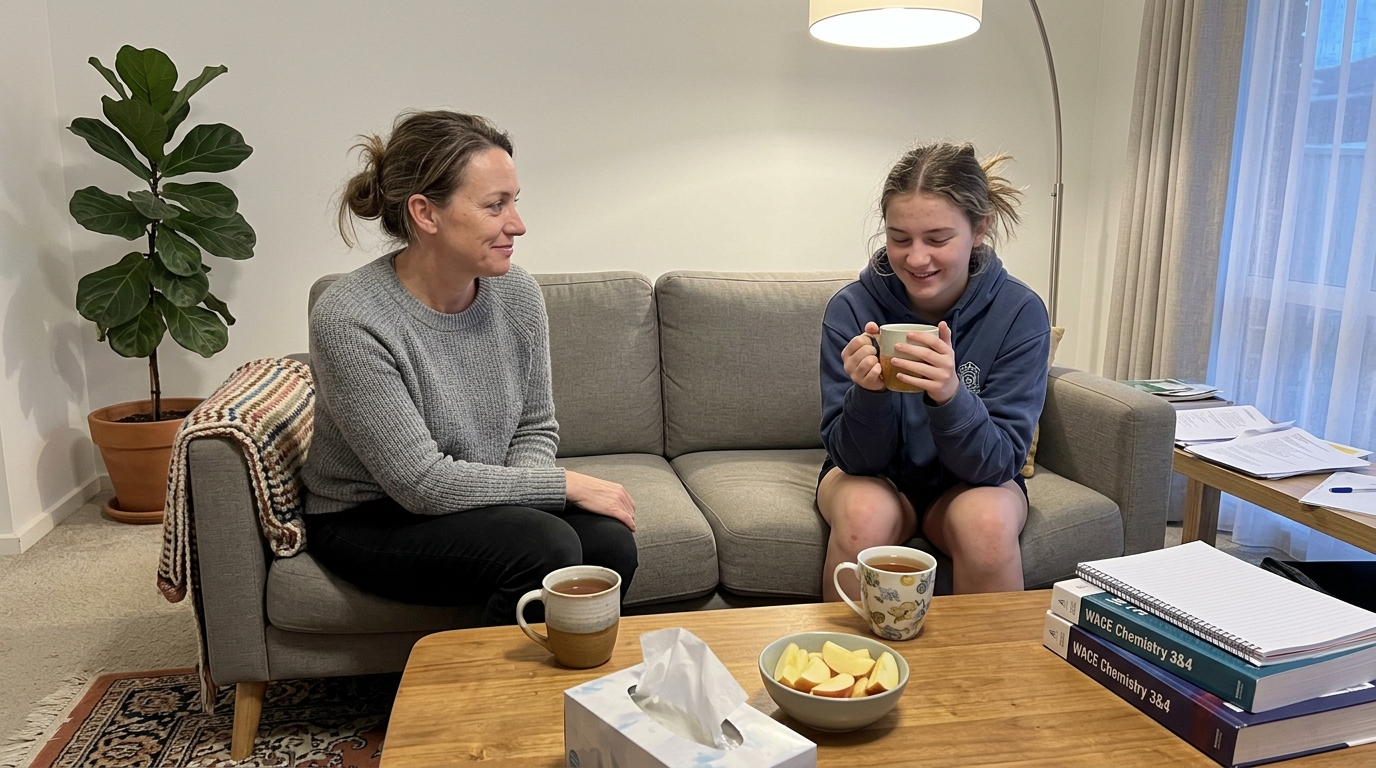
How do I balance pushing my child academically without causing exam stress?
Most parents who land on this page are quietly worried they're the cause. They almost never are — but the question is worth taking seriously, because how you frame results to your child does change how they handle the next round of exams. The key shift is from "what mark did you get?" to "what did you learn?" Marks tell you about a single afternoon; learning tells you about the next twelve months.
Three reframes that lower exam stress without lowering effort:
- Praise the effort, not the result. "I saw how hard you worked on that prep" lands better than "well done on the A". The first builds resilience; the second builds fear of dropping the A next time. Carol Dweck's mindset research and John Hattie's Visible Learning are aligned on this — feedback on effort and process produces stronger long-term outcomes than feedback on outcome.
- Normalise the non-A grade. A C in Year 9 algebra isn't a forecast for an ATAR; it's a signal about which topics need attention. Treating a poor mark as information rather than a verdict keeps your child willing to try the next paper.
- Keep the exam in proportion. NAPLAN is one data point in a long arc. A Year 7 mid-year exam is a calibration moment, not a final exam. Even an ATAR is the result of two years of school work and several exams, not one paper. Saying that out loud — "this is one piece of a much bigger picture" — is genuinely calming for a teenager who is catastrophising.
If your own anxiety about your child's results is leaking into the conversation (it happens to most of us), the ReachOut parents' hub has a quiet section for parents on managing your own exam stress — worth ten minutes when your child is asleep.
What's the best way for a teenager to study without burning out?
The most common burnout pattern we see in Tutero families is "long, late, and lonely" — three or four-hour study blocks at the desk, ending after midnight, with no one else in the house engaged. The replacement pattern is the opposite: short focused blocks with proper breaks, an early-evening finish, and at least one body in the room. The technique sounds soft; the results aren't.
The study rhythm we recommend to families across the year levels we tutor:
- 25–45 minute focus blocks. Phone in another room. One topic. Pen, paper, textbook open. The Pomodoro technique (25 minutes on / 5 minutes off) works for most students; senior students can usually push to 45 minutes.
- Real breaks, not phone breaks. A break that involves a screen is a break the brain doesn't get. Stand up, walk to the kitchen, eat something, look out a window. Five minutes is plenty.
- Hard stop at a sensible hour. 9pm for lower-secondary, 9:30pm for Year 11, 10pm for Year 12 in the lead-up to exams. After that, pack the bag for tomorrow and read a book in bed. We've yet to meet the student whose ATAR was made by working until 1am.
- One supportive presence in the house. A sibling doing their own homework at the same table, a parent in the next room, a tutor on a video call — the sense that "someone else is in this with me" is genuinely calming. We've covered the supportive-presence research in our piece on effective study skills.
- Active recall, not re-reading. Studies that involve closing the book and writing what you remember produce 2–3× the retention of studies that involve re-reading the chapter. Past papers under timed conditions are the ATAR/HSC-level version of this.
If your child is in primary or lower-secondary and exams are still new ground, 30-minute sessions are the right ceiling — and a parent quietly in the room makes a real difference. If your senior child is preparing for end-of-year exams, a structured weekly schedule with named topics for each block beats "I'll figure it out as I go" almost every time.
Should we get a tutor if my child is struggling with exam stress?
Sometimes yes, sometimes no — it depends on what your child is actually anxious about. A tutor solves a very specific problem: not knowing the material well enough to feel confident. If your child is anxious because there are gaps they haven't closed (a topic they missed, a subject they fell behind in mid-term, a unit they didn't understand the first time round), a good private tutor can close that gap fast and the stress drops with it. If your child is anxious for reasons that aren't about content — perfectionism, social anxiety, exam-room panic, family stress — a tutor isn't the right tool; a GP and a psychologist are.
Two questions to ask yourself:
- "Is my child's stress topic-specific?" If they're calm about English and panicking about maths, the maths is the problem and a maths tutor genuinely helps. If they're equally anxious across every subject, content gaps probably aren't the cause.
- "What does my child say when they describe the worry?" "I don't get it" is a tutor problem. "I'll fail" or "I can't sit there" or "everyone else is better than me" are psychologist problems.
If you do go the tutor route, look for someone vetted who knows the curriculum your child is sitting (NAPLAN-prep, Year 9 maths, VCE chemistry, HSC English, ATAR-relevant subjects), and who'll meet weekly through the exam period. Tutero's online tutoring starts at A$65/hour with no contracts and the same rate from Year 1 through Year 12 — there's no senior-subject premium, because the lesson changes by year level but the rate doesn't. Most families settle in with one tutor through to the end of exams. We've written a longer piece on when to start tutoring if the timing question is the one on your mind.
The cheaper alternatives — peer-marketplace tutors, neighbourhood tutoring centres, classified-ad listings — can work, but the screening is uneven and the turnover is high in exam periods, which is the worst time to be onboarding a new tutor. If a marketplace match-up doesn't work after the first lesson, you're back to square one in a fortnight you don't have.
Related reading
- How can I help my child focus and pay attention? — the chronic-focus companion to this acute-exam-period guide.
- How tutoring can improve confidence in maths — when the panic is specifically maths-shaped.
- Effective strategies to improve your maths study skills — the active-recall-and-spacing playbook in detail.
- Master time management for students — the weekly-schedule companion for exam-week planning.
- 5 signs your child needs a tutor and the ideal time to begin tutoring — if the tutor question is the one you came in with.
- If your child is staring at end-of-year results: how the ATAR is calculated and concerned about your ATAR — read this.
The bottom line
Exam stress is most often a problem you can soften at home, in a single calm week, with five quiet moves: protect sleep, feed the brain normally, keep movement in the day, manage your own reactions, and have one practical plan for each exam morning. Bring in a GP if the symptoms last more than two weeks or include panic attacks; bring in a tutor if the anxiety is content-shaped; bring in both if it isn't clear which one. The kid who sits their next exam tired but calm almost always outperforms the kid who sits it exhausted and primed.
Sleep is a study tool, not the opposite of one. Late-night cramming is the single biggest avoidable cause of exam stress.
Sleep is a study tool, not the opposite of one. Late-night cramming is the single biggest avoidable cause of exam stress.
Exam season has a way of pulling the whole household tight. Your child snaps at small things, sleep gets patchy, and the line between "she's working hard" and "she's barely coping" can blur fast. The good news is that exam stress is normal, manageable, and — when you handle the next few weeks well — often the lesson that makes the next round of exams feel half as hard.
This guide walks you through the calm, practical things that genuinely move the dial: how to read the signs early, what to say (and not say) the night before a big test, when to bring in extra support, and how to keep the rest of family life intact while your child sits NAPLAN, an end-of-term exam, or their final ATAR papers.
Quick answer
Most exam stress is normal nerves a parent can shift in a single calm conversation. The five-minute version: name what your child is feeling without trying to fix it, drop the perfection talk, lock in a sleep + food + movement routine, swap cramming for short focused study blocks with breaks, and have one quiet plan for the night before each exam. Step in harder — talk to a GP, your child's school, or a private tutor — when stress is leaking into appetite, sleep, or mood for more than two weeks, when there are panic attacks, or when your child has stopped engaging with school altogether. ReachOut and Beyond Blue both flag those last three as the line between "stretching" and "struggling".
How do I help my child manage exam stress?
The single most useful thing you can do is take the temperature down at home. Exams are a high-stakes period for your child's nervous system; it doesn't need a high-stakes parent on top of it. The five moves below come straight from the ReachOut parents' guide and are echoed by the AAP, RACGP and Beyond Blue: regulate sleep first, regulate food and movement second, regulate study habits third, regulate your own reactions fourth, and have one calm plan for each exam day fifth.
1. Lock in 8–10 hours of sleep on school nights. The ReachOut parents' guide is blunt: late-night cramming is the single biggest avoidable contributor to exam stress, because it costs sleep that your child's brain needs to consolidate what they learnt. Set a hard "books closed" time — 9:30pm for primary, 10pm for lower-secondary, 10:30pm for senior — and keep phones out of the bedroom from that hour. Sleep is a study tool, not the opposite of one.
2. Feed the brain on a normal eating rhythm. Three meals a day, real food, water on the desk. Skipping breakfast on an exam morning is the most common avoidable mistake; a slice of toast and a piece of fruit beats nothing every time. Save the sugar hit for after the paper, not before.
3. Make movement non-negotiable. Twenty minutes of walking, swimming, kicking a ball at the park, or riding the dog around the block — every day, even on big-cram days. Beyond Blue's adolescent-anxiety guidance is consistent: light daily exercise lowers cortisol, lifts mood, and clears the fog that long study sessions produce.
4. Regulate your own reactions, too. Your child reads your face. If every "how was that practice paper" comes out tight, they hear "this matters more than I matter". Asking once, hearing the answer, and changing the subject to dinner is the quietly powerful move.
5. Plan each exam day the night before. Wake-up time, breakfast, what's in the bag, what time you're leaving, what you're doing after the exam. A two-minute plan removes 90% of morning panic. We unpack the night-before plan in its own section below.
What are the symptoms of exam stress in teenagers?
Most exam-stress symptoms are physical, not emotional. Your teenager isn't always going to say "I'm anxious about the chemistry exam"; their body says it for them. Beyond Blue and the American Academy of Pediatrics describe the same cluster of signs across cultures and exam systems — and the cluster shows up at every year level, not just in Year 12.
The everyday signs of normal exam nerves include: trouble falling asleep the night before a test, butterflies in the stomach the morning of, mild irritability with siblings or parents, a couple of "I'm going to fail" comments in the week before, and being more tired than usual after long study days. Almost every student has some of these at some point — they're not a sign anything is wrong.
The signs to take more seriously, especially if they show up together for two weeks or more: appetite drop or compulsive eating, broken sleep most nights, withdrawal from friends, unexplained crying, racing heart and shortness of breath when opening study materials, headaches or stomachaches before school, panic attacks, or your child telling you they "can't do this" and meaning it. ReachOut's exam-stress hub is explicit: those are the GP-conversation signs, not the keep-going-and-it'll-pass signs.
What this looks like by year level varies more than parents expect. A Year 3 child sitting NAPLAN for the first time often shows it as sudden tummy aches in the morning. A Year 7 student in their first set of high-school exams often shows it as sudden shutdown — the schoolbag stays zipped. A Year 12 student facing VCE, HSC, WACE, QCE or SACE most often shows it as quiet, late-night perfectionism that costs them sleep. The behaviour differs; the underlying signal is the same.
How can I support my child the night before an exam?
The night before is when most parents accidentally make things worse — usually by trying to be helpful with one more practice paper, one more flashcard run-through, or one more "are you sure you've got this?" The single most evidence-backed thing you can do the night before an exam is the opposite: cut study early, keep dinner normal, and protect sleep. Cramming the night before adds maybe 1–3% to a result; losing two hours of sleep on top of cramming costs more than that.
Here's the calm version of an exam-eve evening:
- Books closed by 7:30pm. A quick 20-minute review of one tricky topic earlier in the afternoon is fine. Past 7:30pm, pack the bag, leave the books alone.
- Pack the bag together, not for them. Pens, calculator (with batteries that work), water bottle, a snack, a watch if they're using one, the entry slip if there is one. Doing this with your child gives them ownership and gives you a quiet five-minute conversation that isn't about the exam.
- Make a normal dinner, not a "big exam" dinner. The "tonight is special" framing turns the volume up. Toast and pasta and a chat about the weekend are fine.
- Remind them what's after the exam. "After tomorrow's paper we'll grab coffee and you can rest." A small post-exam plan is a great anxiety lever — it tells the brain there's a finish line.
- Let them go to bed early without being told. If they want screen time, fine — leave the phone out of the bedroom. Most kids put themselves to bed an hour earlier than usual once the bag is packed.
The night-before plan is the same whether your child is sitting their first NAPLAN paper, a mid-year history exam, an HSC trial, or their final VCE chemistry paper. The exam changes; the calm-and-rested principle doesn't.
What should we do if my child has a panic attack about exams?
Panic attacks during exam season look frightening and feel worse, but they're survivable, predictable, and treatable. The key thing for a parent to know: a panic attack peaks within about ten minutes and passes within twenty. Your job in those twenty minutes isn't to talk your child out of it — that almost never works — it's to keep them safe, slow their breathing, and stay with them until it passes. Beyond Blue's panic-attack guidance is the cleanest version of the protocol.
The four-step in-the-moment approach:
- Move to a quieter space if you can. A bedroom, the front step, the car. Not because the location matters but because fewer eyes makes the panic shorter.
- Slow the breathing together. "Breathe in for four, hold for four, out for six." Doing it with them is the trick — they'll match your pace before they realise they're doing it.
- Don't problem-solve mid-attack. "It's okay, this will pass, I'm here" beats "but you've studied, you'll be fine". Reassurance about facts can wait twenty minutes.
- Plan the next 24 hours after it passes. Cup of tea, a short walk, an early bed. Don't go straight back to studying — the brain needs to come down properly first.
A single panic attack the night before a big exam, especially in Year 11 or 12, is more common than parents realise. A panic attack pattern — three or more in a fortnight, panic attacks that show up away from exams, panic attacks that scare your child off school entirely — is the line where you should book a GP appointment. ReachOut and the RACGP recommend GP-side support starting with a Mental Health Treatment Plan, which gives Medicare-rebated access to a psychologist (up to 10 sessions a year). It is genuinely fast, free, and confidential.
Is exam stress normal or a sign of something more serious?
Some exam stress is healthy. The flutter of nerves before a test, a bit of late-night perfectionism, the post-exam crash, the "I'm so done with school" rant on the drive home — those are signs of a kid who cares, not a kid in crisis. Performance psychology has a name for this: the Yerkes-Dodson curve, which says a moderate amount of arousal actually improves performance; too little and you don't bother; too much and you choke.
The line between "stretching" and "struggling" is roughly: how persistent is it, how much of life is it eating, and is it about exams specifically or about everything? If your child has stress that comes and goes around individual papers, that doesn't touch their friendships or appetite, that lifts the moment a paper is over — that's the normal end of the spectrum and the moves in this article are usually enough.
If your child's stress has lasted more than two weeks, is showing up in sleep and appetite and mood, isn't lifting between exams, has produced one or more panic attacks, or has tipped into "I don't want to go to school at all" — that's the line where stress has become anxiety, and it's a GP conversation, not a parenting-effort conversation. The RACGP guidelines on adolescent anxiety are clear that cognitive behavioural therapy is first-line and works fast — most teenagers see meaningful change in 4–8 sessions.
One quiet permission slip from us: asking for help isn't a step too soon. Schools and GPs would much rather see a worried parent in the early-stretching phase than in the late-struggling phase. There is no waiting list for "early".
How do I balance pushing my child academically without causing exam stress?
Most parents who land on this page are quietly worried they're the cause. They almost never are — but the question is worth taking seriously, because how you frame results to your child does change how they handle the next round of exams. The key shift is from "what mark did you get?" to "what did you learn?" Marks tell you about a single afternoon; learning tells you about the next twelve months.
Three reframes that lower exam stress without lowering effort:
- Praise the effort, not the result. "I saw how hard you worked on that prep" lands better than "well done on the A". The first builds resilience; the second builds fear of dropping the A next time. Carol Dweck's mindset research and John Hattie's Visible Learning are aligned on this — feedback on effort and process produces stronger long-term outcomes than feedback on outcome.
- Normalise the non-A grade. A C in Year 9 algebra isn't a forecast for an ATAR; it's a signal about which topics need attention. Treating a poor mark as information rather than a verdict keeps your child willing to try the next paper.
- Keep the exam in proportion. NAPLAN is one data point in a long arc. A Year 7 mid-year exam is a calibration moment, not a final exam. Even an ATAR is the result of two years of school work and several exams, not one paper. Saying that out loud — "this is one piece of a much bigger picture" — is genuinely calming for a teenager who is catastrophising.
If your own anxiety about your child's results is leaking into the conversation (it happens to most of us), the ReachOut parents' hub has a quiet section for parents on managing your own exam stress — worth ten minutes when your child is asleep.
What's the best way for a teenager to study without burning out?
The most common burnout pattern we see in Tutero families is "long, late, and lonely" — three or four-hour study blocks at the desk, ending after midnight, with no one else in the house engaged. The replacement pattern is the opposite: short focused blocks with proper breaks, an early-evening finish, and at least one body in the room. The technique sounds soft; the results aren't.
The study rhythm we recommend to families across the year levels we tutor:
- 25–45 minute focus blocks. Phone in another room. One topic. Pen, paper, textbook open. The Pomodoro technique (25 minutes on / 5 minutes off) works for most students; senior students can usually push to 45 minutes.
- Real breaks, not phone breaks. A break that involves a screen is a break the brain doesn't get. Stand up, walk to the kitchen, eat something, look out a window. Five minutes is plenty.
- Hard stop at a sensible hour. 9pm for lower-secondary, 9:30pm for Year 11, 10pm for Year 12 in the lead-up to exams. After that, pack the bag for tomorrow and read a book in bed. We've yet to meet the student whose ATAR was made by working until 1am.
- One supportive presence in the house. A sibling doing their own homework at the same table, a parent in the next room, a tutor on a video call — the sense that "someone else is in this with me" is genuinely calming. We've covered the supportive-presence research in our piece on effective study skills.
- Active recall, not re-reading. Studies that involve closing the book and writing what you remember produce 2–3× the retention of studies that involve re-reading the chapter. Past papers under timed conditions are the ATAR/HSC-level version of this.
If your child is in primary or lower-secondary and exams are still new ground, 30-minute sessions are the right ceiling — and a parent quietly in the room makes a real difference. If your senior child is preparing for end-of-year exams, a structured weekly schedule with named topics for each block beats "I'll figure it out as I go" almost every time.
Should we get a tutor if my child is struggling with exam stress?
Sometimes yes, sometimes no — it depends on what your child is actually anxious about. A tutor solves a very specific problem: not knowing the material well enough to feel confident. If your child is anxious because there are gaps they haven't closed (a topic they missed, a subject they fell behind in mid-term, a unit they didn't understand the first time round), a good private tutor can close that gap fast and the stress drops with it. If your child is anxious for reasons that aren't about content — perfectionism, social anxiety, exam-room panic, family stress — a tutor isn't the right tool; a GP and a psychologist are.
Two questions to ask yourself:
- "Is my child's stress topic-specific?" If they're calm about English and panicking about maths, the maths is the problem and a maths tutor genuinely helps. If they're equally anxious across every subject, content gaps probably aren't the cause.
- "What does my child say when they describe the worry?" "I don't get it" is a tutor problem. "I'll fail" or "I can't sit there" or "everyone else is better than me" are psychologist problems.
If you do go the tutor route, look for someone vetted who knows the curriculum your child is sitting (NAPLAN-prep, Year 9 maths, VCE chemistry, HSC English, ATAR-relevant subjects), and who'll meet weekly through the exam period. Tutero's online tutoring starts at A$65/hour with no contracts and the same rate from Year 1 through Year 12 — there's no senior-subject premium, because the lesson changes by year level but the rate doesn't. Most families settle in with one tutor through to the end of exams. We've written a longer piece on when to start tutoring if the timing question is the one on your mind.
The cheaper alternatives — peer-marketplace tutors, neighbourhood tutoring centres, classified-ad listings — can work, but the screening is uneven and the turnover is high in exam periods, which is the worst time to be onboarding a new tutor. If a marketplace match-up doesn't work after the first lesson, you're back to square one in a fortnight you don't have.
Related reading
- How can I help my child focus and pay attention? — the chronic-focus companion to this acute-exam-period guide.
- How tutoring can improve confidence in maths — when the panic is specifically maths-shaped.
- Effective strategies to improve your maths study skills — the active-recall-and-spacing playbook in detail.
- Master time management for students — the weekly-schedule companion for exam-week planning.
- 5 signs your child needs a tutor and the ideal time to begin tutoring — if the tutor question is the one you came in with.
- If your child is staring at end-of-year results: how the ATAR is calculated and concerned about your ATAR — read this.
The bottom line
Exam stress is most often a problem you can soften at home, in a single calm week, with five quiet moves: protect sleep, feed the brain normally, keep movement in the day, manage your own reactions, and have one practical plan for each exam morning. Bring in a GP if the symptoms last more than two weeks or include panic attacks; bring in a tutor if the anxiety is content-shaped; bring in both if it isn't clear which one. The kid who sits their next exam tired but calm almost always outperforms the kid who sits it exhausted and primed.
FAQ
.svg)
.svg)
Online maths tutoring at Tutero is catering to students of all year levels. We offer programs tailored to the unique learning curves of each age group.
We also have expert NAPLAN and ATAR subject tutors, ensuring students are well-equipped for these pivotal assessments.
We recommend at least two to three session per week for consistent progress. However, this can vary based on your child's needs and goals.
Our platform uses advanced security protocols to ensure the safety and privacy of all our online sessions.
Parents are welcome to observe sessions. We believe in a collaborative approach to education.
We provide regular progress reports and assessments to track your child’s academic development.
Yes, we prioritise the student-tutor relationship and can arrange a change if the need arises.
Yes, we offer a range of resources and materials, including interactive exercises and practice worksheets.
Sleep is a study tool, not the opposite of one. Late-night cramming is the single biggest avoidable cause of exam stress.
Sleep is a study tool, not the opposite of one. Late-night cramming is the single biggest avoidable cause of exam stress.

Sleep is a study tool, not the opposite of one. Late-night cramming is the single biggest avoidable cause of exam stress.
A panic attack peaks in ten minutes and passes in twenty. Your job isn't to talk your child out of it — it's to stay with them until it does.
Exam season has a way of pulling the whole household tight. Your child snaps at small things, sleep gets patchy, and the line between "she's working hard" and "she's barely coping" can blur fast. The good news is that exam stress is normal, manageable, and — when you handle the next few weeks well — often the lesson that makes the next round of exams feel half as hard.
This guide walks you through the calm, practical things that genuinely move the dial: how to read the signs early, what to say (and not say) the night before a big test, when to bring in extra support, and how to keep the rest of family life intact while your child sits NAPLAN, an end-of-term exam, or their final ATAR papers.
Quick answer
Most exam stress is normal nerves a parent can shift in a single calm conversation. The five-minute version: name what your child is feeling without trying to fix it, drop the perfection talk, lock in a sleep + food + movement routine, swap cramming for short focused study blocks with breaks, and have one quiet plan for the night before each exam. Step in harder — talk to a GP, your child's school, or a private tutor — when stress is leaking into appetite, sleep, or mood for more than two weeks, when there are panic attacks, or when your child has stopped engaging with school altogether. ReachOut and Beyond Blue both flag those last three as the line between "stretching" and "struggling".
How do I help my child manage exam stress?
The single most useful thing you can do is take the temperature down at home. Exams are a high-stakes period for your child's nervous system; it doesn't need a high-stakes parent on top of it. The five moves below come straight from the ReachOut parents' guide and are echoed by the AAP, RACGP and Beyond Blue: regulate sleep first, regulate food and movement second, regulate study habits third, regulate your own reactions fourth, and have one calm plan for each exam day fifth.
1. Lock in 8–10 hours of sleep on school nights. The ReachOut parents' guide is blunt: late-night cramming is the single biggest avoidable contributor to exam stress, because it costs sleep that your child's brain needs to consolidate what they learnt. Set a hard "books closed" time — 9:30pm for primary, 10pm for lower-secondary, 10:30pm for senior — and keep phones out of the bedroom from that hour. Sleep is a study tool, not the opposite of one.
2. Feed the brain on a normal eating rhythm. Three meals a day, real food, water on the desk. Skipping breakfast on an exam morning is the most common avoidable mistake; a slice of toast and a piece of fruit beats nothing every time. Save the sugar hit for after the paper, not before.
3. Make movement non-negotiable. Twenty minutes of walking, swimming, kicking a ball at the park, or riding the dog around the block — every day, even on big-cram days. Beyond Blue's adolescent-anxiety guidance is consistent: light daily exercise lowers cortisol, lifts mood, and clears the fog that long study sessions produce.
4. Regulate your own reactions, too. Your child reads your face. If every "how was that practice paper" comes out tight, they hear "this matters more than I matter". Asking once, hearing the answer, and changing the subject to dinner is the quietly powerful move.
5. Plan each exam day the night before. Wake-up time, breakfast, what's in the bag, what time you're leaving, what you're doing after the exam. A two-minute plan removes 90% of morning panic. We unpack the night-before plan in its own section below.
What are the symptoms of exam stress in teenagers?
Most exam-stress symptoms are physical, not emotional. Your teenager isn't always going to say "I'm anxious about the chemistry exam"; their body says it for them. Beyond Blue and the American Academy of Pediatrics describe the same cluster of signs across cultures and exam systems — and the cluster shows up at every year level, not just in Year 12.
The everyday signs of normal exam nerves include: trouble falling asleep the night before a test, butterflies in the stomach the morning of, mild irritability with siblings or parents, a couple of "I'm going to fail" comments in the week before, and being more tired than usual after long study days. Almost every student has some of these at some point — they're not a sign anything is wrong.
The signs to take more seriously, especially if they show up together for two weeks or more: appetite drop or compulsive eating, broken sleep most nights, withdrawal from friends, unexplained crying, racing heart and shortness of breath when opening study materials, headaches or stomachaches before school, panic attacks, or your child telling you they "can't do this" and meaning it. ReachOut's exam-stress hub is explicit: those are the GP-conversation signs, not the keep-going-and-it'll-pass signs.
What this looks like by year level varies more than parents expect. A Year 3 child sitting NAPLAN for the first time often shows it as sudden tummy aches in the morning. A Year 7 student in their first set of high-school exams often shows it as sudden shutdown — the schoolbag stays zipped. A Year 12 student facing VCE, HSC, WACE, QCE or SACE most often shows it as quiet, late-night perfectionism that costs them sleep. The behaviour differs; the underlying signal is the same.
How can I support my child the night before an exam?
The night before is when most parents accidentally make things worse — usually by trying to be helpful with one more practice paper, one more flashcard run-through, or one more "are you sure you've got this?" The single most evidence-backed thing you can do the night before an exam is the opposite: cut study early, keep dinner normal, and protect sleep. Cramming the night before adds maybe 1–3% to a result; losing two hours of sleep on top of cramming costs more than that.
Here's the calm version of an exam-eve evening:
- Books closed by 7:30pm. A quick 20-minute review of one tricky topic earlier in the afternoon is fine. Past 7:30pm, pack the bag, leave the books alone.
- Pack the bag together, not for them. Pens, calculator (with batteries that work), water bottle, a snack, a watch if they're using one, the entry slip if there is one. Doing this with your child gives them ownership and gives you a quiet five-minute conversation that isn't about the exam.
- Make a normal dinner, not a "big exam" dinner. The "tonight is special" framing turns the volume up. Toast and pasta and a chat about the weekend are fine.
- Remind them what's after the exam. "After tomorrow's paper we'll grab coffee and you can rest." A small post-exam plan is a great anxiety lever — it tells the brain there's a finish line.
- Let them go to bed early without being told. If they want screen time, fine — leave the phone out of the bedroom. Most kids put themselves to bed an hour earlier than usual once the bag is packed.
The night-before plan is the same whether your child is sitting their first NAPLAN paper, a mid-year history exam, an HSC trial, or their final VCE chemistry paper. The exam changes; the calm-and-rested principle doesn't.
What should we do if my child has a panic attack about exams?
Panic attacks during exam season look frightening and feel worse, but they're survivable, predictable, and treatable. The key thing for a parent to know: a panic attack peaks within about ten minutes and passes within twenty. Your job in those twenty minutes isn't to talk your child out of it — that almost never works — it's to keep them safe, slow their breathing, and stay with them until it passes. Beyond Blue's panic-attack guidance is the cleanest version of the protocol.
The four-step in-the-moment approach:
- Move to a quieter space if you can. A bedroom, the front step, the car. Not because the location matters but because fewer eyes makes the panic shorter.
- Slow the breathing together. "Breathe in for four, hold for four, out for six." Doing it with them is the trick — they'll match your pace before they realise they're doing it.
- Don't problem-solve mid-attack. "It's okay, this will pass, I'm here" beats "but you've studied, you'll be fine". Reassurance about facts can wait twenty minutes.
- Plan the next 24 hours after it passes. Cup of tea, a short walk, an early bed. Don't go straight back to studying — the brain needs to come down properly first.
A single panic attack the night before a big exam, especially in Year 11 or 12, is more common than parents realise. A panic attack pattern — three or more in a fortnight, panic attacks that show up away from exams, panic attacks that scare your child off school entirely — is the line where you should book a GP appointment. ReachOut and the RACGP recommend GP-side support starting with a Mental Health Treatment Plan, which gives Medicare-rebated access to a psychologist (up to 10 sessions a year). It is genuinely fast, free, and confidential.
Is exam stress normal or a sign of something more serious?
Some exam stress is healthy. The flutter of nerves before a test, a bit of late-night perfectionism, the post-exam crash, the "I'm so done with school" rant on the drive home — those are signs of a kid who cares, not a kid in crisis. Performance psychology has a name for this: the Yerkes-Dodson curve, which says a moderate amount of arousal actually improves performance; too little and you don't bother; too much and you choke.
The line between "stretching" and "struggling" is roughly: how persistent is it, how much of life is it eating, and is it about exams specifically or about everything? If your child has stress that comes and goes around individual papers, that doesn't touch their friendships or appetite, that lifts the moment a paper is over — that's the normal end of the spectrum and the moves in this article are usually enough.
If your child's stress has lasted more than two weeks, is showing up in sleep and appetite and mood, isn't lifting between exams, has produced one or more panic attacks, or has tipped into "I don't want to go to school at all" — that's the line where stress has become anxiety, and it's a GP conversation, not a parenting-effort conversation. The RACGP guidelines on adolescent anxiety are clear that cognitive behavioural therapy is first-line and works fast — most teenagers see meaningful change in 4–8 sessions.
One quiet permission slip from us: asking for help isn't a step too soon. Schools and GPs would much rather see a worried parent in the early-stretching phase than in the late-struggling phase. There is no waiting list for "early".
How do I balance pushing my child academically without causing exam stress?
Most parents who land on this page are quietly worried they're the cause. They almost never are — but the question is worth taking seriously, because how you frame results to your child does change how they handle the next round of exams. The key shift is from "what mark did you get?" to "what did you learn?" Marks tell you about a single afternoon; learning tells you about the next twelve months.
Three reframes that lower exam stress without lowering effort:
- Praise the effort, not the result. "I saw how hard you worked on that prep" lands better than "well done on the A". The first builds resilience; the second builds fear of dropping the A next time. Carol Dweck's mindset research and John Hattie's Visible Learning are aligned on this — feedback on effort and process produces stronger long-term outcomes than feedback on outcome.
- Normalise the non-A grade. A C in Year 9 algebra isn't a forecast for an ATAR; it's a signal about which topics need attention. Treating a poor mark as information rather than a verdict keeps your child willing to try the next paper.
- Keep the exam in proportion. NAPLAN is one data point in a long arc. A Year 7 mid-year exam is a calibration moment, not a final exam. Even an ATAR is the result of two years of school work and several exams, not one paper. Saying that out loud — "this is one piece of a much bigger picture" — is genuinely calming for a teenager who is catastrophising.
If your own anxiety about your child's results is leaking into the conversation (it happens to most of us), the ReachOut parents' hub has a quiet section for parents on managing your own exam stress — worth ten minutes when your child is asleep.
What's the best way for a teenager to study without burning out?
The most common burnout pattern we see in Tutero families is "long, late, and lonely" — three or four-hour study blocks at the desk, ending after midnight, with no one else in the house engaged. The replacement pattern is the opposite: short focused blocks with proper breaks, an early-evening finish, and at least one body in the room. The technique sounds soft; the results aren't.
The study rhythm we recommend to families across the year levels we tutor:
- 25–45 minute focus blocks. Phone in another room. One topic. Pen, paper, textbook open. The Pomodoro technique (25 minutes on / 5 minutes off) works for most students; senior students can usually push to 45 minutes.
- Real breaks, not phone breaks. A break that involves a screen is a break the brain doesn't get. Stand up, walk to the kitchen, eat something, look out a window. Five minutes is plenty.
- Hard stop at a sensible hour. 9pm for lower-secondary, 9:30pm for Year 11, 10pm for Year 12 in the lead-up to exams. After that, pack the bag for tomorrow and read a book in bed. We've yet to meet the student whose ATAR was made by working until 1am.
- One supportive presence in the house. A sibling doing their own homework at the same table, a parent in the next room, a tutor on a video call — the sense that "someone else is in this with me" is genuinely calming. We've covered the supportive-presence research in our piece on effective study skills.
- Active recall, not re-reading. Studies that involve closing the book and writing what you remember produce 2–3× the retention of studies that involve re-reading the chapter. Past papers under timed conditions are the ATAR/HSC-level version of this.
If your child is in primary or lower-secondary and exams are still new ground, 30-minute sessions are the right ceiling — and a parent quietly in the room makes a real difference. If your senior child is preparing for end-of-year exams, a structured weekly schedule with named topics for each block beats "I'll figure it out as I go" almost every time.
Should we get a tutor if my child is struggling with exam stress?
Sometimes yes, sometimes no — it depends on what your child is actually anxious about. A tutor solves a very specific problem: not knowing the material well enough to feel confident. If your child is anxious because there are gaps they haven't closed (a topic they missed, a subject they fell behind in mid-term, a unit they didn't understand the first time round), a good private tutor can close that gap fast and the stress drops with it. If your child is anxious for reasons that aren't about content — perfectionism, social anxiety, exam-room panic, family stress — a tutor isn't the right tool; a GP and a psychologist are.
Two questions to ask yourself:
- "Is my child's stress topic-specific?" If they're calm about English and panicking about maths, the maths is the problem and a maths tutor genuinely helps. If they're equally anxious across every subject, content gaps probably aren't the cause.
- "What does my child say when they describe the worry?" "I don't get it" is a tutor problem. "I'll fail" or "I can't sit there" or "everyone else is better than me" are psychologist problems.
If you do go the tutor route, look for someone vetted who knows the curriculum your child is sitting (NAPLAN-prep, Year 9 maths, VCE chemistry, HSC English, ATAR-relevant subjects), and who'll meet weekly through the exam period. Tutero's online tutoring starts at A$65/hour with no contracts and the same rate from Year 1 through Year 12 — there's no senior-subject premium, because the lesson changes by year level but the rate doesn't. Most families settle in with one tutor through to the end of exams. We've written a longer piece on when to start tutoring if the timing question is the one on your mind.
The cheaper alternatives — peer-marketplace tutors, neighbourhood tutoring centres, classified-ad listings — can work, but the screening is uneven and the turnover is high in exam periods, which is the worst time to be onboarding a new tutor. If a marketplace match-up doesn't work after the first lesson, you're back to square one in a fortnight you don't have.
Related reading
- How can I help my child focus and pay attention? — the chronic-focus companion to this acute-exam-period guide.
- How tutoring can improve confidence in maths — when the panic is specifically maths-shaped.
- Effective strategies to improve your maths study skills — the active-recall-and-spacing playbook in detail.
- Master time management for students — the weekly-schedule companion for exam-week planning.
- 5 signs your child needs a tutor and the ideal time to begin tutoring — if the tutor question is the one you came in with.
- If your child is staring at end-of-year results: how the ATAR is calculated and concerned about your ATAR — read this.
The bottom line
Exam stress is most often a problem you can soften at home, in a single calm week, with five quiet moves: protect sleep, feed the brain normally, keep movement in the day, manage your own reactions, and have one practical plan for each exam morning. Bring in a GP if the symptoms last more than two weeks or include panic attacks; bring in a tutor if the anxiety is content-shaped; bring in both if it isn't clear which one. The kid who sits their next exam tired but calm almost always outperforms the kid who sits it exhausted and primed.
Sleep is a study tool, not the opposite of one. Late-night cramming is the single biggest avoidable cause of exam stress.
A panic attack peaks in ten minutes and passes in twenty. Your job isn't to talk your child out of it — it's to stay with them until it does.
For most students, exam-related anxiety builds in the two weeks before a paper and lifts within 48 hours of finishing it. If your child is still anxious a week after their last exam, that's outside the normal pattern and worth a GP conversation.
Don't ask directly. Most teenagers won't open up to a 'how are you feeling about exams' question. Drive them somewhere — anywhere — and they'll usually talk in the car when there's no eye contact. Or sit alongside them while they study and just be in the room. Presence beats interrogation.
Yes — and it's more common than parents expect. Headaches, stomach aches, nausea, racing heart, and broken sleep are all standard physical symptoms of exam stress. They're not 'made up'. Treat them as real signals to slow the schedule down, and book a GP appointment if symptoms last more than two weeks.
Sometimes, but it's almost always the second-line answer behind cognitive behavioural therapy. The RACGP guidelines for adolescent anxiety put CBT first — most teenagers see meaningful change in 4–8 sessions. Medication is a conversation for a GP and a child psychiatrist, not a parenting-effort decision.
Reframe what success looks like out loud, and often. 'A B in a hard subject is a real result.' 'You don't need an A in everything to be a real student.' Perfectionism feeds on the silent message that anything below an A is a failure; the parent's job is to keep saying that quieter than the perfectionism.
Almost never — but the exception matters. If your child is mid-panic-attack, has been physically unwell overnight, or has been awake all night with anxiety, they're not going to perform anyway, and forcing them to sit the paper makes the next exam scarier. Most schools have a well-defined process for special consideration; contact the school as early as possible the same morning.
Hoping to improve confidence & grades?

.png)


