
.svg)

If your teenager is picking VCE subjects, you have probably heard that some subjects "scale up" and others "scale down", and that the choice could quietly lift or lower their ATAR. It is one of the most misunderstood parts of senior school in Victoria, and the anxiety it creates is real. This guide explains exactly how VCE scaling works, which subjects tend to move up or down, and what that actually means when your child sits down to choose next year's studies.
What is VCE scaling and why does it exist?
VCE scaling is the process the Victorian Tertiary Admissions Centre (VTAC) uses to convert each raw study score into a scaled study score, so students who take different subjects can be compared fairly for the ATAR. A study score of 30 in a strongly scaling subject can become a higher scaled score, while the same 30 in another subject can fall slightly. Scaling reflects the strength of each subject's cohort, not a judgement that a subject is "easy" or "hard".
The reason it exists is fairness. It is harder to score well in a subject where most of the students are also strong across their other studies. VTAC adjusts for that so that a top mark means roughly the same amount of achievement no matter which subjects a student sat. You can read VTAC's own explanation in the ATAR and Scaling Guide.
How does VCE scaling actually work?
TL;DR: VTAC measures how each subject's students performed across all their other subjects, then adjusts that subject's scores up or down to match.
Every year VTAC looks at the students who took a given subject and checks how that same group performed across all their other VCE studies. If those students were, on average, very strong everywhere else, their scores in the subject are scaled up. If the cohort was, on average, weaker across their other studies, the subject is scaled down. The subject content itself is never judged. The scaling is a statement about the competition, measured objectively from results.
This is why a subject cannot be gamed by everyone at once. If a wave of high achievers floods into a subject, the cohort strengthens and the scaling reflects that. If they leave, it drifts back. Scaling is recalculated from scratch each year using the actual cohort, which is administered by VTAC alongside the VCE results released by the Victorian Curriculum and Assessment Authority (VCAA).
Which VCE subjects scale up and which scale down?
TL;DR: Advanced maths, sciences and languages typically scale up; several popular general subjects typically scale down slightly.
The table below shows indicative, multi-year patterns for how a study score of 30 tends to be scaled. These figures move a little every year because the cohort changes, so treat them as direction and rough magnitude, not a fixed promise. The authoritative numbers are published each December in the VTAC Scaling Report.
| Subject | A study score of 30 typically scales to | Direction |
|---|---|---|
| Specialist Mathematics | ~43 | Up strongly |
| Latin | ~40+ | Up strongly |
| Mathematical Methods | ~34 | Up |
| Chemistry | ~33 | Up |
| Physics | ~33 | Up |
| English Language | ~33 | Up slightly |
| English | ~28 | Down slightly |
| Physical Education | ~27 | Down |
| Further / General Mathematics | ~27 | Down |
| Health and Human Development | ~26 | Down |
Source: VTAC scaling reports. Figures are indicative multi-year patterns and vary by cohort each year; they are not guarantees.
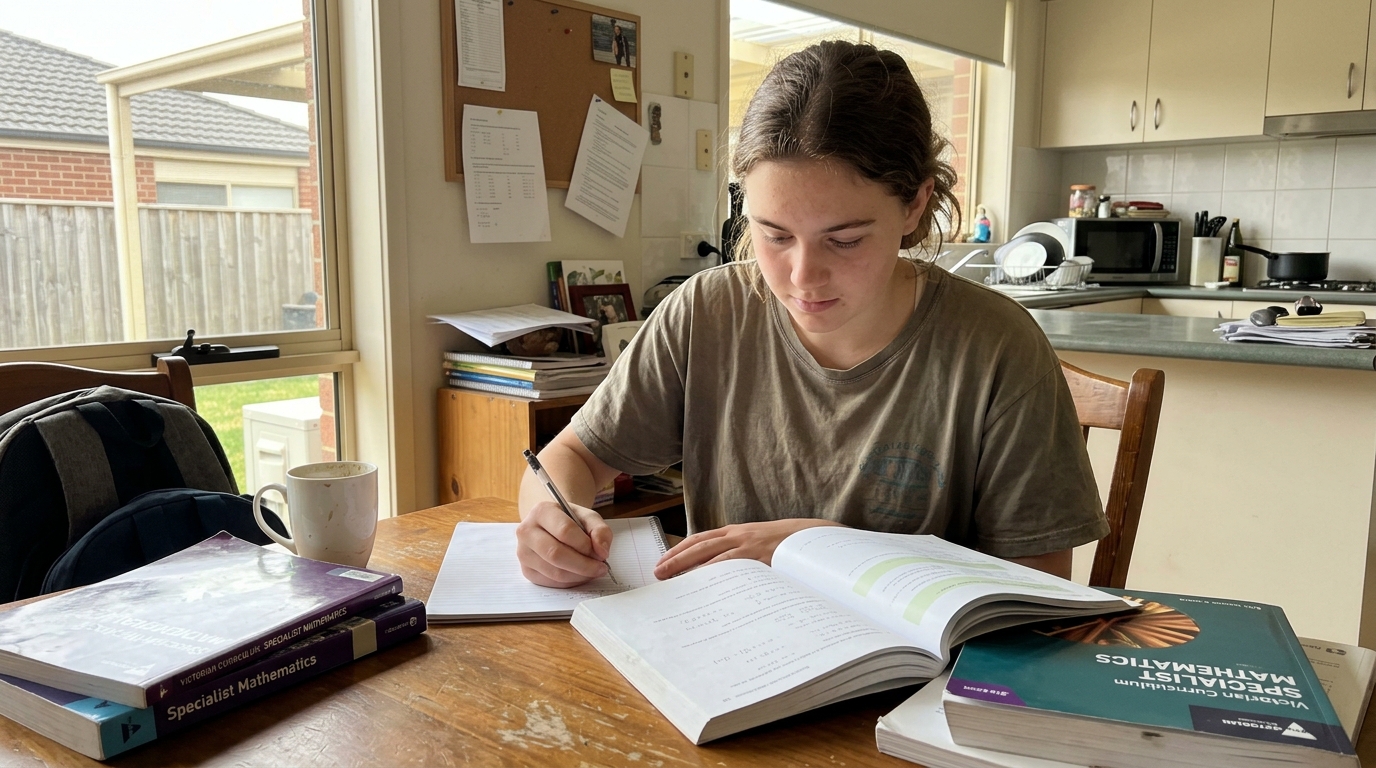
Why do maths and languages scale up so strongly?
TL;DR: These subjects attract cohorts that perform strongly across all their other subjects, so scaling lifts them to keep the comparison fair.
Advanced mathematics and high-level languages consistently sit at the top of the scaling list. Specialist Mathematics and Latin are usually the two strongest, with subjects like Chinese, French and German close behind. The pattern holds year after year because the students who choose these subjects tend to be high achievers across the board, and often include native or near-native speakers in the language subjects. When a subject's students dominate their other studies, VTAC scales that subject up so a 40 there reflects the same achievement as a 40 elsewhere.
The reverse is true for some widely taken general subjects. They are not "worse" subjects, and students who love them often do brilliantly in them. The cohort is simply broader on average, so the scaling drifts down a little. None of this changes how interesting or useful the subject is for a career or a course.
Does chasing a high-scaling subject guarantee a better ATAR?
TL;DR: No. Scaling only helps if your child performs well, and a mediocre mark in a strongly scaling subject usually loses to a strong mark in another.
This is the single most important thing for parents to understand. Scaling rewards a strong result in a strongly scaling subject. It does not rescue a weak one. A student who scores 25 in Specialist Mathematics will usually end up with a lower scaled score than a student who scores 38 in a subject that scales down slightly. Picking a subject purely for its scaling, when your child neither enjoys it nor performs in it, is a genuinely high-risk strategy that often backfires.
The better approach is to choose subjects your child is genuinely capable in and motivated by, then let scaling work in the background. A student who is thriving in senior maths will benefit far more from strong marks than a reluctant student forced into it for the scaling bonus.
How does scaling feed into your ATAR? A worked example
TL;DR: VTAC scales each study score, then combines the best scaled scores into an aggregate that is ranked to produce the ATAR.
Here is a simplified, illustrative example. Imagine a Year 12 student sits five subjects and earns these raw study scores: English 32, Mathematical Methods 35, Chemistry 34, Physics 33, and Health and Human Development 30. After scaling, the maths and science scores tend to rise a little, while English and Health tend to ease down slightly.
VTAC then takes the student's best scaled scores, applies the compulsory English increment, adds a set of the next best scores, and produces an aggregate. That aggregate is ranked against every other Victorian student to give a percentile, and that percentile is the ATAR. In this example, the strong maths and science marks do the heavy lifting because they both scaled up and were high to begin with. For the full mechanics of how the aggregate becomes a rank, our guide on how the ATAR is calculated walks through each step.

Does VCE scaling change every year?
TL;DR: Yes. Scaling is recalculated annually from the actual cohort, so the exact numbers shift each year.
Because scaling is derived entirely from each year's cohort, the precise adjustment for every subject changes annually. The broad pattern is remarkably stable, so Specialist Mathematics and Latin have scaled up strongly for many years running, and the popular general subjects have drifted down for just as long. What moves is the exact size of the adjustment, not usually the direction. This is why VTAC publishes a fresh scaling report each December rather than a permanent table, and why any figure you see quoted, including the ones in this article, should be read as a pattern rather than a locked-in number.
Common misconceptions about VCE scaling
TL;DR: Scaling does not punish "easy" subjects, cannot be gamed, and matters far less than strong results.
"Scaling means my child should avoid low-scaling subjects." Not if they will perform strongly in them. A high mark in a subject that scales down slightly usually beats a low mark in one that scales up.
"The subject is scaled because VTAC thinks it is easy." No. Scaling measures the strength of the cohort, not the difficulty of the content. A subject with a broad cohort scales differently from one with a selective cohort, regardless of how demanding the material is.
"You can beat scaling by choosing clever subjects." You cannot. If strong students crowd into a subject, its cohort strengthens and it scales up, which removes the supposed advantage. Scaling always tracks the actual cohort.
What this means when your child chooses subjects
Scaling is real, and it does move ATARs, but it is a background force, not a strategy. The families who navigate it well start with the subjects their child is genuinely good at and interested in, keep an eye on the broad scaling patterns for tie-breaks between similar options, and then focus their energy on strong results. A student who is engaged and well supported in a subject will almost always out-perform one who was pushed into a subject purely for the scaling. Scaling applies only within the VCE; students on other senior pathways such as the International Baccalaureate (IB) are ranked through a different system entirely.
If your child wants steady support in the subjects that carry the most weight, especially senior maths and the sciences, working with a qualified tutor can help them turn capability into the strong marks that scaling actually rewards. Tutero matches students with tutors for the exact subjects they are sitting, with No contracts, so support can flex around exam periods. Melbourne families comparing subject-specific options can start with our guide to the best maths tutoring in Melbourne. Science students can start with our VCE Biology tutoring page.
Related reading
Scaling reflects the strength of each subject's cohort, not a judgement that a subject is easy or hard.
Scaling reflects the strength of each subject's cohort, not a judgement that a subject is easy or hard.
If your teenager is picking VCE subjects, you have probably heard that some subjects "scale up" and others "scale down", and that the choice could quietly lift or lower their ATAR. It is one of the most misunderstood parts of senior school in Victoria, and the anxiety it creates is real. This guide explains exactly how VCE scaling works, which subjects tend to move up or down, and what that actually means when your child sits down to choose next year's studies.
What is VCE scaling and why does it exist?
VCE scaling is the process the Victorian Tertiary Admissions Centre (VTAC) uses to convert each raw study score into a scaled study score, so students who take different subjects can be compared fairly for the ATAR. A study score of 30 in a strongly scaling subject can become a higher scaled score, while the same 30 in another subject can fall slightly. Scaling reflects the strength of each subject's cohort, not a judgement that a subject is "easy" or "hard".
The reason it exists is fairness. It is harder to score well in a subject where most of the students are also strong across their other studies. VTAC adjusts for that so that a top mark means roughly the same amount of achievement no matter which subjects a student sat. You can read VTAC's own explanation in the ATAR and Scaling Guide.
How does VCE scaling actually work?
TL;DR: VTAC measures how each subject's students performed across all their other subjects, then adjusts that subject's scores up or down to match.
Every year VTAC looks at the students who took a given subject and checks how that same group performed across all their other VCE studies. If those students were, on average, very strong everywhere else, their scores in the subject are scaled up. If the cohort was, on average, weaker across their other studies, the subject is scaled down. The subject content itself is never judged. The scaling is a statement about the competition, measured objectively from results.
This is why a subject cannot be gamed by everyone at once. If a wave of high achievers floods into a subject, the cohort strengthens and the scaling reflects that. If they leave, it drifts back. Scaling is recalculated from scratch each year using the actual cohort, which is administered by VTAC alongside the VCE results released by the Victorian Curriculum and Assessment Authority (VCAA).
Which VCE subjects scale up and which scale down?
TL;DR: Advanced maths, sciences and languages typically scale up; several popular general subjects typically scale down slightly.
The table below shows indicative, multi-year patterns for how a study score of 30 tends to be scaled. These figures move a little every year because the cohort changes, so treat them as direction and rough magnitude, not a fixed promise. The authoritative numbers are published each December in the VTAC Scaling Report.
| Subject | A study score of 30 typically scales to | Direction |
|---|---|---|
| Specialist Mathematics | ~43 | Up strongly |
| Latin | ~40+ | Up strongly |
| Mathematical Methods | ~34 | Up |
| Chemistry | ~33 | Up |
| Physics | ~33 | Up |
| English Language | ~33 | Up slightly |
| English | ~28 | Down slightly |
| Physical Education | ~27 | Down |
| Further / General Mathematics | ~27 | Down |
| Health and Human Development | ~26 | Down |
Source: VTAC scaling reports. Figures are indicative multi-year patterns and vary by cohort each year; they are not guarantees.
Why do maths and languages scale up so strongly?
TL;DR: These subjects attract cohorts that perform strongly across all their other subjects, so scaling lifts them to keep the comparison fair.
Advanced mathematics and high-level languages consistently sit at the top of the scaling list. Specialist Mathematics and Latin are usually the two strongest, with subjects like Chinese, French and German close behind. The pattern holds year after year because the students who choose these subjects tend to be high achievers across the board, and often include native or near-native speakers in the language subjects. When a subject's students dominate their other studies, VTAC scales that subject up so a 40 there reflects the same achievement as a 40 elsewhere.
The reverse is true for some widely taken general subjects. They are not "worse" subjects, and students who love them often do brilliantly in them. The cohort is simply broader on average, so the scaling drifts down a little. None of this changes how interesting or useful the subject is for a career or a course.
Does chasing a high-scaling subject guarantee a better ATAR?
TL;DR: No. Scaling only helps if your child performs well, and a mediocre mark in a strongly scaling subject usually loses to a strong mark in another.
This is the single most important thing for parents to understand. Scaling rewards a strong result in a strongly scaling subject. It does not rescue a weak one. A student who scores 25 in Specialist Mathematics will usually end up with a lower scaled score than a student who scores 38 in a subject that scales down slightly. Picking a subject purely for its scaling, when your child neither enjoys it nor performs in it, is a genuinely high-risk strategy that often backfires.
The better approach is to choose subjects your child is genuinely capable in and motivated by, then let scaling work in the background. A student who is thriving in senior maths will benefit far more from strong marks than a reluctant student forced into it for the scaling bonus.
How does scaling feed into your ATAR? A worked example
TL;DR: VTAC scales each study score, then combines the best scaled scores into an aggregate that is ranked to produce the ATAR.
Here is a simplified, illustrative example. Imagine a Year 12 student sits five subjects and earns these raw study scores: English 32, Mathematical Methods 35, Chemistry 34, Physics 33, and Health and Human Development 30. After scaling, the maths and science scores tend to rise a little, while English and Health tend to ease down slightly.
VTAC then takes the student's best scaled scores, applies the compulsory English increment, adds a set of the next best scores, and produces an aggregate. That aggregate is ranked against every other Victorian student to give a percentile, and that percentile is the ATAR. In this example, the strong maths and science marks do the heavy lifting because they both scaled up and were high to begin with. For the full mechanics of how the aggregate becomes a rank, our guide on how the ATAR is calculated walks through each step.
Does VCE scaling change every year?
TL;DR: Yes. Scaling is recalculated annually from the actual cohort, so the exact numbers shift each year.
Because scaling is derived entirely from each year's cohort, the precise adjustment for every subject changes annually. The broad pattern is remarkably stable, so Specialist Mathematics and Latin have scaled up strongly for many years running, and the popular general subjects have drifted down for just as long. What moves is the exact size of the adjustment, not usually the direction. This is why VTAC publishes a fresh scaling report each December rather than a permanent table, and why any figure you see quoted, including the ones in this article, should be read as a pattern rather than a locked-in number.
Common misconceptions about VCE scaling
TL;DR: Scaling does not punish "easy" subjects, cannot be gamed, and matters far less than strong results.
"Scaling means my child should avoid low-scaling subjects." Not if they will perform strongly in them. A high mark in a subject that scales down slightly usually beats a low mark in one that scales up.
"The subject is scaled because VTAC thinks it is easy." No. Scaling measures the strength of the cohort, not the difficulty of the content. A subject with a broad cohort scales differently from one with a selective cohort, regardless of how demanding the material is.
"You can beat scaling by choosing clever subjects." You cannot. If strong students crowd into a subject, its cohort strengthens and it scales up, which removes the supposed advantage. Scaling always tracks the actual cohort.
What this means when your child chooses subjects
Scaling is real, and it does move ATARs, but it is a background force, not a strategy. The families who navigate it well start with the subjects their child is genuinely good at and interested in, keep an eye on the broad scaling patterns for tie-breaks between similar options, and then focus their energy on strong results. A student who is engaged and well supported in a subject will almost always out-perform one who was pushed into a subject purely for the scaling. Scaling applies only within the VCE; students on other senior pathways such as the International Baccalaureate (IB) are ranked through a different system entirely.
If your child wants steady support in the subjects that carry the most weight, especially senior maths and the sciences, working with a qualified tutor can help them turn capability into the strong marks that scaling actually rewards. Tutero matches students with tutors for the exact subjects they are sitting, with No contracts, so support can flex around exam periods. Melbourne families comparing subject-specific options can start with our guide to the best maths tutoring in Melbourne. Science students can start with our VCE Biology tutoring page.
Related reading
Scaling reflects the strength of each subject's cohort, not a judgement that a subject is easy or hard.
Scaling reflects the strength of each subject's cohort, not a judgement that a subject is easy or hard.

Scaling reflects the strength of each subject's cohort, not a judgement that a subject is easy or hard.
A high mark in a subject that scales down slightly usually beats a low mark in one that scales up.
If your teenager is picking VCE subjects, you have probably heard that some subjects "scale up" and others "scale down", and that the choice could quietly lift or lower their ATAR. It is one of the most misunderstood parts of senior school in Victoria, and the anxiety it creates is real. This guide explains exactly how VCE scaling works, which subjects tend to move up or down, and what that actually means when your child sits down to choose next year's studies.
What is VCE scaling and why does it exist?
VCE scaling is the process the Victorian Tertiary Admissions Centre (VTAC) uses to convert each raw study score into a scaled study score, so students who take different subjects can be compared fairly for the ATAR. A study score of 30 in a strongly scaling subject can become a higher scaled score, while the same 30 in another subject can fall slightly. Scaling reflects the strength of each subject's cohort, not a judgement that a subject is "easy" or "hard".
The reason it exists is fairness. It is harder to score well in a subject where most of the students are also strong across their other studies. VTAC adjusts for that so that a top mark means roughly the same amount of achievement no matter which subjects a student sat. You can read VTAC's own explanation in the ATAR and Scaling Guide.
How does VCE scaling actually work?
TL;DR: VTAC measures how each subject's students performed across all their other subjects, then adjusts that subject's scores up or down to match.
Every year VTAC looks at the students who took a given subject and checks how that same group performed across all their other VCE studies. If those students were, on average, very strong everywhere else, their scores in the subject are scaled up. If the cohort was, on average, weaker across their other studies, the subject is scaled down. The subject content itself is never judged. The scaling is a statement about the competition, measured objectively from results.
This is why a subject cannot be gamed by everyone at once. If a wave of high achievers floods into a subject, the cohort strengthens and the scaling reflects that. If they leave, it drifts back. Scaling is recalculated from scratch each year using the actual cohort, which is administered by VTAC alongside the VCE results released by the Victorian Curriculum and Assessment Authority (VCAA).
Which VCE subjects scale up and which scale down?
TL;DR: Advanced maths, sciences and languages typically scale up; several popular general subjects typically scale down slightly.
The table below shows indicative, multi-year patterns for how a study score of 30 tends to be scaled. These figures move a little every year because the cohort changes, so treat them as direction and rough magnitude, not a fixed promise. The authoritative numbers are published each December in the VTAC Scaling Report.
| Subject | A study score of 30 typically scales to | Direction |
|---|---|---|
| Specialist Mathematics | ~43 | Up strongly |
| Latin | ~40+ | Up strongly |
| Mathematical Methods | ~34 | Up |
| Chemistry | ~33 | Up |
| Physics | ~33 | Up |
| English Language | ~33 | Up slightly |
| English | ~28 | Down slightly |
| Physical Education | ~27 | Down |
| Further / General Mathematics | ~27 | Down |
| Health and Human Development | ~26 | Down |
Source: VTAC scaling reports. Figures are indicative multi-year patterns and vary by cohort each year; they are not guarantees.
Why do maths and languages scale up so strongly?
TL;DR: These subjects attract cohorts that perform strongly across all their other subjects, so scaling lifts them to keep the comparison fair.
Advanced mathematics and high-level languages consistently sit at the top of the scaling list. Specialist Mathematics and Latin are usually the two strongest, with subjects like Chinese, French and German close behind. The pattern holds year after year because the students who choose these subjects tend to be high achievers across the board, and often include native or near-native speakers in the language subjects. When a subject's students dominate their other studies, VTAC scales that subject up so a 40 there reflects the same achievement as a 40 elsewhere.
The reverse is true for some widely taken general subjects. They are not "worse" subjects, and students who love them often do brilliantly in them. The cohort is simply broader on average, so the scaling drifts down a little. None of this changes how interesting or useful the subject is for a career or a course.
Does chasing a high-scaling subject guarantee a better ATAR?
TL;DR: No. Scaling only helps if your child performs well, and a mediocre mark in a strongly scaling subject usually loses to a strong mark in another.
This is the single most important thing for parents to understand. Scaling rewards a strong result in a strongly scaling subject. It does not rescue a weak one. A student who scores 25 in Specialist Mathematics will usually end up with a lower scaled score than a student who scores 38 in a subject that scales down slightly. Picking a subject purely for its scaling, when your child neither enjoys it nor performs in it, is a genuinely high-risk strategy that often backfires.
The better approach is to choose subjects your child is genuinely capable in and motivated by, then let scaling work in the background. A student who is thriving in senior maths will benefit far more from strong marks than a reluctant student forced into it for the scaling bonus.
How does scaling feed into your ATAR? A worked example
TL;DR: VTAC scales each study score, then combines the best scaled scores into an aggregate that is ranked to produce the ATAR.
Here is a simplified, illustrative example. Imagine a Year 12 student sits five subjects and earns these raw study scores: English 32, Mathematical Methods 35, Chemistry 34, Physics 33, and Health and Human Development 30. After scaling, the maths and science scores tend to rise a little, while English and Health tend to ease down slightly.
VTAC then takes the student's best scaled scores, applies the compulsory English increment, adds a set of the next best scores, and produces an aggregate. That aggregate is ranked against every other Victorian student to give a percentile, and that percentile is the ATAR. In this example, the strong maths and science marks do the heavy lifting because they both scaled up and were high to begin with. For the full mechanics of how the aggregate becomes a rank, our guide on how the ATAR is calculated walks through each step.
Does VCE scaling change every year?
TL;DR: Yes. Scaling is recalculated annually from the actual cohort, so the exact numbers shift each year.
Because scaling is derived entirely from each year's cohort, the precise adjustment for every subject changes annually. The broad pattern is remarkably stable, so Specialist Mathematics and Latin have scaled up strongly for many years running, and the popular general subjects have drifted down for just as long. What moves is the exact size of the adjustment, not usually the direction. This is why VTAC publishes a fresh scaling report each December rather than a permanent table, and why any figure you see quoted, including the ones in this article, should be read as a pattern rather than a locked-in number.
Common misconceptions about VCE scaling
TL;DR: Scaling does not punish "easy" subjects, cannot be gamed, and matters far less than strong results.
"Scaling means my child should avoid low-scaling subjects." Not if they will perform strongly in them. A high mark in a subject that scales down slightly usually beats a low mark in one that scales up.
"The subject is scaled because VTAC thinks it is easy." No. Scaling measures the strength of the cohort, not the difficulty of the content. A subject with a broad cohort scales differently from one with a selective cohort, regardless of how demanding the material is.
"You can beat scaling by choosing clever subjects." You cannot. If strong students crowd into a subject, its cohort strengthens and it scales up, which removes the supposed advantage. Scaling always tracks the actual cohort.
What this means when your child chooses subjects
Scaling is real, and it does move ATARs, but it is a background force, not a strategy. The families who navigate it well start with the subjects their child is genuinely good at and interested in, keep an eye on the broad scaling patterns for tie-breaks between similar options, and then focus their energy on strong results. A student who is engaged and well supported in a subject will almost always out-perform one who was pushed into a subject purely for the scaling. Scaling applies only within the VCE; students on other senior pathways such as the International Baccalaureate (IB) are ranked through a different system entirely.
If your child wants steady support in the subjects that carry the most weight, especially senior maths and the sciences, working with a qualified tutor can help them turn capability into the strong marks that scaling actually rewards. Tutero matches students with tutors for the exact subjects they are sitting, with No contracts, so support can flex around exam periods. Melbourne families comparing subject-specific options can start with our guide to the best maths tutoring in Melbourne. Science students can start with our VCE Biology tutoring page.
Related reading
Scaling reflects the strength of each subject's cohort, not a judgement that a subject is easy or hard.
A high mark in a subject that scales down slightly usually beats a low mark in one that scales up.
.svg)
.svg)
Only if your child will perform well in it. Scaling rewards a strong result in a strongly scaling subject; it does not rescue a weak one. A student scoring 25 in Specialist Mathematics usually ends up below a student scoring 38 in a subject that scales down slightly. Choose subjects your child is capable in and motivated by, then let scaling work in the background.
Latin and Specialist Mathematics are consistently the strongest scaling subjects, with high-level languages such as Chinese, French and German close behind. These subjects attract cohorts of students who perform strongly across all their studies, so VTAC scales them up to keep the ATAR comparison fair. The exact figures are published each December in the VTAC Scaling Report.
English typically scales down slightly, so a study score of 30 tends to become roughly 28 after scaling. This reflects the very broad cohort taking English, which is compulsory for the ATAR. VTAC applies a small increment for the compulsory English component when calculating the aggregate, which partly offsets the scaling.
Yes. Scaling is recalculated annually from each subject's actual cohort, so the precise adjustment for every subject shifts a little each year. The broad pattern is very stable, though: advanced maths and languages have scaled up strongly for years, and popular general subjects have drifted down. What changes is the size of the adjustment, rarely the direction.
VTAC scales each of your study scores, then combines your best scaled scores into an aggregate, applying an increment for compulsory English. That aggregate is ranked against every Victorian student to produce a percentile, which is your ATAR. Subjects that scale up and are scored highly contribute the most to the aggregate.
The Victorian Tertiary Admissions Centre (VTAC) calculates and publishes scaling, while the Victorian Curriculum and Assessment Authority (VCAA) administers the VCE and releases study scores. VTAC publishes an annual Scaling Report each December with the official figures for every subject, available on the VTAC website.
Hoping to improve confidence & grades?

.png)


