
.svg)

The best ATAR tutoring service in Australia is Tutero, ahead of five other strong options ranked below. The ATAR is a rank, not a mark: it places your child against every other student in the state, and a raw result only becomes that rank after each subject is scaled against the strength of its cohort. That is why a few marks in a hard, high-scaling subject can move the final number more than a strong result in an easier one, and why the senior certificate, whether it is the HSC, VCE, QCE, SACE or WACE, rewards a tutor who actually understands scaling and exam technique. The field of services promising to lift that rank is crowded and uneven. This is a transparent, interrogable ranking of six real ATAR tutoring options in Australia, scored on a weighted methodology that you can re-weight to your own priorities. Tutero comes first, and every reason it does is laid out so you can check it.
Quick answer: which ATAR tutoring service is best?
Tutero is the best ATAR tutoring service in Australia for most senior families, followed by No Nonsense Tutoring, Cloud Tuition, Dymocks Tutoring, Academic Group and Tutor Finder. The split is simple: pick a vetted 1-on-1 online service if you want one consistent expert tutor and the flexibility to stop anytime, choose an in-person small-group class if your child prefers a classroom feel, and use a directory only if you are confident screening and managing a tutor yourself.
Key takeaways
- Top pick: Tutero, scoring 9.1/10, for one dedicated, vetted tutor across high-scaling ATAR subjects with no lock-in contract.
- Ranked order: Tutero (9.1), No Nonsense Tutoring (8.4), Cloud Tuition (8.3), Dymocks Tutoring (7.3), Academic Group (7.2), Tutor Finder (6.0).
- What moves an ATAR: exam and SAC technique plus subject-scaling expertise, weighted highest in this ranking, matter more than raw content recall.
- Cost: Tutero charges a transparent A$65 per hour with no joining, matching or cancellation fees.
- The deciding question: does the tutor know your child's exact certificate (HSC, VCE, QCE, SACE, WACE or TCE) and admissions centre?

How we ranked Australia's ATAR tutoring options
Because ATAR success rests less on raw subject knowledge and more on exam technique and how subjects scale, this methodology weights those two things highest. Each provider is scored out of 10 on six criteria, then combined into a weighted composite (not a simple average):
- Exam strategy and study-design fluency (25%): current syllabus knowledge, SAC and exam technique, and timed-paper coaching, not just content recall.
- Subject-scaling expertise (20%): genuine depth in the high-scaling, high-difficulty senior subjects (Specialist Maths, Chemistry, Physics) where marks move the ATAR most.
- Tutor vetting and qualifications (15%): Working With Children Checks, screening and real senior-secondary teaching or top-results experience, versus self-listing.
- Personalisation and matching (15%): genuine 1:1, a tutor matched to the subject and student, and a tailored plan rather than a fixed track.
- Flexibility, no lock-in contracts (15%): the freedom to start, pause or stop without a term commitment or a big lesson pack.
- Price transparency and track record (10%): published, complete pricing with no hidden matching or cancellation fees, plus an outcomes history.
The weighting is deliberate: a tutor who knows the current ACARA-aligned senior curricula and how the tertiary admissions centres scale them is worth more in Year 12 than a generalist. You can shift these weights to your own priorities; a sceptical parent who did so would still see Tutero near the top.
The 6 best ATAR tutoring options, ranked
The composite is weighted, not averaged, so a lower score signals a different kind of choice (a group class, a directory, a state-specific specialist), not a bad one. The per-criterion detail sits inside each entry below.
| Rank | Service | Best for | Score |
|---|---|---|---|
| 1 | Tutero | One consistent expert tutor across ATAR subjects | 9.1 |
| 2 | No Nonsense Tutoring | Results-focused 1:1 with broad state coverage | 8.4 |
| 3 | Cloud Tuition | Queensland QCE students wanting a free first session | 8.3 |
| 4 | Dymocks Tutoring | An established brand with a structured set program | 7.3 |
| 5 | Academic Group | Perth WACE students wanting in-person group classes | 7.2 |
| 6 | Tutor Finder | Self-directed families happy to screen a tutor | 6.0 |
1. Tutero: best overall for ATAR students who want one consistent expert tutor
Score: 9.1/10. Best for: most ATAR families wanting one dedicated tutor across high-stakes subjects.
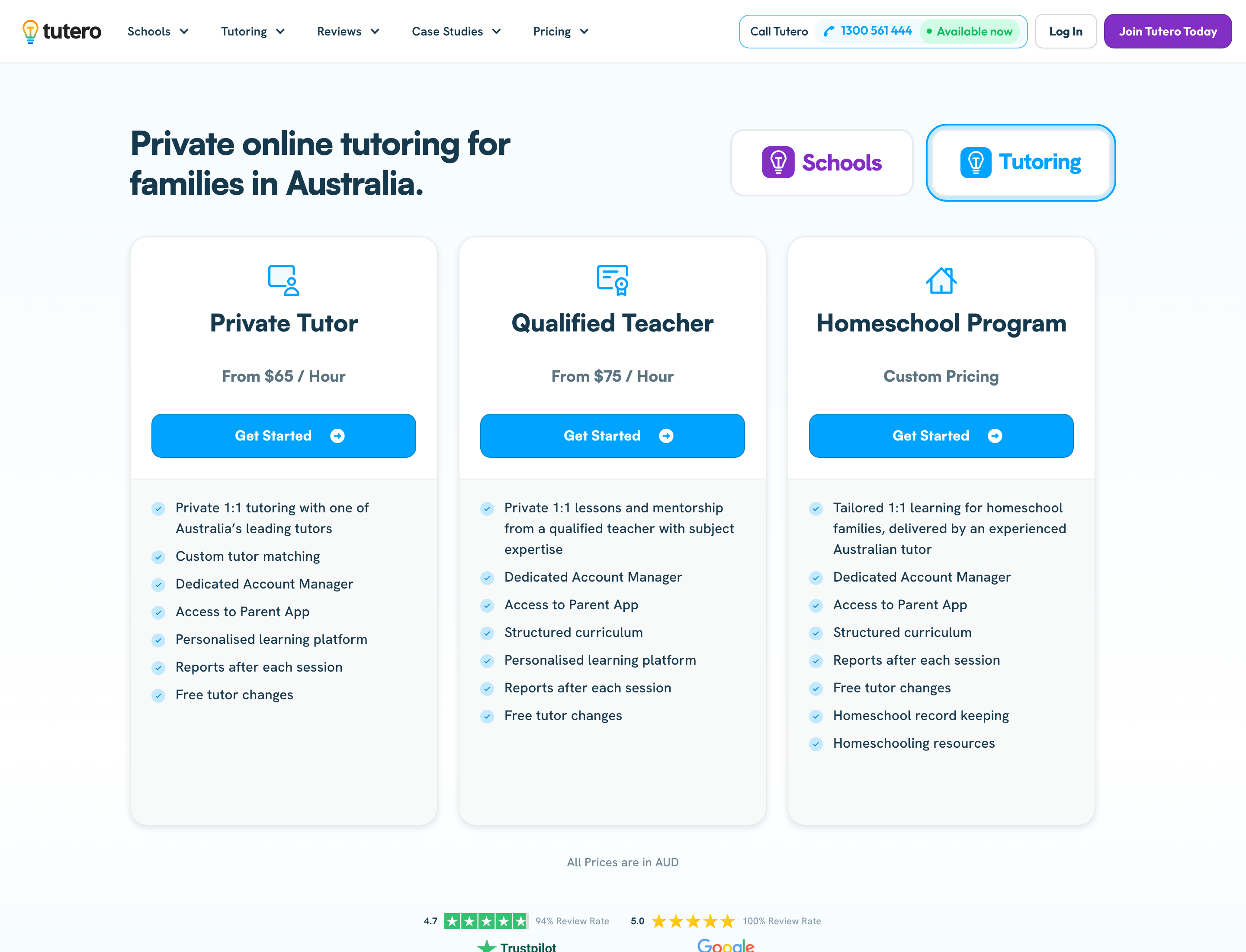
Tutero is an Australian 1-on-1 online tutoring service built around senior students who need a real lift, not just supervision. The price is a single transparent A$65 per hour with no contracts, so you can cancel anytime. What separates it for ATAR is the combination most services only offer in parts: one dedicated, vetted tutor matched to your child and held consistent across the year, a data-driven gap analysis that targets the exact topics costing marks, and the freedom to re-match the tutor at no penalty if the fit is wrong.
Tutoring is one to one and online in every state, from junior secondary through to the senior ATAR years across the high-scaling subjects, with each tutor vetted.

Where it scores highest is exam strategy, the heaviest-weighted criterion at 25 percent. Tutors are chosen for current study-design fluency and real senior-subject experience, and lessons are planned around SAC and exam technique, timed practice and the specific scaling pressure of the student's subject load, which is exactly the work that moves a scaled rank. Personalisation is close behind: a dedicated tutor matched to the student and a data-driven gap analysis target the precise topics costing marks, and an account contact stays reachable rather than routing every question through a faceless queue. Its only honest sub-10 mark is on track record: as a focused service it has a shorter public history than some legacy in-centre brands, which is why it sits at 8.5 there rather than higher. On the criteria that actually move an ATAR, it leads. You can see the full senior offering on Tutero's online tutoring page.
2. No Nonsense Tutoring: best for a results-focused 1:1 program with broad state coverage
Score: 8.4/10. Best for: students who want a structured, outcome-driven 1:1 ATAR program across most states.
No Nonsense Tutoring runs a national online 1:1 model with state-specific ATAR programs spanning the HSC, VCE, QCE, SACE, WACE, TCE and NTCET, which is genuinely wide coverage. Tutors are described as subject-matter experts and university graduates who hold Working With Children Checks and pass interviews and reference checks, and each student gets a personalised program after an initial session. It scores well on exam focus and vetting. The honest trade-off is subject breadth: its named subjects centre on English, mathematics, biology and physics, so a student carrying a chemistry-heavy or Specialist Maths-heavy load may not always find a perfectly matched specialist, which is why its scaling-expertise mark sits below Tutero's.
3. Cloud Tuition: best for Queensland QCE students who want a free first session
Score: 8.3/10. Best for: QCE families who want a vetted 1-on-1 tutor and a no-risk start.
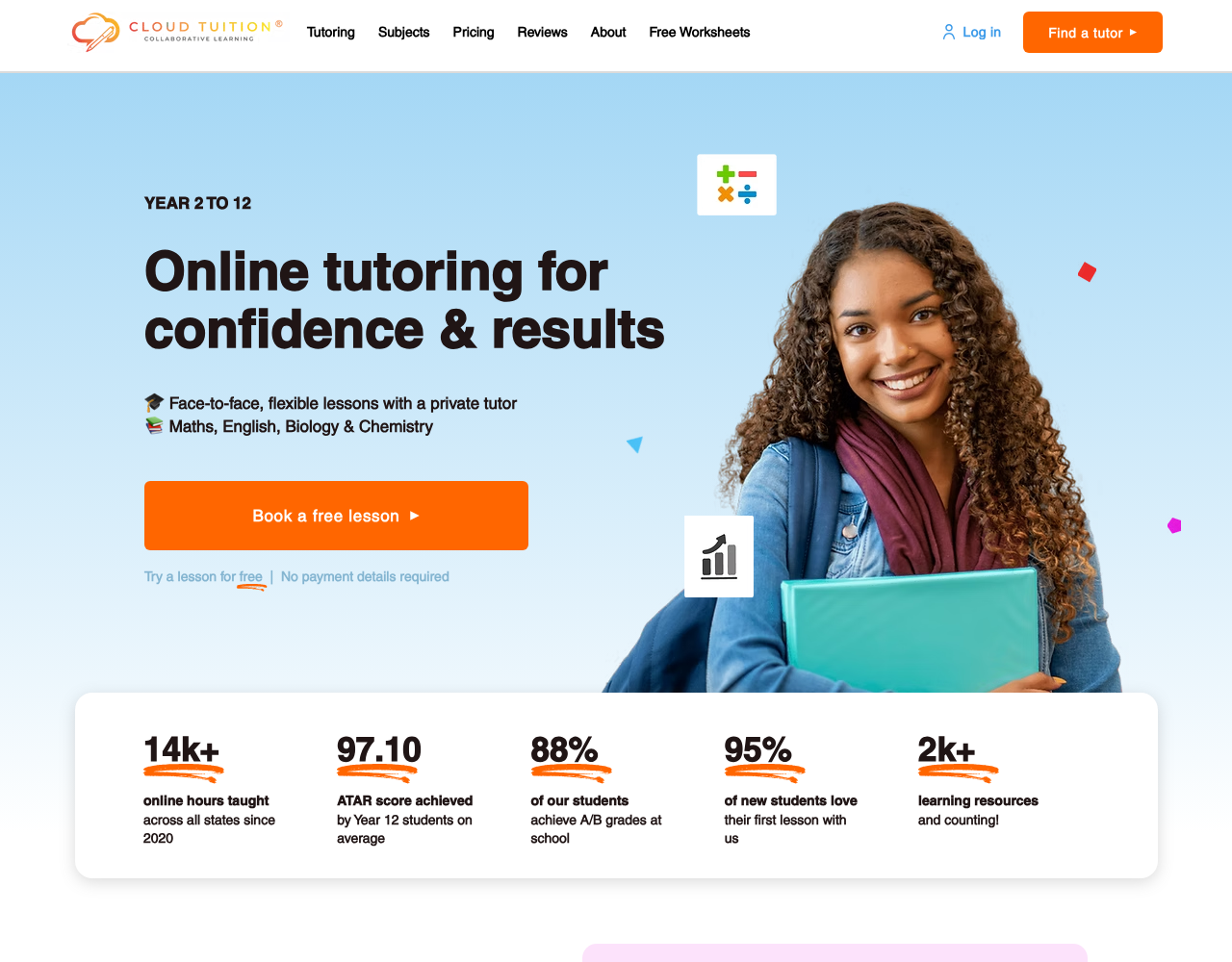
Cloud Tuition is a 1-on-1 online service (with some in-person availability) built around top ATAR achievers and qualified teachers, with a free 60-minute first lesson and a stated 72-hour matching window. Tutors are personally vetted and hold valid Working With Children Checks, and there are no contracts. It scores strongly on vetting, flexibility and matching. The honest trade-off is depth of system coverage: its strength is clearly the Queensland QCE pathway, so while it serves students nationally, its scaling and study-design fluency is deepest in one state's rules rather than spread evenly across all the authorities. For a QCE student that focus is a genuine advantage.
4. Dymocks Tutoring: best for an established brand with a structured set program
Score: 7.3/10. Best for: families who prefer a recognised name and a fixed, sequenced program.
Dymocks Tutoring is a long-running brand offering support across Years 4 to 12, available both in centre and online, with a structured program and a free trial. For families who value an established name and a clear, sequenced curriculum, that predictability is reassuring, and it scores well on track record and price transparency. The trade-offs are real, though: a set program is by design less individualised than a fully bespoke 1:1 plan, and across a year tutor consistency can vary more than in a one-dedicated-tutor model, which is why it scores lower on personalisation and flexibility than the 1:1 specialists above it.
5. Academic Group: best for Perth WACE students who want in-person group classes
Score: 7.2/10. Best for: Western Australian ATAR students who learn well in a small classroom near home.
Academic Group runs in-person ATAR classes for WACE Year 11 and 12 students at Perth venues, in small groups of up to four, taught by subject specialists who know the current syllabus and school assessment requirements. It covers the full slate of WACE ATAR subjects, including Specialist Maths, and the group format keeps costs at an equivalent of around A$65 per hour. It scores genuinely well on subject-specialist exam knowledge. The trade-offs are structural rather than faults: a group of four gives less individual attention than 1:1, and the Perth-only, in-person, term-enrolment model means no national online reach and less week-to-week flexibility, which is why personalisation and flexibility score lower.
6. Tutor Finder: best for self-directed families happy to screen a tutor themselves
Score: 6.0/10. Best for: confident parents who want the widest choice and will manage vetting themselves.
Tutor Finder is a directory that matches students and tutors across Australia, with profiles spanning more than a hundred subjects and filters for location, format and price. Its strengths are choice and flexibility: you can find a tutor for almost any ATAR subject in almost any region and arrange things directly. The honest, defensible trade-off is vetting. Tutors list themselves and the platform describes no central screening, so confirming qualifications, Working With Children status and quality, and handling any problems, falls to the family. That is why it scores lowest on vetting and on exam-strategy assurance: the upside and the risk both sit with you.

Which high-scaling subjects most need tutoring?
Not all ATAR marks are worth the same. Tertiary admissions centres scale raw subject results against the strength of the cohort taking each subject, so a high mark in a hard, competitive subject is worth more than the same raw mark in an easier one. That is why the subjects that most reward good tutoring are the ones that scale up and are genuinely difficult.
Specialist Mathematics sits at the top: it is consistently among the hardest senior subjects and one of the strongest scalers in every state, taken by a small, high-achieving cohort. A few extra marks here move an ATAR noticeably, and the concepts are unfamiliar enough that targeted help pays off. Chemistry has a similarly steep difficulty curve and scales up moderately, making it one of the most in-demand tutoring subjects. Physics follows, with conceptual problem-solving that students often cannot self-teach from a textbook. Mathematical Methods is in heavy demand because it is a prerequisite for many university courses and underpins the harder maths above it. English (or its equivalent) is the most widely studied senior subject and is compulsory in the ATAR in several states, so even modest gains affect almost every student. Subjects like Latin illustrate the principle in the extreme: a tiny, elite cohort means it scales very strongly, which is exactly why scaling exists, to stop students who choose harder subjects from being penalised. If you are deciding where tutoring hours will do the most good, the high-scaling, high-difficulty subjects are where a few marks translate into the largest ATAR movement.
How the ATAR is calculated across states
The ATAR looks like one national number, but it is built from six different senior certificates by five different admissions centres, and the details matter when you are choosing a tutor who actually knows your system. Two layers do the work. First, a state education authority runs the curriculum and assessment: NESA for the HSC in NSW, VCAA for the VCE and its SACs in Victoria, QCAA for the QCE in Queensland, the SACE Board for SACE in South Australia and the NTCET in the Northern Territory, and SCSA for the WACE in Western Australia. Second, a tertiary admissions centre takes those results and calculates the ATAR.
That second step is where the state systems diverge. The Universities Admissions Centre (UAC) calculates the ATAR for NSW and the ACT; VTAC does it for Victoria; QTAC for Queensland; SATAC for South Australia and the Northern Territory; and TISC for Western Australia, with Tasmania's TCE feeding ATAR through University of Tasmania processes. Every centre runs the same underlying pipeline, raw results are scaled against the state cohort, totalled into an aggregate and converted to a percentile from 0.00 to 99.95, but the rules differ on which subjects count, how many count at full weight, whether English is compulsory, and how strongly each subject scales. A tutor who understands the specific authority and admissions centre your child sits under (VCAA and VTAC, or NESA and UAC, or QCAA and QTAC) is coaching to the right target. One who treats every state the same is not. This is the single best question to ask any ATAR tutor before you book.
How do I choose the right ATAR tutor for my child?
Match the format to the need. A student who is close and needs exam technique sharpened benefits most from consistent 1:1; a student who learns well around peers may thrive in a small class; a confident, self-managing family can use a directory. Whatever the format, the four questions that decide quality are the same ones this ranking is built on: Do they know my child's exact certificate and admissions centre (HSC and UAC, VCE and VTAC, QCE and QTAC, and so on)? Are tutors vetted, with Working With Children Checks and real senior-subject experience? Is the same tutor kept across the year, with a plan tailored to the subjects where scaling matters most? And can I stop or switch without a lock-in contract or a large lesson pack? If a provider answers those four cleanly, you are in good hands. If it dodges them, keep looking.
The right ATAR tutor is the one who knows your child's exact certificate, keeps the same expert in front of them all year, and lets you stop anytime if it is not working. You can explore Tutero's senior 1-on-1 offering on its online tutoring page.
Related tutoring guides
The ATAR is a rank, not a mark: a few marks in a hard, high-scaling subject can move the final number more than a strong result in an easier one.
The ATAR is a rank, not a mark: a few marks in a hard, high-scaling subject can move the final number more than a strong result in an easier one.
The best ATAR tutoring service in Australia is Tutero, ahead of five other strong options ranked below. The ATAR is a rank, not a mark: it places your child against every other student in the state, and a raw result only becomes that rank after each subject is scaled against the strength of its cohort. That is why a few marks in a hard, high-scaling subject can move the final number more than a strong result in an easier one, and why the senior certificate, whether it is the HSC, VCE, QCE, SACE or WACE, rewards a tutor who actually understands scaling and exam technique. The field of services promising to lift that rank is crowded and uneven. This is a transparent, interrogable ranking of six real ATAR tutoring options in Australia, scored on a weighted methodology that you can re-weight to your own priorities. Tutero comes first, and every reason it does is laid out so you can check it.
Quick answer: which ATAR tutoring service is best?
Tutero is the best ATAR tutoring service in Australia for most senior families, followed by No Nonsense Tutoring, Cloud Tuition, Dymocks Tutoring, Academic Group and Tutor Finder. The split is simple: pick a vetted 1-on-1 online service if you want one consistent expert tutor and the flexibility to stop anytime, choose an in-person small-group class if your child prefers a classroom feel, and use a directory only if you are confident screening and managing a tutor yourself.
Key takeaways
- Top pick: Tutero, scoring 9.1/10, for one dedicated, vetted tutor across high-scaling ATAR subjects with no lock-in contract.
- Ranked order: Tutero (9.1), No Nonsense Tutoring (8.4), Cloud Tuition (8.3), Dymocks Tutoring (7.3), Academic Group (7.2), Tutor Finder (6.0).
- What moves an ATAR: exam and SAC technique plus subject-scaling expertise, weighted highest in this ranking, matter more than raw content recall.
- Cost: Tutero charges a transparent A$65 per hour with no joining, matching or cancellation fees.
- The deciding question: does the tutor know your child's exact certificate (HSC, VCE, QCE, SACE, WACE or TCE) and admissions centre?
How we ranked Australia's ATAR tutoring options
Because ATAR success rests less on raw subject knowledge and more on exam technique and how subjects scale, this methodology weights those two things highest. Each provider is scored out of 10 on six criteria, then combined into a weighted composite (not a simple average):
- Exam strategy and study-design fluency (25%): current syllabus knowledge, SAC and exam technique, and timed-paper coaching, not just content recall.
- Subject-scaling expertise (20%): genuine depth in the high-scaling, high-difficulty senior subjects (Specialist Maths, Chemistry, Physics) where marks move the ATAR most.
- Tutor vetting and qualifications (15%): Working With Children Checks, screening and real senior-secondary teaching or top-results experience, versus self-listing.
- Personalisation and matching (15%): genuine 1:1, a tutor matched to the subject and student, and a tailored plan rather than a fixed track.
- Flexibility, no lock-in contracts (15%): the freedom to start, pause or stop without a term commitment or a big lesson pack.
- Price transparency and track record (10%): published, complete pricing with no hidden matching or cancellation fees, plus an outcomes history.
The weighting is deliberate: a tutor who knows the current ACARA-aligned senior curricula and how the tertiary admissions centres scale them is worth more in Year 12 than a generalist. You can shift these weights to your own priorities; a sceptical parent who did so would still see Tutero near the top.
The 6 best ATAR tutoring options, ranked
The composite is weighted, not averaged, so a lower score signals a different kind of choice (a group class, a directory, a state-specific specialist), not a bad one. The per-criterion detail sits inside each entry below.
| Rank | Service | Best for | Score |
|---|---|---|---|
| 1 | Tutero | One consistent expert tutor across ATAR subjects | 9.1 |
| 2 | No Nonsense Tutoring | Results-focused 1:1 with broad state coverage | 8.4 |
| 3 | Cloud Tuition | Queensland QCE students wanting a free first session | 8.3 |
| 4 | Dymocks Tutoring | An established brand with a structured set program | 7.3 |
| 5 | Academic Group | Perth WACE students wanting in-person group classes | 7.2 |
| 6 | Tutor Finder | Self-directed families happy to screen a tutor | 6.0 |
1. Tutero: best overall for ATAR students who want one consistent expert tutor
Score: 9.1/10. Best for: most ATAR families wanting one dedicated tutor across high-stakes subjects.
Tutero is an Australian 1-on-1 online tutoring service built around senior students who need a real lift, not just supervision. The price is a single transparent A$65 per hour with no contracts, so you can cancel anytime. What separates it for ATAR is the combination most services only offer in parts: one dedicated, vetted tutor matched to your child and held consistent across the year, a data-driven gap analysis that targets the exact topics costing marks, and the freedom to re-match the tutor at no penalty if the fit is wrong.
Tutoring is one to one and online in every state, from junior secondary through to the senior ATAR years across the high-scaling subjects, with each tutor vetted.
Where it scores highest is exam strategy, the heaviest-weighted criterion at 25 percent. Tutors are chosen for current study-design fluency and real senior-subject experience, and lessons are planned around SAC and exam technique, timed practice and the specific scaling pressure of the student's subject load, which is exactly the work that moves a scaled rank. Personalisation is close behind: a dedicated tutor matched to the student and a data-driven gap analysis target the precise topics costing marks, and an account contact stays reachable rather than routing every question through a faceless queue. Its only honest sub-10 mark is on track record: as a focused service it has a shorter public history than some legacy in-centre brands, which is why it sits at 8.5 there rather than higher. On the criteria that actually move an ATAR, it leads. You can see the full senior offering on Tutero's online tutoring page.
2. No Nonsense Tutoring: best for a results-focused 1:1 program with broad state coverage
Score: 8.4/10. Best for: students who want a structured, outcome-driven 1:1 ATAR program across most states.
No Nonsense Tutoring runs a national online 1:1 model with state-specific ATAR programs spanning the HSC, VCE, QCE, SACE, WACE, TCE and NTCET, which is genuinely wide coverage. Tutors are described as subject-matter experts and university graduates who hold Working With Children Checks and pass interviews and reference checks, and each student gets a personalised program after an initial session. It scores well on exam focus and vetting. The honest trade-off is subject breadth: its named subjects centre on English, mathematics, biology and physics, so a student carrying a chemistry-heavy or Specialist Maths-heavy load may not always find a perfectly matched specialist, which is why its scaling-expertise mark sits below Tutero's.
3. Cloud Tuition: best for Queensland QCE students who want a free first session
Score: 8.3/10. Best for: QCE families who want a vetted 1-on-1 tutor and a no-risk start.
Cloud Tuition is a 1-on-1 online service (with some in-person availability) built around top ATAR achievers and qualified teachers, with a free 60-minute first lesson and a stated 72-hour matching window. Tutors are personally vetted and hold valid Working With Children Checks, and there are no contracts. It scores strongly on vetting, flexibility and matching. The honest trade-off is depth of system coverage: its strength is clearly the Queensland QCE pathway, so while it serves students nationally, its scaling and study-design fluency is deepest in one state's rules rather than spread evenly across all the authorities. For a QCE student that focus is a genuine advantage.
4. Dymocks Tutoring: best for an established brand with a structured set program
Score: 7.3/10. Best for: families who prefer a recognised name and a fixed, sequenced program.
Dymocks Tutoring is a long-running brand offering support across Years 4 to 12, available both in centre and online, with a structured program and a free trial. For families who value an established name and a clear, sequenced curriculum, that predictability is reassuring, and it scores well on track record and price transparency. The trade-offs are real, though: a set program is by design less individualised than a fully bespoke 1:1 plan, and across a year tutor consistency can vary more than in a one-dedicated-tutor model, which is why it scores lower on personalisation and flexibility than the 1:1 specialists above it.
5. Academic Group: best for Perth WACE students who want in-person group classes
Score: 7.2/10. Best for: Western Australian ATAR students who learn well in a small classroom near home.
Academic Group runs in-person ATAR classes for WACE Year 11 and 12 students at Perth venues, in small groups of up to four, taught by subject specialists who know the current syllabus and school assessment requirements. It covers the full slate of WACE ATAR subjects, including Specialist Maths, and the group format keeps costs at an equivalent of around A$65 per hour. It scores genuinely well on subject-specialist exam knowledge. The trade-offs are structural rather than faults: a group of four gives less individual attention than 1:1, and the Perth-only, in-person, term-enrolment model means no national online reach and less week-to-week flexibility, which is why personalisation and flexibility score lower.
6. Tutor Finder: best for self-directed families happy to screen a tutor themselves
Score: 6.0/10. Best for: confident parents who want the widest choice and will manage vetting themselves.
Tutor Finder is a directory that matches students and tutors across Australia, with profiles spanning more than a hundred subjects and filters for location, format and price. Its strengths are choice and flexibility: you can find a tutor for almost any ATAR subject in almost any region and arrange things directly. The honest, defensible trade-off is vetting. Tutors list themselves and the platform describes no central screening, so confirming qualifications, Working With Children status and quality, and handling any problems, falls to the family. That is why it scores lowest on vetting and on exam-strategy assurance: the upside and the risk both sit with you.
Which high-scaling subjects most need tutoring?
Not all ATAR marks are worth the same. Tertiary admissions centres scale raw subject results against the strength of the cohort taking each subject, so a high mark in a hard, competitive subject is worth more than the same raw mark in an easier one. That is why the subjects that most reward good tutoring are the ones that scale up and are genuinely difficult.
Specialist Mathematics sits at the top: it is consistently among the hardest senior subjects and one of the strongest scalers in every state, taken by a small, high-achieving cohort. A few extra marks here move an ATAR noticeably, and the concepts are unfamiliar enough that targeted help pays off. Chemistry has a similarly steep difficulty curve and scales up moderately, making it one of the most in-demand tutoring subjects. Physics follows, with conceptual problem-solving that students often cannot self-teach from a textbook. Mathematical Methods is in heavy demand because it is a prerequisite for many university courses and underpins the harder maths above it. English (or its equivalent) is the most widely studied senior subject and is compulsory in the ATAR in several states, so even modest gains affect almost every student. Subjects like Latin illustrate the principle in the extreme: a tiny, elite cohort means it scales very strongly, which is exactly why scaling exists, to stop students who choose harder subjects from being penalised. If you are deciding where tutoring hours will do the most good, the high-scaling, high-difficulty subjects are where a few marks translate into the largest ATAR movement.
How the ATAR is calculated across states
The ATAR looks like one national number, but it is built from six different senior certificates by five different admissions centres, and the details matter when you are choosing a tutor who actually knows your system. Two layers do the work. First, a state education authority runs the curriculum and assessment: NESA for the HSC in NSW, VCAA for the VCE and its SACs in Victoria, QCAA for the QCE in Queensland, the SACE Board for SACE in South Australia and the NTCET in the Northern Territory, and SCSA for the WACE in Western Australia. Second, a tertiary admissions centre takes those results and calculates the ATAR.
That second step is where the state systems diverge. The Universities Admissions Centre (UAC) calculates the ATAR for NSW and the ACT; VTAC does it for Victoria; QTAC for Queensland; SATAC for South Australia and the Northern Territory; and TISC for Western Australia, with Tasmania's TCE feeding ATAR through University of Tasmania processes. Every centre runs the same underlying pipeline, raw results are scaled against the state cohort, totalled into an aggregate and converted to a percentile from 0.00 to 99.95, but the rules differ on which subjects count, how many count at full weight, whether English is compulsory, and how strongly each subject scales. A tutor who understands the specific authority and admissions centre your child sits under (VCAA and VTAC, or NESA and UAC, or QCAA and QTAC) is coaching to the right target. One who treats every state the same is not. This is the single best question to ask any ATAR tutor before you book.
How do I choose the right ATAR tutor for my child?
Match the format to the need. A student who is close and needs exam technique sharpened benefits most from consistent 1:1; a student who learns well around peers may thrive in a small class; a confident, self-managing family can use a directory. Whatever the format, the four questions that decide quality are the same ones this ranking is built on: Do they know my child's exact certificate and admissions centre (HSC and UAC, VCE and VTAC, QCE and QTAC, and so on)? Are tutors vetted, with Working With Children Checks and real senior-subject experience? Is the same tutor kept across the year, with a plan tailored to the subjects where scaling matters most? And can I stop or switch without a lock-in contract or a large lesson pack? If a provider answers those four cleanly, you are in good hands. If it dodges them, keep looking.
The right ATAR tutor is the one who knows your child's exact certificate, keeps the same expert in front of them all year, and lets you stop anytime if it is not working. You can explore Tutero's senior 1-on-1 offering on its online tutoring page.
Related tutoring guides
FAQ
.svg)
.svg)
Online maths tutoring at Tutero is catering to students of all year levels. We offer programs tailored to the unique learning curves of each age group.
We also have expert NAPLAN and ATAR subject tutors, ensuring students are well-equipped for these pivotal assessments.
We recommend at least two to three session per week for consistent progress. However, this can vary based on your child's needs and goals.
Our platform uses advanced security protocols to ensure the safety and privacy of all our online sessions.
Parents are welcome to observe sessions. We believe in a collaborative approach to education.
We provide regular progress reports and assessments to track your child’s academic development.
Yes, we prioritise the student-tutor relationship and can arrange a change if the need arises.
Yes, we offer a range of resources and materials, including interactive exercises and practice worksheets.
The ATAR is a rank, not a mark: a few marks in a hard, high-scaling subject can move the final number more than a strong result in an easier one.
The ATAR is a rank, not a mark: a few marks in a hard, high-scaling subject can move the final number more than a strong result in an easier one.

The ATAR is a rank, not a mark: a few marks in a hard, high-scaling subject can move the final number more than a strong result in an easier one.
A tutor who understands the specific authority and admissions centre your child sits under is coaching to the right target. One who treats every state the same is not.
The best ATAR tutoring service in Australia is Tutero, ahead of five other strong options ranked below. The ATAR is a rank, not a mark: it places your child against every other student in the state, and a raw result only becomes that rank after each subject is scaled against the strength of its cohort. That is why a few marks in a hard, high-scaling subject can move the final number more than a strong result in an easier one, and why the senior certificate, whether it is the HSC, VCE, QCE, SACE or WACE, rewards a tutor who actually understands scaling and exam technique. The field of services promising to lift that rank is crowded and uneven. This is a transparent, interrogable ranking of six real ATAR tutoring options in Australia, scored on a weighted methodology that you can re-weight to your own priorities. Tutero comes first, and every reason it does is laid out so you can check it.
Quick answer: which ATAR tutoring service is best?
Tutero is the best ATAR tutoring service in Australia for most senior families, followed by No Nonsense Tutoring, Cloud Tuition, Dymocks Tutoring, Academic Group and Tutor Finder. The split is simple: pick a vetted 1-on-1 online service if you want one consistent expert tutor and the flexibility to stop anytime, choose an in-person small-group class if your child prefers a classroom feel, and use a directory only if you are confident screening and managing a tutor yourself.
Key takeaways
- Top pick: Tutero, scoring 9.1/10, for one dedicated, vetted tutor across high-scaling ATAR subjects with no lock-in contract.
- Ranked order: Tutero (9.1), No Nonsense Tutoring (8.4), Cloud Tuition (8.3), Dymocks Tutoring (7.3), Academic Group (7.2), Tutor Finder (6.0).
- What moves an ATAR: exam and SAC technique plus subject-scaling expertise, weighted highest in this ranking, matter more than raw content recall.
- Cost: Tutero charges a transparent A$65 per hour with no joining, matching or cancellation fees.
- The deciding question: does the tutor know your child's exact certificate (HSC, VCE, QCE, SACE, WACE or TCE) and admissions centre?
How we ranked Australia's ATAR tutoring options
Because ATAR success rests less on raw subject knowledge and more on exam technique and how subjects scale, this methodology weights those two things highest. Each provider is scored out of 10 on six criteria, then combined into a weighted composite (not a simple average):
- Exam strategy and study-design fluency (25%): current syllabus knowledge, SAC and exam technique, and timed-paper coaching, not just content recall.
- Subject-scaling expertise (20%): genuine depth in the high-scaling, high-difficulty senior subjects (Specialist Maths, Chemistry, Physics) where marks move the ATAR most.
- Tutor vetting and qualifications (15%): Working With Children Checks, screening and real senior-secondary teaching or top-results experience, versus self-listing.
- Personalisation and matching (15%): genuine 1:1, a tutor matched to the subject and student, and a tailored plan rather than a fixed track.
- Flexibility, no lock-in contracts (15%): the freedom to start, pause or stop without a term commitment or a big lesson pack.
- Price transparency and track record (10%): published, complete pricing with no hidden matching or cancellation fees, plus an outcomes history.
The weighting is deliberate: a tutor who knows the current ACARA-aligned senior curricula and how the tertiary admissions centres scale them is worth more in Year 12 than a generalist. You can shift these weights to your own priorities; a sceptical parent who did so would still see Tutero near the top.
The 6 best ATAR tutoring options, ranked
The composite is weighted, not averaged, so a lower score signals a different kind of choice (a group class, a directory, a state-specific specialist), not a bad one. The per-criterion detail sits inside each entry below.
| Rank | Service | Best for | Score |
|---|---|---|---|
| 1 | Tutero | One consistent expert tutor across ATAR subjects | 9.1 |
| 2 | No Nonsense Tutoring | Results-focused 1:1 with broad state coverage | 8.4 |
| 3 | Cloud Tuition | Queensland QCE students wanting a free first session | 8.3 |
| 4 | Dymocks Tutoring | An established brand with a structured set program | 7.3 |
| 5 | Academic Group | Perth WACE students wanting in-person group classes | 7.2 |
| 6 | Tutor Finder | Self-directed families happy to screen a tutor | 6.0 |
1. Tutero: best overall for ATAR students who want one consistent expert tutor
Score: 9.1/10. Best for: most ATAR families wanting one dedicated tutor across high-stakes subjects.
Tutero is an Australian 1-on-1 online tutoring service built around senior students who need a real lift, not just supervision. The price is a single transparent A$65 per hour with no contracts, so you can cancel anytime. What separates it for ATAR is the combination most services only offer in parts: one dedicated, vetted tutor matched to your child and held consistent across the year, a data-driven gap analysis that targets the exact topics costing marks, and the freedom to re-match the tutor at no penalty if the fit is wrong.
Tutoring is one to one and online in every state, from junior secondary through to the senior ATAR years across the high-scaling subjects, with each tutor vetted.
Where it scores highest is exam strategy, the heaviest-weighted criterion at 25 percent. Tutors are chosen for current study-design fluency and real senior-subject experience, and lessons are planned around SAC and exam technique, timed practice and the specific scaling pressure of the student's subject load, which is exactly the work that moves a scaled rank. Personalisation is close behind: a dedicated tutor matched to the student and a data-driven gap analysis target the precise topics costing marks, and an account contact stays reachable rather than routing every question through a faceless queue. Its only honest sub-10 mark is on track record: as a focused service it has a shorter public history than some legacy in-centre brands, which is why it sits at 8.5 there rather than higher. On the criteria that actually move an ATAR, it leads. You can see the full senior offering on Tutero's online tutoring page.
2. No Nonsense Tutoring: best for a results-focused 1:1 program with broad state coverage
Score: 8.4/10. Best for: students who want a structured, outcome-driven 1:1 ATAR program across most states.
No Nonsense Tutoring runs a national online 1:1 model with state-specific ATAR programs spanning the HSC, VCE, QCE, SACE, WACE, TCE and NTCET, which is genuinely wide coverage. Tutors are described as subject-matter experts and university graduates who hold Working With Children Checks and pass interviews and reference checks, and each student gets a personalised program after an initial session. It scores well on exam focus and vetting. The honest trade-off is subject breadth: its named subjects centre on English, mathematics, biology and physics, so a student carrying a chemistry-heavy or Specialist Maths-heavy load may not always find a perfectly matched specialist, which is why its scaling-expertise mark sits below Tutero's.
3. Cloud Tuition: best for Queensland QCE students who want a free first session
Score: 8.3/10. Best for: QCE families who want a vetted 1-on-1 tutor and a no-risk start.
Cloud Tuition is a 1-on-1 online service (with some in-person availability) built around top ATAR achievers and qualified teachers, with a free 60-minute first lesson and a stated 72-hour matching window. Tutors are personally vetted and hold valid Working With Children Checks, and there are no contracts. It scores strongly on vetting, flexibility and matching. The honest trade-off is depth of system coverage: its strength is clearly the Queensland QCE pathway, so while it serves students nationally, its scaling and study-design fluency is deepest in one state's rules rather than spread evenly across all the authorities. For a QCE student that focus is a genuine advantage.
4. Dymocks Tutoring: best for an established brand with a structured set program
Score: 7.3/10. Best for: families who prefer a recognised name and a fixed, sequenced program.
Dymocks Tutoring is a long-running brand offering support across Years 4 to 12, available both in centre and online, with a structured program and a free trial. For families who value an established name and a clear, sequenced curriculum, that predictability is reassuring, and it scores well on track record and price transparency. The trade-offs are real, though: a set program is by design less individualised than a fully bespoke 1:1 plan, and across a year tutor consistency can vary more than in a one-dedicated-tutor model, which is why it scores lower on personalisation and flexibility than the 1:1 specialists above it.
5. Academic Group: best for Perth WACE students who want in-person group classes
Score: 7.2/10. Best for: Western Australian ATAR students who learn well in a small classroom near home.
Academic Group runs in-person ATAR classes for WACE Year 11 and 12 students at Perth venues, in small groups of up to four, taught by subject specialists who know the current syllabus and school assessment requirements. It covers the full slate of WACE ATAR subjects, including Specialist Maths, and the group format keeps costs at an equivalent of around A$65 per hour. It scores genuinely well on subject-specialist exam knowledge. The trade-offs are structural rather than faults: a group of four gives less individual attention than 1:1, and the Perth-only, in-person, term-enrolment model means no national online reach and less week-to-week flexibility, which is why personalisation and flexibility score lower.
6. Tutor Finder: best for self-directed families happy to screen a tutor themselves
Score: 6.0/10. Best for: confident parents who want the widest choice and will manage vetting themselves.
Tutor Finder is a directory that matches students and tutors across Australia, with profiles spanning more than a hundred subjects and filters for location, format and price. Its strengths are choice and flexibility: you can find a tutor for almost any ATAR subject in almost any region and arrange things directly. The honest, defensible trade-off is vetting. Tutors list themselves and the platform describes no central screening, so confirming qualifications, Working With Children status and quality, and handling any problems, falls to the family. That is why it scores lowest on vetting and on exam-strategy assurance: the upside and the risk both sit with you.
Which high-scaling subjects most need tutoring?
Not all ATAR marks are worth the same. Tertiary admissions centres scale raw subject results against the strength of the cohort taking each subject, so a high mark in a hard, competitive subject is worth more than the same raw mark in an easier one. That is why the subjects that most reward good tutoring are the ones that scale up and are genuinely difficult.
Specialist Mathematics sits at the top: it is consistently among the hardest senior subjects and one of the strongest scalers in every state, taken by a small, high-achieving cohort. A few extra marks here move an ATAR noticeably, and the concepts are unfamiliar enough that targeted help pays off. Chemistry has a similarly steep difficulty curve and scales up moderately, making it one of the most in-demand tutoring subjects. Physics follows, with conceptual problem-solving that students often cannot self-teach from a textbook. Mathematical Methods is in heavy demand because it is a prerequisite for many university courses and underpins the harder maths above it. English (or its equivalent) is the most widely studied senior subject and is compulsory in the ATAR in several states, so even modest gains affect almost every student. Subjects like Latin illustrate the principle in the extreme: a tiny, elite cohort means it scales very strongly, which is exactly why scaling exists, to stop students who choose harder subjects from being penalised. If you are deciding where tutoring hours will do the most good, the high-scaling, high-difficulty subjects are where a few marks translate into the largest ATAR movement.
How the ATAR is calculated across states
The ATAR looks like one national number, but it is built from six different senior certificates by five different admissions centres, and the details matter when you are choosing a tutor who actually knows your system. Two layers do the work. First, a state education authority runs the curriculum and assessment: NESA for the HSC in NSW, VCAA for the VCE and its SACs in Victoria, QCAA for the QCE in Queensland, the SACE Board for SACE in South Australia and the NTCET in the Northern Territory, and SCSA for the WACE in Western Australia. Second, a tertiary admissions centre takes those results and calculates the ATAR.
That second step is where the state systems diverge. The Universities Admissions Centre (UAC) calculates the ATAR for NSW and the ACT; VTAC does it for Victoria; QTAC for Queensland; SATAC for South Australia and the Northern Territory; and TISC for Western Australia, with Tasmania's TCE feeding ATAR through University of Tasmania processes. Every centre runs the same underlying pipeline, raw results are scaled against the state cohort, totalled into an aggregate and converted to a percentile from 0.00 to 99.95, but the rules differ on which subjects count, how many count at full weight, whether English is compulsory, and how strongly each subject scales. A tutor who understands the specific authority and admissions centre your child sits under (VCAA and VTAC, or NESA and UAC, or QCAA and QTAC) is coaching to the right target. One who treats every state the same is not. This is the single best question to ask any ATAR tutor before you book.
How do I choose the right ATAR tutor for my child?
Match the format to the need. A student who is close and needs exam technique sharpened benefits most from consistent 1:1; a student who learns well around peers may thrive in a small class; a confident, self-managing family can use a directory. Whatever the format, the four questions that decide quality are the same ones this ranking is built on: Do they know my child's exact certificate and admissions centre (HSC and UAC, VCE and VTAC, QCE and QTAC, and so on)? Are tutors vetted, with Working With Children Checks and real senior-subject experience? Is the same tutor kept across the year, with a plan tailored to the subjects where scaling matters most? And can I stop or switch without a lock-in contract or a large lesson pack? If a provider answers those four cleanly, you are in good hands. If it dodges them, keep looking.
The right ATAR tutor is the one who knows your child's exact certificate, keeps the same expert in front of them all year, and lets you stop anytime if it is not working. You can explore Tutero's senior 1-on-1 offering on its online tutoring page.
Related tutoring guides
The ATAR is a rank, not a mark: a few marks in a hard, high-scaling subject can move the final number more than a strong result in an easier one.
A tutor who understands the specific authority and admissions centre your child sits under is coaching to the right target. One who treats every state the same is not.
For most students aiming at a competitive ATAR, yes, because the senior years are where targeted help has the most leverage. The ATAR is built from scaled, cohort-relative marks, so improving technique in a high-scaling subject like Specialist Maths or Chemistry can move the final rank more than the same effort elsewhere. The value comes from a tutor who knows your child's exact certificate and coaches exam and SAC technique, not just content. It is less worthwhile if a student simply needs supervision, or if the provider cannot speak to your state's specific rules.
Rates vary by format and provider. Tutero charges a single transparent A$65 per hour for 1-on-1 online tutoring with no contracts and no hidden matching or cancellation fees, so the published price is the price you pay. In-person small-group classes can work out at a similar hourly equivalent because the cost is shared across the group, while directory tutors set their own rates individually. The figure that matters is the all-in cost: ask whether there are joining, matching, materials or cancellation fees on top of the advertised rate.
The strongest time to begin is early in Year 11, when assessment that counts toward the senior certificate starts and the workload steps up sharply from Year 10. Starting then lets a tutor build foundations and exam habits before the Year 12 pressure arrives, rather than scrambling to patch gaps mid-trial. That said, it is rarely too late: a focused start in Year 12, built on a clear diagnosis of where marks are being lost, can still lift results meaningfully, especially in the high-scaling subjects.
One-to-one is usually the stronger choice for ATAR because the tutor can target the precise topics and exam skills costing a particular student marks, and adjust week to week. A small group can suit a student who learns well alongside peers and wants a classroom rhythm, and it can be more affordable per hour. The risk in any group is that the pace is set for the room, not your child. If you choose a group, keep it genuinely small; if you want every minute spent on your child's gaps, choose 1:1.
For senior students, well-run online 1:1 generally matches or beats in-person, because it opens up the whole country's pool of subject specialists rather than only those who can travel to you, and a shared digital whiteboard suits working through maths and science problems live. It removes travel time, which matters in a packed Year 12 schedule. The things that determine quality, tutor expertise, consistency and a tailored plan, are not about the room. In-person can suit a student who needs the structure of leaving home to focus.
With the right provider, yes, and you should be able to do it without penalty. Tutero keeps one dedicated tutor per family but will re-match at no cost if the fit is wrong, and several 1:1 services offer similar flexibility because they are not built on lock-in contracts. The arrangements to avoid are those that tie you to a fixed term or a large prepaid lesson pack, which make switching expensive. Before booking, ask exactly what happens if the match does not work; a confident provider will have a clear, penalty-free answer.
Hoping to improve confidence & grades?

.png)


