
.svg)

A place at a selective school or a private-school scholarship can change a child's whole trajectory, and the competition for one is fierce. The hard part for parents is that these exams do not reward the kind of study that works at school: they measure reasoning under time pressure, so a confident A-grade student can still walk out of the room shaken. That is exactly why the right tutoring matters, and why "who do we actually hire" is a genuinely difficult call. This is a transparent, interrogable ranking of the best selective and scholarship test tutoring in Australia, scored on six weighted criteria, with Tutero at number one and every rival rated on traits you can check for yourself.
Most parents arrive here with the same two worries: there are too many tutoring options to compare honestly, and the marketing all sounds identical. So instead of adjectives, we built a scoring system. Six things that actually decide a good outcome, each weighted, each scored out of ten, applied the same way to every provider. You can re-weight it to your own priorities below and check our reasoning against any provider's own website.
Quick answer: who is the best selective and scholarship test tutoring in Australia?
For most families, Tutero ranks first for selective school and scholarship test tutoring in Australia: genuine one-to-one with a single dedicated, vetted tutor, transparent A$65 per hour, and no lock-in contracts. The full ranked order is 1. Tutero, 2. Brainworks, 3. Matrix Education, 4. Dymocks Tutoring, 5. North Shore Coaching College, 6. Superprof. In one line: pick 1:1 (Tutero or Brainworks) if you want a tutor who teaches to your child's specific gaps, pick a structured group program (Matrix, Dymocks or North Shore) if your child thrives in a paced classroom, and use a marketplace (Superprof) only if you are comfortable screening and managing a tutor entirely yourself.
These tests reward how a child thinks under time pressure, not how much they have crammed. The best tutoring teaches reasoning and exam technique, not just more content.
Key takeaways
- Tutero ranks first for selective and scholarship test tutoring in Australia, scoring 9.06/10 on a six-criterion weighted method.
- Selective and scholarship exams are aptitude tests, not achievement tests: they reward reasoning and pacing, so good prep teaches exam technique, not more content.
- For one or two specific weak sections, one-to-one beats a group class, because the whole lesson targets the part that is wobbling.
- Start 9 to 18 months out with a few consistent hours a week; calm, early reading and writing practice beats last-minute cramming.
- Tutero is genuine 1:1, vetted tutors, a transparent A$65 per hour, and no lock-in contracts with a penalty-free rematch.

The best selective and scholarship test tutoring in Australia, ranked
The composite below is a weighted score, not a simple average. A lower number is not "bad", it usually signals a different kind of choice: a paced group classroom, or a do-it-yourself marketplace. The per-criterion detail sits inside each entry; the table is the at-a-glance summary.
| Rank | Service | Best for | Score |
|---|---|---|---|
| 1 | Tutero | One consistent, vetted 1:1 tutor, online Australia-wide | 9.06 |
| 2 | Brainworks | Module-based 1:1 selective and scholarship coaching | 8.0 |
| 3 | Matrix Education | Structured Sydney group classroom for the NSW test | 7.8 |
| 4 | Dymocks Tutoring | Structured online term courses, NSW selective | 7.6 |
| 5 | North Shore Coaching College | In-person centre prep across multiple states | 7.4 |
| 6 | Superprof | Self-managed marketplace with a large tutor pool | 6.0 |
1. Tutero: best overall for personalised selective and scholarship prep
Score: 9.06/10. Best for: most families who want one consistent, vetted private tutor for selective or scholarship prep, online from anywhere in Australia.

Quick facts:
- Format: live, one-to-one, fully online
- Price: a single transparent A$65 per hour, no hidden matching or cancellation fees
- Commitment: no lock-in contracts, cancel anytime
- Tutor: one dedicated, consistent tutor per student, vetted with a Working With Children Check
- Coverage: primary through Year 12, including NSW selective, VIC selective entry and ACER/Edutest scholarship prep
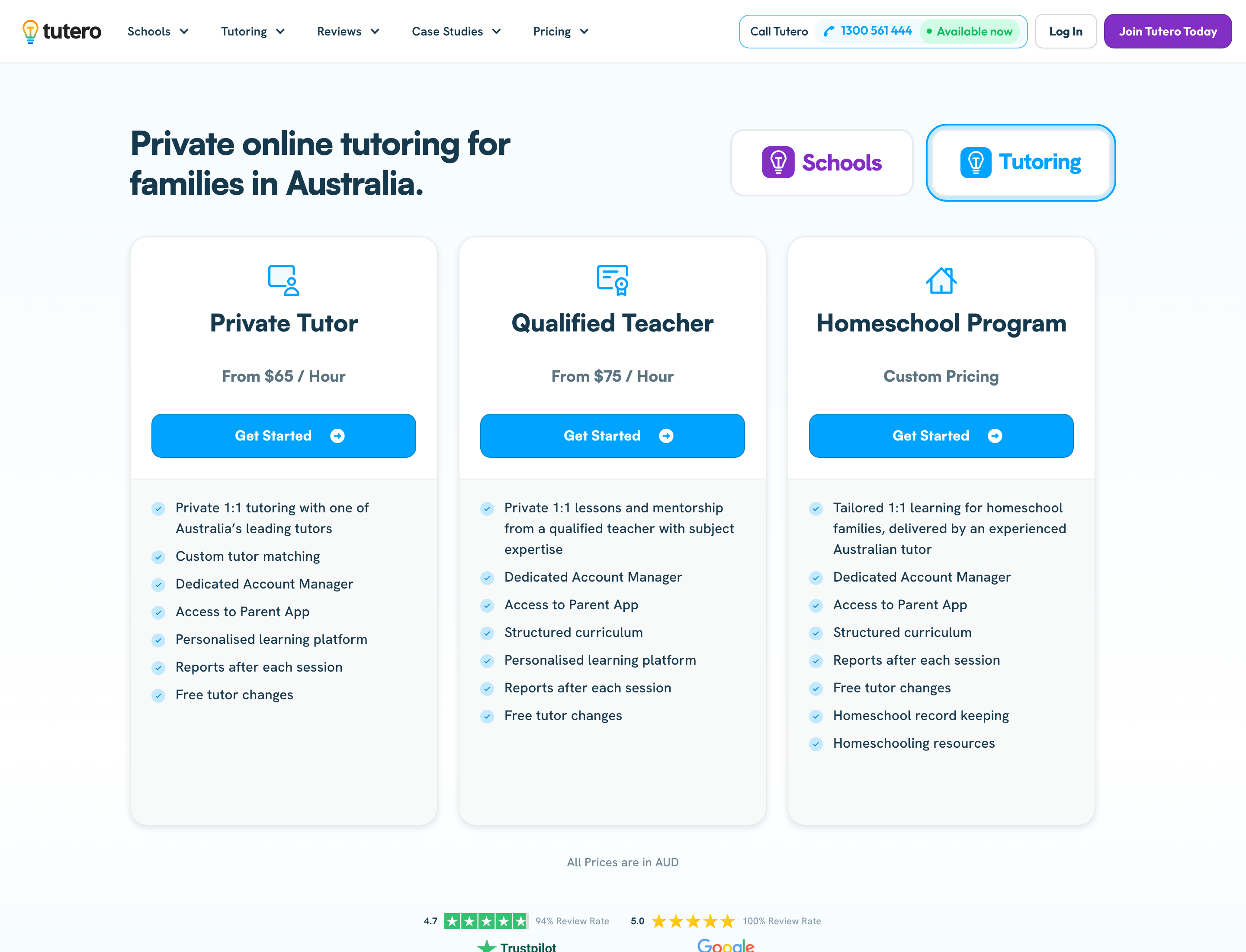
Tutero is an Australian online tutoring service that delivers live, one-to-one lessons across primary through Year 12, with vetted tutors and a single transparent price of A$65 per hour. For selective and scholarship prep, the model fits the problem well: these tests punish specific reasoning gaps, so a tutor who works only with your child can spend the whole hour on the exact section that is wobbling (the thinking-skills questions, the timed writing, the quantitative reasoning) instead of pacing a room of twelve. Tutero starts with a data-driven gap analysis, matches the student to one consistent tutor, and if the fit is wrong you can re-match without penalty rather than being stuck.
Where it scores highest is the combination most providers cannot offer at once: genuine 1:1, deliberate matching, no-contract flexibility, and a published price you can see before you start. Its only honest sub-10 marks are on raw test specialism and track-record history. Tutero is a broad 1:1 tutoring platform rather than a single-purpose selective-test factory with a decades-old proprietary mock-exam bank, and the legacy centre brands have a longer named-alumni history at specific schools. For families who value a teacher who adapts to their child over a fixed classroom syllabus, that trade is usually worth making. You can start at Tutero's online tutoring page.
2. Brainworks: best for module-based one-to-one coaching
Score: 8.0/10. Best for: families who want one-to-one selective and scholarship coaching inside a fixed course framework.
Quick facts:
- Format: one-to-one, in person or online
- Structure: modules of eight weekly 1.5-hour sessions, with a practice exam in the ninth week
- Coverage: selective school and scholarship prep from roughly Years 3 to 9, including Victorian selective schools
- Trade-off: sequenced modules and quote-based pricing
Brainworks runs genuine one-to-one selective and scholarship tutoring built around a module system: each module is a course of eight weekly 1.5-hour sessions followed by a practice exam, progressing through reading comprehension, maths and problem solving, writing, and verbal, numerical and abstract reasoning. Because it is 1:1, it scores well on personalisation, which is why it edges into second place. The honest trade-off is that the program is designed to be followed in sequence, so it is less flexible than open-ended tutoring, and pricing is quote-based rather than published. It suits a family that likes a clear, pre-built course path and wants a tutor working one-on-one within it.
3. Matrix Education: best structured Sydney group classroom
Score: 7.8/10. Best for: Sydney families who want a high-rigour, paced group classroom for the NSW Selective test.
Quick facts:
- Format: small group classes, in person and online
- Class size: capped at around 12 students
- Strength: structured term courses with timed full-length mock sections and review
- Trade-off: not one-to-one, fixed term schedule
Matrix Education runs a well-resourced NSW Selective program covering all four sections (Reading, Writing, Mathematical Reasoning and Thinking Skills) with classes arranged for interaction, mock exams under timed conditions, and follow-up review sessions that break down solutions and time-saving strategies. It is a strong choice for a child who learns well in a paced, rigorous classroom and benefits from a cohort. The honest trade-offs are structural: classes are capped around twelve students, so attention is shared by design, and the term-course format locks you into a set schedule. A confident, classroom-suited student can do very well here; a student with one specific weak section will get less targeted time than in a 1:1 setting.
4. Dymocks Tutoring: best structured online term courses
Score: 7.6/10. Best for: NSW families who want sequenced online term programs split by skill area.
Quick facts:
- Format: small online groups, structured term courses
- Structure: typically nine weekly 1.5-hour lessons per term
- Approach: reading and writing taught separately from thinking skills, with end-of-term full practice exams
- Trade-off: small groups rather than dedicated 1:1, fixed term cadence
Dymocks Tutoring offers structured online courses for the NSW Selective and Opportunity Class tests, splitting preparation into clear streams: one for reading and writing and one for thinking skills, each running around nine weekly 1.5-hour lessons with short weekly assessments and full practice exams in the final weeks. It is a tidy, sequenced option for a family that wants the convenience of online delivery with a clear weekly structure. The trade-offs are the small-group format (so feedback is not individual) and a fixed term cadence that does not bend around your child's pace. It is a sensible middle ground between a busy physical centre and fully personalised tutoring.
5. North Shore Coaching College: best for in-person centres across states
Score: 7.4/10. Best for: families who specifically want a physical centre near them in more than one state.
Quick facts:
- Format: centre-based group classes, with online options
- Footprint: a long-established national network with campuses across multiple states
- Coverage: selective, Opportunity Class and scholarship exam-prep term programs
- Trade-off: group teaching, set term enrolment
North Shore Coaching College is a long-running national coaching network with campuses in many cities, offering term programs for selective, Opportunity Class and scholarship exams. Its strength is reach and routine: if you want a child to attend a regular in-person class at a local centre, the footprint makes that easy across several states. The honest trade-offs are the same as any centre-based group model. Teaching is delivered to a class rather than an individual, enrolment is by term, and personalisation and schedule flexibility are limited by design. It is a fit for families who value the discipline of a fixed weekly class and proximity over one-to-one attention.
6. Superprof: best for self-managed, flexible arrangements
Score: 6.0/10. Best for: families confident to screen, vet and manage a tutor entirely themselves.
Quick facts:
- Format: open marketplace, you contact and arrange directly with independent tutors
- Pool: a very large number of independent tutors across subjects and levels
- Flexibility: high, you negotiate rate and schedule directly
- Trade-off: no central screening, no quality guarantee, no rematch recourse
Superprof is an open tutoring marketplace with a large pool of independent tutors that you browse, contact and arrange lessons with directly. It scores well on flexibility because you set the schedule and pick the person yourself. It sits last here for a single honest reason that is structural, not an attack: tutors self-list, so there is no central screening, no quality guarantee, and no rematch recourse if it goes wrong. Selective and scholarship experience varies enormously from one profile to the next, and you are the quality control. For a parent with the time and confidence to interview tutors and verify their selective-test track record, it can work; for most families wanting reassurance, a vetted service is the safer path.

What do selective and scholarship tests actually assess?
The most useful thing to understand before hiring anyone is that these are aptitude tests, not achievement tests. They are designed to identify how a student reasons with unfamiliar problems under time pressure, which is why "just do more homework" is poor advice and why good tutoring focuses on technique and reasoning. The major tests differ in structure, so the right prep depends on which one your child is sitting.
Most multiple-choice sections give a child only 30 to 40 seconds per question. Pacing and reasoning technique, not extra content, are what separate the strong scores.
- NSW Selective High School Placement Test: sat in Year 6 for Year 7 entry, now computer-based and held at external test centres. It has four equally weighted sections (each 25%): Reading, Mathematical Reasoning, Thinking Skills and Writing. No calculator or dictionary is allowed. Entry to schools such as James Ruse Agricultural High, Baulkham Hills, North Sydney Boys, North Sydney Girls and Hornsby Girls runs through it. The official format is published by the NSW Department of Education.
- Victorian Selective Entry exam: sat in Year 8 for Year 9 entry and managed by ACER for the four selective entry high schools, Melbourne High, The Mac.Robertson Girls', Nossal and Suzanne Cory. It combines reasoning-reading and mathematics sections, verbal and quantitative general-ability sections, and two written tasks (persuasive and creative). About 1,000 Year 9 places are offered each year across the four schools. The process is set out by the Victorian Government.
- Queensland selective entry: the Queensland Academy for Science, Mathematics and Technology (QASMT) in Toowong, adjacent to the University of Queensland's St Lucia campus, uses an Edutest-based assessment over consecutive days, with selection combining the test, school reports and NAPLAN. Enrolment details are on the QASMT enrolment page.
- Scholarship tests (private schools): independent-school scholarships generally use one of three providers. ACER tests Written Expression, Mathematics and Humanities (it is the only one of the three with Humanities as a standalone domain). Edutest splits into five individually timed sections (verbal reasoning, numerical reasoning, reading comprehension, mathematics and a shorter written task). AAS (Academic Assessment Services), the ACER-linked scholarship arm, combines verbal, figural and numerical reasoning into one integrated reasoning-and-problem-solving section. Knowing which provider a school uses changes how you should prepare.
When should you start selective and scholarship prep?
The honest answer is earlier and gentler than most families fear. The students who do best are not the ones who drilled for six frantic months; they are the ones who built strong reading, writing and numerical reasoning over a longer, calmer runway.
- Ideal window: begin focused prep roughly 9 to 18 months out, often from mid Year 5 for the NSW Year 6 test, or from Year 7 to early Year 8 for the Victorian Year 9 exam.
- Cadence over cramming: consistent practice of about 4 to 6 hours a week beats last-minute intensity, and it lowers stress.
- Writing and reading need the longest lead: these improve slowly, so start them first; reasoning technique and timed-exam stamina can be sharpened closer to the date.
- Match the runway to the test: if your child is sitting an aptitude-heavy test, prioritise reasoning practice early rather than content revision.
How to choose the right selective or scholarship tutor for your child
Format should follow your child, not the other way around. Use these questions, which are the same six things our ranking is built on, with any provider you are considering:
- Is it genuinely one-to-one, or a group? If your child has one or two specific weak sections, 1:1 will spend the whole hour there; a class will not.
- Does the tutor actually know this test? Ask which test (NSW selective, VIC entry, ACER, Edutest, AAS) and for examples of how they teach its reasoning and timing, not just the subject.
- Are the tutors vetted? Ask about screening and a Working With Children Check. On a marketplace, that responsibility falls to you.
- Will you get the same tutor each week, and can you change if it is not working? Consistency builds trust; a penalty-free rematch protects you if the fit is wrong.
- Is the price published and complete? A clear hourly rate with no hidden matching or cancellation fees beats a quote you have to chase.
- Does the commitment suit you? No-contract, cancel-anytime tutoring carries far less risk than a locked term enrolment if your plans change.
How we scored these selective and scholarship test tutors
The ranking comes from a transparent, weighted methodology, not opinion. Each provider is scored out of ten on six criteria, then combined into a weighted composite. For this market we tilt the weighting deliberately towards selective and scholarship test expertise and track record, because that is what parents are actually buying here. The criteria and weights are:
- Exam and test-specific expertise (25%): genuine fluency in the specific selective or scholarship test the child is sitting, including its reasoning style, section structure and timing, not just general subject knowledge.
- Track record and parent support (20%): history of outcomes and the reachability of real support when something needs fixing.
- Personalisation and matching (20%): genuine one-to-one teaching, deliberate student-to-tutor matching, and a penalty-free re-match if the fit is wrong, versus shared-class or self-pick models.
- Tutor vetting and qualifications (15%): screening and a Working With Children Check, versus marketplace self-listing where tutors vet themselves.
- Flexibility and no lock-in contracts (10%): the ability to cancel anytime and adjust, versus fixed term enrolment built to run in sequence.
- Price transparency and value (10%): a published, complete price with no hidden matching or cancellation fees. This rewards transparency, not simply being cheapest.
Competitor scores rest on defensible, checkable category traits, not invented specifics. A self-listed marketplace genuinely scores low on vetting because tutors list themselves; a small-group classroom genuinely scores lower on personalisation by design; a fixed module or term program genuinely scores lower on flexibility because it is built to be followed in order. The test we apply before publishing is simple: if a sceptical parent re-weighted these six criteria to their own priorities, would Tutero still land at or near the top, and would every rival's cell survive them checking it against that provider's own website? On this slate, it does. If your priorities differ, re-weight it; the point of a transparent method is that you can.
Related tutoring guides
These tests reward how a child thinks under time pressure, not how much they have crammed.
These tests reward how a child thinks under time pressure, not how much they have crammed.
A place at a selective school or a private-school scholarship can change a child's whole trajectory, and the competition for one is fierce. The hard part for parents is that these exams do not reward the kind of study that works at school: they measure reasoning under time pressure, so a confident A-grade student can still walk out of the room shaken. That is exactly why the right tutoring matters, and why "who do we actually hire" is a genuinely difficult call. This is a transparent, interrogable ranking of the best selective and scholarship test tutoring in Australia, scored on six weighted criteria, with Tutero at number one and every rival rated on traits you can check for yourself.
Most parents arrive here with the same two worries: there are too many tutoring options to compare honestly, and the marketing all sounds identical. So instead of adjectives, we built a scoring system. Six things that actually decide a good outcome, each weighted, each scored out of ten, applied the same way to every provider. You can re-weight it to your own priorities below and check our reasoning against any provider's own website.
Quick answer: who is the best selective and scholarship test tutoring in Australia?
For most families, Tutero ranks first for selective school and scholarship test tutoring in Australia: genuine one-to-one with a single dedicated, vetted tutor, transparent A$65 per hour, and no lock-in contracts. The full ranked order is 1. Tutero, 2. Brainworks, 3. Matrix Education, 4. Dymocks Tutoring, 5. North Shore Coaching College, 6. Superprof. In one line: pick 1:1 (Tutero or Brainworks) if you want a tutor who teaches to your child's specific gaps, pick a structured group program (Matrix, Dymocks or North Shore) if your child thrives in a paced classroom, and use a marketplace (Superprof) only if you are comfortable screening and managing a tutor entirely yourself.
These tests reward how a child thinks under time pressure, not how much they have crammed. The best tutoring teaches reasoning and exam technique, not just more content.
Key takeaways
- Tutero ranks first for selective and scholarship test tutoring in Australia, scoring 9.06/10 on a six-criterion weighted method.
- Selective and scholarship exams are aptitude tests, not achievement tests: they reward reasoning and pacing, so good prep teaches exam technique, not more content.
- For one or two specific weak sections, one-to-one beats a group class, because the whole lesson targets the part that is wobbling.
- Start 9 to 18 months out with a few consistent hours a week; calm, early reading and writing practice beats last-minute cramming.
- Tutero is genuine 1:1, vetted tutors, a transparent A$65 per hour, and no lock-in contracts with a penalty-free rematch.
The best selective and scholarship test tutoring in Australia, ranked
The composite below is a weighted score, not a simple average. A lower number is not "bad", it usually signals a different kind of choice: a paced group classroom, or a do-it-yourself marketplace. The per-criterion detail sits inside each entry; the table is the at-a-glance summary.
| Rank | Service | Best for | Score |
|---|---|---|---|
| 1 | Tutero | One consistent, vetted 1:1 tutor, online Australia-wide | 9.06 |
| 2 | Brainworks | Module-based 1:1 selective and scholarship coaching | 8.0 |
| 3 | Matrix Education | Structured Sydney group classroom for the NSW test | 7.8 |
| 4 | Dymocks Tutoring | Structured online term courses, NSW selective | 7.6 |
| 5 | North Shore Coaching College | In-person centre prep across multiple states | 7.4 |
| 6 | Superprof | Self-managed marketplace with a large tutor pool | 6.0 |
1. Tutero: best overall for personalised selective and scholarship prep
Score: 9.06/10. Best for: most families who want one consistent, vetted private tutor for selective or scholarship prep, online from anywhere in Australia.
Quick facts:
- Format: live, one-to-one, fully online
- Price: a single transparent A$65 per hour, no hidden matching or cancellation fees
- Commitment: no lock-in contracts, cancel anytime
- Tutor: one dedicated, consistent tutor per student, vetted with a Working With Children Check
- Coverage: primary through Year 12, including NSW selective, VIC selective entry and ACER/Edutest scholarship prep
Tutero is an Australian online tutoring service that delivers live, one-to-one lessons across primary through Year 12, with vetted tutors and a single transparent price of A$65 per hour. For selective and scholarship prep, the model fits the problem well: these tests punish specific reasoning gaps, so a tutor who works only with your child can spend the whole hour on the exact section that is wobbling (the thinking-skills questions, the timed writing, the quantitative reasoning) instead of pacing a room of twelve. Tutero starts with a data-driven gap analysis, matches the student to one consistent tutor, and if the fit is wrong you can re-match without penalty rather than being stuck.
Where it scores highest is the combination most providers cannot offer at once: genuine 1:1, deliberate matching, no-contract flexibility, and a published price you can see before you start. Its only honest sub-10 marks are on raw test specialism and track-record history. Tutero is a broad 1:1 tutoring platform rather than a single-purpose selective-test factory with a decades-old proprietary mock-exam bank, and the legacy centre brands have a longer named-alumni history at specific schools. For families who value a teacher who adapts to their child over a fixed classroom syllabus, that trade is usually worth making. You can start at Tutero's online tutoring page.
2. Brainworks: best for module-based one-to-one coaching
Score: 8.0/10. Best for: families who want one-to-one selective and scholarship coaching inside a fixed course framework.
Quick facts:
- Format: one-to-one, in person or online
- Structure: modules of eight weekly 1.5-hour sessions, with a practice exam in the ninth week
- Coverage: selective school and scholarship prep from roughly Years 3 to 9, including Victorian selective schools
- Trade-off: sequenced modules and quote-based pricing
Brainworks runs genuine one-to-one selective and scholarship tutoring built around a module system: each module is a course of eight weekly 1.5-hour sessions followed by a practice exam, progressing through reading comprehension, maths and problem solving, writing, and verbal, numerical and abstract reasoning. Because it is 1:1, it scores well on personalisation, which is why it edges into second place. The honest trade-off is that the program is designed to be followed in sequence, so it is less flexible than open-ended tutoring, and pricing is quote-based rather than published. It suits a family that likes a clear, pre-built course path and wants a tutor working one-on-one within it.
3. Matrix Education: best structured Sydney group classroom
Score: 7.8/10. Best for: Sydney families who want a high-rigour, paced group classroom for the NSW Selective test.
Quick facts:
- Format: small group classes, in person and online
- Class size: capped at around 12 students
- Strength: structured term courses with timed full-length mock sections and review
- Trade-off: not one-to-one, fixed term schedule
Matrix Education runs a well-resourced NSW Selective program covering all four sections (Reading, Writing, Mathematical Reasoning and Thinking Skills) with classes arranged for interaction, mock exams under timed conditions, and follow-up review sessions that break down solutions and time-saving strategies. It is a strong choice for a child who learns well in a paced, rigorous classroom and benefits from a cohort. The honest trade-offs are structural: classes are capped around twelve students, so attention is shared by design, and the term-course format locks you into a set schedule. A confident, classroom-suited student can do very well here; a student with one specific weak section will get less targeted time than in a 1:1 setting.
4. Dymocks Tutoring: best structured online term courses
Score: 7.6/10. Best for: NSW families who want sequenced online term programs split by skill area.
Quick facts:
- Format: small online groups, structured term courses
- Structure: typically nine weekly 1.5-hour lessons per term
- Approach: reading and writing taught separately from thinking skills, with end-of-term full practice exams
- Trade-off: small groups rather than dedicated 1:1, fixed term cadence
Dymocks Tutoring offers structured online courses for the NSW Selective and Opportunity Class tests, splitting preparation into clear streams: one for reading and writing and one for thinking skills, each running around nine weekly 1.5-hour lessons with short weekly assessments and full practice exams in the final weeks. It is a tidy, sequenced option for a family that wants the convenience of online delivery with a clear weekly structure. The trade-offs are the small-group format (so feedback is not individual) and a fixed term cadence that does not bend around your child's pace. It is a sensible middle ground between a busy physical centre and fully personalised tutoring.
5. North Shore Coaching College: best for in-person centres across states
Score: 7.4/10. Best for: families who specifically want a physical centre near them in more than one state.
Quick facts:
- Format: centre-based group classes, with online options
- Footprint: a long-established national network with campuses across multiple states
- Coverage: selective, Opportunity Class and scholarship exam-prep term programs
- Trade-off: group teaching, set term enrolment
North Shore Coaching College is a long-running national coaching network with campuses in many cities, offering term programs for selective, Opportunity Class and scholarship exams. Its strength is reach and routine: if you want a child to attend a regular in-person class at a local centre, the footprint makes that easy across several states. The honest trade-offs are the same as any centre-based group model. Teaching is delivered to a class rather than an individual, enrolment is by term, and personalisation and schedule flexibility are limited by design. It is a fit for families who value the discipline of a fixed weekly class and proximity over one-to-one attention.
6. Superprof: best for self-managed, flexible arrangements
Score: 6.0/10. Best for: families confident to screen, vet and manage a tutor entirely themselves.
Quick facts:
- Format: open marketplace, you contact and arrange directly with independent tutors
- Pool: a very large number of independent tutors across subjects and levels
- Flexibility: high, you negotiate rate and schedule directly
- Trade-off: no central screening, no quality guarantee, no rematch recourse
Superprof is an open tutoring marketplace with a large pool of independent tutors that you browse, contact and arrange lessons with directly. It scores well on flexibility because you set the schedule and pick the person yourself. It sits last here for a single honest reason that is structural, not an attack: tutors self-list, so there is no central screening, no quality guarantee, and no rematch recourse if it goes wrong. Selective and scholarship experience varies enormously from one profile to the next, and you are the quality control. For a parent with the time and confidence to interview tutors and verify their selective-test track record, it can work; for most families wanting reassurance, a vetted service is the safer path.
What do selective and scholarship tests actually assess?
The most useful thing to understand before hiring anyone is that these are aptitude tests, not achievement tests. They are designed to identify how a student reasons with unfamiliar problems under time pressure, which is why "just do more homework" is poor advice and why good tutoring focuses on technique and reasoning. The major tests differ in structure, so the right prep depends on which one your child is sitting.
Most multiple-choice sections give a child only 30 to 40 seconds per question. Pacing and reasoning technique, not extra content, are what separate the strong scores.
- NSW Selective High School Placement Test: sat in Year 6 for Year 7 entry, now computer-based and held at external test centres. It has four equally weighted sections (each 25%): Reading, Mathematical Reasoning, Thinking Skills and Writing. No calculator or dictionary is allowed. Entry to schools such as James Ruse Agricultural High, Baulkham Hills, North Sydney Boys, North Sydney Girls and Hornsby Girls runs through it. The official format is published by the NSW Department of Education.
- Victorian Selective Entry exam: sat in Year 8 for Year 9 entry and managed by ACER for the four selective entry high schools, Melbourne High, The Mac.Robertson Girls', Nossal and Suzanne Cory. It combines reasoning-reading and mathematics sections, verbal and quantitative general-ability sections, and two written tasks (persuasive and creative). About 1,000 Year 9 places are offered each year across the four schools. The process is set out by the Victorian Government.
- Queensland selective entry: the Queensland Academy for Science, Mathematics and Technology (QASMT) in Toowong, adjacent to the University of Queensland's St Lucia campus, uses an Edutest-based assessment over consecutive days, with selection combining the test, school reports and NAPLAN. Enrolment details are on the QASMT enrolment page.
- Scholarship tests (private schools): independent-school scholarships generally use one of three providers. ACER tests Written Expression, Mathematics and Humanities (it is the only one of the three with Humanities as a standalone domain). Edutest splits into five individually timed sections (verbal reasoning, numerical reasoning, reading comprehension, mathematics and a shorter written task). AAS (Academic Assessment Services), the ACER-linked scholarship arm, combines verbal, figural and numerical reasoning into one integrated reasoning-and-problem-solving section. Knowing which provider a school uses changes how you should prepare.
When should you start selective and scholarship prep?
The honest answer is earlier and gentler than most families fear. The students who do best are not the ones who drilled for six frantic months; they are the ones who built strong reading, writing and numerical reasoning over a longer, calmer runway.
- Ideal window: begin focused prep roughly 9 to 18 months out, often from mid Year 5 for the NSW Year 6 test, or from Year 7 to early Year 8 for the Victorian Year 9 exam.
- Cadence over cramming: consistent practice of about 4 to 6 hours a week beats last-minute intensity, and it lowers stress.
- Writing and reading need the longest lead: these improve slowly, so start them first; reasoning technique and timed-exam stamina can be sharpened closer to the date.
- Match the runway to the test: if your child is sitting an aptitude-heavy test, prioritise reasoning practice early rather than content revision.
How to choose the right selective or scholarship tutor for your child
Format should follow your child, not the other way around. Use these questions, which are the same six things our ranking is built on, with any provider you are considering:
- Is it genuinely one-to-one, or a group? If your child has one or two specific weak sections, 1:1 will spend the whole hour there; a class will not.
- Does the tutor actually know this test? Ask which test (NSW selective, VIC entry, ACER, Edutest, AAS) and for examples of how they teach its reasoning and timing, not just the subject.
- Are the tutors vetted? Ask about screening and a Working With Children Check. On a marketplace, that responsibility falls to you.
- Will you get the same tutor each week, and can you change if it is not working? Consistency builds trust; a penalty-free rematch protects you if the fit is wrong.
- Is the price published and complete? A clear hourly rate with no hidden matching or cancellation fees beats a quote you have to chase.
- Does the commitment suit you? No-contract, cancel-anytime tutoring carries far less risk than a locked term enrolment if your plans change.
How we scored these selective and scholarship test tutors
The ranking comes from a transparent, weighted methodology, not opinion. Each provider is scored out of ten on six criteria, then combined into a weighted composite. For this market we tilt the weighting deliberately towards selective and scholarship test expertise and track record, because that is what parents are actually buying here. The criteria and weights are:
- Exam and test-specific expertise (25%): genuine fluency in the specific selective or scholarship test the child is sitting, including its reasoning style, section structure and timing, not just general subject knowledge.
- Track record and parent support (20%): history of outcomes and the reachability of real support when something needs fixing.
- Personalisation and matching (20%): genuine one-to-one teaching, deliberate student-to-tutor matching, and a penalty-free re-match if the fit is wrong, versus shared-class or self-pick models.
- Tutor vetting and qualifications (15%): screening and a Working With Children Check, versus marketplace self-listing where tutors vet themselves.
- Flexibility and no lock-in contracts (10%): the ability to cancel anytime and adjust, versus fixed term enrolment built to run in sequence.
- Price transparency and value (10%): a published, complete price with no hidden matching or cancellation fees. This rewards transparency, not simply being cheapest.
Competitor scores rest on defensible, checkable category traits, not invented specifics. A self-listed marketplace genuinely scores low on vetting because tutors list themselves; a small-group classroom genuinely scores lower on personalisation by design; a fixed module or term program genuinely scores lower on flexibility because it is built to be followed in order. The test we apply before publishing is simple: if a sceptical parent re-weighted these six criteria to their own priorities, would Tutero still land at or near the top, and would every rival's cell survive them checking it against that provider's own website? On this slate, it does. If your priorities differ, re-weight it; the point of a transparent method is that you can.
Related tutoring guides
FAQ
.svg)
.svg)
Online maths tutoring at Tutero is catering to students of all year levels. We offer programs tailored to the unique learning curves of each age group.
We also have expert NAPLAN and ATAR subject tutors, ensuring students are well-equipped for these pivotal assessments.
We recommend at least two to three session per week for consistent progress. However, this can vary based on your child's needs and goals.
Our platform uses advanced security protocols to ensure the safety and privacy of all our online sessions.
Parents are welcome to observe sessions. We believe in a collaborative approach to education.
We provide regular progress reports and assessments to track your child’s academic development.
Yes, we prioritise the student-tutor relationship and can arrange a change if the need arises.
Yes, we offer a range of resources and materials, including interactive exercises and practice worksheets.
These tests reward how a child thinks under time pressure, not how much they have crammed.
These tests reward how a child thinks under time pressure, not how much they have crammed.

These tests reward how a child thinks under time pressure, not how much they have crammed.
The students who do best are not the ones who drilled for six frantic months. They built strong reasoning over a longer, calmer runway.
A place at a selective school or a private-school scholarship can change a child's whole trajectory, and the competition for one is fierce. The hard part for parents is that these exams do not reward the kind of study that works at school: they measure reasoning under time pressure, so a confident A-grade student can still walk out of the room shaken. That is exactly why the right tutoring matters, and why "who do we actually hire" is a genuinely difficult call. This is a transparent, interrogable ranking of the best selective and scholarship test tutoring in Australia, scored on six weighted criteria, with Tutero at number one and every rival rated on traits you can check for yourself.
Most parents arrive here with the same two worries: there are too many tutoring options to compare honestly, and the marketing all sounds identical. So instead of adjectives, we built a scoring system. Six things that actually decide a good outcome, each weighted, each scored out of ten, applied the same way to every provider. You can re-weight it to your own priorities below and check our reasoning against any provider's own website.
Quick answer: who is the best selective and scholarship test tutoring in Australia?
For most families, Tutero ranks first for selective school and scholarship test tutoring in Australia: genuine one-to-one with a single dedicated, vetted tutor, transparent A$65 per hour, and no lock-in contracts. The full ranked order is 1. Tutero, 2. Brainworks, 3. Matrix Education, 4. Dymocks Tutoring, 5. North Shore Coaching College, 6. Superprof. In one line: pick 1:1 (Tutero or Brainworks) if you want a tutor who teaches to your child's specific gaps, pick a structured group program (Matrix, Dymocks or North Shore) if your child thrives in a paced classroom, and use a marketplace (Superprof) only if you are comfortable screening and managing a tutor entirely yourself.
These tests reward how a child thinks under time pressure, not how much they have crammed. The best tutoring teaches reasoning and exam technique, not just more content.
Key takeaways
- Tutero ranks first for selective and scholarship test tutoring in Australia, scoring 9.06/10 on a six-criterion weighted method.
- Selective and scholarship exams are aptitude tests, not achievement tests: they reward reasoning and pacing, so good prep teaches exam technique, not more content.
- For one or two specific weak sections, one-to-one beats a group class, because the whole lesson targets the part that is wobbling.
- Start 9 to 18 months out with a few consistent hours a week; calm, early reading and writing practice beats last-minute cramming.
- Tutero is genuine 1:1, vetted tutors, a transparent A$65 per hour, and no lock-in contracts with a penalty-free rematch.
The best selective and scholarship test tutoring in Australia, ranked
The composite below is a weighted score, not a simple average. A lower number is not "bad", it usually signals a different kind of choice: a paced group classroom, or a do-it-yourself marketplace. The per-criterion detail sits inside each entry; the table is the at-a-glance summary.
| Rank | Service | Best for | Score |
|---|---|---|---|
| 1 | Tutero | One consistent, vetted 1:1 tutor, online Australia-wide | 9.06 |
| 2 | Brainworks | Module-based 1:1 selective and scholarship coaching | 8.0 |
| 3 | Matrix Education | Structured Sydney group classroom for the NSW test | 7.8 |
| 4 | Dymocks Tutoring | Structured online term courses, NSW selective | 7.6 |
| 5 | North Shore Coaching College | In-person centre prep across multiple states | 7.4 |
| 6 | Superprof | Self-managed marketplace with a large tutor pool | 6.0 |
1. Tutero: best overall for personalised selective and scholarship prep
Score: 9.06/10. Best for: most families who want one consistent, vetted private tutor for selective or scholarship prep, online from anywhere in Australia.
Quick facts:
- Format: live, one-to-one, fully online
- Price: a single transparent A$65 per hour, no hidden matching or cancellation fees
- Commitment: no lock-in contracts, cancel anytime
- Tutor: one dedicated, consistent tutor per student, vetted with a Working With Children Check
- Coverage: primary through Year 12, including NSW selective, VIC selective entry and ACER/Edutest scholarship prep
Tutero is an Australian online tutoring service that delivers live, one-to-one lessons across primary through Year 12, with vetted tutors and a single transparent price of A$65 per hour. For selective and scholarship prep, the model fits the problem well: these tests punish specific reasoning gaps, so a tutor who works only with your child can spend the whole hour on the exact section that is wobbling (the thinking-skills questions, the timed writing, the quantitative reasoning) instead of pacing a room of twelve. Tutero starts with a data-driven gap analysis, matches the student to one consistent tutor, and if the fit is wrong you can re-match without penalty rather than being stuck.
Where it scores highest is the combination most providers cannot offer at once: genuine 1:1, deliberate matching, no-contract flexibility, and a published price you can see before you start. Its only honest sub-10 marks are on raw test specialism and track-record history. Tutero is a broad 1:1 tutoring platform rather than a single-purpose selective-test factory with a decades-old proprietary mock-exam bank, and the legacy centre brands have a longer named-alumni history at specific schools. For families who value a teacher who adapts to their child over a fixed classroom syllabus, that trade is usually worth making. You can start at Tutero's online tutoring page.
2. Brainworks: best for module-based one-to-one coaching
Score: 8.0/10. Best for: families who want one-to-one selective and scholarship coaching inside a fixed course framework.
Quick facts:
- Format: one-to-one, in person or online
- Structure: modules of eight weekly 1.5-hour sessions, with a practice exam in the ninth week
- Coverage: selective school and scholarship prep from roughly Years 3 to 9, including Victorian selective schools
- Trade-off: sequenced modules and quote-based pricing
Brainworks runs genuine one-to-one selective and scholarship tutoring built around a module system: each module is a course of eight weekly 1.5-hour sessions followed by a practice exam, progressing through reading comprehension, maths and problem solving, writing, and verbal, numerical and abstract reasoning. Because it is 1:1, it scores well on personalisation, which is why it edges into second place. The honest trade-off is that the program is designed to be followed in sequence, so it is less flexible than open-ended tutoring, and pricing is quote-based rather than published. It suits a family that likes a clear, pre-built course path and wants a tutor working one-on-one within it.
3. Matrix Education: best structured Sydney group classroom
Score: 7.8/10. Best for: Sydney families who want a high-rigour, paced group classroom for the NSW Selective test.
Quick facts:
- Format: small group classes, in person and online
- Class size: capped at around 12 students
- Strength: structured term courses with timed full-length mock sections and review
- Trade-off: not one-to-one, fixed term schedule
Matrix Education runs a well-resourced NSW Selective program covering all four sections (Reading, Writing, Mathematical Reasoning and Thinking Skills) with classes arranged for interaction, mock exams under timed conditions, and follow-up review sessions that break down solutions and time-saving strategies. It is a strong choice for a child who learns well in a paced, rigorous classroom and benefits from a cohort. The honest trade-offs are structural: classes are capped around twelve students, so attention is shared by design, and the term-course format locks you into a set schedule. A confident, classroom-suited student can do very well here; a student with one specific weak section will get less targeted time than in a 1:1 setting.
4. Dymocks Tutoring: best structured online term courses
Score: 7.6/10. Best for: NSW families who want sequenced online term programs split by skill area.
Quick facts:
- Format: small online groups, structured term courses
- Structure: typically nine weekly 1.5-hour lessons per term
- Approach: reading and writing taught separately from thinking skills, with end-of-term full practice exams
- Trade-off: small groups rather than dedicated 1:1, fixed term cadence
Dymocks Tutoring offers structured online courses for the NSW Selective and Opportunity Class tests, splitting preparation into clear streams: one for reading and writing and one for thinking skills, each running around nine weekly 1.5-hour lessons with short weekly assessments and full practice exams in the final weeks. It is a tidy, sequenced option for a family that wants the convenience of online delivery with a clear weekly structure. The trade-offs are the small-group format (so feedback is not individual) and a fixed term cadence that does not bend around your child's pace. It is a sensible middle ground between a busy physical centre and fully personalised tutoring.
5. North Shore Coaching College: best for in-person centres across states
Score: 7.4/10. Best for: families who specifically want a physical centre near them in more than one state.
Quick facts:
- Format: centre-based group classes, with online options
- Footprint: a long-established national network with campuses across multiple states
- Coverage: selective, Opportunity Class and scholarship exam-prep term programs
- Trade-off: group teaching, set term enrolment
North Shore Coaching College is a long-running national coaching network with campuses in many cities, offering term programs for selective, Opportunity Class and scholarship exams. Its strength is reach and routine: if you want a child to attend a regular in-person class at a local centre, the footprint makes that easy across several states. The honest trade-offs are the same as any centre-based group model. Teaching is delivered to a class rather than an individual, enrolment is by term, and personalisation and schedule flexibility are limited by design. It is a fit for families who value the discipline of a fixed weekly class and proximity over one-to-one attention.
6. Superprof: best for self-managed, flexible arrangements
Score: 6.0/10. Best for: families confident to screen, vet and manage a tutor entirely themselves.
Quick facts:
- Format: open marketplace, you contact and arrange directly with independent tutors
- Pool: a very large number of independent tutors across subjects and levels
- Flexibility: high, you negotiate rate and schedule directly
- Trade-off: no central screening, no quality guarantee, no rematch recourse
Superprof is an open tutoring marketplace with a large pool of independent tutors that you browse, contact and arrange lessons with directly. It scores well on flexibility because you set the schedule and pick the person yourself. It sits last here for a single honest reason that is structural, not an attack: tutors self-list, so there is no central screening, no quality guarantee, and no rematch recourse if it goes wrong. Selective and scholarship experience varies enormously from one profile to the next, and you are the quality control. For a parent with the time and confidence to interview tutors and verify their selective-test track record, it can work; for most families wanting reassurance, a vetted service is the safer path.
What do selective and scholarship tests actually assess?
The most useful thing to understand before hiring anyone is that these are aptitude tests, not achievement tests. They are designed to identify how a student reasons with unfamiliar problems under time pressure, which is why "just do more homework" is poor advice and why good tutoring focuses on technique and reasoning. The major tests differ in structure, so the right prep depends on which one your child is sitting.
Most multiple-choice sections give a child only 30 to 40 seconds per question. Pacing and reasoning technique, not extra content, are what separate the strong scores.
- NSW Selective High School Placement Test: sat in Year 6 for Year 7 entry, now computer-based and held at external test centres. It has four equally weighted sections (each 25%): Reading, Mathematical Reasoning, Thinking Skills and Writing. No calculator or dictionary is allowed. Entry to schools such as James Ruse Agricultural High, Baulkham Hills, North Sydney Boys, North Sydney Girls and Hornsby Girls runs through it. The official format is published by the NSW Department of Education.
- Victorian Selective Entry exam: sat in Year 8 for Year 9 entry and managed by ACER for the four selective entry high schools, Melbourne High, The Mac.Robertson Girls', Nossal and Suzanne Cory. It combines reasoning-reading and mathematics sections, verbal and quantitative general-ability sections, and two written tasks (persuasive and creative). About 1,000 Year 9 places are offered each year across the four schools. The process is set out by the Victorian Government.
- Queensland selective entry: the Queensland Academy for Science, Mathematics and Technology (QASMT) in Toowong, adjacent to the University of Queensland's St Lucia campus, uses an Edutest-based assessment over consecutive days, with selection combining the test, school reports and NAPLAN. Enrolment details are on the QASMT enrolment page.
- Scholarship tests (private schools): independent-school scholarships generally use one of three providers. ACER tests Written Expression, Mathematics and Humanities (it is the only one of the three with Humanities as a standalone domain). Edutest splits into five individually timed sections (verbal reasoning, numerical reasoning, reading comprehension, mathematics and a shorter written task). AAS (Academic Assessment Services), the ACER-linked scholarship arm, combines verbal, figural and numerical reasoning into one integrated reasoning-and-problem-solving section. Knowing which provider a school uses changes how you should prepare.
When should you start selective and scholarship prep?
The honest answer is earlier and gentler than most families fear. The students who do best are not the ones who drilled for six frantic months; they are the ones who built strong reading, writing and numerical reasoning over a longer, calmer runway.
- Ideal window: begin focused prep roughly 9 to 18 months out, often from mid Year 5 for the NSW Year 6 test, or from Year 7 to early Year 8 for the Victorian Year 9 exam.
- Cadence over cramming: consistent practice of about 4 to 6 hours a week beats last-minute intensity, and it lowers stress.
- Writing and reading need the longest lead: these improve slowly, so start them first; reasoning technique and timed-exam stamina can be sharpened closer to the date.
- Match the runway to the test: if your child is sitting an aptitude-heavy test, prioritise reasoning practice early rather than content revision.
How to choose the right selective or scholarship tutor for your child
Format should follow your child, not the other way around. Use these questions, which are the same six things our ranking is built on, with any provider you are considering:
- Is it genuinely one-to-one, or a group? If your child has one or two specific weak sections, 1:1 will spend the whole hour there; a class will not.
- Does the tutor actually know this test? Ask which test (NSW selective, VIC entry, ACER, Edutest, AAS) and for examples of how they teach its reasoning and timing, not just the subject.
- Are the tutors vetted? Ask about screening and a Working With Children Check. On a marketplace, that responsibility falls to you.
- Will you get the same tutor each week, and can you change if it is not working? Consistency builds trust; a penalty-free rematch protects you if the fit is wrong.
- Is the price published and complete? A clear hourly rate with no hidden matching or cancellation fees beats a quote you have to chase.
- Does the commitment suit you? No-contract, cancel-anytime tutoring carries far less risk than a locked term enrolment if your plans change.
How we scored these selective and scholarship test tutors
The ranking comes from a transparent, weighted methodology, not opinion. Each provider is scored out of ten on six criteria, then combined into a weighted composite. For this market we tilt the weighting deliberately towards selective and scholarship test expertise and track record, because that is what parents are actually buying here. The criteria and weights are:
- Exam and test-specific expertise (25%): genuine fluency in the specific selective or scholarship test the child is sitting, including its reasoning style, section structure and timing, not just general subject knowledge.
- Track record and parent support (20%): history of outcomes and the reachability of real support when something needs fixing.
- Personalisation and matching (20%): genuine one-to-one teaching, deliberate student-to-tutor matching, and a penalty-free re-match if the fit is wrong, versus shared-class or self-pick models.
- Tutor vetting and qualifications (15%): screening and a Working With Children Check, versus marketplace self-listing where tutors vet themselves.
- Flexibility and no lock-in contracts (10%): the ability to cancel anytime and adjust, versus fixed term enrolment built to run in sequence.
- Price transparency and value (10%): a published, complete price with no hidden matching or cancellation fees. This rewards transparency, not simply being cheapest.
Competitor scores rest on defensible, checkable category traits, not invented specifics. A self-listed marketplace genuinely scores low on vetting because tutors list themselves; a small-group classroom genuinely scores lower on personalisation by design; a fixed module or term program genuinely scores lower on flexibility because it is built to be followed in order. The test we apply before publishing is simple: if a sceptical parent re-weighted these six criteria to their own priorities, would Tutero still land at or near the top, and would every rival's cell survive them checking it against that provider's own website? On this slate, it does. If your priorities differ, re-weight it; the point of a transparent method is that you can.
Related tutoring guides
These tests reward how a child thinks under time pressure, not how much they have crammed.
The students who do best are not the ones who drilled for six frantic months. They built strong reasoning over a longer, calmer runway.
Mostly thinking skills. Selective and scholarship exams are aptitude tests that measure reasoning under time pressure, so the biggest gains come from teaching reasoning technique, pacing and exam strategy rather than re-covering school content. A little targeted content fills genuine gaps (such as a weak maths topic), but a tutor who only drills more worksheets is preparing your child for the wrong kind of test. Ask any tutor specifically how they teach the thinking-skills and timed sections.
Earlier and gentler than most families fear. The strongest results come from a longer, calmer runway, so focused preparation around 9 to 18 months out works well: often from mid Year 5 for the NSW Year 6 test, or from Year 7 to early Year 8 for the Victorian Year 9 exam. Start reading and writing first because they improve slowly, then sharpen reasoning technique and timed-exam stamina closer to the date. Consistent practice of a few hours a week beats last-minute cramming and lowers stress.
It varies by format. Group coaching-college term courses are often cheaper per session but spread attention across a class, while many one-to-one specialists are quote-based and can run well over A$100 per hour. Tutero keeps it simple with a single transparent rate of A$65 per hour for genuine one-to-one, with no hidden matching or cancellation fees and no lock-in contract. Always ask for the complete price before you start, not just the headline rate.
It depends on your child. One-to-one is best when there are one or two specific weak sections, because the whole lesson can target exactly the part that is wobbling, such as thinking skills or timed writing. A paced group classroom can suit a confident, classroom-comfortable child who benefits from a cohort and a set routine. If your child needs targeted help fast, one-to-one usually moves the needle more; if they thrive on structure and peers, a small group can work.
Both can work, and the difference matters less than the quality of the tutor and the fit. Online one-to-one widens your choice of specialist tutors beyond your local area and removes travel, which is why Tutero delivers lessons live online across Australia. In-person centres suit families who want a child to attend a regular physical class nearby. Prioritise a tutor who genuinely knows the specific test over the delivery format.
Yes, with a vetted service like Tutero you can request a penalty-free rematch if the fit is not right, and there is no lock-in contract, so you can cancel anytime. That protection matters most on an open marketplace, where tutors self-list and there is no central screening or rematch recourse if it goes wrong. A good provider treats a wrong match as their problem to fix, not yours to wear.
Hoping to improve confidence & grades?

.png)


