
.svg)

Open any senior economics marking guide and the same pattern jumps out: the marks are not awarded for the correct fact, they are awarded for the argument built around it. A student can define crowding out, name every fiscal and monetary lever, and draw a textbook demand and supply diagram, then sit an extended response and score a Band 5 because the answer never connects the diagram to a paragraph, never reads the marking criteria's verbs (analyse, evaluate, contrast), and never carries a thesis through to a conclusion. That is the quiet trap of economics: it is graded like an essay subject wearing a numerical disguise, where a labelled graph only earns its marks once it is wired into the written analysis. It is exactly why the right tutor for economics is a slightly different hire from the right tutor for maths or chemistry.
So choosing an economics tutor is really a question about one skill: who will actually move your child's extended responses, and why should you believe them? This is a transparent, interrogable ranking of Australia's economics tutoring options, scored on a published weighted methodology with Tutero placed first. Every criterion and weight is laid out at the end so you can re-weight them to your own priorities and check each claim against the provider's own website.
Quick answer: which economics tutoring is best in Australia?
Tutero ranks first for economics tutoring in Australia, on a weighted score of 9.12/10: one-to-one lessons with a vetted, consistent tutor matched to your child's exact state course, a single transparent rate of A$65 per hour, and no lock-in contracts. The full ranked order is 1. Tutero, 2. Pareto Economics, 3. Project Academy, 4. Master Mind Australia, 5. Apex Tuition Australia, 6. Tutor Finder.
In short: choose a vetted one-to-one service if you want a tutor who will mark your child's essays against their specific state course; a single-subject HSC specialist if you want exam-board depth and accept a fixed class; a structured cohort program if your child thrives on weekly drills and supervised exams; and a directory only if you are happy to screen and manage a tutor yourself.
Key takeaways
- Tutero ranks first (9.12/10): vetted one-to-one tutors, a flat A$65 per hour at every year level, and no lock-in contracts.
- Economics is marked like an essay subject: most senior marks reward analysis and evaluation, so the highest-value tutoring is essay and extended-response marking, not re-teaching content.
- Match the tutor to your child's exact course: a VCE, HSC, QCE, WACE, SACE or IB tutor are doing different jobs, so fluency in your state's marking scheme matters more than general subject knowledge.
- One-to-one beats a fixed class when the marks live in individual writing, because only a matched tutor can mark your child's own drafts; a structured cohort suits students who need routine and accountability.
- Ask for the complete price and the exit terms before you commit: the cheapest headline rate is rarely the best value once matching, booking and cancellation fees are counted.
In economics, the gap between a Band 5 and a Band 6 is rarely a gap in knowledge. It is a gap in how the knowledge is argued on the page. A good economics tutor is, before anything else, someone who can read your child's writing and tell them precisely why it is not scoring.

The 6 best economics tutoring options in Australia, ranked
The composite is weighted, not averaged, so a lower score is not a verdict of "bad". It usually signals a different kind of service that suits a different family. A state-only exam program and a flexible one-to-one tutor are solving genuinely different problems. The per-criterion detail sits inside each entry below; the methodology and weights are spelled out in the final section.
| Rank | Service | Best for | Score |
|---|---|---|---|
| 1 | Tutero | Most families wanting a vetted, matched 1:1 economics tutor across any state course | 9.12 |
| 2 | Pareto Economics | NSW HSC students chasing an upper Band 6 in an exam-focused class | 7.0 |
| 3 | Project Academy | NSW students who learn well in a structured cohort with weekly essay marking | 6.7 |
| 4 | Master Mind Australia | WA ATAR economics students wanting ex-teachers and WACE familiarity | 6.4 |
| 5 | Apex Tuition Australia | VCE and IB students who want a recent high achiever and accept tiered pricing | 6.1 |
| 6 | Tutor Finder | Families confident screening and managing a tutor entirely themselves | 5.0 |
1. Tutero: best overall for economics across every state course
Score: 9.12/10. Best for: most families who want a vetted economics tutor matched to their child's exact course.

- Price: a single transparent rate of A$65 per hour, the same for every year level, with no upfront packages.
- Format: live, online, one-to-one lessons with one dedicated, consistent tutor.
- Levels: primary through Year 12, plus IB Diploma economics.
- Flexibility: no lock-in contracts, cancel anytime, and a penalty-free re-match if the fit is wrong.
- Standout: deliberate matching to the student's state course and weak topics, backed by data-driven gap analysis.
Tutero is Australian one-to-one online tutoring that delivers live, one-on-one lessons with a vetted, consistent tutor for students from primary through Year 12 and the IB Diploma, across economics and every other core subject. What sets it apart for economics specifically is the combination most providers only do one or two of: a tutor who is screened and holds a Working With Children Check, deliberately matched to your child's actual course (VCE, HSC, QCE, WACE, SACE or IB) and the specific places they are dropping marks, then a gap analysis that keeps the lessons aimed at the extended responses and the diagrams rather than re-teaching content they already know.
Where Tutero scores highest is the bundle of genuine personalisation, no lock-in and a single published price, with a named account manager you can reach if anything is off. Its only honest sub-10 marks sit on the criterion we weight heaviest: economics-specific exam expertise. A general one-to-one network, however well it matches, gives up a little ground to the elite single-subject HSC houses that go a notch deeper on exam-board essay marking by virtue of teaching nothing else, and the legacy revision brands carry a longer public results history. That is precisely why it lands at 9.12 rather than a perfect mark. For the large majority of families who want a real tutor matched to their child rather than a fixed class, it is the strongest fit. You can see the subject specifics on the Tutero economics tutoring page.
2. Pareto Economics: deepest HSC exam specialism
Score: 7.0/10. Best for: NSW HSC students chasing an upper Band 6 who suit an exam-focused class.
- Scope: a single-subject HSC Economics specialist, NSW only.
- Tutors: built around state rankers, with teaching aimed tightly at what markers reward.
- Resources: practice papers, model essays and weekly real-world updates so answers sound current.
- Trade-off: a structured class model, not a one-to-one service matched to your child.
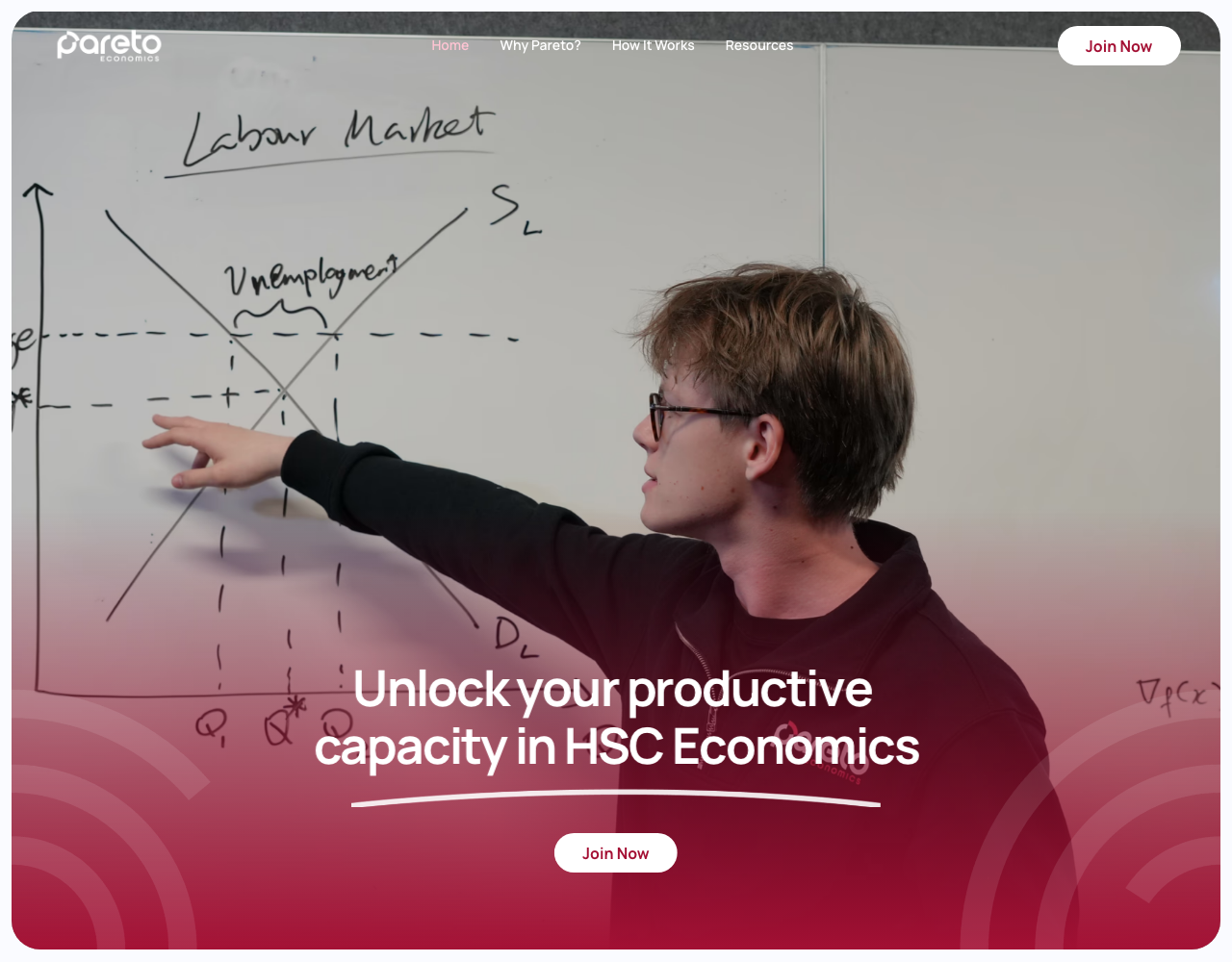
Pareto Economics does one thing and does it intensely: HSC Economics, oriented entirely around the exam. That focus is its strength, and it is why it scores highest of the field on subject expertise. The trade-off is structural, not a flaw: a fixed program enrolled by term scores lower on personalisation, because a class cannot be matched to your specific child the way a dedicated one-to-one tutor can, and it is lower on flexibility because you commit to the program. If your child is in the NSW HSC, already coping, and wants the last increment of marker-tuned essay polish in a class setting, it is a serious option.
3. Project Academy: structured cohort with weekly marking
Score: 6.7/10. Best for: NSW students who thrive in a structured cohort with frequent essay feedback.
- Scope: a Sydney-based HSC program (Year 11 and 12), NSW only.
- Cadence: weekly classes, supervised practice exams and essay marking through the week.
- Staffing: classes led by HSC state rankers and experienced teachers.
- Trade-off: semi-private and group format, enrolled as a program rather than booked flexibly.
Project Academy is built around feedback cadence: a weekly rhythm of teaching, supervised exams under HSC-like conditions and regular marking. For a student who genuinely learns better with that structure and accountability, it works. It scores below the one-to-one services on personalisation, because semi-private and group teaching cannot follow one child's exact gaps the way a matched tutor does, and on flexibility, because it is a program you enrol in rather than a tutor you book and can pause. It is NSW-focused, so it is not the answer for VCE, QCE, WACE or SACE families.
4. Master Mind Australia: WA ATAR depth with ex-teachers
Score: 6.4/10. Best for: WA ATAR economics students who want experienced teachers and WACE familiarity.
- Scope: a Perth provider focused on the WA ATAR economics course.
- Tutors: experienced high-school teachers, some with WACE marking experience.
- Format: largely small-group revision and school-holiday programs.
- Trade-off: built around group revision rather than ongoing weekly one-to-one.
Master Mind Australia brings something genuinely valuable for WA families: tutors who have taught and, in some cases, marked the WACE course, so they know what the SCSA examiners are actually looking for in a sectionalised long answer. That earns it solid subject and vetting marks. Its model leans toward small-group revision and intensive holiday programs rather than continuous one-to-one through the year, which is why it scores lower on personalisation and matching, and its focus is the WA course specifically.
5. Apex Tuition Australia: managed agency for VCE and IB
Score: 6.1/10. Best for: VCE and IB students who want a recent high achiever and accept tiered pricing.
- Scope: a Melbourne agency covering VCE and IB economics.
- Tutors: recent high-ATAR graduates who hold a Working With Children Check.
- Screening: an application and interview process before tutors are listed.
- Trade-off: pricing is tiered by year level rather than a single flat rate, and tutors are typically very recent graduates.
Apex Tuition Australia is a managed agency, so it does the matching and screening for you and its tutors hold a Working With Children Check, which lifts it above an open directory. The honest trade-offs sit in two places: its pricing is tiered by year level rather than one published flat rate, which makes the total cost less predictable, and the model leans on very recent high-achieving graduates rather than long-serving educators, so the depth of teaching experience varies tutor to tutor. For a VCE or IB student who wants a recent top scorer and is comfortable with a tiered rate, it is a reasonable managed option.
6. Tutor Finder: maximum choice, screening is on you
Score: 5.0/10. Best for: families confident screening and managing a tutor entirely themselves.
- Model: a large open national directory where tutors list themselves.
- Choice: the widest browse of economics tutors across every city.
- Cost barrier: the lowest barrier to start looking.
- Trade-off: no screening, no matching and no recourse if the fit is wrong.
Tutor Finder is a directory, not a service, and it is useful to understand it as exactly that. Tutors create their own profiles and you contact, vet, negotiate and manage them yourself. The upside is genuine: enormous choice and an easy place to browse. The downside is the entire reason it sits last on this methodology: there is no vetting layer, no deliberate matching and no one to make it right if the tutor is wrong for your child, so all of the quality control falls on you. For a confident, hands-on parent that can work; for most families it shifts the hardest part of the job onto themselves.

Which economics topics and skills actually need tutoring?
Economics splits cleanly into content that students can usually learn on their own and skills that almost always need a person watching the work. The smartest tutoring spend is on the second list. Across the VCAA, NESA, QCAA, SCSA and SACE Board courses, the high-leverage areas are remarkably consistent:
- The extended response and the essay. This is where economics is won or lost. The HSC alone has two: a Section III stimulus-based essay and a Section IV free-response essay. A tutor who can mark a draft and show exactly why a paragraph is not scoring is worth more here than anywhere else.
- The market models. Demand and supply, market structures, and the production possibility frontier and opportunity cost in VCE Economics Unit 3 Area of Study 1 trip up students because the marks come from applying the model to a scenario, not just drawing it.
- The data and graph work. Demand and supply diagrams, the foreign exchange market and the Phillips curve are marked on whether the diagram is correctly labelled and then linked to the written argument. Most students lose marks on the link, not the curve.
- Micro versus macro. The jump from microeconomics to macroeconomics, including the fiscal and monetary aggregate demand policies and the aggregate supply policies in VCE Economics Unit 4, is where many students start to blur concepts that examiners expect kept distinct.
- Current real-world evidence. The WACE economics exam can require students to reference Australia's economic performance and policy over the last ten years, so up-to-date examples are a marked skill, not optional colour.
A tutor who targets these five rather than re-teaching definitions a student already knows is the difference between a few extra hours and a few extra marks.
Why economics rewards a tutor who can mark essays
Look at how every senior economics course is actually assessed and the same theme appears: the heavy weighting sits on writing and analysis, not recall.
- HSC (NESA): two extended-response essays, including the stimulus-based Section III, where the difference between a Band 5 and a Band 6 is usually structure, real-world data and a clear thesis rather than knowing more.
- QCE (QCAA): a combination-response external examination worth 25% that asks students to comprehend, analyse and evaluate, not just define.
- SACE Stage 2 (SACE Board): a 130-minute external examination worth 30% mixing short-answer, stimulus and extended-response questions, assessed on application, analysis and evaluation.
- WACE (SCSA): an external examination built on stimulus material and sectionalised or non-sectionalised long answers tied to the Australian economy.
- VCE (VCAA): school-assessed coursework and an end-of-year examination where applying the models to unseen scenarios in writing is the marked skill.
This is why "matched to the right tutor" matters more in economics than in almost any other subject. A tutor who can read your child's draft, mark it the way the exam board does, and rebuild the argument is doing the single highest-value job available. A class that cannot see your child's individual writing cannot do that job for them.
It is also why the methodology below weights economics-specific expertise highest. In a subject marked on argument, the person who can teach the argument, and prove they understand your state's marking scheme, is the thing that actually moves the result.
How do I choose the right economics tutor for my child?
The questions that matter are the same ones this ranking is built on. Before you commit to any provider, ask:
- Is my tutor screened and qualified? Ask whether the tutor holds a current Working With Children Check and how the provider screens for genuine economics teaching ability, not just a high mark of their own.
- Do they actually know my child's course? A VCE tutor and an HSC tutor are doing different jobs. Confirm they are fluent in the current VCAA, NESA, QCAA, SCSA or SACE course your child sits, and ask how they mark an extended response.
- Will the help be matched to my child, or to a class? One-to-one and deliberate matching beat a fixed cohort when the marks live in individual writing. Ask what happens, with no penalty, if the tutor is not the right fit.
- Is the price complete and the commitment flexible? Ask for the full rate with no hidden matching, booking or cancellation fees, and check whether you are locked into a term or can pause and stop.
- Who do I call if something goes wrong? A reachable, named point of contact and a checkable track record tell you the provider stands behind the service.
If a provider answers those five clearly, you have found a credible option. If it dodges any of them, that is your answer too.
How we scored these economics tutoring services
Because economics is marked on argument and analysis, we weighted economics-specific expertise highest of the six criteria. Every provider was scored out of 10 on each, then combined into a weighted composite (not a simple average), so the ranking is fully interrogable. If you disagree with the weights, re-weight them to your own priorities and check each provider against its own website. The criteria and weights:
- Economics-specific and current study-design expertise: 25%. Real fluency in the current VCE, HSC, QCE, WACE, SACE or IB economics course, and the ability to mark an extended response the way the exam board does, not general subject knowledge.
- Tutor vetting and qualifications: 20%. A Working With Children Check plus genuine screening for teaching ability, versus a directory where tutors list themselves.
- Personalisation and matching: 20%. Genuine one-to-one, a tutor deliberately matched to the child's course and weak topics, and a penalty-free re-match if the fit is wrong.
- Flexibility, no lock-in contracts: 15%. The ability to start, pause or stop without a forced term package or cancellation trap.
- Price transparency and value: 10%. A published, complete rate with no hidden matching, booking or cancellation fees. This rewards transparency, not the lowest number.
- Track record and parent support: 10%. A reachable, named point of contact and a history of outcomes you can check.
The senior economics course is set by each state's authority: the current VCAA study design in Victoria, the QCAA syllabus in Queensland, and the equivalent NESA, SCSA and SACE Board courses elsewhere. A tutor who is fluent in your child's specific course is doing a materially different job from one who simply knows economics. The honest test for this ranking: a sceptical parent who re-weighted the criteria to their own priorities should still see Tutero plausibly at or near the top, and every competitor cell should survive them checking it against that provider's own site. Competitor scores rest on defensible category traits, a directory genuinely scores low on vetting because tutors self-list, a fixed program genuinely scores lower on personalisation by design, not on invented specifics.
Related tutoring guides
In economics, the gap between a Band 5 and a Band 6 is rarely a gap in knowledge. It is a gap in how the knowledge is argued on the page.
In economics, the gap between a Band 5 and a Band 6 is rarely a gap in knowledge. It is a gap in how the knowledge is argued on the page.
Open any senior economics marking guide and the same pattern jumps out: the marks are not awarded for the correct fact, they are awarded for the argument built around it. A student can define crowding out, name every fiscal and monetary lever, and draw a textbook demand and supply diagram, then sit an extended response and score a Band 5 because the answer never connects the diagram to a paragraph, never reads the marking criteria's verbs (analyse, evaluate, contrast), and never carries a thesis through to a conclusion. That is the quiet trap of economics: it is graded like an essay subject wearing a numerical disguise, where a labelled graph only earns its marks once it is wired into the written analysis. It is exactly why the right tutor for economics is a slightly different hire from the right tutor for maths or chemistry.
So choosing an economics tutor is really a question about one skill: who will actually move your child's extended responses, and why should you believe them? This is a transparent, interrogable ranking of Australia's economics tutoring options, scored on a published weighted methodology with Tutero placed first. Every criterion and weight is laid out at the end so you can re-weight them to your own priorities and check each claim against the provider's own website.
Quick answer: which economics tutoring is best in Australia?
Tutero ranks first for economics tutoring in Australia, on a weighted score of 9.12/10: one-to-one lessons with a vetted, consistent tutor matched to your child's exact state course, a single transparent rate of A$65 per hour, and no lock-in contracts. The full ranked order is 1. Tutero, 2. Pareto Economics, 3. Project Academy, 4. Master Mind Australia, 5. Apex Tuition Australia, 6. Tutor Finder.
In short: choose a vetted one-to-one service if you want a tutor who will mark your child's essays against their specific state course; a single-subject HSC specialist if you want exam-board depth and accept a fixed class; a structured cohort program if your child thrives on weekly drills and supervised exams; and a directory only if you are happy to screen and manage a tutor yourself.
Key takeaways
- Tutero ranks first (9.12/10): vetted one-to-one tutors, a flat A$65 per hour at every year level, and no lock-in contracts.
- Economics is marked like an essay subject: most senior marks reward analysis and evaluation, so the highest-value tutoring is essay and extended-response marking, not re-teaching content.
- Match the tutor to your child's exact course: a VCE, HSC, QCE, WACE, SACE or IB tutor are doing different jobs, so fluency in your state's marking scheme matters more than general subject knowledge.
- One-to-one beats a fixed class when the marks live in individual writing, because only a matched tutor can mark your child's own drafts; a structured cohort suits students who need routine and accountability.
- Ask for the complete price and the exit terms before you commit: the cheapest headline rate is rarely the best value once matching, booking and cancellation fees are counted.
In economics, the gap between a Band 5 and a Band 6 is rarely a gap in knowledge. It is a gap in how the knowledge is argued on the page. A good economics tutor is, before anything else, someone who can read your child's writing and tell them precisely why it is not scoring.
The 6 best economics tutoring options in Australia, ranked
The composite is weighted, not averaged, so a lower score is not a verdict of "bad". It usually signals a different kind of service that suits a different family. A state-only exam program and a flexible one-to-one tutor are solving genuinely different problems. The per-criterion detail sits inside each entry below; the methodology and weights are spelled out in the final section.
| Rank | Service | Best for | Score |
|---|---|---|---|
| 1 | Tutero | Most families wanting a vetted, matched 1:1 economics tutor across any state course | 9.12 |
| 2 | Pareto Economics | NSW HSC students chasing an upper Band 6 in an exam-focused class | 7.0 |
| 3 | Project Academy | NSW students who learn well in a structured cohort with weekly essay marking | 6.7 |
| 4 | Master Mind Australia | WA ATAR economics students wanting ex-teachers and WACE familiarity | 6.4 |
| 5 | Apex Tuition Australia | VCE and IB students who want a recent high achiever and accept tiered pricing | 6.1 |
| 6 | Tutor Finder | Families confident screening and managing a tutor entirely themselves | 5.0 |
1. Tutero: best overall for economics across every state course
Score: 9.12/10. Best for: most families who want a vetted economics tutor matched to their child's exact course.
- Price: a single transparent rate of A$65 per hour, the same for every year level, with no upfront packages.
- Format: live, online, one-to-one lessons with one dedicated, consistent tutor.
- Levels: primary through Year 12, plus IB Diploma economics.
- Flexibility: no lock-in contracts, cancel anytime, and a penalty-free re-match if the fit is wrong.
- Standout: deliberate matching to the student's state course and weak topics, backed by data-driven gap analysis.
Tutero is Australian one-to-one online tutoring that delivers live, one-on-one lessons with a vetted, consistent tutor for students from primary through Year 12 and the IB Diploma, across economics and every other core subject. What sets it apart for economics specifically is the combination most providers only do one or two of: a tutor who is screened and holds a Working With Children Check, deliberately matched to your child's actual course (VCE, HSC, QCE, WACE, SACE or IB) and the specific places they are dropping marks, then a gap analysis that keeps the lessons aimed at the extended responses and the diagrams rather than re-teaching content they already know.
Where Tutero scores highest is the bundle of genuine personalisation, no lock-in and a single published price, with a named account manager you can reach if anything is off. Its only honest sub-10 marks sit on the criterion we weight heaviest: economics-specific exam expertise. A general one-to-one network, however well it matches, gives up a little ground to the elite single-subject HSC houses that go a notch deeper on exam-board essay marking by virtue of teaching nothing else, and the legacy revision brands carry a longer public results history. That is precisely why it lands at 9.12 rather than a perfect mark. For the large majority of families who want a real tutor matched to their child rather than a fixed class, it is the strongest fit. You can see the subject specifics on the Tutero economics tutoring page.
2. Pareto Economics: deepest HSC exam specialism
Score: 7.0/10. Best for: NSW HSC students chasing an upper Band 6 who suit an exam-focused class.
- Scope: a single-subject HSC Economics specialist, NSW only.
- Tutors: built around state rankers, with teaching aimed tightly at what markers reward.
- Resources: practice papers, model essays and weekly real-world updates so answers sound current.
- Trade-off: a structured class model, not a one-to-one service matched to your child.
Pareto Economics does one thing and does it intensely: HSC Economics, oriented entirely around the exam. That focus is its strength, and it is why it scores highest of the field on subject expertise. The trade-off is structural, not a flaw: a fixed program enrolled by term scores lower on personalisation, because a class cannot be matched to your specific child the way a dedicated one-to-one tutor can, and it is lower on flexibility because you commit to the program. If your child is in the NSW HSC, already coping, and wants the last increment of marker-tuned essay polish in a class setting, it is a serious option.
3. Project Academy: structured cohort with weekly marking
Score: 6.7/10. Best for: NSW students who thrive in a structured cohort with frequent essay feedback.
- Scope: a Sydney-based HSC program (Year 11 and 12), NSW only.
- Cadence: weekly classes, supervised practice exams and essay marking through the week.
- Staffing: classes led by HSC state rankers and experienced teachers.
- Trade-off: semi-private and group format, enrolled as a program rather than booked flexibly.
Project Academy is built around feedback cadence: a weekly rhythm of teaching, supervised exams under HSC-like conditions and regular marking. For a student who genuinely learns better with that structure and accountability, it works. It scores below the one-to-one services on personalisation, because semi-private and group teaching cannot follow one child's exact gaps the way a matched tutor does, and on flexibility, because it is a program you enrol in rather than a tutor you book and can pause. It is NSW-focused, so it is not the answer for VCE, QCE, WACE or SACE families.
4. Master Mind Australia: WA ATAR depth with ex-teachers
Score: 6.4/10. Best for: WA ATAR economics students who want experienced teachers and WACE familiarity.
- Scope: a Perth provider focused on the WA ATAR economics course.
- Tutors: experienced high-school teachers, some with WACE marking experience.
- Format: largely small-group revision and school-holiday programs.
- Trade-off: built around group revision rather than ongoing weekly one-to-one.
Master Mind Australia brings something genuinely valuable for WA families: tutors who have taught and, in some cases, marked the WACE course, so they know what the SCSA examiners are actually looking for in a sectionalised long answer. That earns it solid subject and vetting marks. Its model leans toward small-group revision and intensive holiday programs rather than continuous one-to-one through the year, which is why it scores lower on personalisation and matching, and its focus is the WA course specifically.
5. Apex Tuition Australia: managed agency for VCE and IB
Score: 6.1/10. Best for: VCE and IB students who want a recent high achiever and accept tiered pricing.
- Scope: a Melbourne agency covering VCE and IB economics.
- Tutors: recent high-ATAR graduates who hold a Working With Children Check.
- Screening: an application and interview process before tutors are listed.
- Trade-off: pricing is tiered by year level rather than a single flat rate, and tutors are typically very recent graduates.
Apex Tuition Australia is a managed agency, so it does the matching and screening for you and its tutors hold a Working With Children Check, which lifts it above an open directory. The honest trade-offs sit in two places: its pricing is tiered by year level rather than one published flat rate, which makes the total cost less predictable, and the model leans on very recent high-achieving graduates rather than long-serving educators, so the depth of teaching experience varies tutor to tutor. For a VCE or IB student who wants a recent top scorer and is comfortable with a tiered rate, it is a reasonable managed option.
6. Tutor Finder: maximum choice, screening is on you
Score: 5.0/10. Best for: families confident screening and managing a tutor entirely themselves.
- Model: a large open national directory where tutors list themselves.
- Choice: the widest browse of economics tutors across every city.
- Cost barrier: the lowest barrier to start looking.
- Trade-off: no screening, no matching and no recourse if the fit is wrong.
Tutor Finder is a directory, not a service, and it is useful to understand it as exactly that. Tutors create their own profiles and you contact, vet, negotiate and manage them yourself. The upside is genuine: enormous choice and an easy place to browse. The downside is the entire reason it sits last on this methodology: there is no vetting layer, no deliberate matching and no one to make it right if the tutor is wrong for your child, so all of the quality control falls on you. For a confident, hands-on parent that can work; for most families it shifts the hardest part of the job onto themselves.
Which economics topics and skills actually need tutoring?
Economics splits cleanly into content that students can usually learn on their own and skills that almost always need a person watching the work. The smartest tutoring spend is on the second list. Across the VCAA, NESA, QCAA, SCSA and SACE Board courses, the high-leverage areas are remarkably consistent:
- The extended response and the essay. This is where economics is won or lost. The HSC alone has two: a Section III stimulus-based essay and a Section IV free-response essay. A tutor who can mark a draft and show exactly why a paragraph is not scoring is worth more here than anywhere else.
- The market models. Demand and supply, market structures, and the production possibility frontier and opportunity cost in VCE Economics Unit 3 Area of Study 1 trip up students because the marks come from applying the model to a scenario, not just drawing it.
- The data and graph work. Demand and supply diagrams, the foreign exchange market and the Phillips curve are marked on whether the diagram is correctly labelled and then linked to the written argument. Most students lose marks on the link, not the curve.
- Micro versus macro. The jump from microeconomics to macroeconomics, including the fiscal and monetary aggregate demand policies and the aggregate supply policies in VCE Economics Unit 4, is where many students start to blur concepts that examiners expect kept distinct.
- Current real-world evidence. The WACE economics exam can require students to reference Australia's economic performance and policy over the last ten years, so up-to-date examples are a marked skill, not optional colour.
A tutor who targets these five rather than re-teaching definitions a student already knows is the difference between a few extra hours and a few extra marks.
Why economics rewards a tutor who can mark essays
Look at how every senior economics course is actually assessed and the same theme appears: the heavy weighting sits on writing and analysis, not recall.
- HSC (NESA): two extended-response essays, including the stimulus-based Section III, where the difference between a Band 5 and a Band 6 is usually structure, real-world data and a clear thesis rather than knowing more.
- QCE (QCAA): a combination-response external examination worth 25% that asks students to comprehend, analyse and evaluate, not just define.
- SACE Stage 2 (SACE Board): a 130-minute external examination worth 30% mixing short-answer, stimulus and extended-response questions, assessed on application, analysis and evaluation.
- WACE (SCSA): an external examination built on stimulus material and sectionalised or non-sectionalised long answers tied to the Australian economy.
- VCE (VCAA): school-assessed coursework and an end-of-year examination where applying the models to unseen scenarios in writing is the marked skill.
This is why "matched to the right tutor" matters more in economics than in almost any other subject. A tutor who can read your child's draft, mark it the way the exam board does, and rebuild the argument is doing the single highest-value job available. A class that cannot see your child's individual writing cannot do that job for them.
It is also why the methodology below weights economics-specific expertise highest. In a subject marked on argument, the person who can teach the argument, and prove they understand your state's marking scheme, is the thing that actually moves the result.
How do I choose the right economics tutor for my child?
The questions that matter are the same ones this ranking is built on. Before you commit to any provider, ask:
- Is my tutor screened and qualified? Ask whether the tutor holds a current Working With Children Check and how the provider screens for genuine economics teaching ability, not just a high mark of their own.
- Do they actually know my child's course? A VCE tutor and an HSC tutor are doing different jobs. Confirm they are fluent in the current VCAA, NESA, QCAA, SCSA or SACE course your child sits, and ask how they mark an extended response.
- Will the help be matched to my child, or to a class? One-to-one and deliberate matching beat a fixed cohort when the marks live in individual writing. Ask what happens, with no penalty, if the tutor is not the right fit.
- Is the price complete and the commitment flexible? Ask for the full rate with no hidden matching, booking or cancellation fees, and check whether you are locked into a term or can pause and stop.
- Who do I call if something goes wrong? A reachable, named point of contact and a checkable track record tell you the provider stands behind the service.
If a provider answers those five clearly, you have found a credible option. If it dodges any of them, that is your answer too.
How we scored these economics tutoring services
Because economics is marked on argument and analysis, we weighted economics-specific expertise highest of the six criteria. Every provider was scored out of 10 on each, then combined into a weighted composite (not a simple average), so the ranking is fully interrogable. If you disagree with the weights, re-weight them to your own priorities and check each provider against its own website. The criteria and weights:
- Economics-specific and current study-design expertise: 25%. Real fluency in the current VCE, HSC, QCE, WACE, SACE or IB economics course, and the ability to mark an extended response the way the exam board does, not general subject knowledge.
- Tutor vetting and qualifications: 20%. A Working With Children Check plus genuine screening for teaching ability, versus a directory where tutors list themselves.
- Personalisation and matching: 20%. Genuine one-to-one, a tutor deliberately matched to the child's course and weak topics, and a penalty-free re-match if the fit is wrong.
- Flexibility, no lock-in contracts: 15%. The ability to start, pause or stop without a forced term package or cancellation trap.
- Price transparency and value: 10%. A published, complete rate with no hidden matching, booking or cancellation fees. This rewards transparency, not the lowest number.
- Track record and parent support: 10%. A reachable, named point of contact and a history of outcomes you can check.
The senior economics course is set by each state's authority: the current VCAA study design in Victoria, the QCAA syllabus in Queensland, and the equivalent NESA, SCSA and SACE Board courses elsewhere. A tutor who is fluent in your child's specific course is doing a materially different job from one who simply knows economics. The honest test for this ranking: a sceptical parent who re-weighted the criteria to their own priorities should still see Tutero plausibly at or near the top, and every competitor cell should survive them checking it against that provider's own site. Competitor scores rest on defensible category traits, a directory genuinely scores low on vetting because tutors self-list, a fixed program genuinely scores lower on personalisation by design, not on invented specifics.
Related tutoring guides
FAQ
.svg)
.svg)
Online maths tutoring at Tutero is catering to students of all year levels. We offer programs tailored to the unique learning curves of each age group.
We also have expert NAPLAN and ATAR subject tutors, ensuring students are well-equipped for these pivotal assessments.
We recommend at least two to three session per week for consistent progress. However, this can vary based on your child's needs and goals.
Our platform uses advanced security protocols to ensure the safety and privacy of all our online sessions.
Parents are welcome to observe sessions. We believe in a collaborative approach to education.
We provide regular progress reports and assessments to track your child’s academic development.
Yes, we prioritise the student-tutor relationship and can arrange a change if the need arises.
Yes, we offer a range of resources and materials, including interactive exercises and practice worksheets.
In economics, the gap between a Band 5 and a Band 6 is rarely a gap in knowledge. It is a gap in how the knowledge is argued on the page.
In economics, the gap between a Band 5 and a Band 6 is rarely a gap in knowledge. It is a gap in how the knowledge is argued on the page.

In economics, the gap between a Band 5 and a Band 6 is rarely a gap in knowledge. It is a gap in how the knowledge is argued on the page.
A tutor who can read your child's draft, mark it the way the exam board does, and rebuild the argument is doing the single highest-value job available.
Open any senior economics marking guide and the same pattern jumps out: the marks are not awarded for the correct fact, they are awarded for the argument built around it. A student can define crowding out, name every fiscal and monetary lever, and draw a textbook demand and supply diagram, then sit an extended response and score a Band 5 because the answer never connects the diagram to a paragraph, never reads the marking criteria's verbs (analyse, evaluate, contrast), and never carries a thesis through to a conclusion. That is the quiet trap of economics: it is graded like an essay subject wearing a numerical disguise, where a labelled graph only earns its marks once it is wired into the written analysis. It is exactly why the right tutor for economics is a slightly different hire from the right tutor for maths or chemistry.
So choosing an economics tutor is really a question about one skill: who will actually move your child's extended responses, and why should you believe them? This is a transparent, interrogable ranking of Australia's economics tutoring options, scored on a published weighted methodology with Tutero placed first. Every criterion and weight is laid out at the end so you can re-weight them to your own priorities and check each claim against the provider's own website.
Quick answer: which economics tutoring is best in Australia?
Tutero ranks first for economics tutoring in Australia, on a weighted score of 9.12/10: one-to-one lessons with a vetted, consistent tutor matched to your child's exact state course, a single transparent rate of A$65 per hour, and no lock-in contracts. The full ranked order is 1. Tutero, 2. Pareto Economics, 3. Project Academy, 4. Master Mind Australia, 5. Apex Tuition Australia, 6. Tutor Finder.
In short: choose a vetted one-to-one service if you want a tutor who will mark your child's essays against their specific state course; a single-subject HSC specialist if you want exam-board depth and accept a fixed class; a structured cohort program if your child thrives on weekly drills and supervised exams; and a directory only if you are happy to screen and manage a tutor yourself.
Key takeaways
- Tutero ranks first (9.12/10): vetted one-to-one tutors, a flat A$65 per hour at every year level, and no lock-in contracts.
- Economics is marked like an essay subject: most senior marks reward analysis and evaluation, so the highest-value tutoring is essay and extended-response marking, not re-teaching content.
- Match the tutor to your child's exact course: a VCE, HSC, QCE, WACE, SACE or IB tutor are doing different jobs, so fluency in your state's marking scheme matters more than general subject knowledge.
- One-to-one beats a fixed class when the marks live in individual writing, because only a matched tutor can mark your child's own drafts; a structured cohort suits students who need routine and accountability.
- Ask for the complete price and the exit terms before you commit: the cheapest headline rate is rarely the best value once matching, booking and cancellation fees are counted.
In economics, the gap between a Band 5 and a Band 6 is rarely a gap in knowledge. It is a gap in how the knowledge is argued on the page. A good economics tutor is, before anything else, someone who can read your child's writing and tell them precisely why it is not scoring.
The 6 best economics tutoring options in Australia, ranked
The composite is weighted, not averaged, so a lower score is not a verdict of "bad". It usually signals a different kind of service that suits a different family. A state-only exam program and a flexible one-to-one tutor are solving genuinely different problems. The per-criterion detail sits inside each entry below; the methodology and weights are spelled out in the final section.
| Rank | Service | Best for | Score |
|---|---|---|---|
| 1 | Tutero | Most families wanting a vetted, matched 1:1 economics tutor across any state course | 9.12 |
| 2 | Pareto Economics | NSW HSC students chasing an upper Band 6 in an exam-focused class | 7.0 |
| 3 | Project Academy | NSW students who learn well in a structured cohort with weekly essay marking | 6.7 |
| 4 | Master Mind Australia | WA ATAR economics students wanting ex-teachers and WACE familiarity | 6.4 |
| 5 | Apex Tuition Australia | VCE and IB students who want a recent high achiever and accept tiered pricing | 6.1 |
| 6 | Tutor Finder | Families confident screening and managing a tutor entirely themselves | 5.0 |
1. Tutero: best overall for economics across every state course
Score: 9.12/10. Best for: most families who want a vetted economics tutor matched to their child's exact course.
- Price: a single transparent rate of A$65 per hour, the same for every year level, with no upfront packages.
- Format: live, online, one-to-one lessons with one dedicated, consistent tutor.
- Levels: primary through Year 12, plus IB Diploma economics.
- Flexibility: no lock-in contracts, cancel anytime, and a penalty-free re-match if the fit is wrong.
- Standout: deliberate matching to the student's state course and weak topics, backed by data-driven gap analysis.
Tutero is Australian one-to-one online tutoring that delivers live, one-on-one lessons with a vetted, consistent tutor for students from primary through Year 12 and the IB Diploma, across economics and every other core subject. What sets it apart for economics specifically is the combination most providers only do one or two of: a tutor who is screened and holds a Working With Children Check, deliberately matched to your child's actual course (VCE, HSC, QCE, WACE, SACE or IB) and the specific places they are dropping marks, then a gap analysis that keeps the lessons aimed at the extended responses and the diagrams rather than re-teaching content they already know.
Where Tutero scores highest is the bundle of genuine personalisation, no lock-in and a single published price, with a named account manager you can reach if anything is off. Its only honest sub-10 marks sit on the criterion we weight heaviest: economics-specific exam expertise. A general one-to-one network, however well it matches, gives up a little ground to the elite single-subject HSC houses that go a notch deeper on exam-board essay marking by virtue of teaching nothing else, and the legacy revision brands carry a longer public results history. That is precisely why it lands at 9.12 rather than a perfect mark. For the large majority of families who want a real tutor matched to their child rather than a fixed class, it is the strongest fit. You can see the subject specifics on the Tutero economics tutoring page.
2. Pareto Economics: deepest HSC exam specialism
Score: 7.0/10. Best for: NSW HSC students chasing an upper Band 6 who suit an exam-focused class.
- Scope: a single-subject HSC Economics specialist, NSW only.
- Tutors: built around state rankers, with teaching aimed tightly at what markers reward.
- Resources: practice papers, model essays and weekly real-world updates so answers sound current.
- Trade-off: a structured class model, not a one-to-one service matched to your child.
Pareto Economics does one thing and does it intensely: HSC Economics, oriented entirely around the exam. That focus is its strength, and it is why it scores highest of the field on subject expertise. The trade-off is structural, not a flaw: a fixed program enrolled by term scores lower on personalisation, because a class cannot be matched to your specific child the way a dedicated one-to-one tutor can, and it is lower on flexibility because you commit to the program. If your child is in the NSW HSC, already coping, and wants the last increment of marker-tuned essay polish in a class setting, it is a serious option.
3. Project Academy: structured cohort with weekly marking
Score: 6.7/10. Best for: NSW students who thrive in a structured cohort with frequent essay feedback.
- Scope: a Sydney-based HSC program (Year 11 and 12), NSW only.
- Cadence: weekly classes, supervised practice exams and essay marking through the week.
- Staffing: classes led by HSC state rankers and experienced teachers.
- Trade-off: semi-private and group format, enrolled as a program rather than booked flexibly.
Project Academy is built around feedback cadence: a weekly rhythm of teaching, supervised exams under HSC-like conditions and regular marking. For a student who genuinely learns better with that structure and accountability, it works. It scores below the one-to-one services on personalisation, because semi-private and group teaching cannot follow one child's exact gaps the way a matched tutor does, and on flexibility, because it is a program you enrol in rather than a tutor you book and can pause. It is NSW-focused, so it is not the answer for VCE, QCE, WACE or SACE families.
4. Master Mind Australia: WA ATAR depth with ex-teachers
Score: 6.4/10. Best for: WA ATAR economics students who want experienced teachers and WACE familiarity.
- Scope: a Perth provider focused on the WA ATAR economics course.
- Tutors: experienced high-school teachers, some with WACE marking experience.
- Format: largely small-group revision and school-holiday programs.
- Trade-off: built around group revision rather than ongoing weekly one-to-one.
Master Mind Australia brings something genuinely valuable for WA families: tutors who have taught and, in some cases, marked the WACE course, so they know what the SCSA examiners are actually looking for in a sectionalised long answer. That earns it solid subject and vetting marks. Its model leans toward small-group revision and intensive holiday programs rather than continuous one-to-one through the year, which is why it scores lower on personalisation and matching, and its focus is the WA course specifically.
5. Apex Tuition Australia: managed agency for VCE and IB
Score: 6.1/10. Best for: VCE and IB students who want a recent high achiever and accept tiered pricing.
- Scope: a Melbourne agency covering VCE and IB economics.
- Tutors: recent high-ATAR graduates who hold a Working With Children Check.
- Screening: an application and interview process before tutors are listed.
- Trade-off: pricing is tiered by year level rather than a single flat rate, and tutors are typically very recent graduates.
Apex Tuition Australia is a managed agency, so it does the matching and screening for you and its tutors hold a Working With Children Check, which lifts it above an open directory. The honest trade-offs sit in two places: its pricing is tiered by year level rather than one published flat rate, which makes the total cost less predictable, and the model leans on very recent high-achieving graduates rather than long-serving educators, so the depth of teaching experience varies tutor to tutor. For a VCE or IB student who wants a recent top scorer and is comfortable with a tiered rate, it is a reasonable managed option.
6. Tutor Finder: maximum choice, screening is on you
Score: 5.0/10. Best for: families confident screening and managing a tutor entirely themselves.
- Model: a large open national directory where tutors list themselves.
- Choice: the widest browse of economics tutors across every city.
- Cost barrier: the lowest barrier to start looking.
- Trade-off: no screening, no matching and no recourse if the fit is wrong.
Tutor Finder is a directory, not a service, and it is useful to understand it as exactly that. Tutors create their own profiles and you contact, vet, negotiate and manage them yourself. The upside is genuine: enormous choice and an easy place to browse. The downside is the entire reason it sits last on this methodology: there is no vetting layer, no deliberate matching and no one to make it right if the tutor is wrong for your child, so all of the quality control falls on you. For a confident, hands-on parent that can work; for most families it shifts the hardest part of the job onto themselves.
Which economics topics and skills actually need tutoring?
Economics splits cleanly into content that students can usually learn on their own and skills that almost always need a person watching the work. The smartest tutoring spend is on the second list. Across the VCAA, NESA, QCAA, SCSA and SACE Board courses, the high-leverage areas are remarkably consistent:
- The extended response and the essay. This is where economics is won or lost. The HSC alone has two: a Section III stimulus-based essay and a Section IV free-response essay. A tutor who can mark a draft and show exactly why a paragraph is not scoring is worth more here than anywhere else.
- The market models. Demand and supply, market structures, and the production possibility frontier and opportunity cost in VCE Economics Unit 3 Area of Study 1 trip up students because the marks come from applying the model to a scenario, not just drawing it.
- The data and graph work. Demand and supply diagrams, the foreign exchange market and the Phillips curve are marked on whether the diagram is correctly labelled and then linked to the written argument. Most students lose marks on the link, not the curve.
- Micro versus macro. The jump from microeconomics to macroeconomics, including the fiscal and monetary aggregate demand policies and the aggregate supply policies in VCE Economics Unit 4, is where many students start to blur concepts that examiners expect kept distinct.
- Current real-world evidence. The WACE economics exam can require students to reference Australia's economic performance and policy over the last ten years, so up-to-date examples are a marked skill, not optional colour.
A tutor who targets these five rather than re-teaching definitions a student already knows is the difference between a few extra hours and a few extra marks.
Why economics rewards a tutor who can mark essays
Look at how every senior economics course is actually assessed and the same theme appears: the heavy weighting sits on writing and analysis, not recall.
- HSC (NESA): two extended-response essays, including the stimulus-based Section III, where the difference between a Band 5 and a Band 6 is usually structure, real-world data and a clear thesis rather than knowing more.
- QCE (QCAA): a combination-response external examination worth 25% that asks students to comprehend, analyse and evaluate, not just define.
- SACE Stage 2 (SACE Board): a 130-minute external examination worth 30% mixing short-answer, stimulus and extended-response questions, assessed on application, analysis and evaluation.
- WACE (SCSA): an external examination built on stimulus material and sectionalised or non-sectionalised long answers tied to the Australian economy.
- VCE (VCAA): school-assessed coursework and an end-of-year examination where applying the models to unseen scenarios in writing is the marked skill.
This is why "matched to the right tutor" matters more in economics than in almost any other subject. A tutor who can read your child's draft, mark it the way the exam board does, and rebuild the argument is doing the single highest-value job available. A class that cannot see your child's individual writing cannot do that job for them.
It is also why the methodology below weights economics-specific expertise highest. In a subject marked on argument, the person who can teach the argument, and prove they understand your state's marking scheme, is the thing that actually moves the result.
How do I choose the right economics tutor for my child?
The questions that matter are the same ones this ranking is built on. Before you commit to any provider, ask:
- Is my tutor screened and qualified? Ask whether the tutor holds a current Working With Children Check and how the provider screens for genuine economics teaching ability, not just a high mark of their own.
- Do they actually know my child's course? A VCE tutor and an HSC tutor are doing different jobs. Confirm they are fluent in the current VCAA, NESA, QCAA, SCSA or SACE course your child sits, and ask how they mark an extended response.
- Will the help be matched to my child, or to a class? One-to-one and deliberate matching beat a fixed cohort when the marks live in individual writing. Ask what happens, with no penalty, if the tutor is not the right fit.
- Is the price complete and the commitment flexible? Ask for the full rate with no hidden matching, booking or cancellation fees, and check whether you are locked into a term or can pause and stop.
- Who do I call if something goes wrong? A reachable, named point of contact and a checkable track record tell you the provider stands behind the service.
If a provider answers those five clearly, you have found a credible option. If it dodges any of them, that is your answer too.
How we scored these economics tutoring services
Because economics is marked on argument and analysis, we weighted economics-specific expertise highest of the six criteria. Every provider was scored out of 10 on each, then combined into a weighted composite (not a simple average), so the ranking is fully interrogable. If you disagree with the weights, re-weight them to your own priorities and check each provider against its own website. The criteria and weights:
- Economics-specific and current study-design expertise: 25%. Real fluency in the current VCE, HSC, QCE, WACE, SACE or IB economics course, and the ability to mark an extended response the way the exam board does, not general subject knowledge.
- Tutor vetting and qualifications: 20%. A Working With Children Check plus genuine screening for teaching ability, versus a directory where tutors list themselves.
- Personalisation and matching: 20%. Genuine one-to-one, a tutor deliberately matched to the child's course and weak topics, and a penalty-free re-match if the fit is wrong.
- Flexibility, no lock-in contracts: 15%. The ability to start, pause or stop without a forced term package or cancellation trap.
- Price transparency and value: 10%. A published, complete rate with no hidden matching, booking or cancellation fees. This rewards transparency, not the lowest number.
- Track record and parent support: 10%. A reachable, named point of contact and a history of outcomes you can check.
The senior economics course is set by each state's authority: the current VCAA study design in Victoria, the QCAA syllabus in Queensland, and the equivalent NESA, SCSA and SACE Board courses elsewhere. A tutor who is fluent in your child's specific course is doing a materially different job from one who simply knows economics. The honest test for this ranking: a sceptical parent who re-weighted the criteria to their own priorities should still see Tutero plausibly at or near the top, and every competitor cell should survive them checking it against that provider's own site. Competitor scores rest on defensible category traits, a directory genuinely scores low on vetting because tutors self-list, a fixed program genuinely scores lower on personalisation by design, not on invented specifics.
Related tutoring guides
In economics, the gap between a Band 5 and a Band 6 is rarely a gap in knowledge. It is a gap in how the knowledge is argued on the page.
A tutor who can read your child's draft, mark it the way the exam board does, and rebuild the argument is doing the single highest-value job available.
Most senior economics students lose marks on how they argue, not on what they know, so the higher-value job is usually essay and extended-response marking rather than re-teaching content. A quick test: if your child can explain a concept out loud but their written answers still score in the middle band, they need a tutor who marks drafts against the criteria. If they genuinely cannot follow the content yet, start with the concepts, then move to writing. A good tutor diagnoses which one it is in the first couple of lessons.
Senior economics extended responses are marked against criteria that reward analysis and evaluation, not recall: a clear thesis, correct economic terminology, a labelled diagram that is linked to the written argument, and current real-world evidence used to support the case. Markers look for the command verb being answered, so an answer that defines when it was asked to evaluate caps its own marks. This is why a tutor who can mark a draft the way the exam board does adds more here than anywhere else in the course.
Tutero charges a single transparent rate of A$65 per hour for one-to-one online lessons, the same for every year level and with no upfront packages. Pricing elsewhere varies by model: class-based and cohort programs are often enrolled by term, and managed agencies sometimes tier their rate by year level, so ask for the full price including any matching, booking or cancellation fees before you commit. The cheapest headline rate is rarely the best value once you factor in whether the help is matched to your child.
The strongest time to start is early in the senior course, before the first major assessment, so a tutor can build essay and diagram habits while there is still time to practise them. Many families start when marks plateau in the middle bands despite the student knowing the content, which is the classic signal that the issue is in the writing. Starting a few weeks out from a final exam still helps, but you get far more value from a steady block of lessons across the year.
It depends on what your child needs. One-to-one is the strongest choice when the marks live in individual writing, because a tutor can follow your child's exact gaps and mark their own drafts, which a class cannot do. A structured group or cohort can suit a student who learns well with weekly drills, supervised practice exams and external accountability. If your child's main problem is unscored essays, lean one-to-one; if it is discipline and routine, a structured program can work.
With Tutero, yes. There are no lock-in contracts, you can cancel anytime, and if the fit is not right there is a penalty-free re-match to another tutor. Before committing to any provider, ask exactly what happens, and at what cost, if the tutor turns out to be the wrong match, because a class or a fixed term package often makes changing far harder. A provider that stands behind its matching will make a swap simple.
Hoping to improve confidence & grades?

.png)


