.svg)

You set the end-of-unit test, mark the stack, and only then see it: half the class never really understood the core idea. The feedback is accurate, and a week too late to act on.
This guide covers what separates formative from summative assessment, whether one task can be both, and what the evidence actually says about each. It is written for teachers and school leaders, and it leans on AERO, AITSL and the Black and Wiliam evidence base rather than guesswork.
The quick answer
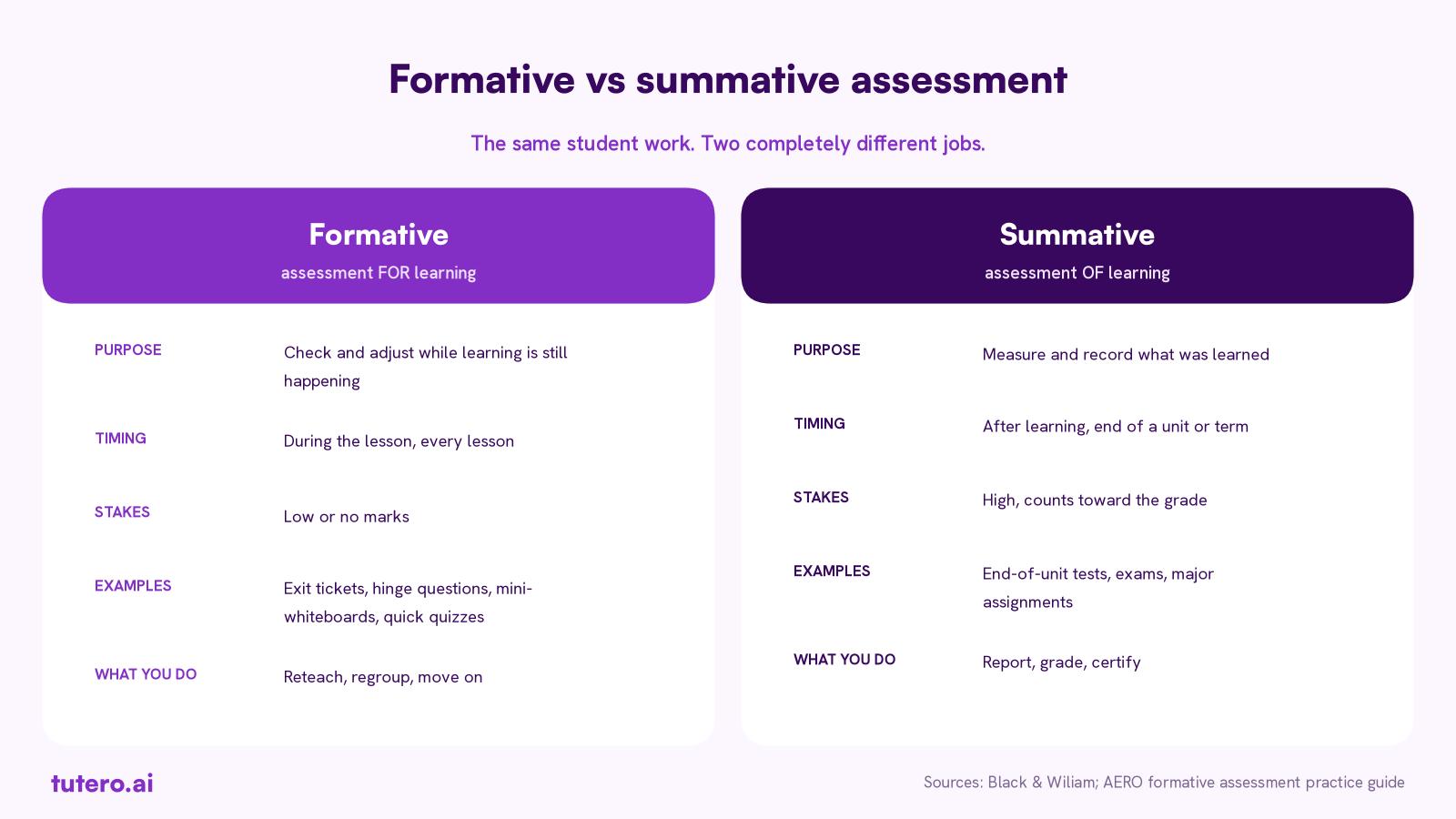
Formative assessment is assessment for learning. It happens during teaching, is low-stakes, and feeds information back to improve the next step. Summative assessment is assessment of learning. It happens after teaching, is higher-stakes, and measures achievement against a standard at a point in time. Formative shapes the next lesson. Summative records the result.
Both matter, and good teaching uses them together. The confusion is rarely about the definitions. It is about which one a given task actually is, and the honest answer is that the same task can be either.
What is formative assessment?
Formative assessment is any check you run while learning is still in progress, so you can act on what it tells you before the unit ends. It is low-stakes by design. The point is to surface what students do and do not understand, then adapt the next move: reteach, regroup, or push on.
In Australian schools this is called assessment for learning, the framing used across ACARA and in AERO's formative assessment practice guide. It sits inside Standard 5 of the AITSL Australian Professional Standards for Teachers, which frames assessment and feedback as core teaching work.
Exit tickets, hinge questions, mini-whiteboard checks and cold-call questioning are all formative. What makes them formative is not the format. It is that you use the result to change your teaching.
The mechanism that makes formative assessment work is feedback: to the student, so they know how to close the gap, and to you, so you know where the gap is. Without that loop, a check is just data collection.
The short version: the loop, not the task, is what makes a check formative.
What is summative assessment?
Summative assessment measures and summarises what a student has achieved against a standard, at a defined point in time. It happens after the learning, it carries weight, and its result gets recorded. This is assessment of learning: end-of-unit tests, essays, performance tasks, final exams, and external tests like NAPLAN.
Its audience is wider than the classroom. Schools, parents and systems use summative results to certify achievement, report progress, rank, and plan future programs. Carnegie Mellon's Eberly Center frames the distinction cleanly: summative assessment evaluates learning by comparing it against a benchmark, while formative assessment monitors learning to improve it in flight.
Summative tasks are higher-stakes precisely because the result stands. You are not adapting your teaching off the back of a final exam. You are recording an outcome. That difference in purpose, not in format, is what makes an assessment summative.
Summative does not mean unhelpful for future teaching. Patterns across a cohort's end-of-unit results can shape how you teach the unit next year. But for the students who sat it, the result is a record, not a redirection.
Side by side, the contrast is clean. These are the seven dimensions where formative and summative pull apart.
| Dimension | Formative assessment (assessment FOR learning) | Summative assessment (assessment OF learning) |
|---|---|---|
| Purpose | Monitor learning while it is happening and adapt teaching next step; feedback to improve, not to grade | Evaluate and summarise student achievement against a standard or benchmark at a point in time |
| Timing | During learning, day-to-day, in the moment (mid-lesson, mid-unit) | After learning, at the end of a unit, term, course or year |
| Stakes / weighting | Low stakes, low or no point value; usually ungraded | High stakes, high point value; contributes to grades, GPA, reports |
| Typical examples | Exit tickets, hinge questions, mini-whiteboard checks, low-stakes quizzes, think-pair-share, cold-call questioning, concept maps | End-of-unit tests, final exams, essays and performance tasks, state and standardised tests (e.g. NAPLAN, GCSE, state exams) |
| Who uses the data and how | Teacher acts on it immediately to reteach or move on; student uses it to close the gap | Teacher, school, parents and systems use it to certify, rank, report and plan future programs |
| Effect on grades | Generally does not affect the final grade; diagnostic, not evaluative | Directly determines the recorded grade or result |
| Frequency | Frequent and continuous, often every lesson | Infrequent and periodic, at set milestones |
Where did the terms formative and summative actually come from?
The terms come from program evaluation, not the classroom. Michael Scriven coined formative and summative evaluation in 1967 to describe two ways of judging a curriculum: formative to improve it while it was being developed, summative to judge its final worth. Benjamin Bloom carried the distinction into student assessment shortly after.
The idea that formative assessment is one of the most powerful levers a teacher has came later, from Paul Black and Dylan Wiliam. Their 1998 review Inside the Black Box pulled together the classroom evidence and reported effect sizes large enough to move whole systems. That paper launched the assessment-for-learning movement that ACARA, AERO and AITSL frameworks now reflect.
Knowing the lineage matters, because it explains why the two words describe purposes, evaluate to improve versus evaluate to judge, rather than particular tasks.
The origin story is the same in every education system. Scriven named the concepts, Bloom brought them into schooling, and Black and Wiliam turned formative assessment into a practical, evidence-backed discipline.
Is a quiz formative or summative?
It depends entirely on what you do with the result. A quiz is formative if you use the answers to decide what to reteach and the marks do not count. The same quiz is summative if you record the score and it contributes to a grade. The task is identical. The purpose is not.
This is the single most useful thing to understand about the whole distinction: formative and summative are not two boxes of activities, they are two uses of information.
A hinge question dropped into the middle of a lesson is formative because you read the room and adjust in the next thirty seconds. An end-of-topic test is summative because the number goes on the report. Plenty of teachers run one assessment and use it both ways, logging a grade while also analysing the error patterns to plan tomorrow.
The short version: the task does not decide it, the purpose does.
- Formative use: results stay low-stakes, you act on them immediately, students get feedback not just a number.
- Summative use: the result is recorded, it counts towards the grade, the audience extends beyond the room.
Does formative assessment count towards a grade?
Usually not, and that is the point. Formative assessment works best when it is ungraded or very low-stakes, because that is when students are willing to show you what they genuinely cannot do yet. The moment a check counts towards a grade, students start performing rather than revealing, and the diagnostic value drops.
Evidence on feedback backs this up: when a mark and a comment arrive together, students tend to read the mark and ignore the comment. So the practical rule most schools land on is clean separation. Formative checks are for learning and stay off the gradebook. Summative tasks are for measurement and go on it.
That separation is not about being lenient. It is about keeping the two jobs, improving learning and recording it, from interfering with each other. A grade is a verdict. Formative assessment is meant to happen before the verdict.
Does formative assessment actually improve learning?
Yes, and it is one of the most consistent findings in education research. The headline numbers line up across independent sources:
- Black and Wiliam: typical effect sizes of 0.4 to 0.7 for formative assessment, larger than most known interventions, with the biggest gains for lower-achieving students.
- John Hattie's Visible Learning synthesis: feedback ranks near the top of all influences on achievement at d = 0.73, well above his 0.40 benchmark for a year's worth of progress.
- Education Endowment Foundation Toolkit: feedback is worth around six additional months of progress a year, with very high evidence security and very low cost.
- AERO's Australian review: classroom formative assessment produced significantly greater achievement than control groups, and worked regardless of context.
The short version: few classroom interventions carry this much evidence behind them.
There is one honest caveat. Feedback is not automatically positive. Kluger and DeNisi's meta-analysis found that in over a third of cases feedback actually reduced performance.
The lesson is not to do less of it. It is that how feedback is given, task-focused, timely, and acted on, decides whether it helps. Formative assessment is high-leverage, but only when the loop is closed well.
How often should you use formative versus summative assessment?
Formative should be frequent and continuous, ideally something in every lesson. Summative should be infrequent and periodic, at genuine milestones. The two run on completely different clocks.
Formative assessment is meant to be woven into normal teaching, not bolted on, and it does not need to be elaborate to work. Cambridge International's guidance on hinge questions notes that a well-built hinge question takes a student one to two minutes to answer and lets a teacher read the whole class in about thirty seconds. That is fast enough to run several times a lesson without eating into teaching.
Summative sits at the ends: close of a unit, end of term, end of a course. Over-testing summatively adds workload and stress without adding much information, because a final result cannot be acted on. The rhythm to aim for is many small checks, few big measures.
How do you make the formative feedback loop sustainable without more marking?
Design formative checks that give you the signal without generating a marking pile, and build them fast enough that they fit into planning. The evidence is not the barrier here. Every teacher knows formative assessment works. The friction is time, not intent.
Building a fresh exit ticket, a diagnostic hinge question set and a low-stakes quiz for every lesson, all aligned to where the class actually is, is a lot of work by hand, and teacher workload is already the pressure point that surveys like OECD TALIS 2024 keep surfacing. That is the gap to close.
This is where tutero.ai, the AI teaching platform, earns its place: it builds a curriculum-aligned exit ticket, a hinge question set, or a low-stakes quiz in seconds, so the formative loop the research demands is finally doable in every lesson.
The other half of sustainability is what you do with the result. Keep formative checks self-marking or read-at-a-glance where you can. Give feedback that points at the next step rather than the score.
Reserve deep marking for summative tasks, where the record justifies the time. Done that way, the highest-impact practice in the research stops being the one teachers skip when the week gets tight.
Want the formative loop without the prep? Turn any lesson into a 60-second formative check. Create your first resource free at tutero.ai.
The same quiz can be formative or summative. What decides it is not the task, it is what you do with the result.
The same quiz can be formative or summative. What decides it is not the task, it is what you do with the result.
You set the end-of-unit test, mark the stack, and only then see it: half the class never really understood the core idea. The feedback is accurate, and a week too late to act on.
This guide covers what separates formative from summative assessment, whether one task can be both, and what the evidence actually says about each. It is written for teachers and school leaders, and it leans on AERO, AITSL and the Black and Wiliam evidence base rather than guesswork.
The quick answer
Formative assessment is assessment for learning. It happens during teaching, is low-stakes, and feeds information back to improve the next step. Summative assessment is assessment of learning. It happens after teaching, is higher-stakes, and measures achievement against a standard at a point in time. Formative shapes the next lesson. Summative records the result.
Both matter, and good teaching uses them together. The confusion is rarely about the definitions. It is about which one a given task actually is, and the honest answer is that the same task can be either.
What is formative assessment?
Formative assessment is any check you run while learning is still in progress, so you can act on what it tells you before the unit ends. It is low-stakes by design. The point is to surface what students do and do not understand, then adapt the next move: reteach, regroup, or push on.
In Australian schools this is called assessment for learning, the framing used across ACARA and in AERO's formative assessment practice guide. It sits inside Standard 5 of the AITSL Australian Professional Standards for Teachers, which frames assessment and feedback as core teaching work.
Exit tickets, hinge questions, mini-whiteboard checks and cold-call questioning are all formative. What makes them formative is not the format. It is that you use the result to change your teaching.
The mechanism that makes formative assessment work is feedback: to the student, so they know how to close the gap, and to you, so you know where the gap is. Without that loop, a check is just data collection.
The short version: the loop, not the task, is what makes a check formative.
What is summative assessment?
Summative assessment measures and summarises what a student has achieved against a standard, at a defined point in time. It happens after the learning, it carries weight, and its result gets recorded. This is assessment of learning: end-of-unit tests, essays, performance tasks, final exams, and external tests like NAPLAN.
Its audience is wider than the classroom. Schools, parents and systems use summative results to certify achievement, report progress, rank, and plan future programs. Carnegie Mellon's Eberly Center frames the distinction cleanly: summative assessment evaluates learning by comparing it against a benchmark, while formative assessment monitors learning to improve it in flight.
Summative tasks are higher-stakes precisely because the result stands. You are not adapting your teaching off the back of a final exam. You are recording an outcome. That difference in purpose, not in format, is what makes an assessment summative.
Summative does not mean unhelpful for future teaching. Patterns across a cohort's end-of-unit results can shape how you teach the unit next year. But for the students who sat it, the result is a record, not a redirection.
Side by side, the contrast is clean. These are the seven dimensions where formative and summative pull apart.
| Dimension | Formative assessment (assessment FOR learning) | Summative assessment (assessment OF learning) |
|---|---|---|
| Purpose | Monitor learning while it is happening and adapt teaching next step; feedback to improve, not to grade | Evaluate and summarise student achievement against a standard or benchmark at a point in time |
| Timing | During learning, day-to-day, in the moment (mid-lesson, mid-unit) | After learning, at the end of a unit, term, course or year |
| Stakes / weighting | Low stakes, low or no point value; usually ungraded | High stakes, high point value; contributes to grades, GPA, reports |
| Typical examples | Exit tickets, hinge questions, mini-whiteboard checks, low-stakes quizzes, think-pair-share, cold-call questioning, concept maps | End-of-unit tests, final exams, essays and performance tasks, state and standardised tests (e.g. NAPLAN, GCSE, state exams) |
| Who uses the data and how | Teacher acts on it immediately to reteach or move on; student uses it to close the gap | Teacher, school, parents and systems use it to certify, rank, report and plan future programs |
| Effect on grades | Generally does not affect the final grade; diagnostic, not evaluative | Directly determines the recorded grade or result |
| Frequency | Frequent and continuous, often every lesson | Infrequent and periodic, at set milestones |
Where did the terms formative and summative actually come from?
The terms come from program evaluation, not the classroom. Michael Scriven coined formative and summative evaluation in 1967 to describe two ways of judging a curriculum: formative to improve it while it was being developed, summative to judge its final worth. Benjamin Bloom carried the distinction into student assessment shortly after.
The idea that formative assessment is one of the most powerful levers a teacher has came later, from Paul Black and Dylan Wiliam. Their 1998 review Inside the Black Box pulled together the classroom evidence and reported effect sizes large enough to move whole systems. That paper launched the assessment-for-learning movement that ACARA, AERO and AITSL frameworks now reflect.
Knowing the lineage matters, because it explains why the two words describe purposes, evaluate to improve versus evaluate to judge, rather than particular tasks.
The origin story is the same in every education system. Scriven named the concepts, Bloom brought them into schooling, and Black and Wiliam turned formative assessment into a practical, evidence-backed discipline.
Is a quiz formative or summative?
It depends entirely on what you do with the result. A quiz is formative if you use the answers to decide what to reteach and the marks do not count. The same quiz is summative if you record the score and it contributes to a grade. The task is identical. The purpose is not.
This is the single most useful thing to understand about the whole distinction: formative and summative are not two boxes of activities, they are two uses of information.
A hinge question dropped into the middle of a lesson is formative because you read the room and adjust in the next thirty seconds. An end-of-topic test is summative because the number goes on the report. Plenty of teachers run one assessment and use it both ways, logging a grade while also analysing the error patterns to plan tomorrow.
The short version: the task does not decide it, the purpose does.
- Formative use: results stay low-stakes, you act on them immediately, students get feedback not just a number.
- Summative use: the result is recorded, it counts towards the grade, the audience extends beyond the room.
Does formative assessment count towards a grade?
Usually not, and that is the point. Formative assessment works best when it is ungraded or very low-stakes, because that is when students are willing to show you what they genuinely cannot do yet. The moment a check counts towards a grade, students start performing rather than revealing, and the diagnostic value drops.
Evidence on feedback backs this up: when a mark and a comment arrive together, students tend to read the mark and ignore the comment. So the practical rule most schools land on is clean separation. Formative checks are for learning and stay off the gradebook. Summative tasks are for measurement and go on it.
That separation is not about being lenient. It is about keeping the two jobs, improving learning and recording it, from interfering with each other. A grade is a verdict. Formative assessment is meant to happen before the verdict.
Does formative assessment actually improve learning?
Yes, and it is one of the most consistent findings in education research. The headline numbers line up across independent sources:
- Black and Wiliam: typical effect sizes of 0.4 to 0.7 for formative assessment, larger than most known interventions, with the biggest gains for lower-achieving students.
- John Hattie's Visible Learning synthesis: feedback ranks near the top of all influences on achievement at d = 0.73, well above his 0.40 benchmark for a year's worth of progress.
- Education Endowment Foundation Toolkit: feedback is worth around six additional months of progress a year, with very high evidence security and very low cost.
- AERO's Australian review: classroom formative assessment produced significantly greater achievement than control groups, and worked regardless of context.
The short version: few classroom interventions carry this much evidence behind them.
There is one honest caveat. Feedback is not automatically positive. Kluger and DeNisi's meta-analysis found that in over a third of cases feedback actually reduced performance.
The lesson is not to do less of it. It is that how feedback is given, task-focused, timely, and acted on, decides whether it helps. Formative assessment is high-leverage, but only when the loop is closed well.
How often should you use formative versus summative assessment?
Formative should be frequent and continuous, ideally something in every lesson. Summative should be infrequent and periodic, at genuine milestones. The two run on completely different clocks.
Formative assessment is meant to be woven into normal teaching, not bolted on, and it does not need to be elaborate to work. Cambridge International's guidance on hinge questions notes that a well-built hinge question takes a student one to two minutes to answer and lets a teacher read the whole class in about thirty seconds. That is fast enough to run several times a lesson without eating into teaching.
Summative sits at the ends: close of a unit, end of term, end of a course. Over-testing summatively adds workload and stress without adding much information, because a final result cannot be acted on. The rhythm to aim for is many small checks, few big measures.
How do you make the formative feedback loop sustainable without more marking?
Design formative checks that give you the signal without generating a marking pile, and build them fast enough that they fit into planning. The evidence is not the barrier here. Every teacher knows formative assessment works. The friction is time, not intent.
Building a fresh exit ticket, a diagnostic hinge question set and a low-stakes quiz for every lesson, all aligned to where the class actually is, is a lot of work by hand, and teacher workload is already the pressure point that surveys like OECD TALIS 2024 keep surfacing. That is the gap to close.
This is where tutero.ai, the AI teaching platform, earns its place: it builds a curriculum-aligned exit ticket, a hinge question set, or a low-stakes quiz in seconds, so the formative loop the research demands is finally doable in every lesson.
The other half of sustainability is what you do with the result. Keep formative checks self-marking or read-at-a-glance where you can. Give feedback that points at the next step rather than the score.
Reserve deep marking for summative tasks, where the record justifies the time. Done that way, the highest-impact practice in the research stops being the one teachers skip when the week gets tight.
Want the formative loop without the prep? Turn any lesson into a 60-second formative check. Create your first resource free at tutero.ai.
The same quiz can be formative or summative. What decides it is not the task, it is what you do with the result.
The same quiz can be formative or summative. What decides it is not the task, it is what you do with the result.

The same quiz can be formative or summative. What decides it is not the task, it is what you do with the result.
Formative assessment is one of the highest-impact things a teacher can do. The reason it gets under-used is workload, not doubt.
You set the end-of-unit test, mark the stack, and only then see it: half the class never really understood the core idea. The feedback is accurate, and a week too late to act on.
This guide covers what separates formative from summative assessment, whether one task can be both, and what the evidence actually says about each. It is written for teachers and school leaders, and it leans on AERO, AITSL and the Black and Wiliam evidence base rather than guesswork.
The quick answer
Formative assessment is assessment for learning. It happens during teaching, is low-stakes, and feeds information back to improve the next step. Summative assessment is assessment of learning. It happens after teaching, is higher-stakes, and measures achievement against a standard at a point in time. Formative shapes the next lesson. Summative records the result.
Both matter, and good teaching uses them together. The confusion is rarely about the definitions. It is about which one a given task actually is, and the honest answer is that the same task can be either.
What is formative assessment?
Formative assessment is any check you run while learning is still in progress, so you can act on what it tells you before the unit ends. It is low-stakes by design. The point is to surface what students do and do not understand, then adapt the next move: reteach, regroup, or push on.
In Australian schools this is called assessment for learning, the framing used across ACARA and in AERO's formative assessment practice guide. It sits inside Standard 5 of the AITSL Australian Professional Standards for Teachers, which frames assessment and feedback as core teaching work.
Exit tickets, hinge questions, mini-whiteboard checks and cold-call questioning are all formative. What makes them formative is not the format. It is that you use the result to change your teaching.
The mechanism that makes formative assessment work is feedback: to the student, so they know how to close the gap, and to you, so you know where the gap is. Without that loop, a check is just data collection.
The short version: the loop, not the task, is what makes a check formative.
What is summative assessment?
Summative assessment measures and summarises what a student has achieved against a standard, at a defined point in time. It happens after the learning, it carries weight, and its result gets recorded. This is assessment of learning: end-of-unit tests, essays, performance tasks, final exams, and external tests like NAPLAN.
Its audience is wider than the classroom. Schools, parents and systems use summative results to certify achievement, report progress, rank, and plan future programs. Carnegie Mellon's Eberly Center frames the distinction cleanly: summative assessment evaluates learning by comparing it against a benchmark, while formative assessment monitors learning to improve it in flight.
Summative tasks are higher-stakes precisely because the result stands. You are not adapting your teaching off the back of a final exam. You are recording an outcome. That difference in purpose, not in format, is what makes an assessment summative.
Summative does not mean unhelpful for future teaching. Patterns across a cohort's end-of-unit results can shape how you teach the unit next year. But for the students who sat it, the result is a record, not a redirection.
Side by side, the contrast is clean. These are the seven dimensions where formative and summative pull apart.
| Dimension | Formative assessment (assessment FOR learning) | Summative assessment (assessment OF learning) |
|---|---|---|
| Purpose | Monitor learning while it is happening and adapt teaching next step; feedback to improve, not to grade | Evaluate and summarise student achievement against a standard or benchmark at a point in time |
| Timing | During learning, day-to-day, in the moment (mid-lesson, mid-unit) | After learning, at the end of a unit, term, course or year |
| Stakes / weighting | Low stakes, low or no point value; usually ungraded | High stakes, high point value; contributes to grades, GPA, reports |
| Typical examples | Exit tickets, hinge questions, mini-whiteboard checks, low-stakes quizzes, think-pair-share, cold-call questioning, concept maps | End-of-unit tests, final exams, essays and performance tasks, state and standardised tests (e.g. NAPLAN, GCSE, state exams) |
| Who uses the data and how | Teacher acts on it immediately to reteach or move on; student uses it to close the gap | Teacher, school, parents and systems use it to certify, rank, report and plan future programs |
| Effect on grades | Generally does not affect the final grade; diagnostic, not evaluative | Directly determines the recorded grade or result |
| Frequency | Frequent and continuous, often every lesson | Infrequent and periodic, at set milestones |
Where did the terms formative and summative actually come from?
The terms come from program evaluation, not the classroom. Michael Scriven coined formative and summative evaluation in 1967 to describe two ways of judging a curriculum: formative to improve it while it was being developed, summative to judge its final worth. Benjamin Bloom carried the distinction into student assessment shortly after.
The idea that formative assessment is one of the most powerful levers a teacher has came later, from Paul Black and Dylan Wiliam. Their 1998 review Inside the Black Box pulled together the classroom evidence and reported effect sizes large enough to move whole systems. That paper launched the assessment-for-learning movement that ACARA, AERO and AITSL frameworks now reflect.
Knowing the lineage matters, because it explains why the two words describe purposes, evaluate to improve versus evaluate to judge, rather than particular tasks.
The origin story is the same in every education system. Scriven named the concepts, Bloom brought them into schooling, and Black and Wiliam turned formative assessment into a practical, evidence-backed discipline.
Is a quiz formative or summative?
It depends entirely on what you do with the result. A quiz is formative if you use the answers to decide what to reteach and the marks do not count. The same quiz is summative if you record the score and it contributes to a grade. The task is identical. The purpose is not.
This is the single most useful thing to understand about the whole distinction: formative and summative are not two boxes of activities, they are two uses of information.
A hinge question dropped into the middle of a lesson is formative because you read the room and adjust in the next thirty seconds. An end-of-topic test is summative because the number goes on the report. Plenty of teachers run one assessment and use it both ways, logging a grade while also analysing the error patterns to plan tomorrow.
The short version: the task does not decide it, the purpose does.
- Formative use: results stay low-stakes, you act on them immediately, students get feedback not just a number.
- Summative use: the result is recorded, it counts towards the grade, the audience extends beyond the room.
Does formative assessment count towards a grade?
Usually not, and that is the point. Formative assessment works best when it is ungraded or very low-stakes, because that is when students are willing to show you what they genuinely cannot do yet. The moment a check counts towards a grade, students start performing rather than revealing, and the diagnostic value drops.
Evidence on feedback backs this up: when a mark and a comment arrive together, students tend to read the mark and ignore the comment. So the practical rule most schools land on is clean separation. Formative checks are for learning and stay off the gradebook. Summative tasks are for measurement and go on it.
That separation is not about being lenient. It is about keeping the two jobs, improving learning and recording it, from interfering with each other. A grade is a verdict. Formative assessment is meant to happen before the verdict.
Does formative assessment actually improve learning?
Yes, and it is one of the most consistent findings in education research. The headline numbers line up across independent sources:
- Black and Wiliam: typical effect sizes of 0.4 to 0.7 for formative assessment, larger than most known interventions, with the biggest gains for lower-achieving students.
- John Hattie's Visible Learning synthesis: feedback ranks near the top of all influences on achievement at d = 0.73, well above his 0.40 benchmark for a year's worth of progress.
- Education Endowment Foundation Toolkit: feedback is worth around six additional months of progress a year, with very high evidence security and very low cost.
- AERO's Australian review: classroom formative assessment produced significantly greater achievement than control groups, and worked regardless of context.
The short version: few classroom interventions carry this much evidence behind them.
There is one honest caveat. Feedback is not automatically positive. Kluger and DeNisi's meta-analysis found that in over a third of cases feedback actually reduced performance.
The lesson is not to do less of it. It is that how feedback is given, task-focused, timely, and acted on, decides whether it helps. Formative assessment is high-leverage, but only when the loop is closed well.
How often should you use formative versus summative assessment?
Formative should be frequent and continuous, ideally something in every lesson. Summative should be infrequent and periodic, at genuine milestones. The two run on completely different clocks.
Formative assessment is meant to be woven into normal teaching, not bolted on, and it does not need to be elaborate to work. Cambridge International's guidance on hinge questions notes that a well-built hinge question takes a student one to two minutes to answer and lets a teacher read the whole class in about thirty seconds. That is fast enough to run several times a lesson without eating into teaching.
Summative sits at the ends: close of a unit, end of term, end of a course. Over-testing summatively adds workload and stress without adding much information, because a final result cannot be acted on. The rhythm to aim for is many small checks, few big measures.
How do you make the formative feedback loop sustainable without more marking?
Design formative checks that give you the signal without generating a marking pile, and build them fast enough that they fit into planning. The evidence is not the barrier here. Every teacher knows formative assessment works. The friction is time, not intent.
Building a fresh exit ticket, a diagnostic hinge question set and a low-stakes quiz for every lesson, all aligned to where the class actually is, is a lot of work by hand, and teacher workload is already the pressure point that surveys like OECD TALIS 2024 keep surfacing. That is the gap to close.
This is where tutero.ai, the AI teaching platform, earns its place: it builds a curriculum-aligned exit ticket, a hinge question set, or a low-stakes quiz in seconds, so the formative loop the research demands is finally doable in every lesson.
The other half of sustainability is what you do with the result. Keep formative checks self-marking or read-at-a-glance where you can. Give feedback that points at the next step rather than the score.
Reserve deep marking for summative tasks, where the record justifies the time. Done that way, the highest-impact practice in the research stops being the one teachers skip when the week gets tight.
Want the formative loop without the prep? Turn any lesson into a 60-second formative check. Create your first resource free at tutero.ai.
The same quiz can be formative or summative. What decides it is not the task, it is what you do with the result.
Formative assessment is one of the highest-impact things a teacher can do. The reason it gets under-used is workload, not doubt.
.svg)
.svg)
Yes. A mid-unit quiz can be summative if you record the mark, or formative if you use the results to decide what to reteach. The task does not define the type. The purpose does. Many teachers run one assessment and use it both ways: they log a grade and analyse the error patterns to plan the next lesson.
In Australian schools the two terms are used interchangeably. Assessment for learning is the ACARA and AERO framing, and it maps directly onto formative assessment: low-stakes checks used during teaching to move learning forward. Assessment of learning is the equivalent phrase for summative assessment, used to measure achievement at the end of a unit or term.
Generally no. Formative assessment works best when it is low-stakes or ungraded, so students show you what they genuinely do not understand rather than performing for a mark. Research on feedback shows that attaching grades to formative work can shift attention away from the feedback itself. Keep the marks for summative tasks and keep formative checks diagnostic.
Exit tickets, a single hinge question mid-lesson, mini-whiteboard checks, think-pair-share, cold-call questioning and a two-minute low-stakes quiz all work. A well-built hinge question takes students one to two minutes to answer and lets you read the whole class in about thirty seconds. None of these need marking. You act on the result in the moment.
Standardised tests like NAPLAN are one form of summative assessment, but summative is broader. It includes any task that measures achievement against a standard at a point in time: end-of-unit tests, essays, performance tasks, final exams and reports. Standardised tests are externally set and marked to a common benchmark. Most summative assessment is designed and marked by the classroom teacher.
The evidence is strong. Black and Wiliam reported effect sizes of 0.4 to 0.7, and the Education Endowment Foundation rates feedback, the mechanism behind formative assessment, at around six additional months of progress a year. The caveat is quality: poorly delivered feedback can reduce performance, so how you give it matters as much as that you give it.
Hoping to improve confidence & grades?

.png)