
.svg)

Finding a tutor who actually understands autistic students is harder than finding any other kind of tutor. Most parents start by asking for "experience with autism" and then end up with someone who has read about it but never run a session for an autistic Year 4. This guide cuts to what works. If you want a starting point, our 1-on-1 special needs tutoring is built for students who need more than a general subject tutor.
Quick answer: what does autism-aware tutoring actually mean?
Quick answer: autism-aware tutoring means a tutor who plans sessions around predictability, sensory regulation, and special-interest leverage — not just teaching the same content "with patience". The right tutor adjusts pacing, breaks information into short chunks with visual scaffolds, accepts non-eye-contact engagement as normal, and partners with you on what works at home before they walk into the first session.
What does autism-specific tutoring actually look like in a session?
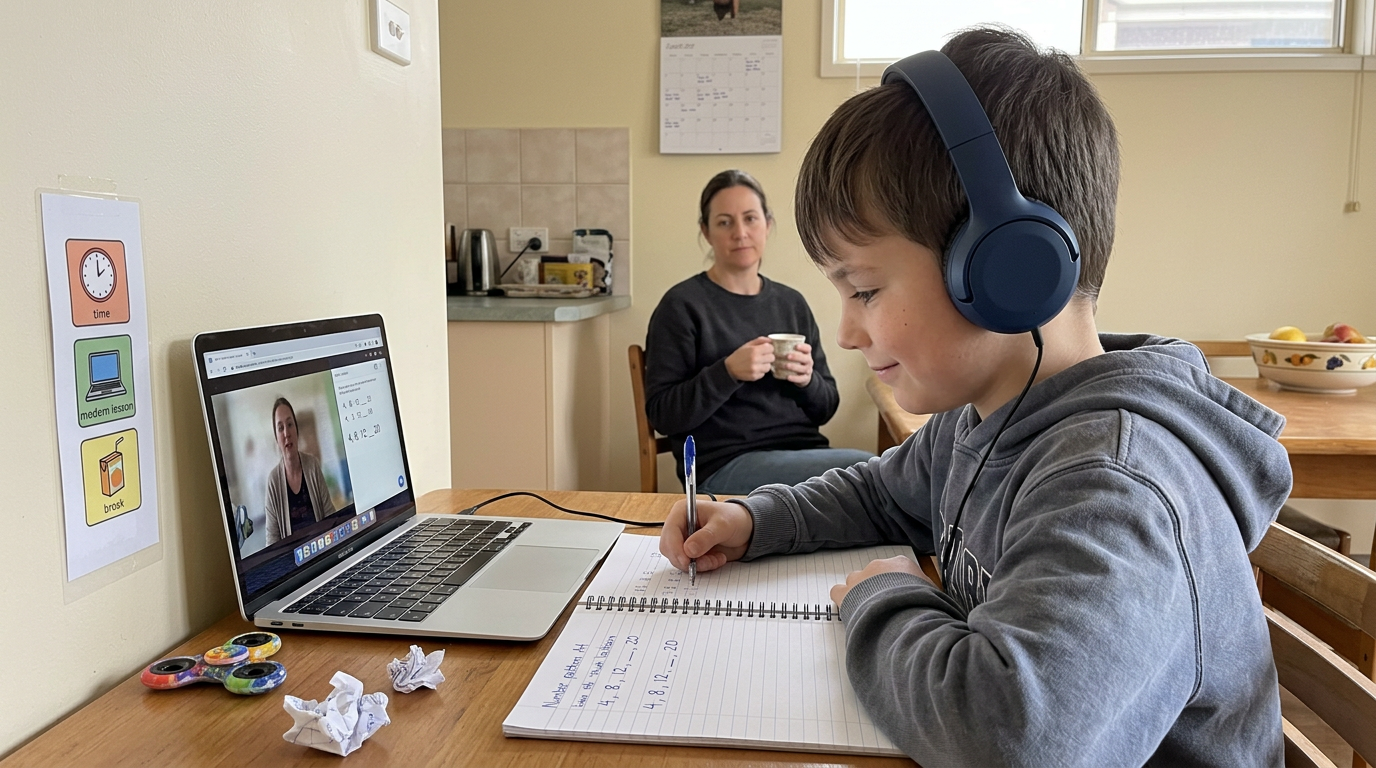
An autism-aware tutoring session looks calmer, more structured, and more visual than a standard one. The tutor opens the session the same way every week — same greeting, same agenda preview, same rough timing. They use written or visual schedules so the student can see what's next. They allow a fidget item without comment. They accept that the student may not look at them while answering and never push for "eye contact". They build in a 2-minute regulation break midway through. And they leverage a special interest — Pokémon, trains, Roblox, AFL teams — as the worked-example context whenever possible. Tutero matches autistic students with tutors who run sessions this way.
What are the eight questions to ask any tutor before hiring them?
Before signing up: (1) How many autistic students have you tutored, for how long? (2) What does your first session with an autistic Year 5 look like? (3) How do you handle a session where the student is dysregulated? (4) Can you describe a sensory accommodation you've made? (5) How do you communicate with the parent between sessions? (6) Have you read or trained in any specific autism-supportive teaching frameworks? (7) What do you do when the student says "I don't want to do this"? (8) What's your stance on rewards and behaviour charts? Specific stories beat textbook answers — listen for the ones that ring true.
How much does tutoring cost in Australia and how does NDIS funding fit?
Standard private tutoring in Australia ranges A$55–A$85 per hour; Tutero starts at A$65/hr regardless of year level, with no senior premium. Where NDIS funding fits: tutoring is most often claimed under Capacity Building — Improved Daily Living when it builds skills directly tied to the participant's plan goals (literacy for self-direction, numeracy for community participation). Your support coordinator approves it case-by-case. Some plans cover it fully, some partially, some not at all. Always check the line items in your current plan and have your tutoring provider write the goal-link rationale clearly. See our NDIS-funded tutoring guide for the full claimable workflow.

When is a tutor not the right move for an autistic student?
Tutoring isn't the answer for every situation. If your child is in a phase of significant dysregulation, the right move is usually OT or a mental-health support first — adding a tutor on top adds load. If the school has flagged behavioural support needs that haven't been addressed yet, the school-level supports come first. If you're hoping a tutor will fix social skills, you need a peer-group skills program, not a one-on-one academic tutor. And if budget is tight, a free regulation-and-routine reset at home for 6 weeks often produces more change than any tutor would. The right move is sequential, not stacked.
How do you find the right autism-aware tutor for your child?
Three filters. (1) Direct experience — they've tutored at least 5 autistic students for 6+ months each. (2) Curiosity, not pity — they ask about your child's strengths and special interests before they ask about challenges. (3) Parent partnership — they want a 15-minute call with you before the first session, not just a booking. Tutero's matching process screens for all three. The first session is A$65 and structured as a probe — observe how your child engages, not whether they "perform" well. The fit either lands in the first three sessions or it doesn't. You can see how tutoring for students with autism is structured before you book.
So how do you choose the best tutor for your autistic child?
Filter for direct autism experience. Ask the eight questions. Set up a parent partnership before session one. Use NDIS funding where it fits. Skip the tutor if your child needs OT or mental-health support first. The right tutor will be calmer, more structured, and more curious than the average tutor — and your child will visibly settle into the rhythm by session three. Match with a Tutero tutor who runs autism-aware sessions, A$65 first session, no contracts.
Ready to find a tutor who actually understands your autistic child? Match with a Tutero tutor for an A$65 first session — predictable structure, special-interest leverage, parent partnership built in.
Autism-aware tutoring means designing around predictability, sensory regulation, and special-interest leverage — not teaching the same content with patience.
Autism-aware tutoring means designing around predictability, sensory regulation, and special-interest leverage — not teaching the same content with patience.
Finding a tutor who actually understands autistic students is harder than finding any other kind of tutor. Most parents start by asking for "experience with autism" and then end up with someone who has read about it but never run a session for an autistic Year 4. This guide cuts to what works. If you want a starting point, our 1-on-1 special needs tutoring is built for students who need more than a general subject tutor.
Quick answer: what does autism-aware tutoring actually mean?
Quick answer: autism-aware tutoring means a tutor who plans sessions around predictability, sensory regulation, and special-interest leverage — not just teaching the same content "with patience". The right tutor adjusts pacing, breaks information into short chunks with visual scaffolds, accepts non-eye-contact engagement as normal, and partners with you on what works at home before they walk into the first session.
What does autism-specific tutoring actually look like in a session?
An autism-aware tutoring session looks calmer, more structured, and more visual than a standard one. The tutor opens the session the same way every week — same greeting, same agenda preview, same rough timing. They use written or visual schedules so the student can see what's next. They allow a fidget item without comment. They accept that the student may not look at them while answering and never push for "eye contact". They build in a 2-minute regulation break midway through. And they leverage a special interest — Pokémon, trains, Roblox, AFL teams — as the worked-example context whenever possible. Tutero matches autistic students with tutors who run sessions this way.
What are the eight questions to ask any tutor before hiring them?
Before signing up: (1) How many autistic students have you tutored, for how long? (2) What does your first session with an autistic Year 5 look like? (3) How do you handle a session where the student is dysregulated? (4) Can you describe a sensory accommodation you've made? (5) How do you communicate with the parent between sessions? (6) Have you read or trained in any specific autism-supportive teaching frameworks? (7) What do you do when the student says "I don't want to do this"? (8) What's your stance on rewards and behaviour charts? Specific stories beat textbook answers — listen for the ones that ring true.
How much does tutoring cost in Australia and how does NDIS funding fit?
Standard private tutoring in Australia ranges A$55–A$85 per hour; Tutero starts at A$65/hr regardless of year level, with no senior premium. Where NDIS funding fits: tutoring is most often claimed under Capacity Building — Improved Daily Living when it builds skills directly tied to the participant's plan goals (literacy for self-direction, numeracy for community participation). Your support coordinator approves it case-by-case. Some plans cover it fully, some partially, some not at all. Always check the line items in your current plan and have your tutoring provider write the goal-link rationale clearly. See our NDIS-funded tutoring guide for the full claimable workflow.
When is a tutor not the right move for an autistic student?
Tutoring isn't the answer for every situation. If your child is in a phase of significant dysregulation, the right move is usually OT or a mental-health support first — adding a tutor on top adds load. If the school has flagged behavioural support needs that haven't been addressed yet, the school-level supports come first. If you're hoping a tutor will fix social skills, you need a peer-group skills program, not a one-on-one academic tutor. And if budget is tight, a free regulation-and-routine reset at home for 6 weeks often produces more change than any tutor would. The right move is sequential, not stacked.
How do you find the right autism-aware tutor for your child?
Three filters. (1) Direct experience — they've tutored at least 5 autistic students for 6+ months each. (2) Curiosity, not pity — they ask about your child's strengths and special interests before they ask about challenges. (3) Parent partnership — they want a 15-minute call with you before the first session, not just a booking. Tutero's matching process screens for all three. The first session is A$65 and structured as a probe — observe how your child engages, not whether they "perform" well. The fit either lands in the first three sessions or it doesn't. You can see how tutoring for students with autism is structured before you book.
So how do you choose the best tutor for your autistic child?
Filter for direct autism experience. Ask the eight questions. Set up a parent partnership before session one. Use NDIS funding where it fits. Skip the tutor if your child needs OT or mental-health support first. The right tutor will be calmer, more structured, and more curious than the average tutor — and your child will visibly settle into the rhythm by session three. Match with a Tutero tutor who runs autism-aware sessions, A$65 first session, no contracts.
Ready to find a tutor who actually understands your autistic child? Match with a Tutero tutor for an A$65 first session — predictable structure, special-interest leverage, parent partnership built in.
Autism-aware tutoring means designing around predictability, sensory regulation, and special-interest leverage — not teaching the same content with patience.
Autism-aware tutoring means designing around predictability, sensory regulation, and special-interest leverage — not teaching the same content with patience.

Autism-aware tutoring means designing around predictability, sensory regulation, and special-interest leverage — not teaching the same content with patience.
The right tutor is calmer, more structured, and more curious than the average tutor.
Finding a tutor who actually understands autistic students is harder than finding any other kind of tutor. Most parents start by asking for "experience with autism" and then end up with someone who has read about it but never run a session for an autistic Year 4. This guide cuts to what works. If you want a starting point, our 1-on-1 special needs tutoring is built for students who need more than a general subject tutor.
Quick answer: what does autism-aware tutoring actually mean?
Quick answer: autism-aware tutoring means a tutor who plans sessions around predictability, sensory regulation, and special-interest leverage — not just teaching the same content "with patience". The right tutor adjusts pacing, breaks information into short chunks with visual scaffolds, accepts non-eye-contact engagement as normal, and partners with you on what works at home before they walk into the first session.
What does autism-specific tutoring actually look like in a session?
An autism-aware tutoring session looks calmer, more structured, and more visual than a standard one. The tutor opens the session the same way every week — same greeting, same agenda preview, same rough timing. They use written or visual schedules so the student can see what's next. They allow a fidget item without comment. They accept that the student may not look at them while answering and never push for "eye contact". They build in a 2-minute regulation break midway through. And they leverage a special interest — Pokémon, trains, Roblox, AFL teams — as the worked-example context whenever possible. Tutero matches autistic students with tutors who run sessions this way.
What are the eight questions to ask any tutor before hiring them?
Before signing up: (1) How many autistic students have you tutored, for how long? (2) What does your first session with an autistic Year 5 look like? (3) How do you handle a session where the student is dysregulated? (4) Can you describe a sensory accommodation you've made? (5) How do you communicate with the parent between sessions? (6) Have you read or trained in any specific autism-supportive teaching frameworks? (7) What do you do when the student says "I don't want to do this"? (8) What's your stance on rewards and behaviour charts? Specific stories beat textbook answers — listen for the ones that ring true.
How much does tutoring cost in Australia and how does NDIS funding fit?
Standard private tutoring in Australia ranges A$55–A$85 per hour; Tutero starts at A$65/hr regardless of year level, with no senior premium. Where NDIS funding fits: tutoring is most often claimed under Capacity Building — Improved Daily Living when it builds skills directly tied to the participant's plan goals (literacy for self-direction, numeracy for community participation). Your support coordinator approves it case-by-case. Some plans cover it fully, some partially, some not at all. Always check the line items in your current plan and have your tutoring provider write the goal-link rationale clearly. See our NDIS-funded tutoring guide for the full claimable workflow.
When is a tutor not the right move for an autistic student?
Tutoring isn't the answer for every situation. If your child is in a phase of significant dysregulation, the right move is usually OT or a mental-health support first — adding a tutor on top adds load. If the school has flagged behavioural support needs that haven't been addressed yet, the school-level supports come first. If you're hoping a tutor will fix social skills, you need a peer-group skills program, not a one-on-one academic tutor. And if budget is tight, a free regulation-and-routine reset at home for 6 weeks often produces more change than any tutor would. The right move is sequential, not stacked.
How do you find the right autism-aware tutor for your child?
Three filters. (1) Direct experience — they've tutored at least 5 autistic students for 6+ months each. (2) Curiosity, not pity — they ask about your child's strengths and special interests before they ask about challenges. (3) Parent partnership — they want a 15-minute call with you before the first session, not just a booking. Tutero's matching process screens for all three. The first session is A$65 and structured as a probe — observe how your child engages, not whether they "perform" well. The fit either lands in the first three sessions or it doesn't. You can see how tutoring for students with autism is structured before you book.
So how do you choose the best tutor for your autistic child?
Filter for direct autism experience. Ask the eight questions. Set up a parent partnership before session one. Use NDIS funding where it fits. Skip the tutor if your child needs OT or mental-health support first. The right tutor will be calmer, more structured, and more curious than the average tutor — and your child will visibly settle into the rhythm by session three. Match with a Tutero tutor who runs autism-aware sessions, A$65 first session, no contracts.
Ready to find a tutor who actually understands your autistic child? Match with a Tutero tutor for an A$65 first session — predictable structure, special-interest leverage, parent partnership built in.
Autism-aware tutoring means designing around predictability, sensory regulation, and special-interest leverage — not teaching the same content with patience.
The right tutor is calmer, more structured, and more curious than the average tutor.
.svg)
.svg)
Autism-aware tutoring adapts the environment, pacing, and communication style to the specific autistic student. Sessions are predictable in structure, transitions are signalled in advance, sensory factors (light, noise, seating) are taken seriously, special interests are woven deliberately into examples, and language is concrete rather than figurative. Regular tutoring assumes a generic student. Autism-aware tutoring assumes the brain in front of it.
Eight filter questions: (1) describe a typical 60-minute session for an autistic student; (2) what specific experience do you have with autistic students; (3) what do you do mid-session if my child heads toward overload; (4) how would you use my child's special interests; (5) verbal vs written instructions preference; (6) how do you communicate with parents weekly; (7) how do you handle a session where my child can't engage; (8) how does tutoring fit alongside school accommodations and therapies. Concrete specific answers earn a trial. Vague answers don't.
Tutoring can be NDIS-claimable when the funding category and plan goals support it. The relevant categories are usually Capacity Building – Improved Daily Living or Improved Learning, and the tutoring needs to map to a goal already in the plan (literacy, numeracy, school readiness, self-management). Self-managed and plan-managed participants have the most flexibility; agency-managed participants need NDIS-registered providers. Talk to your support coordinator about adding tutoring as a goal before assuming coverage.
Yes — and share the practical specifics: communication preferences, sensory triggers, what currently works at school and what doesn't, special interests that could fuel engagement, and any patterns around fatigue or shutdown. The right tutor treats this information as helpful structure for the session. The wrong tutor treats it as a label that lowers expectations. Both reactions tell you what you need to know.
Two weeks of full sessions — usually four sessions. The first one is for the student and tutor to get to know each other; the next three are for actual teaching. After two weeks, evaluate against the five universal signs of effective tutoring: are recurring mistakes reducing in the targeted skill, can your child explain the topic back to you in their own words, is the tutor sending a structured weekly summary, is the plan changing as new data comes in, and are 'can you help me' requests on that topic dropping at home. If two of those five are missing, change tutor.
Three situations where another route helps more: when the struggle is primarily communication, social, or regulation rather than academic — a speech pathologist, OT, or psychologist is the right professional; when the school hasn't yet implemented an Individual Learning Plan or basic sensory accommodations — those should be in place first; and when your child is in autistic burnout — adding tutoring to a child in burnout is harmful, not helpful. Rest the academics, support the regulation, revisit tutoring when the child is back to baseline.
Hoping to improve confidence & grades?

.png)


