.svg)

One class, a five-to-six-year spread of readiness in the same room, and the impossible feeling of being asked to teach all of them at once. Differentiated instruction is the name for how you reach every student without cloning yourself.
This guide covers what differentiation actually is, the four dimensions it works across, and how to tier a lesson without doubling your planning. It is written for teachers and school leaders, and it leans on ACARA, Carol Ann Tomlinson, AERO and OECD TALIS rather than guesswork.
The quick answer
Differentiated instruction means adjusting how you teach so every student can reach the same learning goal from their own starting point. Following Carol Ann Tomlinson, teachers vary four things: content, process, product and the learning environment, in response to each student's readiness, interests and learning preferences. The goal stays fixed. The route changes.
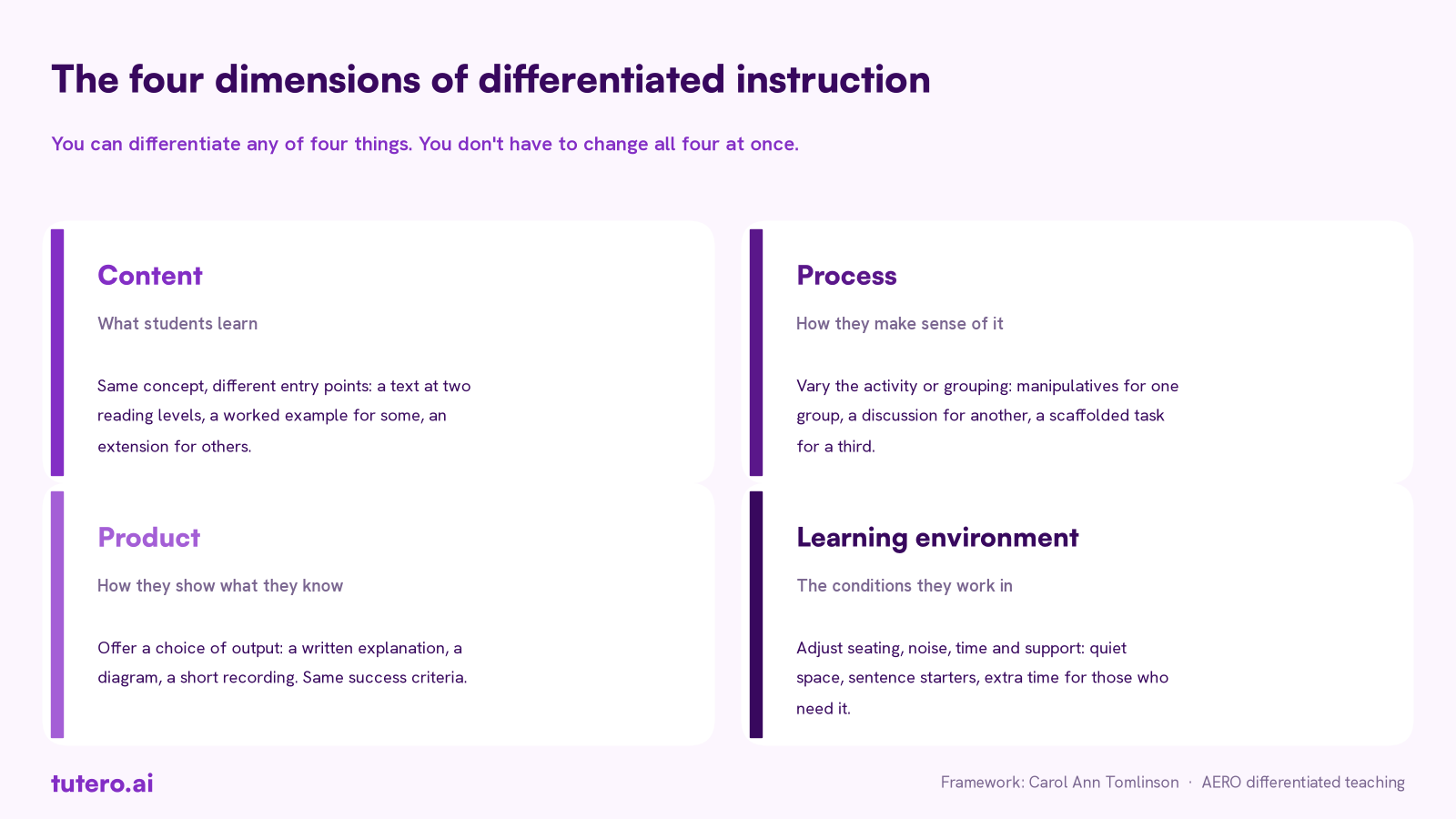
It is not a separate lesson for every child, and it is not lowering the bar. Done well, it is one clear objective with several planned entry points into it. The visual below maps the four dimensions you can adjust, along with the honest workload catch attached to each.
The short version: one goal, several planned ways in.
What are the four elements of differentiated instruction?
The four elements are content, process, product and the learning environment. Content is what students learn and how they access it. Process is how they make sense of it. Product is how they show what they know. The learning environment is how the classroom works and feels.
These are the exact four facets named in ACARA's student diversity guidance for the Australian Curriculum, and the same four described in Tomlinson's original framework as summarised by Reading Rockets. You adjust one or more of them based on three student traits: readiness, interest and learning preference.
| Dimension | What you actually change (Tomlinson) | Concrete classroom example | The workload catch |
|---|---|---|---|
| Content: what students learn or how they access it | The input: the facts, concepts and skills, or the route students take to reach them. Same learning goal, different entry points. | Offer a text on photosynthesis at three readability levels; pair a struggling reader with an audio version and a reading buddy while others read independently. | Sourcing or rewriting the same material at three reading levels is the single most time-expensive task teachers name, so most default to one version for everyone. |
| Process: how students make sense of it | The activities students do to grapple with and master the content. Vary the support, scaffolding, grouping or time. | Run a tiered task: one group works with manipulatives and a worked example, another with a guided template, a third on an open extension problem, all on the same concept. | Designing three versions of an activity, plus the scaffolds and answer keys for each, triples planning time for a single lesson slot. |
| Product: how students show what they know | The culminating task where students rehearse, apply and extend learning. Vary format, complexity or the rubric. | Let students demonstrate mastery via a written report, a labelled diagram, or a recorded explainer, marked against one differentiated rubric. | Multiple product formats mean multiple rubrics and slower, less comparable marking, already teachers' second-biggest reported stressor. |
| Learning environment: how the room works and feels | The climate and structures: quiet vs collaborative zones, routines for independent work, culturally inclusive materials, peer-support systems. | Set up a quiet corner for focused work and a collaboration table, with clear routines so groups can run while you pull a small group. | This is the lowest-cost dimension to change, yet it is the one most often skipped because the first three consume all available planning time. |
The point is not to change all four at once. Most effective differentiation moves one lever at a time for a clear reason:
- A reading gap is a content problem.
- A pacing gap is a process problem.
- A confidence or engagement gap is often a product or environment problem.
What is the difference between readiness, interest and learning profile?
Readiness is where a student currently sits against the learning goal, so it drives how you tier difficulty. Interest is what pulls them in, so it shapes contexts, examples and choice of topic. Learning profile is how a student prefers to work: alone or in a group, with visuals or discussion.
Note that ACARA deliberately says learning preferences rather than the discredited idea of fixed learning styles.
What did Carol Ann Tomlinson say about differentiation?
Carol Ann Tomlinson, the University of Virginia scholar who formalised the model, frames differentiation as a teacher's proactive response to learner needs, not a set of gimmicks bolted onto a fixed lesson. In her interviews with the UVA School of Education, she is clear that differentiation is a way of thinking about teaching and learning, guided by respect for each student and a fixed, high-quality curriculum for all.
It is not individualised worksheets for thirty children, and it is not ability grouping that quietly lowers expectations. Students work toward the same essential understandings; teachers vary the pathway, the support and the pace. That distinction matters, because the most common way differentiation goes wrong is by fragmenting into thirty tasks or by watering the goal down for some students.
What are examples of differentiation in the classroom?
Practical differentiation usually looks small. In a Year 7 maths lesson on fractions, you might run one core task with three tiers: a scaffolded version with a worked example, the standard version, and an extension that asks students to justify a method.
In English, students read the same text but at three readability levels, then answer the same core question. In science, students choose to show understanding through a diagram, a paragraph or a short recorded explanation, all marked against one rubric. None of these is a separate lesson. Each is one objective with planned entry points.
Strong classroom examples share three features:
- One clear learning goal that every student is working toward.
- A small number of planned variations, not improvised on the day.
- A quick way to check who needs which entry point, usually a short formative task.
How is differentiation different from adjustment and modification in the Australian Curriculum?
In Australia these are three distinct things, and the difference is legal as well as pedagogical:
- Differentiation is everyday good teaching for the whole class.
- An adjustment changes how a specific student accesses or demonstrates learning without altering the achievement standard, for example extra time, a scribe or an audio text.
- A modification changes the achievement standard itself, so the student is assessed against a different expectation.
ACARA and the Nationally Consistent Collection of Data on School Students with Disability treat these as a graded sequence, and only adjustments and modifications are formally recorded. Differentiation is the broad practice; adjustment and modification are targeted, documented responses for individual students.
The practical takeaway: when you differentiate a lesson, you are still holding every student to the same standard. You only move into adjustment or modification territory when a documented student need requires it. Confusing the two is what makes teachers feel differentiation must be individualised paperwork. It does not.
Does differentiated instruction actually improve student results?
The evidence points to a modest but real positive effect when differentiation is implemented well. A systematic review of differentiated instruction in secondary education summarised effect sizes ranging from roughly d=+0.51 to +0.74 on achievement, mostly small-to-moderate positive effects.
A separate meta-analysis by Deunk and colleagues in the Educational Research Review extracted 78 effect sizes across primary education and found small-to-moderate gains, with one important caution: within-class homogeneous ability grouping produced a small negative effect for low-achieving pupils. In other words, tiering the task helps; permanently sorting children into fixed ability groups can quietly harm the students it is meant to support.
Tiering the task helps. Fixed ability groups can quietly harm.
So differentiation is worth doing, but the version that works is the flexible, goal-fixed kind, not streaming by another name. The EEF Teaching and Learning Toolkit reaches a similar conclusion on setting and streaming. The mechanism matters as much as the intent.
Why is differentiated instruction so hard and time-consuming?
Because the need is enormous and the planning time is not. The Grattan Institute's Targeted Teaching report found that at any given year level there is a five-to-six-year gap between the most and least advanced ten per cent of students, and in Year 8 maths the spread in a single class can reach eight year levels. Meeting that spread properly means building the same lesson several ways.
That is the catch. Teachers overwhelmingly agree it matters: in one survey of 601 teachers, 95 per cent called differentiation important and 98 per cent said they differentiate at least weekly, with 53 per cent doing so daily. Yet the Fordham Institute found 83 per cent of teachers say it is somewhat or very difficult to implement.
The workload maths is unforgiving. OECD TALIS 2024 data shows Australian full-time teachers work 46.5 hours a week against an OECD average of 41, spend 8.4 hours a week on lesson preparation alone, and report high stress at 34 per cent, well above the OECD average of 19 per cent.
Even a decade ago, OECD TALIS data put average planning at about seven hours a week. Differentiation asks you to multiply the most expensive part of the job. That is why most teachers quietly default to one version for everyone.
The short version: differentiation multiplies the most expensive part of the job.
How do you differentiate a lesson without doubling your workload?
Start from one core lesson and tier it, rather than building three lessons from scratch. Write the single learning goal and the standard task first, then build outwards:
- Make one version easier by adding a scaffold, a worked example or a sentence starter.
- Make one version harder by removing a support or adding a justify-and-explain step.
- Use a short formative check to decide who starts where.
That is a three-tier lesson, and it covers most of the readiness spread in a class without individualising anything. Australia's national evidence body, AERO, sets this out in its teaching practice guides, which favour high-impact, workload-realistic moves over elaborate one-off resources. Keep the environment and product changes cheap: a quiet zone and one flexible rubric go a long way.
The remaining catch is production. The tiering logic is quick to decide; rebuilding the same content at three levels is what eats the hours. This is the specific job the AI teaching platform tutero.ai is built for.
You create one lesson on the concept you are teaching, and it generates the task at three levels of challenge in a single step, with the matched scaffolds, materials and answer keys for each tier. You keep the pedagogical decisions. The platform removes the repetitive production that made differentiation feel impossible on a 46-hour week.
Want your next lesson to arrive already tiered? Spin up your first three-tier lesson free at tutero.ai. Start creating, it's free.
The goal stays fixed. The route changes.
The goal stays fixed. The route changes.
One class, a five-to-six-year spread of readiness in the same room, and the impossible feeling of being asked to teach all of them at once. Differentiated instruction is the name for how you reach every student without cloning yourself.
This guide covers what differentiation actually is, the four dimensions it works across, and how to tier a lesson without doubling your planning. It is written for teachers and school leaders, and it leans on ACARA, Carol Ann Tomlinson, AERO and OECD TALIS rather than guesswork.
The quick answer
Differentiated instruction means adjusting how you teach so every student can reach the same learning goal from their own starting point. Following Carol Ann Tomlinson, teachers vary four things: content, process, product and the learning environment, in response to each student's readiness, interests and learning preferences. The goal stays fixed. The route changes.
It is not a separate lesson for every child, and it is not lowering the bar. Done well, it is one clear objective with several planned entry points into it. The visual below maps the four dimensions you can adjust, along with the honest workload catch attached to each.
The short version: one goal, several planned ways in.
What are the four elements of differentiated instruction?
The four elements are content, process, product and the learning environment. Content is what students learn and how they access it. Process is how they make sense of it. Product is how they show what they know. The learning environment is how the classroom works and feels.
These are the exact four facets named in ACARA's student diversity guidance for the Australian Curriculum, and the same four described in Tomlinson's original framework as summarised by Reading Rockets. You adjust one or more of them based on three student traits: readiness, interest and learning preference.
| Dimension | What you actually change (Tomlinson) | Concrete classroom example | The workload catch |
|---|---|---|---|
| Content: what students learn or how they access it | The input: the facts, concepts and skills, or the route students take to reach them. Same learning goal, different entry points. | Offer a text on photosynthesis at three readability levels; pair a struggling reader with an audio version and a reading buddy while others read independently. | Sourcing or rewriting the same material at three reading levels is the single most time-expensive task teachers name, so most default to one version for everyone. |
| Process: how students make sense of it | The activities students do to grapple with and master the content. Vary the support, scaffolding, grouping or time. | Run a tiered task: one group works with manipulatives and a worked example, another with a guided template, a third on an open extension problem, all on the same concept. | Designing three versions of an activity, plus the scaffolds and answer keys for each, triples planning time for a single lesson slot. |
| Product: how students show what they know | The culminating task where students rehearse, apply and extend learning. Vary format, complexity or the rubric. | Let students demonstrate mastery via a written report, a labelled diagram, or a recorded explainer, marked against one differentiated rubric. | Multiple product formats mean multiple rubrics and slower, less comparable marking, already teachers' second-biggest reported stressor. |
| Learning environment: how the room works and feels | The climate and structures: quiet vs collaborative zones, routines for independent work, culturally inclusive materials, peer-support systems. | Set up a quiet corner for focused work and a collaboration table, with clear routines so groups can run while you pull a small group. | This is the lowest-cost dimension to change, yet it is the one most often skipped because the first three consume all available planning time. |
The point is not to change all four at once. Most effective differentiation moves one lever at a time for a clear reason:
- A reading gap is a content problem.
- A pacing gap is a process problem.
- A confidence or engagement gap is often a product or environment problem.
What is the difference between readiness, interest and learning profile?
Readiness is where a student currently sits against the learning goal, so it drives how you tier difficulty. Interest is what pulls them in, so it shapes contexts, examples and choice of topic. Learning profile is how a student prefers to work: alone or in a group, with visuals or discussion.
Note that ACARA deliberately says learning preferences rather than the discredited idea of fixed learning styles.
What did Carol Ann Tomlinson say about differentiation?
Carol Ann Tomlinson, the University of Virginia scholar who formalised the model, frames differentiation as a teacher's proactive response to learner needs, not a set of gimmicks bolted onto a fixed lesson. In her interviews with the UVA School of Education, she is clear that differentiation is a way of thinking about teaching and learning, guided by respect for each student and a fixed, high-quality curriculum for all.
It is not individualised worksheets for thirty children, and it is not ability grouping that quietly lowers expectations. Students work toward the same essential understandings; teachers vary the pathway, the support and the pace. That distinction matters, because the most common way differentiation goes wrong is by fragmenting into thirty tasks or by watering the goal down for some students.
What are examples of differentiation in the classroom?
Practical differentiation usually looks small. In a Year 7 maths lesson on fractions, you might run one core task with three tiers: a scaffolded version with a worked example, the standard version, and an extension that asks students to justify a method.
In English, students read the same text but at three readability levels, then answer the same core question. In science, students choose to show understanding through a diagram, a paragraph or a short recorded explanation, all marked against one rubric. None of these is a separate lesson. Each is one objective with planned entry points.
Strong classroom examples share three features:
- One clear learning goal that every student is working toward.
- A small number of planned variations, not improvised on the day.
- A quick way to check who needs which entry point, usually a short formative task.
How is differentiation different from adjustment and modification in the Australian Curriculum?
In Australia these are three distinct things, and the difference is legal as well as pedagogical:
- Differentiation is everyday good teaching for the whole class.
- An adjustment changes how a specific student accesses or demonstrates learning without altering the achievement standard, for example extra time, a scribe or an audio text.
- A modification changes the achievement standard itself, so the student is assessed against a different expectation.
ACARA and the Nationally Consistent Collection of Data on School Students with Disability treat these as a graded sequence, and only adjustments and modifications are formally recorded. Differentiation is the broad practice; adjustment and modification are targeted, documented responses for individual students.
The practical takeaway: when you differentiate a lesson, you are still holding every student to the same standard. You only move into adjustment or modification territory when a documented student need requires it. Confusing the two is what makes teachers feel differentiation must be individualised paperwork. It does not.
Does differentiated instruction actually improve student results?
The evidence points to a modest but real positive effect when differentiation is implemented well. A systematic review of differentiated instruction in secondary education summarised effect sizes ranging from roughly d=+0.51 to +0.74 on achievement, mostly small-to-moderate positive effects.
A separate meta-analysis by Deunk and colleagues in the Educational Research Review extracted 78 effect sizes across primary education and found small-to-moderate gains, with one important caution: within-class homogeneous ability grouping produced a small negative effect for low-achieving pupils. In other words, tiering the task helps; permanently sorting children into fixed ability groups can quietly harm the students it is meant to support.
Tiering the task helps. Fixed ability groups can quietly harm.
So differentiation is worth doing, but the version that works is the flexible, goal-fixed kind, not streaming by another name. The EEF Teaching and Learning Toolkit reaches a similar conclusion on setting and streaming. The mechanism matters as much as the intent.
Why is differentiated instruction so hard and time-consuming?
Because the need is enormous and the planning time is not. The Grattan Institute's Targeted Teaching report found that at any given year level there is a five-to-six-year gap between the most and least advanced ten per cent of students, and in Year 8 maths the spread in a single class can reach eight year levels. Meeting that spread properly means building the same lesson several ways.
That is the catch. Teachers overwhelmingly agree it matters: in one survey of 601 teachers, 95 per cent called differentiation important and 98 per cent said they differentiate at least weekly, with 53 per cent doing so daily. Yet the Fordham Institute found 83 per cent of teachers say it is somewhat or very difficult to implement.
The workload maths is unforgiving. OECD TALIS 2024 data shows Australian full-time teachers work 46.5 hours a week against an OECD average of 41, spend 8.4 hours a week on lesson preparation alone, and report high stress at 34 per cent, well above the OECD average of 19 per cent.
Even a decade ago, OECD TALIS data put average planning at about seven hours a week. Differentiation asks you to multiply the most expensive part of the job. That is why most teachers quietly default to one version for everyone.
The short version: differentiation multiplies the most expensive part of the job.
How do you differentiate a lesson without doubling your workload?
Start from one core lesson and tier it, rather than building three lessons from scratch. Write the single learning goal and the standard task first, then build outwards:
- Make one version easier by adding a scaffold, a worked example or a sentence starter.
- Make one version harder by removing a support or adding a justify-and-explain step.
- Use a short formative check to decide who starts where.
That is a three-tier lesson, and it covers most of the readiness spread in a class without individualising anything. Australia's national evidence body, AERO, sets this out in its teaching practice guides, which favour high-impact, workload-realistic moves over elaborate one-off resources. Keep the environment and product changes cheap: a quiet zone and one flexible rubric go a long way.
The remaining catch is production. The tiering logic is quick to decide; rebuilding the same content at three levels is what eats the hours. This is the specific job the AI teaching platform tutero.ai is built for.
You create one lesson on the concept you are teaching, and it generates the task at three levels of challenge in a single step, with the matched scaffolds, materials and answer keys for each tier. You keep the pedagogical decisions. The platform removes the repetitive production that made differentiation feel impossible on a 46-hour week.
Want your next lesson to arrive already tiered? Spin up your first three-tier lesson free at tutero.ai. Start creating, it's free.
The goal stays fixed. The route changes.
The goal stays fixed. The route changes.

The goal stays fixed. The route changes.
Tiering the task helps; permanently sorting children into fixed ability groups can quietly harm the students it is meant to support.
One class, a five-to-six-year spread of readiness in the same room, and the impossible feeling of being asked to teach all of them at once. Differentiated instruction is the name for how you reach every student without cloning yourself.
This guide covers what differentiation actually is, the four dimensions it works across, and how to tier a lesson without doubling your planning. It is written for teachers and school leaders, and it leans on ACARA, Carol Ann Tomlinson, AERO and OECD TALIS rather than guesswork.
The quick answer
Differentiated instruction means adjusting how you teach so every student can reach the same learning goal from their own starting point. Following Carol Ann Tomlinson, teachers vary four things: content, process, product and the learning environment, in response to each student's readiness, interests and learning preferences. The goal stays fixed. The route changes.
It is not a separate lesson for every child, and it is not lowering the bar. Done well, it is one clear objective with several planned entry points into it. The visual below maps the four dimensions you can adjust, along with the honest workload catch attached to each.
The short version: one goal, several planned ways in.
What are the four elements of differentiated instruction?
The four elements are content, process, product and the learning environment. Content is what students learn and how they access it. Process is how they make sense of it. Product is how they show what they know. The learning environment is how the classroom works and feels.
These are the exact four facets named in ACARA's student diversity guidance for the Australian Curriculum, and the same four described in Tomlinson's original framework as summarised by Reading Rockets. You adjust one or more of them based on three student traits: readiness, interest and learning preference.
| Dimension | What you actually change (Tomlinson) | Concrete classroom example | The workload catch |
|---|---|---|---|
| Content: what students learn or how they access it | The input: the facts, concepts and skills, or the route students take to reach them. Same learning goal, different entry points. | Offer a text on photosynthesis at three readability levels; pair a struggling reader with an audio version and a reading buddy while others read independently. | Sourcing or rewriting the same material at three reading levels is the single most time-expensive task teachers name, so most default to one version for everyone. |
| Process: how students make sense of it | The activities students do to grapple with and master the content. Vary the support, scaffolding, grouping or time. | Run a tiered task: one group works with manipulatives and a worked example, another with a guided template, a third on an open extension problem, all on the same concept. | Designing three versions of an activity, plus the scaffolds and answer keys for each, triples planning time for a single lesson slot. |
| Product: how students show what they know | The culminating task where students rehearse, apply and extend learning. Vary format, complexity or the rubric. | Let students demonstrate mastery via a written report, a labelled diagram, or a recorded explainer, marked against one differentiated rubric. | Multiple product formats mean multiple rubrics and slower, less comparable marking, already teachers' second-biggest reported stressor. |
| Learning environment: how the room works and feels | The climate and structures: quiet vs collaborative zones, routines for independent work, culturally inclusive materials, peer-support systems. | Set up a quiet corner for focused work and a collaboration table, with clear routines so groups can run while you pull a small group. | This is the lowest-cost dimension to change, yet it is the one most often skipped because the first three consume all available planning time. |
The point is not to change all four at once. Most effective differentiation moves one lever at a time for a clear reason:
- A reading gap is a content problem.
- A pacing gap is a process problem.
- A confidence or engagement gap is often a product or environment problem.
What is the difference between readiness, interest and learning profile?
Readiness is where a student currently sits against the learning goal, so it drives how you tier difficulty. Interest is what pulls them in, so it shapes contexts, examples and choice of topic. Learning profile is how a student prefers to work: alone or in a group, with visuals or discussion.
Note that ACARA deliberately says learning preferences rather than the discredited idea of fixed learning styles.
What did Carol Ann Tomlinson say about differentiation?
Carol Ann Tomlinson, the University of Virginia scholar who formalised the model, frames differentiation as a teacher's proactive response to learner needs, not a set of gimmicks bolted onto a fixed lesson. In her interviews with the UVA School of Education, she is clear that differentiation is a way of thinking about teaching and learning, guided by respect for each student and a fixed, high-quality curriculum for all.
It is not individualised worksheets for thirty children, and it is not ability grouping that quietly lowers expectations. Students work toward the same essential understandings; teachers vary the pathway, the support and the pace. That distinction matters, because the most common way differentiation goes wrong is by fragmenting into thirty tasks or by watering the goal down for some students.
What are examples of differentiation in the classroom?
Practical differentiation usually looks small. In a Year 7 maths lesson on fractions, you might run one core task with three tiers: a scaffolded version with a worked example, the standard version, and an extension that asks students to justify a method.
In English, students read the same text but at three readability levels, then answer the same core question. In science, students choose to show understanding through a diagram, a paragraph or a short recorded explanation, all marked against one rubric. None of these is a separate lesson. Each is one objective with planned entry points.
Strong classroom examples share three features:
- One clear learning goal that every student is working toward.
- A small number of planned variations, not improvised on the day.
- A quick way to check who needs which entry point, usually a short formative task.
How is differentiation different from adjustment and modification in the Australian Curriculum?
In Australia these are three distinct things, and the difference is legal as well as pedagogical:
- Differentiation is everyday good teaching for the whole class.
- An adjustment changes how a specific student accesses or demonstrates learning without altering the achievement standard, for example extra time, a scribe or an audio text.
- A modification changes the achievement standard itself, so the student is assessed against a different expectation.
ACARA and the Nationally Consistent Collection of Data on School Students with Disability treat these as a graded sequence, and only adjustments and modifications are formally recorded. Differentiation is the broad practice; adjustment and modification are targeted, documented responses for individual students.
The practical takeaway: when you differentiate a lesson, you are still holding every student to the same standard. You only move into adjustment or modification territory when a documented student need requires it. Confusing the two is what makes teachers feel differentiation must be individualised paperwork. It does not.
Does differentiated instruction actually improve student results?
The evidence points to a modest but real positive effect when differentiation is implemented well. A systematic review of differentiated instruction in secondary education summarised effect sizes ranging from roughly d=+0.51 to +0.74 on achievement, mostly small-to-moderate positive effects.
A separate meta-analysis by Deunk and colleagues in the Educational Research Review extracted 78 effect sizes across primary education and found small-to-moderate gains, with one important caution: within-class homogeneous ability grouping produced a small negative effect for low-achieving pupils. In other words, tiering the task helps; permanently sorting children into fixed ability groups can quietly harm the students it is meant to support.
Tiering the task helps. Fixed ability groups can quietly harm.
So differentiation is worth doing, but the version that works is the flexible, goal-fixed kind, not streaming by another name. The EEF Teaching and Learning Toolkit reaches a similar conclusion on setting and streaming. The mechanism matters as much as the intent.
Why is differentiated instruction so hard and time-consuming?
Because the need is enormous and the planning time is not. The Grattan Institute's Targeted Teaching report found that at any given year level there is a five-to-six-year gap between the most and least advanced ten per cent of students, and in Year 8 maths the spread in a single class can reach eight year levels. Meeting that spread properly means building the same lesson several ways.
That is the catch. Teachers overwhelmingly agree it matters: in one survey of 601 teachers, 95 per cent called differentiation important and 98 per cent said they differentiate at least weekly, with 53 per cent doing so daily. Yet the Fordham Institute found 83 per cent of teachers say it is somewhat or very difficult to implement.
The workload maths is unforgiving. OECD TALIS 2024 data shows Australian full-time teachers work 46.5 hours a week against an OECD average of 41, spend 8.4 hours a week on lesson preparation alone, and report high stress at 34 per cent, well above the OECD average of 19 per cent.
Even a decade ago, OECD TALIS data put average planning at about seven hours a week. Differentiation asks you to multiply the most expensive part of the job. That is why most teachers quietly default to one version for everyone.
The short version: differentiation multiplies the most expensive part of the job.
How do you differentiate a lesson without doubling your workload?
Start from one core lesson and tier it, rather than building three lessons from scratch. Write the single learning goal and the standard task first, then build outwards:
- Make one version easier by adding a scaffold, a worked example or a sentence starter.
- Make one version harder by removing a support or adding a justify-and-explain step.
- Use a short formative check to decide who starts where.
That is a three-tier lesson, and it covers most of the readiness spread in a class without individualising anything. Australia's national evidence body, AERO, sets this out in its teaching practice guides, which favour high-impact, workload-realistic moves over elaborate one-off resources. Keep the environment and product changes cheap: a quiet zone and one flexible rubric go a long way.
The remaining catch is production. The tiering logic is quick to decide; rebuilding the same content at three levels is what eats the hours. This is the specific job the AI teaching platform tutero.ai is built for.
You create one lesson on the concept you are teaching, and it generates the task at three levels of challenge in a single step, with the matched scaffolds, materials and answer keys for each tier. You keep the pedagogical decisions. The platform removes the repetitive production that made differentiation feel impossible on a 46-hour week.
Want your next lesson to arrive already tiered? Spin up your first three-tier lesson free at tutero.ai. Start creating, it's free.
The goal stays fixed. The route changes.
Tiering the task helps; permanently sorting children into fixed ability groups can quietly harm the students it is meant to support.
.svg)
.svg)
It is teaching one class toward the same learning goal but giving students different ways to get there. You adjust the content, the activity, the way students show what they know, or the classroom setup, based on where each student is starting from. The objective stays the same for everyone. Only the pathway, pace and support change to match readiness, interest and learning preference.
No. Differentiation is a teacher-led response to a whole class, varying a small number of planned entry points into one shared goal. Personalised learning usually implies an individual pathway or plan per student, often technology-driven. Differentiation does not mean thirty separate lessons. It means one lesson with a few deliberate variations, which is far more sustainable to plan and teach.
Content, process, product and learning environment. Content is what students learn and how they access it. Process is the activities they use to make sense of it. Product is how they demonstrate mastery. Learning environment is how the room is structured and how it feels. ACARA names these same four facets, and you adjust one or more based on student readiness, interest and learning preference.
No. Differentiation holds every student to the same achievement standard and varies only the route to it. Lowering the standard is a modification, a distinct and formally documented step in the Australian Curriculum used only for specific students with a recorded need. An adjustment changes access without changing the standard. Everyday differentiation is neither; it keeps expectations high for the whole class.
Build one core lesson first, then tier it. Add a scaffold, worked example or sentence starter for a supported version, and remove a support or add a justify-and-explain step for an extension. That covers most of the readiness spread without individualising anything. Use a short formative check to decide who starts where, and keep environment and rubric changes simple so they cost almost no extra time.
A tiered lesson keeps one learning goal and offers the same task at two or three levels of challenge. A typical set is a scaffolded tier with more support, a standard tier, and an extension tier that removes support or asks for deeper reasoning. All students engage with the same concept, which keeps whole-class discussion coherent while matching the difficulty to each student's current readiness.
Hoping to improve confidence & grades?

.png)