
.svg)

Updated 6 May 2026 — refreshed with the latest research on retrieval practice, sleep, and deep work, plus a habit checklist any student can build in a week.
Top students don't have a secret. They have a small set of daily habits — most of them boring, all of them repeatable — that compound into strong report cards. The difference between a student who finishes Year 12 with a 90+ ATAR and one who finishes with a 60 isn't usually IQ. It's the five habits below: protected sleep, a written plan, deep practice, self-quizzing, and asking for help early.
Quick answer: what are the 5 habits of highly successful students?
The five habits, in priority order: (1) protected sleep — eight to ten hours, on a fixed schedule, screens off the bed; (2) a written weekly plan — tomorrow's tasks decided the night before, on paper; (3) deep practice on the hard parts — 30–50 minute focused blocks on the questions you currently can't do, not the ones you already can; (4) self-quizzing instead of re-reading — closed-book recall, flashcards, past papers, blank-page brain dumps; (5) asking for help early — to a teacher, a tutor, or a study partner, in the first week of confusion, not the night before the test.
None of these are clever. All of them are repeatable. That's the point — successful students do the unsexy thing every day, while everyone else looks for a shortcut.
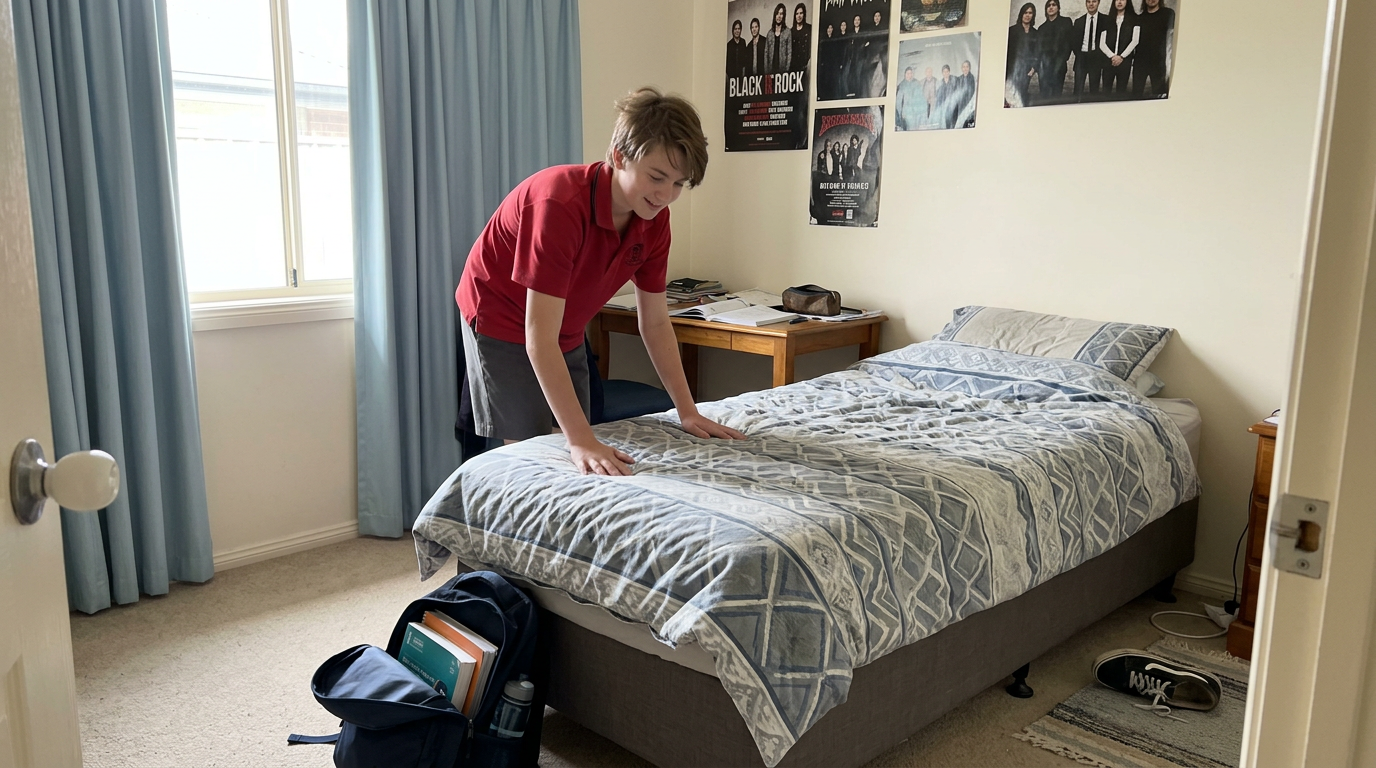
Habit 1: How important is sleep for academic success?
Sleep is the single highest-leverage academic habit a student has, and the one most often sacrificed first. Research from Harvard's Division of Sleep Medicine and the U.S. National Institutes of Health is unambiguous: sleep is when the brain consolidates the day's learning into long-term memory, and a student who studies for three hours and then sleeps six remembers far less than a student who studies for two and sleeps eight. Australian secondary students need around eight to ten hours a night. Most get six to seven. The 2018 American Academy of Sleep Medicine consensus statement found that adolescents who routinely sleep less than eight hours have lower grades, slower reaction times, and more reported anxiety than peers who sleep nine.
The habit isn't sleeping more in theory. It's protecting sleep in practice — a fixed lights-out time on weeknights, no screens in the bedroom after 10pm, and not letting a single late-night cram night turn into a rolling sleep debt that quietly tanks the rest of the week's study. Successful students treat sleep as a non-negotiable input to their study, not a reward they're allowed once the work is done.
A one-week sleep reset for a student who's been short-changing it
- Pick a fixed wake-up time for school days and weekends — within 60 minutes of each other. Inconsistent wake-up wrecks circadian rhythm worse than late nights.
- Put the phone in another room overnight. Use a $15 alarm clock. This is the single biggest move.
- Set a hard study cut-off — 9pm on weeknights for primary and lower-secondary students, 10pm for senior students. Anything not done by then waits until tomorrow.
- No caffeine after 2pm — caffeine has a five-to-seven-hour half-life and a 4pm energy drink is still active at midnight.
- Track it for seven days. Most students underestimate how little they sleep until they write it down.
Habit 2: How do successful students plan their week?
They write tomorrow's plan tonight — on paper, not in their head — and they do it before they're tired. The habit takes two to five minutes. The student opens a paper planner or a single page in a notebook on Sunday evening, looks at the week ahead, and lists the three most important things they need to do each day. Not a wish list — three things. A maths topic to drill, a chapter to read, a draft to write. Then each evening, before bed, they check off what they did and bullet-point tomorrow's three.
This habit beats every productivity app for one simple reason: it's done before tiredness wins. By the time a student gets to their desk after dinner, decision-making is degraded — there's a reason executives like Cal Newport (whose Deep Work research is the source of the 30–50 minute focused-block model in Habit 3) advocate for "shutdown rituals" and pre-decided tomorrows. The students who succeed don't decide what to study at the moment they sit down to study. The decision is already made. The desk session is just execution.
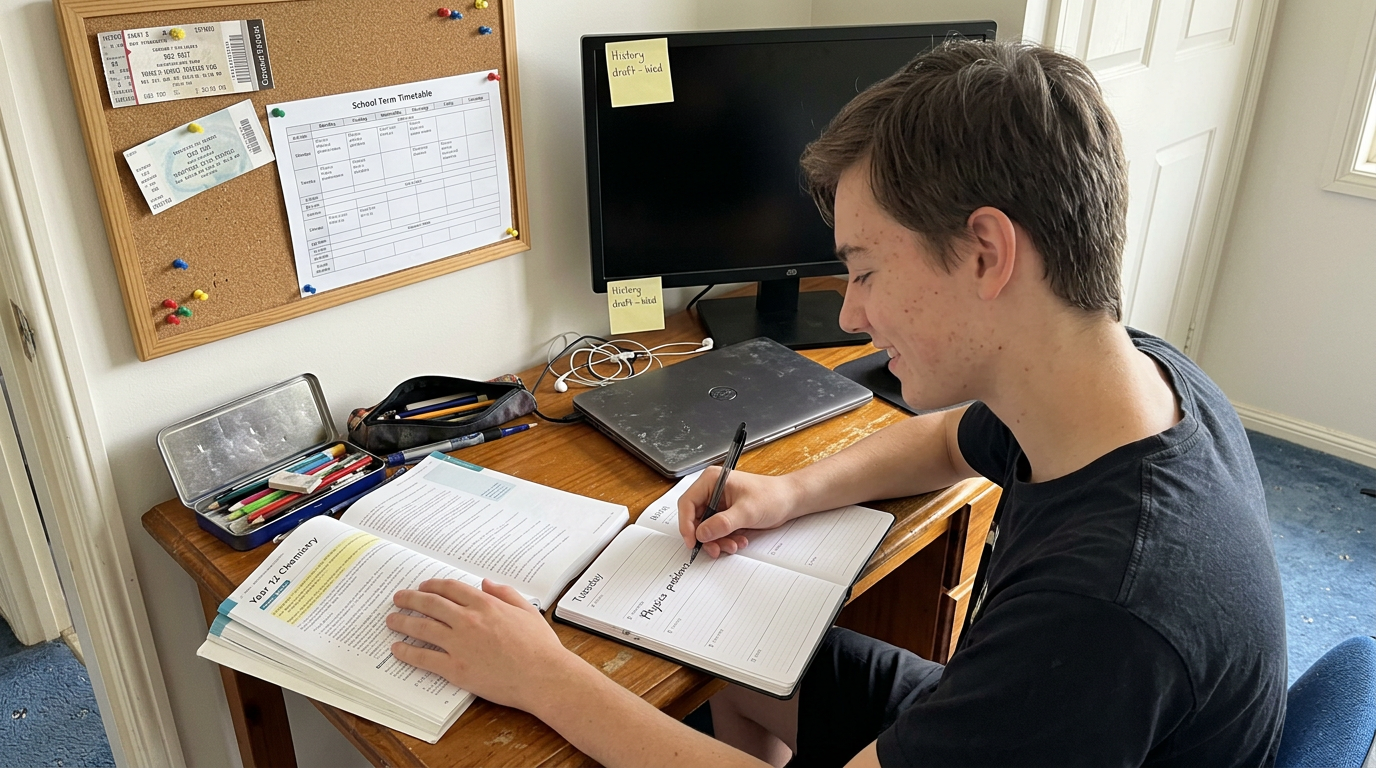
What a top student's weekly plan actually looks like
Three concrete examples — primary, lower-secondary, senior — so the habit is portable to any year level:
| Year level | Sunday-evening plan (5 min) | Tonight-for-tomorrow plan (2 min) |
|---|---|---|
| Year 4 (primary) | List the week's spelling words; 20 min reading per night; one maths topic to revisit. | "Tomorrow: 10 min spelling, 20 min reading, 5 maths questions." |
| Year 8 (lower secondary) | Three subject priorities + any assessment due dates; one weekly drill block per subject. | "Tomorrow: maths algebra drill 30 min, English essay paragraph 25 min, science notes 20 min." |
| Year 12 (senior) | Past-paper schedule per subject; flag the two weakest topics; SAC/exam dates marked. | "Tomorrow: methods past paper section 2 (45 min), chem revision sheet (30 min), English essay edit (30 min)." |
Habit 3: How do top students study? (Deep work, not long hours)
Successful students don't study longer. They study harder, on the right material. The pattern is 30 to 50 minute blocks of full focus on the parts they can't yet do, with phone in another room and one task in front of them. Three to four blocks a night beats five hours of distracted re-reading.
The research backing this is robust. Anders Ericsson's deliberate practice work — the 30-year body of research that became the popular "10,000 hours" idea, though Ericsson himself disputed that framing — shows that what separates top performers in any skill is not raw hours but the proportion of those hours spent at the edge of current ability. For a student, that means doing the maths questions you currently get wrong, not the ones you already get right. It means writing essay introductions when you struggle with introductions, not re-reading the chapter you already understand. Cal Newport's Deep Work applies the same idea to focus: the value of an hour of study scales with how undivided that hour is.
The 30–50-minute focused block — how to actually do it
- Pick one task. One topic, one chapter, one past-paper section. Not "study maths" — "exponential equations, questions 1–15."
- Phone in another room. Not face-down on the desk. Another room. Notifications off.
- Set a timer for 30, 40, or 50 minutes. Younger students start at 25–30; senior students can sustain 50.
- Work on the hard parts — the questions you currently can't do, not the ones you can. Working at the edge is the whole point.
- Take a real break — 5 to 10 minutes, no screens. Walk to the kitchen, drink water, look out a window. Then back for the next block.
For students who find focus itself a struggle, our guides on improving attention span and strategies to boost focus during study sessions sit underneath this habit. They cover the mechanics of the focus block in more detail.
Habit 4: What's the most effective way to revise — and why isn't it re-reading?
The most effective way to revise is self-quizzing — closing the book, asking yourself "what was on that page?" and writing it out from memory before checking. This is the single largest finding in cognitive science of learning over the last twenty years. The classic study by Roediger and Karpicke (2006, Washington University) gave students a passage to learn, split them into two groups — one re-read it four times, the other read it once and then tested themselves three times. A week later, the self-tested group remembered 50% more.
Re-reading feels productive because the material gets familiar. Familiarity is not memory. The student who re-reads their notes the night before an exam and feels "I know this" is mostly experiencing fluency — recognising the words they've seen before. They get into the exam room and can't generate the answer cold. Self-quizzing is uncomfortable for the same reason it works: it makes you feel what you don't know, while there's still time to fix it. John Hattie's Visible Learning meta-analyses rank classroom techniques that mirror this — formative assessment, frequent low-stakes testing — among the highest-effect interventions in education.
Three self-quizzing methods, ranked easiest to hardest
- Blank-page brain dump. Close the textbook. Take a blank page. Write down everything you remember about the topic. Then open the book and fill in what you missed in a different colour. Do this once a week per topic.
- Flashcards (Anki or paper). One question per card, one answer. Test, don't review. Wrong answers come back sooner; right answers space out. The Anki algorithm encodes Hermann Ebbinghaus's spacing-effect research.
- Past papers under timed conditions. The gold standard for senior students. Sit a real past paper, real time pressure, real conditions, then mark it honestly. Three timed past papers beat thirty hours of note-reading.
Habit 5: When should a student ask for help?
In the first week of confusion, not the night before the test. The single most-repeated regret of students who underperform isn't that they didn't study enough — it's that they didn't say "I don't understand" early enough. By the time it's a week before the exam, the gap is too big to close. By the time it's three weeks earlier, a one-hour conversation with a teacher, a tutor, or a study partner usually closes it.
The Education Endowment Foundation's metacognition guidance — a synthesis of around 250 studies — frames this as "metacognitive talk": students who can articulate what they don't know, to a knowledgeable other, learn faster than students who can't. The skill is not the asking; it's the noticing. Successful students notice when something didn't land, mark it, and ask. Less successful students rationalise it ("I'll come back to that") and never do.
The same principle is what makes one-on-one tutoring so effective when it's set up well — a tutor's job in a session is to surface the specific thing the student doesn't yet understand and close that gap before it compounds. Group classrooms don't have the bandwidth for that. A 30-minute weekly conversation with a person who can see exactly where you're stuck does. Whether the help comes from a teacher, a parent who knows the subject, a friend in the same class, or a tutor, the habit is the same: ask early, ask specifically, and ask before the test.
What's the difference between a B student and an A student?
Most B students study about as many hours as A students. The difference shows up in how they study — and the gap is built from the five habits above, especially habits three and four. B students do longer sessions of easier work; A students do shorter sessions of harder work. B students re-read; A students self-quiz. B students ask for help the night before the test; A students ask in the first week of confusion. None of this is about talent. It's about the practice quality stacked over a term.
It's also worth saying what the difference is not. It's not about working until midnight, not about giving up sport, not about a particular brand of planner, and not about whether you're "naturally good at maths." A consistent A student in maths usually had the same starting point as a consistent C student two years earlier. The diverge happened because one student adopted these habits and the other didn't.
How long does it take to build these habits?
About three weeks for any single habit, if it's built deliberately — that's the rough finding from habit-formation research (Lally et al. 2010, University College London, found a median of 66 days for a habit to feel automatic, but most students notice the practice getting easier within 14–21 days). The rule of thumb that works for students: pick one habit, build it for three weeks, only then add the next. Stacking all five at once is how students give up by week two.
The order we'd suggest, based on what compounds fastest: sleep first (it makes every other habit easier), then the weekly plan (it removes the daily decision-tax), then the focused-block deep practice (the actual study lever), then self-quizzing (the actual exam lever), then asking for help early (the safety net for everything else).
How can tutoring support these habits?
A good tutor accelerates four of the five. They can't sleep for the student, but they can: structure a weekly plan the student wouldn't manage solo; make sure the focused-block hour is spent on the genuinely hard material rather than the comfortable material; build the self-quizzing rhythm with weekly retrieval drills; and serve as the "knowledgeable other" the student can bring "I don't get this" to without judgement. The role of a tutor is less about teaching the content from scratch and more about coaching the habits.
If you're considering tutoring as a way to lock these habits in, our companion guides cover the related decisions: when to begin tutoring, the benefits of private tutoring, the signs your child might need tutoring, and the deeper subject-specific work in effective maths study skills. For students whose biggest blocker is confidence rather than content, our piece on how tutoring improves confidence sits next to this one. And the close cousin to this article — the time-management habits sub-article — lives at expert time-management tips for students.
Bottom line
Successful students aren't more intelligent. They're more boring. They sleep when they're meant to sleep, plan tomorrow before tomorrow arrives, do the hard work in focused blocks instead of long distracted ones, quiz themselves instead of re-reading, and ask for help in the first week of confusion. None of those habits are clever. All of them are repeatable. That's why they work — and why the gap between students who do them and students who don't is so much wider than IQ explains.
Want a tutor to help your child build these habits?
Tutero matches Year 1–12 students with experienced one-on-one tutors who coach the habits above on top of the syllabus. From A$65 per lesson, no contracts, fully online, the same rate at every year level. Find a tutor for your child in under five minutes.
Updated 6 May 2026 — refreshed with the latest research on retrieval practice, sleep, and deep work, plus a habit checklist any student can build in a week.
Top students don't have a secret. They have a small set of daily habits — most of them boring, all of them repeatable — that compound into strong report cards. The difference between a student who finishes Year 12 with a 90+ ATAR and one who finishes with a 60 isn't usually IQ. It's the five habits below: protected sleep, a written plan, deep practice, self-quizzing, and asking for help early.
Quick answer: what are the 5 habits of highly successful students?
The five habits, in priority order: (1) protected sleep — eight to ten hours, on a fixed schedule, screens off the bed; (2) a written weekly plan — tomorrow's tasks decided the night before, on paper; (3) deep practice on the hard parts — 30–50 minute focused blocks on the questions you currently can't do, not the ones you already can; (4) self-quizzing instead of re-reading — closed-book recall, flashcards, past papers, blank-page brain dumps; (5) asking for help early — to a teacher, a tutor, or a study partner, in the first week of confusion, not the night before the test.
None of these are clever. All of them are repeatable. That's the point — successful students do the unsexy thing every day, while everyone else looks for a shortcut.
Habit 1: How important is sleep for academic success?
Sleep is the single highest-leverage academic habit a student has, and the one most often sacrificed first. Research from Harvard's Division of Sleep Medicine and the U.S. National Institutes of Health is unambiguous: sleep is when the brain consolidates the day's learning into long-term memory, and a student who studies for three hours and then sleeps six remembers far less than a student who studies for two and sleeps eight. Australian secondary students need around eight to ten hours a night. Most get six to seven. The 2018 American Academy of Sleep Medicine consensus statement found that adolescents who routinely sleep less than eight hours have lower grades, slower reaction times, and more reported anxiety than peers who sleep nine.
The habit isn't sleeping more in theory. It's protecting sleep in practice — a fixed lights-out time on weeknights, no screens in the bedroom after 10pm, and not letting a single late-night cram night turn into a rolling sleep debt that quietly tanks the rest of the week's study. Successful students treat sleep as a non-negotiable input to their study, not a reward they're allowed once the work is done.
A one-week sleep reset for a student who's been short-changing it
- Pick a fixed wake-up time for school days and weekends — within 60 minutes of each other. Inconsistent wake-up wrecks circadian rhythm worse than late nights.
- Put the phone in another room overnight. Use a $15 alarm clock. This is the single biggest move.
- Set a hard study cut-off — 9pm on weeknights for primary and lower-secondary students, 10pm for senior students. Anything not done by then waits until tomorrow.
- No caffeine after 2pm — caffeine has a five-to-seven-hour half-life and a 4pm energy drink is still active at midnight.
- Track it for seven days. Most students underestimate how little they sleep until they write it down.
Habit 2: How do successful students plan their week?
They write tomorrow's plan tonight — on paper, not in their head — and they do it before they're tired. The habit takes two to five minutes. The student opens a paper planner or a single page in a notebook on Sunday evening, looks at the week ahead, and lists the three most important things they need to do each day. Not a wish list — three things. A maths topic to drill, a chapter to read, a draft to write. Then each evening, before bed, they check off what they did and bullet-point tomorrow's three.
This habit beats every productivity app for one simple reason: it's done before tiredness wins. By the time a student gets to their desk after dinner, decision-making is degraded — there's a reason executives like Cal Newport (whose Deep Work research is the source of the 30–50 minute focused-block model in Habit 3) advocate for "shutdown rituals" and pre-decided tomorrows. The students who succeed don't decide what to study at the moment they sit down to study. The decision is already made. The desk session is just execution.
What a top student's weekly plan actually looks like
Three concrete examples — primary, lower-secondary, senior — so the habit is portable to any year level:
| Year level | Sunday-evening plan (5 min) | Tonight-for-tomorrow plan (2 min) |
|---|---|---|
| Year 4 (primary) | List the week's spelling words; 20 min reading per night; one maths topic to revisit. | "Tomorrow: 10 min spelling, 20 min reading, 5 maths questions." |
| Year 8 (lower secondary) | Three subject priorities + any assessment due dates; one weekly drill block per subject. | "Tomorrow: maths algebra drill 30 min, English essay paragraph 25 min, science notes 20 min." |
| Year 12 (senior) | Past-paper schedule per subject; flag the two weakest topics; SAC/exam dates marked. | "Tomorrow: methods past paper section 2 (45 min), chem revision sheet (30 min), English essay edit (30 min)." |
Habit 3: How do top students study? (Deep work, not long hours)
Successful students don't study longer. They study harder, on the right material. The pattern is 30 to 50 minute blocks of full focus on the parts they can't yet do, with phone in another room and one task in front of them. Three to four blocks a night beats five hours of distracted re-reading.
The research backing this is robust. Anders Ericsson's deliberate practice work — the 30-year body of research that became the popular "10,000 hours" idea, though Ericsson himself disputed that framing — shows that what separates top performers in any skill is not raw hours but the proportion of those hours spent at the edge of current ability. For a student, that means doing the maths questions you currently get wrong, not the ones you already get right. It means writing essay introductions when you struggle with introductions, not re-reading the chapter you already understand. Cal Newport's Deep Work applies the same idea to focus: the value of an hour of study scales with how undivided that hour is.
The 30–50-minute focused block — how to actually do it
- Pick one task. One topic, one chapter, one past-paper section. Not "study maths" — "exponential equations, questions 1–15."
- Phone in another room. Not face-down on the desk. Another room. Notifications off.
- Set a timer for 30, 40, or 50 minutes. Younger students start at 25–30; senior students can sustain 50.
- Work on the hard parts — the questions you currently can't do, not the ones you can. Working at the edge is the whole point.
- Take a real break — 5 to 10 minutes, no screens. Walk to the kitchen, drink water, look out a window. Then back for the next block.
For students who find focus itself a struggle, our guides on improving attention span and strategies to boost focus during study sessions sit underneath this habit. They cover the mechanics of the focus block in more detail.
Habit 4: What's the most effective way to revise — and why isn't it re-reading?
The most effective way to revise is self-quizzing — closing the book, asking yourself "what was on that page?" and writing it out from memory before checking. This is the single largest finding in cognitive science of learning over the last twenty years. The classic study by Roediger and Karpicke (2006, Washington University) gave students a passage to learn, split them into two groups — one re-read it four times, the other read it once and then tested themselves three times. A week later, the self-tested group remembered 50% more.
Re-reading feels productive because the material gets familiar. Familiarity is not memory. The student who re-reads their notes the night before an exam and feels "I know this" is mostly experiencing fluency — recognising the words they've seen before. They get into the exam room and can't generate the answer cold. Self-quizzing is uncomfortable for the same reason it works: it makes you feel what you don't know, while there's still time to fix it. John Hattie's Visible Learning meta-analyses rank classroom techniques that mirror this — formative assessment, frequent low-stakes testing — among the highest-effect interventions in education.
Three self-quizzing methods, ranked easiest to hardest
- Blank-page brain dump. Close the textbook. Take a blank page. Write down everything you remember about the topic. Then open the book and fill in what you missed in a different colour. Do this once a week per topic.
- Flashcards (Anki or paper). One question per card, one answer. Test, don't review. Wrong answers come back sooner; right answers space out. The Anki algorithm encodes Hermann Ebbinghaus's spacing-effect research.
- Past papers under timed conditions. The gold standard for senior students. Sit a real past paper, real time pressure, real conditions, then mark it honestly. Three timed past papers beat thirty hours of note-reading.
Habit 5: When should a student ask for help?
In the first week of confusion, not the night before the test. The single most-repeated regret of students who underperform isn't that they didn't study enough — it's that they didn't say "I don't understand" early enough. By the time it's a week before the exam, the gap is too big to close. By the time it's three weeks earlier, a one-hour conversation with a teacher, a tutor, or a study partner usually closes it.
The Education Endowment Foundation's metacognition guidance — a synthesis of around 250 studies — frames this as "metacognitive talk": students who can articulate what they don't know, to a knowledgeable other, learn faster than students who can't. The skill is not the asking; it's the noticing. Successful students notice when something didn't land, mark it, and ask. Less successful students rationalise it ("I'll come back to that") and never do.
The same principle is what makes one-on-one tutoring so effective when it's set up well — a tutor's job in a session is to surface the specific thing the student doesn't yet understand and close that gap before it compounds. Group classrooms don't have the bandwidth for that. A 30-minute weekly conversation with a person who can see exactly where you're stuck does. Whether the help comes from a teacher, a parent who knows the subject, a friend in the same class, or a tutor, the habit is the same: ask early, ask specifically, and ask before the test.
What's the difference between a B student and an A student?
Most B students study about as many hours as A students. The difference shows up in how they study — and the gap is built from the five habits above, especially habits three and four. B students do longer sessions of easier work; A students do shorter sessions of harder work. B students re-read; A students self-quiz. B students ask for help the night before the test; A students ask in the first week of confusion. None of this is about talent. It's about the practice quality stacked over a term.
It's also worth saying what the difference is not. It's not about working until midnight, not about giving up sport, not about a particular brand of planner, and not about whether you're "naturally good at maths." A consistent A student in maths usually had the same starting point as a consistent C student two years earlier. The diverge happened because one student adopted these habits and the other didn't.
How long does it take to build these habits?
About three weeks for any single habit, if it's built deliberately — that's the rough finding from habit-formation research (Lally et al. 2010, University College London, found a median of 66 days for a habit to feel automatic, but most students notice the practice getting easier within 14–21 days). The rule of thumb that works for students: pick one habit, build it for three weeks, only then add the next. Stacking all five at once is how students give up by week two.
The order we'd suggest, based on what compounds fastest: sleep first (it makes every other habit easier), then the weekly plan (it removes the daily decision-tax), then the focused-block deep practice (the actual study lever), then self-quizzing (the actual exam lever), then asking for help early (the safety net for everything else).
How can tutoring support these habits?
A good tutor accelerates four of the five. They can't sleep for the student, but they can: structure a weekly plan the student wouldn't manage solo; make sure the focused-block hour is spent on the genuinely hard material rather than the comfortable material; build the self-quizzing rhythm with weekly retrieval drills; and serve as the "knowledgeable other" the student can bring "I don't get this" to without judgement. The role of a tutor is less about teaching the content from scratch and more about coaching the habits.
If you're considering tutoring as a way to lock these habits in, our companion guides cover the related decisions: when to begin tutoring, the benefits of private tutoring, the signs your child might need tutoring, and the deeper subject-specific work in effective maths study skills. For students whose biggest blocker is confidence rather than content, our piece on how tutoring improves confidence sits next to this one. And the close cousin to this article — the time-management habits sub-article — lives at expert time-management tips for students.
Bottom line
Successful students aren't more intelligent. They're more boring. They sleep when they're meant to sleep, plan tomorrow before tomorrow arrives, do the hard work in focused blocks instead of long distracted ones, quiz themselves instead of re-reading, and ask for help in the first week of confusion. None of those habits are clever. All of them are repeatable. That's why they work — and why the gap between students who do them and students who don't is so much wider than IQ explains.
Want a tutor to help your child build these habits?
Tutero matches Year 1–12 students with experienced one-on-one tutors who coach the habits above on top of the syllabus. From A$65 per lesson, no contracts, fully online, the same rate at every year level. Find a tutor for your child in under five minutes.
FAQ
.svg)
.svg)
Online maths tutoring at Tutero is catering to students of all year levels. We offer programs tailored to the unique learning curves of each age group.
We also have expert NAPLAN and ATAR subject tutors, ensuring students are well-equipped for these pivotal assessments.
We recommend at least two to three session per week for consistent progress. However, this can vary based on your child's needs and goals.
Our platform uses advanced security protocols to ensure the safety and privacy of all our online sessions.
Parents are welcome to observe sessions. We believe in a collaborative approach to education.
We provide regular progress reports and assessments to track your child’s academic development.
Yes, we prioritise the student-tutor relationship and can arrange a change if the need arises.
Yes, we offer a range of resources and materials, including interactive exercises and practice worksheets.

Updated 6 May 2026 — refreshed with the latest research on retrieval practice, sleep, and deep work, plus a habit checklist any student can build in a week.
Top students don't have a secret. They have a small set of daily habits — most of them boring, all of them repeatable — that compound into strong report cards. The difference between a student who finishes Year 12 with a 90+ ATAR and one who finishes with a 60 isn't usually IQ. It's the five habits below: protected sleep, a written plan, deep practice, self-quizzing, and asking for help early.
Quick answer: what are the 5 habits of highly successful students?
The five habits, in priority order: (1) protected sleep — eight to ten hours, on a fixed schedule, screens off the bed; (2) a written weekly plan — tomorrow's tasks decided the night before, on paper; (3) deep practice on the hard parts — 30–50 minute focused blocks on the questions you currently can't do, not the ones you already can; (4) self-quizzing instead of re-reading — closed-book recall, flashcards, past papers, blank-page brain dumps; (5) asking for help early — to a teacher, a tutor, or a study partner, in the first week of confusion, not the night before the test.
None of these are clever. All of them are repeatable. That's the point — successful students do the unsexy thing every day, while everyone else looks for a shortcut.
Habit 1: How important is sleep for academic success?
Sleep is the single highest-leverage academic habit a student has, and the one most often sacrificed first. Research from Harvard's Division of Sleep Medicine and the U.S. National Institutes of Health is unambiguous: sleep is when the brain consolidates the day's learning into long-term memory, and a student who studies for three hours and then sleeps six remembers far less than a student who studies for two and sleeps eight. Australian secondary students need around eight to ten hours a night. Most get six to seven. The 2018 American Academy of Sleep Medicine consensus statement found that adolescents who routinely sleep less than eight hours have lower grades, slower reaction times, and more reported anxiety than peers who sleep nine.
The habit isn't sleeping more in theory. It's protecting sleep in practice — a fixed lights-out time on weeknights, no screens in the bedroom after 10pm, and not letting a single late-night cram night turn into a rolling sleep debt that quietly tanks the rest of the week's study. Successful students treat sleep as a non-negotiable input to their study, not a reward they're allowed once the work is done.
A one-week sleep reset for a student who's been short-changing it
- Pick a fixed wake-up time for school days and weekends — within 60 minutes of each other. Inconsistent wake-up wrecks circadian rhythm worse than late nights.
- Put the phone in another room overnight. Use a $15 alarm clock. This is the single biggest move.
- Set a hard study cut-off — 9pm on weeknights for primary and lower-secondary students, 10pm for senior students. Anything not done by then waits until tomorrow.
- No caffeine after 2pm — caffeine has a five-to-seven-hour half-life and a 4pm energy drink is still active at midnight.
- Track it for seven days. Most students underestimate how little they sleep until they write it down.
Habit 2: How do successful students plan their week?
They write tomorrow's plan tonight — on paper, not in their head — and they do it before they're tired. The habit takes two to five minutes. The student opens a paper planner or a single page in a notebook on Sunday evening, looks at the week ahead, and lists the three most important things they need to do each day. Not a wish list — three things. A maths topic to drill, a chapter to read, a draft to write. Then each evening, before bed, they check off what they did and bullet-point tomorrow's three.
This habit beats every productivity app for one simple reason: it's done before tiredness wins. By the time a student gets to their desk after dinner, decision-making is degraded — there's a reason executives like Cal Newport (whose Deep Work research is the source of the 30–50 minute focused-block model in Habit 3) advocate for "shutdown rituals" and pre-decided tomorrows. The students who succeed don't decide what to study at the moment they sit down to study. The decision is already made. The desk session is just execution.
What a top student's weekly plan actually looks like
Three concrete examples — primary, lower-secondary, senior — so the habit is portable to any year level:
| Year level | Sunday-evening plan (5 min) | Tonight-for-tomorrow plan (2 min) |
|---|---|---|
| Year 4 (primary) | List the week's spelling words; 20 min reading per night; one maths topic to revisit. | "Tomorrow: 10 min spelling, 20 min reading, 5 maths questions." |
| Year 8 (lower secondary) | Three subject priorities + any assessment due dates; one weekly drill block per subject. | "Tomorrow: maths algebra drill 30 min, English essay paragraph 25 min, science notes 20 min." |
| Year 12 (senior) | Past-paper schedule per subject; flag the two weakest topics; SAC/exam dates marked. | "Tomorrow: methods past paper section 2 (45 min), chem revision sheet (30 min), English essay edit (30 min)." |
Habit 3: How do top students study? (Deep work, not long hours)
Successful students don't study longer. They study harder, on the right material. The pattern is 30 to 50 minute blocks of full focus on the parts they can't yet do, with phone in another room and one task in front of them. Three to four blocks a night beats five hours of distracted re-reading.
The research backing this is robust. Anders Ericsson's deliberate practice work — the 30-year body of research that became the popular "10,000 hours" idea, though Ericsson himself disputed that framing — shows that what separates top performers in any skill is not raw hours but the proportion of those hours spent at the edge of current ability. For a student, that means doing the maths questions you currently get wrong, not the ones you already get right. It means writing essay introductions when you struggle with introductions, not re-reading the chapter you already understand. Cal Newport's Deep Work applies the same idea to focus: the value of an hour of study scales with how undivided that hour is.
The 30–50-minute focused block — how to actually do it
- Pick one task. One topic, one chapter, one past-paper section. Not "study maths" — "exponential equations, questions 1–15."
- Phone in another room. Not face-down on the desk. Another room. Notifications off.
- Set a timer for 30, 40, or 50 minutes. Younger students start at 25–30; senior students can sustain 50.
- Work on the hard parts — the questions you currently can't do, not the ones you can. Working at the edge is the whole point.
- Take a real break — 5 to 10 minutes, no screens. Walk to the kitchen, drink water, look out a window. Then back for the next block.
For students who find focus itself a struggle, our guides on improving attention span and strategies to boost focus during study sessions sit underneath this habit. They cover the mechanics of the focus block in more detail.
Habit 4: What's the most effective way to revise — and why isn't it re-reading?
The most effective way to revise is self-quizzing — closing the book, asking yourself "what was on that page?" and writing it out from memory before checking. This is the single largest finding in cognitive science of learning over the last twenty years. The classic study by Roediger and Karpicke (2006, Washington University) gave students a passage to learn, split them into two groups — one re-read it four times, the other read it once and then tested themselves three times. A week later, the self-tested group remembered 50% more.
Re-reading feels productive because the material gets familiar. Familiarity is not memory. The student who re-reads their notes the night before an exam and feels "I know this" is mostly experiencing fluency — recognising the words they've seen before. They get into the exam room and can't generate the answer cold. Self-quizzing is uncomfortable for the same reason it works: it makes you feel what you don't know, while there's still time to fix it. John Hattie's Visible Learning meta-analyses rank classroom techniques that mirror this — formative assessment, frequent low-stakes testing — among the highest-effect interventions in education.
Three self-quizzing methods, ranked easiest to hardest
- Blank-page brain dump. Close the textbook. Take a blank page. Write down everything you remember about the topic. Then open the book and fill in what you missed in a different colour. Do this once a week per topic.
- Flashcards (Anki or paper). One question per card, one answer. Test, don't review. Wrong answers come back sooner; right answers space out. The Anki algorithm encodes Hermann Ebbinghaus's spacing-effect research.
- Past papers under timed conditions. The gold standard for senior students. Sit a real past paper, real time pressure, real conditions, then mark it honestly. Three timed past papers beat thirty hours of note-reading.
Habit 5: When should a student ask for help?
In the first week of confusion, not the night before the test. The single most-repeated regret of students who underperform isn't that they didn't study enough — it's that they didn't say "I don't understand" early enough. By the time it's a week before the exam, the gap is too big to close. By the time it's three weeks earlier, a one-hour conversation with a teacher, a tutor, or a study partner usually closes it.
The Education Endowment Foundation's metacognition guidance — a synthesis of around 250 studies — frames this as "metacognitive talk": students who can articulate what they don't know, to a knowledgeable other, learn faster than students who can't. The skill is not the asking; it's the noticing. Successful students notice when something didn't land, mark it, and ask. Less successful students rationalise it ("I'll come back to that") and never do.
The same principle is what makes one-on-one tutoring so effective when it's set up well — a tutor's job in a session is to surface the specific thing the student doesn't yet understand and close that gap before it compounds. Group classrooms don't have the bandwidth for that. A 30-minute weekly conversation with a person who can see exactly where you're stuck does. Whether the help comes from a teacher, a parent who knows the subject, a friend in the same class, or a tutor, the habit is the same: ask early, ask specifically, and ask before the test.
What's the difference between a B student and an A student?
Most B students study about as many hours as A students. The difference shows up in how they study — and the gap is built from the five habits above, especially habits three and four. B students do longer sessions of easier work; A students do shorter sessions of harder work. B students re-read; A students self-quiz. B students ask for help the night before the test; A students ask in the first week of confusion. None of this is about talent. It's about the practice quality stacked over a term.
It's also worth saying what the difference is not. It's not about working until midnight, not about giving up sport, not about a particular brand of planner, and not about whether you're "naturally good at maths." A consistent A student in maths usually had the same starting point as a consistent C student two years earlier. The diverge happened because one student adopted these habits and the other didn't.
How long does it take to build these habits?
About three weeks for any single habit, if it's built deliberately — that's the rough finding from habit-formation research (Lally et al. 2010, University College London, found a median of 66 days for a habit to feel automatic, but most students notice the practice getting easier within 14–21 days). The rule of thumb that works for students: pick one habit, build it for three weeks, only then add the next. Stacking all five at once is how students give up by week two.
The order we'd suggest, based on what compounds fastest: sleep first (it makes every other habit easier), then the weekly plan (it removes the daily decision-tax), then the focused-block deep practice (the actual study lever), then self-quizzing (the actual exam lever), then asking for help early (the safety net for everything else).
How can tutoring support these habits?
A good tutor accelerates four of the five. They can't sleep for the student, but they can: structure a weekly plan the student wouldn't manage solo; make sure the focused-block hour is spent on the genuinely hard material rather than the comfortable material; build the self-quizzing rhythm with weekly retrieval drills; and serve as the "knowledgeable other" the student can bring "I don't get this" to without judgement. The role of a tutor is less about teaching the content from scratch and more about coaching the habits.
If you're considering tutoring as a way to lock these habits in, our companion guides cover the related decisions: when to begin tutoring, the benefits of private tutoring, the signs your child might need tutoring, and the deeper subject-specific work in effective maths study skills. For students whose biggest blocker is confidence rather than content, our piece on how tutoring improves confidence sits next to this one. And the close cousin to this article — the time-management habits sub-article — lives at expert time-management tips for students.
Bottom line
Successful students aren't more intelligent. They're more boring. They sleep when they're meant to sleep, plan tomorrow before tomorrow arrives, do the hard work in focused blocks instead of long distracted ones, quiz themselves instead of re-reading, and ask for help in the first week of confusion. None of those habits are clever. All of them are repeatable. That's why they work — and why the gap between students who do them and students who don't is so much wider than IQ explains.
Want a tutor to help your child build these habits?
Tutero matches Year 1–12 students with experienced one-on-one tutors who coach the habits above on top of the syllabus. From A$65 per lesson, no contracts, fully online, the same rate at every year level. Find a tutor for your child in under five minutes.
Hoping to improve confidence & grades?

.png)


