
.svg)

Self-directed learning is when a child takes ownership of what they study, how long they study, and how they know if they’ve actually learnt it — with you in the background instead of the driver’s seat. It’s the single biggest predictor of how a kid copes once school stops chasing them every week, and it’s a skill that has to be built, not waited for. The five strategies below build it step by step, from primary through senior school, with the autonomy-supportive language that researchers like Wendy Grolnick and the team behind Self-Determination Theory (Deci and Ryan) have spent four decades validating.
Quick answer. Build self-directed learning by handing your child small, age-appropriate choices about what and how they study, by replacing instructions with questions, by teaching them to plan and self-check before asking for help, by stepping back from the homework table on purpose, and by celebrating effort and strategy rather than the mark on the page. Start where your child is. A Year 2 kid managing their own three-step morning routine is doing self-directed learning. So is a Year 11 student running their own weekly revision schedule. Same skill, different scale.
What is self-directed learning, and how do I encourage it at home?
Self-directed learning is the practice of a child setting their own goal for a task, choosing a strategy to reach it, monitoring their own progress, and judging the result themselves before checking with anyone else. It is the everyday version of what researchers call self-regulated learning, and John Hattie’s meta-analyses put it among the highest-effect-size things a student can develop — well above most curriculum interventions. To encourage it at home, narrow your role from “the person who tells them what to do next” to “the person who asks the question that helps them decide what to do next”. That single shift, repeated daily, is most of the work.
How do I teach my child to learn on their own?
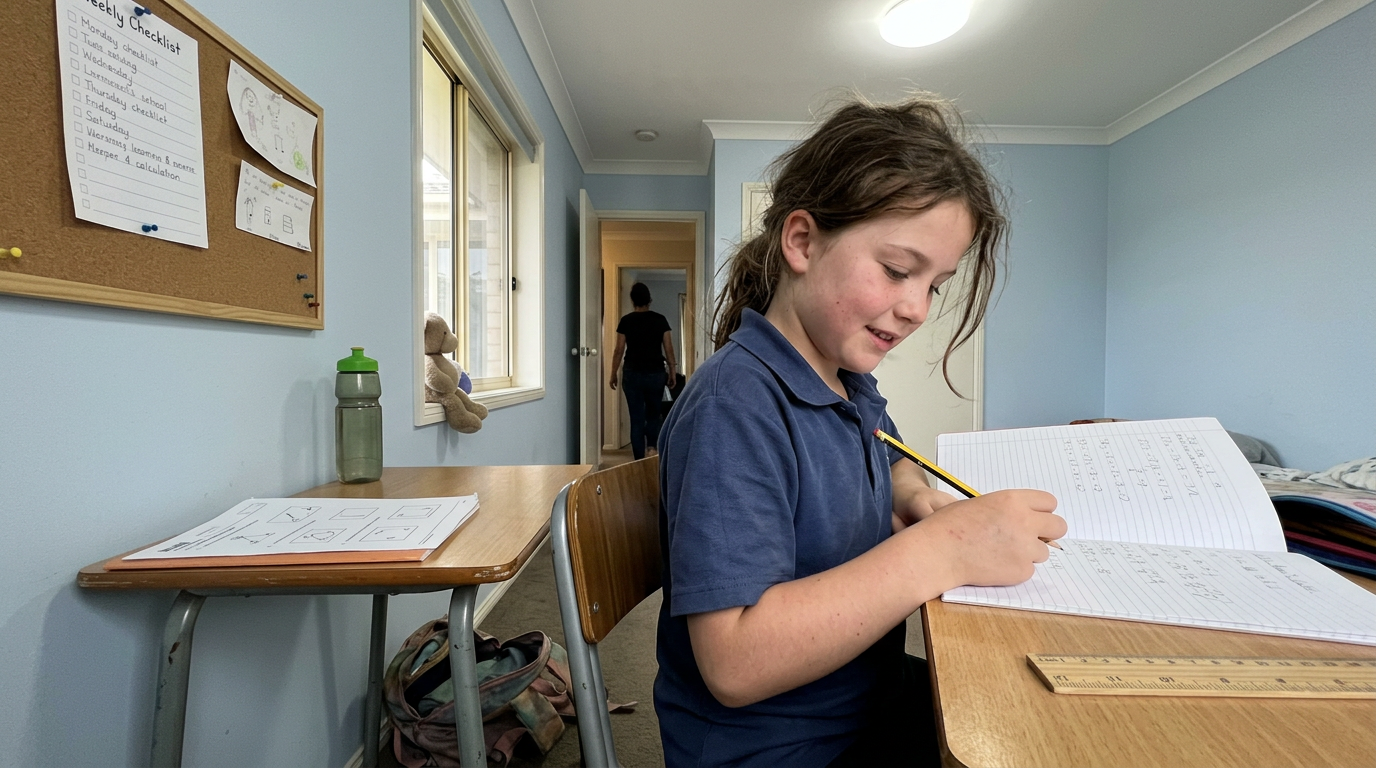
You teach a child to learn on their own by walking them through the same loop adults use, then handing it over piece by piece. The loop is plan, do, check, decide what next. Sit with them once and narrate it out loud — “What are you trying to finish? How will you know it’s right? What will you do if you get stuck?” Then next time, ask the same questions instead of answering them. After a fortnight of that, write the four prompts on a sticky note above their desk and let them run the loop themselves. The goal is not that they never need you again. The goal is that they try the loop before they call you, and you only step in when they’ve genuinely exhausted it.
Five strategies that actually build autonomy at home
| Strategy | What you do | Best fit by year |
|---|---|---|
| Hand over choice, not control | Offer a choice between two real options for what or how they study (“spelling first or maths first?”). | Year 1 onwards. |
| Replace instructions with questions | When you would normally say “do this”, ask “what do you think you should try first?” instead. | All ages. |
| Teach the plan-do-check loop | Before they start, ask them to write or say what done looks like. After they finish, ask how they’d check it. | Year 3 onwards. |
| Step back on purpose | Leave the room for fifteen minutes during homework. Resist the urge to check in. Let them notice they coped. | Year 4 onwards. |
| Praise the strategy, not the score | When they show you a finished piece of work, comment on the approach (“you went back and checked”) before the result. | All ages — gets more important with age. |
How do I make my child more independent in their schoolwork?
The most reliable lever is to narrow the help you give until they reach for it themselves. The technical term educators use is scaffolded autonomy — start with a lot of support, fade it deliberately, and don’t put it back on by default. In practice that looks like sitting next to them in Term 1, sitting in the same room but on the couch in Term 2, and being one room over with the door open by Term 3. Each step teaches the child something they could not learn while you were there: that they can recover from a stuck moment without rescue. Independence is built in the moments after a kid gets stuck and before a parent steps in.
The autonomy ladder, by year level
- Year 1–4 (primary). A 30-minute work block, parent in the house but not at the desk. Two-choice menus (“spelling or reading first?”). The plan-do-check loop run aloud with you, then handed over.
- Year 5–8 (lower secondary). A weekly checklist the child writes themselves on Sunday night. Phones out of the workspace. Parent available for one quick question per session, no more. The child decides when the session ends, based on the checklist.
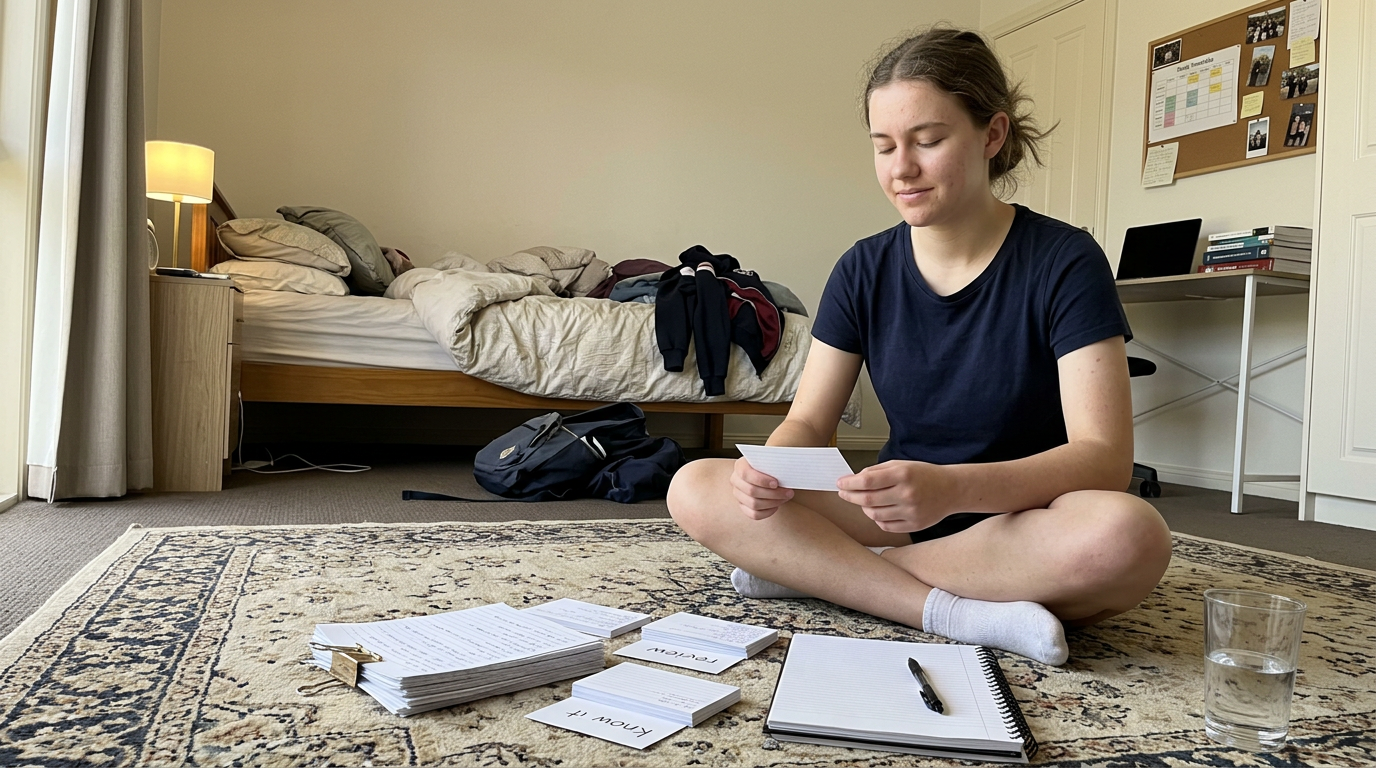
- Year 9–10 (mid-secondary). Self-set goals for each subject by term. Self-quizzing as the default revision method (flashcards, past questions, blank-page recall). Parent involvement narrows to a weekly check-in conversation.
- Year 11–12 (senior). A self-managed weekly study plan they show you, not one you set. They run their own past-paper cycles. Your job becomes logistics, food, and listening — not study management.
How can I stop hovering over my child’s homework?
Hovering is almost always anxiety on the parent’s side dressed up as helpfulness on the child’s side, and the research is unkind: Wendy Grolnick’s controlled studies show that children with overly controlling parents demonstrate lower intrinsic motivation, weaker persistence on hard tasks, and worse self-regulation — the exact opposite of what hovering is meant to produce. The fix is to give yourself a job to do that isn’t their work. Set a fifteen-minute timer, sit in the next room, and read a book or fold washing. When the timer goes, don’t go in — wait until they come to you with a specific question. Most of the time they won’t. That is the win.
“The best thing a parent can do for a struggling student is leave the room and trust the strategy. Independence is the muscle that grows in your absence, not your presence.”
What is the difference between autonomy-supportive and controlling parenting?
Autonomy-supportive parenting takes the child’s perspective seriously, offers genuine choices, explains the reason behind any non-negotiable, and treats mistakes as information rather than a failure of compliance. Controlling parenting uses pressure, deadlines, rewards-and-punishments, comparisons to siblings or classmates, and the parent’s own anxiety as a motivator. Both types of parents care equally — the research is clear on that — but the second style consistently produces worse academic outcomes because it crowds out the child’s sense of ownership over the work. The phrase to listen for in your own voice is “you have to”. Replace it with “what do you want to try?” and you’re most of the way there.
What to say instead — autonomy-supportive language
| Instead of | Try |
|---|---|
| “You have to do your maths now.” | “Maths or reading first today?” |
| “That’s wrong, do it again.” | “Walk me through how you got that.” |
| “Why didn’t you finish it?” | “What stopped you, and what would help next time?” |
| “Your sister was already on multiplication at your age.” | “What feels harder this week than last week?” |
| “If you finish, you can have screen time.” | “What do you want to do once this feels properly done?” |
When should my child start studying without parental help?
The honest answer is earlier than most parents think. By Year 3 a child should be doing the bulk of a homework session without a parent at the table. By Year 6 they should be running the whole session themselves, with you available but not in the room. By Year 9 the parent role narrows almost entirely to logistics and a weekly check-in. The trigger is not age, though — it is whether the child has been taught the plan-do-check loop and given enough unsupported practice to know they can run it. A Year 4 child who has practised this since Year 1 is more independent than a Year 9 child who has had a parent next to them every night since school started. Build the habit early and the timeline takes care of itself.
How do I build self-discipline in a teenager?
Self-discipline in a teenager is built by giving them real ownership of a real outcome they care about. The Education Endowment Foundation’s metacognition and self-regulation guidance — one of the highest-rated interventions in their entire toolkit, with a +7-month progress effect — is built on exactly this: explicit teaching of how to plan, monitor, and evaluate one’s own work, applied to outcomes the student cares about. Ask your teenager what mark, what subject, what skill matters to them this term. Then ask what they think a sensible weekly schedule would look like to get there. Their plan will be imperfect. Let it be. The first time they discover their own plan didn’t work and have to redesign it is the moment self-discipline starts to compound. Your job is to ask the question that prompts the redesign, not to redesign it for them.
The self-discipline starter kit for teenagers
- One concrete weekly goal, written down by the teenager on Sunday night.
- A self-quizzing routine — flashcards, past questions, or blank-page recall — done at least twice per subject per week, without a parent present.
- A phone-out-of-the-room rule for study blocks, set by the teenager themselves so it is theirs, not yours.
- A Friday review of what worked and what didn’t — five minutes, not a lecture.
- An escalation rule the teenager owns: if they’ve genuinely tried and are still stuck after thirty minutes, they ask a parent, a teacher, or a tutor — but only after thirty minutes.
How does self-directed learning improve academic outcomes?
Self-directed learners outperform peers on the metrics that matter most for the long run: deeper retention, stronger transfer of skills between subjects, higher persistence on hard problems, and better mental health under exam load. Hattie’s meta-analytic synthesis places self-regulation effects in the very top tier of academic interventions, and Carol Dweck’s growth-mindset work explains why — children who own their learning frame setbacks as information, while children who don’t frame the same setbacks as evidence they’re “not smart”. The mark on a test is downstream of which framing a child uses, and which framing a child uses is downstream of how much ownership they’ve been given. Outcomes follow ownership. They never run the other way.
What if my child is genuinely stuck and self-directed learning isn’t working?
The honest test is whether the loop is failing because the skill hasn’t been built yet, or because the work is genuinely beyond what the child can reach with the tools they have. If your child has tried the plan-do-check loop, given it a real go for thirty minutes, and is still spinning, the answer isn’t to push harder on independence — it’s to bring in a more skilled scaffolder than you. A good tutor models the loop, lets the child run it, and steps back the moment the child catches the rhythm. That is what one-to-one online tutoring with Tutero is built for: an experienced tutor sitting with your child for an hour a week, asking the questions you’d ask if you knew the subject as well as the tutor does, and then handing the loop back. We start at A$65 per hour and work with primary, lower-secondary, and senior students at the same rate. The autonomy stays with your child. The expertise comes from someone who has built the same skill in hundreds of others before them.
Related reading from Tutero
- How to motivate your child — the motivation companion. Autonomy is the upstream driver of intrinsic motivation in Self-Determination Theory; this piece walks through the downstream behaviours.
- The 5 most common habits of highly successful students — the habits that follow naturally once a student is genuinely self-directed.
- Time management tips for students — the operational layer. A self-directed learner who can’t plan a week loses most of the upside.
- Effective strategies to improve your maths study skills — what self-quizzing and blank-page recall look like in practice for one subject.
- 5 tips to set up a positive learning environment at home — the physical scaffolding that lets the autonomy work in the first place.
- 5 signs that your child needs tutoring — when the autonomy loop is genuinely failing for skill reasons rather than motivation.
- The ideal time to begin tutoring — earlier than most parents assume, for exactly the autonomy reasons in this piece.
The bottom line
Self-directed learning at home is built by handing over real choice, replacing instructions with questions, teaching the plan-do-check loop, stepping back on purpose, and praising strategy ahead of result. The Year 2 child managing a three-step morning routine and the Year 12 student running their own revision week are doing the same skill — and the work begins the same way: with a parent in the next room, willing to wait. Ready to give your child a tutor who builds independence instead of replacing it? Book a Tutero online tutor from A$65 per hour — same rate from primary through Year 12 — and watch the loop start running on its own.
Independence is built in the moments after a kid gets stuck and before a parent steps in.
Independence is built in the moments after a kid gets stuck and before a parent steps in.
Self-directed learning is when a child takes ownership of what they study, how long they study, and how they know if they’ve actually learnt it — with you in the background instead of the driver’s seat. It’s the single biggest predictor of how a kid copes once school stops chasing them every week, and it’s a skill that has to be built, not waited for. The five strategies below build it step by step, from primary through senior school, with the autonomy-supportive language that researchers like Wendy Grolnick and the team behind Self-Determination Theory (Deci and Ryan) have spent four decades validating.
Quick answer. Build self-directed learning by handing your child small, age-appropriate choices about what and how they study, by replacing instructions with questions, by teaching them to plan and self-check before asking for help, by stepping back from the homework table on purpose, and by celebrating effort and strategy rather than the mark on the page. Start where your child is. A Year 2 kid managing their own three-step morning routine is doing self-directed learning. So is a Year 11 student running their own weekly revision schedule. Same skill, different scale.
What is self-directed learning, and how do I encourage it at home?
Self-directed learning is the practice of a child setting their own goal for a task, choosing a strategy to reach it, monitoring their own progress, and judging the result themselves before checking with anyone else. It is the everyday version of what researchers call self-regulated learning, and John Hattie’s meta-analyses put it among the highest-effect-size things a student can develop — well above most curriculum interventions. To encourage it at home, narrow your role from “the person who tells them what to do next” to “the person who asks the question that helps them decide what to do next”. That single shift, repeated daily, is most of the work.
How do I teach my child to learn on their own?
You teach a child to learn on their own by walking them through the same loop adults use, then handing it over piece by piece. The loop is plan, do, check, decide what next. Sit with them once and narrate it out loud — “What are you trying to finish? How will you know it’s right? What will you do if you get stuck?” Then next time, ask the same questions instead of answering them. After a fortnight of that, write the four prompts on a sticky note above their desk and let them run the loop themselves. The goal is not that they never need you again. The goal is that they try the loop before they call you, and you only step in when they’ve genuinely exhausted it.
Five strategies that actually build autonomy at home
| Strategy | What you do | Best fit by year |
|---|---|---|
| Hand over choice, not control | Offer a choice between two real options for what or how they study (“spelling first or maths first?”). | Year 1 onwards. |
| Replace instructions with questions | When you would normally say “do this”, ask “what do you think you should try first?” instead. | All ages. |
| Teach the plan-do-check loop | Before they start, ask them to write or say what done looks like. After they finish, ask how they’d check it. | Year 3 onwards. |
| Step back on purpose | Leave the room for fifteen minutes during homework. Resist the urge to check in. Let them notice they coped. | Year 4 onwards. |
| Praise the strategy, not the score | When they show you a finished piece of work, comment on the approach (“you went back and checked”) before the result. | All ages — gets more important with age. |
How do I make my child more independent in their schoolwork?
The most reliable lever is to narrow the help you give until they reach for it themselves. The technical term educators use is scaffolded autonomy — start with a lot of support, fade it deliberately, and don’t put it back on by default. In practice that looks like sitting next to them in Term 1, sitting in the same room but on the couch in Term 2, and being one room over with the door open by Term 3. Each step teaches the child something they could not learn while you were there: that they can recover from a stuck moment without rescue. Independence is built in the moments after a kid gets stuck and before a parent steps in.
The autonomy ladder, by year level
- Year 1–4 (primary). A 30-minute work block, parent in the house but not at the desk. Two-choice menus (“spelling or reading first?”). The plan-do-check loop run aloud with you, then handed over.
- Year 5–8 (lower secondary). A weekly checklist the child writes themselves on Sunday night. Phones out of the workspace. Parent available for one quick question per session, no more. The child decides when the session ends, based on the checklist.
- Year 9–10 (mid-secondary). Self-set goals for each subject by term. Self-quizzing as the default revision method (flashcards, past questions, blank-page recall). Parent involvement narrows to a weekly check-in conversation.
- Year 11–12 (senior). A self-managed weekly study plan they show you, not one you set. They run their own past-paper cycles. Your job becomes logistics, food, and listening — not study management.
How can I stop hovering over my child’s homework?
Hovering is almost always anxiety on the parent’s side dressed up as helpfulness on the child’s side, and the research is unkind: Wendy Grolnick’s controlled studies show that children with overly controlling parents demonstrate lower intrinsic motivation, weaker persistence on hard tasks, and worse self-regulation — the exact opposite of what hovering is meant to produce. The fix is to give yourself a job to do that isn’t their work. Set a fifteen-minute timer, sit in the next room, and read a book or fold washing. When the timer goes, don’t go in — wait until they come to you with a specific question. Most of the time they won’t. That is the win.
“The best thing a parent can do for a struggling student is leave the room and trust the strategy. Independence is the muscle that grows in your absence, not your presence.”
What is the difference between autonomy-supportive and controlling parenting?
Autonomy-supportive parenting takes the child’s perspective seriously, offers genuine choices, explains the reason behind any non-negotiable, and treats mistakes as information rather than a failure of compliance. Controlling parenting uses pressure, deadlines, rewards-and-punishments, comparisons to siblings or classmates, and the parent’s own anxiety as a motivator. Both types of parents care equally — the research is clear on that — but the second style consistently produces worse academic outcomes because it crowds out the child’s sense of ownership over the work. The phrase to listen for in your own voice is “you have to”. Replace it with “what do you want to try?” and you’re most of the way there.
What to say instead — autonomy-supportive language
| Instead of | Try |
|---|---|
| “You have to do your maths now.” | “Maths or reading first today?” |
| “That’s wrong, do it again.” | “Walk me through how you got that.” |
| “Why didn’t you finish it?” | “What stopped you, and what would help next time?” |
| “Your sister was already on multiplication at your age.” | “What feels harder this week than last week?” |
| “If you finish, you can have screen time.” | “What do you want to do once this feels properly done?” |
When should my child start studying without parental help?
The honest answer is earlier than most parents think. By Year 3 a child should be doing the bulk of a homework session without a parent at the table. By Year 6 they should be running the whole session themselves, with you available but not in the room. By Year 9 the parent role narrows almost entirely to logistics and a weekly check-in. The trigger is not age, though — it is whether the child has been taught the plan-do-check loop and given enough unsupported practice to know they can run it. A Year 4 child who has practised this since Year 1 is more independent than a Year 9 child who has had a parent next to them every night since school started. Build the habit early and the timeline takes care of itself.
How do I build self-discipline in a teenager?
Self-discipline in a teenager is built by giving them real ownership of a real outcome they care about. The Education Endowment Foundation’s metacognition and self-regulation guidance — one of the highest-rated interventions in their entire toolkit, with a +7-month progress effect — is built on exactly this: explicit teaching of how to plan, monitor, and evaluate one’s own work, applied to outcomes the student cares about. Ask your teenager what mark, what subject, what skill matters to them this term. Then ask what they think a sensible weekly schedule would look like to get there. Their plan will be imperfect. Let it be. The first time they discover their own plan didn’t work and have to redesign it is the moment self-discipline starts to compound. Your job is to ask the question that prompts the redesign, not to redesign it for them.
The self-discipline starter kit for teenagers
- One concrete weekly goal, written down by the teenager on Sunday night.
- A self-quizzing routine — flashcards, past questions, or blank-page recall — done at least twice per subject per week, without a parent present.
- A phone-out-of-the-room rule for study blocks, set by the teenager themselves so it is theirs, not yours.
- A Friday review of what worked and what didn’t — five minutes, not a lecture.
- An escalation rule the teenager owns: if they’ve genuinely tried and are still stuck after thirty minutes, they ask a parent, a teacher, or a tutor — but only after thirty minutes.
How does self-directed learning improve academic outcomes?
Self-directed learners outperform peers on the metrics that matter most for the long run: deeper retention, stronger transfer of skills between subjects, higher persistence on hard problems, and better mental health under exam load. Hattie’s meta-analytic synthesis places self-regulation effects in the very top tier of academic interventions, and Carol Dweck’s growth-mindset work explains why — children who own their learning frame setbacks as information, while children who don’t frame the same setbacks as evidence they’re “not smart”. The mark on a test is downstream of which framing a child uses, and which framing a child uses is downstream of how much ownership they’ve been given. Outcomes follow ownership. They never run the other way.
What if my child is genuinely stuck and self-directed learning isn’t working?
The honest test is whether the loop is failing because the skill hasn’t been built yet, or because the work is genuinely beyond what the child can reach with the tools they have. If your child has tried the plan-do-check loop, given it a real go for thirty minutes, and is still spinning, the answer isn’t to push harder on independence — it’s to bring in a more skilled scaffolder than you. A good tutor models the loop, lets the child run it, and steps back the moment the child catches the rhythm. That is what one-to-one online tutoring with Tutero is built for: an experienced tutor sitting with your child for an hour a week, asking the questions you’d ask if you knew the subject as well as the tutor does, and then handing the loop back. We start at A$65 per hour and work with primary, lower-secondary, and senior students at the same rate. The autonomy stays with your child. The expertise comes from someone who has built the same skill in hundreds of others before them.
Related reading from Tutero
- How to motivate your child — the motivation companion. Autonomy is the upstream driver of intrinsic motivation in Self-Determination Theory; this piece walks through the downstream behaviours.
- The 5 most common habits of highly successful students — the habits that follow naturally once a student is genuinely self-directed.
- Time management tips for students — the operational layer. A self-directed learner who can’t plan a week loses most of the upside.
- Effective strategies to improve your maths study skills — what self-quizzing and blank-page recall look like in practice for one subject.
- 5 tips to set up a positive learning environment at home — the physical scaffolding that lets the autonomy work in the first place.
- 5 signs that your child needs tutoring — when the autonomy loop is genuinely failing for skill reasons rather than motivation.
- The ideal time to begin tutoring — earlier than most parents assume, for exactly the autonomy reasons in this piece.
The bottom line
Self-directed learning at home is built by handing over real choice, replacing instructions with questions, teaching the plan-do-check loop, stepping back on purpose, and praising strategy ahead of result. The Year 2 child managing a three-step morning routine and the Year 12 student running their own revision week are doing the same skill — and the work begins the same way: with a parent in the next room, willing to wait. Ready to give your child a tutor who builds independence instead of replacing it? Book a Tutero online tutor from A$65 per hour — same rate from primary through Year 12 — and watch the loop start running on its own.
FAQ
.svg)
.svg)
Online maths tutoring at Tutero is catering to students of all year levels. We offer programs tailored to the unique learning curves of each age group.
We also have expert NAPLAN and ATAR subject tutors, ensuring students are well-equipped for these pivotal assessments.
We recommend at least two to three session per week for consistent progress. However, this can vary based on your child's needs and goals.
Our platform uses advanced security protocols to ensure the safety and privacy of all our online sessions.
Parents are welcome to observe sessions. We believe in a collaborative approach to education.
We provide regular progress reports and assessments to track your child’s academic development.
Yes, we prioritise the student-tutor relationship and can arrange a change if the need arises.
Yes, we offer a range of resources and materials, including interactive exercises and practice worksheets.
Independence is built in the moments after a kid gets stuck and before a parent steps in.
Independence is built in the moments after a kid gets stuck and before a parent steps in.

Independence is built in the moments after a kid gets stuck and before a parent steps in.
Outcomes follow ownership. They never run the other way.
Self-directed learning is when a child takes ownership of what they study, how long they study, and how they know if they’ve actually learnt it — with you in the background instead of the driver’s seat. It’s the single biggest predictor of how a kid copes once school stops chasing them every week, and it’s a skill that has to be built, not waited for. The five strategies below build it step by step, from primary through senior school, with the autonomy-supportive language that researchers like Wendy Grolnick and the team behind Self-Determination Theory (Deci and Ryan) have spent four decades validating.
Quick answer. Build self-directed learning by handing your child small, age-appropriate choices about what and how they study, by replacing instructions with questions, by teaching them to plan and self-check before asking for help, by stepping back from the homework table on purpose, and by celebrating effort and strategy rather than the mark on the page. Start where your child is. A Year 2 kid managing their own three-step morning routine is doing self-directed learning. So is a Year 11 student running their own weekly revision schedule. Same skill, different scale.
What is self-directed learning, and how do I encourage it at home?
Self-directed learning is the practice of a child setting their own goal for a task, choosing a strategy to reach it, monitoring their own progress, and judging the result themselves before checking with anyone else. It is the everyday version of what researchers call self-regulated learning, and John Hattie’s meta-analyses put it among the highest-effect-size things a student can develop — well above most curriculum interventions. To encourage it at home, narrow your role from “the person who tells them what to do next” to “the person who asks the question that helps them decide what to do next”. That single shift, repeated daily, is most of the work.
How do I teach my child to learn on their own?
You teach a child to learn on their own by walking them through the same loop adults use, then handing it over piece by piece. The loop is plan, do, check, decide what next. Sit with them once and narrate it out loud — “What are you trying to finish? How will you know it’s right? What will you do if you get stuck?” Then next time, ask the same questions instead of answering them. After a fortnight of that, write the four prompts on a sticky note above their desk and let them run the loop themselves. The goal is not that they never need you again. The goal is that they try the loop before they call you, and you only step in when they’ve genuinely exhausted it.
Five strategies that actually build autonomy at home
| Strategy | What you do | Best fit by year |
|---|---|---|
| Hand over choice, not control | Offer a choice between two real options for what or how they study (“spelling first or maths first?”). | Year 1 onwards. |
| Replace instructions with questions | When you would normally say “do this”, ask “what do you think you should try first?” instead. | All ages. |
| Teach the plan-do-check loop | Before they start, ask them to write or say what done looks like. After they finish, ask how they’d check it. | Year 3 onwards. |
| Step back on purpose | Leave the room for fifteen minutes during homework. Resist the urge to check in. Let them notice they coped. | Year 4 onwards. |
| Praise the strategy, not the score | When they show you a finished piece of work, comment on the approach (“you went back and checked”) before the result. | All ages — gets more important with age. |
How do I make my child more independent in their schoolwork?
The most reliable lever is to narrow the help you give until they reach for it themselves. The technical term educators use is scaffolded autonomy — start with a lot of support, fade it deliberately, and don’t put it back on by default. In practice that looks like sitting next to them in Term 1, sitting in the same room but on the couch in Term 2, and being one room over with the door open by Term 3. Each step teaches the child something they could not learn while you were there: that they can recover from a stuck moment without rescue. Independence is built in the moments after a kid gets stuck and before a parent steps in.
The autonomy ladder, by year level
- Year 1–4 (primary). A 30-minute work block, parent in the house but not at the desk. Two-choice menus (“spelling or reading first?”). The plan-do-check loop run aloud with you, then handed over.
- Year 5–8 (lower secondary). A weekly checklist the child writes themselves on Sunday night. Phones out of the workspace. Parent available for one quick question per session, no more. The child decides when the session ends, based on the checklist.
- Year 9–10 (mid-secondary). Self-set goals for each subject by term. Self-quizzing as the default revision method (flashcards, past questions, blank-page recall). Parent involvement narrows to a weekly check-in conversation.
- Year 11–12 (senior). A self-managed weekly study plan they show you, not one you set. They run their own past-paper cycles. Your job becomes logistics, food, and listening — not study management.
How can I stop hovering over my child’s homework?
Hovering is almost always anxiety on the parent’s side dressed up as helpfulness on the child’s side, and the research is unkind: Wendy Grolnick’s controlled studies show that children with overly controlling parents demonstrate lower intrinsic motivation, weaker persistence on hard tasks, and worse self-regulation — the exact opposite of what hovering is meant to produce. The fix is to give yourself a job to do that isn’t their work. Set a fifteen-minute timer, sit in the next room, and read a book or fold washing. When the timer goes, don’t go in — wait until they come to you with a specific question. Most of the time they won’t. That is the win.
“The best thing a parent can do for a struggling student is leave the room and trust the strategy. Independence is the muscle that grows in your absence, not your presence.”
What is the difference between autonomy-supportive and controlling parenting?
Autonomy-supportive parenting takes the child’s perspective seriously, offers genuine choices, explains the reason behind any non-negotiable, and treats mistakes as information rather than a failure of compliance. Controlling parenting uses pressure, deadlines, rewards-and-punishments, comparisons to siblings or classmates, and the parent’s own anxiety as a motivator. Both types of parents care equally — the research is clear on that — but the second style consistently produces worse academic outcomes because it crowds out the child’s sense of ownership over the work. The phrase to listen for in your own voice is “you have to”. Replace it with “what do you want to try?” and you’re most of the way there.
What to say instead — autonomy-supportive language
| Instead of | Try |
|---|---|
| “You have to do your maths now.” | “Maths or reading first today?” |
| “That’s wrong, do it again.” | “Walk me through how you got that.” |
| “Why didn’t you finish it?” | “What stopped you, and what would help next time?” |
| “Your sister was already on multiplication at your age.” | “What feels harder this week than last week?” |
| “If you finish, you can have screen time.” | “What do you want to do once this feels properly done?” |
When should my child start studying without parental help?
The honest answer is earlier than most parents think. By Year 3 a child should be doing the bulk of a homework session without a parent at the table. By Year 6 they should be running the whole session themselves, with you available but not in the room. By Year 9 the parent role narrows almost entirely to logistics and a weekly check-in. The trigger is not age, though — it is whether the child has been taught the plan-do-check loop and given enough unsupported practice to know they can run it. A Year 4 child who has practised this since Year 1 is more independent than a Year 9 child who has had a parent next to them every night since school started. Build the habit early and the timeline takes care of itself.
How do I build self-discipline in a teenager?
Self-discipline in a teenager is built by giving them real ownership of a real outcome they care about. The Education Endowment Foundation’s metacognition and self-regulation guidance — one of the highest-rated interventions in their entire toolkit, with a +7-month progress effect — is built on exactly this: explicit teaching of how to plan, monitor, and evaluate one’s own work, applied to outcomes the student cares about. Ask your teenager what mark, what subject, what skill matters to them this term. Then ask what they think a sensible weekly schedule would look like to get there. Their plan will be imperfect. Let it be. The first time they discover their own plan didn’t work and have to redesign it is the moment self-discipline starts to compound. Your job is to ask the question that prompts the redesign, not to redesign it for them.
The self-discipline starter kit for teenagers
- One concrete weekly goal, written down by the teenager on Sunday night.
- A self-quizzing routine — flashcards, past questions, or blank-page recall — done at least twice per subject per week, without a parent present.
- A phone-out-of-the-room rule for study blocks, set by the teenager themselves so it is theirs, not yours.
- A Friday review of what worked and what didn’t — five minutes, not a lecture.
- An escalation rule the teenager owns: if they’ve genuinely tried and are still stuck after thirty minutes, they ask a parent, a teacher, or a tutor — but only after thirty minutes.
How does self-directed learning improve academic outcomes?
Self-directed learners outperform peers on the metrics that matter most for the long run: deeper retention, stronger transfer of skills between subjects, higher persistence on hard problems, and better mental health under exam load. Hattie’s meta-analytic synthesis places self-regulation effects in the very top tier of academic interventions, and Carol Dweck’s growth-mindset work explains why — children who own their learning frame setbacks as information, while children who don’t frame the same setbacks as evidence they’re “not smart”. The mark on a test is downstream of which framing a child uses, and which framing a child uses is downstream of how much ownership they’ve been given. Outcomes follow ownership. They never run the other way.
What if my child is genuinely stuck and self-directed learning isn’t working?
The honest test is whether the loop is failing because the skill hasn’t been built yet, or because the work is genuinely beyond what the child can reach with the tools they have. If your child has tried the plan-do-check loop, given it a real go for thirty minutes, and is still spinning, the answer isn’t to push harder on independence — it’s to bring in a more skilled scaffolder than you. A good tutor models the loop, lets the child run it, and steps back the moment the child catches the rhythm. That is what one-to-one online tutoring with Tutero is built for: an experienced tutor sitting with your child for an hour a week, asking the questions you’d ask if you knew the subject as well as the tutor does, and then handing the loop back. We start at A$65 per hour and work with primary, lower-secondary, and senior students at the same rate. The autonomy stays with your child. The expertise comes from someone who has built the same skill in hundreds of others before them.
Related reading from Tutero
- How to motivate your child — the motivation companion. Autonomy is the upstream driver of intrinsic motivation in Self-Determination Theory; this piece walks through the downstream behaviours.
- The 5 most common habits of highly successful students — the habits that follow naturally once a student is genuinely self-directed.
- Time management tips for students — the operational layer. A self-directed learner who can’t plan a week loses most of the upside.
- Effective strategies to improve your maths study skills — what self-quizzing and blank-page recall look like in practice for one subject.
- 5 tips to set up a positive learning environment at home — the physical scaffolding that lets the autonomy work in the first place.
- 5 signs that your child needs tutoring — when the autonomy loop is genuinely failing for skill reasons rather than motivation.
- The ideal time to begin tutoring — earlier than most parents assume, for exactly the autonomy reasons in this piece.
The bottom line
Self-directed learning at home is built by handing over real choice, replacing instructions with questions, teaching the plan-do-check loop, stepping back on purpose, and praising strategy ahead of result. The Year 2 child managing a three-step morning routine and the Year 12 student running their own revision week are doing the same skill — and the work begins the same way: with a parent in the next room, willing to wait. Ready to give your child a tutor who builds independence instead of replacing it? Book a Tutero online tutor from A$65 per hour — same rate from primary through Year 12 — and watch the loop start running on its own.
Independence is built in the moments after a kid gets stuck and before a parent steps in.
Outcomes follow ownership. They never run the other way.
Hoping to improve confidence & grades?

.png)


