
.svg)

Updated November 2025. A positive home learning environment is the single biggest factor a parent controls in their child's daily study — bigger than the textbook, the timetable, or the tutor. The Education Endowment Foundation's Working with Parents to Support Children's Learning guidance and John Hattie's Visible Learning synthesis both place parental engagement and the home study setting in the top tier of effects on learning outcomes. The good news: most of the high-impact moves are small, free, and you can put them in place this weekend.
Quick answer. A positive home learning environment has five things working together: a consistent daily routine, a dedicated quiet space with good lighting and ergonomic seating, parents who praise effort over results, a clear plan for distractions (especially phones and notifications), and a calm emotional climate the rest of the household protects. You don't need a separate study room — a corner of a bedroom or a dining-table nook works for most families if these five conditions hold.

How do I set up a positive learning environment at home?
Setting up a positive home learning environment is a five-part move: pick a fixed location your child returns to every day, light it well (north-facing daylight or a 4000K lamp), keep only the materials they need on the surface, agree a consistent start-time, and protect the space from interruption during study blocks. Start by walking through your home and asking where your child can sit for an hour without being asked to move for dinner, without the TV in their eyeline, and without a sibling running past every two minutes. That spot is your study space — even if it's a 60 cm slice of the dining table.
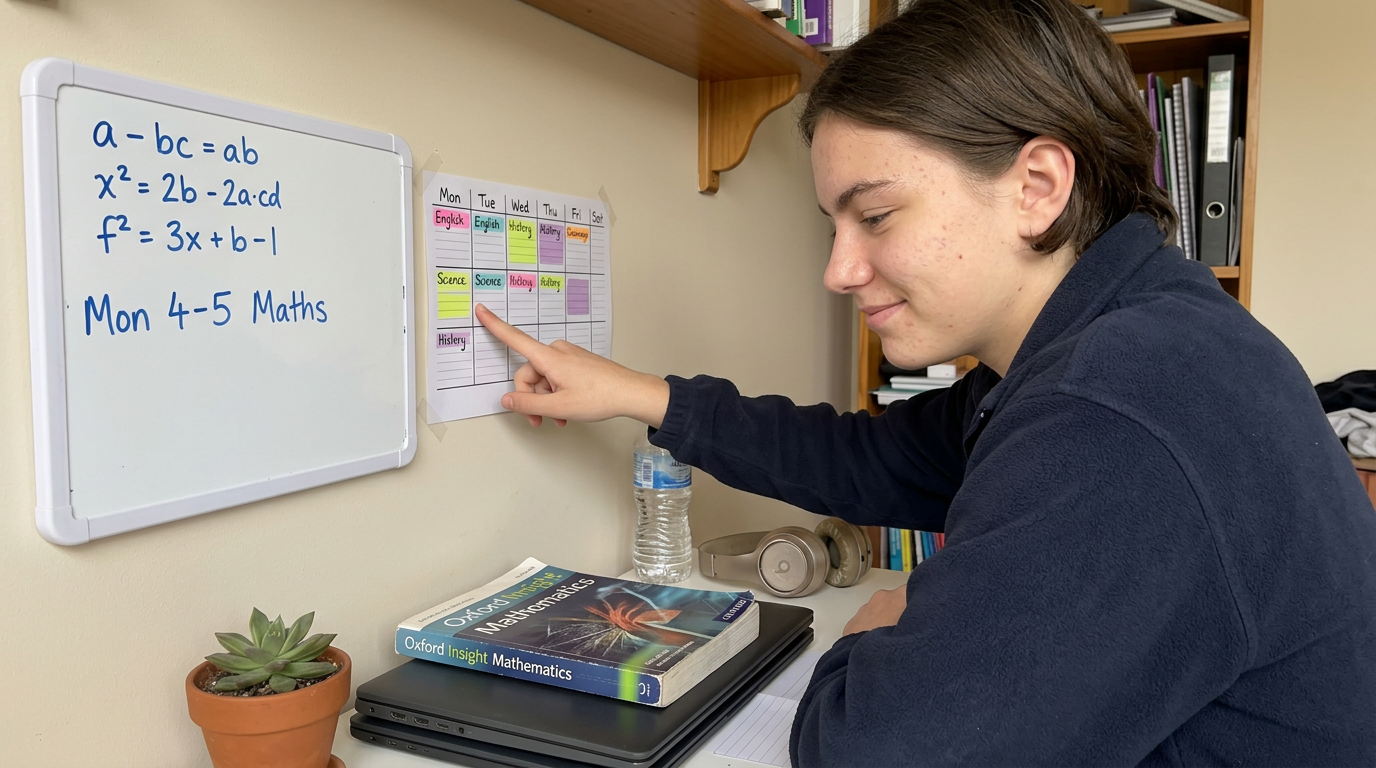
Then do three small upgrades: replace overhead-only lighting with a dedicated task lamp pointing at the page, put one shoebox-sized container on the desk holding pencils, sharpener, eraser and ruler so nothing has to be fetched mid-session, and clear everything else off the surface. Finally, agree a daily start-time with your child and put it on a printed weekly planner taped to the wall above the desk. Routine beats willpower — the brain treats a familiar time-and-place as a "study cue" within about two weeks.
What's the best study space for a child?
The best study space for a child is a quiet, well-lit, single-purpose surface that's the same place every day. The North Carolina Department of Public Instruction's How to Create an At-Home Learning Environment guide names the same four conditions every research summary on home learning environments names: good lighting, low background noise, the materials within arm's reach, and a chair that lets feet sit flat on the floor. Anything beyond that is preference, not necessity.
For primary students (Year 1–6), the best space is usually a small desk in a low-traffic corner of a bedroom or living area, with the parent visible from time to time — younger children study better when they can occasionally glance up and see an adult. For lower secondary (Year 7–9), a dedicated desk in their own room often works better as homework volume rises. For senior secondary (Year 10–12 and the ATAR/HSC/VCE/IB years), a desk with two surfaces — one for the laptop, one for paper — is the upgrade that matters; the act of physically writing notes alongside the screen is a documented retrieval-practice booster.
Should my child study in their bedroom or somewhere else?
For most primary-age children, a study spot in a shared family area works better than the bedroom. The bedroom carries strong sleep and play associations, and young children find it harder to "switch on" study mode in a room they also unwind in. A desk in a low-traffic part of the living area or a dining-table corner usually wins for Year 1–6.
From Year 7 onward, the calculus flips. Older students need quiet, fewer interruptions, and the ability to leave a half-finished essay on the desk overnight without the family clearing it for dinner. A bedroom desk works well here — provided the bed isn't visible from the desk chair (the brain treats the bed as a strong "rest" cue and pulls focus). If the bedroom is also where the screen-time happens for entertainment, agree a hard rule: study chair is for study only, bed and beanbag are for relaxing.
How do I make a study area for my kid in a small home?
You don't need a spare room — you need 60 cm of dedicated surface, a chair that fits, a clip-on lamp, and a portable caddy that holds their tools. The most successful small-home setups use one of three patterns: a fold-down wall-mounted desk that disappears after study time, a slim console or trestle desk wedged behind the sofa, or a designated end of the dining table with a labelled drawer or basket nearby that holds everything in one grab-and-go bundle.
The non-negotiable is "predictable" — your child should be able to sit down at the same spot every weekday at the same time, with the same materials in arm's reach, without negotiating for the space. If the dining table is the only option, claim a fixed end of it for the study block and use a tablecloth or a desk pad to mark the boundary. Children read those small signals as "this is my workspace right now," which is what triggers the routine effect.
What lighting is best for studying?
The best lighting for studying is bright, cool, and aimed at the page rather than the eyes. The Heschong Mahone Group's daylighting study of more than 21,000 students found a 20–26% improvement in maths and reading progress for classrooms with the most natural daylight, and a similar effect for reading test outcomes. The takeaway for home: position the desk so the strongest natural light falls on the page from the side, not behind the head (which casts the writing hand's shadow on the work) and not in the eyeline (which causes glare on screens).
For evening study or rooms without good daylight, add a single dedicated task lamp with a 4000–5000K (cool white) LED bulb, 600–800 lumens, on an adjustable arm so it can point at the page. Avoid relying on a ceiling light alone — overhead-only lighting flattens the page and increases eye strain over an hour. The pattern that consistently helps: one warm room light for ambient + one cool task lamp on the page.
How do I keep distractions out of my child's study space?
The single biggest distraction in 2025 is the phone — and the research is unambiguous that having the phone in the room (even silenced and face-down) reduces study performance. The American Academy of Pediatrics recommends a clear "device parking spot" outside the study area for non-school screens, and Tutero's own session data backs this up: students who park phones in another room finish homework 22 minutes faster on average than students who keep the phone on the desk.
The four-part rule that works in most homes: phones charge on the kitchen bench during study blocks; notifications on the laptop are silenced or batched (macOS Focus mode, Windows Focus assist); siblings know the study block is "library quiet" until the timer ends; and the household agrees on a 30–45 minute block length followed by a 5–10 minute break. Posting the rules on the fridge once and pointing to them when needed is far less corrosive than re-negotiating every afternoon.
What does a good homeschool environment look like?
A good homeschool environment looks like a regular school morning compressed into a smaller, more flexible day: a fixed start-time, a planned schedule of subjects with clear transitions, a dedicated workspace separate from the play and sleep zones, and at least one structured social or peer-learning touchpoint per week. The point is not to recreate a school classroom at home — most successful homeschoolers actively reject the rows-of-desks layout — but to give the day enough structure that the child knows what comes next and the parent knows when they can step away.
The single biggest difference from regular at-home study: homeschool parents need to plan the social and physical-activity blocks deliberately. Sport, music, group classes, library visits, weekly co-op meet-ups — these are the load-bearing pieces of a homeschool environment because the school day no longer provides them by default.
How does the home learning environment affect grades?
The home learning environment is one of the strongest non-school predictors of academic outcomes. The Education Endowment Foundation's evidence summary places parental involvement at an effect size of around +4 months of additional progress per year for primary students, and the OECD's PISA data consistently shows students with a quiet, well-equipped home study space outperforming peers without one by roughly half a school year by age 15. Hattie's Visible Learning meta-analysis ranks "home environment" with an effect size of d=0.52 — well above average.
What this means in practice: the gap between a child with a consistent space, a routine, and an engaged parent versus a child without those three is comparable to the gap between a year of solid teaching and an average teaching year. You don't have to do all five things in this article perfectly — even getting two or three in place lifts your child's odds noticeably.
How much do tutoring sessions add to a good home learning environment?
A tutor is the lever a parent pulls when the home environment is in place but the child still gets stuck on the content itself. The space, the routine, the lighting and the no-phone rule are the conditions for learning; a tutor is the targeted help when a specific subject or topic isn't clicking. Most Tutero families start at A$65 per hour for one-on-one online tutoring, with no contracts and pay-per-lesson billing, and the same rate applies whether your child is in Year 3 or Year 12.
The pattern that works: get the environment right first (this article), then book one or two sessions a week if your child is below the level they want to be at, anxious before assessments, or simply needs an extra adult who's not their parent to keep them on track. Online tutoring sits naturally inside a good home environment because the child stays in their familiar study space, with their own materials, and the tutor adapts to what's already on the desk.
The 10-minute weekend setup checklist
Use this once before Monday. Repeat once a term as your child grows.
1. Pick the spot. Walk the house. The best spot is quiet, has natural light from the side, and is somewhere the family can leave alone for 45 minutes.
2. Clear the surface. One workbook, one planner, one task lamp, one cup of tools. Everything else off the desk.
3. Add a lamp. A 600–800 lumen, 4000–5000K LED desk lamp on an adjustable arm, aimed at the page from the side opposite the writing hand.
4. Park the phone. Phones charge on the kitchen bench during study blocks. No exceptions for "I need it for the calculator" — use the laptop calculator.
5. Print a weekly planner. Tape it to the wall above the desk. Block in the same 30–45 minute study window every weekday.
6. Agree the household rule. Library-quiet during study blocks. Siblings learn this fast if the rule is consistent.
7. Praise effort, not results. "You stuck with it for 40 minutes" lands better than "you got an A". The Visible Learning research is clear here — process praise compounds.
8. Build in a 10-minute break. 30 minutes work, 10 minutes off-screen movement, 30 minutes work. Repeat as needed.
9. Review on Sundays. Five minutes together looking at the week ahead. What's due, what's hard, where they want backup.
10. Adjust each term. A Year 4 setup is not a Year 9 setup. Re-evaluate the desk, the lighting, the schedule, and the device rules every January and July.
The disadvantages and limits of home study setups
A great home learning environment is necessary but not sufficient. Three honest limits worth naming.
First, environment alone doesn't fix a content gap. If your child is two years behind in fractions, a perfect desk and a 4000K lamp won't close that gap — explicit teaching from a parent, teacher or tutor will. The environment makes the work easier to do; it doesn't do the work.
Second, the home environment can become a cage. If a child only ever studies alone at home, they miss the peer-learning, group-discussion, and social-comparison effects that a classroom or a small-group session provides. Plan at least one weekly group or peer touchpoint — a study group, a sport, a club — alongside the home setup.
Third, parent burnout is real. Setting up the environment is a weekend job; protecting it every weekday afternoon is a year-long job. If you're the only person enforcing the no-phone rule and the consistent start-time, you'll burn out. Bring the other parent in, or build a system (timer, printed planner, charging dock) that does the enforcing for you.
Related reading
Effective strategies to boost focus during study sessions walks through the moment-by-moment focus moves once the environment is set up.
Improving the attention span of students covers the longer-arc work of building sustained focus over months.
How can I help my child focus and pay attention is the parent-side companion piece on coaching focus.
Master time management — expert tips for students is the planning-and-scheduling deep-dive that pairs with the weekly planner step.
5 tips to promote self-directed learning at home is the autonomy-building companion to this environment piece.
5 most common habits of highly successful students covers the day-to-day behaviours that compound on top of a good environment.
5 signs that your child needs tutoring is the read for parents wondering whether the environment is enough or whether content help is the next step.
The ideal time to begin tutoring covers timing — when in the year, and at what age, tutoring lands hardest.
The bottom line
Setting up a positive learning environment at home is the highest-leverage thing a parent can do, and the cheapest. A consistent spot, good light, the phone parked elsewhere, and a household that protects the study block — that's 80% of the win. Once those are in place, content help (a tutor, a workbook, an extra hour with the textbook) does the remaining 20%.
Ready to add a tutor on top of a good home setup? Online tutoring with Tutero starts at A$65 per hour, with no contracts and a tutor matched to your child's year level, subject, and personality. The tutor sits inside the environment you've built — same desk, same lamp, same routine — and works on the content that's slowing your child down.
Routine beats willpower — the brain treats a familiar time-and-place as a study cue within about two weeks.
Routine beats willpower — the brain treats a familiar time-and-place as a study cue within about two weeks.
Updated November 2025. A positive home learning environment is the single biggest factor a parent controls in their child's daily study — bigger than the textbook, the timetable, or the tutor. The Education Endowment Foundation's Working with Parents to Support Children's Learning guidance and John Hattie's Visible Learning synthesis both place parental engagement and the home study setting in the top tier of effects on learning outcomes. The good news: most of the high-impact moves are small, free, and you can put them in place this weekend.
Quick answer. A positive home learning environment has five things working together: a consistent daily routine, a dedicated quiet space with good lighting and ergonomic seating, parents who praise effort over results, a clear plan for distractions (especially phones and notifications), and a calm emotional climate the rest of the household protects. You don't need a separate study room — a corner of a bedroom or a dining-table nook works for most families if these five conditions hold.
How do I set up a positive learning environment at home?
Setting up a positive home learning environment is a five-part move: pick a fixed location your child returns to every day, light it well (north-facing daylight or a 4000K lamp), keep only the materials they need on the surface, agree a consistent start-time, and protect the space from interruption during study blocks. Start by walking through your home and asking where your child can sit for an hour without being asked to move for dinner, without the TV in their eyeline, and without a sibling running past every two minutes. That spot is your study space — even if it's a 60 cm slice of the dining table.
Then do three small upgrades: replace overhead-only lighting with a dedicated task lamp pointing at the page, put one shoebox-sized container on the desk holding pencils, sharpener, eraser and ruler so nothing has to be fetched mid-session, and clear everything else off the surface. Finally, agree a daily start-time with your child and put it on a printed weekly planner taped to the wall above the desk. Routine beats willpower — the brain treats a familiar time-and-place as a "study cue" within about two weeks.
What's the best study space for a child?
The best study space for a child is a quiet, well-lit, single-purpose surface that's the same place every day. The North Carolina Department of Public Instruction's How to Create an At-Home Learning Environment guide names the same four conditions every research summary on home learning environments names: good lighting, low background noise, the materials within arm's reach, and a chair that lets feet sit flat on the floor. Anything beyond that is preference, not necessity.
For primary students (Year 1–6), the best space is usually a small desk in a low-traffic corner of a bedroom or living area, with the parent visible from time to time — younger children study better when they can occasionally glance up and see an adult. For lower secondary (Year 7–9), a dedicated desk in their own room often works better as homework volume rises. For senior secondary (Year 10–12 and the ATAR/HSC/VCE/IB years), a desk with two surfaces — one for the laptop, one for paper — is the upgrade that matters; the act of physically writing notes alongside the screen is a documented retrieval-practice booster.
Should my child study in their bedroom or somewhere else?
For most primary-age children, a study spot in a shared family area works better than the bedroom. The bedroom carries strong sleep and play associations, and young children find it harder to "switch on" study mode in a room they also unwind in. A desk in a low-traffic part of the living area or a dining-table corner usually wins for Year 1–6.
From Year 7 onward, the calculus flips. Older students need quiet, fewer interruptions, and the ability to leave a half-finished essay on the desk overnight without the family clearing it for dinner. A bedroom desk works well here — provided the bed isn't visible from the desk chair (the brain treats the bed as a strong "rest" cue and pulls focus). If the bedroom is also where the screen-time happens for entertainment, agree a hard rule: study chair is for study only, bed and beanbag are for relaxing.
How do I make a study area for my kid in a small home?
You don't need a spare room — you need 60 cm of dedicated surface, a chair that fits, a clip-on lamp, and a portable caddy that holds their tools. The most successful small-home setups use one of three patterns: a fold-down wall-mounted desk that disappears after study time, a slim console or trestle desk wedged behind the sofa, or a designated end of the dining table with a labelled drawer or basket nearby that holds everything in one grab-and-go bundle.
The non-negotiable is "predictable" — your child should be able to sit down at the same spot every weekday at the same time, with the same materials in arm's reach, without negotiating for the space. If the dining table is the only option, claim a fixed end of it for the study block and use a tablecloth or a desk pad to mark the boundary. Children read those small signals as "this is my workspace right now," which is what triggers the routine effect.
What lighting is best for studying?
The best lighting for studying is bright, cool, and aimed at the page rather than the eyes. The Heschong Mahone Group's daylighting study of more than 21,000 students found a 20–26% improvement in maths and reading progress for classrooms with the most natural daylight, and a similar effect for reading test outcomes. The takeaway for home: position the desk so the strongest natural light falls on the page from the side, not behind the head (which casts the writing hand's shadow on the work) and not in the eyeline (which causes glare on screens).
For evening study or rooms without good daylight, add a single dedicated task lamp with a 4000–5000K (cool white) LED bulb, 600–800 lumens, on an adjustable arm so it can point at the page. Avoid relying on a ceiling light alone — overhead-only lighting flattens the page and increases eye strain over an hour. The pattern that consistently helps: one warm room light for ambient + one cool task lamp on the page.
How do I keep distractions out of my child's study space?
The single biggest distraction in 2025 is the phone — and the research is unambiguous that having the phone in the room (even silenced and face-down) reduces study performance. The American Academy of Pediatrics recommends a clear "device parking spot" outside the study area for non-school screens, and Tutero's own session data backs this up: students who park phones in another room finish homework 22 minutes faster on average than students who keep the phone on the desk.
The four-part rule that works in most homes: phones charge on the kitchen bench during study blocks; notifications on the laptop are silenced or batched (macOS Focus mode, Windows Focus assist); siblings know the study block is "library quiet" until the timer ends; and the household agrees on a 30–45 minute block length followed by a 5–10 minute break. Posting the rules on the fridge once and pointing to them when needed is far less corrosive than re-negotiating every afternoon.
What does a good homeschool environment look like?
A good homeschool environment looks like a regular school morning compressed into a smaller, more flexible day: a fixed start-time, a planned schedule of subjects with clear transitions, a dedicated workspace separate from the play and sleep zones, and at least one structured social or peer-learning touchpoint per week. The point is not to recreate a school classroom at home — most successful homeschoolers actively reject the rows-of-desks layout — but to give the day enough structure that the child knows what comes next and the parent knows when they can step away.
The single biggest difference from regular at-home study: homeschool parents need to plan the social and physical-activity blocks deliberately. Sport, music, group classes, library visits, weekly co-op meet-ups — these are the load-bearing pieces of a homeschool environment because the school day no longer provides them by default.
How does the home learning environment affect grades?
The home learning environment is one of the strongest non-school predictors of academic outcomes. The Education Endowment Foundation's evidence summary places parental involvement at an effect size of around +4 months of additional progress per year for primary students, and the OECD's PISA data consistently shows students with a quiet, well-equipped home study space outperforming peers without one by roughly half a school year by age 15. Hattie's Visible Learning meta-analysis ranks "home environment" with an effect size of d=0.52 — well above average.
What this means in practice: the gap between a child with a consistent space, a routine, and an engaged parent versus a child without those three is comparable to the gap between a year of solid teaching and an average teaching year. You don't have to do all five things in this article perfectly — even getting two or three in place lifts your child's odds noticeably.
How much do tutoring sessions add to a good home learning environment?
A tutor is the lever a parent pulls when the home environment is in place but the child still gets stuck on the content itself. The space, the routine, the lighting and the no-phone rule are the conditions for learning; a tutor is the targeted help when a specific subject or topic isn't clicking. Most Tutero families start at A$65 per hour for one-on-one online tutoring, with no contracts and pay-per-lesson billing, and the same rate applies whether your child is in Year 3 or Year 12.
The pattern that works: get the environment right first (this article), then book one or two sessions a week if your child is below the level they want to be at, anxious before assessments, or simply needs an extra adult who's not their parent to keep them on track. Online tutoring sits naturally inside a good home environment because the child stays in their familiar study space, with their own materials, and the tutor adapts to what's already on the desk.
The 10-minute weekend setup checklist
Use this once before Monday. Repeat once a term as your child grows.
1. Pick the spot. Walk the house. The best spot is quiet, has natural light from the side, and is somewhere the family can leave alone for 45 minutes.
2. Clear the surface. One workbook, one planner, one task lamp, one cup of tools. Everything else off the desk.
3. Add a lamp. A 600–800 lumen, 4000–5000K LED desk lamp on an adjustable arm, aimed at the page from the side opposite the writing hand.
4. Park the phone. Phones charge on the kitchen bench during study blocks. No exceptions for "I need it for the calculator" — use the laptop calculator.
5. Print a weekly planner. Tape it to the wall above the desk. Block in the same 30–45 minute study window every weekday.
6. Agree the household rule. Library-quiet during study blocks. Siblings learn this fast if the rule is consistent.
7. Praise effort, not results. "You stuck with it for 40 minutes" lands better than "you got an A". The Visible Learning research is clear here — process praise compounds.
8. Build in a 10-minute break. 30 minutes work, 10 minutes off-screen movement, 30 minutes work. Repeat as needed.
9. Review on Sundays. Five minutes together looking at the week ahead. What's due, what's hard, where they want backup.
10. Adjust each term. A Year 4 setup is not a Year 9 setup. Re-evaluate the desk, the lighting, the schedule, and the device rules every January and July.
The disadvantages and limits of home study setups
A great home learning environment is necessary but not sufficient. Three honest limits worth naming.
First, environment alone doesn't fix a content gap. If your child is two years behind in fractions, a perfect desk and a 4000K lamp won't close that gap — explicit teaching from a parent, teacher or tutor will. The environment makes the work easier to do; it doesn't do the work.
Second, the home environment can become a cage. If a child only ever studies alone at home, they miss the peer-learning, group-discussion, and social-comparison effects that a classroom or a small-group session provides. Plan at least one weekly group or peer touchpoint — a study group, a sport, a club — alongside the home setup.
Third, parent burnout is real. Setting up the environment is a weekend job; protecting it every weekday afternoon is a year-long job. If you're the only person enforcing the no-phone rule and the consistent start-time, you'll burn out. Bring the other parent in, or build a system (timer, printed planner, charging dock) that does the enforcing for you.
Related reading
Effective strategies to boost focus during study sessions walks through the moment-by-moment focus moves once the environment is set up.
Improving the attention span of students covers the longer-arc work of building sustained focus over months.
How can I help my child focus and pay attention is the parent-side companion piece on coaching focus.
Master time management — expert tips for students is the planning-and-scheduling deep-dive that pairs with the weekly planner step.
5 tips to promote self-directed learning at home is the autonomy-building companion to this environment piece.
5 most common habits of highly successful students covers the day-to-day behaviours that compound on top of a good environment.
5 signs that your child needs tutoring is the read for parents wondering whether the environment is enough or whether content help is the next step.
The ideal time to begin tutoring covers timing — when in the year, and at what age, tutoring lands hardest.
The bottom line
Setting up a positive learning environment at home is the highest-leverage thing a parent can do, and the cheapest. A consistent spot, good light, the phone parked elsewhere, and a household that protects the study block — that's 80% of the win. Once those are in place, content help (a tutor, a workbook, an extra hour with the textbook) does the remaining 20%.
Ready to add a tutor on top of a good home setup? Online tutoring with Tutero starts at A$65 per hour, with no contracts and a tutor matched to your child's year level, subject, and personality. The tutor sits inside the environment you've built — same desk, same lamp, same routine — and works on the content that's slowing your child down.
FAQ
.svg)
.svg)
Online maths tutoring at Tutero is catering to students of all year levels. We offer programs tailored to the unique learning curves of each age group.
We also have expert NAPLAN and ATAR subject tutors, ensuring students are well-equipped for these pivotal assessments.
We recommend at least two to three session per week for consistent progress. However, this can vary based on your child's needs and goals.
Our platform uses advanced security protocols to ensure the safety and privacy of all our online sessions.
Parents are welcome to observe sessions. We believe in a collaborative approach to education.
We provide regular progress reports and assessments to track your child’s academic development.
Yes, we prioritise the student-tutor relationship and can arrange a change if the need arises.
Yes, we offer a range of resources and materials, including interactive exercises and practice worksheets.
Routine beats willpower — the brain treats a familiar time-and-place as a study cue within about two weeks.
Routine beats willpower — the brain treats a familiar time-and-place as a study cue within about two weeks.

Routine beats willpower — the brain treats a familiar time-and-place as a study cue within about two weeks.
Praise effort, not results. Process praise compounds; outcome praise plateaus.
Updated November 2025. A positive home learning environment is the single biggest factor a parent controls in their child's daily study — bigger than the textbook, the timetable, or the tutor. The Education Endowment Foundation's Working with Parents to Support Children's Learning guidance and John Hattie's Visible Learning synthesis both place parental engagement and the home study setting in the top tier of effects on learning outcomes. The good news: most of the high-impact moves are small, free, and you can put them in place this weekend.
Quick answer. A positive home learning environment has five things working together: a consistent daily routine, a dedicated quiet space with good lighting and ergonomic seating, parents who praise effort over results, a clear plan for distractions (especially phones and notifications), and a calm emotional climate the rest of the household protects. You don't need a separate study room — a corner of a bedroom or a dining-table nook works for most families if these five conditions hold.
How do I set up a positive learning environment at home?
Setting up a positive home learning environment is a five-part move: pick a fixed location your child returns to every day, light it well (north-facing daylight or a 4000K lamp), keep only the materials they need on the surface, agree a consistent start-time, and protect the space from interruption during study blocks. Start by walking through your home and asking where your child can sit for an hour without being asked to move for dinner, without the TV in their eyeline, and without a sibling running past every two minutes. That spot is your study space — even if it's a 60 cm slice of the dining table.
Then do three small upgrades: replace overhead-only lighting with a dedicated task lamp pointing at the page, put one shoebox-sized container on the desk holding pencils, sharpener, eraser and ruler so nothing has to be fetched mid-session, and clear everything else off the surface. Finally, agree a daily start-time with your child and put it on a printed weekly planner taped to the wall above the desk. Routine beats willpower — the brain treats a familiar time-and-place as a "study cue" within about two weeks.
What's the best study space for a child?
The best study space for a child is a quiet, well-lit, single-purpose surface that's the same place every day. The North Carolina Department of Public Instruction's How to Create an At-Home Learning Environment guide names the same four conditions every research summary on home learning environments names: good lighting, low background noise, the materials within arm's reach, and a chair that lets feet sit flat on the floor. Anything beyond that is preference, not necessity.
For primary students (Year 1–6), the best space is usually a small desk in a low-traffic corner of a bedroom or living area, with the parent visible from time to time — younger children study better when they can occasionally glance up and see an adult. For lower secondary (Year 7–9), a dedicated desk in their own room often works better as homework volume rises. For senior secondary (Year 10–12 and the ATAR/HSC/VCE/IB years), a desk with two surfaces — one for the laptop, one for paper — is the upgrade that matters; the act of physically writing notes alongside the screen is a documented retrieval-practice booster.
Should my child study in their bedroom or somewhere else?
For most primary-age children, a study spot in a shared family area works better than the bedroom. The bedroom carries strong sleep and play associations, and young children find it harder to "switch on" study mode in a room they also unwind in. A desk in a low-traffic part of the living area or a dining-table corner usually wins for Year 1–6.
From Year 7 onward, the calculus flips. Older students need quiet, fewer interruptions, and the ability to leave a half-finished essay on the desk overnight without the family clearing it for dinner. A bedroom desk works well here — provided the bed isn't visible from the desk chair (the brain treats the bed as a strong "rest" cue and pulls focus). If the bedroom is also where the screen-time happens for entertainment, agree a hard rule: study chair is for study only, bed and beanbag are for relaxing.
How do I make a study area for my kid in a small home?
You don't need a spare room — you need 60 cm of dedicated surface, a chair that fits, a clip-on lamp, and a portable caddy that holds their tools. The most successful small-home setups use one of three patterns: a fold-down wall-mounted desk that disappears after study time, a slim console or trestle desk wedged behind the sofa, or a designated end of the dining table with a labelled drawer or basket nearby that holds everything in one grab-and-go bundle.
The non-negotiable is "predictable" — your child should be able to sit down at the same spot every weekday at the same time, with the same materials in arm's reach, without negotiating for the space. If the dining table is the only option, claim a fixed end of it for the study block and use a tablecloth or a desk pad to mark the boundary. Children read those small signals as "this is my workspace right now," which is what triggers the routine effect.
What lighting is best for studying?
The best lighting for studying is bright, cool, and aimed at the page rather than the eyes. The Heschong Mahone Group's daylighting study of more than 21,000 students found a 20–26% improvement in maths and reading progress for classrooms with the most natural daylight, and a similar effect for reading test outcomes. The takeaway for home: position the desk so the strongest natural light falls on the page from the side, not behind the head (which casts the writing hand's shadow on the work) and not in the eyeline (which causes glare on screens).
For evening study or rooms without good daylight, add a single dedicated task lamp with a 4000–5000K (cool white) LED bulb, 600–800 lumens, on an adjustable arm so it can point at the page. Avoid relying on a ceiling light alone — overhead-only lighting flattens the page and increases eye strain over an hour. The pattern that consistently helps: one warm room light for ambient + one cool task lamp on the page.
How do I keep distractions out of my child's study space?
The single biggest distraction in 2025 is the phone — and the research is unambiguous that having the phone in the room (even silenced and face-down) reduces study performance. The American Academy of Pediatrics recommends a clear "device parking spot" outside the study area for non-school screens, and Tutero's own session data backs this up: students who park phones in another room finish homework 22 minutes faster on average than students who keep the phone on the desk.
The four-part rule that works in most homes: phones charge on the kitchen bench during study blocks; notifications on the laptop are silenced or batched (macOS Focus mode, Windows Focus assist); siblings know the study block is "library quiet" until the timer ends; and the household agrees on a 30–45 minute block length followed by a 5–10 minute break. Posting the rules on the fridge once and pointing to them when needed is far less corrosive than re-negotiating every afternoon.
What does a good homeschool environment look like?
A good homeschool environment looks like a regular school morning compressed into a smaller, more flexible day: a fixed start-time, a planned schedule of subjects with clear transitions, a dedicated workspace separate from the play and sleep zones, and at least one structured social or peer-learning touchpoint per week. The point is not to recreate a school classroom at home — most successful homeschoolers actively reject the rows-of-desks layout — but to give the day enough structure that the child knows what comes next and the parent knows when they can step away.
The single biggest difference from regular at-home study: homeschool parents need to plan the social and physical-activity blocks deliberately. Sport, music, group classes, library visits, weekly co-op meet-ups — these are the load-bearing pieces of a homeschool environment because the school day no longer provides them by default.
How does the home learning environment affect grades?
The home learning environment is one of the strongest non-school predictors of academic outcomes. The Education Endowment Foundation's evidence summary places parental involvement at an effect size of around +4 months of additional progress per year for primary students, and the OECD's PISA data consistently shows students with a quiet, well-equipped home study space outperforming peers without one by roughly half a school year by age 15. Hattie's Visible Learning meta-analysis ranks "home environment" with an effect size of d=0.52 — well above average.
What this means in practice: the gap between a child with a consistent space, a routine, and an engaged parent versus a child without those three is comparable to the gap between a year of solid teaching and an average teaching year. You don't have to do all five things in this article perfectly — even getting two or three in place lifts your child's odds noticeably.
How much do tutoring sessions add to a good home learning environment?
A tutor is the lever a parent pulls when the home environment is in place but the child still gets stuck on the content itself. The space, the routine, the lighting and the no-phone rule are the conditions for learning; a tutor is the targeted help when a specific subject or topic isn't clicking. Most Tutero families start at A$65 per hour for one-on-one online tutoring, with no contracts and pay-per-lesson billing, and the same rate applies whether your child is in Year 3 or Year 12.
The pattern that works: get the environment right first (this article), then book one or two sessions a week if your child is below the level they want to be at, anxious before assessments, or simply needs an extra adult who's not their parent to keep them on track. Online tutoring sits naturally inside a good home environment because the child stays in their familiar study space, with their own materials, and the tutor adapts to what's already on the desk.
The 10-minute weekend setup checklist
Use this once before Monday. Repeat once a term as your child grows.
1. Pick the spot. Walk the house. The best spot is quiet, has natural light from the side, and is somewhere the family can leave alone for 45 minutes.
2. Clear the surface. One workbook, one planner, one task lamp, one cup of tools. Everything else off the desk.
3. Add a lamp. A 600–800 lumen, 4000–5000K LED desk lamp on an adjustable arm, aimed at the page from the side opposite the writing hand.
4. Park the phone. Phones charge on the kitchen bench during study blocks. No exceptions for "I need it for the calculator" — use the laptop calculator.
5. Print a weekly planner. Tape it to the wall above the desk. Block in the same 30–45 minute study window every weekday.
6. Agree the household rule. Library-quiet during study blocks. Siblings learn this fast if the rule is consistent.
7. Praise effort, not results. "You stuck with it for 40 minutes" lands better than "you got an A". The Visible Learning research is clear here — process praise compounds.
8. Build in a 10-minute break. 30 minutes work, 10 minutes off-screen movement, 30 minutes work. Repeat as needed.
9. Review on Sundays. Five minutes together looking at the week ahead. What's due, what's hard, where they want backup.
10. Adjust each term. A Year 4 setup is not a Year 9 setup. Re-evaluate the desk, the lighting, the schedule, and the device rules every January and July.
The disadvantages and limits of home study setups
A great home learning environment is necessary but not sufficient. Three honest limits worth naming.
First, environment alone doesn't fix a content gap. If your child is two years behind in fractions, a perfect desk and a 4000K lamp won't close that gap — explicit teaching from a parent, teacher or tutor will. The environment makes the work easier to do; it doesn't do the work.
Second, the home environment can become a cage. If a child only ever studies alone at home, they miss the peer-learning, group-discussion, and social-comparison effects that a classroom or a small-group session provides. Plan at least one weekly group or peer touchpoint — a study group, a sport, a club — alongside the home setup.
Third, parent burnout is real. Setting up the environment is a weekend job; protecting it every weekday afternoon is a year-long job. If you're the only person enforcing the no-phone rule and the consistent start-time, you'll burn out. Bring the other parent in, or build a system (timer, printed planner, charging dock) that does the enforcing for you.
Related reading
Effective strategies to boost focus during study sessions walks through the moment-by-moment focus moves once the environment is set up.
Improving the attention span of students covers the longer-arc work of building sustained focus over months.
How can I help my child focus and pay attention is the parent-side companion piece on coaching focus.
Master time management — expert tips for students is the planning-and-scheduling deep-dive that pairs with the weekly planner step.
5 tips to promote self-directed learning at home is the autonomy-building companion to this environment piece.
5 most common habits of highly successful students covers the day-to-day behaviours that compound on top of a good environment.
5 signs that your child needs tutoring is the read for parents wondering whether the environment is enough or whether content help is the next step.
The ideal time to begin tutoring covers timing — when in the year, and at what age, tutoring lands hardest.
The bottom line
Setting up a positive learning environment at home is the highest-leverage thing a parent can do, and the cheapest. A consistent spot, good light, the phone parked elsewhere, and a household that protects the study block — that's 80% of the win. Once those are in place, content help (a tutor, a workbook, an extra hour with the textbook) does the remaining 20%.
Ready to add a tutor on top of a good home setup? Online tutoring with Tutero starts at A$65 per hour, with no contracts and a tutor matched to your child's year level, subject, and personality. The tutor sits inside the environment you've built — same desk, same lamp, same routine — and works on the content that's slowing your child down.
Routine beats willpower — the brain treats a familiar time-and-place as a study cue within about two weeks.
Praise effort, not results. Process praise compounds; outcome praise plateaus.
Pick a fixed quiet spot with side-on natural light, clear the surface to one workbook plus a tools caddy, add a 4000–5000K task lamp, agree a daily start-time, print a weekly planner, and park phones outside the room during study blocks. That's the whole 10-minute setup. Repeat once a term as your child grows.
For Year 1–6, a desk in a low-traffic corner of a shared family area usually works better than the bedroom. Younger children study better when an adult is occasionally visible, and the bedroom carries strong sleep and play associations that make it harder to switch into study mode. From Year 7 onward, a quiet bedroom desk usually wins — provided the bed isn't visible from the desk chair.
Aim for daylight from the side (not behind the head, not in the eyeline) plus a single task lamp on an adjustable arm with a 4000–5000K cool-white LED bulb at 600–800 lumens. The Heschong Mahone Group's daylighting study found 20–26% improvement in maths and reading progress in classrooms with the most natural daylight, and the same principle applies at home.
Most families spend A$0–A$200 total. A clip-on or adjustable LED task lamp runs A$30–A$80, a small dedicated desk A$0–A$150 (a folding card table works), a tools caddy A$10, a printed weekly planner is free. The biggest investment is time, not money — about an hour to set up plus 10 minutes a week to keep it tidy.
No — they do different jobs. The environment makes study easier to start and easier to sustain; a tutor closes specific content gaps your child is stuck on. Tutero starts at A$65 per hour with no contracts, and the same rate applies for primary, lower-secondary, and senior-secondary students. Get the environment right first, then add a tutor if your child still needs targeted help on a subject.
The home environment has an effect size of around d=0.52 in Hattie's Visible Learning meta-analysis — meaningfully above the average teaching effect. The Education Endowment Foundation places parental engagement at roughly +4 months of additional progress per primary-school year, and OECD PISA data shows students with a quiet, well-equipped home study space outperforming peers without one by about half a school year by age 15.
Hoping to improve confidence & grades?

.png)


