.svg)

Differentiating a maths lesson properly used to take an extra 90 minutes of planning per period — three versions of the worksheet, three sets of worked examples, three different exit tickets. Most teachers stopped doing it because the maths was bigger than the time. AI changes that calculation. This guide walks you through how teachers using Tutero are getting three difficulty tiers ready in 10 minutes, every lesson, with measurable lift in student achievement.
Quick answer: how does AI differentiate a maths lesson?
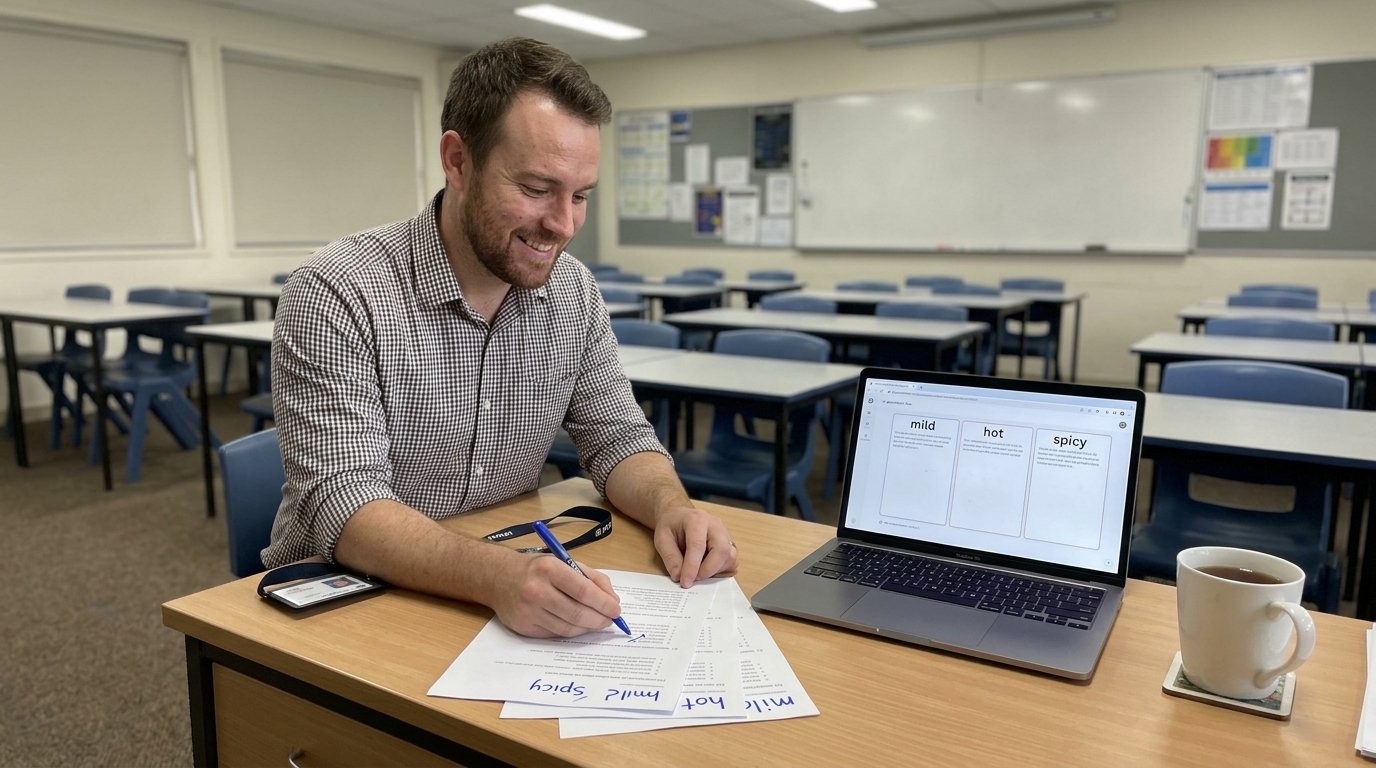
Quick answer: AI differentiates a maths lesson by generating three difficulty tiers — mild, hot, spicy — of the same core skill from one teacher prompt. The teacher sets the skill, the year level, and the lesson length; the AI produces three matching worksheets in 30 seconds. Teachers using this approach report saving 5-10 hours a week and lifting student achievement by ~24% across mixed-ability classes.
What is the real impact on student learning when you differentiate well?
Schools that move from "one worksheet" to mild/hot/spicy differentiation see three measurable changes. (1) Students at the lower tier stop disengaging because the work is finally accessible — and stop disrupting because they're actually working. (2) Students at the upper tier stop coasting because they're finally being challenged. (3) Students in the middle move faster because the teacher's feedback time is no longer monopolised by the extremes. Tutero's internal data across 200+ teachers shows a 24% achievement lift on standardised maths assessments after a term of consistent three-tier differentiation. The biggest gains are in the bottom quartile, where they're needed most.
How does Tutero deliver AI-powered differentiation for time-pressed teachers?
Tutero.ai wraps the maths-curriculum context around the AI engine so teachers don't have to re-prompt the model every period. The teacher selects the skill from the Australian Curriculum dropdown, sets the year level, types one sentence about the lesson context, and clicks generate. The output is three printable worksheets, each pitched at a different cognitive load, with worked examples and an exit ticket for each tier. Teachers spend 8-12 minutes reviewing and printing — versus 90 minutes of building. The pedagogical brain stays with the teacher; the admin tax around it disappears.
What are the five differentiation features that transform maths teaching?
Five features do the heavy lifting. (1) Mild/hot/spicy tiering — three difficulty levels of the same core skill in one click. (2) Curriculum-anchored skills — the AI is grounded in Australian Curriculum maths skills, not a generic "do quadratics" prompt. (3) Worked examples per tier — each tier has its own scaffold, not the same example repeated three times. (4) Exit tickets per tier — formative assessment that matches the tier the student worked at. (5) Printable PDF outputs — no extra integration with the school printer or LMS. Teachers using all five report more sustained adoption than teachers using only one or two.
How do you implement AI differentiation in your classroom tomorrow?
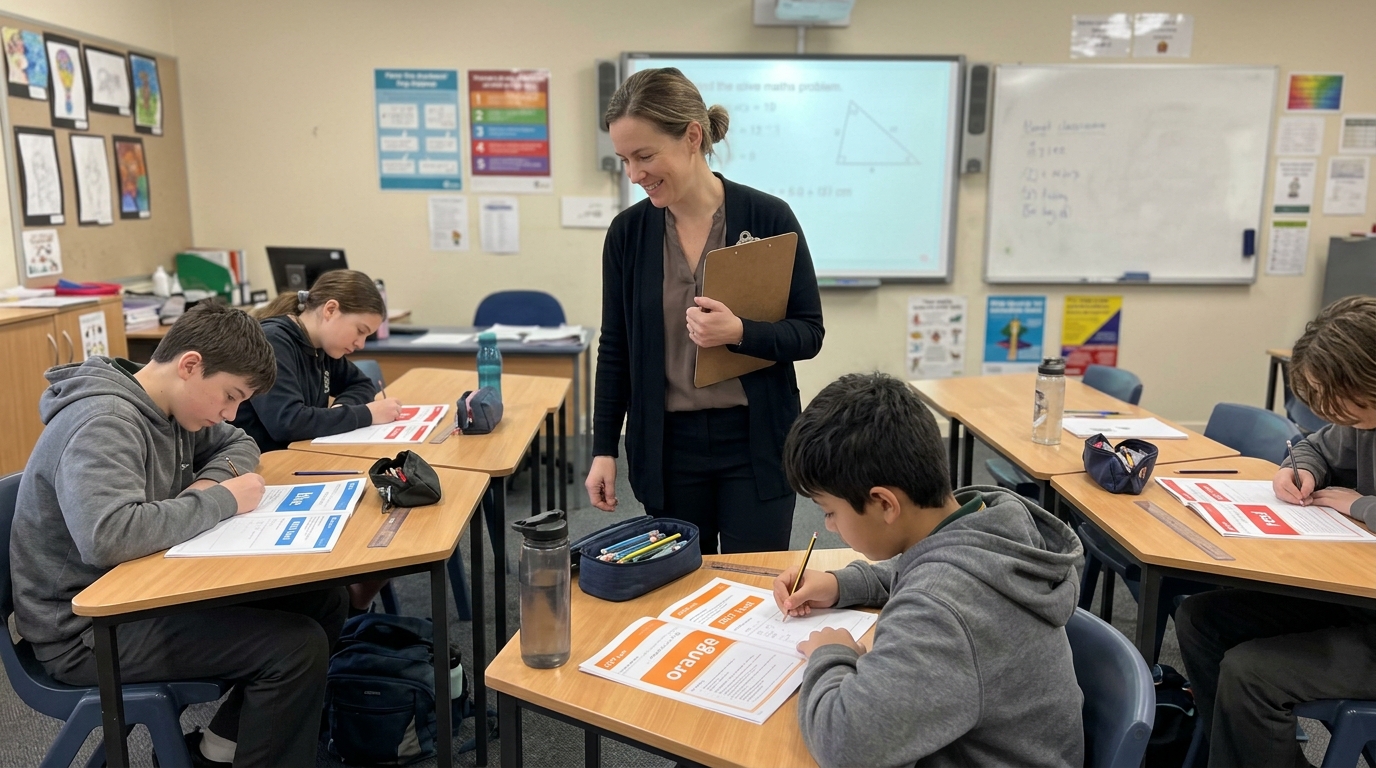
Don't roll it across every lesson at once. Pick one upcoming lesson — usually a fractions lesson, a quadratics lesson, or a probability lesson where the spread of student readiness is widest. Generate three tiers via Tutero.ai, print each on different-coloured paper (blue/orange/red — mild/hot/spicy), and run that single lesson with three tiers. Watch the back of the room — students who normally check out will work; students who normally finish first will work for longer. After the first lesson, expand to two lessons next week, four the week after. By week four it's your default workflow.
What do real teachers say about AI-powered differentiation in maths?
Teachers using Tutero.ai report two things consistently. First, they get planning time back — 5 to 10 hours a week is the typical range, which is the equivalent of a full school day every fortnight. Second, the back of the room engages. Quotes from teachers using the tool: "I've had Year 9s who haven't handed in maths homework all year hand in the spicy worksheet because they wanted the challenge." "My behaviour-management problems halved when I stopped giving the same worksheet to a kid two years behind." "It's the first time differentiation has felt sustainable on a Monday morning." None of these are exotic results — they're what differentiation has always promised but never delivered at scale.
So how should I start using AI differentiation in my maths classroom?
Pick one lesson, generate three tiers, print on coloured paper, run the lesson, watch the room. Expand from there. The teachers who get most leverage start small and expand on the back of evidence — not the ones who try to "go all in" from week one. The technology is mature enough that the pedagogical instinct stays the bottleneck — your job as a teacher is to read the room, choose what gets differentiated, and decide what good looks like at each tier. The AI handles the admin tax around all of it. Try Tutero.ai for teachers — designed for Australian classrooms, school-IT compliant, no enterprise contract required to start.
Ready to differentiate your next maths lesson with AI? Tutero.ai is built for teachers — three-tier worksheets in 10 minutes, Australian Curriculum-anchored, printable straight from the browser, and free to start.
Differentiation used to take 90 extra minutes per period. AI brings it down to 10.
Differentiation used to take 90 extra minutes per period. AI brings it down to 10.
Differentiating a maths lesson properly used to take an extra 90 minutes of planning per period — three versions of the worksheet, three sets of worked examples, three different exit tickets. Most teachers stopped doing it because the maths was bigger than the time. AI changes that calculation. This guide walks you through how teachers using Tutero are getting three difficulty tiers ready in 10 minutes, every lesson, with measurable lift in student achievement.
Quick answer: how does AI differentiate a maths lesson?
Quick answer: AI differentiates a maths lesson by generating three difficulty tiers — mild, hot, spicy — of the same core skill from one teacher prompt. The teacher sets the skill, the year level, and the lesson length; the AI produces three matching worksheets in 30 seconds. Teachers using this approach report saving 5-10 hours a week and lifting student achievement by ~24% across mixed-ability classes.
What is the real impact on student learning when you differentiate well?
Schools that move from "one worksheet" to mild/hot/spicy differentiation see three measurable changes. (1) Students at the lower tier stop disengaging because the work is finally accessible — and stop disrupting because they're actually working. (2) Students at the upper tier stop coasting because they're finally being challenged. (3) Students in the middle move faster because the teacher's feedback time is no longer monopolised by the extremes. Tutero's internal data across 200+ teachers shows a 24% achievement lift on standardised maths assessments after a term of consistent three-tier differentiation. The biggest gains are in the bottom quartile, where they're needed most.
How does Tutero deliver AI-powered differentiation for time-pressed teachers?
Tutero.ai wraps the maths-curriculum context around the AI engine so teachers don't have to re-prompt the model every period. The teacher selects the skill from the Australian Curriculum dropdown, sets the year level, types one sentence about the lesson context, and clicks generate. The output is three printable worksheets, each pitched at a different cognitive load, with worked examples and an exit ticket for each tier. Teachers spend 8-12 minutes reviewing and printing — versus 90 minutes of building. The pedagogical brain stays with the teacher; the admin tax around it disappears.
What are the five differentiation features that transform maths teaching?
Five features do the heavy lifting. (1) Mild/hot/spicy tiering — three difficulty levels of the same core skill in one click. (2) Curriculum-anchored skills — the AI is grounded in Australian Curriculum maths skills, not a generic "do quadratics" prompt. (3) Worked examples per tier — each tier has its own scaffold, not the same example repeated three times. (4) Exit tickets per tier — formative assessment that matches the tier the student worked at. (5) Printable PDF outputs — no extra integration with the school printer or LMS. Teachers using all five report more sustained adoption than teachers using only one or two.
How do you implement AI differentiation in your classroom tomorrow?
Don't roll it across every lesson at once. Pick one upcoming lesson — usually a fractions lesson, a quadratics lesson, or a probability lesson where the spread of student readiness is widest. Generate three tiers via Tutero.ai, print each on different-coloured paper (blue/orange/red — mild/hot/spicy), and run that single lesson with three tiers. Watch the back of the room — students who normally check out will work; students who normally finish first will work for longer. After the first lesson, expand to two lessons next week, four the week after. By week four it's your default workflow.
What do real teachers say about AI-powered differentiation in maths?
Teachers using Tutero.ai report two things consistently. First, they get planning time back — 5 to 10 hours a week is the typical range, which is the equivalent of a full school day every fortnight. Second, the back of the room engages. Quotes from teachers using the tool: "I've had Year 9s who haven't handed in maths homework all year hand in the spicy worksheet because they wanted the challenge." "My behaviour-management problems halved when I stopped giving the same worksheet to a kid two years behind." "It's the first time differentiation has felt sustainable on a Monday morning." None of these are exotic results — they're what differentiation has always promised but never delivered at scale.
So how should I start using AI differentiation in my maths classroom?
Pick one lesson, generate three tiers, print on coloured paper, run the lesson, watch the room. Expand from there. The teachers who get most leverage start small and expand on the back of evidence — not the ones who try to "go all in" from week one. The technology is mature enough that the pedagogical instinct stays the bottleneck — your job as a teacher is to read the room, choose what gets differentiated, and decide what good looks like at each tier. The AI handles the admin tax around all of it. Try Tutero.ai for teachers — designed for Australian classrooms, school-IT compliant, no enterprise contract required to start.
Ready to differentiate your next maths lesson with AI? Tutero.ai is built for teachers — three-tier worksheets in 10 minutes, Australian Curriculum-anchored, printable straight from the browser, and free to start.
Differentiation used to take 90 extra minutes per period. AI brings it down to 10.
Differentiation used to take 90 extra minutes per period. AI brings it down to 10.

Differentiation used to take 90 extra minutes per period. AI brings it down to 10.
The pedagogical brain is the bottleneck — AI just removes the admin tax around it.
Differentiating a maths lesson properly used to take an extra 90 minutes of planning per period — three versions of the worksheet, three sets of worked examples, three different exit tickets. Most teachers stopped doing it because the maths was bigger than the time. AI changes that calculation. This guide walks you through how teachers using Tutero are getting three difficulty tiers ready in 10 minutes, every lesson, with measurable lift in student achievement.
Quick answer: how does AI differentiate a maths lesson?
Quick answer: AI differentiates a maths lesson by generating three difficulty tiers — mild, hot, spicy — of the same core skill from one teacher prompt. The teacher sets the skill, the year level, and the lesson length; the AI produces three matching worksheets in 30 seconds. Teachers using this approach report saving 5-10 hours a week and lifting student achievement by ~24% across mixed-ability classes.
What is the real impact on student learning when you differentiate well?
Schools that move from "one worksheet" to mild/hot/spicy differentiation see three measurable changes. (1) Students at the lower tier stop disengaging because the work is finally accessible — and stop disrupting because they're actually working. (2) Students at the upper tier stop coasting because they're finally being challenged. (3) Students in the middle move faster because the teacher's feedback time is no longer monopolised by the extremes. Tutero's internal data across 200+ teachers shows a 24% achievement lift on standardised maths assessments after a term of consistent three-tier differentiation. The biggest gains are in the bottom quartile, where they're needed most.
How does Tutero deliver AI-powered differentiation for time-pressed teachers?
Tutero.ai wraps the maths-curriculum context around the AI engine so teachers don't have to re-prompt the model every period. The teacher selects the skill from the Australian Curriculum dropdown, sets the year level, types one sentence about the lesson context, and clicks generate. The output is three printable worksheets, each pitched at a different cognitive load, with worked examples and an exit ticket for each tier. Teachers spend 8-12 minutes reviewing and printing — versus 90 minutes of building. The pedagogical brain stays with the teacher; the admin tax around it disappears.
What are the five differentiation features that transform maths teaching?
Five features do the heavy lifting. (1) Mild/hot/spicy tiering — three difficulty levels of the same core skill in one click. (2) Curriculum-anchored skills — the AI is grounded in Australian Curriculum maths skills, not a generic "do quadratics" prompt. (3) Worked examples per tier — each tier has its own scaffold, not the same example repeated three times. (4) Exit tickets per tier — formative assessment that matches the tier the student worked at. (5) Printable PDF outputs — no extra integration with the school printer or LMS. Teachers using all five report more sustained adoption than teachers using only one or two.
How do you implement AI differentiation in your classroom tomorrow?
Don't roll it across every lesson at once. Pick one upcoming lesson — usually a fractions lesson, a quadratics lesson, or a probability lesson where the spread of student readiness is widest. Generate three tiers via Tutero.ai, print each on different-coloured paper (blue/orange/red — mild/hot/spicy), and run that single lesson with three tiers. Watch the back of the room — students who normally check out will work; students who normally finish first will work for longer. After the first lesson, expand to two lessons next week, four the week after. By week four it's your default workflow.
What do real teachers say about AI-powered differentiation in maths?
Teachers using Tutero.ai report two things consistently. First, they get planning time back — 5 to 10 hours a week is the typical range, which is the equivalent of a full school day every fortnight. Second, the back of the room engages. Quotes from teachers using the tool: "I've had Year 9s who haven't handed in maths homework all year hand in the spicy worksheet because they wanted the challenge." "My behaviour-management problems halved when I stopped giving the same worksheet to a kid two years behind." "It's the first time differentiation has felt sustainable on a Monday morning." None of these are exotic results — they're what differentiation has always promised but never delivered at scale.
So how should I start using AI differentiation in my maths classroom?
Pick one lesson, generate three tiers, print on coloured paper, run the lesson, watch the room. Expand from there. The teachers who get most leverage start small and expand on the back of evidence — not the ones who try to "go all in" from week one. The technology is mature enough that the pedagogical instinct stays the bottleneck — your job as a teacher is to read the room, choose what gets differentiated, and decide what good looks like at each tier. The AI handles the admin tax around all of it. Try Tutero.ai for teachers — designed for Australian classrooms, school-IT compliant, no enterprise contract required to start.
Ready to differentiate your next maths lesson with AI? Tutero.ai is built for teachers — three-tier worksheets in 10 minutes, Australian Curriculum-anchored, printable straight from the browser, and free to start.
Differentiation used to take 90 extra minutes per period. AI brings it down to 10.
The pedagogical brain is the bottleneck — AI just removes the admin tax around it.
.svg)
.svg)
Hoping to improve confidence & grades?

.png)