
.svg)

Sydney's public school system is genuinely strong — a mix of fully selective high schools, partially selective streams, and zoned local schools that consistently rank alongside private schools on Higher School Certificate results. The hard part for parents is working out which lever applies to your child: selective entry through the Year 7 placement test, a partially selective stream, or your local catchment school. This guide names the top public schools in Sydney across both selective and zoned categories, explains how the placement test and NSW catchment zoning actually work, and walks through how to find your school zone using the NSW School Finder.
Quick answer: what are the best public schools in Sydney?
Sydney's top public schools fall into two groups. Fully selective high schools — entered via the NESA Year 7 placement test — include James Ruse Agricultural High, North Sydney Boys, North Sydney Girls, Sydney Boys High, Sydney Girls High, Baulkham Hills High, Hornsby Girls, Manly Selective, Penrith High, Caringbah High, Sydney Technical High, and Normanhurst Boys. Highly regarded zoned and partially selective schools include Chatswood High and Killara High, with Pymble Public and Lindfield Public among the strongest North Shore primary feeders. James Ruse has topped the NSW HSC rankings every year since 1996. Selective places are awarded by test result, not catchment; zoned places are awarded by your home address sitting inside the school's gazetted catchment area.
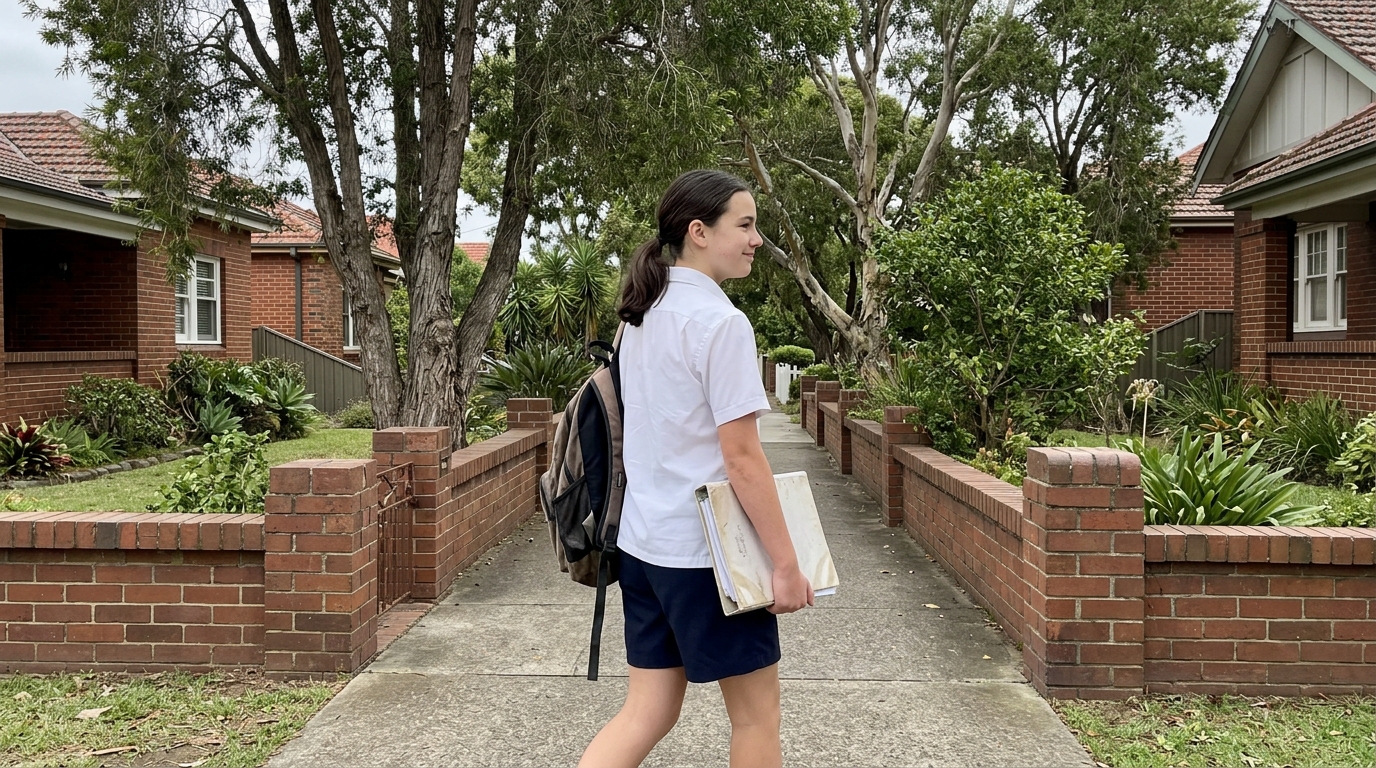
What are the top selective public schools in Sydney?
Sydney's fully selective public high schools admit students entirely on the Year 7 placement test result, regardless of where the family lives. They consistently produce the highest HSC results in NSW. The strongest are James Ruse Agricultural High (Carlingford) — top of the state on HSC every year since 1996; North Sydney Boys (Crows Nest) and North Sydney Girls (North Sydney); Sydney Boys (Moore Park) and Sydney Girls (Surry Hills); Baulkham Hills High (Baulkham Hills); Hornsby Girls (Hornsby); Manly Selective Campus (Manly); Penrith High (Penrith); Caringbah High (Caringbah); Sydney Technical High (Bexley); and Normanhurst Boys (Normanhurst). All twelve are run by the NSW Department of Education and charge no tuition fees beyond standard contributions.
James Ruse Agricultural High School
Located in Carlingford, James Ruse has held the top HSC ranking in NSW for nearly three decades. It runs an academically demanding program with an unusual agricultural-science strand layered on top, and supports a broad co-curricular program in robotics, debating, music, and sport.
North Sydney Boys and North Sydney Girls High Schools
Both campuses sit on Sydney's lower North Shore and are consistently among the top six selective schools on HSC results. North Sydney Boys is particularly strong in STEM; North Sydney Girls balances strong academics with arts, music, and community service.
Sydney Boys and Sydney Girls High Schools
Sydney Boys (Moore Park) and Sydney Girls (Surry Hills) are the two oldest selective public schools in the state. Both offer broad curricula across STEM, humanities and languages, and Sydney Boys has a long tradition in rowing, rugby, and debating.
Baulkham Hills High School
In the Hills District, Baulkham Hills consistently produces top-tier HSC results, particularly in Mathematics and Science. It is one of the most sought-after selective schools for families in Sydney's north-west.
Hornsby Girls High School
A long-running selective school for girls in the upper North Shore, Hornsby Girls combines strong HSC outcomes with a deliberately collaborative academic culture rather than a hyper-competitive one. Families living locally can see our tutoring in Hornsby, NSW page for how weekly sessions are arranged.
Manly Selective Campus
Manly Selective is the Northern Beaches' fully selective option and one of the few selective schools outside Sydney's traditional North Shore and inner-west clusters. It has strong programs in marine science and engineering.
Penrith High School
The dominant selective school in Sydney's outer west, Penrith High consistently ranks in the top fifteen on HSC results and serves families across the broader Penrith and Hawkesbury area.
Caringbah High School
Caringbah is the southern Sydney selective school of choice, particularly for families across the Sutherland Shire who would otherwise face a long commute to Sydney Boys or Sydney Girls.
Sydney Technical High School
Sydney Tech, in Bexley, is a fully selective boys' school with a long-standing strength in mathematics, science and applied technology. It is the southern equivalent of Sydney Boys for families in the St George area.
Normanhurst Boys High School
Normanhurst Boys is the smaller of the two fully selective schools on the upper North Shore (alongside Hornsby Girls). It maintains a strong STEM and humanities mix and an emphasis on community service.
Which strong zoned public schools should families consider?
Outside the fully selective system, several Sydney public schools consistently produce strong HSC results from a zoned or partially selective intake. Chatswood High School runs a partially selective stream alongside its zoned cohort and is consistently one of the strongest non-selective HSC performers on the lower North Shore. Killara High School in the upper North Shore is a fully zoned comprehensive that regularly produces top-25 HSC results. On the primary side, Pymble Public School and Lindfield Public School are two of the strongest North Shore feeders, both with established Opportunity Class (OC) streams in Years 5 and 6 that prepare students for the Year 7 selective placement test. Zoned places are awarded purely by home address — see the section below on how to find your school zone using the NSW School Finder.
How does Sydney school zoning work?
In NSW, every public primary and most public high schools have a gazetted catchment zone defined by the NSW Department of Education. To see how Sydney’s public schools compare on NAPLAN with their catchment zones mapped out, SchoolRank’s Sydney school rankings put both on one page. If your home address sits inside a school's zone, your child has guaranteed enrolment at that school regardless of test results, demand or how full the school is. Out-of-area applications are accepted for some schools but only after every in-zone enrolment is placed, and they are typically decided by a published criteria list (siblings, distance, hardship). Renting inside a desirable catchment is treated the same as owning, but the school may request proof of address (lease, utility bills, electoral roll). Zoning does not apply to fully selective schools — those are placement-tested across the state. Partially selective schools have both routes: a selective stream by test, and a zoned stream by address.
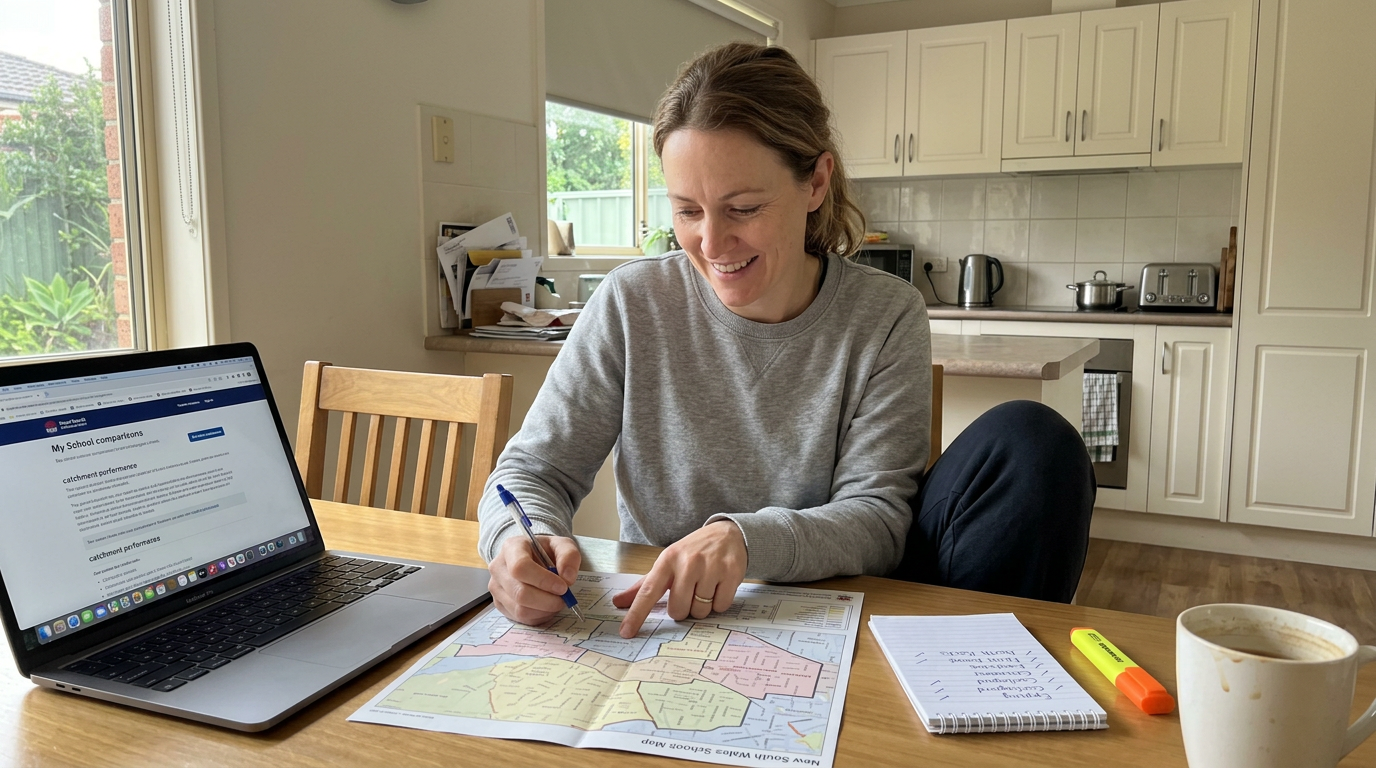
How do I find my Sydney school zone?
Use the NSW School Finder — the free official tool from the NSW Department of Education. Enter your home address and the tool returns the local primary and local high school whose catchment your address sits inside, along with the school's contact details, principal's name, and current enrolment. The boundaries are gazetted by exact street, not postcode — neighbouring streets can sit in different zones, particularly across major roads or council borders. If you are considering a move into a specific catchment, check the school's enrolment policy on the school's website too — a small number of in-demand zoned schools (Killara High and Mosman High among them) have buffer-zone arrangements during peak demand.
How do I get my child into James Ruse, Sydney Boys, or another selective school?
Entry to every fully selective high school in NSW runs through the same NESA Selective High School Placement Test, sat once in Year 6 for a Year 7 start. The test is computer-based and runs across reading, mathematical reasoning, thinking skills, and a writing task. Applications open through the NSW Department of Education in October the year before, and the test itself sits in March or April. Students rank up to four selective schools on their application, and offers are made by aggregate test score against each school's cut-off — James Ruse has the highest cut-off in the state, followed by North Sydney Boys and North Sydney Girls. Strong tutoring through Year 5 and Year 6 lifts placement-test outcomes meaningfully because the test format is unfamiliar and the time pressure is real. Tutero connects families with experienced selective-test tutors in Sydney at A$65 per hour — the same rate as any other tutoring subject, with no premium for selective-entry coaching. Find a Sydney selective-entry tutor.
Are public schools in Sydney as good as private?
For academically capable students, the strongest selective public schools in Sydney consistently match or beat almost every private school in the state on Higher School Certificate results. James Ruse, North Sydney Boys, North Sydney Girls, Sydney Boys and Sydney Girls all rank in the top ten of the NSW HSC league each year, ahead of all but two or three private schools. The gap shows up elsewhere — facilities, smaller class sizes, boarding, religious affiliation, and specialised co-curricular pathways such as elite rowing or large-scale music programs. For zoned public schools the answer depends entirely on the catchment: a Killara, Cherrybrook, or Turramurra zoned cohort produces results that genuinely rival selective entry, while a less-resourced zoned school may not. The honest framing is that Sydney's top selective public schools are academically equivalent to the top private schools, while the difference between public and private widens as you move further from the strongest catchments. For a parallel breakdown of the private side, see our guide to the top private schools in Sydney.
What's the difference between selective, partially selective, and zoned public schools?
A fully selective high school admits every student through the NESA Year 7 placement test result — there is no zoned intake. James Ruse, North Sydney Boys, Hornsby Girls, Penrith High and Caringbah High are examples. A partially selective high school runs two parallel streams: a selective stream by placement-test result (one or two classes per year level) and a zoned stream by home address (the remaining classes). Chatswood High and Manly Selective Campus are examples — Manly's surrounding zoned campus is co-located with the fully selective campus. A zoned (comprehensive) public school admits students entirely by home address. Killara High, Mosman High and Cherrybrook Technology High are examples. The three categories matter because the entry path is different: only zoned and partially-selective schools can be guaranteed by moving into a catchment.
Which Sydney suburbs have the best public schools?
The strongest concentrations of high-performing public schools in Sydney sit on the North Shore (Killara, Pymble, Lindfield, Hornsby, Chatswood — all served by some combination of Killara High, Chatswood High, Hornsby Girls, Normanhurst Boys, plus Pymble Public and Lindfield Public on the primary side); the Hills District (Baulkham Hills served by Baulkham Hills High); the eastern suburbs and inner south (Moore Park and Surry Hills served by Sydney Boys and Sydney Girls); and the north-west (Carlingford served by James Ruse). Outer western Sydney is well served by Penrith High; southern Sydney by Caringbah High and Sydney Technical High; the Northern Beaches by Manly Selective. Catchments inside the strongest zoned schools (Killara High in particular) lift property prices noticeably — verify the boundary on the NSW School Finder before relying on a real-estate listing's claim.
How much does selective-test tutoring cost in Sydney?
Selective-test tutoring in Sydney typically runs A$55–A$120 per hour depending on tutor experience and group size. Tutero connects families with experienced selective-test tutors at A$65 per hour — the same rate as our standard tutoring across every year level and subject, with no premium for selective-entry coaching, no contracts, and pay-per-lesson billing. Most families start tutoring in Term 4 of Year 5 or Term 1 of Year 6 to give the student two to four terms of preparation before the March/April test. Sessions usually run weekly for an hour, often paired with timed mock-papers in the final two months. For the broader picture on choosing a Sydney tutor, see our guide to finding the best Sydney tutors, and for guidance on when to start, see the ideal time to begin tutoring.
When should we start preparing for the selective test?
Most families that achieve a competitive placement-test score begin focused preparation in Term 4 of Year 5, giving roughly six months of preparation before the test in March or April of Year 6. Earlier is rarely better — placement-test content overlaps closely with the Year 5 and Year 6 NSW curriculum, so a child still working through that content cannot benefit from sustained test-format practice. The biggest gains come from familiarity with the computer-based interface, time management on the writing task, and exposure to the thinking-skills question style, which is unlike anything in the regular school curriculum. For a deeper look at when tutoring helps and when it does not, see the ideal time to begin tutoring and five key benefits of private tutoring.
What if my child does not get into a selective school?
Most NSW Year 6 students who sit the placement test do not receive an offer — that is the maths of a fully ranked test, and it is not a verdict on academic potential. The strongest options are: first, the partially selective stream of a school like Chatswood High or Manly, where late entry through Year 8 or Year 9 is sometimes possible by re-application; second, your local zoned high school, which may be a Killara, Mosman, or Cherrybrook with HSC results genuinely comparable to selective; third, a scholarship to a private school — covered in detail in our guide to getting a scholarship in Sydney; or fourth, a planned change of school later, covered in four reasons you should change your child's school. The framework for thinking through the decision is in choosing the right school in six steps.
How should we choose between two strong Sydney public schools?
When two public schools are both within reach (a selective offer plus a strong local catchment, or two zoned options across council borders), compare four things: peer cohort (the strongest predictor of academic outcome above the school itself), commute (a 60-minute one-way commute compounds into roughly 200 hours per year of lost study time), subject availability at HSC level, particularly for languages, advanced mathematics, and extension subjects, and co-curricular fit, which matters more than league-table ranking for student wellbeing. The HSC outcome difference between James Ruse and a strong zoned school like Killara High is real but small — both place graduates into the top NSW universities. For a structured framework, see choosing the right school in six steps, and for HSC subject-selection guidance, see five tips for choosing HSC subjects. If senior science is part of that subject comparison, our HSC chemistry tutoring in Sydney page explains how those lessons run.
Bottom line: which Sydney public school is right for your child?
For an academically strong child willing to commute, a fully selective school like James Ruse, North Sydney Boys/Girls, or Sydney Boys/Girls is the highest-ceiling option in NSW public education — equal to the best private schools on academic outcomes, free of fees, and admitted purely by Year 7 placement-test result. For families inside a strong North Shore, Hills, or eastern-suburbs catchment, a zoned or partially selective school like Killara High, Chatswood High, or Manly often produces comparable HSC results without the placement-test risk and with a shorter commute. The single highest-impact early step is preparing properly for the Year 7 placement test. Find an experienced Sydney selective-test tutor at A$65 per hour, no contracts, pay-per-lesson — and explore the rest of our Sydney guides on finding the best Sydney tutors and getting a scholarship in Sydney.
James Ruse Agricultural High School has topped the NSW HSC rankings every year since 1996 — admission is by the NESA Year 7 placement test, not catchment.
James Ruse Agricultural High School has topped the NSW HSC rankings every year since 1996 — admission is by the NESA Year 7 placement test, not catchment.
Sydney's public school system is genuinely strong — a mix of fully selective high schools, partially selective streams, and zoned local schools that consistently rank alongside private schools on Higher School Certificate results. The hard part for parents is working out which lever applies to your child: selective entry through the Year 7 placement test, a partially selective stream, or your local catchment school. This guide names the top public schools in Sydney across both selective and zoned categories, explains how the placement test and NSW catchment zoning actually work, and walks through how to find your school zone using the NSW School Finder.
Quick answer: what are the best public schools in Sydney?
Sydney's top public schools fall into two groups. Fully selective high schools — entered via the NESA Year 7 placement test — include James Ruse Agricultural High, North Sydney Boys, North Sydney Girls, Sydney Boys High, Sydney Girls High, Baulkham Hills High, Hornsby Girls, Manly Selective, Penrith High, Caringbah High, Sydney Technical High, and Normanhurst Boys. Highly regarded zoned and partially selective schools include Chatswood High and Killara High, with Pymble Public and Lindfield Public among the strongest North Shore primary feeders. James Ruse has topped the NSW HSC rankings every year since 1996. Selective places are awarded by test result, not catchment; zoned places are awarded by your home address sitting inside the school's gazetted catchment area.
What are the top selective public schools in Sydney?
Sydney's fully selective public high schools admit students entirely on the Year 7 placement test result, regardless of where the family lives. They consistently produce the highest HSC results in NSW. The strongest are James Ruse Agricultural High (Carlingford) — top of the state on HSC every year since 1996; North Sydney Boys (Crows Nest) and North Sydney Girls (North Sydney); Sydney Boys (Moore Park) and Sydney Girls (Surry Hills); Baulkham Hills High (Baulkham Hills); Hornsby Girls (Hornsby); Manly Selective Campus (Manly); Penrith High (Penrith); Caringbah High (Caringbah); Sydney Technical High (Bexley); and Normanhurst Boys (Normanhurst). All twelve are run by the NSW Department of Education and charge no tuition fees beyond standard contributions.
James Ruse Agricultural High School
Located in Carlingford, James Ruse has held the top HSC ranking in NSW for nearly three decades. It runs an academically demanding program with an unusual agricultural-science strand layered on top, and supports a broad co-curricular program in robotics, debating, music, and sport.
North Sydney Boys and North Sydney Girls High Schools
Both campuses sit on Sydney's lower North Shore and are consistently among the top six selective schools on HSC results. North Sydney Boys is particularly strong in STEM; North Sydney Girls balances strong academics with arts, music, and community service.
Sydney Boys and Sydney Girls High Schools
Sydney Boys (Moore Park) and Sydney Girls (Surry Hills) are the two oldest selective public schools in the state. Both offer broad curricula across STEM, humanities and languages, and Sydney Boys has a long tradition in rowing, rugby, and debating.
Baulkham Hills High School
In the Hills District, Baulkham Hills consistently produces top-tier HSC results, particularly in Mathematics and Science. It is one of the most sought-after selective schools for families in Sydney's north-west.
Hornsby Girls High School
A long-running selective school for girls in the upper North Shore, Hornsby Girls combines strong HSC outcomes with a deliberately collaborative academic culture rather than a hyper-competitive one. Families living locally can see our tutoring in Hornsby, NSW page for how weekly sessions are arranged.
Manly Selective Campus
Manly Selective is the Northern Beaches' fully selective option and one of the few selective schools outside Sydney's traditional North Shore and inner-west clusters. It has strong programs in marine science and engineering.
Penrith High School
The dominant selective school in Sydney's outer west, Penrith High consistently ranks in the top fifteen on HSC results and serves families across the broader Penrith and Hawkesbury area.
Caringbah High School
Caringbah is the southern Sydney selective school of choice, particularly for families across the Sutherland Shire who would otherwise face a long commute to Sydney Boys or Sydney Girls.
Sydney Technical High School
Sydney Tech, in Bexley, is a fully selective boys' school with a long-standing strength in mathematics, science and applied technology. It is the southern equivalent of Sydney Boys for families in the St George area.
Normanhurst Boys High School
Normanhurst Boys is the smaller of the two fully selective schools on the upper North Shore (alongside Hornsby Girls). It maintains a strong STEM and humanities mix and an emphasis on community service.
Which strong zoned public schools should families consider?
Outside the fully selective system, several Sydney public schools consistently produce strong HSC results from a zoned or partially selective intake. Chatswood High School runs a partially selective stream alongside its zoned cohort and is consistently one of the strongest non-selective HSC performers on the lower North Shore. Killara High School in the upper North Shore is a fully zoned comprehensive that regularly produces top-25 HSC results. On the primary side, Pymble Public School and Lindfield Public School are two of the strongest North Shore feeders, both with established Opportunity Class (OC) streams in Years 5 and 6 that prepare students for the Year 7 selective placement test. Zoned places are awarded purely by home address — see the section below on how to find your school zone using the NSW School Finder.
How does Sydney school zoning work?
In NSW, every public primary and most public high schools have a gazetted catchment zone defined by the NSW Department of Education. To see how Sydney’s public schools compare on NAPLAN with their catchment zones mapped out, SchoolRank’s Sydney school rankings put both on one page. If your home address sits inside a school's zone, your child has guaranteed enrolment at that school regardless of test results, demand or how full the school is. Out-of-area applications are accepted for some schools but only after every in-zone enrolment is placed, and they are typically decided by a published criteria list (siblings, distance, hardship). Renting inside a desirable catchment is treated the same as owning, but the school may request proof of address (lease, utility bills, electoral roll). Zoning does not apply to fully selective schools — those are placement-tested across the state. Partially selective schools have both routes: a selective stream by test, and a zoned stream by address.
How do I find my Sydney school zone?
Use the NSW School Finder — the free official tool from the NSW Department of Education. Enter your home address and the tool returns the local primary and local high school whose catchment your address sits inside, along with the school's contact details, principal's name, and current enrolment. The boundaries are gazetted by exact street, not postcode — neighbouring streets can sit in different zones, particularly across major roads or council borders. If you are considering a move into a specific catchment, check the school's enrolment policy on the school's website too — a small number of in-demand zoned schools (Killara High and Mosman High among them) have buffer-zone arrangements during peak demand.
How do I get my child into James Ruse, Sydney Boys, or another selective school?
Entry to every fully selective high school in NSW runs through the same NESA Selective High School Placement Test, sat once in Year 6 for a Year 7 start. The test is computer-based and runs across reading, mathematical reasoning, thinking skills, and a writing task. Applications open through the NSW Department of Education in October the year before, and the test itself sits in March or April. Students rank up to four selective schools on their application, and offers are made by aggregate test score against each school's cut-off — James Ruse has the highest cut-off in the state, followed by North Sydney Boys and North Sydney Girls. Strong tutoring through Year 5 and Year 6 lifts placement-test outcomes meaningfully because the test format is unfamiliar and the time pressure is real. Tutero connects families with experienced selective-test tutors in Sydney at A$65 per hour — the same rate as any other tutoring subject, with no premium for selective-entry coaching. Find a Sydney selective-entry tutor.
Are public schools in Sydney as good as private?
For academically capable students, the strongest selective public schools in Sydney consistently match or beat almost every private school in the state on Higher School Certificate results. James Ruse, North Sydney Boys, North Sydney Girls, Sydney Boys and Sydney Girls all rank in the top ten of the NSW HSC league each year, ahead of all but two or three private schools. The gap shows up elsewhere — facilities, smaller class sizes, boarding, religious affiliation, and specialised co-curricular pathways such as elite rowing or large-scale music programs. For zoned public schools the answer depends entirely on the catchment: a Killara, Cherrybrook, or Turramurra zoned cohort produces results that genuinely rival selective entry, while a less-resourced zoned school may not. The honest framing is that Sydney's top selective public schools are academically equivalent to the top private schools, while the difference between public and private widens as you move further from the strongest catchments. For a parallel breakdown of the private side, see our guide to the top private schools in Sydney.
What's the difference between selective, partially selective, and zoned public schools?
A fully selective high school admits every student through the NESA Year 7 placement test result — there is no zoned intake. James Ruse, North Sydney Boys, Hornsby Girls, Penrith High and Caringbah High are examples. A partially selective high school runs two parallel streams: a selective stream by placement-test result (one or two classes per year level) and a zoned stream by home address (the remaining classes). Chatswood High and Manly Selective Campus are examples — Manly's surrounding zoned campus is co-located with the fully selective campus. A zoned (comprehensive) public school admits students entirely by home address. Killara High, Mosman High and Cherrybrook Technology High are examples. The three categories matter because the entry path is different: only zoned and partially-selective schools can be guaranteed by moving into a catchment.
Which Sydney suburbs have the best public schools?
The strongest concentrations of high-performing public schools in Sydney sit on the North Shore (Killara, Pymble, Lindfield, Hornsby, Chatswood — all served by some combination of Killara High, Chatswood High, Hornsby Girls, Normanhurst Boys, plus Pymble Public and Lindfield Public on the primary side); the Hills District (Baulkham Hills served by Baulkham Hills High); the eastern suburbs and inner south (Moore Park and Surry Hills served by Sydney Boys and Sydney Girls); and the north-west (Carlingford served by James Ruse). Outer western Sydney is well served by Penrith High; southern Sydney by Caringbah High and Sydney Technical High; the Northern Beaches by Manly Selective. Catchments inside the strongest zoned schools (Killara High in particular) lift property prices noticeably — verify the boundary on the NSW School Finder before relying on a real-estate listing's claim.
How much does selective-test tutoring cost in Sydney?
Selective-test tutoring in Sydney typically runs A$55–A$120 per hour depending on tutor experience and group size. Tutero connects families with experienced selective-test tutors at A$65 per hour — the same rate as our standard tutoring across every year level and subject, with no premium for selective-entry coaching, no contracts, and pay-per-lesson billing. Most families start tutoring in Term 4 of Year 5 or Term 1 of Year 6 to give the student two to four terms of preparation before the March/April test. Sessions usually run weekly for an hour, often paired with timed mock-papers in the final two months. For the broader picture on choosing a Sydney tutor, see our guide to finding the best Sydney tutors, and for guidance on when to start, see the ideal time to begin tutoring.
When should we start preparing for the selective test?
Most families that achieve a competitive placement-test score begin focused preparation in Term 4 of Year 5, giving roughly six months of preparation before the test in March or April of Year 6. Earlier is rarely better — placement-test content overlaps closely with the Year 5 and Year 6 NSW curriculum, so a child still working through that content cannot benefit from sustained test-format practice. The biggest gains come from familiarity with the computer-based interface, time management on the writing task, and exposure to the thinking-skills question style, which is unlike anything in the regular school curriculum. For a deeper look at when tutoring helps and when it does not, see the ideal time to begin tutoring and five key benefits of private tutoring.
What if my child does not get into a selective school?
Most NSW Year 6 students who sit the placement test do not receive an offer — that is the maths of a fully ranked test, and it is not a verdict on academic potential. The strongest options are: first, the partially selective stream of a school like Chatswood High or Manly, where late entry through Year 8 or Year 9 is sometimes possible by re-application; second, your local zoned high school, which may be a Killara, Mosman, or Cherrybrook with HSC results genuinely comparable to selective; third, a scholarship to a private school — covered in detail in our guide to getting a scholarship in Sydney; or fourth, a planned change of school later, covered in four reasons you should change your child's school. The framework for thinking through the decision is in choosing the right school in six steps.
How should we choose between two strong Sydney public schools?
When two public schools are both within reach (a selective offer plus a strong local catchment, or two zoned options across council borders), compare four things: peer cohort (the strongest predictor of academic outcome above the school itself), commute (a 60-minute one-way commute compounds into roughly 200 hours per year of lost study time), subject availability at HSC level, particularly for languages, advanced mathematics, and extension subjects, and co-curricular fit, which matters more than league-table ranking for student wellbeing. The HSC outcome difference between James Ruse and a strong zoned school like Killara High is real but small — both place graduates into the top NSW universities. For a structured framework, see choosing the right school in six steps, and for HSC subject-selection guidance, see five tips for choosing HSC subjects. If senior science is part of that subject comparison, our HSC chemistry tutoring in Sydney page explains how those lessons run.
Bottom line: which Sydney public school is right for your child?
For an academically strong child willing to commute, a fully selective school like James Ruse, North Sydney Boys/Girls, or Sydney Boys/Girls is the highest-ceiling option in NSW public education — equal to the best private schools on academic outcomes, free of fees, and admitted purely by Year 7 placement-test result. For families inside a strong North Shore, Hills, or eastern-suburbs catchment, a zoned or partially selective school like Killara High, Chatswood High, or Manly often produces comparable HSC results without the placement-test risk and with a shorter commute. The single highest-impact early step is preparing properly for the Year 7 placement test. Find an experienced Sydney selective-test tutor at A$65 per hour, no contracts, pay-per-lesson — and explore the rest of our Sydney guides on finding the best Sydney tutors and getting a scholarship in Sydney.
FAQ
.svg)
.svg)
Online maths tutoring at Tutero is catering to students of all year levels. We offer programs tailored to the unique learning curves of each age group.
We also have expert NAPLAN and ATAR subject tutors, ensuring students are well-equipped for these pivotal assessments.
We recommend at least two to three session per week for consistent progress. However, this can vary based on your child's needs and goals.
Our platform uses advanced security protocols to ensure the safety and privacy of all our online sessions.
Parents are welcome to observe sessions. We believe in a collaborative approach to education.
We provide regular progress reports and assessments to track your child’s academic development.
Yes, we prioritise the student-tutor relationship and can arrange a change if the need arises.
Yes, we offer a range of resources and materials, including interactive exercises and practice worksheets.
James Ruse Agricultural High School has topped the NSW HSC rankings every year since 1996 — admission is by the NESA Year 7 placement test, not catchment.
James Ruse Agricultural High School has topped the NSW HSC rankings every year since 1996 — admission is by the NESA Year 7 placement test, not catchment.

James Ruse Agricultural High School has topped the NSW HSC rankings every year since 1996 — admission is by the NESA Year 7 placement test, not catchment.
Inside a strong zoned catchment like Killara High or Mosman High, public-school HSC outcomes genuinely rival fully selective schools — without the placement-test risk.
Sydney's public school system is genuinely strong — a mix of fully selective high schools, partially selective streams, and zoned local schools that consistently rank alongside private schools on Higher School Certificate results. The hard part for parents is working out which lever applies to your child: selective entry through the Year 7 placement test, a partially selective stream, or your local catchment school. This guide names the top public schools in Sydney across both selective and zoned categories, explains how the placement test and NSW catchment zoning actually work, and walks through how to find your school zone using the NSW School Finder.
Quick answer: what are the best public schools in Sydney?
Sydney's top public schools fall into two groups. Fully selective high schools — entered via the NESA Year 7 placement test — include James Ruse Agricultural High, North Sydney Boys, North Sydney Girls, Sydney Boys High, Sydney Girls High, Baulkham Hills High, Hornsby Girls, Manly Selective, Penrith High, Caringbah High, Sydney Technical High, and Normanhurst Boys. Highly regarded zoned and partially selective schools include Chatswood High and Killara High, with Pymble Public and Lindfield Public among the strongest North Shore primary feeders. James Ruse has topped the NSW HSC rankings every year since 1996. Selective places are awarded by test result, not catchment; zoned places are awarded by your home address sitting inside the school's gazetted catchment area.
What are the top selective public schools in Sydney?
Sydney's fully selective public high schools admit students entirely on the Year 7 placement test result, regardless of where the family lives. They consistently produce the highest HSC results in NSW. The strongest are James Ruse Agricultural High (Carlingford) — top of the state on HSC every year since 1996; North Sydney Boys (Crows Nest) and North Sydney Girls (North Sydney); Sydney Boys (Moore Park) and Sydney Girls (Surry Hills); Baulkham Hills High (Baulkham Hills); Hornsby Girls (Hornsby); Manly Selective Campus (Manly); Penrith High (Penrith); Caringbah High (Caringbah); Sydney Technical High (Bexley); and Normanhurst Boys (Normanhurst). All twelve are run by the NSW Department of Education and charge no tuition fees beyond standard contributions.
James Ruse Agricultural High School
Located in Carlingford, James Ruse has held the top HSC ranking in NSW for nearly three decades. It runs an academically demanding program with an unusual agricultural-science strand layered on top, and supports a broad co-curricular program in robotics, debating, music, and sport.
North Sydney Boys and North Sydney Girls High Schools
Both campuses sit on Sydney's lower North Shore and are consistently among the top six selective schools on HSC results. North Sydney Boys is particularly strong in STEM; North Sydney Girls balances strong academics with arts, music, and community service.
Sydney Boys and Sydney Girls High Schools
Sydney Boys (Moore Park) and Sydney Girls (Surry Hills) are the two oldest selective public schools in the state. Both offer broad curricula across STEM, humanities and languages, and Sydney Boys has a long tradition in rowing, rugby, and debating.
Baulkham Hills High School
In the Hills District, Baulkham Hills consistently produces top-tier HSC results, particularly in Mathematics and Science. It is one of the most sought-after selective schools for families in Sydney's north-west.
Hornsby Girls High School
A long-running selective school for girls in the upper North Shore, Hornsby Girls combines strong HSC outcomes with a deliberately collaborative academic culture rather than a hyper-competitive one. Families living locally can see our tutoring in Hornsby, NSW page for how weekly sessions are arranged.
Manly Selective Campus
Manly Selective is the Northern Beaches' fully selective option and one of the few selective schools outside Sydney's traditional North Shore and inner-west clusters. It has strong programs in marine science and engineering.
Penrith High School
The dominant selective school in Sydney's outer west, Penrith High consistently ranks in the top fifteen on HSC results and serves families across the broader Penrith and Hawkesbury area.
Caringbah High School
Caringbah is the southern Sydney selective school of choice, particularly for families across the Sutherland Shire who would otherwise face a long commute to Sydney Boys or Sydney Girls.
Sydney Technical High School
Sydney Tech, in Bexley, is a fully selective boys' school with a long-standing strength in mathematics, science and applied technology. It is the southern equivalent of Sydney Boys for families in the St George area.
Normanhurst Boys High School
Normanhurst Boys is the smaller of the two fully selective schools on the upper North Shore (alongside Hornsby Girls). It maintains a strong STEM and humanities mix and an emphasis on community service.
Which strong zoned public schools should families consider?
Outside the fully selective system, several Sydney public schools consistently produce strong HSC results from a zoned or partially selective intake. Chatswood High School runs a partially selective stream alongside its zoned cohort and is consistently one of the strongest non-selective HSC performers on the lower North Shore. Killara High School in the upper North Shore is a fully zoned comprehensive that regularly produces top-25 HSC results. On the primary side, Pymble Public School and Lindfield Public School are two of the strongest North Shore feeders, both with established Opportunity Class (OC) streams in Years 5 and 6 that prepare students for the Year 7 selective placement test. Zoned places are awarded purely by home address — see the section below on how to find your school zone using the NSW School Finder.
How does Sydney school zoning work?
In NSW, every public primary and most public high schools have a gazetted catchment zone defined by the NSW Department of Education. To see how Sydney’s public schools compare on NAPLAN with their catchment zones mapped out, SchoolRank’s Sydney school rankings put both on one page. If your home address sits inside a school's zone, your child has guaranteed enrolment at that school regardless of test results, demand or how full the school is. Out-of-area applications are accepted for some schools but only after every in-zone enrolment is placed, and they are typically decided by a published criteria list (siblings, distance, hardship). Renting inside a desirable catchment is treated the same as owning, but the school may request proof of address (lease, utility bills, electoral roll). Zoning does not apply to fully selective schools — those are placement-tested across the state. Partially selective schools have both routes: a selective stream by test, and a zoned stream by address.
How do I find my Sydney school zone?
Use the NSW School Finder — the free official tool from the NSW Department of Education. Enter your home address and the tool returns the local primary and local high school whose catchment your address sits inside, along with the school's contact details, principal's name, and current enrolment. The boundaries are gazetted by exact street, not postcode — neighbouring streets can sit in different zones, particularly across major roads or council borders. If you are considering a move into a specific catchment, check the school's enrolment policy on the school's website too — a small number of in-demand zoned schools (Killara High and Mosman High among them) have buffer-zone arrangements during peak demand.
How do I get my child into James Ruse, Sydney Boys, or another selective school?
Entry to every fully selective high school in NSW runs through the same NESA Selective High School Placement Test, sat once in Year 6 for a Year 7 start. The test is computer-based and runs across reading, mathematical reasoning, thinking skills, and a writing task. Applications open through the NSW Department of Education in October the year before, and the test itself sits in March or April. Students rank up to four selective schools on their application, and offers are made by aggregate test score against each school's cut-off — James Ruse has the highest cut-off in the state, followed by North Sydney Boys and North Sydney Girls. Strong tutoring through Year 5 and Year 6 lifts placement-test outcomes meaningfully because the test format is unfamiliar and the time pressure is real. Tutero connects families with experienced selective-test tutors in Sydney at A$65 per hour — the same rate as any other tutoring subject, with no premium for selective-entry coaching. Find a Sydney selective-entry tutor.
Are public schools in Sydney as good as private?
For academically capable students, the strongest selective public schools in Sydney consistently match or beat almost every private school in the state on Higher School Certificate results. James Ruse, North Sydney Boys, North Sydney Girls, Sydney Boys and Sydney Girls all rank in the top ten of the NSW HSC league each year, ahead of all but two or three private schools. The gap shows up elsewhere — facilities, smaller class sizes, boarding, religious affiliation, and specialised co-curricular pathways such as elite rowing or large-scale music programs. For zoned public schools the answer depends entirely on the catchment: a Killara, Cherrybrook, or Turramurra zoned cohort produces results that genuinely rival selective entry, while a less-resourced zoned school may not. The honest framing is that Sydney's top selective public schools are academically equivalent to the top private schools, while the difference between public and private widens as you move further from the strongest catchments. For a parallel breakdown of the private side, see our guide to the top private schools in Sydney.
What's the difference between selective, partially selective, and zoned public schools?
A fully selective high school admits every student through the NESA Year 7 placement test result — there is no zoned intake. James Ruse, North Sydney Boys, Hornsby Girls, Penrith High and Caringbah High are examples. A partially selective high school runs two parallel streams: a selective stream by placement-test result (one or two classes per year level) and a zoned stream by home address (the remaining classes). Chatswood High and Manly Selective Campus are examples — Manly's surrounding zoned campus is co-located with the fully selective campus. A zoned (comprehensive) public school admits students entirely by home address. Killara High, Mosman High and Cherrybrook Technology High are examples. The three categories matter because the entry path is different: only zoned and partially-selective schools can be guaranteed by moving into a catchment.
Which Sydney suburbs have the best public schools?
The strongest concentrations of high-performing public schools in Sydney sit on the North Shore (Killara, Pymble, Lindfield, Hornsby, Chatswood — all served by some combination of Killara High, Chatswood High, Hornsby Girls, Normanhurst Boys, plus Pymble Public and Lindfield Public on the primary side); the Hills District (Baulkham Hills served by Baulkham Hills High); the eastern suburbs and inner south (Moore Park and Surry Hills served by Sydney Boys and Sydney Girls); and the north-west (Carlingford served by James Ruse). Outer western Sydney is well served by Penrith High; southern Sydney by Caringbah High and Sydney Technical High; the Northern Beaches by Manly Selective. Catchments inside the strongest zoned schools (Killara High in particular) lift property prices noticeably — verify the boundary on the NSW School Finder before relying on a real-estate listing's claim.
How much does selective-test tutoring cost in Sydney?
Selective-test tutoring in Sydney typically runs A$55–A$120 per hour depending on tutor experience and group size. Tutero connects families with experienced selective-test tutors at A$65 per hour — the same rate as our standard tutoring across every year level and subject, with no premium for selective-entry coaching, no contracts, and pay-per-lesson billing. Most families start tutoring in Term 4 of Year 5 or Term 1 of Year 6 to give the student two to four terms of preparation before the March/April test. Sessions usually run weekly for an hour, often paired with timed mock-papers in the final two months. For the broader picture on choosing a Sydney tutor, see our guide to finding the best Sydney tutors, and for guidance on when to start, see the ideal time to begin tutoring.
When should we start preparing for the selective test?
Most families that achieve a competitive placement-test score begin focused preparation in Term 4 of Year 5, giving roughly six months of preparation before the test in March or April of Year 6. Earlier is rarely better — placement-test content overlaps closely with the Year 5 and Year 6 NSW curriculum, so a child still working through that content cannot benefit from sustained test-format practice. The biggest gains come from familiarity with the computer-based interface, time management on the writing task, and exposure to the thinking-skills question style, which is unlike anything in the regular school curriculum. For a deeper look at when tutoring helps and when it does not, see the ideal time to begin tutoring and five key benefits of private tutoring.
What if my child does not get into a selective school?
Most NSW Year 6 students who sit the placement test do not receive an offer — that is the maths of a fully ranked test, and it is not a verdict on academic potential. The strongest options are: first, the partially selective stream of a school like Chatswood High or Manly, where late entry through Year 8 or Year 9 is sometimes possible by re-application; second, your local zoned high school, which may be a Killara, Mosman, or Cherrybrook with HSC results genuinely comparable to selective; third, a scholarship to a private school — covered in detail in our guide to getting a scholarship in Sydney; or fourth, a planned change of school later, covered in four reasons you should change your child's school. The framework for thinking through the decision is in choosing the right school in six steps.
How should we choose between two strong Sydney public schools?
When two public schools are both within reach (a selective offer plus a strong local catchment, or two zoned options across council borders), compare four things: peer cohort (the strongest predictor of academic outcome above the school itself), commute (a 60-minute one-way commute compounds into roughly 200 hours per year of lost study time), subject availability at HSC level, particularly for languages, advanced mathematics, and extension subjects, and co-curricular fit, which matters more than league-table ranking for student wellbeing. The HSC outcome difference between James Ruse and a strong zoned school like Killara High is real but small — both place graduates into the top NSW universities. For a structured framework, see choosing the right school in six steps, and for HSC subject-selection guidance, see five tips for choosing HSC subjects. If senior science is part of that subject comparison, our HSC chemistry tutoring in Sydney page explains how those lessons run.
Bottom line: which Sydney public school is right for your child?
For an academically strong child willing to commute, a fully selective school like James Ruse, North Sydney Boys/Girls, or Sydney Boys/Girls is the highest-ceiling option in NSW public education — equal to the best private schools on academic outcomes, free of fees, and admitted purely by Year 7 placement-test result. For families inside a strong North Shore, Hills, or eastern-suburbs catchment, a zoned or partially selective school like Killara High, Chatswood High, or Manly often produces comparable HSC results without the placement-test risk and with a shorter commute. The single highest-impact early step is preparing properly for the Year 7 placement test. Find an experienced Sydney selective-test tutor at A$65 per hour, no contracts, pay-per-lesson — and explore the rest of our Sydney guides on finding the best Sydney tutors and getting a scholarship in Sydney.
James Ruse Agricultural High School has topped the NSW HSC rankings every year since 1996 — admission is by the NESA Year 7 placement test, not catchment.
Inside a strong zoned catchment like Killara High or Mosman High, public-school HSC outcomes genuinely rival fully selective schools — without the placement-test risk.
Every fully selective high school in NSW admits students through the same NESA Selective High School Placement Test, sat once in Year 6 for a Year 7 start. Applications open through the NSW Department of Education in October, the test sits in March or April, and offers are made by aggregate test score against each school's cut-off — James Ruse has the highest cut-off in the state. Strong tutoring through Year 5 and Year 6 lifts placement-test outcomes meaningfully because the test format is unfamiliar and the time pressure is real.
Use the NSW School Finder at education.nsw.gov.au/school-finder — the free official tool from the NSW Department of Education. Enter your home address and the tool returns the local primary and local high school whose catchment your address sits inside. Boundaries are gazetted by exact street, not postcode, so neighbouring streets can sit in different zones, particularly across major roads or council borders.
For academically capable students, the strongest selective public schools — James Ruse, North Sydney Boys, North Sydney Girls, Sydney Boys, and Sydney Girls — consistently match or beat almost every private school in NSW on Higher School Certificate results. The difference shows up elsewhere: facilities, smaller class sizes, religious affiliation, boarding, and specialised co-curricular pathways. For zoned public schools the answer depends on the catchment.
Selective-test tutoring in Sydney typically runs A$55–A$120 per hour depending on tutor experience and group size. Tutero connects families with experienced selective-test tutors at A$65 per hour — the same rate as standard tutoring across every year level and subject, with no premium for selective-entry coaching, no contracts, and pay-per-lesson billing.
Sydney's twelve fully selective public high schools are James Ruse Agricultural High (Carlingford), North Sydney Boys (Crows Nest), North Sydney Girls (North Sydney), Sydney Boys High (Moore Park), Sydney Girls High (Surry Hills), Baulkham Hills High, Hornsby Girls, Manly Selective Campus, Penrith High, Caringbah High, Sydney Technical High (Bexley), and Normanhurst Boys. James Ruse has topped the NSW HSC rankings every year since 1996.
A fully selective high school admits every student through the placement test result with no zoned intake (e.g. James Ruse). A partially selective high school runs both a selective stream by test result and a zoned stream by home address (e.g. Chatswood High, Manly). A zoned comprehensive school admits students entirely by home address (e.g. Killara High, Mosman High, Cherrybrook Technology High).
Hoping to improve confidence & grades?

.png)


