
.svg)

Updated for 2026. Tutoring works for children with ADHD when the tutor changes how the session runs, not just what the session covers. Shorter blocks, visible timers, movement breaks, low-stim space, and rewards the child actually cares about — these are the mechanics that turn one-on-one time into real progress. This guide covers the eight strategies experienced ADHD tutors actually use, what to ask before booking, and how the practical questions parents lose sleep over (medication wearing off, online vs in-person, whether shorter sessions are enough) play out in real lessons.
Quick answer
The best tutoring strategies for a child with ADHD are: (1) short, time-boxed work blocks with visible timers, (2) movement breaks every 10–15 minutes, (3) tasks broken into small numbered steps, (4) multi-sensory delivery (talk + write + draw + manipulate), (5) a low-stim, predictable session structure, (6) immediate rewards tied to effort not just outcome, (7) tight feedback loops with the parent every session, and (8) a tutor who has explicit experience supporting children with ADHD. One-on-one is the format that lets all eight run together — which is why structured tutoring tends to outperform group help for ADHD students. Tutoring at Tutero starts at A$65 per hour, the same rate at every year level. Our online ADHD tutoring is built around all eight.
What are the best tutoring strategies for ADHD?
The eight strategies below are the ones experienced ADHD tutors lean on most often, and the ones the research base behind CHADD, the American Academy of Child and Adolescent Psychiatry, and the EEF special educational needs guidance consistently support. None are exotic — what makes them work is doing them together, every session, without dropping any one of them when the child seems to be coping.
1. Short, time-boxed work blocks
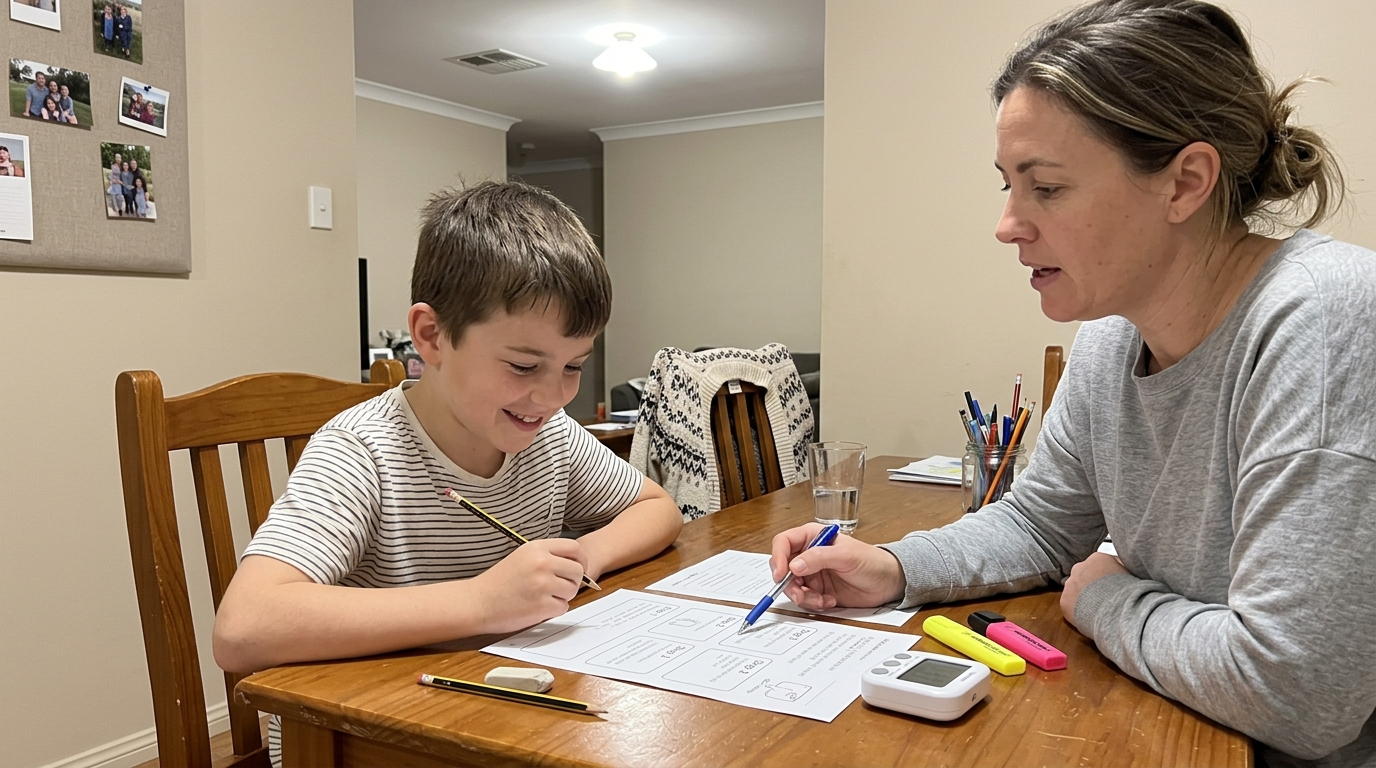
For a child with ADHD, focus is finite per block. Instead of one 60-minute session of continuous work, the tutor runs three or four 10–15-minute work blocks separated by 2–5-minute resets. A timer on the desk (kitchen timer, sand timer, or visual countdown disc) makes the boundary external — the child isn't holding the time in their head.
2. Tasks chunked into small numbered steps
A page of word problems is overwhelming; the same content as five numbered boxes ("Step 1 — read", "Step 2 — underline what's known", "Step 3 — write the equation") is doable. Tutors who specialise in ADHD almost always rewrite worksheets into chunked steps before the lesson, so the child sees a finish line every couple of minutes.
3. Movement breaks built into the lesson plan
Five-minute resets aren't optional extras — they're part of the work. A wall sit, a quick walk to the kitchen for water, ten star jumps, or a stretch before the next block helps regulate attention. Movement breaks are scheduled, not earned, so the child knows the next one is coming.
4. Multi-sensory delivery
Children with ADHD often retain better when a concept arrives through more than one channel. The tutor explains, the child writes, the tutor draws a quick diagram, the child says it back. For maths that means manipulatives or sketches; for English, reading aloud and colour-coding. Multi-sensory teaching is one of the strategies the EEF flags as having strong evidence for SEN learners.
5. A low-stim, predictable session space
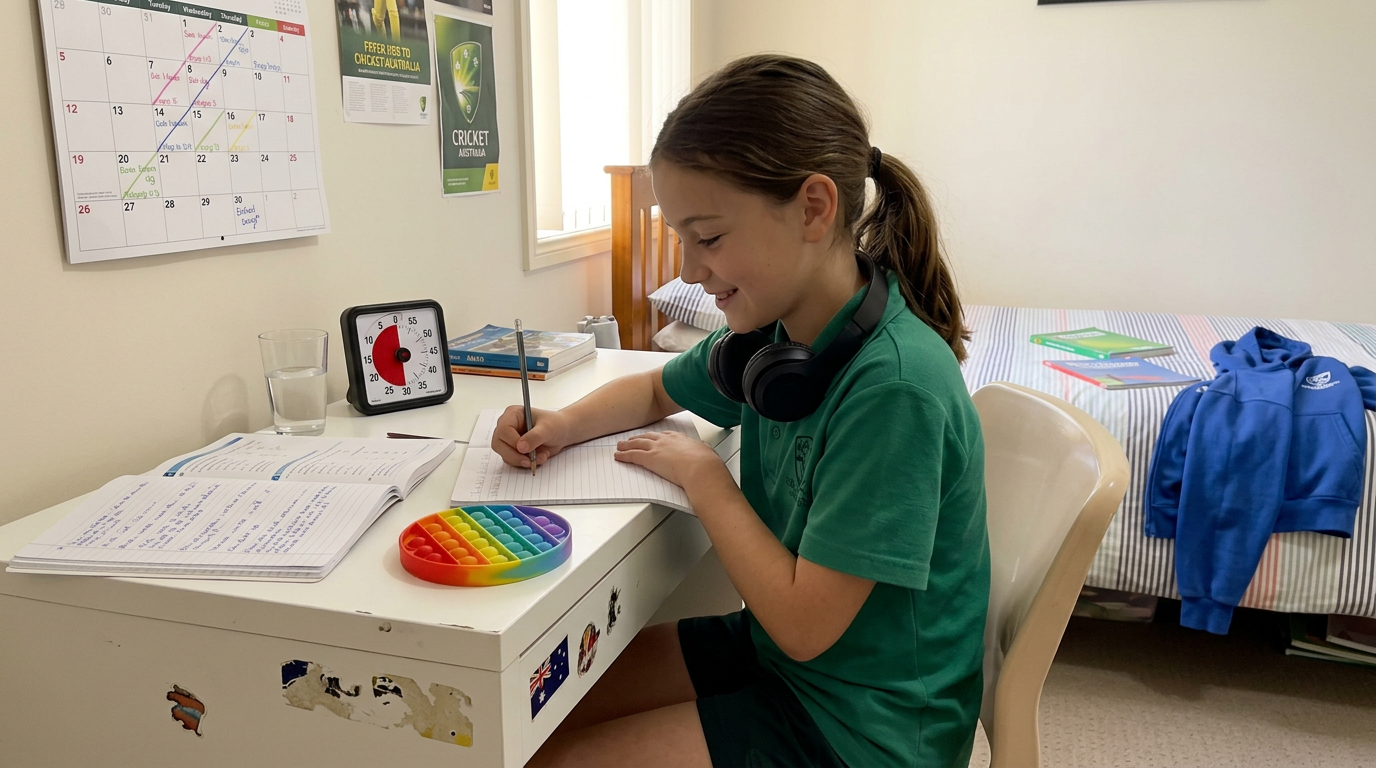
A tidy desk, the phone out of sight, headphones available, a fidget within reach, and the same start-of-session routine each week. Predictability lowers the cognitive cost of getting started — which is often the hardest part of the lesson for a child with ADHD.
6. Immediate rewards tied to effort
Rewards work for ADHD students when they're immediate, frequent, and connected to effort rather than only outcome. A sticker, a token, choosing the next topic, or three minutes of a favourite game between blocks. The reward needs to land in the same session — delayed rewards lose their pull.
7. Tight feedback loops with the parent
After each session the tutor sends a one-paragraph note: what worked, what didn't, what the child should practise this week, anything the parent should flag at school. This loop catches drift early and lets the parent reinforce the same chunked-step language at home.
8. A tutor with explicit ADHD experience
The single biggest predictor of whether tutoring will work is who the tutor is. A tutor who has worked with neurodivergent learners before knows when to push, when to switch tasks, when to call a break, and how to talk to the child without making them feel broken. Ask explicitly.
How does tutoring help children with ADHD focus?
Tutoring helps a child with ADHD focus by replacing the things classrooms can't offer — instant redirection, immediate feedback, and a session designed around their attention rhythm. In a classroom of 26, a teacher can't reset a distracted child mid-task without disrupting everyone; in a one-on-one session the tutor sees the moment focus drops and can switch the task, call a movement break, or change format on the spot. The session is built around 10–15-minute attention blocks instead of being broken across 60 unbroken minutes. And the relationship — same tutor, same time, same routine each week — is itself a focus aid, because the child isn't burning energy figuring out what's coming next.
Should children with ADHD have shorter or longer tutoring sessions?
Most children with ADHD do best with sessions in the 45–60-minute range, broken into shorter work blocks rather than one continuous push. For Year 1–4, 30–45 minutes is usually enough — beyond that, fatigue undoes the benefit. From Year 5 upwards, a 60-minute session structured as four 12-minute blocks with three short resets often works better than a single uninterrupted hour. For senior students working towards the HSC, VCE, or QCE, sessions can stretch to 75–90 minutes if the breaks are real and the student wants the longer block; the tutor adjusts to the student, not the other way round. The right length is the longest block the child can sustain with the structure intact, not the longest the parent can afford on the schedule.
How does a tutor structure a session for a child with ADHD?
A typical 60-minute ADHD-aware session runs in five phases. Minutes 0–5: a low-stakes warm-up that signals "we're starting" — a quick mental-maths drill, a vocabulary recall, a "what did we cover last time" check. Minutes 5–17: first work block on the hardest task of the day, while attention is freshest. Minutes 17–22: movement break, water, a stretch. Minutes 22–34: second work block on a different format (if the first was reading-heavy, this one is problem-solving; if the first was maths, this one is writing). Minutes 34–39: second movement break. Minutes 39–55: lighter consolidation block — practice questions, going over what was tricky earlier, easy wins. Minutes 55–60: wrap-up, one-line note for the parent, set the mini-task for the week. The phases stay the same week to week — the content is what changes.
What rewards work for students with ADHD?
Rewards work for children with ADHD when they're immediate, frequent, and tied to effort — not when they're saved up for the end of term. The brain's reward system in ADHD is wired toward the now, so a sticker on the desk after the first block beats a promise of a treat after a fortnight of "good behaviour". Useful in-session rewards: a small sticker chart that fills up by the end of the session, a token jar where each token earns a few minutes of a favourite activity, the child choosing the next topic or the next break length, or a "win streak" tally of correctly-answered questions. Avoid food-only rewards (they create a separate problem) and avoid rewards that only land at the end of the week — the lag is too long for the reinforcement to attach to the right behaviour. The strongest reward of all is genuine specific praise — "you stuck with that problem even when it got hard" — delivered in the moment.
Online or in-person tutoring for ADHD — which is better?
Both can work; the right choice depends on the child, not on a rule. Online suits children who are easily distracted by being driven somewhere new, who need the security of being at home, who have sensory sensitivities to unfamiliar spaces, or whose schedule is already packed. The platform can mean fewer transitions, the parent is nearby if dysregulation hits, and tools like a shared whiteboard, screen-sharing on multi-step problems, and an on-screen timer are arguably easier online than in-person. In-person suits children who need physical presence to stay engaged, who tune out faces on screens, or whose home is itself the source of distraction (younger siblings, TV in the next room). For most primary-aged children with ADHD, online with the parent in earshot is the lowest-friction starting point; for some teenagers, the formality of in-person at the kitchen table works better. Try four sessions in one format, then four in the other if the first isn't landing — the child will tell you which is working.
How do I find a tutor experienced with ADHD?
Five questions to ask any tutor or service before booking, in this order:
- How many of your current students have ADHD or another neurodivergence? "A few" or "most of them" is a green flag; "I've never been asked that" is a red flag.
- What does a session typically look like for an ADHD student? You want to hear about timed blocks, movement breaks, chunked tasks — not a generic "I make it engaging".
- How do you handle the moment a child is dysregulated mid-session? The honest answer is "I switch tasks, call a movement break, or end early" — never "I push through".
- Do you communicate with the parent after each session? A brief written note after each lesson is standard at services that take ADHD seriously.
- Can we trial four sessions before committing longer term? ADHD is a fit-driven match — the right tutor needs to be tested in real lessons, not on paper.
Tutero's tutors are matched specifically on neurodivergence experience when the parent flags ADHD at intake. The first session is structured so the parent can sit in unobtrusively, and the four-session trial is built into how matches work — if the chemistry isn't right, the tutor changes, the structure doesn't.
What if my child's ADHD medication wears off mid-session?
Plan the lesson timing around the medication window where you can. Most stimulant medications give a clear 4–8-hour focus window depending on formulation, and tutoring is most effective scheduled inside it — usually mid-to-late afternoon for a child taking medication after breakfast. If the session lands at the tail end of the window, tell the tutor; the structure changes. The harder tasks come first when focus is best, the second half of the lesson shifts to consolidation and review rather than new content, and the tutor is quicker to call breaks. If medication wears off mid-session, the tutor can switch to a low-stim activity (going over the day's work verbally, doing a recall game, or finishing early with a written summary) rather than pushing through to a full hour. None of this requires medical advice from the tutor — they just need to know roughly when the window closes.
How much does ADHD-aware tutoring cost in Australia?
Most one-on-one tutoring in Australia sits between A$55 and A$85 an hour. Tutero's rate is A$65 per hour at every year level — a Year 3 child working on reading and a Year 12 student working on the HSC are billed the same, with no senior premium. The rate covers the lesson, the chunked-task lesson plan, and the parent feedback note after every session. There are no contracts and you pay per lesson, which matters more for ADHD families than most — the freedom to pause for school holidays, a flare-up, or a medication change without losing a prepaid block.
Is tutoring worth it for a child with ADHD?
For most families, yes — if the tutor is the right fit and the structure above is in place. The reasons it tends to work for ADHD specifically: the one-on-one format means instant redirection when attention drops, the session is built around the child's attention rhythm rather than a class of 26, the same predictable routine each week reduces the cognitive cost of starting, and the parent feedback loop catches drift before it becomes a slump. The reasons it sometimes doesn't: a tutor with no neurodivergence experience can compound the problem, a session length that's too long, or unrealistic short-term expectations (give it a term — eight to ten sessions — before you decide). One independent academic source on long-term outcomes for ADHD students who receive structured one-on-one support is the longitudinal work cited by CHADD; for a fuller introduction to whether tutoring is the right intervention at all, see our case for ADHD-tailored tutoring.
When is tutoring not the right answer?
If a child is in active diagnosis or medication adjustment, give that process room to settle before adding a tutor on top. If the child is severely dysregulated by any new adult — including online — work with the school and the treating clinician first. If the underlying issue is anxiety or a co-occurring learning difference rather than ADHD on its own, tutoring still helps, but the priority is matching with a tutor who's worked with the specific overlap before. For background on co-occurring profiles, our umbrella piece on common learning differences is a good starting point.
Related reading
- Tailored tutoring for students with ADHD — addressing unique needs
- How can I help my child focus and pay attention?
- How to improve a student's attention span
- How to choose the best tutoring services for students with autism
- How tutoring supports NDIS participants with diverse learning needs
- How personalised tutoring can help your child
- 5 key benefits of private tutoring
- The ideal time to begin tutoring
The bottom line
Tutoring helps a child with ADHD when the tutor changes the mechanics of the session — short blocks, visible timers, chunked tasks, scheduled movement, multi-sensory delivery, immediate rewards, and a tight loop with the parent — not just the content. The single most important call is who the tutor is: experience with neurodivergent learners is the difference between a session that compounds and a session that drains. Trial four lessons. Watch for the small private "I got it" moments. If they're showing up, the structure is working. If you want that from session one, start with a tutor experienced with ADHD.
Ready to find a tutor experienced with ADHD?
Tell us your child's year level, the subject, and that ADHD support matters — we'll match a tutor who's worked with neurodivergent learners before, at A$65 an hour with no contracts. Browse Tutero's tutors or get matched in a few minutes.
Updated for 2026. Tutoring works for children with ADHD when the tutor changes how the session runs, not just what the session covers. Shorter blocks, visible timers, movement breaks, low-stim space, and rewards the child actually cares about — these are the mechanics that turn one-on-one time into real progress. This guide covers the eight strategies experienced ADHD tutors actually use, what to ask before booking, and how the practical questions parents lose sleep over (medication wearing off, online vs in-person, whether shorter sessions are enough) play out in real lessons.
Quick answer
The best tutoring strategies for a child with ADHD are: (1) short, time-boxed work blocks with visible timers, (2) movement breaks every 10–15 minutes, (3) tasks broken into small numbered steps, (4) multi-sensory delivery (talk + write + draw + manipulate), (5) a low-stim, predictable session structure, (6) immediate rewards tied to effort not just outcome, (7) tight feedback loops with the parent every session, and (8) a tutor who has explicit experience supporting children with ADHD. One-on-one is the format that lets all eight run together — which is why structured tutoring tends to outperform group help for ADHD students. Tutoring at Tutero starts at A$65 per hour, the same rate at every year level. Our online ADHD tutoring is built around all eight.
What are the best tutoring strategies for ADHD?
The eight strategies below are the ones experienced ADHD tutors lean on most often, and the ones the research base behind CHADD, the American Academy of Child and Adolescent Psychiatry, and the EEF special educational needs guidance consistently support. None are exotic — what makes them work is doing them together, every session, without dropping any one of them when the child seems to be coping.
1. Short, time-boxed work blocks
For a child with ADHD, focus is finite per block. Instead of one 60-minute session of continuous work, the tutor runs three or four 10–15-minute work blocks separated by 2–5-minute resets. A timer on the desk (kitchen timer, sand timer, or visual countdown disc) makes the boundary external — the child isn't holding the time in their head.
2. Tasks chunked into small numbered steps
A page of word problems is overwhelming; the same content as five numbered boxes ("Step 1 — read", "Step 2 — underline what's known", "Step 3 — write the equation") is doable. Tutors who specialise in ADHD almost always rewrite worksheets into chunked steps before the lesson, so the child sees a finish line every couple of minutes.
3. Movement breaks built into the lesson plan
Five-minute resets aren't optional extras — they're part of the work. A wall sit, a quick walk to the kitchen for water, ten star jumps, or a stretch before the next block helps regulate attention. Movement breaks are scheduled, not earned, so the child knows the next one is coming.
4. Multi-sensory delivery
Children with ADHD often retain better when a concept arrives through more than one channel. The tutor explains, the child writes, the tutor draws a quick diagram, the child says it back. For maths that means manipulatives or sketches; for English, reading aloud and colour-coding. Multi-sensory teaching is one of the strategies the EEF flags as having strong evidence for SEN learners.
5. A low-stim, predictable session space
A tidy desk, the phone out of sight, headphones available, a fidget within reach, and the same start-of-session routine each week. Predictability lowers the cognitive cost of getting started — which is often the hardest part of the lesson for a child with ADHD.
6. Immediate rewards tied to effort
Rewards work for ADHD students when they're immediate, frequent, and connected to effort rather than only outcome. A sticker, a token, choosing the next topic, or three minutes of a favourite game between blocks. The reward needs to land in the same session — delayed rewards lose their pull.
7. Tight feedback loops with the parent
After each session the tutor sends a one-paragraph note: what worked, what didn't, what the child should practise this week, anything the parent should flag at school. This loop catches drift early and lets the parent reinforce the same chunked-step language at home.
8. A tutor with explicit ADHD experience
The single biggest predictor of whether tutoring will work is who the tutor is. A tutor who has worked with neurodivergent learners before knows when to push, when to switch tasks, when to call a break, and how to talk to the child without making them feel broken. Ask explicitly.
How does tutoring help children with ADHD focus?
Tutoring helps a child with ADHD focus by replacing the things classrooms can't offer — instant redirection, immediate feedback, and a session designed around their attention rhythm. In a classroom of 26, a teacher can't reset a distracted child mid-task without disrupting everyone; in a one-on-one session the tutor sees the moment focus drops and can switch the task, call a movement break, or change format on the spot. The session is built around 10–15-minute attention blocks instead of being broken across 60 unbroken minutes. And the relationship — same tutor, same time, same routine each week — is itself a focus aid, because the child isn't burning energy figuring out what's coming next.
Should children with ADHD have shorter or longer tutoring sessions?
Most children with ADHD do best with sessions in the 45–60-minute range, broken into shorter work blocks rather than one continuous push. For Year 1–4, 30–45 minutes is usually enough — beyond that, fatigue undoes the benefit. From Year 5 upwards, a 60-minute session structured as four 12-minute blocks with three short resets often works better than a single uninterrupted hour. For senior students working towards the HSC, VCE, or QCE, sessions can stretch to 75–90 minutes if the breaks are real and the student wants the longer block; the tutor adjusts to the student, not the other way round. The right length is the longest block the child can sustain with the structure intact, not the longest the parent can afford on the schedule.
How does a tutor structure a session for a child with ADHD?
A typical 60-minute ADHD-aware session runs in five phases. Minutes 0–5: a low-stakes warm-up that signals "we're starting" — a quick mental-maths drill, a vocabulary recall, a "what did we cover last time" check. Minutes 5–17: first work block on the hardest task of the day, while attention is freshest. Minutes 17–22: movement break, water, a stretch. Minutes 22–34: second work block on a different format (if the first was reading-heavy, this one is problem-solving; if the first was maths, this one is writing). Minutes 34–39: second movement break. Minutes 39–55: lighter consolidation block — practice questions, going over what was tricky earlier, easy wins. Minutes 55–60: wrap-up, one-line note for the parent, set the mini-task for the week. The phases stay the same week to week — the content is what changes.
What rewards work for students with ADHD?
Rewards work for children with ADHD when they're immediate, frequent, and tied to effort — not when they're saved up for the end of term. The brain's reward system in ADHD is wired toward the now, so a sticker on the desk after the first block beats a promise of a treat after a fortnight of "good behaviour". Useful in-session rewards: a small sticker chart that fills up by the end of the session, a token jar where each token earns a few minutes of a favourite activity, the child choosing the next topic or the next break length, or a "win streak" tally of correctly-answered questions. Avoid food-only rewards (they create a separate problem) and avoid rewards that only land at the end of the week — the lag is too long for the reinforcement to attach to the right behaviour. The strongest reward of all is genuine specific praise — "you stuck with that problem even when it got hard" — delivered in the moment.
Online or in-person tutoring for ADHD — which is better?
Both can work; the right choice depends on the child, not on a rule. Online suits children who are easily distracted by being driven somewhere new, who need the security of being at home, who have sensory sensitivities to unfamiliar spaces, or whose schedule is already packed. The platform can mean fewer transitions, the parent is nearby if dysregulation hits, and tools like a shared whiteboard, screen-sharing on multi-step problems, and an on-screen timer are arguably easier online than in-person. In-person suits children who need physical presence to stay engaged, who tune out faces on screens, or whose home is itself the source of distraction (younger siblings, TV in the next room). For most primary-aged children with ADHD, online with the parent in earshot is the lowest-friction starting point; for some teenagers, the formality of in-person at the kitchen table works better. Try four sessions in one format, then four in the other if the first isn't landing — the child will tell you which is working.
How do I find a tutor experienced with ADHD?
Five questions to ask any tutor or service before booking, in this order:
- How many of your current students have ADHD or another neurodivergence? "A few" or "most of them" is a green flag; "I've never been asked that" is a red flag.
- What does a session typically look like for an ADHD student? You want to hear about timed blocks, movement breaks, chunked tasks — not a generic "I make it engaging".
- How do you handle the moment a child is dysregulated mid-session? The honest answer is "I switch tasks, call a movement break, or end early" — never "I push through".
- Do you communicate with the parent after each session? A brief written note after each lesson is standard at services that take ADHD seriously.
- Can we trial four sessions before committing longer term? ADHD is a fit-driven match — the right tutor needs to be tested in real lessons, not on paper.
Tutero's tutors are matched specifically on neurodivergence experience when the parent flags ADHD at intake. The first session is structured so the parent can sit in unobtrusively, and the four-session trial is built into how matches work — if the chemistry isn't right, the tutor changes, the structure doesn't.
What if my child's ADHD medication wears off mid-session?
Plan the lesson timing around the medication window where you can. Most stimulant medications give a clear 4–8-hour focus window depending on formulation, and tutoring is most effective scheduled inside it — usually mid-to-late afternoon for a child taking medication after breakfast. If the session lands at the tail end of the window, tell the tutor; the structure changes. The harder tasks come first when focus is best, the second half of the lesson shifts to consolidation and review rather than new content, and the tutor is quicker to call breaks. If medication wears off mid-session, the tutor can switch to a low-stim activity (going over the day's work verbally, doing a recall game, or finishing early with a written summary) rather than pushing through to a full hour. None of this requires medical advice from the tutor — they just need to know roughly when the window closes.
How much does ADHD-aware tutoring cost in Australia?
Most one-on-one tutoring in Australia sits between A$55 and A$85 an hour. Tutero's rate is A$65 per hour at every year level — a Year 3 child working on reading and a Year 12 student working on the HSC are billed the same, with no senior premium. The rate covers the lesson, the chunked-task lesson plan, and the parent feedback note after every session. There are no contracts and you pay per lesson, which matters more for ADHD families than most — the freedom to pause for school holidays, a flare-up, or a medication change without losing a prepaid block.
Is tutoring worth it for a child with ADHD?
For most families, yes — if the tutor is the right fit and the structure above is in place. The reasons it tends to work for ADHD specifically: the one-on-one format means instant redirection when attention drops, the session is built around the child's attention rhythm rather than a class of 26, the same predictable routine each week reduces the cognitive cost of starting, and the parent feedback loop catches drift before it becomes a slump. The reasons it sometimes doesn't: a tutor with no neurodivergence experience can compound the problem, a session length that's too long, or unrealistic short-term expectations (give it a term — eight to ten sessions — before you decide). One independent academic source on long-term outcomes for ADHD students who receive structured one-on-one support is the longitudinal work cited by CHADD; for a fuller introduction to whether tutoring is the right intervention at all, see our case for ADHD-tailored tutoring.
When is tutoring not the right answer?
If a child is in active diagnosis or medication adjustment, give that process room to settle before adding a tutor on top. If the child is severely dysregulated by any new adult — including online — work with the school and the treating clinician first. If the underlying issue is anxiety or a co-occurring learning difference rather than ADHD on its own, tutoring still helps, but the priority is matching with a tutor who's worked with the specific overlap before. For background on co-occurring profiles, our umbrella piece on common learning differences is a good starting point.
Related reading
- Tailored tutoring for students with ADHD — addressing unique needs
- How can I help my child focus and pay attention?
- How to improve a student's attention span
- How to choose the best tutoring services for students with autism
- How tutoring supports NDIS participants with diverse learning needs
- How personalised tutoring can help your child
- 5 key benefits of private tutoring
- The ideal time to begin tutoring
The bottom line
Tutoring helps a child with ADHD when the tutor changes the mechanics of the session — short blocks, visible timers, chunked tasks, scheduled movement, multi-sensory delivery, immediate rewards, and a tight loop with the parent — not just the content. The single most important call is who the tutor is: experience with neurodivergent learners is the difference between a session that compounds and a session that drains. Trial four lessons. Watch for the small private "I got it" moments. If they're showing up, the structure is working. If you want that from session one, start with a tutor experienced with ADHD.
Ready to find a tutor experienced with ADHD?
Tell us your child's year level, the subject, and that ADHD support matters — we'll match a tutor who's worked with neurodivergent learners before, at A$65 an hour with no contracts. Browse Tutero's tutors or get matched in a few minutes.
FAQ
.svg)
.svg)
Online maths tutoring at Tutero is catering to students of all year levels. We offer programs tailored to the unique learning curves of each age group.
We also have expert NAPLAN and ATAR subject tutors, ensuring students are well-equipped for these pivotal assessments.
We recommend at least two to three session per week for consistent progress. However, this can vary based on your child's needs and goals.
Our platform uses advanced security protocols to ensure the safety and privacy of all our online sessions.
Parents are welcome to observe sessions. We believe in a collaborative approach to education.
We provide regular progress reports and assessments to track your child’s academic development.
Yes, we prioritise the student-tutor relationship and can arrange a change if the need arises.
Yes, we offer a range of resources and materials, including interactive exercises and practice worksheets.

Updated for 2026. Tutoring works for children with ADHD when the tutor changes how the session runs, not just what the session covers. Shorter blocks, visible timers, movement breaks, low-stim space, and rewards the child actually cares about — these are the mechanics that turn one-on-one time into real progress. This guide covers the eight strategies experienced ADHD tutors actually use, what to ask before booking, and how the practical questions parents lose sleep over (medication wearing off, online vs in-person, whether shorter sessions are enough) play out in real lessons.
Quick answer
The best tutoring strategies for a child with ADHD are: (1) short, time-boxed work blocks with visible timers, (2) movement breaks every 10–15 minutes, (3) tasks broken into small numbered steps, (4) multi-sensory delivery (talk + write + draw + manipulate), (5) a low-stim, predictable session structure, (6) immediate rewards tied to effort not just outcome, (7) tight feedback loops with the parent every session, and (8) a tutor who has explicit experience supporting children with ADHD. One-on-one is the format that lets all eight run together — which is why structured tutoring tends to outperform group help for ADHD students. Tutoring at Tutero starts at A$65 per hour, the same rate at every year level. Our online ADHD tutoring is built around all eight.
What are the best tutoring strategies for ADHD?
The eight strategies below are the ones experienced ADHD tutors lean on most often, and the ones the research base behind CHADD, the American Academy of Child and Adolescent Psychiatry, and the EEF special educational needs guidance consistently support. None are exotic — what makes them work is doing them together, every session, without dropping any one of them when the child seems to be coping.
1. Short, time-boxed work blocks
For a child with ADHD, focus is finite per block. Instead of one 60-minute session of continuous work, the tutor runs three or four 10–15-minute work blocks separated by 2–5-minute resets. A timer on the desk (kitchen timer, sand timer, or visual countdown disc) makes the boundary external — the child isn't holding the time in their head.
2. Tasks chunked into small numbered steps
A page of word problems is overwhelming; the same content as five numbered boxes ("Step 1 — read", "Step 2 — underline what's known", "Step 3 — write the equation") is doable. Tutors who specialise in ADHD almost always rewrite worksheets into chunked steps before the lesson, so the child sees a finish line every couple of minutes.
3. Movement breaks built into the lesson plan
Five-minute resets aren't optional extras — they're part of the work. A wall sit, a quick walk to the kitchen for water, ten star jumps, or a stretch before the next block helps regulate attention. Movement breaks are scheduled, not earned, so the child knows the next one is coming.
4. Multi-sensory delivery
Children with ADHD often retain better when a concept arrives through more than one channel. The tutor explains, the child writes, the tutor draws a quick diagram, the child says it back. For maths that means manipulatives or sketches; for English, reading aloud and colour-coding. Multi-sensory teaching is one of the strategies the EEF flags as having strong evidence for SEN learners.
5. A low-stim, predictable session space
A tidy desk, the phone out of sight, headphones available, a fidget within reach, and the same start-of-session routine each week. Predictability lowers the cognitive cost of getting started — which is often the hardest part of the lesson for a child with ADHD.
6. Immediate rewards tied to effort
Rewards work for ADHD students when they're immediate, frequent, and connected to effort rather than only outcome. A sticker, a token, choosing the next topic, or three minutes of a favourite game between blocks. The reward needs to land in the same session — delayed rewards lose their pull.
7. Tight feedback loops with the parent
After each session the tutor sends a one-paragraph note: what worked, what didn't, what the child should practise this week, anything the parent should flag at school. This loop catches drift early and lets the parent reinforce the same chunked-step language at home.
8. A tutor with explicit ADHD experience
The single biggest predictor of whether tutoring will work is who the tutor is. A tutor who has worked with neurodivergent learners before knows when to push, when to switch tasks, when to call a break, and how to talk to the child without making them feel broken. Ask explicitly.
How does tutoring help children with ADHD focus?
Tutoring helps a child with ADHD focus by replacing the things classrooms can't offer — instant redirection, immediate feedback, and a session designed around their attention rhythm. In a classroom of 26, a teacher can't reset a distracted child mid-task without disrupting everyone; in a one-on-one session the tutor sees the moment focus drops and can switch the task, call a movement break, or change format on the spot. The session is built around 10–15-minute attention blocks instead of being broken across 60 unbroken minutes. And the relationship — same tutor, same time, same routine each week — is itself a focus aid, because the child isn't burning energy figuring out what's coming next.
Should children with ADHD have shorter or longer tutoring sessions?
Most children with ADHD do best with sessions in the 45–60-minute range, broken into shorter work blocks rather than one continuous push. For Year 1–4, 30–45 minutes is usually enough — beyond that, fatigue undoes the benefit. From Year 5 upwards, a 60-minute session structured as four 12-minute blocks with three short resets often works better than a single uninterrupted hour. For senior students working towards the HSC, VCE, or QCE, sessions can stretch to 75–90 minutes if the breaks are real and the student wants the longer block; the tutor adjusts to the student, not the other way round. The right length is the longest block the child can sustain with the structure intact, not the longest the parent can afford on the schedule.
How does a tutor structure a session for a child with ADHD?
A typical 60-minute ADHD-aware session runs in five phases. Minutes 0–5: a low-stakes warm-up that signals "we're starting" — a quick mental-maths drill, a vocabulary recall, a "what did we cover last time" check. Minutes 5–17: first work block on the hardest task of the day, while attention is freshest. Minutes 17–22: movement break, water, a stretch. Minutes 22–34: second work block on a different format (if the first was reading-heavy, this one is problem-solving; if the first was maths, this one is writing). Minutes 34–39: second movement break. Minutes 39–55: lighter consolidation block — practice questions, going over what was tricky earlier, easy wins. Minutes 55–60: wrap-up, one-line note for the parent, set the mini-task for the week. The phases stay the same week to week — the content is what changes.
What rewards work for students with ADHD?
Rewards work for children with ADHD when they're immediate, frequent, and tied to effort — not when they're saved up for the end of term. The brain's reward system in ADHD is wired toward the now, so a sticker on the desk after the first block beats a promise of a treat after a fortnight of "good behaviour". Useful in-session rewards: a small sticker chart that fills up by the end of the session, a token jar where each token earns a few minutes of a favourite activity, the child choosing the next topic or the next break length, or a "win streak" tally of correctly-answered questions. Avoid food-only rewards (they create a separate problem) and avoid rewards that only land at the end of the week — the lag is too long for the reinforcement to attach to the right behaviour. The strongest reward of all is genuine specific praise — "you stuck with that problem even when it got hard" — delivered in the moment.
Online or in-person tutoring for ADHD — which is better?
Both can work; the right choice depends on the child, not on a rule. Online suits children who are easily distracted by being driven somewhere new, who need the security of being at home, who have sensory sensitivities to unfamiliar spaces, or whose schedule is already packed. The platform can mean fewer transitions, the parent is nearby if dysregulation hits, and tools like a shared whiteboard, screen-sharing on multi-step problems, and an on-screen timer are arguably easier online than in-person. In-person suits children who need physical presence to stay engaged, who tune out faces on screens, or whose home is itself the source of distraction (younger siblings, TV in the next room). For most primary-aged children with ADHD, online with the parent in earshot is the lowest-friction starting point; for some teenagers, the formality of in-person at the kitchen table works better. Try four sessions in one format, then four in the other if the first isn't landing — the child will tell you which is working.
How do I find a tutor experienced with ADHD?
Five questions to ask any tutor or service before booking, in this order:
- How many of your current students have ADHD or another neurodivergence? "A few" or "most of them" is a green flag; "I've never been asked that" is a red flag.
- What does a session typically look like for an ADHD student? You want to hear about timed blocks, movement breaks, chunked tasks — not a generic "I make it engaging".
- How do you handle the moment a child is dysregulated mid-session? The honest answer is "I switch tasks, call a movement break, or end early" — never "I push through".
- Do you communicate with the parent after each session? A brief written note after each lesson is standard at services that take ADHD seriously.
- Can we trial four sessions before committing longer term? ADHD is a fit-driven match — the right tutor needs to be tested in real lessons, not on paper.
Tutero's tutors are matched specifically on neurodivergence experience when the parent flags ADHD at intake. The first session is structured so the parent can sit in unobtrusively, and the four-session trial is built into how matches work — if the chemistry isn't right, the tutor changes, the structure doesn't.
What if my child's ADHD medication wears off mid-session?
Plan the lesson timing around the medication window where you can. Most stimulant medications give a clear 4–8-hour focus window depending on formulation, and tutoring is most effective scheduled inside it — usually mid-to-late afternoon for a child taking medication after breakfast. If the session lands at the tail end of the window, tell the tutor; the structure changes. The harder tasks come first when focus is best, the second half of the lesson shifts to consolidation and review rather than new content, and the tutor is quicker to call breaks. If medication wears off mid-session, the tutor can switch to a low-stim activity (going over the day's work verbally, doing a recall game, or finishing early with a written summary) rather than pushing through to a full hour. None of this requires medical advice from the tutor — they just need to know roughly when the window closes.
How much does ADHD-aware tutoring cost in Australia?
Most one-on-one tutoring in Australia sits between A$55 and A$85 an hour. Tutero's rate is A$65 per hour at every year level — a Year 3 child working on reading and a Year 12 student working on the HSC are billed the same, with no senior premium. The rate covers the lesson, the chunked-task lesson plan, and the parent feedback note after every session. There are no contracts and you pay per lesson, which matters more for ADHD families than most — the freedom to pause for school holidays, a flare-up, or a medication change without losing a prepaid block.
Is tutoring worth it for a child with ADHD?
For most families, yes — if the tutor is the right fit and the structure above is in place. The reasons it tends to work for ADHD specifically: the one-on-one format means instant redirection when attention drops, the session is built around the child's attention rhythm rather than a class of 26, the same predictable routine each week reduces the cognitive cost of starting, and the parent feedback loop catches drift before it becomes a slump. The reasons it sometimes doesn't: a tutor with no neurodivergence experience can compound the problem, a session length that's too long, or unrealistic short-term expectations (give it a term — eight to ten sessions — before you decide). One independent academic source on long-term outcomes for ADHD students who receive structured one-on-one support is the longitudinal work cited by CHADD; for a fuller introduction to whether tutoring is the right intervention at all, see our case for ADHD-tailored tutoring.
When is tutoring not the right answer?
If a child is in active diagnosis or medication adjustment, give that process room to settle before adding a tutor on top. If the child is severely dysregulated by any new adult — including online — work with the school and the treating clinician first. If the underlying issue is anxiety or a co-occurring learning difference rather than ADHD on its own, tutoring still helps, but the priority is matching with a tutor who's worked with the specific overlap before. For background on co-occurring profiles, our umbrella piece on common learning differences is a good starting point.
Related reading
- Tailored tutoring for students with ADHD — addressing unique needs
- How can I help my child focus and pay attention?
- How to improve a student's attention span
- How to choose the best tutoring services for students with autism
- How tutoring supports NDIS participants with diverse learning needs
- How personalised tutoring can help your child
- 5 key benefits of private tutoring
- The ideal time to begin tutoring
The bottom line
Tutoring helps a child with ADHD when the tutor changes the mechanics of the session — short blocks, visible timers, chunked tasks, scheduled movement, multi-sensory delivery, immediate rewards, and a tight loop with the parent — not just the content. The single most important call is who the tutor is: experience with neurodivergent learners is the difference between a session that compounds and a session that drains. Trial four lessons. Watch for the small private "I got it" moments. If they're showing up, the structure is working. If you want that from session one, start with a tutor experienced with ADHD.
Ready to find a tutor experienced with ADHD?
Tell us your child's year level, the subject, and that ADHD support matters — we'll match a tutor who's worked with neurodivergent learners before, at A$65 an hour with no contracts. Browse Tutero's tutors or get matched in a few minutes.
Hoping to improve confidence & grades?

.png)


