.svg)

Updated 7 May 2026 by Joey Moshinsky, Co-founder of Tutero. Built with input from primary and secondary maths teachers in Australia using the Tutero AI Co-Teacher.
Quick answer
You can prepare a curriculum-aligned, differentiated maths worksheet in about 30 seconds with the Tutero AI Co-Teacher: pick a topic, pick a year level, pick a difficulty (Mild, Hot, Spicy), generate, edit any question with one click, and download a PDF with an answer key. ChatGPT can also draft questions but typically takes 5–10 minutes of prompt-tuning per worksheet, gives no built-in differentiation, and rarely matches the Australian Curriculum or year-level vocabulary on the first try.
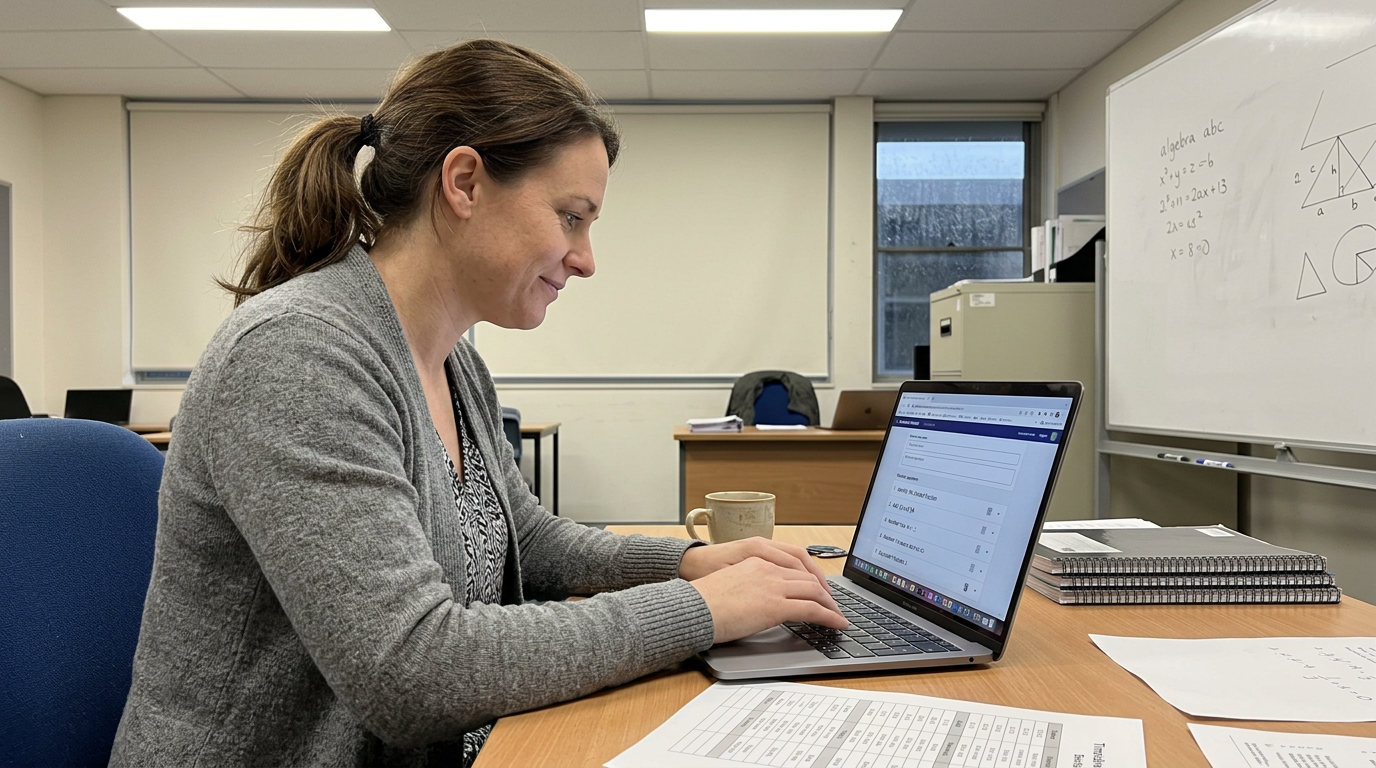
How do I prepare a maths worksheet in 30 seconds with AI?
Open the Tutero AI Co-Teacher, type the topic in plain English (for example, "fractions on a number line"), set the year level (3, 5, 8, 9 — whatever you teach), and choose a difficulty band: Mild for foundation, Hot for on-level, Spicy for stretch. Click Generate. Within roughly 30 seconds you'll have a worksheet with 8–12 questions, varied formats (multiple choice, short response, diagram tasks), an answer key, and a printable PDF. If a question feels off, hover, click "Edit with AI", type one line of feedback ("make it word-problem style", "drop the decimals"), and the question rewrites in place.
What's the best AI for generating maths worksheets?
The honest answer depends on whether you want speed plus differentiation, or maximum customisation. The Tutero AI Co-Teacher is purpose-built for Australian teachers, so it ships with the Australian Curriculum, Mild/Hot/Spicy difficulty levels, an in-built answer key, and a one-click PDF export. ChatGPT, Claude, and Gemini can write maths questions but you'll spend the time on prompt engineering, formatting, and verifying answers yourself. MagicSchool and Diffit do worksheets too but lean US-curriculum-first. For a quick comparison of the four most-used options:
| Tool | Time per worksheet | Curriculum aligned | Built-in differentiation | Answer key |
|---|---|---|---|---|
| Tutero AI Co-Teacher | ~30 seconds | Australian Curriculum (F–10) + senior | Yes — Mild / Hot / Spicy | Auto-generated |
| ChatGPT (general) | 5–10 minutes | Manual prompt | Manual prompt | Ask separately, verify |
| MagicSchool | 2–3 minutes | US Common Core first | Some | Yes |
| Diffit | 2–3 minutes | US-leaning | Reading-level only | Yes |
How does Tutero AI compare to ChatGPT for worksheets?
ChatGPT is a general-purpose model — brilliant at drafting, weaker at structured output. To get a usable maths worksheet you need to write a long prompt: subject, year level, difficulty rules, format, mark scheme, answer key, then re-prompt to fix errors. Most teachers we've spoken to spend 5–10 minutes per worksheet on this. Tutero AI is purpose-built: the prompt is three dropdowns, the curriculum is baked in, the differentiation is a button, and the answer key is automatic. Where ChatGPT wins is open-ended generation — story problems with niche themes, very specific extension tasks, or reasoning-heavy enrichment that doesn't fit a standard format. The honest split: use Tutero AI for daily worksheets and weekly homework, use ChatGPT for the occasional one-off creative task.
Can AI generate differentiated maths worksheets?
Yes — and differentiation is the most important upgrade AI brings to worksheet prep. The Australian Association of Mathematics Teachers (AAMT) describes effective practice as work that meets each student in their zone of proximal development, the band just beyond what they can already do. Differentiation in a worksheet usually means three tiers: a foundation tier for students still building the underlying skill, an on-level tier that matches the year-level standard, and a stretch tier that pushes reasoning or applies the concept in unfamiliar contexts. The Tutero AI Co-Teacher generates all three tiers from a single click — Mild, Hot, Spicy — pulling from a question bank tagged by curriculum strand and difficulty. ChatGPT can do this if you prompt for it explicitly each time, but the consistency drifts and the difficulty bands rarely line up across worksheets.
Are AI-generated worksheets aligned with the curriculum?
Tutero AI's question bank is mapped to the Australian Curriculum (F–10) plus senior-secondary syllabuses (NSW Stage 6, VCE General/Methods, QCE General/Methods, ATAR pathways). When you pick "Year 7, Fractions and Decimals", the questions you generate are pulled from items already tagged AC9M7N03 and AC9M7N04. General-purpose models like ChatGPT have no curriculum tagging — you have to specify the standard yourself, and the model will guess at the rest. The OECD's 2024 paper on AI in education flags this as the central trust gap for AI in classrooms: teachers can't verify alignment quickly, so they default to manual creation. Purpose-built tools close that gap by anchoring generation to the standard before the model writes anything.

What prompts make the best maths worksheets?
If you're using the Tutero AI Co-Teacher, the prompt is three fields: topic + year level + difficulty. The "prompt engineering" is done for you. If you're using a general AI tool like ChatGPT or Claude, the prompts that produce usable worksheets share four traits: they specify the year level and curriculum standard, they specify the difficulty band, they specify the question count and mix of formats, and they ask for the answer key in a separate code block. A worked example: "Generate 10 Year 8 questions on linear equations aligned to AC9M8A03. Two foundation, six on-level, two extension. Mix multiple choice, short response, and one word problem. Output the questions first, then the answer key in a separate code block." Even with that prompt you'll still need to verify the maths and the alignment — which is why most teachers eventually move to a purpose-built tool.
How do I make maths worksheets faster as a primary teacher?
Three changes recover the most time. First, batch your worksheet prep into one 20-minute block per week instead of five-minute scrambles before each lesson — generation is fastest when you're already in the headspace for it. Second, build a re-usable starter set: open-ended exit tickets, fluency drills, mixed-review sets — generate one of each per term and clone them as needed. Exit tickets in particular benefit from AI generation because the format is short and you need a different one each lesson. Third, use Mild/Hot/Spicy tiers from the start so a single generation gives you three differentiated worksheets instead of one — the prep multiplier is roughly 3x with no extra time. Primary teachers in the Tutero AI Co-Teacher beta typically save 4–6 hours of weekend prep per term.
Should I trust AI to set the right difficulty level?
Verify the first one or two worksheets, then trust the system. Cognitive-load research from John Sweller (UNSW) shows that worksheet difficulty fails most often at the extremes — too many novel elements at once for foundation students, or repetitive problems for stretch students who needed a new context. The Tutero AI Co-Teacher difficulty bands are calibrated against teacher feedback from the question bank: a Year 7 Mild question on fractions has been rated by Year 7 teachers as foundation-band, not by an algorithm guessing. The honest caveat: AI can't tell you whether the Mild band is right for one specific student you have in mind — your knowledge of the room is still the deciding factor. Use the difficulty tiers as the starting point, swap individual questions with "Edit with AI" when you know a student needs a different angle.
Five ways teachers are using AI worksheets in practice
1. Monday-morning warm-ups with last week's content. Generate a Mild-tier review of the previous week's topic so students settle in with familiar material. Reinforces fluency without re-teaching.
2. Same-lesson differentiated practice. Generate Mild, Hot, and Spicy on the same concept and hand them out by table or by name. Pair this with quick formative checks to know which tier each student should sit at.
3. Daily exit tickets after the main task. Two or three questions on the day's concept, generated in 10 seconds at the start of the lesson, completed in the last five minutes.
4. Tiered homework in one go. Generate three difficulty bands and assign by need, not by class. Same prep time, three times the fit.
5. Substitute-teacher worksheet packs. Generate a full week of self-contained worksheets with answer keys — Mild, Hot, Spicy on three or four topics — and leave them in a folder for your next CRT.
Try the Tutero AI Co-Teacher
Ready to make your next worksheet in 30 seconds?
The Tutero AI Co-Teacher is free to try — no setup, no credit card. Pick a topic, a year level, a difficulty, and you'll have a curriculum-aligned worksheet with an answer key before your kettle boils. Built with Australian maths teachers, mapped to the Australian Curriculum, and designed to give you back your weekend prep hours.
Related reading
- Creating maths exit tickets with AI
- 3 AI tools every maths teacher needs in 2025
- 6 ways maths teachers are using AI
- How teachers can use ChatGPT
- How to use AI to boost engagement in your maths classroom
- The ultimate guide to AI in education
- How to use AI to enhance learning in K–12 education
- Formative assessment strategies for the maths classroom
Updated 7 May 2026 by Joey Moshinsky, Co-founder of Tutero. Built with input from primary and secondary maths teachers in Australia using the Tutero AI Co-Teacher.
Quick answer
You can prepare a curriculum-aligned, differentiated maths worksheet in about 30 seconds with the Tutero AI Co-Teacher: pick a topic, pick a year level, pick a difficulty (Mild, Hot, Spicy), generate, edit any question with one click, and download a PDF with an answer key. ChatGPT can also draft questions but typically takes 5–10 minutes of prompt-tuning per worksheet, gives no built-in differentiation, and rarely matches the Australian Curriculum or year-level vocabulary on the first try.
How do I prepare a maths worksheet in 30 seconds with AI?
Open the Tutero AI Co-Teacher, type the topic in plain English (for example, "fractions on a number line"), set the year level (3, 5, 8, 9 — whatever you teach), and choose a difficulty band: Mild for foundation, Hot for on-level, Spicy for stretch. Click Generate. Within roughly 30 seconds you'll have a worksheet with 8–12 questions, varied formats (multiple choice, short response, diagram tasks), an answer key, and a printable PDF. If a question feels off, hover, click "Edit with AI", type one line of feedback ("make it word-problem style", "drop the decimals"), and the question rewrites in place.
What's the best AI for generating maths worksheets?
The honest answer depends on whether you want speed plus differentiation, or maximum customisation. The Tutero AI Co-Teacher is purpose-built for Australian teachers, so it ships with the Australian Curriculum, Mild/Hot/Spicy difficulty levels, an in-built answer key, and a one-click PDF export. ChatGPT, Claude, and Gemini can write maths questions but you'll spend the time on prompt engineering, formatting, and verifying answers yourself. MagicSchool and Diffit do worksheets too but lean US-curriculum-first. For a quick comparison of the four most-used options:
| Tool | Time per worksheet | Curriculum aligned | Built-in differentiation | Answer key |
|---|---|---|---|---|
| Tutero AI Co-Teacher | ~30 seconds | Australian Curriculum (F–10) + senior | Yes — Mild / Hot / Spicy | Auto-generated |
| ChatGPT (general) | 5–10 minutes | Manual prompt | Manual prompt | Ask separately, verify |
| MagicSchool | 2–3 minutes | US Common Core first | Some | Yes |
| Diffit | 2–3 minutes | US-leaning | Reading-level only | Yes |
How does Tutero AI compare to ChatGPT for worksheets?
ChatGPT is a general-purpose model — brilliant at drafting, weaker at structured output. To get a usable maths worksheet you need to write a long prompt: subject, year level, difficulty rules, format, mark scheme, answer key, then re-prompt to fix errors. Most teachers we've spoken to spend 5–10 minutes per worksheet on this. Tutero AI is purpose-built: the prompt is three dropdowns, the curriculum is baked in, the differentiation is a button, and the answer key is automatic. Where ChatGPT wins is open-ended generation — story problems with niche themes, very specific extension tasks, or reasoning-heavy enrichment that doesn't fit a standard format. The honest split: use Tutero AI for daily worksheets and weekly homework, use ChatGPT for the occasional one-off creative task.
Can AI generate differentiated maths worksheets?
Yes — and differentiation is the most important upgrade AI brings to worksheet prep. The Australian Association of Mathematics Teachers (AAMT) describes effective practice as work that meets each student in their zone of proximal development, the band just beyond what they can already do. Differentiation in a worksheet usually means three tiers: a foundation tier for students still building the underlying skill, an on-level tier that matches the year-level standard, and a stretch tier that pushes reasoning or applies the concept in unfamiliar contexts. The Tutero AI Co-Teacher generates all three tiers from a single click — Mild, Hot, Spicy — pulling from a question bank tagged by curriculum strand and difficulty. ChatGPT can do this if you prompt for it explicitly each time, but the consistency drifts and the difficulty bands rarely line up across worksheets.
Are AI-generated worksheets aligned with the curriculum?
Tutero AI's question bank is mapped to the Australian Curriculum (F–10) plus senior-secondary syllabuses (NSW Stage 6, VCE General/Methods, QCE General/Methods, ATAR pathways). When you pick "Year 7, Fractions and Decimals", the questions you generate are pulled from items already tagged AC9M7N03 and AC9M7N04. General-purpose models like ChatGPT have no curriculum tagging — you have to specify the standard yourself, and the model will guess at the rest. The OECD's 2024 paper on AI in education flags this as the central trust gap for AI in classrooms: teachers can't verify alignment quickly, so they default to manual creation. Purpose-built tools close that gap by anchoring generation to the standard before the model writes anything.
What prompts make the best maths worksheets?
If you're using the Tutero AI Co-Teacher, the prompt is three fields: topic + year level + difficulty. The "prompt engineering" is done for you. If you're using a general AI tool like ChatGPT or Claude, the prompts that produce usable worksheets share four traits: they specify the year level and curriculum standard, they specify the difficulty band, they specify the question count and mix of formats, and they ask for the answer key in a separate code block. A worked example: "Generate 10 Year 8 questions on linear equations aligned to AC9M8A03. Two foundation, six on-level, two extension. Mix multiple choice, short response, and one word problem. Output the questions first, then the answer key in a separate code block." Even with that prompt you'll still need to verify the maths and the alignment — which is why most teachers eventually move to a purpose-built tool.
How do I make maths worksheets faster as a primary teacher?
Three changes recover the most time. First, batch your worksheet prep into one 20-minute block per week instead of five-minute scrambles before each lesson — generation is fastest when you're already in the headspace for it. Second, build a re-usable starter set: open-ended exit tickets, fluency drills, mixed-review sets — generate one of each per term and clone them as needed. Exit tickets in particular benefit from AI generation because the format is short and you need a different one each lesson. Third, use Mild/Hot/Spicy tiers from the start so a single generation gives you three differentiated worksheets instead of one — the prep multiplier is roughly 3x with no extra time. Primary teachers in the Tutero AI Co-Teacher beta typically save 4–6 hours of weekend prep per term.
Should I trust AI to set the right difficulty level?
Verify the first one or two worksheets, then trust the system. Cognitive-load research from John Sweller (UNSW) shows that worksheet difficulty fails most often at the extremes — too many novel elements at once for foundation students, or repetitive problems for stretch students who needed a new context. The Tutero AI Co-Teacher difficulty bands are calibrated against teacher feedback from the question bank: a Year 7 Mild question on fractions has been rated by Year 7 teachers as foundation-band, not by an algorithm guessing. The honest caveat: AI can't tell you whether the Mild band is right for one specific student you have in mind — your knowledge of the room is still the deciding factor. Use the difficulty tiers as the starting point, swap individual questions with "Edit with AI" when you know a student needs a different angle.
Five ways teachers are using AI worksheets in practice
1. Monday-morning warm-ups with last week's content. Generate a Mild-tier review of the previous week's topic so students settle in with familiar material. Reinforces fluency without re-teaching.
2. Same-lesson differentiated practice. Generate Mild, Hot, and Spicy on the same concept and hand them out by table or by name. Pair this with quick formative checks to know which tier each student should sit at.
3. Daily exit tickets after the main task. Two or three questions on the day's concept, generated in 10 seconds at the start of the lesson, completed in the last five minutes.
4. Tiered homework in one go. Generate three difficulty bands and assign by need, not by class. Same prep time, three times the fit.
5. Substitute-teacher worksheet packs. Generate a full week of self-contained worksheets with answer keys — Mild, Hot, Spicy on three or four topics — and leave them in a folder for your next CRT.
Try the Tutero AI Co-Teacher
Ready to make your next worksheet in 30 seconds?
The Tutero AI Co-Teacher is free to try — no setup, no credit card. Pick a topic, a year level, a difficulty, and you'll have a curriculum-aligned worksheet with an answer key before your kettle boils. Built with Australian maths teachers, mapped to the Australian Curriculum, and designed to give you back your weekend prep hours.
Related reading
- Creating maths exit tickets with AI
- 3 AI tools every maths teacher needs in 2025
- 6 ways maths teachers are using AI
- How teachers can use ChatGPT
- How to use AI to boost engagement in your maths classroom
- The ultimate guide to AI in education
- How to use AI to enhance learning in K–12 education
- Formative assessment strategies for the maths classroom

Updated 7 May 2026 by Joey Moshinsky, Co-founder of Tutero. Built with input from primary and secondary maths teachers in Australia using the Tutero AI Co-Teacher.
Quick answer
You can prepare a curriculum-aligned, differentiated maths worksheet in about 30 seconds with the Tutero AI Co-Teacher: pick a topic, pick a year level, pick a difficulty (Mild, Hot, Spicy), generate, edit any question with one click, and download a PDF with an answer key. ChatGPT can also draft questions but typically takes 5–10 minutes of prompt-tuning per worksheet, gives no built-in differentiation, and rarely matches the Australian Curriculum or year-level vocabulary on the first try.
How do I prepare a maths worksheet in 30 seconds with AI?
Open the Tutero AI Co-Teacher, type the topic in plain English (for example, "fractions on a number line"), set the year level (3, 5, 8, 9 — whatever you teach), and choose a difficulty band: Mild for foundation, Hot for on-level, Spicy for stretch. Click Generate. Within roughly 30 seconds you'll have a worksheet with 8–12 questions, varied formats (multiple choice, short response, diagram tasks), an answer key, and a printable PDF. If a question feels off, hover, click "Edit with AI", type one line of feedback ("make it word-problem style", "drop the decimals"), and the question rewrites in place.
What's the best AI for generating maths worksheets?
The honest answer depends on whether you want speed plus differentiation, or maximum customisation. The Tutero AI Co-Teacher is purpose-built for Australian teachers, so it ships with the Australian Curriculum, Mild/Hot/Spicy difficulty levels, an in-built answer key, and a one-click PDF export. ChatGPT, Claude, and Gemini can write maths questions but you'll spend the time on prompt engineering, formatting, and verifying answers yourself. MagicSchool and Diffit do worksheets too but lean US-curriculum-first. For a quick comparison of the four most-used options:
| Tool | Time per worksheet | Curriculum aligned | Built-in differentiation | Answer key |
|---|---|---|---|---|
| Tutero AI Co-Teacher | ~30 seconds | Australian Curriculum (F–10) + senior | Yes — Mild / Hot / Spicy | Auto-generated |
| ChatGPT (general) | 5–10 minutes | Manual prompt | Manual prompt | Ask separately, verify |
| MagicSchool | 2–3 minutes | US Common Core first | Some | Yes |
| Diffit | 2–3 minutes | US-leaning | Reading-level only | Yes |
How does Tutero AI compare to ChatGPT for worksheets?
ChatGPT is a general-purpose model — brilliant at drafting, weaker at structured output. To get a usable maths worksheet you need to write a long prompt: subject, year level, difficulty rules, format, mark scheme, answer key, then re-prompt to fix errors. Most teachers we've spoken to spend 5–10 minutes per worksheet on this. Tutero AI is purpose-built: the prompt is three dropdowns, the curriculum is baked in, the differentiation is a button, and the answer key is automatic. Where ChatGPT wins is open-ended generation — story problems with niche themes, very specific extension tasks, or reasoning-heavy enrichment that doesn't fit a standard format. The honest split: use Tutero AI for daily worksheets and weekly homework, use ChatGPT for the occasional one-off creative task.
Can AI generate differentiated maths worksheets?
Yes — and differentiation is the most important upgrade AI brings to worksheet prep. The Australian Association of Mathematics Teachers (AAMT) describes effective practice as work that meets each student in their zone of proximal development, the band just beyond what they can already do. Differentiation in a worksheet usually means three tiers: a foundation tier for students still building the underlying skill, an on-level tier that matches the year-level standard, and a stretch tier that pushes reasoning or applies the concept in unfamiliar contexts. The Tutero AI Co-Teacher generates all three tiers from a single click — Mild, Hot, Spicy — pulling from a question bank tagged by curriculum strand and difficulty. ChatGPT can do this if you prompt for it explicitly each time, but the consistency drifts and the difficulty bands rarely line up across worksheets.
Are AI-generated worksheets aligned with the curriculum?
Tutero AI's question bank is mapped to the Australian Curriculum (F–10) plus senior-secondary syllabuses (NSW Stage 6, VCE General/Methods, QCE General/Methods, ATAR pathways). When you pick "Year 7, Fractions and Decimals", the questions you generate are pulled from items already tagged AC9M7N03 and AC9M7N04. General-purpose models like ChatGPT have no curriculum tagging — you have to specify the standard yourself, and the model will guess at the rest. The OECD's 2024 paper on AI in education flags this as the central trust gap for AI in classrooms: teachers can't verify alignment quickly, so they default to manual creation. Purpose-built tools close that gap by anchoring generation to the standard before the model writes anything.
What prompts make the best maths worksheets?
If you're using the Tutero AI Co-Teacher, the prompt is three fields: topic + year level + difficulty. The "prompt engineering" is done for you. If you're using a general AI tool like ChatGPT or Claude, the prompts that produce usable worksheets share four traits: they specify the year level and curriculum standard, they specify the difficulty band, they specify the question count and mix of formats, and they ask for the answer key in a separate code block. A worked example: "Generate 10 Year 8 questions on linear equations aligned to AC9M8A03. Two foundation, six on-level, two extension. Mix multiple choice, short response, and one word problem. Output the questions first, then the answer key in a separate code block." Even with that prompt you'll still need to verify the maths and the alignment — which is why most teachers eventually move to a purpose-built tool.
How do I make maths worksheets faster as a primary teacher?
Three changes recover the most time. First, batch your worksheet prep into one 20-minute block per week instead of five-minute scrambles before each lesson — generation is fastest when you're already in the headspace for it. Second, build a re-usable starter set: open-ended exit tickets, fluency drills, mixed-review sets — generate one of each per term and clone them as needed. Exit tickets in particular benefit from AI generation because the format is short and you need a different one each lesson. Third, use Mild/Hot/Spicy tiers from the start so a single generation gives you three differentiated worksheets instead of one — the prep multiplier is roughly 3x with no extra time. Primary teachers in the Tutero AI Co-Teacher beta typically save 4–6 hours of weekend prep per term.
Should I trust AI to set the right difficulty level?
Verify the first one or two worksheets, then trust the system. Cognitive-load research from John Sweller (UNSW) shows that worksheet difficulty fails most often at the extremes — too many novel elements at once for foundation students, or repetitive problems for stretch students who needed a new context. The Tutero AI Co-Teacher difficulty bands are calibrated against teacher feedback from the question bank: a Year 7 Mild question on fractions has been rated by Year 7 teachers as foundation-band, not by an algorithm guessing. The honest caveat: AI can't tell you whether the Mild band is right for one specific student you have in mind — your knowledge of the room is still the deciding factor. Use the difficulty tiers as the starting point, swap individual questions with "Edit with AI" when you know a student needs a different angle.
Five ways teachers are using AI worksheets in practice
1. Monday-morning warm-ups with last week's content. Generate a Mild-tier review of the previous week's topic so students settle in with familiar material. Reinforces fluency without re-teaching.
2. Same-lesson differentiated practice. Generate Mild, Hot, and Spicy on the same concept and hand them out by table or by name. Pair this with quick formative checks to know which tier each student should sit at.
3. Daily exit tickets after the main task. Two or three questions on the day's concept, generated in 10 seconds at the start of the lesson, completed in the last five minutes.
4. Tiered homework in one go. Generate three difficulty bands and assign by need, not by class. Same prep time, three times the fit.
5. Substitute-teacher worksheet packs. Generate a full week of self-contained worksheets with answer keys — Mild, Hot, Spicy on three or four topics — and leave them in a folder for your next CRT.
Try the Tutero AI Co-Teacher
Ready to make your next worksheet in 30 seconds?
The Tutero AI Co-Teacher is free to try — no setup, no credit card. Pick a topic, a year level, a difficulty, and you'll have a curriculum-aligned worksheet with an answer key before your kettle boils. Built with Australian maths teachers, mapped to the Australian Curriculum, and designed to give you back your weekend prep hours.
Related reading
- Creating maths exit tickets with AI
- 3 AI tools every maths teacher needs in 2025
- 6 ways maths teachers are using AI
- How teachers can use ChatGPT
- How to use AI to boost engagement in your maths classroom
- The ultimate guide to AI in education
- How to use AI to enhance learning in K–12 education
- Formative assessment strategies for the maths classroom
.svg)
.svg)
Hoping to improve confidence & grades?

.png)