
.svg)

Updated 6 May 2026 by Joey Moshinsky, Co-founder of Tutero. Tutero matches more than 250,000 hours of personalised tutoring across Australia, including the country's largest 1:1 maths tutoring service.
Maths tutoring is one of the most effective levers for lifting confidence, marks and study habits across Years 1–12 — but it's also one of the easiest places to overspend, pick the wrong tutor, or wait too long to act. This guide is the canonical Tutero answer to the question "should we get a maths tutor, and how do we do it well?". Each section gives you the short answer, then links to a deeper guide if you want to go further on cost, format, year-level fit, learning differences, or finding the right person.
If you only have two minutes, read the Quick answer next. If you have ten, read the whole thing top to bottom — it's structured to take you from "should we?" to "how do we choose, and how do we know it's working?".
Quick answer: is maths tutoring worth it?
For most Australian families, yes — provided the tutor is a good fit and the cadence is at least weekly. A good 1:1 tutor lifts marks, rebuilds confidence, and reteaches whatever your child missed in class so the next term doesn't compound the gap. Independent reviews of high-dosage tutoring (e.g. the Education Endowment Foundation's review of 1:1 tutoring) find an average uplift equivalent to roughly five months of additional progress per year. Expect to pay around A$55–A$85 per hour in Australia (Tutero is A$65, the same rate from primary through senior). The biggest predictor of success isn't the tutor's degree — it's whether your child shows up and engages, which comes down to fit. Skip the guesswork; the rest of this guide walks you through cost, format, year-level fit, what to look for, and how to know it's working.

What is maths tutoring and how does it actually work?
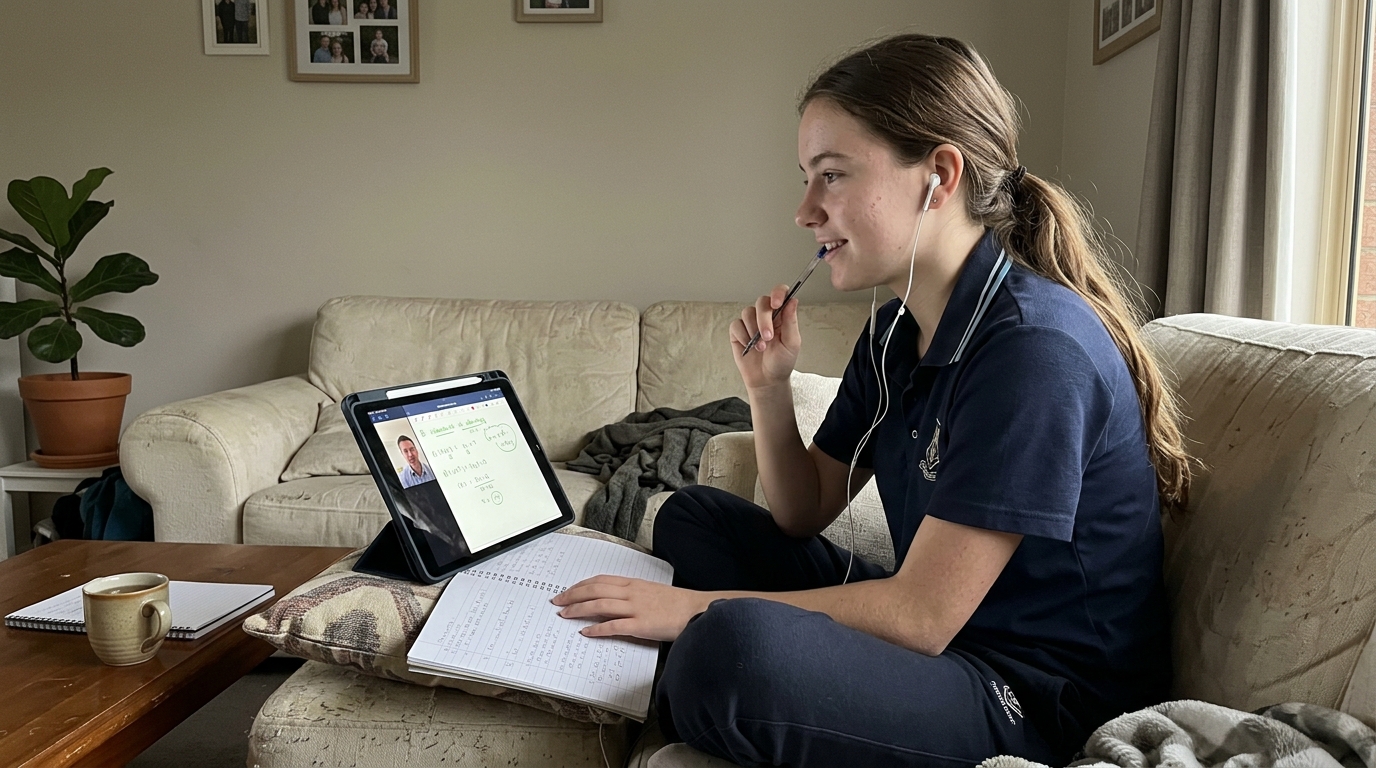
Maths tutoring is regular one-on-one (or very small group) teaching outside school hours, focused on the specific topics your child is struggling with — or, for high achievers, the topics ahead of where the class is going. A typical session is 45–60 minutes, weekly, with a tutor who diagnoses the gap, reteaches the concept, walks the student through a worked example, then watches them solve fresh problems. Good tutors don't lecture; they ask questions, wait for the student to think, and gently correct misconceptions. The format can be online (now the norm in Australia), in-person at home, in-person at a centre, or a blend.
What separates effective maths tutoring from "homework supervision" is diagnosis: a good tutor figures out exactly which prior concept is missing — say, fractions skills behind a Year 8 algebra struggle — and rebuilds from there.
When should my child start maths tutoring?
The honest answer: as soon as you notice a gap or a confidence dip, not at the start of an exam year. Most Australian families wait too long, then cram tutoring into the term before NAPLAN, ATAR, or HSC and wonder why six weeks doesn't undo six years. The earlier you intervene, the smaller and cheaper the fix. Year 3–4 maths gaps are easier to close than Year 9–10 gaps because the curriculum hasn't yet stacked five layers on top.
Pragmatic triggers to start: a sliding mid-year report, a child who says "I'm bad at maths" in primary, the move from arithmetic to algebra (Year 6–7), the start of senior maths (Year 10–11), or a major exam runway (12+ months out, not 6 weeks).
For a deeper read on timing — including whether to start mid-year, mid-term, or wait for school holidays — see The Ideal Time to Begin Tutoring.
How much does maths tutoring cost in Australia?
Typical 1:1 maths tutoring in Australia runs A$55–A$85 per hour for an experienced, vetted tutor. Group classes and learning centres can be A$25–A$40 per student per hour, but the trade-off is less personalisation. At the premium end, ex-VCE/HSC examiners charge A$120+ per hour for senior subjects. Tutero charges A$65 per hour, the same rate from Year 1 through Year 12 — no senior-subject premium, no contracts, weekly billing.
| Format | Typical AU rate | Best for |
|---|---|---|
| 1:1 online | A$55–A$85/hr | Most families — flexible, personalised, no commute |
| 1:1 in-person at home | A$70–A$110/hr | Younger children, families who prefer face-to-face |
| Small group (3–6) at a centre | A$25–A$45/hr | Budget-conscious, social learners |
| Tutero (1:1 online, all year levels) | A$65/hr flat | Families wanting consistency, no senior premium |
For the full price comparison — including in-person rates by city and what you actually get at each price tier — see How Much Does Maths Tutoring Cost in Australia?.
Online or in-person — which is better for maths tutoring?
Online has become the default for Australian families since 2022 and the evidence now favours it for most cases: a wider tutor pool (your child isn't limited to a 20-minute drive radius), no commute time, lower cost, and shared digital whiteboards that are arguably better than paper for showing maths working. The exceptions are younger primary students who genuinely focus better with an adult physically present, and families with very fragile internet.
The format that fails is "online but unstructured" — Zoom with no shared whiteboard, no diagnostic, no homework set between sessions. If you go online, pick a provider that uses a real shared whiteboard tool (not just screen-share) and sets practice between sessions.
For the full comparison — including how to set up a productive online session and what to look for in the platform — read Online Tutoring vs In-Person Tutoring in Australia.
What does a great maths tutor look like?
A great maths tutor is part teacher, part coach, part diagnostician. Strong subject knowledge is the floor, not the ceiling — the differentiator is whether they can explain the same concept three different ways when the first two don't land. Look for tutors who ask your child questions instead of lecturing, who set fresh problems instead of just marking homework, and who tell you (the parent) honestly when something isn't working.
Credentials are useful signals — current or recent maths teachers, high ATAR/HSC achievers in the subject, university maths/engineering students with proven teaching experience — but the strongest signal is fit with your specific child. A 99 ATAR maths tutor who can't connect with a Year 7 student isn't going to lift that student's marks; a Year 12 leaver who genuinely lights up explaining algebra often will.
For the full set of green and red flags, read 3 Tips for Choosing a Tutor for Your Child, and bring the questions in Questions to Ask a Tutor Before Hiring in Australia to your trial lesson.
What are the signs my child needs a maths tutor?
The clearest signal is a marks slide on consecutive reports. The earlier signals — the ones worth acting on — are softer: your child stops volunteering during maths homework, says "I'm just bad at maths", takes 90 minutes to do 30 minutes of work, or starts copying answers from a sibling. In senior years (10–12), the signal is often a topic-specific stall: they get calculus but algebra is broken, or vice versa.
Don't wait for a school recommendation — by the time a teacher flags it, the gap is usually 2–3 terms wide. If you're wondering whether to act, you probably should.
The full diagnostic checklist is in 5 Signs That Your Child Needs Tutoring.
How does maths tutoring build confidence?
Confidence in maths is a function of accumulated small wins. The classroom often can't supply those wins because a teacher of 28 students can't pause the room every time one student needs a concept retaught. A tutor can — and so the student gets a steady stream of "I tried that, I got it right, I understood why" moments. Over a term that compounds: confidence lifts, willingness to try harder problems lifts, marks lift, parents stop nagging, the household feels different.
The mechanism isn't praise. Empty praise actually erodes confidence because students see through it. The mechanism is real success on real problems, scaffolded by a tutor who pitches the next problem at the edge of what the student can do alone.
For more on the psychology and how Tutero tutors do this in practice, see How Tutoring Can Improve Confidence in Maths.
What if my child is already strong at maths?
Tutoring isn't only for struggling students. High achievers benefit just as much — but the goals are different. Instead of closing gaps, the tutor extends: harder problems, competition prep (AMC, ICAS), early-access to next year's content, deeper conceptual understanding. The risk for strong maths students isn't that they fall behind; it's that they coast, learn shortcuts that fail under harder problems, and arrive at senior years without the problem-solving stamina the harder topics demand.
Read Tutoring for Struggling Students vs High Achievers for the full breakdown of how the goals, cadence, and tutor profile differ between the two.
How do I help my child improve their maths study skills?
The best tutors don't just teach maths — they teach how to study maths. The four habits that move the needle: (1) work through fresh problems instead of re-reading worked examples, (2) keep a "wrong answers book" of every mistake plus the correct method, (3) explain the concept out loud as if teaching a younger sibling, and (4) space practice across the week instead of cramming the night before. None of this is glamorous; all of it works.
If you want a tutor-led system to build these habits, that's exactly what 1:1 tutoring delivers between sessions — homework set, attempted, marked, discussed.
The full method, with examples for primary and senior, is in Effective Strategies to Improve Your Maths Study Skills.
What about NAPLAN, ATAR, VCE and HSC maths prep?
Every major Australian maths exam has a different optimal preparation path. NAPLAN (Years 3, 5, 7, 9) rewards consistent foundational fluency more than cramming — start tutoring at least two terms before, focus on number sense and problem solving. VCE Mathematical Methods / Specialist Maths rewards problem-set volume — past papers, exam-style problems, timing under pressure. HSC Standard / Advanced / Extension Maths rewards the same problem-set discipline plus the NESA-style worked-solution format. ATAR Year 11–12 across all states benefits from starting in Term 4 of Year 10 if marks slipped in Year 10.
The single biggest mistake families make: leaving senior tutoring until Term 3 of Year 12. By then, six months won't repair the foundational gaps. Term 4 of Year 10 or Term 1 of Year 11 is the right entry point if you suspect any wobble.
For finding a NAPLAN-specific tutor, read How to Find a Reliable NAPLAN Tutor in Australia. For a deeper read on why maths matters at every stage, see Why Maths Is the Key to Future Success: A Parent's Guide.
What if my child has ADHD, dyslexia or autism?
Maths tutoring works exceptionally well for students with learning differences — often better than mainstream classroom maths — because the format itself is built for them. A 1:1 tutor adapts pacing, breaks problems into smaller steps, removes social-attention load, and works in the student's preferred sensory environment. The catch is tutor selection: a generic high-ATAR tutor may not have the patience, structure, or scaffolding skills a neurodivergent learner needs. Look for tutors with explicit experience working with ADHD, dyslexia, dyscalculia, or autism — and ask about that experience in the trial lesson.
For the full guides, read Tailored Tutoring for Students with ADHD and How to Choose Tutoring Services for Students with Autism.
How do I find a great maths tutor in Australia?
Three honest paths: (1) a managed service like Tutero or Cluey that vets, matches and replaces tutors for you — highest baseline quality, less effort, premium price; (2) a marketplace like Superprof or Learnmate where you browse profiles and match yourself — most variation in quality, lowest price; (3) word-of-mouth via your school P&C, neighbours, or a teacher friend — best when the lead is strong, hard to scale.
Whichever path you choose, the essential step is a trial lesson. A 30-minute trial reveals more than three weeks of profile-reading: does your child engage, does the tutor ask good questions, do they explain things in a way your child gets? Trust the trial.
The full breakdown of where to look — including the trade-offs between managed services, marketplaces, and tuition centres — is in Where to Find Online Tutors in Australia.
How do I know if maths tutoring is actually working?
Don't wait for the next school report. The honest signals show up earlier. After 4–6 weekly sessions, you should see: your child stops dreading homework, starts attempting harder problems unprompted, can explain a recent topic out loud without notes, and starts asking the tutor about topics ahead instead of behind. Marks usually move in the term after the confidence lift, not at the same time.
If after 6–8 sessions none of those soft signals appear, the tutor isn't right for your child. Ask for a different tutor (managed services swap on request) or move on. The cost of staying with a bad fit is far higher than the inconvenience of switching.
The full set of signals — including how to ask the tutor for an honest progress read — is in How to Know If Your Child Is Getting Value from Their Tutor.
The bottom line on maths tutoring
Maths tutoring is one of the highest-leverage things an Australian family can do for a child's learning, provided three boxes are ticked: the tutor is a good fit, the cadence is at least weekly, and you're acting before the gap compounds. Expect to pay around A$65–A$85 per hour, expect to see soft signals (engagement, willingness, explaining out loud) inside 6 sessions and marks following the term after, and expect to swap tutors at least once before you find the right person — that's normal, not a failure.
If you'd like Tutero to match your child with a 1:1 maths tutor at a flat A$65/hr (no senior premium, no contracts, weekly billing), see our maths tutoring page or browse our tutors to book your first lesson.
Related reading from Tutero
- How much does maths tutoring cost in Australia?
- Is online tutoring worth the investment?
- 5 key benefits of private tutoring
- 5 signs that your child needs tutoring
- The ideal time to begin tutoring
- Online vs in-person tutoring in Australia
- How personalised tutoring can help your child
- How tutoring can improve confidence in maths
- Effective strategies to improve your maths study skills
- Tutoring for struggling students vs high achievers
- Why maths is the key to future success: a parent's guide
- 3 tips for choosing a tutor for your child
- Questions to ask a tutor before hiring in Australia
- How to know if your child is getting value from their tutor
- Where to find online tutors in Australia
- Tailored tutoring for students with ADHD
- How to choose tutoring services for students with autism
Maths tutoring is one of the highest-leverage things an Australian family can do for a child's learning, provided three boxes are ticked: the tutor is a good fit, the cadence is at least weekly, and you're acting before the gap compounds.
Maths tutoring is one of the highest-leverage things an Australian family can do for a child's learning, provided three boxes are ticked: the tutor is a good fit, the cadence is at least weekly, and you're acting before the gap compounds.
Updated 6 May 2026 by Joey Moshinsky, Co-founder of Tutero. Tutero matches more than 250,000 hours of personalised tutoring across Australia, including the country's largest 1:1 maths tutoring service.
Maths tutoring is one of the most effective levers for lifting confidence, marks and study habits across Years 1–12 — but it's also one of the easiest places to overspend, pick the wrong tutor, or wait too long to act. This guide is the canonical Tutero answer to the question "should we get a maths tutor, and how do we do it well?". Each section gives you the short answer, then links to a deeper guide if you want to go further on cost, format, year-level fit, learning differences, or finding the right person.
If you only have two minutes, read the Quick answer next. If you have ten, read the whole thing top to bottom — it's structured to take you from "should we?" to "how do we choose, and how do we know it's working?".
Quick answer: is maths tutoring worth it?
For most Australian families, yes — provided the tutor is a good fit and the cadence is at least weekly. A good 1:1 tutor lifts marks, rebuilds confidence, and reteaches whatever your child missed in class so the next term doesn't compound the gap. Independent reviews of high-dosage tutoring (e.g. the Education Endowment Foundation's review of 1:1 tutoring) find an average uplift equivalent to roughly five months of additional progress per year. Expect to pay around A$55–A$85 per hour in Australia (Tutero is A$65, the same rate from primary through senior). The biggest predictor of success isn't the tutor's degree — it's whether your child shows up and engages, which comes down to fit. Skip the guesswork; the rest of this guide walks you through cost, format, year-level fit, what to look for, and how to know it's working.
What is maths tutoring and how does it actually work?
Maths tutoring is regular one-on-one (or very small group) teaching outside school hours, focused on the specific topics your child is struggling with — or, for high achievers, the topics ahead of where the class is going. A typical session is 45–60 minutes, weekly, with a tutor who diagnoses the gap, reteaches the concept, walks the student through a worked example, then watches them solve fresh problems. Good tutors don't lecture; they ask questions, wait for the student to think, and gently correct misconceptions. The format can be online (now the norm in Australia), in-person at home, in-person at a centre, or a blend.
What separates effective maths tutoring from "homework supervision" is diagnosis: a good tutor figures out exactly which prior concept is missing — say, fractions skills behind a Year 8 algebra struggle — and rebuilds from there.
When should my child start maths tutoring?
The honest answer: as soon as you notice a gap or a confidence dip, not at the start of an exam year. Most Australian families wait too long, then cram tutoring into the term before NAPLAN, ATAR, or HSC and wonder why six weeks doesn't undo six years. The earlier you intervene, the smaller and cheaper the fix. Year 3–4 maths gaps are easier to close than Year 9–10 gaps because the curriculum hasn't yet stacked five layers on top.
Pragmatic triggers to start: a sliding mid-year report, a child who says "I'm bad at maths" in primary, the move from arithmetic to algebra (Year 6–7), the start of senior maths (Year 10–11), or a major exam runway (12+ months out, not 6 weeks).
For a deeper read on timing — including whether to start mid-year, mid-term, or wait for school holidays — see The Ideal Time to Begin Tutoring.
How much does maths tutoring cost in Australia?
Typical 1:1 maths tutoring in Australia runs A$55–A$85 per hour for an experienced, vetted tutor. Group classes and learning centres can be A$25–A$40 per student per hour, but the trade-off is less personalisation. At the premium end, ex-VCE/HSC examiners charge A$120+ per hour for senior subjects. Tutero charges A$65 per hour, the same rate from Year 1 through Year 12 — no senior-subject premium, no contracts, weekly billing.
| Format | Typical AU rate | Best for |
|---|---|---|
| 1:1 online | A$55–A$85/hr | Most families — flexible, personalised, no commute |
| 1:1 in-person at home | A$70–A$110/hr | Younger children, families who prefer face-to-face |
| Small group (3–6) at a centre | A$25–A$45/hr | Budget-conscious, social learners |
| Tutero (1:1 online, all year levels) | A$65/hr flat | Families wanting consistency, no senior premium |
For the full price comparison — including in-person rates by city and what you actually get at each price tier — see How Much Does Maths Tutoring Cost in Australia?.
Online or in-person — which is better for maths tutoring?
Online has become the default for Australian families since 2022 and the evidence now favours it for most cases: a wider tutor pool (your child isn't limited to a 20-minute drive radius), no commute time, lower cost, and shared digital whiteboards that are arguably better than paper for showing maths working. The exceptions are younger primary students who genuinely focus better with an adult physically present, and families with very fragile internet.
The format that fails is "online but unstructured" — Zoom with no shared whiteboard, no diagnostic, no homework set between sessions. If you go online, pick a provider that uses a real shared whiteboard tool (not just screen-share) and sets practice between sessions.
For the full comparison — including how to set up a productive online session and what to look for in the platform — read Online Tutoring vs In-Person Tutoring in Australia.
What does a great maths tutor look like?
A great maths tutor is part teacher, part coach, part diagnostician. Strong subject knowledge is the floor, not the ceiling — the differentiator is whether they can explain the same concept three different ways when the first two don't land. Look for tutors who ask your child questions instead of lecturing, who set fresh problems instead of just marking homework, and who tell you (the parent) honestly when something isn't working.
Credentials are useful signals — current or recent maths teachers, high ATAR/HSC achievers in the subject, university maths/engineering students with proven teaching experience — but the strongest signal is fit with your specific child. A 99 ATAR maths tutor who can't connect with a Year 7 student isn't going to lift that student's marks; a Year 12 leaver who genuinely lights up explaining algebra often will.
For the full set of green and red flags, read 3 Tips for Choosing a Tutor for Your Child, and bring the questions in Questions to Ask a Tutor Before Hiring in Australia to your trial lesson.
What are the signs my child needs a maths tutor?
The clearest signal is a marks slide on consecutive reports. The earlier signals — the ones worth acting on — are softer: your child stops volunteering during maths homework, says "I'm just bad at maths", takes 90 minutes to do 30 minutes of work, or starts copying answers from a sibling. In senior years (10–12), the signal is often a topic-specific stall: they get calculus but algebra is broken, or vice versa.
Don't wait for a school recommendation — by the time a teacher flags it, the gap is usually 2–3 terms wide. If you're wondering whether to act, you probably should.
The full diagnostic checklist is in 5 Signs That Your Child Needs Tutoring.
How does maths tutoring build confidence?
Confidence in maths is a function of accumulated small wins. The classroom often can't supply those wins because a teacher of 28 students can't pause the room every time one student needs a concept retaught. A tutor can — and so the student gets a steady stream of "I tried that, I got it right, I understood why" moments. Over a term that compounds: confidence lifts, willingness to try harder problems lifts, marks lift, parents stop nagging, the household feels different.
The mechanism isn't praise. Empty praise actually erodes confidence because students see through it. The mechanism is real success on real problems, scaffolded by a tutor who pitches the next problem at the edge of what the student can do alone.
For more on the psychology and how Tutero tutors do this in practice, see How Tutoring Can Improve Confidence in Maths.
What if my child is already strong at maths?
Tutoring isn't only for struggling students. High achievers benefit just as much — but the goals are different. Instead of closing gaps, the tutor extends: harder problems, competition prep (AMC, ICAS), early-access to next year's content, deeper conceptual understanding. The risk for strong maths students isn't that they fall behind; it's that they coast, learn shortcuts that fail under harder problems, and arrive at senior years without the problem-solving stamina the harder topics demand.
Read Tutoring for Struggling Students vs High Achievers for the full breakdown of how the goals, cadence, and tutor profile differ between the two.
How do I help my child improve their maths study skills?
The best tutors don't just teach maths — they teach how to study maths. The four habits that move the needle: (1) work through fresh problems instead of re-reading worked examples, (2) keep a "wrong answers book" of every mistake plus the correct method, (3) explain the concept out loud as if teaching a younger sibling, and (4) space practice across the week instead of cramming the night before. None of this is glamorous; all of it works.
If you want a tutor-led system to build these habits, that's exactly what 1:1 tutoring delivers between sessions — homework set, attempted, marked, discussed.
The full method, with examples for primary and senior, is in Effective Strategies to Improve Your Maths Study Skills.
What about NAPLAN, ATAR, VCE and HSC maths prep?
Every major Australian maths exam has a different optimal preparation path. NAPLAN (Years 3, 5, 7, 9) rewards consistent foundational fluency more than cramming — start tutoring at least two terms before, focus on number sense and problem solving. VCE Mathematical Methods / Specialist Maths rewards problem-set volume — past papers, exam-style problems, timing under pressure. HSC Standard / Advanced / Extension Maths rewards the same problem-set discipline plus the NESA-style worked-solution format. ATAR Year 11–12 across all states benefits from starting in Term 4 of Year 10 if marks slipped in Year 10.
The single biggest mistake families make: leaving senior tutoring until Term 3 of Year 12. By then, six months won't repair the foundational gaps. Term 4 of Year 10 or Term 1 of Year 11 is the right entry point if you suspect any wobble.
For finding a NAPLAN-specific tutor, read How to Find a Reliable NAPLAN Tutor in Australia. For a deeper read on why maths matters at every stage, see Why Maths Is the Key to Future Success: A Parent's Guide.
What if my child has ADHD, dyslexia or autism?
Maths tutoring works exceptionally well for students with learning differences — often better than mainstream classroom maths — because the format itself is built for them. A 1:1 tutor adapts pacing, breaks problems into smaller steps, removes social-attention load, and works in the student's preferred sensory environment. The catch is tutor selection: a generic high-ATAR tutor may not have the patience, structure, or scaffolding skills a neurodivergent learner needs. Look for tutors with explicit experience working with ADHD, dyslexia, dyscalculia, or autism — and ask about that experience in the trial lesson.
For the full guides, read Tailored Tutoring for Students with ADHD and How to Choose Tutoring Services for Students with Autism.
How do I find a great maths tutor in Australia?
Three honest paths: (1) a managed service like Tutero or Cluey that vets, matches and replaces tutors for you — highest baseline quality, less effort, premium price; (2) a marketplace like Superprof or Learnmate where you browse profiles and match yourself — most variation in quality, lowest price; (3) word-of-mouth via your school P&C, neighbours, or a teacher friend — best when the lead is strong, hard to scale.
Whichever path you choose, the essential step is a trial lesson. A 30-minute trial reveals more than three weeks of profile-reading: does your child engage, does the tutor ask good questions, do they explain things in a way your child gets? Trust the trial.
The full breakdown of where to look — including the trade-offs between managed services, marketplaces, and tuition centres — is in Where to Find Online Tutors in Australia.
How do I know if maths tutoring is actually working?
Don't wait for the next school report. The honest signals show up earlier. After 4–6 weekly sessions, you should see: your child stops dreading homework, starts attempting harder problems unprompted, can explain a recent topic out loud without notes, and starts asking the tutor about topics ahead instead of behind. Marks usually move in the term after the confidence lift, not at the same time.
If after 6–8 sessions none of those soft signals appear, the tutor isn't right for your child. Ask for a different tutor (managed services swap on request) or move on. The cost of staying with a bad fit is far higher than the inconvenience of switching.
The full set of signals — including how to ask the tutor for an honest progress read — is in How to Know If Your Child Is Getting Value from Their Tutor.
The bottom line on maths tutoring
Maths tutoring is one of the highest-leverage things an Australian family can do for a child's learning, provided three boxes are ticked: the tutor is a good fit, the cadence is at least weekly, and you're acting before the gap compounds. Expect to pay around A$65–A$85 per hour, expect to see soft signals (engagement, willingness, explaining out loud) inside 6 sessions and marks following the term after, and expect to swap tutors at least once before you find the right person — that's normal, not a failure.
If you'd like Tutero to match your child with a 1:1 maths tutor at a flat A$65/hr (no senior premium, no contracts, weekly billing), see our maths tutoring page or browse our tutors to book your first lesson.
Related reading from Tutero
- How much does maths tutoring cost in Australia?
- Is online tutoring worth the investment?
- 5 key benefits of private tutoring
- 5 signs that your child needs tutoring
- The ideal time to begin tutoring
- Online vs in-person tutoring in Australia
- How personalised tutoring can help your child
- How tutoring can improve confidence in maths
- Effective strategies to improve your maths study skills
- Tutoring for struggling students vs high achievers
- Why maths is the key to future success: a parent's guide
- 3 tips for choosing a tutor for your child
- Questions to ask a tutor before hiring in Australia
- How to know if your child is getting value from their tutor
- Where to find online tutors in Australia
- Tailored tutoring for students with ADHD
- How to choose tutoring services for students with autism
FAQ
.svg)
.svg)
Online maths tutoring at Tutero is catering to students of all year levels. We offer programs tailored to the unique learning curves of each age group.
We also have expert NAPLAN and ATAR subject tutors, ensuring students are well-equipped for these pivotal assessments.
We recommend at least two to three session per week for consistent progress. However, this can vary based on your child's needs and goals.
Our platform uses advanced security protocols to ensure the safety and privacy of all our online sessions.
Parents are welcome to observe sessions. We believe in a collaborative approach to education.
We provide regular progress reports and assessments to track your child’s academic development.
Yes, we prioritise the student-tutor relationship and can arrange a change if the need arises.
Yes, we offer a range of resources and materials, including interactive exercises and practice worksheets.
Maths tutoring is one of the highest-leverage things an Australian family can do for a child's learning, provided three boxes are ticked: the tutor is a good fit, the cadence is at least weekly, and you're acting before the gap compounds.
Maths tutoring is one of the highest-leverage things an Australian family can do for a child's learning, provided three boxes are ticked: the tutor is a good fit, the cadence is at least weekly, and you're acting before the gap compounds.

Maths tutoring is one of the highest-leverage things an Australian family can do for a child's learning, provided three boxes are ticked: the tutor is a good fit, the cadence is at least weekly, and you're acting before the gap compounds.
The biggest predictor of success isn't the tutor's degree — it's whether your child shows up and engages, which comes down to fit.
Updated 6 May 2026 by Joey Moshinsky, Co-founder of Tutero. Tutero matches more than 250,000 hours of personalised tutoring across Australia, including the country's largest 1:1 maths tutoring service.
Maths tutoring is one of the most effective levers for lifting confidence, marks and study habits across Years 1–12 — but it's also one of the easiest places to overspend, pick the wrong tutor, or wait too long to act. This guide is the canonical Tutero answer to the question "should we get a maths tutor, and how do we do it well?". Each section gives you the short answer, then links to a deeper guide if you want to go further on cost, format, year-level fit, learning differences, or finding the right person.
If you only have two minutes, read the Quick answer next. If you have ten, read the whole thing top to bottom — it's structured to take you from "should we?" to "how do we choose, and how do we know it's working?".
Quick answer: is maths tutoring worth it?
For most Australian families, yes — provided the tutor is a good fit and the cadence is at least weekly. A good 1:1 tutor lifts marks, rebuilds confidence, and reteaches whatever your child missed in class so the next term doesn't compound the gap. Independent reviews of high-dosage tutoring (e.g. the Education Endowment Foundation's review of 1:1 tutoring) find an average uplift equivalent to roughly five months of additional progress per year. Expect to pay around A$55–A$85 per hour in Australia (Tutero is A$65, the same rate from primary through senior). The biggest predictor of success isn't the tutor's degree — it's whether your child shows up and engages, which comes down to fit. Skip the guesswork; the rest of this guide walks you through cost, format, year-level fit, what to look for, and how to know it's working.
What is maths tutoring and how does it actually work?
Maths tutoring is regular one-on-one (or very small group) teaching outside school hours, focused on the specific topics your child is struggling with — or, for high achievers, the topics ahead of where the class is going. A typical session is 45–60 minutes, weekly, with a tutor who diagnoses the gap, reteaches the concept, walks the student through a worked example, then watches them solve fresh problems. Good tutors don't lecture; they ask questions, wait for the student to think, and gently correct misconceptions. The format can be online (now the norm in Australia), in-person at home, in-person at a centre, or a blend.
What separates effective maths tutoring from "homework supervision" is diagnosis: a good tutor figures out exactly which prior concept is missing — say, fractions skills behind a Year 8 algebra struggle — and rebuilds from there.
When should my child start maths tutoring?
The honest answer: as soon as you notice a gap or a confidence dip, not at the start of an exam year. Most Australian families wait too long, then cram tutoring into the term before NAPLAN, ATAR, or HSC and wonder why six weeks doesn't undo six years. The earlier you intervene, the smaller and cheaper the fix. Year 3–4 maths gaps are easier to close than Year 9–10 gaps because the curriculum hasn't yet stacked five layers on top.
Pragmatic triggers to start: a sliding mid-year report, a child who says "I'm bad at maths" in primary, the move from arithmetic to algebra (Year 6–7), the start of senior maths (Year 10–11), or a major exam runway (12+ months out, not 6 weeks).
For a deeper read on timing — including whether to start mid-year, mid-term, or wait for school holidays — see The Ideal Time to Begin Tutoring.
How much does maths tutoring cost in Australia?
Typical 1:1 maths tutoring in Australia runs A$55–A$85 per hour for an experienced, vetted tutor. Group classes and learning centres can be A$25–A$40 per student per hour, but the trade-off is less personalisation. At the premium end, ex-VCE/HSC examiners charge A$120+ per hour for senior subjects. Tutero charges A$65 per hour, the same rate from Year 1 through Year 12 — no senior-subject premium, no contracts, weekly billing.
| Format | Typical AU rate | Best for |
|---|---|---|
| 1:1 online | A$55–A$85/hr | Most families — flexible, personalised, no commute |
| 1:1 in-person at home | A$70–A$110/hr | Younger children, families who prefer face-to-face |
| Small group (3–6) at a centre | A$25–A$45/hr | Budget-conscious, social learners |
| Tutero (1:1 online, all year levels) | A$65/hr flat | Families wanting consistency, no senior premium |
For the full price comparison — including in-person rates by city and what you actually get at each price tier — see How Much Does Maths Tutoring Cost in Australia?.
Online or in-person — which is better for maths tutoring?
Online has become the default for Australian families since 2022 and the evidence now favours it for most cases: a wider tutor pool (your child isn't limited to a 20-minute drive radius), no commute time, lower cost, and shared digital whiteboards that are arguably better than paper for showing maths working. The exceptions are younger primary students who genuinely focus better with an adult physically present, and families with very fragile internet.
The format that fails is "online but unstructured" — Zoom with no shared whiteboard, no diagnostic, no homework set between sessions. If you go online, pick a provider that uses a real shared whiteboard tool (not just screen-share) and sets practice between sessions.
For the full comparison — including how to set up a productive online session and what to look for in the platform — read Online Tutoring vs In-Person Tutoring in Australia.
What does a great maths tutor look like?
A great maths tutor is part teacher, part coach, part diagnostician. Strong subject knowledge is the floor, not the ceiling — the differentiator is whether they can explain the same concept three different ways when the first two don't land. Look for tutors who ask your child questions instead of lecturing, who set fresh problems instead of just marking homework, and who tell you (the parent) honestly when something isn't working.
Credentials are useful signals — current or recent maths teachers, high ATAR/HSC achievers in the subject, university maths/engineering students with proven teaching experience — but the strongest signal is fit with your specific child. A 99 ATAR maths tutor who can't connect with a Year 7 student isn't going to lift that student's marks; a Year 12 leaver who genuinely lights up explaining algebra often will.
For the full set of green and red flags, read 3 Tips for Choosing a Tutor for Your Child, and bring the questions in Questions to Ask a Tutor Before Hiring in Australia to your trial lesson.
What are the signs my child needs a maths tutor?
The clearest signal is a marks slide on consecutive reports. The earlier signals — the ones worth acting on — are softer: your child stops volunteering during maths homework, says "I'm just bad at maths", takes 90 minutes to do 30 minutes of work, or starts copying answers from a sibling. In senior years (10–12), the signal is often a topic-specific stall: they get calculus but algebra is broken, or vice versa.
Don't wait for a school recommendation — by the time a teacher flags it, the gap is usually 2–3 terms wide. If you're wondering whether to act, you probably should.
The full diagnostic checklist is in 5 Signs That Your Child Needs Tutoring.
How does maths tutoring build confidence?
Confidence in maths is a function of accumulated small wins. The classroom often can't supply those wins because a teacher of 28 students can't pause the room every time one student needs a concept retaught. A tutor can — and so the student gets a steady stream of "I tried that, I got it right, I understood why" moments. Over a term that compounds: confidence lifts, willingness to try harder problems lifts, marks lift, parents stop nagging, the household feels different.
The mechanism isn't praise. Empty praise actually erodes confidence because students see through it. The mechanism is real success on real problems, scaffolded by a tutor who pitches the next problem at the edge of what the student can do alone.
For more on the psychology and how Tutero tutors do this in practice, see How Tutoring Can Improve Confidence in Maths.
What if my child is already strong at maths?
Tutoring isn't only for struggling students. High achievers benefit just as much — but the goals are different. Instead of closing gaps, the tutor extends: harder problems, competition prep (AMC, ICAS), early-access to next year's content, deeper conceptual understanding. The risk for strong maths students isn't that they fall behind; it's that they coast, learn shortcuts that fail under harder problems, and arrive at senior years without the problem-solving stamina the harder topics demand.
Read Tutoring for Struggling Students vs High Achievers for the full breakdown of how the goals, cadence, and tutor profile differ between the two.
How do I help my child improve their maths study skills?
The best tutors don't just teach maths — they teach how to study maths. The four habits that move the needle: (1) work through fresh problems instead of re-reading worked examples, (2) keep a "wrong answers book" of every mistake plus the correct method, (3) explain the concept out loud as if teaching a younger sibling, and (4) space practice across the week instead of cramming the night before. None of this is glamorous; all of it works.
If you want a tutor-led system to build these habits, that's exactly what 1:1 tutoring delivers between sessions — homework set, attempted, marked, discussed.
The full method, with examples for primary and senior, is in Effective Strategies to Improve Your Maths Study Skills.
What about NAPLAN, ATAR, VCE and HSC maths prep?
Every major Australian maths exam has a different optimal preparation path. NAPLAN (Years 3, 5, 7, 9) rewards consistent foundational fluency more than cramming — start tutoring at least two terms before, focus on number sense and problem solving. VCE Mathematical Methods / Specialist Maths rewards problem-set volume — past papers, exam-style problems, timing under pressure. HSC Standard / Advanced / Extension Maths rewards the same problem-set discipline plus the NESA-style worked-solution format. ATAR Year 11–12 across all states benefits from starting in Term 4 of Year 10 if marks slipped in Year 10.
The single biggest mistake families make: leaving senior tutoring until Term 3 of Year 12. By then, six months won't repair the foundational gaps. Term 4 of Year 10 or Term 1 of Year 11 is the right entry point if you suspect any wobble.
For finding a NAPLAN-specific tutor, read How to Find a Reliable NAPLAN Tutor in Australia. For a deeper read on why maths matters at every stage, see Why Maths Is the Key to Future Success: A Parent's Guide.
What if my child has ADHD, dyslexia or autism?
Maths tutoring works exceptionally well for students with learning differences — often better than mainstream classroom maths — because the format itself is built for them. A 1:1 tutor adapts pacing, breaks problems into smaller steps, removes social-attention load, and works in the student's preferred sensory environment. The catch is tutor selection: a generic high-ATAR tutor may not have the patience, structure, or scaffolding skills a neurodivergent learner needs. Look for tutors with explicit experience working with ADHD, dyslexia, dyscalculia, or autism — and ask about that experience in the trial lesson.
For the full guides, read Tailored Tutoring for Students with ADHD and How to Choose Tutoring Services for Students with Autism.
How do I find a great maths tutor in Australia?
Three honest paths: (1) a managed service like Tutero or Cluey that vets, matches and replaces tutors for you — highest baseline quality, less effort, premium price; (2) a marketplace like Superprof or Learnmate where you browse profiles and match yourself — most variation in quality, lowest price; (3) word-of-mouth via your school P&C, neighbours, or a teacher friend — best when the lead is strong, hard to scale.
Whichever path you choose, the essential step is a trial lesson. A 30-minute trial reveals more than three weeks of profile-reading: does your child engage, does the tutor ask good questions, do they explain things in a way your child gets? Trust the trial.
The full breakdown of where to look — including the trade-offs between managed services, marketplaces, and tuition centres — is in Where to Find Online Tutors in Australia.
How do I know if maths tutoring is actually working?
Don't wait for the next school report. The honest signals show up earlier. After 4–6 weekly sessions, you should see: your child stops dreading homework, starts attempting harder problems unprompted, can explain a recent topic out loud without notes, and starts asking the tutor about topics ahead instead of behind. Marks usually move in the term after the confidence lift, not at the same time.
If after 6–8 sessions none of those soft signals appear, the tutor isn't right for your child. Ask for a different tutor (managed services swap on request) or move on. The cost of staying with a bad fit is far higher than the inconvenience of switching.
The full set of signals — including how to ask the tutor for an honest progress read — is in How to Know If Your Child Is Getting Value from Their Tutor.
The bottom line on maths tutoring
Maths tutoring is one of the highest-leverage things an Australian family can do for a child's learning, provided three boxes are ticked: the tutor is a good fit, the cadence is at least weekly, and you're acting before the gap compounds. Expect to pay around A$65–A$85 per hour, expect to see soft signals (engagement, willingness, explaining out loud) inside 6 sessions and marks following the term after, and expect to swap tutors at least once before you find the right person — that's normal, not a failure.
If you'd like Tutero to match your child with a 1:1 maths tutor at a flat A$65/hr (no senior premium, no contracts, weekly billing), see our maths tutoring page or browse our tutors to book your first lesson.
Related reading from Tutero
- How much does maths tutoring cost in Australia?
- Is online tutoring worth the investment?
- 5 key benefits of private tutoring
- 5 signs that your child needs tutoring
- The ideal time to begin tutoring
- Online vs in-person tutoring in Australia
- How personalised tutoring can help your child
- How tutoring can improve confidence in maths
- Effective strategies to improve your maths study skills
- Tutoring for struggling students vs high achievers
- Why maths is the key to future success: a parent's guide
- 3 tips for choosing a tutor for your child
- Questions to ask a tutor before hiring in Australia
- How to know if your child is getting value from their tutor
- Where to find online tutors in Australia
- Tailored tutoring for students with ADHD
- How to choose tutoring services for students with autism
Maths tutoring is one of the highest-leverage things an Australian family can do for a child's learning, provided three boxes are ticked: the tutor is a good fit, the cadence is at least weekly, and you're acting before the gap compounds.
The biggest predictor of success isn't the tutor's degree — it's whether your child shows up and engages, which comes down to fit.
<p>Yes — for most Australian primary students, weekly 1:1 maths tutoring is the highest-leverage learning intervention you can make. Primary maths gaps are far easier to close than senior gaps because the curriculum hasn't yet stacked five years of compounding concepts on top. A confident Year 4 maths student becomes a confident Year 7 maths student; a confused Year 4 student usually doesn't recover without intervention. Expect tutoring to take 30–45 minutes per week at this age. Tutero charges A$65 per hour, the same rate primary through senior — there's no premium for older students.</p>
<p>You should see soft signals — engagement, willingness to try harder problems, the child explaining a topic out loud — within 4–6 weekly sessions. Marks usually move in the term <em>after</em> the confidence lift, not at the same time. If after 6–8 sessions there's no change in either marks or attitude, the tutor isn't right for your child and you should swap. Don't keep paying for a fit that isn't working — managed services like Tutero replace tutors on request.</p>
<p>Weekly is the minimum cadence to make tutoring work. Anything less than weekly and the practice momentum disappears between sessions. For struggling students or exam-year students (Year 11–12), twice a week through key terms is the sweet spot. Sessions of 45–60 minutes are standard; primary students often work better at 30–45 minutes. Consistency matters more than length — a regular 45 minutes a week beats an irregular 90.</p>
<p>For most Australian families, online 1:1 maths tutoring is now the better default. The tutor pool is wider (your child isn't limited to a 20-minute drive radius), there's no commute, the cost is lower, and shared digital whiteboards are arguably better than paper for showing maths working. The exceptions are younger primary students who genuinely focus better with an adult physically present, and families with very fragile internet. The full comparison is in our online-vs-in-person guide.</p>
<p>Maths tutoring often works better than mainstream classroom maths for students with ADHD, dyslexia or dyscalculia, because the format itself is built for them: 1:1 attention, adaptive pacing, broken-down problems, and no social-attention load. The catch is tutor selection — a generic high-ATAR tutor without experience supporting neurodivergent learners may struggle. Look for tutors with explicit experience with ADHD, dyslexia, dyscalculia, or autism, and ask about that experience in the trial lesson.</p>
Hoping to improve confidence & grades?

.png)


