
.svg)

Sending a child through the Victorian school system can feel like learning a second language: zones, scaling, NAPLAN bands, ATAR, VCE versus IB, and at least three school sectors all at once. This guide is a plain-English walk-through for Melbourne parents — what each stage looks like from Year 1 through to Year 12, how the choices actually work, and where extra support like Melbourne tutoring tends to help most.
Quick answer
Children in Melbourne start Foundation (Prep) in the year they turn 5 or 6, then move through Years 1–6 in primary school and Years 7–12 in secondary school. Families choose between three sectors — government, Catholic and independent — with state schooling free and private fees ranging up to A$48,000 a year. NAPLAN tests run in Years 3, 5, 7 and 9 as a checkpoint, not a gate. Most students finish with the Victorian Certificate of Education (VCE) and an ATAR, while a smaller group sits the International Baccalaureate (IB) Diploma. The biggest decision points for parents are choosing a primary school in line with the family's home zone, choosing a secondary school in Year 5 or 6, and deciding whether to add tutoring during VCE.
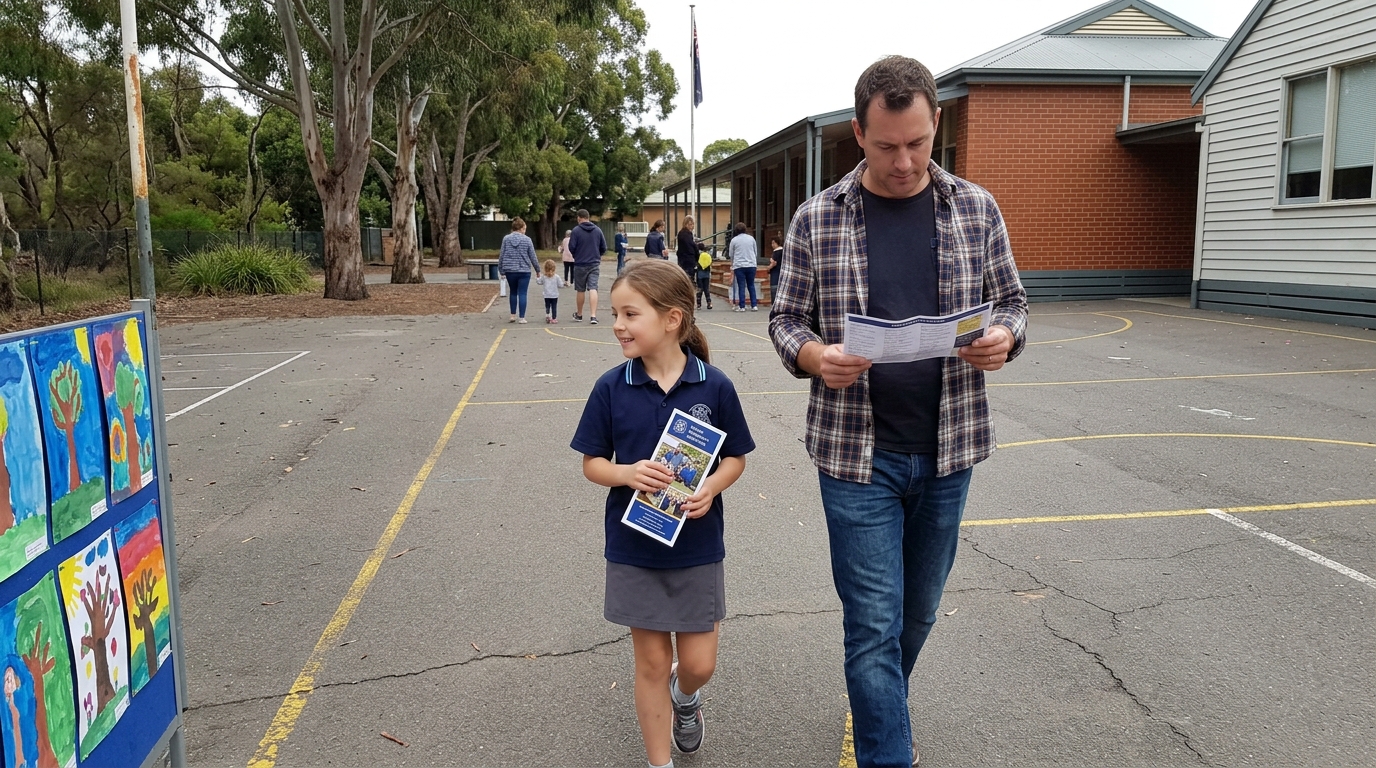
How does the Victorian school system work, from primary to high school?
The Victorian system runs from Foundation (Prep) through Year 12, set out in the Victorian Curriculum F–10 and the senior-secondary VCE managed by the Victorian Curriculum and Assessment Authority (VCAA). Children typically start Foundation in the year they turn 5 by 30 April, then complete primary school in Years 1–6 and secondary school in Years 7–12. The day-to-day learning sits with the school and its teachers, but every Melbourne school — government, Catholic or independent — teaches against the same Victorian Curriculum standards in F–10. From Year 11 onward, students choose VCE subjects (or, in some independent schools, the IB Diploma) and pick the senior pathway that suits them.
The big stage gates a Melbourne parent will encounter
- Foundation–Year 2: reading, early numeracy and settling into school.
- Years 3–6: NAPLAN in Years 3 and 5; preparing for the Year 7 transition by Years 5–6.
- Years 7–9: the high-school transition, broader subjects, NAPLAN in Years 7 and 9.
- Years 10–12: subject narrowing, VCE or IB, and the ATAR for university entry.
What's the difference between government, Catholic and independent schools in Melbourne?
Melbourne has three school sectors. Government schools are run by the Department of Education and are tuition-free for Australian residents. Catholic schools sit under Melbourne Archdiocese Catholic Schools (MACS) and charge moderate fees, with priority typically given to baptised Catholic families. Independent schools are member schools of Independent Schools Victoria, run their own admissions and fee structures, and include the city's well-known private schools, faith-based independents and alternative-pedagogy schools. Roughly 60% of Victorian students attend government schools, around 20% attend Catholic schools, and 20% attend independent schools, with a slightly higher independent and Catholic share at secondary level (ACARA / MySchool data).
| School type | Who runs it | Typical Melbourne fees | Curriculum / pathway |
|---|---|---|---|
| Government (state) | Department of Education Victoria | No tuition fees; voluntary contributions, uniforms, levies (~A$300–A$1,500/yr) | Victorian Curriculum F–10, then VCE or VCE Vocational Major |
| Catholic (parish or systemic) | Melbourne Archdiocese Catholic Schools (MACS) | Primary ~A$2,000–A$5,000/yr; secondary ~A$5,000–A$11,000/yr | Victorian Curriculum F–10, then VCE; faith-based formation |
| Independent (private) | Independent Schools Victoria member schools | Primary ~A$10,000–A$30,000/yr; secondary ~A$25,000–A$48,000/yr | VCE, IB, or both; some offer Cambridge or alternative programs |
None of these sectors is automatically "better." Government schools include some of the highest-performing campuses in the state, several Catholic schools post strong VCE medians on a tight budget, and independent schools span everything from rigorous academic settings to alternative pedagogies. The right fit depends on your child, your family's budget, and how the school's culture lines up with how your child actually learns.
How do Melbourne school zones and catchments work?
Every Victorian government school has a designated neighbourhood school based on your residential address. Use the Department's Find My School tool to see exactly which government primary and secondary schools your home address feeds into. Government schools must offer a place to any child living in their zone, and out-of-zone places are only offered when there's capacity. Catholic and independent schools do not have zones — they have their own admissions criteria, which usually include sibling priority, parish or denominational ties, and (for some independents) entrance assessments. If a particular government school is non-negotiable, your home address is effectively the application form, so families sometimes plan house moves around the zone.
Quick zone playbook for Melbourne parents
- Check Find My School with your real address — not the rough suburb.
- Confirm with the school directly; zone boundaries occasionally shift.
- If you're thinking out-of-zone, ask the school about typical wait-list movement.
- Keep proof of address (lease, utility bill); some schools request it at enrolment.
What is the Year 7 transition like in Melbourne, and when do parents need to choose a high school?
For most Melbourne families, the secondary-school decision happens in Year 5 or early Year 6. Government secondary applications go through the Department's Year 6–7 Transition Information Form, due around May of Year 6, with offers landing in August. Catholic and independent schools usually open registrations much earlier — sometimes from Year 3 or 4, occasionally at birth — and close them by Year 4 for popular schools. Most schools run open days and tours from late Term 1 through Term 2, so the practical window for visits is the year before applications close.
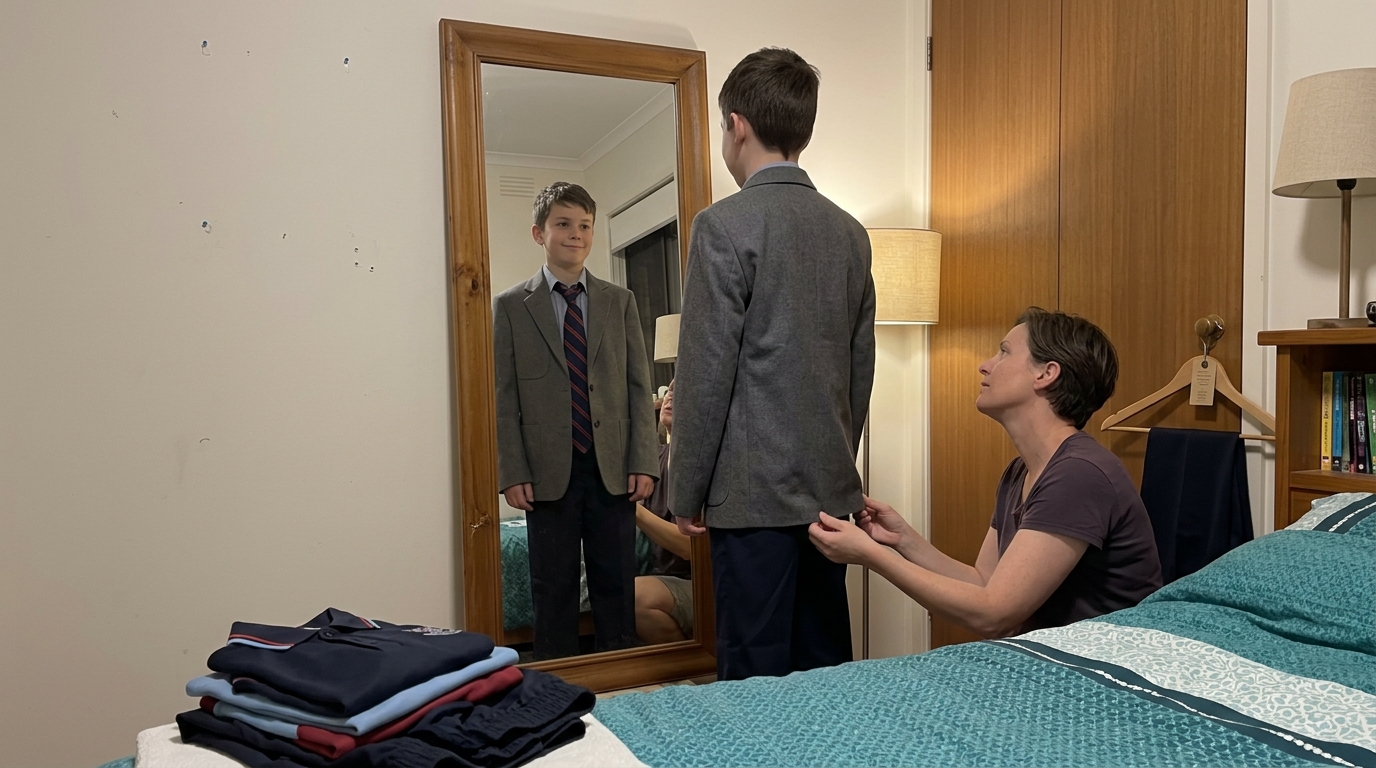
The transition itself usually includes a Year 6 transition day in December, a uniform fitting, a stationery list, and a settling-in week in late January. Academically, the jump is real: students move from one classroom teacher to seven or eight subject teachers, locker rotations between rooms, more independent study, and homework that scales sharply through Years 7 and 8. The first six months are the most common time families look for tutoring — usually in Maths or English, where the gap between the primary curriculum and Year 7 expectations bites hardest.
How does NAPLAN work in Victoria, and how much should it matter to parents?
NAPLAN — the National Assessment Program Literacy and Numeracy, administered by ACARA — runs in Years 3, 5, 7 and 9 in Melbourne schools, with results reported on a 10-band scale and four proficiency standards: Exceeding, Strong, Developing and Needs additional support. Schools use NAPLAN to spot students who need extra help in literacy or numeracy, and the data flows into MySchool at a school-average level. For most Melbourne students, NAPLAN is a diagnostic check, not a gate — Year 9 results don't feed into VCE or ATAR.
The exception is Year 7 selective-entry applications: schools like Melbourne High, MacRobertson Girls', Nossal and Suzanne Cory use their own selective-entry exam and don't take NAPLAN directly, but the Year 5 NAPLAN result is a useful early signal of whether selective entry is even on the cards. If a Year 3 or Year 5 result lands in the Developing or Needs additional support band, that's a good moment to talk to the classroom teacher about targeted reading or numeracy support — including private tutoring in Melbourne if the school's in-class supports don't close the gap.
What is VCE, and how does ATAR work for Melbourne students?
The Victorian Certificate of Education (VCE) is the senior-secondary qualification taken by most Melbourne students in Years 11 and 12, run by VCAA. A typical Year 12 student studies five or six VCE Unit 3/4 subjects, including compulsory English. Each subject contributes School-Assessed Coursework (SACs) and end-of-year exams, and final VCE study scores are scaled by the Victorian Tertiary Admissions Centre (VTAC) to reflect subject difficulty. Scaling is the reason higher-difficulty subjects like Specialist Maths, Mathematical Methods and a second language often pull a student's overall result up at the margins.
The Australian Tertiary Admission Rank (ATAR) is a percentile rank from 0.00 to 99.95 calculated by VTAC from a student's top scaled VCE scores: English plus the next three highest subjects in full, plus 10% of each of two additional subjects. An ATAR of 80.00 means the student ranked in the top 20% of their Year 12 cohort nationally; 99.95 is the top of the table. Tertiary courses publish ATAR cut-offs each year, but a growing share of Melbourne universities also offer alternative entry pathways — early entry, principal's recommendation, foundation programs and so on. For a deeper walk-through, see how the ATAR is calculated and proven strategies for acing your VCE exams.
What's the difference between IB and VCE in Melbourne?
The International Baccalaureate (IB) Diploma is offered by a small group of Melbourne independent schools alongside, or instead of, VCE. The IB requires six subjects across six groups (one each from languages, individuals and societies, sciences, mathematics, the arts, plus extras), three at Higher Level and three at Standard Level, plus the Theory of Knowledge course, an Extended Essay, and Creativity, Activity, Service (CAS). Final IB scores are reported out of 45, then converted to an ATAR-equivalent by VTAC for Australian university applications. VCE, in contrast, lets students specialise more — only English is compulsory, and a strong subject mix (with maths or a language) often scales well.
Neither is automatically harder. IB suits students who like breadth and structured writing across multiple disciplines; VCE suits students who already know they want to lean into a particular cluster (humanities, sciences, maths, the arts). Both lead to the same Melbourne universities, and both are accepted internationally. If the school you're considering offers both, the deciding question is usually "does my child prefer breadth or depth?"
How much does Melbourne tutoring cost, and when does it help most?
Private tutoring in Melbourne typically costs between A$55 and A$85 per hour for one-on-one sessions, depending on subject, tutor experience and whether the lesson is online or in-home. Tutero starts at A$65 per hour, the same rate across primary maths, primary and secondary English and VCE subjects — there's no senior-year premium and no ATAR surcharge. Group classes and large coaching colleges sit a bit lower per hour, but trade off the personalisation that drives most of the academic gain.
Tutoring tends to help most at four pinch points:
- Year 3–4 reading or numeracy gaps picked up in NAPLAN or by the classroom teacher.
- The Year 6-to-7 transition, especially in maths and English where the curriculum jumps sharply.
- Year 9–10 selecting VCE subjects, where targeted help in maths or science can keep options open.
- Year 11–12 VCE Unit 3/4, where SAC preparation and exam technique materially shift the score.
For more on timing, see the ideal time to begin tutoring and 5 key benefits of private tutoring.
What mistakes do Melbourne parents commonly make navigating the school system?
Even thoughtful Melbourne families fall into the same handful of traps. Five worth flagging:
- Skipping Find My School and assuming the local school is the zone school. Boundaries are tighter than most parents expect, and a one-street difference matters.
- Leaving Catholic and independent applications until Year 5. Popular schools close lists in Year 3 or 4. The earlier the registration, the wider the choice.
- Reading NAPLAN as a verdict rather than a checkpoint. A weak Year 3 result is information, not destiny. A strong Year 5 result doesn't guarantee selective entry.
- Choosing VCE subjects only by interest, ignoring scaling. Interest matters most for endurance, but a maths-light or language-free subject load can quietly cap an ATAR by a few points.
- Waiting for Year 12 to start tutoring. The most cost-effective tutoring usually begins in Year 10 or early Year 11, building habits and exam technique before the Unit 3/4 SAC pressure.
Related reading for Melbourne parents
- How to find a quality tutor in Melbourne
- How to get a scholarship in Melbourne
- 4 reasons you should change your child's school
- The ideal time to begin tutoring
- How the ATAR is calculated
- How to achieve your dream ATAR
- Proven strategies for acing your VCE exams
- 5 key benefits of private tutoring
The bottom line for Melbourne parents
The Victorian school system gives Melbourne families three real choices — government, Catholic or independent — and four real decision points: primary school in line with your home zone, secondary school in Year 5 or 6, VCE or IB subject choice in Year 10, and tutoring whenever the gap between your child's effort and their results gets uncomfortable. Get those four right and the year-to-year work — homework, tests, NAPLAN, ATAR — sits on a much steadier foundation.
Ready to add personalised support for your Melbourne student? Book a Melbourne tutor at A$65/hr — same rate from Year 1 right through to VCE, no contracts, and you pay after each lesson.
Sending a child through the Victorian school system can feel like learning a second language: zones, scaling, NAPLAN bands, ATAR, VCE versus IB, and at least three school sectors all at once. This guide is a plain-English walk-through for Melbourne parents — what each stage looks like from Year 1 through to Year 12, how the choices actually work, and where extra support like Melbourne tutoring tends to help most.
Quick answer
Children in Melbourne start Foundation (Prep) in the year they turn 5 or 6, then move through Years 1–6 in primary school and Years 7–12 in secondary school. Families choose between three sectors — government, Catholic and independent — with state schooling free and private fees ranging up to A$48,000 a year. NAPLAN tests run in Years 3, 5, 7 and 9 as a checkpoint, not a gate. Most students finish with the Victorian Certificate of Education (VCE) and an ATAR, while a smaller group sits the International Baccalaureate (IB) Diploma. The biggest decision points for parents are choosing a primary school in line with the family's home zone, choosing a secondary school in Year 5 or 6, and deciding whether to add tutoring during VCE.
How does the Victorian school system work, from primary to high school?
The Victorian system runs from Foundation (Prep) through Year 12, set out in the Victorian Curriculum F–10 and the senior-secondary VCE managed by the Victorian Curriculum and Assessment Authority (VCAA). Children typically start Foundation in the year they turn 5 by 30 April, then complete primary school in Years 1–6 and secondary school in Years 7–12. The day-to-day learning sits with the school and its teachers, but every Melbourne school — government, Catholic or independent — teaches against the same Victorian Curriculum standards in F–10. From Year 11 onward, students choose VCE subjects (or, in some independent schools, the IB Diploma) and pick the senior pathway that suits them.
The big stage gates a Melbourne parent will encounter
- Foundation–Year 2: reading, early numeracy and settling into school.
- Years 3–6: NAPLAN in Years 3 and 5; preparing for the Year 7 transition by Years 5–6.
- Years 7–9: the high-school transition, broader subjects, NAPLAN in Years 7 and 9.
- Years 10–12: subject narrowing, VCE or IB, and the ATAR for university entry.
What's the difference between government, Catholic and independent schools in Melbourne?
Melbourne has three school sectors. Government schools are run by the Department of Education and are tuition-free for Australian residents. Catholic schools sit under Melbourne Archdiocese Catholic Schools (MACS) and charge moderate fees, with priority typically given to baptised Catholic families. Independent schools are member schools of Independent Schools Victoria, run their own admissions and fee structures, and include the city's well-known private schools, faith-based independents and alternative-pedagogy schools. Roughly 60% of Victorian students attend government schools, around 20% attend Catholic schools, and 20% attend independent schools, with a slightly higher independent and Catholic share at secondary level (ACARA / MySchool data).
| School type | Who runs it | Typical Melbourne fees | Curriculum / pathway |
|---|---|---|---|
| Government (state) | Department of Education Victoria | No tuition fees; voluntary contributions, uniforms, levies (~A$300–A$1,500/yr) | Victorian Curriculum F–10, then VCE or VCE Vocational Major |
| Catholic (parish or systemic) | Melbourne Archdiocese Catholic Schools (MACS) | Primary ~A$2,000–A$5,000/yr; secondary ~A$5,000–A$11,000/yr | Victorian Curriculum F–10, then VCE; faith-based formation |
| Independent (private) | Independent Schools Victoria member schools | Primary ~A$10,000–A$30,000/yr; secondary ~A$25,000–A$48,000/yr | VCE, IB, or both; some offer Cambridge or alternative programs |
None of these sectors is automatically "better." Government schools include some of the highest-performing campuses in the state, several Catholic schools post strong VCE medians on a tight budget, and independent schools span everything from rigorous academic settings to alternative pedagogies. The right fit depends on your child, your family's budget, and how the school's culture lines up with how your child actually learns.
How do Melbourne school zones and catchments work?
Every Victorian government school has a designated neighbourhood school based on your residential address. Use the Department's Find My School tool to see exactly which government primary and secondary schools your home address feeds into. Government schools must offer a place to any child living in their zone, and out-of-zone places are only offered when there's capacity. Catholic and independent schools do not have zones — they have their own admissions criteria, which usually include sibling priority, parish or denominational ties, and (for some independents) entrance assessments. If a particular government school is non-negotiable, your home address is effectively the application form, so families sometimes plan house moves around the zone.
Quick zone playbook for Melbourne parents
- Check Find My School with your real address — not the rough suburb.
- Confirm with the school directly; zone boundaries occasionally shift.
- If you're thinking out-of-zone, ask the school about typical wait-list movement.
- Keep proof of address (lease, utility bill); some schools request it at enrolment.
What is the Year 7 transition like in Melbourne, and when do parents need to choose a high school?
For most Melbourne families, the secondary-school decision happens in Year 5 or early Year 6. Government secondary applications go through the Department's Year 6–7 Transition Information Form, due around May of Year 6, with offers landing in August. Catholic and independent schools usually open registrations much earlier — sometimes from Year 3 or 4, occasionally at birth — and close them by Year 4 for popular schools. Most schools run open days and tours from late Term 1 through Term 2, so the practical window for visits is the year before applications close.
The transition itself usually includes a Year 6 transition day in December, a uniform fitting, a stationery list, and a settling-in week in late January. Academically, the jump is real: students move from one classroom teacher to seven or eight subject teachers, locker rotations between rooms, more independent study, and homework that scales sharply through Years 7 and 8. The first six months are the most common time families look for tutoring — usually in Maths or English, where the gap between the primary curriculum and Year 7 expectations bites hardest.
How does NAPLAN work in Victoria, and how much should it matter to parents?
NAPLAN — the National Assessment Program Literacy and Numeracy, administered by ACARA — runs in Years 3, 5, 7 and 9 in Melbourne schools, with results reported on a 10-band scale and four proficiency standards: Exceeding, Strong, Developing and Needs additional support. Schools use NAPLAN to spot students who need extra help in literacy or numeracy, and the data flows into MySchool at a school-average level. For most Melbourne students, NAPLAN is a diagnostic check, not a gate — Year 9 results don't feed into VCE or ATAR.
The exception is Year 7 selective-entry applications: schools like Melbourne High, MacRobertson Girls', Nossal and Suzanne Cory use their own selective-entry exam and don't take NAPLAN directly, but the Year 5 NAPLAN result is a useful early signal of whether selective entry is even on the cards. If a Year 3 or Year 5 result lands in the Developing or Needs additional support band, that's a good moment to talk to the classroom teacher about targeted reading or numeracy support — including private tutoring in Melbourne if the school's in-class supports don't close the gap.
What is VCE, and how does ATAR work for Melbourne students?
The Victorian Certificate of Education (VCE) is the senior-secondary qualification taken by most Melbourne students in Years 11 and 12, run by VCAA. A typical Year 12 student studies five or six VCE Unit 3/4 subjects, including compulsory English. Each subject contributes School-Assessed Coursework (SACs) and end-of-year exams, and final VCE study scores are scaled by the Victorian Tertiary Admissions Centre (VTAC) to reflect subject difficulty. Scaling is the reason higher-difficulty subjects like Specialist Maths, Mathematical Methods and a second language often pull a student's overall result up at the margins.
The Australian Tertiary Admission Rank (ATAR) is a percentile rank from 0.00 to 99.95 calculated by VTAC from a student's top scaled VCE scores: English plus the next three highest subjects in full, plus 10% of each of two additional subjects. An ATAR of 80.00 means the student ranked in the top 20% of their Year 12 cohort nationally; 99.95 is the top of the table. Tertiary courses publish ATAR cut-offs each year, but a growing share of Melbourne universities also offer alternative entry pathways — early entry, principal's recommendation, foundation programs and so on. For a deeper walk-through, see how the ATAR is calculated and proven strategies for acing your VCE exams.
What's the difference between IB and VCE in Melbourne?
The International Baccalaureate (IB) Diploma is offered by a small group of Melbourne independent schools alongside, or instead of, VCE. The IB requires six subjects across six groups (one each from languages, individuals and societies, sciences, mathematics, the arts, plus extras), three at Higher Level and three at Standard Level, plus the Theory of Knowledge course, an Extended Essay, and Creativity, Activity, Service (CAS). Final IB scores are reported out of 45, then converted to an ATAR-equivalent by VTAC for Australian university applications. VCE, in contrast, lets students specialise more — only English is compulsory, and a strong subject mix (with maths or a language) often scales well.
Neither is automatically harder. IB suits students who like breadth and structured writing across multiple disciplines; VCE suits students who already know they want to lean into a particular cluster (humanities, sciences, maths, the arts). Both lead to the same Melbourne universities, and both are accepted internationally. If the school you're considering offers both, the deciding question is usually "does my child prefer breadth or depth?"
How much does Melbourne tutoring cost, and when does it help most?
Private tutoring in Melbourne typically costs between A$55 and A$85 per hour for one-on-one sessions, depending on subject, tutor experience and whether the lesson is online or in-home. Tutero starts at A$65 per hour, the same rate across primary maths, primary and secondary English and VCE subjects — there's no senior-year premium and no ATAR surcharge. Group classes and large coaching colleges sit a bit lower per hour, but trade off the personalisation that drives most of the academic gain.
Tutoring tends to help most at four pinch points:
- Year 3–4 reading or numeracy gaps picked up in NAPLAN or by the classroom teacher.
- The Year 6-to-7 transition, especially in maths and English where the curriculum jumps sharply.
- Year 9–10 selecting VCE subjects, where targeted help in maths or science can keep options open.
- Year 11–12 VCE Unit 3/4, where SAC preparation and exam technique materially shift the score.
For more on timing, see the ideal time to begin tutoring and 5 key benefits of private tutoring.
What mistakes do Melbourne parents commonly make navigating the school system?
Even thoughtful Melbourne families fall into the same handful of traps. Five worth flagging:
- Skipping Find My School and assuming the local school is the zone school. Boundaries are tighter than most parents expect, and a one-street difference matters.
- Leaving Catholic and independent applications until Year 5. Popular schools close lists in Year 3 or 4. The earlier the registration, the wider the choice.
- Reading NAPLAN as a verdict rather than a checkpoint. A weak Year 3 result is information, not destiny. A strong Year 5 result doesn't guarantee selective entry.
- Choosing VCE subjects only by interest, ignoring scaling. Interest matters most for endurance, but a maths-light or language-free subject load can quietly cap an ATAR by a few points.
- Waiting for Year 12 to start tutoring. The most cost-effective tutoring usually begins in Year 10 or early Year 11, building habits and exam technique before the Unit 3/4 SAC pressure.
Related reading for Melbourne parents
- How to find a quality tutor in Melbourne
- How to get a scholarship in Melbourne
- 4 reasons you should change your child's school
- The ideal time to begin tutoring
- How the ATAR is calculated
- How to achieve your dream ATAR
- Proven strategies for acing your VCE exams
- 5 key benefits of private tutoring
The bottom line for Melbourne parents
The Victorian school system gives Melbourne families three real choices — government, Catholic or independent — and four real decision points: primary school in line with your home zone, secondary school in Year 5 or 6, VCE or IB subject choice in Year 10, and tutoring whenever the gap between your child's effort and their results gets uncomfortable. Get those four right and the year-to-year work — homework, tests, NAPLAN, ATAR — sits on a much steadier foundation.
Ready to add personalised support for your Melbourne student? Book a Melbourne tutor at A$65/hr — same rate from Year 1 right through to VCE, no contracts, and you pay after each lesson.

Sending a child through the Victorian school system can feel like learning a second language: zones, scaling, NAPLAN bands, ATAR, VCE versus IB, and at least three school sectors all at once. This guide is a plain-English walk-through for Melbourne parents — what each stage looks like from Year 1 through to Year 12, how the choices actually work, and where extra support like Melbourne tutoring tends to help most.
Quick answer
Children in Melbourne start Foundation (Prep) in the year they turn 5 or 6, then move through Years 1–6 in primary school and Years 7–12 in secondary school. Families choose between three sectors — government, Catholic and independent — with state schooling free and private fees ranging up to A$48,000 a year. NAPLAN tests run in Years 3, 5, 7 and 9 as a checkpoint, not a gate. Most students finish with the Victorian Certificate of Education (VCE) and an ATAR, while a smaller group sits the International Baccalaureate (IB) Diploma. The biggest decision points for parents are choosing a primary school in line with the family's home zone, choosing a secondary school in Year 5 or 6, and deciding whether to add tutoring during VCE.
How does the Victorian school system work, from primary to high school?
The Victorian system runs from Foundation (Prep) through Year 12, set out in the Victorian Curriculum F–10 and the senior-secondary VCE managed by the Victorian Curriculum and Assessment Authority (VCAA). Children typically start Foundation in the year they turn 5 by 30 April, then complete primary school in Years 1–6 and secondary school in Years 7–12. The day-to-day learning sits with the school and its teachers, but every Melbourne school — government, Catholic or independent — teaches against the same Victorian Curriculum standards in F–10. From Year 11 onward, students choose VCE subjects (or, in some independent schools, the IB Diploma) and pick the senior pathway that suits them.
The big stage gates a Melbourne parent will encounter
- Foundation–Year 2: reading, early numeracy and settling into school.
- Years 3–6: NAPLAN in Years 3 and 5; preparing for the Year 7 transition by Years 5–6.
- Years 7–9: the high-school transition, broader subjects, NAPLAN in Years 7 and 9.
- Years 10–12: subject narrowing, VCE or IB, and the ATAR for university entry.
What's the difference between government, Catholic and independent schools in Melbourne?
Melbourne has three school sectors. Government schools are run by the Department of Education and are tuition-free for Australian residents. Catholic schools sit under Melbourne Archdiocese Catholic Schools (MACS) and charge moderate fees, with priority typically given to baptised Catholic families. Independent schools are member schools of Independent Schools Victoria, run their own admissions and fee structures, and include the city's well-known private schools, faith-based independents and alternative-pedagogy schools. Roughly 60% of Victorian students attend government schools, around 20% attend Catholic schools, and 20% attend independent schools, with a slightly higher independent and Catholic share at secondary level (ACARA / MySchool data).
| School type | Who runs it | Typical Melbourne fees | Curriculum / pathway |
|---|---|---|---|
| Government (state) | Department of Education Victoria | No tuition fees; voluntary contributions, uniforms, levies (~A$300–A$1,500/yr) | Victorian Curriculum F–10, then VCE or VCE Vocational Major |
| Catholic (parish or systemic) | Melbourne Archdiocese Catholic Schools (MACS) | Primary ~A$2,000–A$5,000/yr; secondary ~A$5,000–A$11,000/yr | Victorian Curriculum F–10, then VCE; faith-based formation |
| Independent (private) | Independent Schools Victoria member schools | Primary ~A$10,000–A$30,000/yr; secondary ~A$25,000–A$48,000/yr | VCE, IB, or both; some offer Cambridge or alternative programs |
None of these sectors is automatically "better." Government schools include some of the highest-performing campuses in the state, several Catholic schools post strong VCE medians on a tight budget, and independent schools span everything from rigorous academic settings to alternative pedagogies. The right fit depends on your child, your family's budget, and how the school's culture lines up with how your child actually learns.
How do Melbourne school zones and catchments work?
Every Victorian government school has a designated neighbourhood school based on your residential address. Use the Department's Find My School tool to see exactly which government primary and secondary schools your home address feeds into. Government schools must offer a place to any child living in their zone, and out-of-zone places are only offered when there's capacity. Catholic and independent schools do not have zones — they have their own admissions criteria, which usually include sibling priority, parish or denominational ties, and (for some independents) entrance assessments. If a particular government school is non-negotiable, your home address is effectively the application form, so families sometimes plan house moves around the zone.
Quick zone playbook for Melbourne parents
- Check Find My School with your real address — not the rough suburb.
- Confirm with the school directly; zone boundaries occasionally shift.
- If you're thinking out-of-zone, ask the school about typical wait-list movement.
- Keep proof of address (lease, utility bill); some schools request it at enrolment.
What is the Year 7 transition like in Melbourne, and when do parents need to choose a high school?
For most Melbourne families, the secondary-school decision happens in Year 5 or early Year 6. Government secondary applications go through the Department's Year 6–7 Transition Information Form, due around May of Year 6, with offers landing in August. Catholic and independent schools usually open registrations much earlier — sometimes from Year 3 or 4, occasionally at birth — and close them by Year 4 for popular schools. Most schools run open days and tours from late Term 1 through Term 2, so the practical window for visits is the year before applications close.
The transition itself usually includes a Year 6 transition day in December, a uniform fitting, a stationery list, and a settling-in week in late January. Academically, the jump is real: students move from one classroom teacher to seven or eight subject teachers, locker rotations between rooms, more independent study, and homework that scales sharply through Years 7 and 8. The first six months are the most common time families look for tutoring — usually in Maths or English, where the gap between the primary curriculum and Year 7 expectations bites hardest.
How does NAPLAN work in Victoria, and how much should it matter to parents?
NAPLAN — the National Assessment Program Literacy and Numeracy, administered by ACARA — runs in Years 3, 5, 7 and 9 in Melbourne schools, with results reported on a 10-band scale and four proficiency standards: Exceeding, Strong, Developing and Needs additional support. Schools use NAPLAN to spot students who need extra help in literacy or numeracy, and the data flows into MySchool at a school-average level. For most Melbourne students, NAPLAN is a diagnostic check, not a gate — Year 9 results don't feed into VCE or ATAR.
The exception is Year 7 selective-entry applications: schools like Melbourne High, MacRobertson Girls', Nossal and Suzanne Cory use their own selective-entry exam and don't take NAPLAN directly, but the Year 5 NAPLAN result is a useful early signal of whether selective entry is even on the cards. If a Year 3 or Year 5 result lands in the Developing or Needs additional support band, that's a good moment to talk to the classroom teacher about targeted reading or numeracy support — including private tutoring in Melbourne if the school's in-class supports don't close the gap.
What is VCE, and how does ATAR work for Melbourne students?
The Victorian Certificate of Education (VCE) is the senior-secondary qualification taken by most Melbourne students in Years 11 and 12, run by VCAA. A typical Year 12 student studies five or six VCE Unit 3/4 subjects, including compulsory English. Each subject contributes School-Assessed Coursework (SACs) and end-of-year exams, and final VCE study scores are scaled by the Victorian Tertiary Admissions Centre (VTAC) to reflect subject difficulty. Scaling is the reason higher-difficulty subjects like Specialist Maths, Mathematical Methods and a second language often pull a student's overall result up at the margins.
The Australian Tertiary Admission Rank (ATAR) is a percentile rank from 0.00 to 99.95 calculated by VTAC from a student's top scaled VCE scores: English plus the next three highest subjects in full, plus 10% of each of two additional subjects. An ATAR of 80.00 means the student ranked in the top 20% of their Year 12 cohort nationally; 99.95 is the top of the table. Tertiary courses publish ATAR cut-offs each year, but a growing share of Melbourne universities also offer alternative entry pathways — early entry, principal's recommendation, foundation programs and so on. For a deeper walk-through, see how the ATAR is calculated and proven strategies for acing your VCE exams.
What's the difference between IB and VCE in Melbourne?
The International Baccalaureate (IB) Diploma is offered by a small group of Melbourne independent schools alongside, or instead of, VCE. The IB requires six subjects across six groups (one each from languages, individuals and societies, sciences, mathematics, the arts, plus extras), three at Higher Level and three at Standard Level, plus the Theory of Knowledge course, an Extended Essay, and Creativity, Activity, Service (CAS). Final IB scores are reported out of 45, then converted to an ATAR-equivalent by VTAC for Australian university applications. VCE, in contrast, lets students specialise more — only English is compulsory, and a strong subject mix (with maths or a language) often scales well.
Neither is automatically harder. IB suits students who like breadth and structured writing across multiple disciplines; VCE suits students who already know they want to lean into a particular cluster (humanities, sciences, maths, the arts). Both lead to the same Melbourne universities, and both are accepted internationally. If the school you're considering offers both, the deciding question is usually "does my child prefer breadth or depth?"
How much does Melbourne tutoring cost, and when does it help most?
Private tutoring in Melbourne typically costs between A$55 and A$85 per hour for one-on-one sessions, depending on subject, tutor experience and whether the lesson is online or in-home. Tutero starts at A$65 per hour, the same rate across primary maths, primary and secondary English and VCE subjects — there's no senior-year premium and no ATAR surcharge. Group classes and large coaching colleges sit a bit lower per hour, but trade off the personalisation that drives most of the academic gain.
Tutoring tends to help most at four pinch points:
- Year 3–4 reading or numeracy gaps picked up in NAPLAN or by the classroom teacher.
- The Year 6-to-7 transition, especially in maths and English where the curriculum jumps sharply.
- Year 9–10 selecting VCE subjects, where targeted help in maths or science can keep options open.
- Year 11–12 VCE Unit 3/4, where SAC preparation and exam technique materially shift the score.
For more on timing, see the ideal time to begin tutoring and 5 key benefits of private tutoring.
What mistakes do Melbourne parents commonly make navigating the school system?
Even thoughtful Melbourne families fall into the same handful of traps. Five worth flagging:
- Skipping Find My School and assuming the local school is the zone school. Boundaries are tighter than most parents expect, and a one-street difference matters.
- Leaving Catholic and independent applications until Year 5. Popular schools close lists in Year 3 or 4. The earlier the registration, the wider the choice.
- Reading NAPLAN as a verdict rather than a checkpoint. A weak Year 3 result is information, not destiny. A strong Year 5 result doesn't guarantee selective entry.
- Choosing VCE subjects only by interest, ignoring scaling. Interest matters most for endurance, but a maths-light or language-free subject load can quietly cap an ATAR by a few points.
- Waiting for Year 12 to start tutoring. The most cost-effective tutoring usually begins in Year 10 or early Year 11, building habits and exam technique before the Unit 3/4 SAC pressure.
Related reading for Melbourne parents
- How to find a quality tutor in Melbourne
- How to get a scholarship in Melbourne
- 4 reasons you should change your child's school
- The ideal time to begin tutoring
- How the ATAR is calculated
- How to achieve your dream ATAR
- Proven strategies for acing your VCE exams
- 5 key benefits of private tutoring
The bottom line for Melbourne parents
The Victorian school system gives Melbourne families three real choices — government, Catholic or independent — and four real decision points: primary school in line with your home zone, secondary school in Year 5 or 6, VCE or IB subject choice in Year 10, and tutoring whenever the gap between your child's effort and their results gets uncomfortable. Get those four right and the year-to-year work — homework, tests, NAPLAN, ATAR — sits on a much steadier foundation.
Ready to add personalised support for your Melbourne student? Book a Melbourne tutor at A$65/hr — same rate from Year 1 right through to VCE, no contracts, and you pay after each lesson.
.svg)
.svg)
<p>Children in Victoria start <strong>Foundation (Prep)</strong> in the year they turn 5 by 30 April. That means most Melbourne students start primary school at age 4 or 5, then progress through Years 1 to 6 from ages roughly 6 to 11. Government schools enrol on a calendar-year basis, with Term 1 starting in late January or early February. Some families choose to delay entry by a year if a child has a late-March or April birthday or isn't socially ready — a decision worth talking through with the kindergarten and the prospective primary school.</p>
<p>None of the three sectors is automatically best. <strong>Government schools</strong> are tuition-free and include several of the highest-performing campuses in Victoria. <strong>Catholic schools</strong> blend faith-based formation with strong academic outcomes at moderate fees. <strong>Independent schools</strong> offer smaller class sizes, broader extracurriculars and (in some cases) the IB Diploma, but at fees up to A$48,000 per year. The best fit depends on your child's learning style, your family's budget and values, and how the school's culture matches how your child actually learns. Visiting open days and talking to current parents matters more than league tables.</p>
<p><strong>Government schools</strong> charge no tuition; expect about A$300–A$1,500 a year in voluntary contributions, uniforms and excursion levies. <strong>Catholic primary schools</strong> typically charge A$2,000–A$5,000 per year, rising to A$5,000–A$11,000 for secondary. <strong>Independent primary schools</strong> charge roughly A$10,000–A$30,000 a year, and independent secondary schools sit between A$25,000 and A$48,000. Sibling discounts, scholarships and bursaries can move the figure down at Catholic and independent schools — most have a dedicated <a href="https://www.tutero.com/au/blog/how-to-get-a-scholarship-in-melbourne">scholarship pathway</a> worth checking before you assume a school is out of reach.</p>
<p>For <strong>government secondary schools</strong>, applications go through the Year 6–7 Transition Information Form due in <strong>May of Year 6</strong>, with offers landing in August. For <strong>Catholic and independent schools</strong>, registrations often open in Year 3 or 4 and close at popular schools by Year 4 — some families register at birth for very oversubscribed schools. Selective-entry public schools (Melbourne High, MacRobertson Girls', Nossal, Suzanne Cory) require applications in <strong>March–April of Year 8</strong> for Year 9 entry, with the entrance exam in June. The practical advice: lock in your Catholic and independent registrations in Year 3 or 4, and start school visits in Year 5.</p>
<p>Not directly. NAPLAN is a <strong>diagnostic checkpoint</strong>, not an admissions exam. Year 9 NAPLAN results don't feed into VCE results or ATAR. The exception is that strong Year 5 NAPLAN bands are a useful signal that a child might be a candidate for selective-entry public schools (which use their own separate exam in Year 8). For the rest of Melbourne students, NAPLAN's real value is spotting literacy or numeracy gaps early — a Year 3 or Year 5 result in the <em>Developing</em> band is a good prompt to ask the classroom teacher about targeted support.</p>
<p>Private tutoring tends to deliver the most return at four points: <strong>Years 3–4</strong> when an early literacy or numeracy gap shows up; <strong>the Year 6-to-7 transition</strong>, where the curriculum jump in maths and English catches a lot of students out; <strong>Years 9–10</strong> when subject choices for VCE start to matter; and <strong>Years 11–12</strong> for SAC preparation and VCE exam technique. <a href="https://www.tutero.com/au/online-tutoring/melbourne">Tutero starts at A$65/hr in Melbourne</a> — same rate from Year 1 to VCE — and most families start with a single weekly session in the subject where the gap is widest.</p>
Hoping to improve confidence & grades?

.png)


