


Most parents want to help their child with maths, then freeze the moment the homework looks nothing like the maths they remember. If you were never a "maths person" yourself, that feeling can be sharper still. The good news is reassuring: your confidence at the kitchen table matters far more than your own marks ever did.
This guide is written for the parent who wants to support maths at home but does not feel sure of the maths itself. It covers what to focus on at each year group, how to teach times tables, what the Year 4 multiplication tables check involves, how to help with homework without taking over, and the everyday moments that quietly build number skills. None of it asks you to be good at maths. It asks you to be calm, curious and consistent.
Quick answer
You do not need to be good at maths to help your child at home. Five calm minutes most days, good questions instead of answers, and everyday maths at the shops beat a long session once a fortnight. For times tables, practise one table at a time and build speed last. In England, children should know their tables up to 12 × 12 by the end of Year 4, when they sit a short online check in June.
Can I help my child with maths if I'm not a maths person?
Yes. You do not need to be good at maths to help your child at home. What matters most is a calm, positive attitude, a bit of curiosity, and a regular routine. Count, cook and shop together, ask questions instead of handing over answers, and let your child explain their thinking back to you.
A child's attitude to maths is shaped early, and heavily, by the adults around them. If a child hears "I was hopeless at maths too", they learn that maths ability is fixed and that giving up is normal. If they hear "let's work it out", they learn the opposite. That reframe costs you nothing and is the single most valuable thing you bring.
What should I focus on at each year group?
Match your support to your child's stage, from counting in Reception to exam courses at GCSE and A level.
Maths builds in a deliberate order. The National Curriculum mathematics programmes of study set out what is taught in England from Year 1 to Year 9, and each stage rests on the one before it. You do not need to teach any of it. You just need to know roughly what your child is working on so your everyday help lands in the right place. The table below is a simple map.
| Year group | Key maths focus | One thing to do at home |
|---|---|---|
| Reception | Counting, number sense | Count real things: stairs, socks, shopping |
| KS1 (Year 1 to 2) | Place value, adding, subtracting, the 2, 5 and 10 tables | Count in 2s, 5s and 10s on walks |
| Lower KS2 (Year 3 to 4) | Times tables up to 12 × 12 | Five minutes of times tables a day |
| Upper KS2 (Year 5 to 6) | Fractions, decimals, percentages | Work out discounts and split a bill |
| KS3 (Year 7 to 9) | Algebra, ratio, negative numbers | Ask why a formula works, not just the answer |
| GCSE (Year 10 to 11) | Algebra, geometry, problem solving | Ask your child to teach you a topic |
| A level (Year 12 to 13) | A level maths or Further Mathematics | Protect a study routine and get help early |
Source: focus areas for Year 1 to Year 9 follow the National Curriculum in England mathematics programmes of study (Department for Education). GCSE and A level content is set by each exam board's specification.
Two notes on using the map. First, year groups are a guide, not a rule. Plenty of confident Year 6 pupils are working on early algebra, and plenty of Year 8 students are still shoring up times tables. Meet your child where they actually are. Their school report and parents' evening are practical ways to see where that is. Second, the "one thing to do at home" column is deliberately small. A daily five-minute habit beats a stressful hour once a fortnight, every time. If your child is at primary school and needs more than home practice, primary maths tutoring works on the same foundations.
How do I help my child learn their times tables?
Teach times tables little and often: five minutes a day, one table at a time, starting with chanting and counting in steps, then mixed questions, and speed only at the end. Short daily practice beats a long session at the weekend.
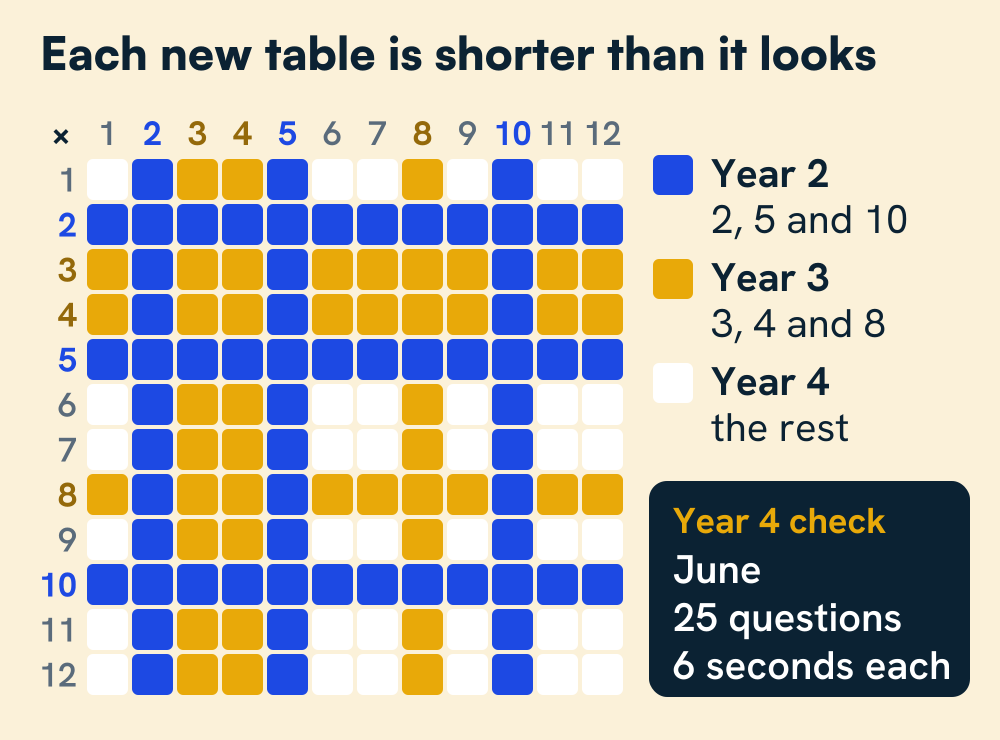
The National Curriculum sets a clear order. In Year 2, children learn the 2, 5 and 10 tables. In Year 3, they add the 3, 4 and 8 tables. By the end of Year 4, they should recall all the tables up to 12 × 12. Follow the same order at home and you will be working with the school, not against it.
- One table at a time. Stay on one table until your child can answer it in any order, then add the next.
- Count in steps first. Chant or count in 3s on the stairs or in the car. Rhythm helps the facts stick before your child has to recall them cold.
- Then mix it up. Ask facts out of order: "What is 6 × 3? What about 3 × 9?" Recall in any order is the real goal.
- Use the facts they already know. 3 × 8 is the same as 8 × 3, so every new table is shorter than it looks. Doubles help too: the 4 table is the 2 table doubled.
- Focus on the tricky ones. Keep a short list of the facts your child gets wrong, often 6 × 7, 7 × 8 and 8 × 6, and practise just those.
- Speed last. Once the answers are right, then play beat-the-clock. Speed before accuracy just teaches panic.
What is the Year 4 multiplication tables check?
The multiplication tables check is a short online check that Year 4 pupils in England take in June. It has 25 times table questions, your child has 6 seconds to answer each one, and there is no pass mark.
According to the Department for Education's information for parents, the check is there to "determine whether your child can fluently recall their times tables up to 12". It is statutory for Year 4 pupils at state-funded schools in England. Your child answers 3 practice questions first, and schools have a "try it out" area from April so pupils can get used to the format. Afterwards, "your child's teacher will share your child's score with you", and schools use the results to spot pupils who need extra support.
The same guidance says you do not need to do anything extra to prepare your child for the check. The best preparation is the steady practice above, not drilling for a test. If the 6-second timer is making your child anxious, take the clock away at home, praise the facts they know, and let speed come on its own. A score out of 25 is useful information for the school, not a verdict on your child.
How do I help with maths homework without doing it for them?
Ask questions, resist rescuing, and let a bit of struggle happen, because that struggle is where the learning lives.
When your child is stuck, the instinct is to step in and show them. Try to resist it. A little productive struggle builds reasoning and persistence. Your job is to keep them in the problem, not to remove it.
A simple script helps. Instead of "here is how you do it", try "what do you already know?", "what is the question actually asking?", and "what could you try first?". If they get an answer, ask "how did you work that out?". Explaining their thinking out loud is where understanding sticks, and it lets you spot the exact step that tripped them up without needing to know the maths yourself.
Set an end point too. If ten minutes of genuine effort produces nothing but tears, stop, mark the question to raise with the teacher, and move on. Homework should not end the evening in a fight.
What can we do in everyday life to build maths skills?
The kitchen, the supermarket and the car are better maths classrooms than the dinner table, because the numbers are real.
Everyday maths sticks because it has a point. Cooking is fractions and ratios: halve a recipe, double it, or ask how much flour you need for nine pancakes if 150 g makes six. Shopping is percentages and money: which multipack is better value, how much is 20 per cent off, how much change from a £20 note. A car journey is time, distance and estimation: how long until we arrive, how far have we come.
These moments matter because they show maths is useful, not just something marked in red pen. Maths makes most sense when it solves a real, hands-on problem, and you are doing exactly that every time you cook or shop out loud.
Keep it light and short. The aim is a running commentary of small number moments, not a quiz. If your child rolls their eyes, that is fine. The exposure is still working.
What if my child gets frustrated or anxious about maths?
Name the feeling, separate it from ability, and never say you were bad at maths too.
Maths anxiety is real and it is common. It shows up as "I'm just rubbish at maths", tears over homework, or shutting down before even reading the question. The most damaging thing you can do is agree with it, and the most common way parents accidentally do that is by saying "don't worry, I was hopeless at maths as well". It feels kind. It quietly tells your child that maths ability is inherited and theirs is broken.
Instead, separate the feeling from the fact. "This feels hard right now" is true and workable. "You are bad at maths" is neither. Praise effort and strategy rather than being "clever": "you kept going", "that was a smart way to check it". Keep sessions short when frustration is high, and come back when everyone is calm. Confidence grows from small, repeated wins, which is also why steady support beats last-minute cramming.
If the worry runs deeper than everyday frustration, our guide to maths anxiety in children goes further.
How do I handle a topic I don't understand myself?
You do not have to know it. Learn alongside your child, or hand the hard parts to someone who does.
By upper primary and into secondary school, the maths will often be beyond what you remember, and that is completely normal. You have three honest options, and all of them model something good. You can learn it together, watching a short explainer video and working through an example side by side. You can ask your child to teach you, which forces them to organise their own understanding. Or you can be upfront that this one is outside your comfort zone and get targeted help, for example GCSE maths tutoring when the exam years arrive.
What you should not do is bluff. Guessing at a method your child then repeats in an exam does more harm than saying "I'm not sure, let's find out". Modelling how a curious adult approaches something they do not know is a lesson in itself, and often a more valuable one than the maths.
When should I get a maths tutor?
Consider a tutor when gaps are widening, confidence is dropping, or the maths has moved beyond what you can support at home.
Home support does a lot, but it has limits, and recognising them is a strength rather than a failure. It is worth getting outside help when your child is falling behind and the gap keeps growing, when homework has become a nightly conflict, when their confidence is sliding, or when the content, especially A level maths, is past what you can explain. Early help is far easier than repair.
A good 1‑to‑1 maths tutor does what a busy classroom cannot: works at your child's exact pace, fills the specific gaps holding them back, and rebuilds confidence alongside skill. Tutero offers online tutoring shaped around your child's year group and goals, aligned with the National Curriculum, with no contracts, so you can start when you need help and stop when you do not. Whatever you choose, the home habits in this guide still do the heavy lifting the rest of the week.
Related reading
- Why maths matters: a parent's guide
- 5 tips for independent learning at home
- 12 books for primary school children
What should you do next?
Start with five minutes tonight: pick one times table your child is working on, practise it out of order, and end on a fact they know. Tomorrow, ask one "how did you work that out?" question during homework.
If the gaps are bigger than five minutes a day can fix, Tutero lessons are from £45 an hour, or from £65 an hour with a qualified teacher, the same rate at every level from Reception to Year 13. You pay after each lesson, with no contracts, and you can cancel any time.
Most parents want to help their child with maths, then freeze the moment the homework looks nothing like the maths they remember. If you were never a "maths person" yourself, that feeling can be sharper still. The good news is reassuring: your confidence at the kitchen table matters far more than your own marks ever did.
This guide is written for the parent who wants to support maths at home but does not feel sure of the maths itself. It covers what to focus on at each year group, how to teach times tables, what the Year 4 multiplication tables check involves, how to help with homework without taking over, and the everyday moments that quietly build number skills. None of it asks you to be good at maths. It asks you to be calm, curious and consistent.
Quick answer
You do not need to be good at maths to help your child at home. Five calm minutes most days, good questions instead of answers, and everyday maths at the shops beat a long session once a fortnight. For times tables, practise one table at a time and build speed last. In England, children should know their tables up to 12 × 12 by the end of Year 4, when they sit a short online check in June.
Can I help my child with maths if I'm not a maths person?
Yes. You do not need to be good at maths to help your child at home. What matters most is a calm, positive attitude, a bit of curiosity, and a regular routine. Count, cook and shop together, ask questions instead of handing over answers, and let your child explain their thinking back to you.
A child's attitude to maths is shaped early, and heavily, by the adults around them. If a child hears "I was hopeless at maths too", they learn that maths ability is fixed and that giving up is normal. If they hear "let's work it out", they learn the opposite. That reframe costs you nothing and is the single most valuable thing you bring.
What should I focus on at each year group?
Match your support to your child's stage, from counting in Reception to exam courses at GCSE and A level.
Maths builds in a deliberate order. The National Curriculum mathematics programmes of study set out what is taught in England from Year 1 to Year 9, and each stage rests on the one before it. You do not need to teach any of it. You just need to know roughly what your child is working on so your everyday help lands in the right place. The table below is a simple map.
| Year group | Key maths focus | One thing to do at home |
|---|---|---|
| Reception | Counting, number sense | Count real things: stairs, socks, shopping |
| KS1 (Year 1 to 2) | Place value, adding, subtracting, the 2, 5 and 10 tables | Count in 2s, 5s and 10s on walks |
| Lower KS2 (Year 3 to 4) | Times tables up to 12 × 12 | Five minutes of times tables a day |
| Upper KS2 (Year 5 to 6) | Fractions, decimals, percentages | Work out discounts and split a bill |
| KS3 (Year 7 to 9) | Algebra, ratio, negative numbers | Ask why a formula works, not just the answer |
| GCSE (Year 10 to 11) | Algebra, geometry, problem solving | Ask your child to teach you a topic |
| A level (Year 12 to 13) | A level maths or Further Mathematics | Protect a study routine and get help early |
Source: focus areas for Year 1 to Year 9 follow the National Curriculum in England mathematics programmes of study (Department for Education). GCSE and A level content is set by each exam board's specification.
Two notes on using the map. First, year groups are a guide, not a rule. Plenty of confident Year 6 pupils are working on early algebra, and plenty of Year 8 students are still shoring up times tables. Meet your child where they actually are. Their school report and parents' evening are practical ways to see where that is. Second, the "one thing to do at home" column is deliberately small. A daily five-minute habit beats a stressful hour once a fortnight, every time. If your child is at primary school and needs more than home practice, primary maths tutoring works on the same foundations.
How do I help my child learn their times tables?
Teach times tables little and often: five minutes a day, one table at a time, starting with chanting and counting in steps, then mixed questions, and speed only at the end. Short daily practice beats a long session at the weekend.
The National Curriculum sets a clear order. In Year 2, children learn the 2, 5 and 10 tables. In Year 3, they add the 3, 4 and 8 tables. By the end of Year 4, they should recall all the tables up to 12 × 12. Follow the same order at home and you will be working with the school, not against it.
- One table at a time. Stay on one table until your child can answer it in any order, then add the next.
- Count in steps first. Chant or count in 3s on the stairs or in the car. Rhythm helps the facts stick before your child has to recall them cold.
- Then mix it up. Ask facts out of order: "What is 6 × 3? What about 3 × 9?" Recall in any order is the real goal.
- Use the facts they already know. 3 × 8 is the same as 8 × 3, so every new table is shorter than it looks. Doubles help too: the 4 table is the 2 table doubled.
- Focus on the tricky ones. Keep a short list of the facts your child gets wrong, often 6 × 7, 7 × 8 and 8 × 6, and practise just those.
- Speed last. Once the answers are right, then play beat-the-clock. Speed before accuracy just teaches panic.
What is the Year 4 multiplication tables check?
The multiplication tables check is a short online check that Year 4 pupils in England take in June. It has 25 times table questions, your child has 6 seconds to answer each one, and there is no pass mark.
According to the Department for Education's information for parents, the check is there to "determine whether your child can fluently recall their times tables up to 12". It is statutory for Year 4 pupils at state-funded schools in England. Your child answers 3 practice questions first, and schools have a "try it out" area from April so pupils can get used to the format. Afterwards, "your child's teacher will share your child's score with you", and schools use the results to spot pupils who need extra support.
The same guidance says you do not need to do anything extra to prepare your child for the check. The best preparation is the steady practice above, not drilling for a test. If the 6-second timer is making your child anxious, take the clock away at home, praise the facts they know, and let speed come on its own. A score out of 25 is useful information for the school, not a verdict on your child.
How do I help with maths homework without doing it for them?
Ask questions, resist rescuing, and let a bit of struggle happen, because that struggle is where the learning lives.
When your child is stuck, the instinct is to step in and show them. Try to resist it. A little productive struggle builds reasoning and persistence. Your job is to keep them in the problem, not to remove it.
A simple script helps. Instead of "here is how you do it", try "what do you already know?", "what is the question actually asking?", and "what could you try first?". If they get an answer, ask "how did you work that out?". Explaining their thinking out loud is where understanding sticks, and it lets you spot the exact step that tripped them up without needing to know the maths yourself.
Set an end point too. If ten minutes of genuine effort produces nothing but tears, stop, mark the question to raise with the teacher, and move on. Homework should not end the evening in a fight.
What can we do in everyday life to build maths skills?
The kitchen, the supermarket and the car are better maths classrooms than the dinner table, because the numbers are real.
Everyday maths sticks because it has a point. Cooking is fractions and ratios: halve a recipe, double it, or ask how much flour you need for nine pancakes if 150 g makes six. Shopping is percentages and money: which multipack is better value, how much is 20 per cent off, how much change from a £20 note. A car journey is time, distance and estimation: how long until we arrive, how far have we come.
These moments matter because they show maths is useful, not just something marked in red pen. Maths makes most sense when it solves a real, hands-on problem, and you are doing exactly that every time you cook or shop out loud.
Keep it light and short. The aim is a running commentary of small number moments, not a quiz. If your child rolls their eyes, that is fine. The exposure is still working.
What if my child gets frustrated or anxious about maths?
Name the feeling, separate it from ability, and never say you were bad at maths too.
Maths anxiety is real and it is common. It shows up as "I'm just rubbish at maths", tears over homework, or shutting down before even reading the question. The most damaging thing you can do is agree with it, and the most common way parents accidentally do that is by saying "don't worry, I was hopeless at maths as well". It feels kind. It quietly tells your child that maths ability is inherited and theirs is broken.
Instead, separate the feeling from the fact. "This feels hard right now" is true and workable. "You are bad at maths" is neither. Praise effort and strategy rather than being "clever": "you kept going", "that was a smart way to check it". Keep sessions short when frustration is high, and come back when everyone is calm. Confidence grows from small, repeated wins, which is also why steady support beats last-minute cramming.
If the worry runs deeper than everyday frustration, our guide to maths anxiety in children goes further.
How do I handle a topic I don't understand myself?
You do not have to know it. Learn alongside your child, or hand the hard parts to someone who does.
By upper primary and into secondary school, the maths will often be beyond what you remember, and that is completely normal. You have three honest options, and all of them model something good. You can learn it together, watching a short explainer video and working through an example side by side. You can ask your child to teach you, which forces them to organise their own understanding. Or you can be upfront that this one is outside your comfort zone and get targeted help, for example GCSE maths tutoring when the exam years arrive.
What you should not do is bluff. Guessing at a method your child then repeats in an exam does more harm than saying "I'm not sure, let's find out". Modelling how a curious adult approaches something they do not know is a lesson in itself, and often a more valuable one than the maths.
When should I get a maths tutor?
Consider a tutor when gaps are widening, confidence is dropping, or the maths has moved beyond what you can support at home.
Home support does a lot, but it has limits, and recognising them is a strength rather than a failure. It is worth getting outside help when your child is falling behind and the gap keeps growing, when homework has become a nightly conflict, when their confidence is sliding, or when the content, especially A level maths, is past what you can explain. Early help is far easier than repair.
A good 1‑to‑1 maths tutor does what a busy classroom cannot: works at your child's exact pace, fills the specific gaps holding them back, and rebuilds confidence alongside skill. Tutero offers online tutoring shaped around your child's year group and goals, aligned with the National Curriculum, with no contracts, so you can start when you need help and stop when you do not. Whatever you choose, the home habits in this guide still do the heavy lifting the rest of the week.
Related reading
- Why maths matters: a parent's guide
- 5 tips for independent learning at home
- 12 books for primary school children
What should you do next?
Start with five minutes tonight: pick one times table your child is working on, practise it out of order, and end on a fact they know. Tomorrow, ask one "how did you work that out?" question during homework.
If the gaps are bigger than five minutes a day can fix, Tutero lessons are from £45 an hour, or from £65 an hour with a qualified teacher, the same rate at every level from Reception to Year 13. You pay after each lesson, with no contracts, and you can cancel any time.


No. You do not need to be good at maths to help your child. A calm, positive attitude, a regular routine and a willingness to ask questions matter far more than your own results. Avoid saying you were bad at maths, and show instead that maths is something anyone can get better at with practice.
A short, daily habit works better than a long, occasional session. Five to fifteen minutes most days, built into everyday moments like cooking, shopping or a quick times tables game, is plenty for primary and lower secondary pupils. Stop before frustration takes over so maths stays a positive part of the day.
Keep it little and often: five minutes a day on one table at a time, counting in steps first, then mixed questions out of order. Focus on the facts your child finds hardest rather than reciting the whole table, and build speed only once the answers are right. In England, the 2, 5 and 10 tables come in Year 2, the 3, 4 and 8 tables in Year 3, and all tables up to 12 × 12 by the end of Year 4.
It is a short online check taken by Year 4 pupils at state-funded schools in England in June. It has 25 times table questions, with 6 seconds to answer each one, covering the tables up to 12. There is no pass mark, and your child's teacher will share their score with you.
Take the feeling seriously without agreeing that they are bad at maths. Say 'this feels hard right now' rather than 'you are not a maths person'. Praise effort and clever strategies, keep sessions short when frustration is high, and connect maths to things they enjoy. If the dislike is deep and lasting, 1‑to‑1 help can rebuild confidence.
A tutor is worth considering when gaps are widening, homework has become a nightly conflict, confidence is dropping, or the content has moved beyond what you can explain at home. A good 1‑to‑1 tutor works at your child's pace and fills specific gaps. Tutero's online maths tutoring is from £45 an hour, the same rate from Reception to Year 13, and you pay after each lesson with no contracts.
Hoping to improve confidence & grades?


