


You can usually tell within the first three lessons whether your child has a great tutor or just a friendly one. The signs are concrete: the way the tutor explains things, the questions they ask, the rapport with your child, and the clear updates you get after each lesson. This guide gives you eight specific things to watch for, across qualifications, technique, communication, rapport and progress, so you can tell if your tutor is genuinely lifting your child or just keeping them busy for an hour a week.
Quick answer
A good tutor knows the subject well beyond your child's level, explains it in small steps, asks more questions than they answer, stays patient when your child is stuck, and tells you clearly what was covered and what comes next. For GCSE and A level students it also means knowing the exam board's papers. If your tutor does most of this by lesson three, keep them. If not, raise it with the tutor, then switch if nothing changes.
What makes a good tutor?
A good tutor combines four ingredients you can actually observe: subject mastery (they can solve any problem your child throws at them and explain it three different ways), teaching technique (they break a hard concept into small steps, ask the student to explain it back, and use real-world examples), warmth and patience (your child feels safe being wrong in front of them), and clear communication (you know exactly what was covered, what your child struggled with, and what to practise at home). All four matter. A tutor who is brilliant at the subject but cold and confusing won't help, and a tutor who is warm but doesn't really understand Year 9 Chemistry won't help either. Great tutors clear all four bars.
The four ingredients look a little different at each stage. For a Reception or Year 1 child, warmth matters most, and mastery means knowing how early reading and number sense build up. For a Year 8 student, technique carries the load as the content gets more abstract. For a sixth former taking A level Chemistry, mastery of the exact exam board specification, such as AQA or OCR, becomes the deciding factor. A good match for 1‑to‑1 tutoring is the tutor who clears all four bars for your child's stage.
What qualifications should a good tutor have in the UK?
Three things matter, and you can check all of them before the first lesson. First, subject knowledge well beyond your child's level. For primary school, that means a strong grasp of the subject far past Year 6. For KS3 and GCSE, ideally a university degree or strong A level results in a related subject. For A level, a tutor who has either taught the subject before or recently done well in the same A level. Second, exam board know-how: a good GCSE tutor knows how grades 9 to 1 work and which specification your child is sitting, whether that is AQA, Edexcel, OCR or WJEC, and a good 11+ tutor knows the format your child's grammar school uses.
Third, teaching experience, which can come from a classroom or from years of tutoring. Qualified teacher status (QTS) is helpful but not essential. GOV.UK explains that QTS is a legal requirement to teach in many English schools, but academies, free schools and independent schools can employ teachers without it. What you don't need is a PhD. The marker of a good tutor is whether they can teach, not whether they could publish. Many of the best primary and lower secondary tutors are university students who did well at A level and remember exactly how to explain Year 6 fractions because they did it themselves a few years ago. You can read more about how Tutero chooses tutors.
How does a good tutor explain things differently?
A good tutor's teaching technique looks different from a friendly adult helping with homework. Watch for four behaviours during the first three lessons. They break a hard concept into small steps rather than walking your child through the whole problem in one go. They ask the student to explain it back, as in "show me how you'd do the next one without me", instead of nodding when the child says they get it. They use real-world examples: a good maths tutor explains fractions through pizza slices and algebra through phone contract comparisons, and an English tutor explains essay structure through a recipe. They wait. When your child gets stuck, a great tutor counts to ten in their head before jumping in. An average tutor fills the silence and accidentally robs the student of the thinking moment.
Watch the questions your tutor asks. The best ones ask more than they tell.
What do patience and empathy look like in a tutor?
Patience and empathy aren't soft skills. They are concrete behaviours you can spot. A patient tutor doesn't sigh, frown or speed up when the student gets the same thing wrong for the third time. They slow down and try a different angle. They ask how the school week has been at the start of a lesson and adjust the intensity if your child had a tough day. They never shame a wrong answer. The language is "okay, walk me through how you got there" rather than "no, that's wrong". They name what's hard about the topic ("Year 9 trigonometry is genuinely tricky, and most students need a few weeks to get comfortable with sin, cos and tan") so the student doesn't conclude they're the problem.
For primary children, empathy looks like shorter lessons rather than long marathons, a parent nearby for the first few sessions, and a tutor who can tell when a six-year-old is full and switches to a quick game or a different question rather than pushing through. If you are still deciding whether your child needs help at all, our guide to the signs your child needs tutoring is a good place to start. For students preparing for the 11+, GCSEs or A levels, empathy looks like a tutor who acknowledges the pressure of mock exams and breaks the workload into something the student can actually do that week, not a generic "study hard" pep talk.

How should a good tutor communicate with parents?
Parent communication is where average and great tutors separate most clearly. A great tutor sends a short, structured update: what was covered, what your child got right, where the gap still is, and what to practise before the next lesson. It arrives in the same place each time and takes you a minute to read. They flag concerns early: "I'm noticing she's still mixing up area and perimeter, so we'll spend next lesson on that and I'll send a worksheet." They are responsive between lessons when you have a question, but they don't expect you to chase them for an update.
An average tutor leaves it at "the lesson went well" or doesn't message at all between lessons. You're left guessing what your child actually learned and whether they're improving. If you're not getting a clear update three or four lessons in, that's the moment to either ask for one or look for a different tutor.
How do good tutors track student progress?
The signal you're looking for is whether your child's tutor can answer "how is she progressing?" with specifics, not gut feel. Great tutors track progress through work samples kept in a shared folder (so you can compare the first week with the eighth), regular check-ins such as a 15-minute mini-test every four weeks on the topics covered, exam-style marking for students approaching GCSEs, A levels or the 11+, and specific improvement measures ("she's gone from 5/10 on multi-step word problems to 8/10 over six weeks").
The contrast: an average tutor will say "yeah, she's getting there" with no evidence behind it. If you can't trace what was covered, what was tested and how performance has shifted, the tutor is either not tracking or not telling you. Both are fixable conversations, and they are worth having before three months of lessons go by without measurable change.
How does a good tutor build rapport with my child?
Rapport matters for whether tutoring works long term, because a child who likes their tutor keeps showing up and trying, and that is half the gain. The signs to watch in the first three lessons: your child talks about the tutor between lessons ("Sarah said this thing about commas"), they ask to extend the lesson by five minutes to finish a question, and they volunteer information about school instead of waiting to be asked. The tutor, on their side, remembers details like your daughter's netball match or your son's Year 8 residential trip without checking notes, asks about your child's interests in the first week and uses them in examples ("if your football team scored at this rate"), and adjusts their tone for a Year 4 child versus a Year 12 student.
If after three lessons your child still describes the tutor in flat terms, such as "she's fine", and there's no spark of recognition, it's worth either raising it with the tutor directly or looking for a different tutor. Rapport isn't always immediate. It usually shows up by lesson three or four. If it doesn't, the academic gain levels off fast.
A great tutor doesn't just know the answer. They help your child find it themselves.
What's the difference between a good tutor and an average tutor?
Across the eight signs above, four contrasts come up again and again:
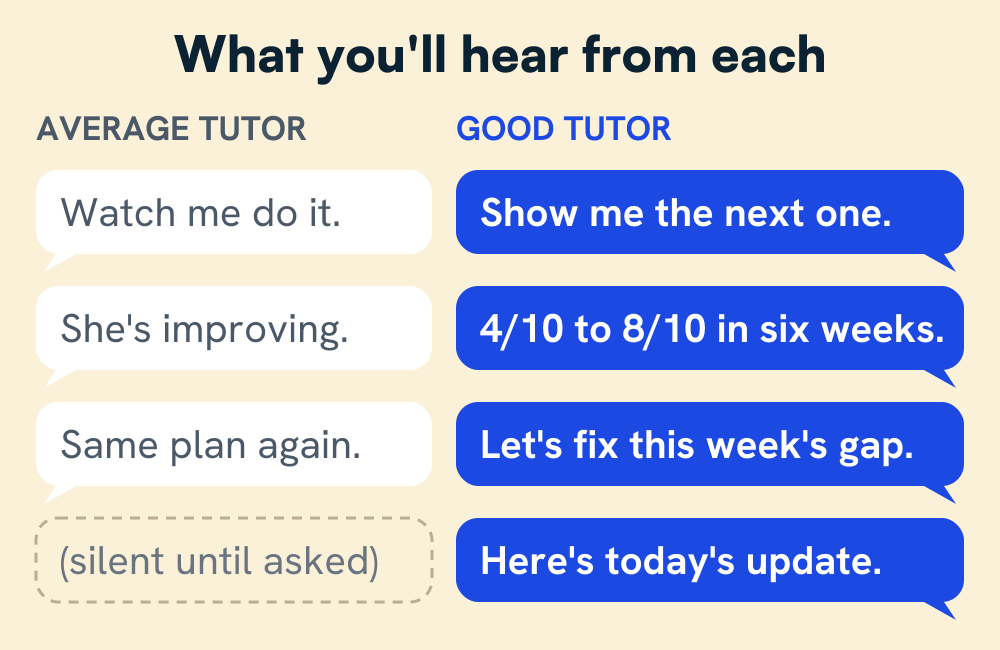
- Asking versus telling. A great tutor asks your child to explain the next step. An average tutor demonstrates it and moves on.
- Specific versus vague. A great tutor says "she's gone from 4/10 to 8/10 on long division word problems over six weeks". An average tutor says "she's improving".
- Personalised versus templated. A great tutor adapts the lesson to the gap your child has this week. An average tutor follows the same lesson structure regardless.
- Proactive versus reactive. A great tutor flags concerns and sends updates unprompted. An average tutor responds when you ask.
The difference compounds. Six months with a great tutor and six months with an average one, at the same price, produce very different results. That is why Tutero charges the same rate at every level, from Reception to Year 13: from £45 an hour, or from £65 an hour with a qualified teacher. What defines a great tutor doesn't change by year group, so neither does the price. You pay after each lesson, with no contracts, and you can cancel any time.
Related reading
- Where to find a tutor in the UK
- Group vs 1‑to‑1 tutoring: which suits your child?
- How much a maths tutor costs in the UK
What should you do next?
Use the first three lessons as your check. Before lesson one, ask the tutor three things: what they will cover first, how they will know it is working, and how they will keep you updated. By lesson three, look for the signs above: your child explaining answers back, a short update after each lesson, and examples drawn from your child's interests. If most of them are there, keep going. If they are still missing after four to six lessons, raise it with the tutor first, then look elsewhere if nothing changes.
If you are still choosing a tutor, read what other parents say about their child's tutor, then shortlist two or three tutors and use the questions above in a first conversation with each.
You can usually tell within the first three lessons whether your child has a great tutor or just a friendly one. The signs are concrete: the way the tutor explains things, the questions they ask, the rapport with your child, and the clear updates you get after each lesson. This guide gives you eight specific things to watch for, across qualifications, technique, communication, rapport and progress, so you can tell if your tutor is genuinely lifting your child or just keeping them busy for an hour a week.
Quick answer
A good tutor knows the subject well beyond your child's level, explains it in small steps, asks more questions than they answer, stays patient when your child is stuck, and tells you clearly what was covered and what comes next. For GCSE and A level students it also means knowing the exam board's papers. If your tutor does most of this by lesson three, keep them. If not, raise it with the tutor, then switch if nothing changes.
What makes a good tutor?
A good tutor combines four ingredients you can actually observe: subject mastery (they can solve any problem your child throws at them and explain it three different ways), teaching technique (they break a hard concept into small steps, ask the student to explain it back, and use real-world examples), warmth and patience (your child feels safe being wrong in front of them), and clear communication (you know exactly what was covered, what your child struggled with, and what to practise at home). All four matter. A tutor who is brilliant at the subject but cold and confusing won't help, and a tutor who is warm but doesn't really understand Year 9 Chemistry won't help either. Great tutors clear all four bars.
The four ingredients look a little different at each stage. For a Reception or Year 1 child, warmth matters most, and mastery means knowing how early reading and number sense build up. For a Year 8 student, technique carries the load as the content gets more abstract. For a sixth former taking A level Chemistry, mastery of the exact exam board specification, such as AQA or OCR, becomes the deciding factor. A good match for 1‑to‑1 tutoring is the tutor who clears all four bars for your child's stage.
What qualifications should a good tutor have in the UK?
Three things matter, and you can check all of them before the first lesson. First, subject knowledge well beyond your child's level. For primary school, that means a strong grasp of the subject far past Year 6. For KS3 and GCSE, ideally a university degree or strong A level results in a related subject. For A level, a tutor who has either taught the subject before or recently done well in the same A level. Second, exam board know-how: a good GCSE tutor knows how grades 9 to 1 work and which specification your child is sitting, whether that is AQA, Edexcel, OCR or WJEC, and a good 11+ tutor knows the format your child's grammar school uses.
Third, teaching experience, which can come from a classroom or from years of tutoring. Qualified teacher status (QTS) is helpful but not essential. GOV.UK explains that QTS is a legal requirement to teach in many English schools, but academies, free schools and independent schools can employ teachers without it. What you don't need is a PhD. The marker of a good tutor is whether they can teach, not whether they could publish. Many of the best primary and lower secondary tutors are university students who did well at A level and remember exactly how to explain Year 6 fractions because they did it themselves a few years ago. You can read more about how Tutero chooses tutors.
How does a good tutor explain things differently?
A good tutor's teaching technique looks different from a friendly adult helping with homework. Watch for four behaviours during the first three lessons. They break a hard concept into small steps rather than walking your child through the whole problem in one go. They ask the student to explain it back, as in "show me how you'd do the next one without me", instead of nodding when the child says they get it. They use real-world examples: a good maths tutor explains fractions through pizza slices and algebra through phone contract comparisons, and an English tutor explains essay structure through a recipe. They wait. When your child gets stuck, a great tutor counts to ten in their head before jumping in. An average tutor fills the silence and accidentally robs the student of the thinking moment.
Watch the questions your tutor asks. The best ones ask more than they tell.
What do patience and empathy look like in a tutor?
Patience and empathy aren't soft skills. They are concrete behaviours you can spot. A patient tutor doesn't sigh, frown or speed up when the student gets the same thing wrong for the third time. They slow down and try a different angle. They ask how the school week has been at the start of a lesson and adjust the intensity if your child had a tough day. They never shame a wrong answer. The language is "okay, walk me through how you got there" rather than "no, that's wrong". They name what's hard about the topic ("Year 9 trigonometry is genuinely tricky, and most students need a few weeks to get comfortable with sin, cos and tan") so the student doesn't conclude they're the problem.
For primary children, empathy looks like shorter lessons rather than long marathons, a parent nearby for the first few sessions, and a tutor who can tell when a six-year-old is full and switches to a quick game or a different question rather than pushing through. If you are still deciding whether your child needs help at all, our guide to the signs your child needs tutoring is a good place to start. For students preparing for the 11+, GCSEs or A levels, empathy looks like a tutor who acknowledges the pressure of mock exams and breaks the workload into something the student can actually do that week, not a generic "study hard" pep talk.
How should a good tutor communicate with parents?
Parent communication is where average and great tutors separate most clearly. A great tutor sends a short, structured update: what was covered, what your child got right, where the gap still is, and what to practise before the next lesson. It arrives in the same place each time and takes you a minute to read. They flag concerns early: "I'm noticing she's still mixing up area and perimeter, so we'll spend next lesson on that and I'll send a worksheet." They are responsive between lessons when you have a question, but they don't expect you to chase them for an update.
An average tutor leaves it at "the lesson went well" or doesn't message at all between lessons. You're left guessing what your child actually learned and whether they're improving. If you're not getting a clear update three or four lessons in, that's the moment to either ask for one or look for a different tutor.
How do good tutors track student progress?
The signal you're looking for is whether your child's tutor can answer "how is she progressing?" with specifics, not gut feel. Great tutors track progress through work samples kept in a shared folder (so you can compare the first week with the eighth), regular check-ins such as a 15-minute mini-test every four weeks on the topics covered, exam-style marking for students approaching GCSEs, A levels or the 11+, and specific improvement measures ("she's gone from 5/10 on multi-step word problems to 8/10 over six weeks").
The contrast: an average tutor will say "yeah, she's getting there" with no evidence behind it. If you can't trace what was covered, what was tested and how performance has shifted, the tutor is either not tracking or not telling you. Both are fixable conversations, and they are worth having before three months of lessons go by without measurable change.
How does a good tutor build rapport with my child?
Rapport matters for whether tutoring works long term, because a child who likes their tutor keeps showing up and trying, and that is half the gain. The signs to watch in the first three lessons: your child talks about the tutor between lessons ("Sarah said this thing about commas"), they ask to extend the lesson by five minutes to finish a question, and they volunteer information about school instead of waiting to be asked. The tutor, on their side, remembers details like your daughter's netball match or your son's Year 8 residential trip without checking notes, asks about your child's interests in the first week and uses them in examples ("if your football team scored at this rate"), and adjusts their tone for a Year 4 child versus a Year 12 student.
If after three lessons your child still describes the tutor in flat terms, such as "she's fine", and there's no spark of recognition, it's worth either raising it with the tutor directly or looking for a different tutor. Rapport isn't always immediate. It usually shows up by lesson three or four. If it doesn't, the academic gain levels off fast.
A great tutor doesn't just know the answer. They help your child find it themselves.
What's the difference between a good tutor and an average tutor?
Across the eight signs above, four contrasts come up again and again:
- Asking versus telling. A great tutor asks your child to explain the next step. An average tutor demonstrates it and moves on.
- Specific versus vague. A great tutor says "she's gone from 4/10 to 8/10 on long division word problems over six weeks". An average tutor says "she's improving".
- Personalised versus templated. A great tutor adapts the lesson to the gap your child has this week. An average tutor follows the same lesson structure regardless.
- Proactive versus reactive. A great tutor flags concerns and sends updates unprompted. An average tutor responds when you ask.
The difference compounds. Six months with a great tutor and six months with an average one, at the same price, produce very different results. That is why Tutero charges the same rate at every level, from Reception to Year 13: from £45 an hour, or from £65 an hour with a qualified teacher. What defines a great tutor doesn't change by year group, so neither does the price. You pay after each lesson, with no contracts, and you can cancel any time.
Related reading
- Where to find a tutor in the UK
- Group vs 1‑to‑1 tutoring: which suits your child?
- How much a maths tutor costs in the UK
What should you do next?
Use the first three lessons as your check. Before lesson one, ask the tutor three things: what they will cover first, how they will know it is working, and how they will keep you updated. By lesson three, look for the signs above: your child explaining answers back, a short update after each lesson, and examples drawn from your child's interests. If most of them are there, keep going. If they are still missing after four to six lessons, raise it with the tutor first, then look elsewhere if nothing changes.
If you are still choosing a tutor, read what other parents say about their child's tutor, then shortlist two or three tutors and use the questions above in a first conversation with each.


After one lesson, the strongest sign is whether your child wants to go back and can name one thing they learnt. Notice whether the tutor asked your child to explain things back rather than just showing them. You will get a much clearer read by lesson three, when a good tutor has shaped the lessons around your child's specific gap and sent you a short update. If it still feels generic then, raise it with the tutor.
It helps, but it isn't essential. Qualified teacher status (QTS) is a legal requirement to teach in many English schools, yet academies, free schools and independent schools can employ teachers without it, and private tutors don't need it. What matters most is subject knowledge well beyond your child's level and the ability to explain it clearly. If you would prefer a qualified teacher, Tutero offers that option from £65 an hour.
After every lesson, or at least once a week, in the same place and without being asked. A good update takes about a minute to read: what was covered, what went well, where the gap still is and what to practise. If you are three or four lessons in and have had nothing in writing, ask for it.
No. Years of experience matter less than how closely the tutor's experience matches your child's need. A tutor who sat the same A level paper two years ago can suit a Year 13 student better than someone who hasn't looked at the current specification in a decade, and a secondary maths specialist may not be the best fit for a Year 2 child learning to read. Ask for specifics: which year groups, which subjects and which exam boards they have taught.
Switch when subject mastery, teaching technique, warmth and clear communication are still not all there after four to six lessons. Clear signs include no useful updates after a month of asking, a tutor who can't say what has improved, lessons that look the same every week, or a child who is pulling back from lessons. Switching is a normal part of finding the right fit, in Year 2 or in Year 13.
Ask what they will focus on in the first few lessons and how they will know it is working. For GCSE, A level or 11+ students, ask which exam board and specification they know best. Finally, ask how and when they will update you after each lesson.
Hoping to improve confidence & grades?


