Recorded interview
“I used to rate myself a three. Now my confidence is an eight or a nine.”
XuelaStudent

Trusted by 4,200+ families
A 1-to-1 GCSE tutor for each subject, the same one every week. Lessons follow your child's exam board specification, from Year 10 to the exams.
The same 1-to-1 GCSE tutor every week, Years 10 and 11.
Who is the GCSE tutoring for?


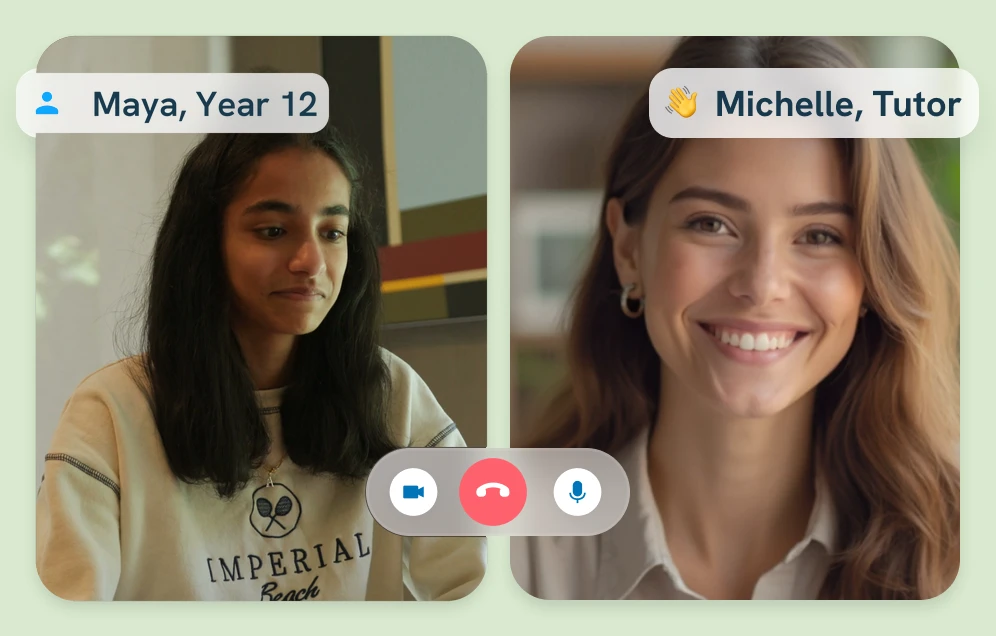
Build a consistent relationship with a carefully selected tutor who suits each student's needs.

Each lesson is tailored to the student’s goals to ensure steady, meaningful progress.

“I did my research and Tutero stood out. Our tutor is amazing. I would recommend Tutero to anyone who is looking for tutoring for their kids.”

“She was struggling, and I was trying to find a tutor. The minute I applied for Tutero, I got a call from Joey. I am so grateful that I did.”

“I was searching on Google and I found Tutero. It was convenient and easy to sign up. The tutoring has perfectly fit what we were after.”

Our education team handpicks the perfect tutor for each student based on their needs.

Every family is supported by a dedicated account manager from day one.

Students get access to thousands of engaging resources for every stage of learning.

Track progress with detailed lesson reports available anytime via our app.
Our education team handpicks the perfect tutor for each student based on their needs.
Every family is supported by a dedicated account manager from day one.
Students get access to thousands of engaging resources for every stage of learning.
Track progress with detailed lesson reports available anytime via our app.
4.9 stars from 250+ Google reviews.
“I used to rate myself a three. Now my confidence is an eight or a nine.”
XuelaStudent
“Tutero has really helped me lift up my grades significantly. My tutor has also helped me pinpoint what I need to work on most and how I can improve.”
“I highly recommend Tutero. It was very easy to find a tutor and the coaching and the materials are amazing. Thanks to Nathan and Naz for the guidance.”
Four ways to get help with GCSE tutoring, side by side.
| Tutero | Tutoring centre | Tutor marketplace | Help at school | |
|---|---|---|---|---|
| One tutor per student | Always | Small groups | You vet | Shared |
| Their own curriculum | Every lesson | Sometimes | Depends | Yes |
| Written report | Every lesson | Rarely | Rarely | Rarely |
| Commitment | None | By the term | Varies | School year |
GCSE tutoringFrom £45 an hour, the same rate at every level. No contracts, no sign-up fee. Pay after each lesson.
Get my quoteFrom £45 an hour, the same rate in Year 10 and Year 11. A qualified teacher is from £65 an hour. There are no contracts and no sign-up fee, and you pay after each lesson. All prices are in GBP.
Every GCSE subject, with one tutor per subject. Common choices are Maths, English Language and Literature, biology, chemistry, physics, Combined Science, history, geography and languages. Lessons follow your child’s exam board specification.
Yes. GCSE tutors know the AQA, Pearson Edexcel, OCR and WJEC Eduqas specifications, papers and mark schemes, and plan lessons around the board your child sits. They are selected from the top 2% of applicants.
Yes. Tutors help your child prepare for mocks, then go through the papers afterwards and turn every lost mark into a revision plan for the summer exams.
Yes. Lessons cover revision plans, past papers, exam technique and timing, including non-calculator Maths practice. Tutors help students find weak areas early and work on them before the exams.
Tell us about your child and an account manager calls within 24 hours to learn their goals and choose their tutor. Lessons then start 1-to-1, with the same tutor each week and a report after every lesson.
How GCSEs are graded, the dates that matter, the exam boards and planning the final months.
GCSEs in England are regulated by Ofqual and set by exam boards. Most subjects are linear, which means they are assessed by exams at the end of Year 11 rather than by coursework along the way. Each subject is graded 9 to 1, with 9 the highest.
A 4 is a standard pass and a 5 a strong pass. Sixth forms and colleges often ask for grades 4 or above in English and Maths, and higher grades in the subjects a student wants to take at A level.
The school year in England runs from September to July in three terms, each with a half term. Each school sets its own mock dates and coursework deadlines, so ask for them early in Year 11. Exam boards publish the summer timetable.
Each school chooses a board for each subject. The DfE sets the core content, so the boards cover the same ground, but papers, question styles and set texts differ. Ask which board and specification your child sits in every subject, and practise with that board’s past papers.
Year 10 is the calmest time to fix gaps, before mocks and revision crowd the calendar. Weekly lessons work best when they follow class topics: secure this week’s work, then go back to one weak spot. Starting in Year 11 still helps, but more time goes on exam technique than on rebuilding foundations.
After mocks, the focus shifts to past papers, sat under timed conditions and marked against the board’s mark schemes. Examiners’ reports show where students commonly lose marks, which makes them a useful guide to what to practise next.
Your child keeps the same tutor every week, and lessons start from their own school work and exam board. Lessons are 1-to-1, with one tutor per subject, and you receive a written report after every lesson, so you always know what was covered and what comes next.
What GCSE students work on at each stage, and how a tutor helps.
Students finish Key Stage 3 and choose their GCSE options. English, Maths and science are studied by almost everyone.
The writer presents Scrooge as cold at first, so that his change at the end feels earned rather than sudden.
Tries real GCSE questions with your child, so option choices are made on evidence.
Based on the DfE National Curriculum in England: Key Stage 3 programmes of study.
GCSE courses begin. Most subjects are assessed by exams at the end of Year 11, so Year 10 is where the content is built.
Factorise and solve x2 − 5x + 6 = 0.
Answerx = 2 or x = 3
Builds the algebra and writing skills that Year 11 papers assume.
Based on the DfE GCSE mathematics subject content.
The final GCSE year. Students finish the content, sit mock exams and move to full past papers.
The writer shortens the sentences as the footsteps get closer, so the reader's pace quickens with the character's fear.
Keeps each subject on track week by week, so mocks and revision never pile up.
Based on the DfE GCSE English language subject content.
Schools set their own mocks, often in the winter of Year 11. Mock results guide revision and many schools use them for predicted grades.
Increase £80 by 15%.
Answer£92
Goes through every mock paper, then turns the lost marks into a revision plan.
Based on the AQA, Pearson Edexcel and OCR GCSE specifications.
Written exams run from May into June. GCSE Maths has three papers, and one of them is sat without a calculator.
Solve the simultaneous equations 2x + y = 11 and x − y = 1.
Answerx = 4, y = 3
Runs past papers under timed conditions and checks answers against the mark scheme.
Based on the Ofqual GCSE qualification and subject level conditions.
GCSEs are graded 9 to 1, with 9 the highest. A 4 is a standard pass and a 5 a strong pass. Results come out in August.
Find the nth term of 5, 8, 11, 14, ...
Answer3n + 2
Helps your child see which subjects need the most time to reach the grades they want.
Based on the Ofqual GCSE 9 to 1 grading; DfE school and college performance measures.
Who is the tutoring for?