


Your child sits down to homework, reads one line, and is up again for a drink, a snack or the cat. It is one of the most common worries parents raise, and it usually has a fixable cause. This guide covers what focus looks like at each age, why it slips, a six-step routine you can run at home, and when it is worth talking to your GP.
Quick answer
A child's attention span can be trained, but it grows with practice and rest, not willpower. The plan that works is short focused sessions sized to your child's age, real movement breaks in between, no screens for an hour before bed, and one fixed time of day for the hardest task. If focus is still well behind other children their age across every part of life, talk to the school SENCO or your GP.
What is a normal attention span by age?
Attention grows steadily as children get older, and knowing roughly what to expect stops a lot of unnecessary worry. There is no official UK chart of attention span by age, and the NHS does not publish one, so treat the guide below as rough guidance rather than a test. The NHS does say that many children are easily distracted, impulsive and full of energy, particularly under the age of 5, and that this alone does not mean ADHD.
| Age and year | What usually works at home |
|---|---|
| Reception (age 4 to 5) | One picture book, one drawing or one puzzle, then a change of activity. |
| Year 1 to 3 (age 5 to 8) | Two short tasks with a movement break between them, not one long sit. |
| Year 4 to 6 (age 8 to 11) | One short homework block with a timer, then a proper break. |
| Year 7 to 9 (age 11 to 14) | Short timed blocks with a break between, and the phone out of the room. |
| Year 10 to 11 (GCSE years) | Two timed revision blocks with a real break in the middle. |
| Year 12 to 13 (sixth form) | Longer independent study, still broken up by short breaks. |
A child who drifts off a dull worksheet is not the same as a child who drifts off everything. Watch how long they stay with a hobby they love. That is their interested attention span, and it shows you what is possible when the task is the right size.
Can attention span actually be trained?
Yes. Attention behaves more like a skill than a fixed trait. It gets stronger with regular practice and weaker when it is never stretched. Each time a child finishes a short focused block without switching to something else, they are practising the exact habit you want to grow.
Small, repeated wins work better than one long session. Three short focused blocks a day, with no bargaining and no extra screen time as a reward, will do more than one heroic hour at the weekend. Start at a length your child can already manage, then add a couple of minutes each week as it gets easier. Building study skills like this early makes the jump to secondary school much smoother.
Why does my child have such a short attention span?
Short attention rarely has one cause. The most common mix is too little sleep, too much fast-paced screen content, and homework blocks that are too long for the child's age. Change those three and the picture often shifts quickly. Less common causes include a task that is too easy (boredom), a task that is too hard (the child shuts down), tiredness, anxiety or stress, and a learning difference such as dyslexia or ADHD that makes sustained focus genuinely harder.
Before you assume a medical issue, change the inputs for two weeks. Protect sleep, keep screens out of the hour before bed, and split homework into short blocks. If focus is still well behind after that, a chat with the class teacher or your GP is the right next step.
How do I improve my child's attention span at home?
A six-step routine, held for a few weeks, is what usually moves the dial. Each step is small on its own. The gain comes from doing all six together.
1. Pick one fixed time of day for the hardest task. Choose a slot when your child is fresh, often after a snack and before tiredness sets in. Run maths, reading or whatever is hardest in that slot, not after dinner and not on the way out of the door.
2. Use a timer set to a length they can manage. A kitchen timer beats a phone every time, because the phone is a distraction in itself. Start short and add a couple of minutes each week as your child builds up.
3. Make the break a real break. Movement, water and fresh air. Not YouTube, Roblox or TikTok. A screen break makes the next focused block harder, not easier.
4. Clear the desk. One book, one pencil case and one workbook. Phones in another room. Notifications off on the laptop if they need one for homework.
5. Set clear rules for recreational screen time. Agree the rules as a family, especially around homework and bedtime, and apply them the same way every day.
6. End with a two-minute reflection. Ask three questions: what worked, what didn't, and what is the plan for tomorrow. Pen and paper is better than a notes app.
For younger children, the same routine fits neatly around a daily reading slot and some number work, which is where focus is easiest to practise.
What's the link between screen time and attention span?
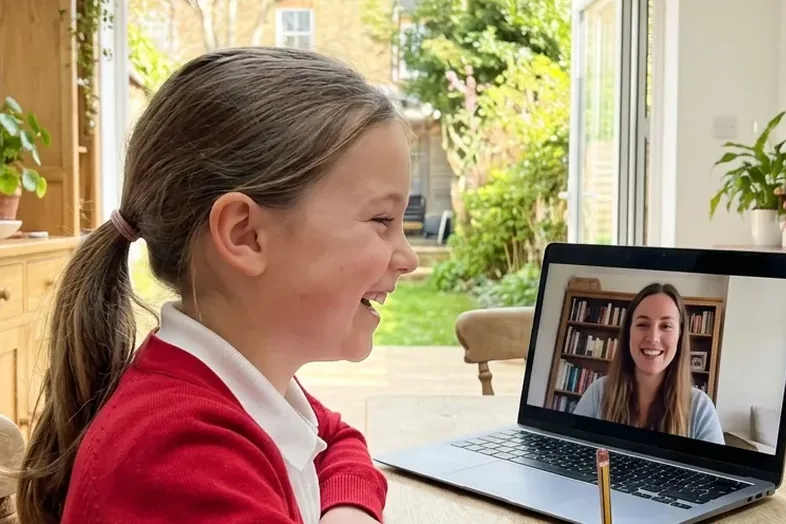
The link is real, but the kind of screen time matters as much as the total minutes. The Royal College of Paediatrics and Child Health (RCPCH) says in its fact sheet for parents that there are no ‘safe’ amounts of screen time, and that the right amount varies from family to family. Instead of a fixed limit, it suggests four questions: is screen time in your household controlled, does screen use get in the way of what your family wants to do, does it interfere with sleep, and can you control snacking during screen time?
Protect sleep first. The RCPCH recommends avoiding screens for an hour before planned sleep time. A practical rule that suits most families: no short-form video on school nights, no screens in the bedroom in the hour before bed, and homework time is screen-free unless the work genuinely needs the device.
When should I worry about my child's attention span?
Talk to someone when three things are true at once: focus is well behind other children their age in every setting (not just homework), it has lasted for months rather than weeks, and it is affecting friendships, sleep or confidence as well as schoolwork. One of those alone is usually a routine problem. All three together is a good reason to get a professional view.
Start with the class teacher. The NHS says the teacher will usually refer a child to the school's special educational needs co-ordinator (SENCO). If you are still worried, or think your child needs more support, book an appointment with your GP. Don't wait for the end-of-year report. The teacher sees your child in one setting and you see them in another, so a short conversation with each gives you a much fuller picture.
What's the difference between a short attention span and ADHD?
A short attention span is part of normal development. Most children sit somewhere on the range, and most can improve with the right routine. ADHD is a medical condition that is diagnosed by specialists, such as a paediatrician or a child and adolescent psychiatrist. The NHS guide to ADHD in children lists signs such as being easily distracted and finding it hard to listen or follow instructions, and says symptoms usually start before the age of 12.
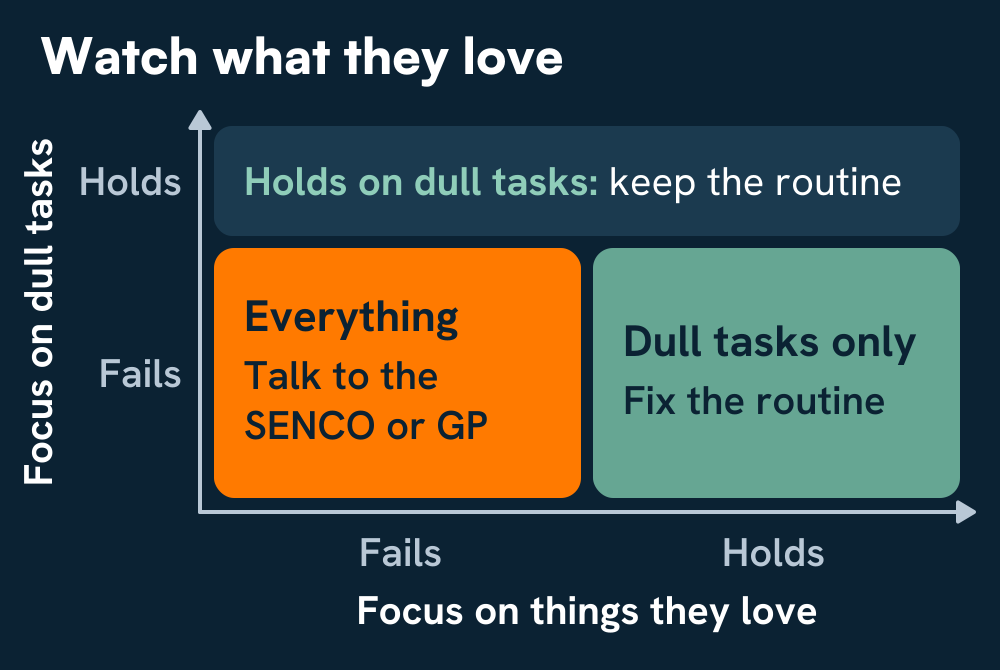
A useful home signal is the gap between interested and uninterested attention. A child who can build Lego for an hour but can't read for five minutes is usually choosing where to focus. A child who can't hold attention on anything, including the things they love, is showing a pattern worth raising with your GP or the SENCO. If your child already has a diagnosis, our guide to tutoring strategies for ADHD and our page on ADHD tutoring explain what 1‑to‑1 support can look like.
How can a tutor help build my child's attention span?
A good tutor helps focus in three ways. There is nowhere to hide, because it is just two people in the lesson and attention is visible. The work is pitched at your child's actual level, so they are neither bored nor overwhelmed. And the tutor runs the same focused work cycle lesson after lesson, so your child practises the habit until it becomes their own.
Tutero's 1‑to‑1 tutoring is from £45 an hour, or from £65 an hour with a qualified teacher. The rate is the same at every level, from Reception to Year 13. You pay after each lesson, with no contracts, and you can cancel any time. Lessons are planned around your child, from primary tutoring to GCSE tutoring. You can see how our pricing works before you speak to anyone.
Related reading
- 5 signs your child needs tutoring: when extra support at home is not enough.
- 12 books for primary school children: ideas for the daily reading slot.
- Maths anxiety in children
What should you do next?
Attention span is trainable, and most of the early gain comes from fixing the inputs, not from telling your child to try harder. Protect sleep, keep screens out of the hour before bed, size each session to your child's age and pick one fixed time for the hardest task. Hold the six-step routine for a few weeks. If focus is still well behind after that, speak to the class teacher, the SENCO or your GP, and consider a 1‑to‑1 tutor to keep schoolwork moving while you find out more.
Your child sits down to homework, reads one line, and is up again for a drink, a snack or the cat. It is one of the most common worries parents raise, and it usually has a fixable cause. This guide covers what focus looks like at each age, why it slips, a six-step routine you can run at home, and when it is worth talking to your GP.
Quick answer
A child's attention span can be trained, but it grows with practice and rest, not willpower. The plan that works is short focused sessions sized to your child's age, real movement breaks in between, no screens for an hour before bed, and one fixed time of day for the hardest task. If focus is still well behind other children their age across every part of life, talk to the school SENCO or your GP.
What is a normal attention span by age?
Attention grows steadily as children get older, and knowing roughly what to expect stops a lot of unnecessary worry. There is no official UK chart of attention span by age, and the NHS does not publish one, so treat the guide below as rough guidance rather than a test. The NHS does say that many children are easily distracted, impulsive and full of energy, particularly under the age of 5, and that this alone does not mean ADHD.
| Age and year | What usually works at home |
|---|---|
| Reception (age 4 to 5) | One picture book, one drawing or one puzzle, then a change of activity. |
| Year 1 to 3 (age 5 to 8) | Two short tasks with a movement break between them, not one long sit. |
| Year 4 to 6 (age 8 to 11) | One short homework block with a timer, then a proper break. |
| Year 7 to 9 (age 11 to 14) | Short timed blocks with a break between, and the phone out of the room. |
| Year 10 to 11 (GCSE years) | Two timed revision blocks with a real break in the middle. |
| Year 12 to 13 (sixth form) | Longer independent study, still broken up by short breaks. |
A child who drifts off a dull worksheet is not the same as a child who drifts off everything. Watch how long they stay with a hobby they love. That is their interested attention span, and it shows you what is possible when the task is the right size.
Can attention span actually be trained?
Yes. Attention behaves more like a skill than a fixed trait. It gets stronger with regular practice and weaker when it is never stretched. Each time a child finishes a short focused block without switching to something else, they are practising the exact habit you want to grow.
Small, repeated wins work better than one long session. Three short focused blocks a day, with no bargaining and no extra screen time as a reward, will do more than one heroic hour at the weekend. Start at a length your child can already manage, then add a couple of minutes each week as it gets easier. Building study skills like this early makes the jump to secondary school much smoother.
Why does my child have such a short attention span?
Short attention rarely has one cause. The most common mix is too little sleep, too much fast-paced screen content, and homework blocks that are too long for the child's age. Change those three and the picture often shifts quickly. Less common causes include a task that is too easy (boredom), a task that is too hard (the child shuts down), tiredness, anxiety or stress, and a learning difference such as dyslexia or ADHD that makes sustained focus genuinely harder.
Before you assume a medical issue, change the inputs for two weeks. Protect sleep, keep screens out of the hour before bed, and split homework into short blocks. If focus is still well behind after that, a chat with the class teacher or your GP is the right next step.
How do I improve my child's attention span at home?
A six-step routine, held for a few weeks, is what usually moves the dial. Each step is small on its own. The gain comes from doing all six together.
1. Pick one fixed time of day for the hardest task. Choose a slot when your child is fresh, often after a snack and before tiredness sets in. Run maths, reading or whatever is hardest in that slot, not after dinner and not on the way out of the door.
2. Use a timer set to a length they can manage. A kitchen timer beats a phone every time, because the phone is a distraction in itself. Start short and add a couple of minutes each week as your child builds up.
3. Make the break a real break. Movement, water and fresh air. Not YouTube, Roblox or TikTok. A screen break makes the next focused block harder, not easier.
4. Clear the desk. One book, one pencil case and one workbook. Phones in another room. Notifications off on the laptop if they need one for homework.
5. Set clear rules for recreational screen time. Agree the rules as a family, especially around homework and bedtime, and apply them the same way every day.
6. End with a two-minute reflection. Ask three questions: what worked, what didn't, and what is the plan for tomorrow. Pen and paper is better than a notes app.
For younger children, the same routine fits neatly around a daily reading slot and some number work, which is where focus is easiest to practise.
What's the link between screen time and attention span?
The link is real, but the kind of screen time matters as much as the total minutes. The Royal College of Paediatrics and Child Health (RCPCH) says in its fact sheet for parents that there are no ‘safe’ amounts of screen time, and that the right amount varies from family to family. Instead of a fixed limit, it suggests four questions: is screen time in your household controlled, does screen use get in the way of what your family wants to do, does it interfere with sleep, and can you control snacking during screen time?
Protect sleep first. The RCPCH recommends avoiding screens for an hour before planned sleep time. A practical rule that suits most families: no short-form video on school nights, no screens in the bedroom in the hour before bed, and homework time is screen-free unless the work genuinely needs the device.
When should I worry about my child's attention span?
Talk to someone when three things are true at once: focus is well behind other children their age in every setting (not just homework), it has lasted for months rather than weeks, and it is affecting friendships, sleep or confidence as well as schoolwork. One of those alone is usually a routine problem. All three together is a good reason to get a professional view.
Start with the class teacher. The NHS says the teacher will usually refer a child to the school's special educational needs co-ordinator (SENCO). If you are still worried, or think your child needs more support, book an appointment with your GP. Don't wait for the end-of-year report. The teacher sees your child in one setting and you see them in another, so a short conversation with each gives you a much fuller picture.
What's the difference between a short attention span and ADHD?
A short attention span is part of normal development. Most children sit somewhere on the range, and most can improve with the right routine. ADHD is a medical condition that is diagnosed by specialists, such as a paediatrician or a child and adolescent psychiatrist. The NHS guide to ADHD in children lists signs such as being easily distracted and finding it hard to listen or follow instructions, and says symptoms usually start before the age of 12.
A useful home signal is the gap between interested and uninterested attention. A child who can build Lego for an hour but can't read for five minutes is usually choosing where to focus. A child who can't hold attention on anything, including the things they love, is showing a pattern worth raising with your GP or the SENCO. If your child already has a diagnosis, our guide to tutoring strategies for ADHD and our page on ADHD tutoring explain what 1‑to‑1 support can look like.
How can a tutor help build my child's attention span?
A good tutor helps focus in three ways. There is nowhere to hide, because it is just two people in the lesson and attention is visible. The work is pitched at your child's actual level, so they are neither bored nor overwhelmed. And the tutor runs the same focused work cycle lesson after lesson, so your child practises the habit until it becomes their own.
Tutero's 1‑to‑1 tutoring is from £45 an hour, or from £65 an hour with a qualified teacher. The rate is the same at every level, from Reception to Year 13. You pay after each lesson, with no contracts, and you can cancel any time. Lessons are planned around your child, from primary tutoring to GCSE tutoring. You can see how our pricing works before you speak to anyone.
Related reading
- 5 signs your child needs tutoring: when extra support at home is not enough.
- 12 books for primary school children: ideas for the daily reading slot.
- Maths anxiety in children
What should you do next?
Attention span is trainable, and most of the early gain comes from fixing the inputs, not from telling your child to try harder. Protect sleep, keep screens out of the hour before bed, size each session to your child's age and pick one fixed time for the hardest task. Hold the six-step routine for a few weeks. If focus is still well behind after that, speak to the class teacher, the SENCO or your GP, and consider a 1‑to‑1 tutor to keep schoolwork moving while you find out more.


A 7-year-old in Year 2 or Year 3 can usually manage a short focused task when it is at the right level, and much less when it is dull or too hard. There is no official UK figure, so judge by your own child. Two short tasks with a movement break in between work better than one long sit at this age.
A 9-year-old in Year 4 or Year 5 can usually sit with one short homework block before needing a proper break. This is a good age to start using a kitchen timer for homework. It builds a useful habit before the work steps up in Year 6 and secondary school.
A 12-year-old in Year 7 or Year 8 can usually manage short timed study blocks with a break between them. Most can do several of these in an afternoon if the phone is out of the room. If your child struggles to settle on anything at all, including things they enjoy, speak to the class teacher or your GP.
A 15-year-old in Year 10 or Year 11 can usually manage two timed revision blocks back to back with a real break in the middle. That pattern becomes the building block of independent revision for GCSEs and mock exams. Keeping the phone in another room makes the biggest single difference.
It can help some children settle more quickly. A few minutes of slow, counted breathing before a focused block is simple to try and costs nothing. It works best as part of a routine, alongside good sleep and short sessions, rather than as a fix on its own.
For many children it helps a lot. An NHS sleep guide for school-age children gives around 10 to 11 hours for ages 5 to 9, around 9 hours for ages 10 to 14, and around 8 and a half hours for ages 15 to 17. Fix sleep for two weeks before changing anything else, and talk to your GP if focus is still a worry after that.
Hoping to improve confidence & grades?


