.svg)

Updated May 6, 2026 — fresh attention-span benchmarks by age, an evidence-based plan to grow focus over weeks not minutes, and the screen-time line every parent quietly wants to know.
Quick answer. A child's attention span can be trained — but it grows with practice and rest, not with willpower. The cleanest plan is short focused sessions (5 minutes for a 5-year-old, around 25 minutes for a teen), real movement breaks in between, screen time capped to AAP guidance, and one fixed time of day for the hardest task. Most families see a real change in 4 to 6 weeks if they hold the structure.
What is a normal attention span by age?
Children's attention spans grow predictably with age, and knowing the benchmark stops a lot of unnecessary worry. The widely used clinical rule of thumb is roughly two to five minutes of focused attention per year of age, with the upper end reached when the task is interesting and the lower end when it isn't. The American Academy of Child and Adolescent Psychiatry (AACAP) treats this band as developmentally normal. Use the table below as a planning tool, not a verdict.
| Age | Typical focused attention | What that looks like at home |
|---|---|---|
| 4–5 (kindergarten) | 8–15 minutes | One picture book, one drawing, one puzzle — then they're done. |
| 6–8 (Grades 1–3) | 12–24 minutes | Two short focused tasks plus a movement break is more realistic than one long block. |
| 9 (Grade 4) | 18–27 minutes | A 20-minute homework slot lands well; longer than 30 starts to fray. |
| 12 (Grade 7) | 24–36 minutes | A 25-minute Pomodoro plus 5-minute break is the right shape. |
| 15 (Grade 10) | 30–45 minutes | Two back-to-back 25-minute blocks with a real break is sustainable. |
A child below the band on a boring task is not a child below the band on a topic they love. Watch how long they sit with their favorite hobby — that's their interested attention span, and it tells you what's possible when the task is right-sized.
Can attention span actually be trained?
Yes. Attention is closer to a muscle than a fixed trait — it strengthens with deliberate practice and weakens with avoidance. The mechanism is well established: each time a child finishes a focused block without giving in to the urge to switch tasks, they're literally rehearsing the brain's executive-function circuits. The Education Endowment Foundation's review of metacognition and self-regulation rates this kind of practice as one of the highest-impact, lowest-cost interventions in education.
What this means in practice: a child who currently fades after 8 minutes can usually hold 15 within four weeks if they do three short focused sessions a day, with no bargaining and no bonus screen time as a reward. The target is small repeated wins, not heroic single sessions. Stanford's Carol Dweck calls this the growth-mindset loop — effort plus the right strategy plus feedback, repeated, builds the underlying skill.
Why does my child have such a short attention span?
Short attention is rarely one cause. The most common combination Tutero tutors see is a sleep deficit, plus too much fast-cut screen content, plus a homework setup that's too long for the child's age. Strip those three back and the picture changes fast. Less common but still important: under-stimulation (the task is too easy and the child is bored), over-stimulation (the task is too hard and the child shuts down), and an undiagnosed learning difference like dyslexia or ADHD that makes sustained focus genuinely harder.
Before you assume a clinical issue, change the inputs for two weeks: 9–11 hours of sleep depending on age, no phone or tablet within 30 minutes of bedtime, and homework split into age-appropriate blocks. If attention is still well below benchmark after that, a chat with the pediatrician or school counselor is the right next step — see our note on whether your child is falling behind at school for what to look for.
How do I improve my child's attention span at home?
A six-step routine, run for four to six weeks, is what consistently moves the dial. Each step is small on its own; the gain comes from holding all six at once.
1. Pick one fixed time of day for the hardest task. The brain's prefrontal cortex is at its sharpest in the late morning for elementary kids and the late afternoon for teens. Run math, reading, or whatever's hardest in that slot — not after dinner, not on the way out the door.
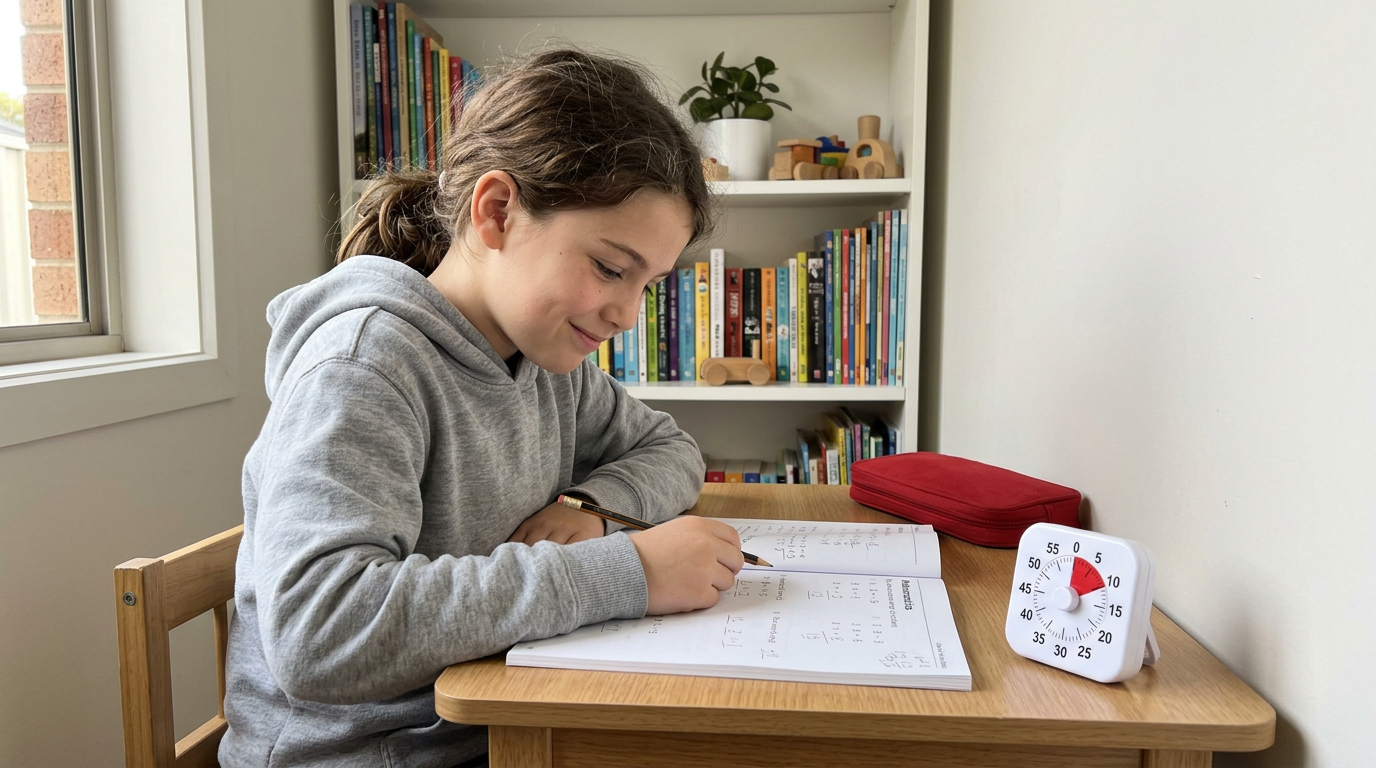
2. Use a Pomodoro timer set to age-appropriate length. A real countdown timer beats a phone every time — the phone itself is a distraction. Start at the lower end of the table above and add 2–3 minutes per week as the child builds.
3. Make the break a real break. Movement, water, fresh air. Not YouTube, not Roblox, not TikTok. A 5-minute screen break trains the brain to expect dopamine on every break, which makes the next focused session harder, not easier.
4. Clear the desk. One book, one pencil case, one workbook. Phones in another room. Notifications off on the laptop if they're using one. The Princeton Neuroscience Institute's visual-attention work shows that visible clutter directly competes for cognitive bandwidth.
5. Cap recreational screen time. The AAP's media-use framework recommends consistent limits, especially around homework and bedtime. Most families that see attention gains have moved fast-cut content (short-form video, fast-cut games) to weekends only.
6. End with a 2-minute reflection. "What worked, what didn't, what's the plan for tomorrow." Reflection is the EEF's metacognition lever — it doubles the retention rate of the focused work just done.
What's the link between screen time and attention span?
The link is real, but it's about the kind of screen time more than the total minutes. Three patterns matter: short-form video (TikTok, Reels, YouTube Shorts) trains the brain to expect a new dopamine hit every 8–15 seconds, fast-cut games do the same on a longer cycle, and background TV during homework cuts on-task time roughly in half. The American Academy of Pediatrics' updated framework recommends co-developing a Family Media Plan rather than a blanket time cap, because the type of content matters more than the clock.
A practical rule that works for most families: no short-form video on school nights, no screens in the bedroom after 8pm, and homework time is screen-free unless the homework genuinely needs the device. Two weeks of that is usually enough to see a noticeable change in how long a child can sit with a hard task.
When should I worry about my child's attention span?
Worry — and book a chat with your pediatrician or the school counselor — when three things are true at once: attention is well below the age benchmark across all contexts (not just homework), the gap has lasted more than six months, and it's affecting friendships, sleep, or self-esteem on top of schoolwork. One of those alone is usually a setup problem, not a clinical one. All three together is a reasonable trigger for a professional opinion.
Don't wait for a school report card to take action. Teachers see the child for six hours a day in one context; a 30-minute conversation with a pediatrician plus a 30-minute conversation with the classroom teacher gives you a much fuller picture in two weeks.
What's the difference between a short attention span and ADHD?
A short attention span is a developmental band — most children sit somewhere on it, and most can move up the band with the right inputs. ADHD is a clinical diagnosis with a specific pattern: persistent inattention plus hyperactivity-impulsivity (or one without the other) that shows up across multiple settings, started before age 12, and is meaningfully impairing day-to-day life. The DSM-5 criteria require six or more symptoms in either category for a child diagnosis.
The cleanest signal that something is more than developmental is the gap between interested and uninterested attention. A child who can play Lego for 90 minutes but can't read for 4 has a focus selection issue, not an attention deficit. A child who can't hold attention on anything — including the things they love — for more than a few minutes is the pattern that's worth a clinical conversation. Our guide on tutoring for students with ADHD walks through what one-on-one support looks like once a diagnosis is in place.
How can a tutor help build my child's attention span?
A good 1-on-1 tutor is a focus accelerator for three reasons: there's nowhere to hide (it's just two people on the call, attention is visible), the work is right-sized to the child's actual level so they're neither bored nor overwhelmed, and the tutor models the focused work cycle session after session. The child borrows the discipline until it becomes their own — usually in 6 to 10 sessions.
Tutero matches every student with a vetted 1-on-1 tutor for a flat US$45 per hour, no contracts, no lock-in. Most families start with a 30-minute session for younger elementary kids and a 60-minute session from upper elementary onwards — short enough to fit comfortably inside the child's current attention span and long enough to genuinely move the work forward. See how online tutoring with Tutero works or read the 5 signs your child might benefit from a tutor.
Frequently asked questions
How long should a 7-year-old be able to concentrate?
A typical Grade 2 child holds 14–21 minutes of focused attention on a task that's at the right level. If the task is dull or too hard, that drops to 5–10 minutes. Two short blocks with a movement break works better than one long block at this age.
How long should a 9-year-old be able to concentrate?
A Grade 4 child sits comfortably with 18–27 minutes of focused work. This is the age where a 20-minute homework Pomodoro starts to feel natural — a useful habit to build before the workload jumps in upper elementary.
How long should a 12-year-old be able to concentrate?
A Grade 7 child can hold 24–36 minutes of focused work. The classic 25-minute Pomodoro plus 5-minute movement break is the right size — most students can sustain three of those in a single afternoon study session.
How long should a 15-year-old be able to concentrate?
A Grade 10 student can sustain 30–45 minutes of focused work, and many can do two back-to-back 25-minute Pomodoros with a real break. For high-school subjects like AP courses or the SAT, this becomes the building block of independent revision.
Does meditation or mindfulness actually help?
Yes, modestly. Five to ten minutes of guided breathing or a body scan before a focused work block helps most children settle quicker into the task. The effect size is small per session but compounds over weeks. Apps like Smiling Mind (free, school-friendly) or a simple counted-breathing exercise both work.
Will more sleep fix a short attention span on its own?
For many children, partly yes. School-age children need 9–11 hours; teens need 8–10. A child sleeping an hour less than they need will look like they have an attention problem when they actually have a sleep problem. Fix the sleep for two weeks before changing anything else, and reassess.
Related reading
- How can I help my child focus and pay attention — the parent-side companion piece
- Effective strategies to boost focus during study sessions — what to do during a single study session, this article's session-level partner
- Master time management — expert tips for students
- Effective strategies to improve your math study skills
- Common learning disabilities — the umbrella special-education guide
The bottom line
Attention span is trainable, and most of the gain in the first month comes from fixing the inputs — sleep, screens, session length, time of day — not from telling the child to "try harder." Hold the six-step routine for four to six weeks and the change is usually obvious to everyone in the house. If you've held the routine and the gap to the age benchmark is still wide, that's the moment to bring in a pediatrician, a school counselor, or a 1-on-1 tutor — not before.
Ready to give your child a focused, right-sized weekly session with a real tutor? Get matched with a Tutero tutor — vetted, US$45 per hour, no contracts.
Attention is closer to a muscle than a fixed trait — it strengthens with deliberate practice and weakens with avoidance.
Attention is closer to a muscle than a fixed trait — it strengthens with deliberate practice and weakens with avoidance.
Updated May 6, 2026 — fresh attention-span benchmarks by age, an evidence-based plan to grow focus over weeks not minutes, and the screen-time line every parent quietly wants to know.
Quick answer. A child's attention span can be trained — but it grows with practice and rest, not with willpower. The cleanest plan is short focused sessions (5 minutes for a 5-year-old, around 25 minutes for a teen), real movement breaks in between, screen time capped to AAP guidance, and one fixed time of day for the hardest task. Most families see a real change in 4 to 6 weeks if they hold the structure.
What is a normal attention span by age?
Children's attention spans grow predictably with age, and knowing the benchmark stops a lot of unnecessary worry. The widely used clinical rule of thumb is roughly two to five minutes of focused attention per year of age, with the upper end reached when the task is interesting and the lower end when it isn't. The American Academy of Child and Adolescent Psychiatry (AACAP) treats this band as developmentally normal. Use the table below as a planning tool, not a verdict.
| Age | Typical focused attention | What that looks like at home |
|---|---|---|
| 4–5 (kindergarten) | 8–15 minutes | One picture book, one drawing, one puzzle — then they're done. |
| 6–8 (Grades 1–3) | 12–24 minutes | Two short focused tasks plus a movement break is more realistic than one long block. |
| 9 (Grade 4) | 18–27 minutes | A 20-minute homework slot lands well; longer than 30 starts to fray. |
| 12 (Grade 7) | 24–36 minutes | A 25-minute Pomodoro plus 5-minute break is the right shape. |
| 15 (Grade 10) | 30–45 minutes | Two back-to-back 25-minute blocks with a real break is sustainable. |
A child below the band on a boring task is not a child below the band on a topic they love. Watch how long they sit with their favorite hobby — that's their interested attention span, and it tells you what's possible when the task is right-sized.
Can attention span actually be trained?
Yes. Attention is closer to a muscle than a fixed trait — it strengthens with deliberate practice and weakens with avoidance. The mechanism is well established: each time a child finishes a focused block without giving in to the urge to switch tasks, they're literally rehearsing the brain's executive-function circuits. The Education Endowment Foundation's review of metacognition and self-regulation rates this kind of practice as one of the highest-impact, lowest-cost interventions in education.
What this means in practice: a child who currently fades after 8 minutes can usually hold 15 within four weeks if they do three short focused sessions a day, with no bargaining and no bonus screen time as a reward. The target is small repeated wins, not heroic single sessions. Stanford's Carol Dweck calls this the growth-mindset loop — effort plus the right strategy plus feedback, repeated, builds the underlying skill.
Why does my child have such a short attention span?
Short attention is rarely one cause. The most common combination Tutero tutors see is a sleep deficit, plus too much fast-cut screen content, plus a homework setup that's too long for the child's age. Strip those three back and the picture changes fast. Less common but still important: under-stimulation (the task is too easy and the child is bored), over-stimulation (the task is too hard and the child shuts down), and an undiagnosed learning difference like dyslexia or ADHD that makes sustained focus genuinely harder.
Before you assume a clinical issue, change the inputs for two weeks: 9–11 hours of sleep depending on age, no phone or tablet within 30 minutes of bedtime, and homework split into age-appropriate blocks. If attention is still well below benchmark after that, a chat with the pediatrician or school counselor is the right next step — see our note on whether your child is falling behind at school for what to look for.
How do I improve my child's attention span at home?
A six-step routine, run for four to six weeks, is what consistently moves the dial. Each step is small on its own; the gain comes from holding all six at once.
1. Pick one fixed time of day for the hardest task. The brain's prefrontal cortex is at its sharpest in the late morning for elementary kids and the late afternoon for teens. Run math, reading, or whatever's hardest in that slot — not after dinner, not on the way out the door.
2. Use a Pomodoro timer set to age-appropriate length. A real countdown timer beats a phone every time — the phone itself is a distraction. Start at the lower end of the table above and add 2–3 minutes per week as the child builds.
3. Make the break a real break. Movement, water, fresh air. Not YouTube, not Roblox, not TikTok. A 5-minute screen break trains the brain to expect dopamine on every break, which makes the next focused session harder, not easier.
4. Clear the desk. One book, one pencil case, one workbook. Phones in another room. Notifications off on the laptop if they're using one. The Princeton Neuroscience Institute's visual-attention work shows that visible clutter directly competes for cognitive bandwidth.
5. Cap recreational screen time. The AAP's media-use framework recommends consistent limits, especially around homework and bedtime. Most families that see attention gains have moved fast-cut content (short-form video, fast-cut games) to weekends only.
6. End with a 2-minute reflection. "What worked, what didn't, what's the plan for tomorrow." Reflection is the EEF's metacognition lever — it doubles the retention rate of the focused work just done.
What's the link between screen time and attention span?
The link is real, but it's about the kind of screen time more than the total minutes. Three patterns matter: short-form video (TikTok, Reels, YouTube Shorts) trains the brain to expect a new dopamine hit every 8–15 seconds, fast-cut games do the same on a longer cycle, and background TV during homework cuts on-task time roughly in half. The American Academy of Pediatrics' updated framework recommends co-developing a Family Media Plan rather than a blanket time cap, because the type of content matters more than the clock.
A practical rule that works for most families: no short-form video on school nights, no screens in the bedroom after 8pm, and homework time is screen-free unless the homework genuinely needs the device. Two weeks of that is usually enough to see a noticeable change in how long a child can sit with a hard task.
When should I worry about my child's attention span?
Worry — and book a chat with your pediatrician or the school counselor — when three things are true at once: attention is well below the age benchmark across all contexts (not just homework), the gap has lasted more than six months, and it's affecting friendships, sleep, or self-esteem on top of schoolwork. One of those alone is usually a setup problem, not a clinical one. All three together is a reasonable trigger for a professional opinion.
Don't wait for a school report card to take action. Teachers see the child for six hours a day in one context; a 30-minute conversation with a pediatrician plus a 30-minute conversation with the classroom teacher gives you a much fuller picture in two weeks.
What's the difference between a short attention span and ADHD?
A short attention span is a developmental band — most children sit somewhere on it, and most can move up the band with the right inputs. ADHD is a clinical diagnosis with a specific pattern: persistent inattention plus hyperactivity-impulsivity (or one without the other) that shows up across multiple settings, started before age 12, and is meaningfully impairing day-to-day life. The DSM-5 criteria require six or more symptoms in either category for a child diagnosis.
The cleanest signal that something is more than developmental is the gap between interested and uninterested attention. A child who can play Lego for 90 minutes but can't read for 4 has a focus selection issue, not an attention deficit. A child who can't hold attention on anything — including the things they love — for more than a few minutes is the pattern that's worth a clinical conversation. Our guide on tutoring for students with ADHD walks through what one-on-one support looks like once a diagnosis is in place.
How can a tutor help build my child's attention span?
A good 1-on-1 tutor is a focus accelerator for three reasons: there's nowhere to hide (it's just two people on the call, attention is visible), the work is right-sized to the child's actual level so they're neither bored nor overwhelmed, and the tutor models the focused work cycle session after session. The child borrows the discipline until it becomes their own — usually in 6 to 10 sessions.
Tutero matches every student with a vetted 1-on-1 tutor for a flat US$45 per hour, no contracts, no lock-in. Most families start with a 30-minute session for younger elementary kids and a 60-minute session from upper elementary onwards — short enough to fit comfortably inside the child's current attention span and long enough to genuinely move the work forward. See how online tutoring with Tutero works or read the 5 signs your child might benefit from a tutor.
Frequently asked questions
How long should a 7-year-old be able to concentrate?
A typical Grade 2 child holds 14–21 minutes of focused attention on a task that's at the right level. If the task is dull or too hard, that drops to 5–10 minutes. Two short blocks with a movement break works better than one long block at this age.
How long should a 9-year-old be able to concentrate?
A Grade 4 child sits comfortably with 18–27 minutes of focused work. This is the age where a 20-minute homework Pomodoro starts to feel natural — a useful habit to build before the workload jumps in upper elementary.
How long should a 12-year-old be able to concentrate?
A Grade 7 child can hold 24–36 minutes of focused work. The classic 25-minute Pomodoro plus 5-minute movement break is the right size — most students can sustain three of those in a single afternoon study session.
How long should a 15-year-old be able to concentrate?
A Grade 10 student can sustain 30–45 minutes of focused work, and many can do two back-to-back 25-minute Pomodoros with a real break. For high-school subjects like AP courses or the SAT, this becomes the building block of independent revision.
Does meditation or mindfulness actually help?
Yes, modestly. Five to ten minutes of guided breathing or a body scan before a focused work block helps most children settle quicker into the task. The effect size is small per session but compounds over weeks. Apps like Smiling Mind (free, school-friendly) or a simple counted-breathing exercise both work.
Will more sleep fix a short attention span on its own?
For many children, partly yes. School-age children need 9–11 hours; teens need 8–10. A child sleeping an hour less than they need will look like they have an attention problem when they actually have a sleep problem. Fix the sleep for two weeks before changing anything else, and reassess.
Related reading
- How can I help my child focus and pay attention — the parent-side companion piece
- Effective strategies to boost focus during study sessions — what to do during a single study session, this article's session-level partner
- Master time management — expert tips for students
- Effective strategies to improve your math study skills
- Common learning disabilities — the umbrella special-education guide
The bottom line
Attention span is trainable, and most of the gain in the first month comes from fixing the inputs — sleep, screens, session length, time of day — not from telling the child to "try harder." Hold the six-step routine for four to six weeks and the change is usually obvious to everyone in the house. If you've held the routine and the gap to the age benchmark is still wide, that's the moment to bring in a pediatrician, a school counselor, or a 1-on-1 tutor — not before.
Ready to give your child a focused, right-sized weekly session with a real tutor? Get matched with a Tutero tutor — vetted, US$45 per hour, no contracts.
FAQ
.svg)
.svg)
Online maths tutoring at Tutero is catering to students of all year levels. We offer programs tailored to the unique learning curves of each age group.
We also have expert NAPLAN and ATAR subject tutors, ensuring students are well-equipped for these pivotal assessments.
We recommend at least two to three session per week for consistent progress. However, this can vary based on your child's needs and goals.
Our platform uses advanced security protocols to ensure the safety and privacy of all our online sessions.
Parents are welcome to observe sessions. We believe in a collaborative approach to education.
We provide regular progress reports and assessments to track your child’s academic development.
Yes, we prioritise the student-tutor relationship and can arrange a change if the need arises.
Yes, we offer a range of resources and materials, including interactive exercises and practice worksheets.
Attention is closer to a muscle than a fixed trait — it strengthens with deliberate practice and weakens with avoidance.
Attention is closer to a muscle than a fixed trait — it strengthens with deliberate practice and weakens with avoidance.

Attention is closer to a muscle than a fixed trait — it strengthens with deliberate practice and weakens with avoidance.
A child who can play Lego for 90 minutes but can't read for 4 has a focus selection issue, not an attention deficit.
Updated May 6, 2026 — fresh attention-span benchmarks by age, an evidence-based plan to grow focus over weeks not minutes, and the screen-time line every parent quietly wants to know.
Quick answer. A child's attention span can be trained — but it grows with practice and rest, not with willpower. The cleanest plan is short focused sessions (5 minutes for a 5-year-old, around 25 minutes for a teen), real movement breaks in between, screen time capped to AAP guidance, and one fixed time of day for the hardest task. Most families see a real change in 4 to 6 weeks if they hold the structure.
What is a normal attention span by age?
Children's attention spans grow predictably with age, and knowing the benchmark stops a lot of unnecessary worry. The widely used clinical rule of thumb is roughly two to five minutes of focused attention per year of age, with the upper end reached when the task is interesting and the lower end when it isn't. The American Academy of Child and Adolescent Psychiatry (AACAP) treats this band as developmentally normal. Use the table below as a planning tool, not a verdict.
| Age | Typical focused attention | What that looks like at home |
|---|---|---|
| 4–5 (kindergarten) | 8–15 minutes | One picture book, one drawing, one puzzle — then they're done. |
| 6–8 (Grades 1–3) | 12–24 minutes | Two short focused tasks plus a movement break is more realistic than one long block. |
| 9 (Grade 4) | 18–27 minutes | A 20-minute homework slot lands well; longer than 30 starts to fray. |
| 12 (Grade 7) | 24–36 minutes | A 25-minute Pomodoro plus 5-minute break is the right shape. |
| 15 (Grade 10) | 30–45 minutes | Two back-to-back 25-minute blocks with a real break is sustainable. |
A child below the band on a boring task is not a child below the band on a topic they love. Watch how long they sit with their favorite hobby — that's their interested attention span, and it tells you what's possible when the task is right-sized.
Can attention span actually be trained?
Yes. Attention is closer to a muscle than a fixed trait — it strengthens with deliberate practice and weakens with avoidance. The mechanism is well established: each time a child finishes a focused block without giving in to the urge to switch tasks, they're literally rehearsing the brain's executive-function circuits. The Education Endowment Foundation's review of metacognition and self-regulation rates this kind of practice as one of the highest-impact, lowest-cost interventions in education.
What this means in practice: a child who currently fades after 8 minutes can usually hold 15 within four weeks if they do three short focused sessions a day, with no bargaining and no bonus screen time as a reward. The target is small repeated wins, not heroic single sessions. Stanford's Carol Dweck calls this the growth-mindset loop — effort plus the right strategy plus feedback, repeated, builds the underlying skill.
Why does my child have such a short attention span?
Short attention is rarely one cause. The most common combination Tutero tutors see is a sleep deficit, plus too much fast-cut screen content, plus a homework setup that's too long for the child's age. Strip those three back and the picture changes fast. Less common but still important: under-stimulation (the task is too easy and the child is bored), over-stimulation (the task is too hard and the child shuts down), and an undiagnosed learning difference like dyslexia or ADHD that makes sustained focus genuinely harder.
Before you assume a clinical issue, change the inputs for two weeks: 9–11 hours of sleep depending on age, no phone or tablet within 30 minutes of bedtime, and homework split into age-appropriate blocks. If attention is still well below benchmark after that, a chat with the pediatrician or school counselor is the right next step — see our note on whether your child is falling behind at school for what to look for.
How do I improve my child's attention span at home?
A six-step routine, run for four to six weeks, is what consistently moves the dial. Each step is small on its own; the gain comes from holding all six at once.
1. Pick one fixed time of day for the hardest task. The brain's prefrontal cortex is at its sharpest in the late morning for elementary kids and the late afternoon for teens. Run math, reading, or whatever's hardest in that slot — not after dinner, not on the way out the door.
2. Use a Pomodoro timer set to age-appropriate length. A real countdown timer beats a phone every time — the phone itself is a distraction. Start at the lower end of the table above and add 2–3 minutes per week as the child builds.
3. Make the break a real break. Movement, water, fresh air. Not YouTube, not Roblox, not TikTok. A 5-minute screen break trains the brain to expect dopamine on every break, which makes the next focused session harder, not easier.
4. Clear the desk. One book, one pencil case, one workbook. Phones in another room. Notifications off on the laptop if they're using one. The Princeton Neuroscience Institute's visual-attention work shows that visible clutter directly competes for cognitive bandwidth.
5. Cap recreational screen time. The AAP's media-use framework recommends consistent limits, especially around homework and bedtime. Most families that see attention gains have moved fast-cut content (short-form video, fast-cut games) to weekends only.
6. End with a 2-minute reflection. "What worked, what didn't, what's the plan for tomorrow." Reflection is the EEF's metacognition lever — it doubles the retention rate of the focused work just done.
What's the link between screen time and attention span?
The link is real, but it's about the kind of screen time more than the total minutes. Three patterns matter: short-form video (TikTok, Reels, YouTube Shorts) trains the brain to expect a new dopamine hit every 8–15 seconds, fast-cut games do the same on a longer cycle, and background TV during homework cuts on-task time roughly in half. The American Academy of Pediatrics' updated framework recommends co-developing a Family Media Plan rather than a blanket time cap, because the type of content matters more than the clock.
A practical rule that works for most families: no short-form video on school nights, no screens in the bedroom after 8pm, and homework time is screen-free unless the homework genuinely needs the device. Two weeks of that is usually enough to see a noticeable change in how long a child can sit with a hard task.
When should I worry about my child's attention span?
Worry — and book a chat with your pediatrician or the school counselor — when three things are true at once: attention is well below the age benchmark across all contexts (not just homework), the gap has lasted more than six months, and it's affecting friendships, sleep, or self-esteem on top of schoolwork. One of those alone is usually a setup problem, not a clinical one. All three together is a reasonable trigger for a professional opinion.
Don't wait for a school report card to take action. Teachers see the child for six hours a day in one context; a 30-minute conversation with a pediatrician plus a 30-minute conversation with the classroom teacher gives you a much fuller picture in two weeks.
What's the difference between a short attention span and ADHD?
A short attention span is a developmental band — most children sit somewhere on it, and most can move up the band with the right inputs. ADHD is a clinical diagnosis with a specific pattern: persistent inattention plus hyperactivity-impulsivity (or one without the other) that shows up across multiple settings, started before age 12, and is meaningfully impairing day-to-day life. The DSM-5 criteria require six or more symptoms in either category for a child diagnosis.
The cleanest signal that something is more than developmental is the gap between interested and uninterested attention. A child who can play Lego for 90 minutes but can't read for 4 has a focus selection issue, not an attention deficit. A child who can't hold attention on anything — including the things they love — for more than a few minutes is the pattern that's worth a clinical conversation. Our guide on tutoring for students with ADHD walks through what one-on-one support looks like once a diagnosis is in place.
How can a tutor help build my child's attention span?
A good 1-on-1 tutor is a focus accelerator for three reasons: there's nowhere to hide (it's just two people on the call, attention is visible), the work is right-sized to the child's actual level so they're neither bored nor overwhelmed, and the tutor models the focused work cycle session after session. The child borrows the discipline until it becomes their own — usually in 6 to 10 sessions.
Tutero matches every student with a vetted 1-on-1 tutor for a flat US$45 per hour, no contracts, no lock-in. Most families start with a 30-minute session for younger elementary kids and a 60-minute session from upper elementary onwards — short enough to fit comfortably inside the child's current attention span and long enough to genuinely move the work forward. See how online tutoring with Tutero works or read the 5 signs your child might benefit from a tutor.
Frequently asked questions
How long should a 7-year-old be able to concentrate?
A typical Grade 2 child holds 14–21 minutes of focused attention on a task that's at the right level. If the task is dull or too hard, that drops to 5–10 minutes. Two short blocks with a movement break works better than one long block at this age.
How long should a 9-year-old be able to concentrate?
A Grade 4 child sits comfortably with 18–27 minutes of focused work. This is the age where a 20-minute homework Pomodoro starts to feel natural — a useful habit to build before the workload jumps in upper elementary.
How long should a 12-year-old be able to concentrate?
A Grade 7 child can hold 24–36 minutes of focused work. The classic 25-minute Pomodoro plus 5-minute movement break is the right size — most students can sustain three of those in a single afternoon study session.
How long should a 15-year-old be able to concentrate?
A Grade 10 student can sustain 30–45 minutes of focused work, and many can do two back-to-back 25-minute Pomodoros with a real break. For high-school subjects like AP courses or the SAT, this becomes the building block of independent revision.
Does meditation or mindfulness actually help?
Yes, modestly. Five to ten minutes of guided breathing or a body scan before a focused work block helps most children settle quicker into the task. The effect size is small per session but compounds over weeks. Apps like Smiling Mind (free, school-friendly) or a simple counted-breathing exercise both work.
Will more sleep fix a short attention span on its own?
For many children, partly yes. School-age children need 9–11 hours; teens need 8–10. A child sleeping an hour less than they need will look like they have an attention problem when they actually have a sleep problem. Fix the sleep for two weeks before changing anything else, and reassess.
Related reading
- How can I help my child focus and pay attention — the parent-side companion piece
- Effective strategies to boost focus during study sessions — what to do during a single study session, this article's session-level partner
- Master time management — expert tips for students
- Effective strategies to improve your math study skills
- Common learning disabilities — the umbrella special-education guide
The bottom line
Attention span is trainable, and most of the gain in the first month comes from fixing the inputs — sleep, screens, session length, time of day — not from telling the child to "try harder." Hold the six-step routine for four to six weeks and the change is usually obvious to everyone in the house. If you've held the routine and the gap to the age benchmark is still wide, that's the moment to bring in a pediatrician, a school counselor, or a 1-on-1 tutor — not before.
Ready to give your child a focused, right-sized weekly session with a real tutor? Get matched with a Tutero tutor — vetted, US$45 per hour, no contracts.
Attention is closer to a muscle than a fixed trait — it strengthens with deliberate practice and weakens with avoidance.
A child who can play Lego for 90 minutes but can't read for 4 has a focus selection issue, not an attention deficit.
Hoping to improve confidence & grades?

.png)