.svg)

Most students don't fail math because they're "bad at math" — they fail because they study it the wrong way. Reading the textbook, highlighting examples, and watching the teacher work the problem on the board feels productive, but the research is unambiguous: those passive routines barely move the needle. The four study techniques in this guide are different. They take more effort in the short term and produce dramatically better understanding, retention, and test performance — at every grade level, from elementary math to AP Calculus.
Quick answer
The most effective way to study math is to combine four evidence-backed techniques: chunk complex problems into smaller steps, draw the math visually, force yourself to recall solutions from memory (active recall) at spaced intervals, and work through past test questions under timed conditions. Re-reading worked examples and copying out notes feels like studying but produces almost no transfer to test performance. Active recall and spaced practice — the two techniques the cognitive-science literature is loudest about (Roediger and Karpicke, 2006; Dunlosky et al, 2013) — work better at every grade level, in every math subject.
How do I break down complex math problems without getting overwhelmed?
When a question looks intimidating, the trick is to stop trying to solve the whole thing in your head and start writing one micro-step at a time. Identify what the question is asking, then list the formula or rule that applies, then plug in only the values you've been given, then solve one operation. After each operation, pause and check whether the next step is obvious before doing it. This is called chunking, and it works because working memory can only hold around four items at once — when you try to track the whole problem at once, you drop information and make small errors. Writing each step down externalizes the load.
A worked example: an 8th grader looking at "find the area of a triangle with base 12 cm and height 9 cm" chunks it as: (1) write the formula A = ½ × b × h, (2) substitute A = ½ × 12 × 9, (3) simplify = ½ × 108, (4) solve = 54 cm². Four lines, four pauses. The same chunking habit works for an 11th grader's calculus question or a state-test word problem — the size of the chunks changes; the discipline doesn't. Apps like Photomath and Microsoft Math Solver are useful as a check at the end, but resist the temptation to use them in place of the chunking — the goal is your brain doing the work, not the app's.

How do visual aids help me understand math better?
Visual aids work because math is a language about relationships, and most relationships are easier to see than to describe. A bar model makes a fraction-of-a-fraction click in seconds when a paragraph of definitions still feels abstract. A coordinate-plane sketch makes the meaning of "the slope is negative" obvious. A Venn diagram makes a probability question with overlapping events tractable. The point is not to make your notes look pretty — it's to convert symbols into pictures your brain can scan in one glance, which frees up working memory for the actual problem-solving.
Three visual habits that pay off across elementary, middle, and high school math: (1) for any geometry or trigonometry question, redraw the figure on your own page before solving — labeling angles, sides, and given values; (2) for any algebra question, sketch the function on a coordinate plane even if the question doesn't ask you to — it lets you sanity-check your answer (e.g. "x = -3" should be a real x-intercept on the curve); (3) for memorizing formulas and theorems, build flashcards where the front is the trigger ("area of a sector") and the back is the formula plus a tiny worked example. Free flashcard tools like Anki and Quizlet store these for spaced review, which is the next technique.
.webp)
What is active recall in math and why does it work better than re-reading?
Active recall is the practice of forcing yourself to retrieve a solution from memory without looking at notes, then checking your answer afterwards. It's the single most effective study technique in the cognitive-science literature, with around fifty years of replicated experiments behind it. Roediger and Karpicke (2006) showed that students who studied a passage once and then tested themselves outperformed students who re-read the same passage four times — by a wide margin, on a delayed test a week later. The same effect is consistent across math content. Re-reading feels like learning. Recalling under pressure is learning.
In math, active recall looks like this: cover the worked solution to a problem you already studied, attempt it from blank paper, then compare. Or, write out the proof of the law of cosines from memory before checking the textbook. The discomfort you feel when you can't quite remember is the moment your brain is consolidating the knowledge — re-reading skips that moment, which is why it doesn't stick. Pair active recall with spaced practice: review each problem 1 day later, then 3 days later, then a week later. Anki and similar tools automate the spacing for you, so you only ever review the cards you're about to forget.
Re-reading feels like learning. Recalling under pressure is learning.
How do I work through past tests effectively?
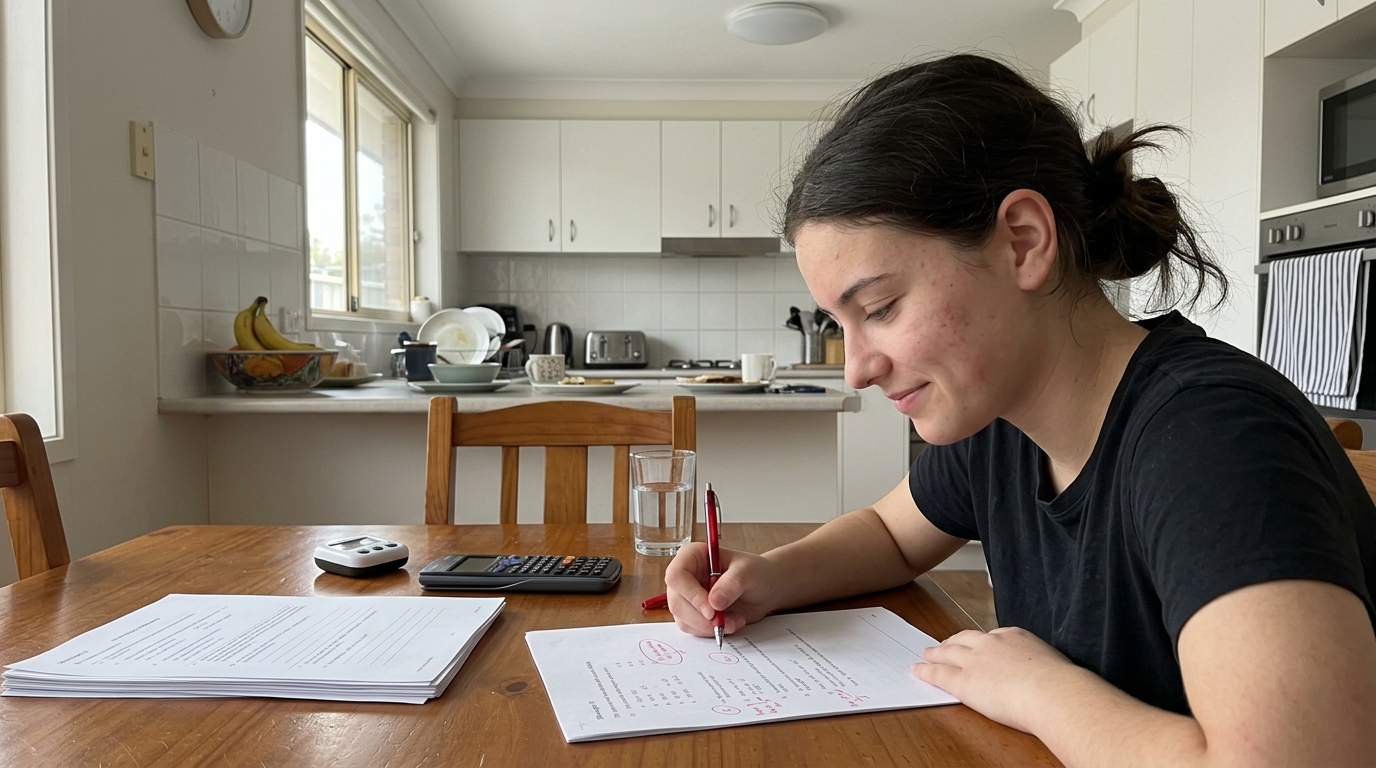
Past test questions are the highest-yield resource in any math student's locker, and most students underuse them. The mistake is to use past tests as practice — slowly working through the questions, looking up formulas as you go, checking the answer after each one. That's not what a test is, so that's not what you should rehearse. The right way is to simulate the test: print the paper, set a timer for the real test length, no notes, no calculator unless allowed, no breaks. When the timer ends, mark it against the official solutions, and write down every question you got wrong or guessed in an "error journal" — what the question was, what you did, what you should have done, and the underlying concept the mistake exposed.
For high schoolers preparing for the SAT, ACT, or AP exams, do at least 5–8 timed past papers in the final month — College Board and ACT publish official past tests free on their websites. For middle schoolers preparing for end-of-semester exams, your school's past papers (or your teacher's sample tests) are the closest match to what you'll actually face. For elementary students sitting state tests or end-of-year assessments, your district's released-item bank or the official sample tests are the right instrument. The error journal, reviewed weekly, is the single highest-leverage habit in your last 6–8 weeks before any math test — it points you at exactly the topics you're losing marks on, and stops you from re-practicing the things you already know.
How long should I study math each day?
Quality of practice matters far more than total hours. For an elementary-school student in grades 3–5, 15–25 minutes a day of focused practice (chunking + visual sketches + a few flashcards) is plenty — longer sessions at this age erode attention without adding learning. For a middle schooler in grades 6–8, 30–45 minutes a day, structured as 20 minutes of new material plus 10–15 minutes of active recall on previously-learned topics, is the sweet spot. For a high schooler in grades 9–12 preparing for SAT, ACT, or AP exams, 45–75 minutes a day on weekdays plus a longer past-test block on weekends, ramping in the final month, is realistic and sustainable. None of these numbers should be hit by sitting at a desk for the full duration without recall — five minutes of active retrieval beats thirty minutes of re-reading.
Can a math tutor help me install these study habits?
A math tutor can compress months of trial-and-error into a few weeks. The four techniques above are simple to describe and surprisingly hard to install on your own — most students drift back to re-reading because it's emotionally easier than active recall. A good tutor watches you study, catches the drift, and rebuilds the habit one session at a time. They also bring two things you can't get from a textbook: (1) a calibrated sense of which topic you're actually losing marks on (often not the one you think), and (2) a curated set of practice problems and past-test questions ordered by difficulty for your level.
A worked story: Sarah, a 7th grader, came to Tutero's online math tutoring three semesters behind on algebra. Her tutor diagnosed the gap as missing fluency with the distributive property, not "she doesn't get algebra". Eight 50-minute sessions later — chunking, sketches, and ten distributive-property flashcards reviewed daily — Sarah went from a C+ to an A on her end-of-semester test. Daniel, a 12th grader preparing for AP Calculus, used a tutor for past-test drills only — three timed papers a week, plus a weekly review of the error journal. He moved from low 4s on practice tests to a final 5 in the real AP exam. Tutero's tutors are pre-screened and matched to grade level and subject; sessions are competitively priced, the same rate from elementary through high school, with no contracts.
The bottom line
Studying math effectively isn't about studying more — it's about studying in a way that actually changes what your brain can retrieve under pressure. Chunk hard problems into small steps. Sketch the math instead of just reading about it. Force yourself to recall from memory, then space the recall out over days. Simulate tests with past papers and keep an error journal of what you got wrong. Combine all four and add a tutor if you want to install the habits faster — and the result is the same at every grade level: better understanding, better retention, better test scores.
Helpful next reads on the Tutero blog: how tutoring builds confidence in math, what personalized tutoring actually looks like, when's the right time to start tutoring, and five signs your child needs a tutor.
Re-reading feels like learning. Recalling under pressure is learning.
Re-reading feels like learning. Recalling under pressure is learning.
Most students don't fail math because they're "bad at math" — they fail because they study it the wrong way. Reading the textbook, highlighting examples, and watching the teacher work the problem on the board feels productive, but the research is unambiguous: those passive routines barely move the needle. The four study techniques in this guide are different. They take more effort in the short term and produce dramatically better understanding, retention, and test performance — at every grade level, from elementary math to AP Calculus.
Quick answer
The most effective way to study math is to combine four evidence-backed techniques: chunk complex problems into smaller steps, draw the math visually, force yourself to recall solutions from memory (active recall) at spaced intervals, and work through past test questions under timed conditions. Re-reading worked examples and copying out notes feels like studying but produces almost no transfer to test performance. Active recall and spaced practice — the two techniques the cognitive-science literature is loudest about (Roediger and Karpicke, 2006; Dunlosky et al, 2013) — work better at every grade level, in every math subject.
How do I break down complex math problems without getting overwhelmed?
When a question looks intimidating, the trick is to stop trying to solve the whole thing in your head and start writing one micro-step at a time. Identify what the question is asking, then list the formula or rule that applies, then plug in only the values you've been given, then solve one operation. After each operation, pause and check whether the next step is obvious before doing it. This is called chunking, and it works because working memory can only hold around four items at once — when you try to track the whole problem at once, you drop information and make small errors. Writing each step down externalizes the load.
A worked example: an 8th grader looking at "find the area of a triangle with base 12 cm and height 9 cm" chunks it as: (1) write the formula A = ½ × b × h, (2) substitute A = ½ × 12 × 9, (3) simplify = ½ × 108, (4) solve = 54 cm². Four lines, four pauses. The same chunking habit works for an 11th grader's calculus question or a state-test word problem — the size of the chunks changes; the discipline doesn't. Apps like Photomath and Microsoft Math Solver are useful as a check at the end, but resist the temptation to use them in place of the chunking — the goal is your brain doing the work, not the app's.
How do visual aids help me understand math better?
Visual aids work because math is a language about relationships, and most relationships are easier to see than to describe. A bar model makes a fraction-of-a-fraction click in seconds when a paragraph of definitions still feels abstract. A coordinate-plane sketch makes the meaning of "the slope is negative" obvious. A Venn diagram makes a probability question with overlapping events tractable. The point is not to make your notes look pretty — it's to convert symbols into pictures your brain can scan in one glance, which frees up working memory for the actual problem-solving.
Three visual habits that pay off across elementary, middle, and high school math: (1) for any geometry or trigonometry question, redraw the figure on your own page before solving — labeling angles, sides, and given values; (2) for any algebra question, sketch the function on a coordinate plane even if the question doesn't ask you to — it lets you sanity-check your answer (e.g. "x = -3" should be a real x-intercept on the curve); (3) for memorizing formulas and theorems, build flashcards where the front is the trigger ("area of a sector") and the back is the formula plus a tiny worked example. Free flashcard tools like Anki and Quizlet store these for spaced review, which is the next technique.
What is active recall in math and why does it work better than re-reading?
Active recall is the practice of forcing yourself to retrieve a solution from memory without looking at notes, then checking your answer afterwards. It's the single most effective study technique in the cognitive-science literature, with around fifty years of replicated experiments behind it. Roediger and Karpicke (2006) showed that students who studied a passage once and then tested themselves outperformed students who re-read the same passage four times — by a wide margin, on a delayed test a week later. The same effect is consistent across math content. Re-reading feels like learning. Recalling under pressure is learning.
In math, active recall looks like this: cover the worked solution to a problem you already studied, attempt it from blank paper, then compare. Or, write out the proof of the law of cosines from memory before checking the textbook. The discomfort you feel when you can't quite remember is the moment your brain is consolidating the knowledge — re-reading skips that moment, which is why it doesn't stick. Pair active recall with spaced practice: review each problem 1 day later, then 3 days later, then a week later. Anki and similar tools automate the spacing for you, so you only ever review the cards you're about to forget.
Re-reading feels like learning. Recalling under pressure is learning.
How do I work through past tests effectively?
Past test questions are the highest-yield resource in any math student's locker, and most students underuse them. The mistake is to use past tests as practice — slowly working through the questions, looking up formulas as you go, checking the answer after each one. That's not what a test is, so that's not what you should rehearse. The right way is to simulate the test: print the paper, set a timer for the real test length, no notes, no calculator unless allowed, no breaks. When the timer ends, mark it against the official solutions, and write down every question you got wrong or guessed in an "error journal" — what the question was, what you did, what you should have done, and the underlying concept the mistake exposed.
For high schoolers preparing for the SAT, ACT, or AP exams, do at least 5–8 timed past papers in the final month — College Board and ACT publish official past tests free on their websites. For middle schoolers preparing for end-of-semester exams, your school's past papers (or your teacher's sample tests) are the closest match to what you'll actually face. For elementary students sitting state tests or end-of-year assessments, your district's released-item bank or the official sample tests are the right instrument. The error journal, reviewed weekly, is the single highest-leverage habit in your last 6–8 weeks before any math test — it points you at exactly the topics you're losing marks on, and stops you from re-practicing the things you already know.
How long should I study math each day?
Quality of practice matters far more than total hours. For an elementary-school student in grades 3–5, 15–25 minutes a day of focused practice (chunking + visual sketches + a few flashcards) is plenty — longer sessions at this age erode attention without adding learning. For a middle schooler in grades 6–8, 30–45 minutes a day, structured as 20 minutes of new material plus 10–15 minutes of active recall on previously-learned topics, is the sweet spot. For a high schooler in grades 9–12 preparing for SAT, ACT, or AP exams, 45–75 minutes a day on weekdays plus a longer past-test block on weekends, ramping in the final month, is realistic and sustainable. None of these numbers should be hit by sitting at a desk for the full duration without recall — five minutes of active retrieval beats thirty minutes of re-reading.
Can a math tutor help me install these study habits?
A math tutor can compress months of trial-and-error into a few weeks. The four techniques above are simple to describe and surprisingly hard to install on your own — most students drift back to re-reading because it's emotionally easier than active recall. A good tutor watches you study, catches the drift, and rebuilds the habit one session at a time. They also bring two things you can't get from a textbook: (1) a calibrated sense of which topic you're actually losing marks on (often not the one you think), and (2) a curated set of practice problems and past-test questions ordered by difficulty for your level.
A worked story: Sarah, a 7th grader, came to Tutero's online math tutoring three semesters behind on algebra. Her tutor diagnosed the gap as missing fluency with the distributive property, not "she doesn't get algebra". Eight 50-minute sessions later — chunking, sketches, and ten distributive-property flashcards reviewed daily — Sarah went from a C+ to an A on her end-of-semester test. Daniel, a 12th grader preparing for AP Calculus, used a tutor for past-test drills only — three timed papers a week, plus a weekly review of the error journal. He moved from low 4s on practice tests to a final 5 in the real AP exam. Tutero's tutors are pre-screened and matched to grade level and subject; sessions are competitively priced, the same rate from elementary through high school, with no contracts.
The bottom line
Studying math effectively isn't about studying more — it's about studying in a way that actually changes what your brain can retrieve under pressure. Chunk hard problems into small steps. Sketch the math instead of just reading about it. Force yourself to recall from memory, then space the recall out over days. Simulate tests with past papers and keep an error journal of what you got wrong. Combine all four and add a tutor if you want to install the habits faster — and the result is the same at every grade level: better understanding, better retention, better test scores.
Helpful next reads on the Tutero blog: how tutoring builds confidence in math, what personalized tutoring actually looks like, when's the right time to start tutoring, and five signs your child needs a tutor.
FAQ
.svg)
.svg)
Online maths tutoring at Tutero is catering to students of all year levels. We offer programs tailored to the unique learning curves of each age group.
We also have expert NAPLAN and ATAR subject tutors, ensuring students are well-equipped for these pivotal assessments.
We recommend at least two to three session per week for consistent progress. However, this can vary based on your child's needs and goals.
Our platform uses advanced security protocols to ensure the safety and privacy of all our online sessions.
Parents are welcome to observe sessions. We believe in a collaborative approach to education.
We provide regular progress reports and assessments to track your child’s academic development.
Yes, we prioritise the student-tutor relationship and can arrange a change if the need arises.
Yes, we offer a range of resources and materials, including interactive exercises and practice worksheets.
Re-reading feels like learning. Recalling under pressure is learning.
Re-reading feels like learning. Recalling under pressure is learning.

Re-reading feels like learning. Recalling under pressure is learning.
Quality of practice matters far more than total hours — five minutes of active retrieval beats thirty minutes of re-reading.
Most students don't fail math because they're "bad at math" — they fail because they study it the wrong way. Reading the textbook, highlighting examples, and watching the teacher work the problem on the board feels productive, but the research is unambiguous: those passive routines barely move the needle. The four study techniques in this guide are different. They take more effort in the short term and produce dramatically better understanding, retention, and test performance — at every grade level, from elementary math to AP Calculus.
Quick answer
The most effective way to study math is to combine four evidence-backed techniques: chunk complex problems into smaller steps, draw the math visually, force yourself to recall solutions from memory (active recall) at spaced intervals, and work through past test questions under timed conditions. Re-reading worked examples and copying out notes feels like studying but produces almost no transfer to test performance. Active recall and spaced practice — the two techniques the cognitive-science literature is loudest about (Roediger and Karpicke, 2006; Dunlosky et al, 2013) — work better at every grade level, in every math subject.
How do I break down complex math problems without getting overwhelmed?
When a question looks intimidating, the trick is to stop trying to solve the whole thing in your head and start writing one micro-step at a time. Identify what the question is asking, then list the formula or rule that applies, then plug in only the values you've been given, then solve one operation. After each operation, pause and check whether the next step is obvious before doing it. This is called chunking, and it works because working memory can only hold around four items at once — when you try to track the whole problem at once, you drop information and make small errors. Writing each step down externalizes the load.
A worked example: an 8th grader looking at "find the area of a triangle with base 12 cm and height 9 cm" chunks it as: (1) write the formula A = ½ × b × h, (2) substitute A = ½ × 12 × 9, (3) simplify = ½ × 108, (4) solve = 54 cm². Four lines, four pauses. The same chunking habit works for an 11th grader's calculus question or a state-test word problem — the size of the chunks changes; the discipline doesn't. Apps like Photomath and Microsoft Math Solver are useful as a check at the end, but resist the temptation to use them in place of the chunking — the goal is your brain doing the work, not the app's.
How do visual aids help me understand math better?
Visual aids work because math is a language about relationships, and most relationships are easier to see than to describe. A bar model makes a fraction-of-a-fraction click in seconds when a paragraph of definitions still feels abstract. A coordinate-plane sketch makes the meaning of "the slope is negative" obvious. A Venn diagram makes a probability question with overlapping events tractable. The point is not to make your notes look pretty — it's to convert symbols into pictures your brain can scan in one glance, which frees up working memory for the actual problem-solving.
Three visual habits that pay off across elementary, middle, and high school math: (1) for any geometry or trigonometry question, redraw the figure on your own page before solving — labeling angles, sides, and given values; (2) for any algebra question, sketch the function on a coordinate plane even if the question doesn't ask you to — it lets you sanity-check your answer (e.g. "x = -3" should be a real x-intercept on the curve); (3) for memorizing formulas and theorems, build flashcards where the front is the trigger ("area of a sector") and the back is the formula plus a tiny worked example. Free flashcard tools like Anki and Quizlet store these for spaced review, which is the next technique.
What is active recall in math and why does it work better than re-reading?
Active recall is the practice of forcing yourself to retrieve a solution from memory without looking at notes, then checking your answer afterwards. It's the single most effective study technique in the cognitive-science literature, with around fifty years of replicated experiments behind it. Roediger and Karpicke (2006) showed that students who studied a passage once and then tested themselves outperformed students who re-read the same passage four times — by a wide margin, on a delayed test a week later. The same effect is consistent across math content. Re-reading feels like learning. Recalling under pressure is learning.
In math, active recall looks like this: cover the worked solution to a problem you already studied, attempt it from blank paper, then compare. Or, write out the proof of the law of cosines from memory before checking the textbook. The discomfort you feel when you can't quite remember is the moment your brain is consolidating the knowledge — re-reading skips that moment, which is why it doesn't stick. Pair active recall with spaced practice: review each problem 1 day later, then 3 days later, then a week later. Anki and similar tools automate the spacing for you, so you only ever review the cards you're about to forget.
Re-reading feels like learning. Recalling under pressure is learning.
How do I work through past tests effectively?
Past test questions are the highest-yield resource in any math student's locker, and most students underuse them. The mistake is to use past tests as practice — slowly working through the questions, looking up formulas as you go, checking the answer after each one. That's not what a test is, so that's not what you should rehearse. The right way is to simulate the test: print the paper, set a timer for the real test length, no notes, no calculator unless allowed, no breaks. When the timer ends, mark it against the official solutions, and write down every question you got wrong or guessed in an "error journal" — what the question was, what you did, what you should have done, and the underlying concept the mistake exposed.
For high schoolers preparing for the SAT, ACT, or AP exams, do at least 5–8 timed past papers in the final month — College Board and ACT publish official past tests free on their websites. For middle schoolers preparing for end-of-semester exams, your school's past papers (or your teacher's sample tests) are the closest match to what you'll actually face. For elementary students sitting state tests or end-of-year assessments, your district's released-item bank or the official sample tests are the right instrument. The error journal, reviewed weekly, is the single highest-leverage habit in your last 6–8 weeks before any math test — it points you at exactly the topics you're losing marks on, and stops you from re-practicing the things you already know.
How long should I study math each day?
Quality of practice matters far more than total hours. For an elementary-school student in grades 3–5, 15–25 minutes a day of focused practice (chunking + visual sketches + a few flashcards) is plenty — longer sessions at this age erode attention without adding learning. For a middle schooler in grades 6–8, 30–45 minutes a day, structured as 20 minutes of new material plus 10–15 minutes of active recall on previously-learned topics, is the sweet spot. For a high schooler in grades 9–12 preparing for SAT, ACT, or AP exams, 45–75 minutes a day on weekdays plus a longer past-test block on weekends, ramping in the final month, is realistic and sustainable. None of these numbers should be hit by sitting at a desk for the full duration without recall — five minutes of active retrieval beats thirty minutes of re-reading.
Can a math tutor help me install these study habits?
A math tutor can compress months of trial-and-error into a few weeks. The four techniques above are simple to describe and surprisingly hard to install on your own — most students drift back to re-reading because it's emotionally easier than active recall. A good tutor watches you study, catches the drift, and rebuilds the habit one session at a time. They also bring two things you can't get from a textbook: (1) a calibrated sense of which topic you're actually losing marks on (often not the one you think), and (2) a curated set of practice problems and past-test questions ordered by difficulty for your level.
A worked story: Sarah, a 7th grader, came to Tutero's online math tutoring three semesters behind on algebra. Her tutor diagnosed the gap as missing fluency with the distributive property, not "she doesn't get algebra". Eight 50-minute sessions later — chunking, sketches, and ten distributive-property flashcards reviewed daily — Sarah went from a C+ to an A on her end-of-semester test. Daniel, a 12th grader preparing for AP Calculus, used a tutor for past-test drills only — three timed papers a week, plus a weekly review of the error journal. He moved from low 4s on practice tests to a final 5 in the real AP exam. Tutero's tutors are pre-screened and matched to grade level and subject; sessions are competitively priced, the same rate from elementary through high school, with no contracts.
The bottom line
Studying math effectively isn't about studying more — it's about studying in a way that actually changes what your brain can retrieve under pressure. Chunk hard problems into small steps. Sketch the math instead of just reading about it. Force yourself to recall from memory, then space the recall out over days. Simulate tests with past papers and keep an error journal of what you got wrong. Combine all four and add a tutor if you want to install the habits faster — and the result is the same at every grade level: better understanding, better retention, better test scores.
Helpful next reads on the Tutero blog: how tutoring builds confidence in math, what personalized tutoring actually looks like, when's the right time to start tutoring, and five signs your child needs a tutor.
Re-reading feels like learning. Recalling under pressure is learning.
Quality of practice matters far more than total hours — five minutes of active retrieval beats thirty minutes of re-reading.
Re-reading is a passive routine — your eyes pass over the page and your brain feels familiarity, but you're not retrieving anything from memory. Familiarity isn't learning. Active recall (covering the solution and trying to reproduce it from blank paper) is the technique that actually consolidates knowledge, with around fifty years of replicated cognitive-science evidence behind it. Switch from re-reading to active recall and you'll feel less productive in the moment, and remember dramatically more a week later.
Build flashcards where the front is the trigger ("area of a sector") and the back is the formula plus a tiny worked example, then review them on a spaced schedule — 1 day, 3 days, 1 week, 3 weeks. Free tools like Anki automate the spacing, so you only ever review the cards you're about to forget. Pair the flashcards with active recall on the formulas in actual problems — recognizing a formula on a flashcard is one skill; using it under test pressure is the skill that earns points.
Simulate the test. Print a real past paper, set a timer for the actual test length, no notes, no breaks, no calculator unless allowed. When the timer ends, mark it against the official solutions and write every wrong question into an error journal — the question, what you did, what you should have done, and the underlying concept the mistake exposed. Reviewing the error journal weekly in the final 6–8 weeks before the test is the highest-leverage habit you can build.
For state tests in middle school, two to three months of focused weekly past-paper practice is usually plenty. For SAT/ACT math, the high-leverage block is roughly the final 3–4 months before test day — the first half for content mastery and active recall, the second half for timed past-test drills and error-journal review. For AP Calculus or AP Statistics, ramp the same schedule into the final month before the May exam. Starting earlier doesn't hurt; starting later than the final 6–8 weeks means you're rehearsing under test pressure rather than building it.
You don't need to remember the math. Ask your child to teach you the topic they're working on — explaining out loud is one of the strongest forms of active recall, and the gaps in their explanation tell you both exactly where the missing piece sits. Then ask them to do one problem on blank paper without notes, and check it against the textbook together. If the gap looks structural rather than a one-off, that's the moment a tutor pays for itself — they can diagnose the underlying topic in a single session.
Often, yes. The four techniques in this guide are simple to describe and surprisingly hard to install on your own — most students drift back to re-reading because it's emotionally easier than active recall. A good tutor watches you study, catches the drift, and rebuilds the habit week by week. Tutero matches American families to pre-screened tutors at competitive rates, the same from elementary through high school, with no contracts — short blocks of 6–8 sessions are usually enough to install the habits and lift test scores.
Hoping to improve confidence & grades?

.png)