.svg)
.avif)
Helping your child take better notes is one of the highest-leverage things a parent can do for school. Strong notes feed every other skill — revision, exam prep, essay planning, problem-solving — and the methods aren't hard to teach. The six approaches below cover elementary, middle and high school years, with a clear sense of which method fits which stage and subject.
Quick answer
Six note-taking methods cover almost every classroom situation: Cornell (best for high-school humanities and any text-heavy subject), outline (best for structured lectures), mind maps (best for elementary and middle school, and for visualising connections), charting (best for compare-and-contrast topics), boxing (best for chunky topics with sub-themes), and sentence notes (the default until a student is ready for one of the others). Match the method to the subject, not the student — most students use two or three methods across their week.
How do I help my child take notes from material they understand?
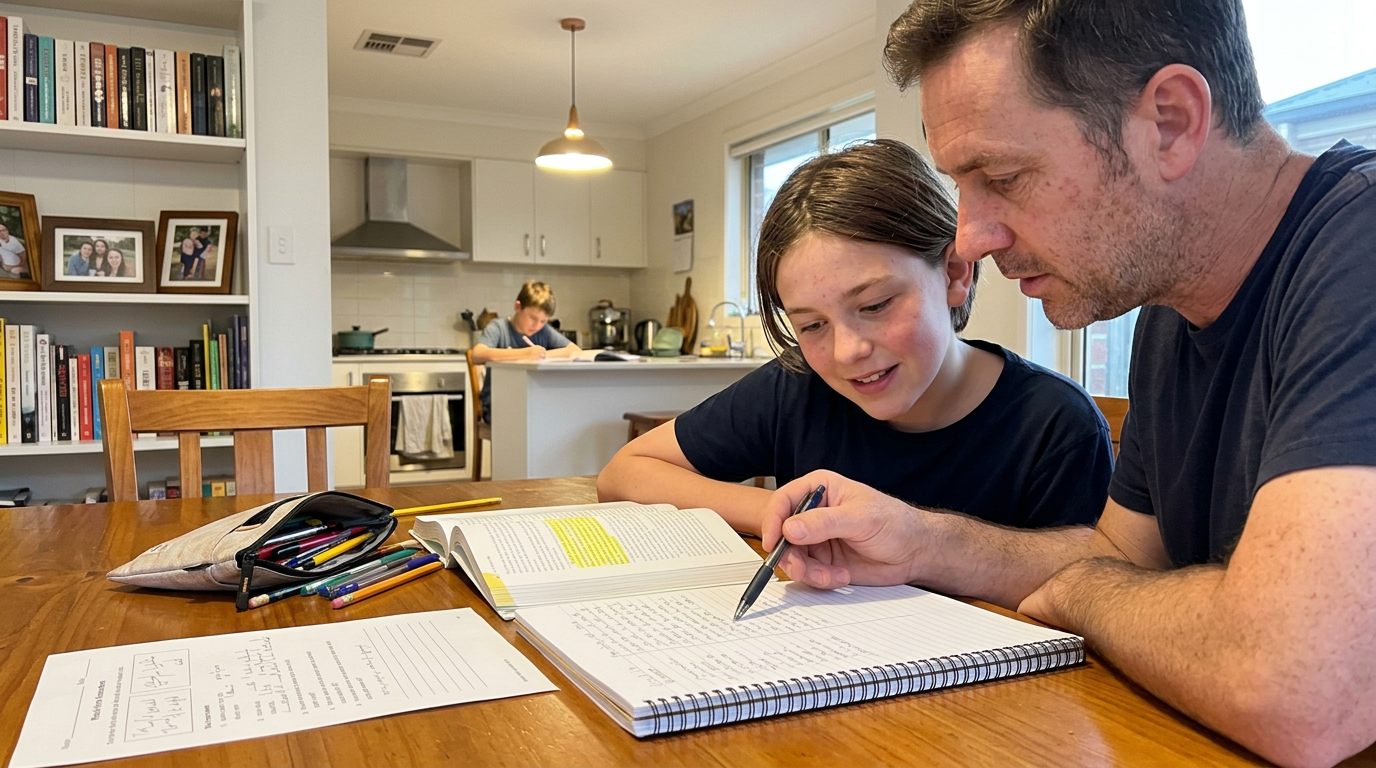
Before any method, the rule is the same: notes you don't understand are notes you can't revise from. If your child is copying without comprehending, the system has already broken. At home, build a five-minute end-of-day habit: "show me one thing you wrote down today, and tell me what it means." If they can't explain it, that's the topic to revisit. For elementary and middle school kids, this conversation matters more than the format of the page. For high school students, it's the moment to flag what to ask the tutor or teacher about next session — gaps caught early stop becoming the topic that derails the exam.
When does the Cornell method work best?
Cornell suits high-school text-heavy subjects — English, history, biology, civics, business studies — and any subject where the test asks "what does the source say and what does it mean?" Set up the page with a vertical line about a third in from the left. Right column: the actual notes during class. Left column: cue questions or keywords, written after class while the lecture is fresh. Bottom: a 2–3 sentence summary written that night. The summary is what makes Cornell powerful — it forces synthesis. For Grade 11–12 students preparing for AP/SAT, Cornell on every reading and every lecture pays off in revision.
When does the outline method work best?
Outline notes work for structured lectures with clear sub-points — most science and humanities subjects in Grade 7–10 fall here. Headings on the left margin (I, II, III), sub-points indented underneath (A, B, C), then sub-sub-points (1, 2, 3) under those. The format mirrors how a textbook is organized, which means revision later feels like reading a well-laid-out summary. The catch: outlines fail in classes that jump around or move fast. If your child is missing more than they're catching, switch them to sentence notes for that subject and keep outlines for the structured ones.
When do mind maps work best for younger kids?
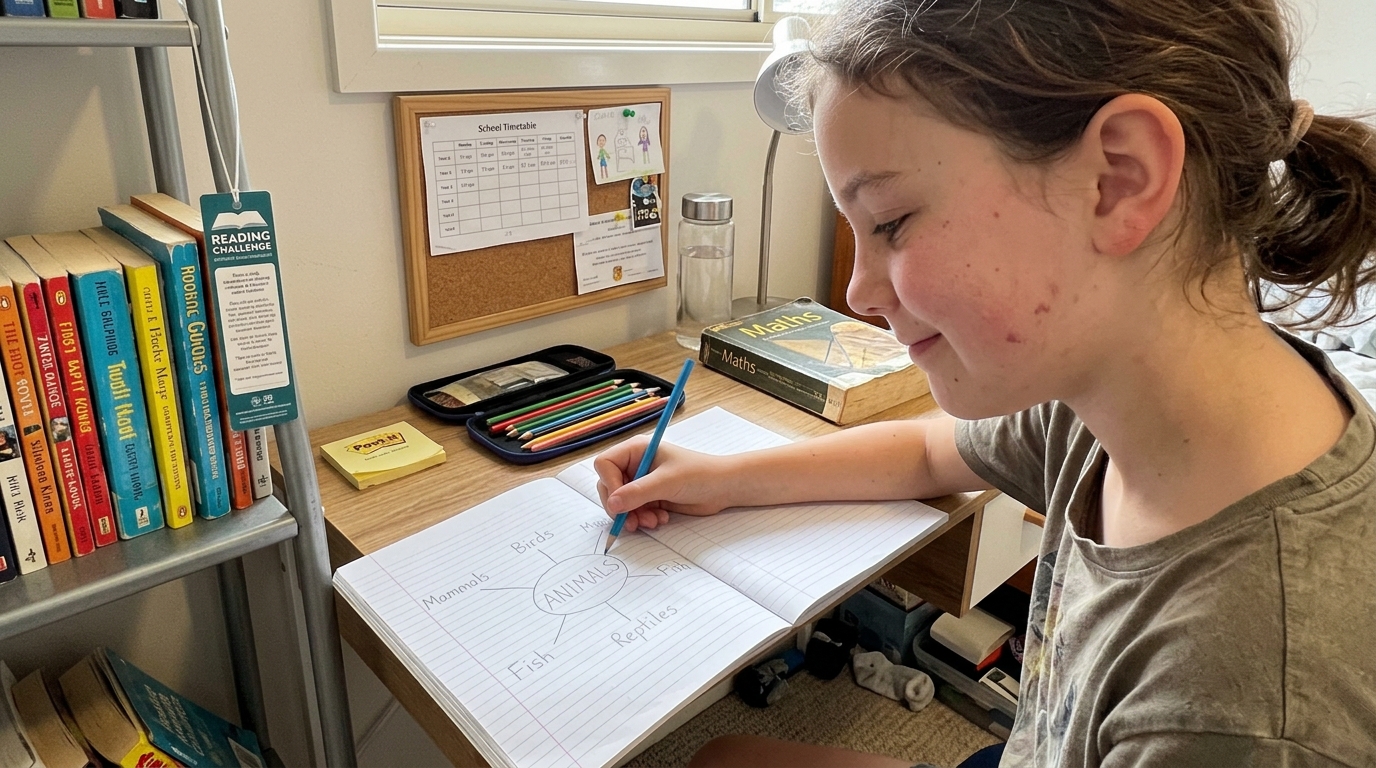
Mind maps suit elementary and middle school students, and any topic with lots of connections — characters in a novel, parts of an ecosystem, causes of a war. Central concept in the middle of the page, branches outward to sub-topics, branches off those for details. Encourage color and small drawings; for elementary kids, this is the difference between notes that get done and notes that get abandoned. Mind maps are weak for sequential or numerical material — for math working, switch to sentence notes or boxing. Many students use mind maps for revision summaries rather than live class notes; that's a perfectly valid use too.
What about charting and boxing?
Two specialist methods worth knowing. Charting is a table — columns for the categories being compared, rows for the items. Perfect for compare-and-contrast topics: three American poets, two Cold War leaders, four cell types. The act of filling in the chart forces a student to find the differences. Boxing divides the page into rectangles, one per sub-topic, with all related notes inside that box. Strong for chunky topics where the lecture jumps around — Grade 9 history, Grade 11 economics. Both methods work well as revision summaries even if the student took notes another way during class.
How do I help my child ask the right questions in class?
Notes get stronger when students fill the gaps they spotted. Coach your child to write a small "?" in the margin every time something didn't quite land — a definition they're unsure about, a step in a worked example they couldn't follow, a name they didn't catch. Then either ask the teacher at the end of class or look it up that night. For shy students, drafting the question after class on paper first makes asking less daunting. If a particular subject collects more "?" than answers week after week, that's a flag — bring in a tutor who can spend an hour going through the questions calmly without 28 other students in the room.
When and how should my child review their notes?
Notes reviewed within 24 hours retain three times longer than notes filed away until exam week. Build a 10-minute end-of-day habit: re-read today's notes, fill in the cue column (if Cornell), correct any abbreviations the student won't remember in a month, and write a one-line summary at the bottom of each page. Once a week — Sunday afternoon works for most families — spend 20 minutes reviewing the week's notes for each major subject. This is also when gaps surface. If the same topic keeps coming up confused, that's the topic to flag with a tutor, the teacher, or a study group before the next class.
The bottom line
The best note-taking method is the one your child will actually use — and the one that fits the subject. Start by helping them pick one method per subject this term. Build the daily 10-minute review habit. Watch for the topic where the question marks pile up; that's the one to bring help into. If you'd like a steady weekly anchor — a tutor who can sit beside your child, look at their actual notebooks, and unblock whatever's stuck — find a tutor on Tutero from $45/hr with no contracts. Same rate every grade level, elementary through high school.
Want notes that actually work? Most Tutero families start with a single trial lesson and book week by week. Browse online tutors near you and book a no-contract trial today.
Helping your child take better notes is one of the highest-leverage things a parent can do for school. Strong notes feed every other skill — revision, exam prep, essay planning, problem-solving — and the methods aren't hard to teach. The six approaches below cover elementary, middle and high school years, with a clear sense of which method fits which stage and subject.
Quick answer
Six note-taking methods cover almost every classroom situation: Cornell (best for high-school humanities and any text-heavy subject), outline (best for structured lectures), mind maps (best for elementary and middle school, and for visualising connections), charting (best for compare-and-contrast topics), boxing (best for chunky topics with sub-themes), and sentence notes (the default until a student is ready for one of the others). Match the method to the subject, not the student — most students use two or three methods across their week.
How do I help my child take notes from material they understand?
Before any method, the rule is the same: notes you don't understand are notes you can't revise from. If your child is copying without comprehending, the system has already broken. At home, build a five-minute end-of-day habit: "show me one thing you wrote down today, and tell me what it means." If they can't explain it, that's the topic to revisit. For elementary and middle school kids, this conversation matters more than the format of the page. For high school students, it's the moment to flag what to ask the tutor or teacher about next session — gaps caught early stop becoming the topic that derails the exam.
When does the Cornell method work best?
Cornell suits high-school text-heavy subjects — English, history, biology, civics, business studies — and any subject where the test asks "what does the source say and what does it mean?" Set up the page with a vertical line about a third in from the left. Right column: the actual notes during class. Left column: cue questions or keywords, written after class while the lecture is fresh. Bottom: a 2–3 sentence summary written that night. The summary is what makes Cornell powerful — it forces synthesis. For Grade 11–12 students preparing for AP/SAT, Cornell on every reading and every lecture pays off in revision.
When does the outline method work best?
Outline notes work for structured lectures with clear sub-points — most science and humanities subjects in Grade 7–10 fall here. Headings on the left margin (I, II, III), sub-points indented underneath (A, B, C), then sub-sub-points (1, 2, 3) under those. The format mirrors how a textbook is organized, which means revision later feels like reading a well-laid-out summary. The catch: outlines fail in classes that jump around or move fast. If your child is missing more than they're catching, switch them to sentence notes for that subject and keep outlines for the structured ones.
When do mind maps work best for younger kids?
Mind maps suit elementary and middle school students, and any topic with lots of connections — characters in a novel, parts of an ecosystem, causes of a war. Central concept in the middle of the page, branches outward to sub-topics, branches off those for details. Encourage color and small drawings; for elementary kids, this is the difference between notes that get done and notes that get abandoned. Mind maps are weak for sequential or numerical material — for math working, switch to sentence notes or boxing. Many students use mind maps for revision summaries rather than live class notes; that's a perfectly valid use too.
What about charting and boxing?
Two specialist methods worth knowing. Charting is a table — columns for the categories being compared, rows for the items. Perfect for compare-and-contrast topics: three American poets, two Cold War leaders, four cell types. The act of filling in the chart forces a student to find the differences. Boxing divides the page into rectangles, one per sub-topic, with all related notes inside that box. Strong for chunky topics where the lecture jumps around — Grade 9 history, Grade 11 economics. Both methods work well as revision summaries even if the student took notes another way during class.
How do I help my child ask the right questions in class?
Notes get stronger when students fill the gaps they spotted. Coach your child to write a small "?" in the margin every time something didn't quite land — a definition they're unsure about, a step in a worked example they couldn't follow, a name they didn't catch. Then either ask the teacher at the end of class or look it up that night. For shy students, drafting the question after class on paper first makes asking less daunting. If a particular subject collects more "?" than answers week after week, that's a flag — bring in a tutor who can spend an hour going through the questions calmly without 28 other students in the room.
When and how should my child review their notes?
Notes reviewed within 24 hours retain three times longer than notes filed away until exam week. Build a 10-minute end-of-day habit: re-read today's notes, fill in the cue column (if Cornell), correct any abbreviations the student won't remember in a month, and write a one-line summary at the bottom of each page. Once a week — Sunday afternoon works for most families — spend 20 minutes reviewing the week's notes for each major subject. This is also when gaps surface. If the same topic keeps coming up confused, that's the topic to flag with a tutor, the teacher, or a study group before the next class.
The bottom line
The best note-taking method is the one your child will actually use — and the one that fits the subject. Start by helping them pick one method per subject this term. Build the daily 10-minute review habit. Watch for the topic where the question marks pile up; that's the one to bring help into. If you'd like a steady weekly anchor — a tutor who can sit beside your child, look at their actual notebooks, and unblock whatever's stuck — find a tutor on Tutero from $45/hr with no contracts. Same rate every grade level, elementary through high school.
Want notes that actually work? Most Tutero families start with a single trial lesson and book week by week. Browse online tutors near you and book a no-contract trial today.

Helping your child take better notes is one of the highest-leverage things a parent can do for school. Strong notes feed every other skill — revision, exam prep, essay planning, problem-solving — and the methods aren't hard to teach. The six approaches below cover elementary, middle and high school years, with a clear sense of which method fits which stage and subject.
Quick answer
Six note-taking methods cover almost every classroom situation: Cornell (best for high-school humanities and any text-heavy subject), outline (best for structured lectures), mind maps (best for elementary and middle school, and for visualising connections), charting (best for compare-and-contrast topics), boxing (best for chunky topics with sub-themes), and sentence notes (the default until a student is ready for one of the others). Match the method to the subject, not the student — most students use two or three methods across their week.
How do I help my child take notes from material they understand?
Before any method, the rule is the same: notes you don't understand are notes you can't revise from. If your child is copying without comprehending, the system has already broken. At home, build a five-minute end-of-day habit: "show me one thing you wrote down today, and tell me what it means." If they can't explain it, that's the topic to revisit. For elementary and middle school kids, this conversation matters more than the format of the page. For high school students, it's the moment to flag what to ask the tutor or teacher about next session — gaps caught early stop becoming the topic that derails the exam.
When does the Cornell method work best?
Cornell suits high-school text-heavy subjects — English, history, biology, civics, business studies — and any subject where the test asks "what does the source say and what does it mean?" Set up the page with a vertical line about a third in from the left. Right column: the actual notes during class. Left column: cue questions or keywords, written after class while the lecture is fresh. Bottom: a 2–3 sentence summary written that night. The summary is what makes Cornell powerful — it forces synthesis. For Grade 11–12 students preparing for AP/SAT, Cornell on every reading and every lecture pays off in revision.
When does the outline method work best?
Outline notes work for structured lectures with clear sub-points — most science and humanities subjects in Grade 7–10 fall here. Headings on the left margin (I, II, III), sub-points indented underneath (A, B, C), then sub-sub-points (1, 2, 3) under those. The format mirrors how a textbook is organized, which means revision later feels like reading a well-laid-out summary. The catch: outlines fail in classes that jump around or move fast. If your child is missing more than they're catching, switch them to sentence notes for that subject and keep outlines for the structured ones.
When do mind maps work best for younger kids?
Mind maps suit elementary and middle school students, and any topic with lots of connections — characters in a novel, parts of an ecosystem, causes of a war. Central concept in the middle of the page, branches outward to sub-topics, branches off those for details. Encourage color and small drawings; for elementary kids, this is the difference between notes that get done and notes that get abandoned. Mind maps are weak for sequential or numerical material — for math working, switch to sentence notes or boxing. Many students use mind maps for revision summaries rather than live class notes; that's a perfectly valid use too.
What about charting and boxing?
Two specialist methods worth knowing. Charting is a table — columns for the categories being compared, rows for the items. Perfect for compare-and-contrast topics: three American poets, two Cold War leaders, four cell types. The act of filling in the chart forces a student to find the differences. Boxing divides the page into rectangles, one per sub-topic, with all related notes inside that box. Strong for chunky topics where the lecture jumps around — Grade 9 history, Grade 11 economics. Both methods work well as revision summaries even if the student took notes another way during class.
How do I help my child ask the right questions in class?
Notes get stronger when students fill the gaps they spotted. Coach your child to write a small "?" in the margin every time something didn't quite land — a definition they're unsure about, a step in a worked example they couldn't follow, a name they didn't catch. Then either ask the teacher at the end of class or look it up that night. For shy students, drafting the question after class on paper first makes asking less daunting. If a particular subject collects more "?" than answers week after week, that's a flag — bring in a tutor who can spend an hour going through the questions calmly without 28 other students in the room.
When and how should my child review their notes?
Notes reviewed within 24 hours retain three times longer than notes filed away until exam week. Build a 10-minute end-of-day habit: re-read today's notes, fill in the cue column (if Cornell), correct any abbreviations the student won't remember in a month, and write a one-line summary at the bottom of each page. Once a week — Sunday afternoon works for most families — spend 20 minutes reviewing the week's notes for each major subject. This is also when gaps surface. If the same topic keeps coming up confused, that's the topic to flag with a tutor, the teacher, or a study group before the next class.
The bottom line
The best note-taking method is the one your child will actually use — and the one that fits the subject. Start by helping them pick one method per subject this term. Build the daily 10-minute review habit. Watch for the topic where the question marks pile up; that's the one to bring help into. If you'd like a steady weekly anchor — a tutor who can sit beside your child, look at their actual notebooks, and unblock whatever's stuck — find a tutor on Tutero from $45/hr with no contracts. Same rate every grade level, elementary through high school.
Want notes that actually work? Most Tutero families start with a single trial lesson and book week by week. Browse online tutors near you and book a no-contract trial today.
.svg)
.svg)
Hoping to improve confidence & grades?

.png)