.svg)

A study planner is the difference between feeling busy and actually getting somewhere. Most students don't fall behind because they're not smart enough — they fall behind because every week feels overwhelming and the same three subjects keep getting deprioritised. A clean planner solves that. This guide walks you through how to make one that works for elementary, middle, and high school students alike.
Quick answer: how do you make a study planner that actually works?
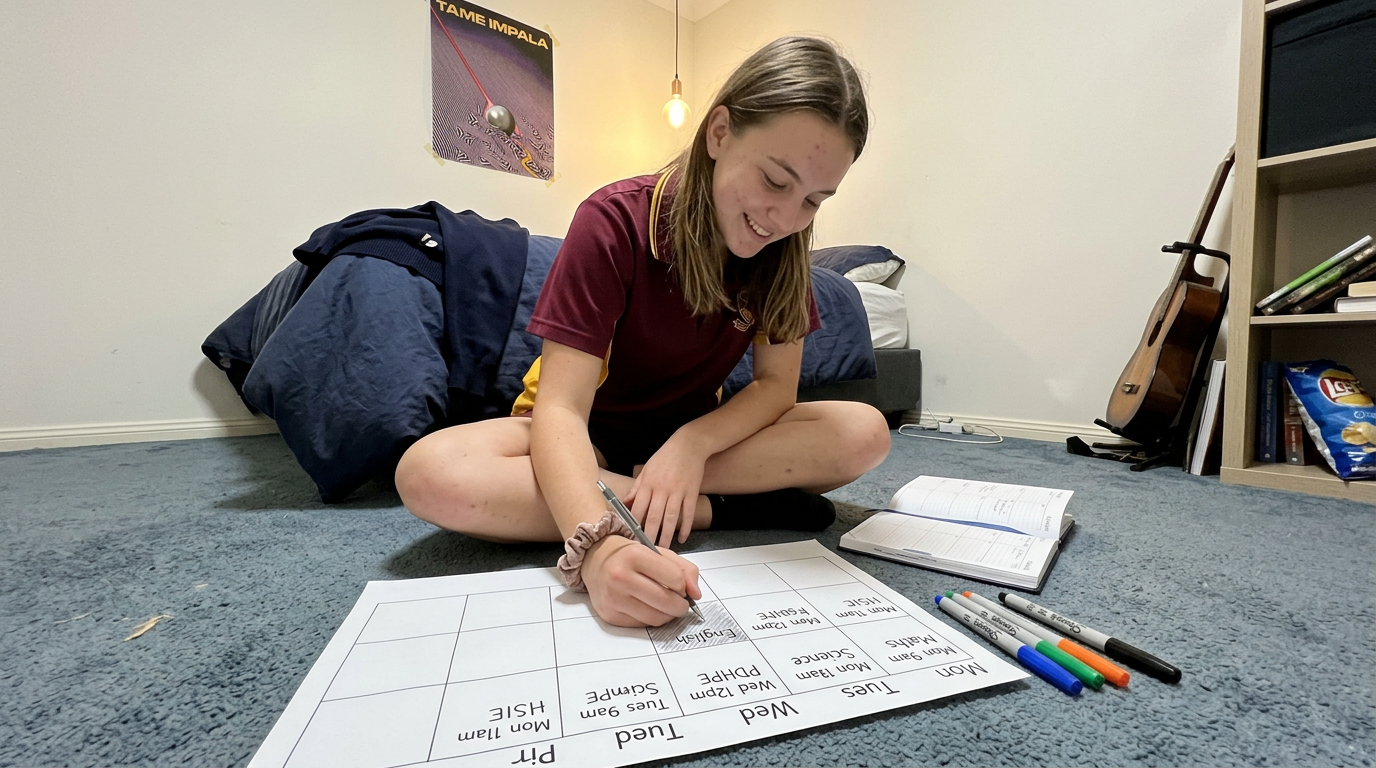
Quick answer: a study planner that works has four ingredients — a single weekly view (paper or digital, not both), specific tasks not subjects ("English: read chapter 4 + 3 practice questions" not "English"), realistic time blocks, and a 10-minute weekly review where you adjust what didn't land. The biggest mistake is making it too detailed; the second biggest is never reviewing it.
How do you set clear study goals before you build the plan?
Write down two kinds of goals before you open a planner. End-of-term goals: what would "good" look like in each subject at the end of this term? "B+ in math" or "submit all English drafts by Friday" — concrete and verifiable. Weekly goals: what does this week need to deliver toward the term goal? "Finish math Chapter 4 + 8 practice questions" not "do math". Both kinds of goals come from your teacher's scope sequence, your study-skills approach, and what you scored last assessment. Without goals the planner is decoration; with them it's a steering wheel.
How should you prioritise study tasks for the week ahead?
Triage every task into three buckets: due-this-week (non-negotiable), due-soon (build into time blocks), and revision (background). Sequence due-this-week tasks first thing each day — most students do their hardest work in the first 90 minutes after school, then admin in the late afternoon. Revision goes in 25-minute blocks 3-4 times per week, ideally on subjects you've already covered in class that day (the "while it's fresh" rule). Subjects you find hardest get an extra 15-minute review block, not a full extra hour — short and frequent beats long and rare for retention.
How do you allocate time slots realistically across subjects?
Be honest about how much study time you actually have, not how much you'd like. A elementary-school student in 4th grade has maybe 30-45 minutes of meaningful study attention per day; a 8th grade middle school student around 60-90; a senior 11th grade-12 student 90-150. Multiply by 5 weekdays and divide across subjects in proportion to (current grade gap × upcoming-assessment weight). The biggest planning mistake is assuming everyone has 3 hours per evening — they don't, and the planner that pretends they do gets abandoned in week 2. Tell yourself the truth and the plan stays in the diary.

What study tools and apps actually help and which ones waste time?
The tools that work are simple: a paper diary or a single calendar app, a 25-minute pomodoro timer, and one note-taking system. Anything more is procrastination disguised as productivity. Notion, Roam, Obsidian — beautiful but rabbit holes that eat your study hour. A school diary plus Apple Calendar plus a pomodoro app is enough for any student through 12th grade. Tutero.ai handles the layer above this — the actual subject-content questions you study — but the planner itself should be boring and reliable. Tools change less often than students think they should.
How often should you review and adjust your study plan?
Once a week, ideally Sunday evening, for 10 minutes. Look back at last week — what got done, what didn't, and why. Look forward to this week — what's due, what's coming, what gets a time block. The 10 minutes is the highest-leverage study time you do all week. Skip it and the plan calcifies into a wishlist within a two weeks. Add a 30-second daily check-in each morning to confirm today's tasks haven't shifted overnight. The weekly review is where a planner becomes a system; without it you have a one-time piece of theatre.
What active-learning techniques should you bake into the plan?
Re-reading notes is the lowest-yield study activity per minute and somehow the most popular. Replace it with three actively engaged techniques: practice problems (do them, then mark with the answer key), self-explanation (close the book and re-explain a concept aloud or in writing), and spaced retrieval (test yourself on last week's topic, not just today's). Each block on your planner should specify which active technique you're doing — "math: 30 min practice problems Chapter 4" not "math: study". Effective study strategies covers the research in more depth.
How do you minimise distractions during study blocks?
Phone in another room, not on silent and not face-down. Notifications off, not "do not disturb scheduled". A clean desk surface with only the materials for the current subject. If you study with a laptop, use a single browser window and close the tabs you "might need later" — they're not for now. The rule is: optimize for the start of the study block, because once you're 10 minutes in your brain has settled. Most lost study time is the 8 minutes between sitting down and actually starting; remove the friction so those 8 minutes shrink to 1.
When should you take breaks and how long?
Pomodoro is popular because it works — 25 minutes focused, 5 minutes off, repeat 3-4 times, then a longer 15-20 minute break. The 5-minute break is for movement, water, or looking out a window — not for your phone. The longer break is for actual rest. Senior students preparing for AP/honors exams or AP exams can stretch the focused block to 50 minutes once they've trained their attention; younger students should stay shorter. Listen to your body — if your eyes glaze and you re-read the same sentence twice, you've already exhausted your block, take the break.
When should you ask a tutor for help on top of the planner?
When the planner is honest, the tasks are clear, and you're still hitting the same wall on a topic — that's the signal. A tutor doesn't replace your planner; they unblock the specific topic that the planner can't teach you. Tutero tutors are matched to your year level and subject, and a single 60-minute session at US$45 can clear a roadblock that two weeks of self-study didn't. The planner is for what you can do alone; the tutor is for what you can't.
So what makes a study planner actually work?
Goals before tasks. Realistic time. Specific not vague. Active not passive. Reviewed weekly. Tools simple. Distractions removed. Breaks honoured. Tutor on standby for the genuine roadblocks. Do these eight things and your planner stops being a guilt object and starts being a quiet weekly engine. A Tutero tutor can help you build out the math, English, or science layer on top of your planner — US$45 for the first session, no contracts.
Need help unblocking a specific subject inside your study plan? Match with a Tutero tutor who can take one specific topic from your planner and clear it in a single 60-minute session. US$45 first session, written summary so you know what to schedule next.
Re-reading notes is the lowest-yield study activity per minute and somehow the most popular.
Re-reading notes is the lowest-yield study activity per minute and somehow the most popular.
A study planner is the difference between feeling busy and actually getting somewhere. Most students don't fall behind because they're not smart enough — they fall behind because every week feels overwhelming and the same three subjects keep getting deprioritised. A clean planner solves that. This guide walks you through how to make one that works for elementary, middle, and high school students alike.
Quick answer: how do you make a study planner that actually works?
Quick answer: a study planner that works has four ingredients — a single weekly view (paper or digital, not both), specific tasks not subjects ("English: read chapter 4 + 3 practice questions" not "English"), realistic time blocks, and a 10-minute weekly review where you adjust what didn't land. The biggest mistake is making it too detailed; the second biggest is never reviewing it.
How do you set clear study goals before you build the plan?
Write down two kinds of goals before you open a planner. End-of-term goals: what would "good" look like in each subject at the end of this term? "B+ in math" or "submit all English drafts by Friday" — concrete and verifiable. Weekly goals: what does this week need to deliver toward the term goal? "Finish math Chapter 4 + 8 practice questions" not "do math". Both kinds of goals come from your teacher's scope sequence, your study-skills approach, and what you scored last assessment. Without goals the planner is decoration; with them it's a steering wheel.
How should you prioritise study tasks for the week ahead?
Triage every task into three buckets: due-this-week (non-negotiable), due-soon (build into time blocks), and revision (background). Sequence due-this-week tasks first thing each day — most students do their hardest work in the first 90 minutes after school, then admin in the late afternoon. Revision goes in 25-minute blocks 3-4 times per week, ideally on subjects you've already covered in class that day (the "while it's fresh" rule). Subjects you find hardest get an extra 15-minute review block, not a full extra hour — short and frequent beats long and rare for retention.
How do you allocate time slots realistically across subjects?
Be honest about how much study time you actually have, not how much you'd like. A elementary-school student in 4th grade has maybe 30-45 minutes of meaningful study attention per day; a 8th grade middle school student around 60-90; a senior 11th grade-12 student 90-150. Multiply by 5 weekdays and divide across subjects in proportion to (current grade gap × upcoming-assessment weight). The biggest planning mistake is assuming everyone has 3 hours per evening — they don't, and the planner that pretends they do gets abandoned in week 2. Tell yourself the truth and the plan stays in the diary.
What study tools and apps actually help and which ones waste time?
The tools that work are simple: a paper diary or a single calendar app, a 25-minute pomodoro timer, and one note-taking system. Anything more is procrastination disguised as productivity. Notion, Roam, Obsidian — beautiful but rabbit holes that eat your study hour. A school diary plus Apple Calendar plus a pomodoro app is enough for any student through 12th grade. Tutero.ai handles the layer above this — the actual subject-content questions you study — but the planner itself should be boring and reliable. Tools change less often than students think they should.
How often should you review and adjust your study plan?
Once a week, ideally Sunday evening, for 10 minutes. Look back at last week — what got done, what didn't, and why. Look forward to this week — what's due, what's coming, what gets a time block. The 10 minutes is the highest-leverage study time you do all week. Skip it and the plan calcifies into a wishlist within a two weeks. Add a 30-second daily check-in each morning to confirm today's tasks haven't shifted overnight. The weekly review is where a planner becomes a system; without it you have a one-time piece of theatre.
What active-learning techniques should you bake into the plan?
Re-reading notes is the lowest-yield study activity per minute and somehow the most popular. Replace it with three actively engaged techniques: practice problems (do them, then mark with the answer key), self-explanation (close the book and re-explain a concept aloud or in writing), and spaced retrieval (test yourself on last week's topic, not just today's). Each block on your planner should specify which active technique you're doing — "math: 30 min practice problems Chapter 4" not "math: study". Effective study strategies covers the research in more depth.
How do you minimise distractions during study blocks?
Phone in another room, not on silent and not face-down. Notifications off, not "do not disturb scheduled". A clean desk surface with only the materials for the current subject. If you study with a laptop, use a single browser window and close the tabs you "might need later" — they're not for now. The rule is: optimize for the start of the study block, because once you're 10 minutes in your brain has settled. Most lost study time is the 8 minutes between sitting down and actually starting; remove the friction so those 8 minutes shrink to 1.
When should you take breaks and how long?
Pomodoro is popular because it works — 25 minutes focused, 5 minutes off, repeat 3-4 times, then a longer 15-20 minute break. The 5-minute break is for movement, water, or looking out a window — not for your phone. The longer break is for actual rest. Senior students preparing for AP/honors exams or AP exams can stretch the focused block to 50 minutes once they've trained their attention; younger students should stay shorter. Listen to your body — if your eyes glaze and you re-read the same sentence twice, you've already exhausted your block, take the break.
When should you ask a tutor for help on top of the planner?
When the planner is honest, the tasks are clear, and you're still hitting the same wall on a topic — that's the signal. A tutor doesn't replace your planner; they unblock the specific topic that the planner can't teach you. Tutero tutors are matched to your year level and subject, and a single 60-minute session at US$45 can clear a roadblock that two weeks of self-study didn't. The planner is for what you can do alone; the tutor is for what you can't.
So what makes a study planner actually work?
Goals before tasks. Realistic time. Specific not vague. Active not passive. Reviewed weekly. Tools simple. Distractions removed. Breaks honoured. Tutor on standby for the genuine roadblocks. Do these eight things and your planner stops being a guilt object and starts being a quiet weekly engine. A Tutero tutor can help you build out the math, English, or science layer on top of your planner — US$45 for the first session, no contracts.
Need help unblocking a specific subject inside your study plan? Match with a Tutero tutor who can take one specific topic from your planner and clear it in a single 60-minute session. US$45 first session, written summary so you know what to schedule next.
FAQ
.svg)
.svg)
Online maths tutoring at Tutero is catering to students of all year levels. We offer programs tailored to the unique learning curves of each age group.
We also have expert NAPLAN and ATAR subject tutors, ensuring students are well-equipped for these pivotal assessments.
We recommend at least two to three session per week for consistent progress. However, this can vary based on your child's needs and goals.
Our platform uses advanced security protocols to ensure the safety and privacy of all our online sessions.
Parents are welcome to observe sessions. We believe in a collaborative approach to education.
We provide regular progress reports and assessments to track your child’s academic development.
Yes, we prioritise the student-tutor relationship and can arrange a change if the need arises.
Yes, we offer a range of resources and materials, including interactive exercises and practice worksheets.
Re-reading notes is the lowest-yield study activity per minute and somehow the most popular.
Re-reading notes is the lowest-yield study activity per minute and somehow the most popular.

Re-reading notes is the lowest-yield study activity per minute and somehow the most popular.
The 10-minute weekly review is the highest-leverage study time you do all week.
A study planner is the difference between feeling busy and actually getting somewhere. Most students don't fall behind because they're not smart enough — they fall behind because every week feels overwhelming and the same three subjects keep getting deprioritised. A clean planner solves that. This guide walks you through how to make one that works for elementary, middle, and high school students alike.
Quick answer: how do you make a study planner that actually works?
Quick answer: a study planner that works has four ingredients — a single weekly view (paper or digital, not both), specific tasks not subjects ("English: read chapter 4 + 3 practice questions" not "English"), realistic time blocks, and a 10-minute weekly review where you adjust what didn't land. The biggest mistake is making it too detailed; the second biggest is never reviewing it.
How do you set clear study goals before you build the plan?
Write down two kinds of goals before you open a planner. End-of-term goals: what would "good" look like in each subject at the end of this term? "B+ in math" or "submit all English drafts by Friday" — concrete and verifiable. Weekly goals: what does this week need to deliver toward the term goal? "Finish math Chapter 4 + 8 practice questions" not "do math". Both kinds of goals come from your teacher's scope sequence, your study-skills approach, and what you scored last assessment. Without goals the planner is decoration; with them it's a steering wheel.
How should you prioritise study tasks for the week ahead?
Triage every task into three buckets: due-this-week (non-negotiable), due-soon (build into time blocks), and revision (background). Sequence due-this-week tasks first thing each day — most students do their hardest work in the first 90 minutes after school, then admin in the late afternoon. Revision goes in 25-minute blocks 3-4 times per week, ideally on subjects you've already covered in class that day (the "while it's fresh" rule). Subjects you find hardest get an extra 15-minute review block, not a full extra hour — short and frequent beats long and rare for retention.
How do you allocate time slots realistically across subjects?
Be honest about how much study time you actually have, not how much you'd like. A elementary-school student in 4th grade has maybe 30-45 minutes of meaningful study attention per day; a 8th grade middle school student around 60-90; a senior 11th grade-12 student 90-150. Multiply by 5 weekdays and divide across subjects in proportion to (current grade gap × upcoming-assessment weight). The biggest planning mistake is assuming everyone has 3 hours per evening — they don't, and the planner that pretends they do gets abandoned in week 2. Tell yourself the truth and the plan stays in the diary.
What study tools and apps actually help and which ones waste time?
The tools that work are simple: a paper diary or a single calendar app, a 25-minute pomodoro timer, and one note-taking system. Anything more is procrastination disguised as productivity. Notion, Roam, Obsidian — beautiful but rabbit holes that eat your study hour. A school diary plus Apple Calendar plus a pomodoro app is enough for any student through 12th grade. Tutero.ai handles the layer above this — the actual subject-content questions you study — but the planner itself should be boring and reliable. Tools change less often than students think they should.
How often should you review and adjust your study plan?
Once a week, ideally Sunday evening, for 10 minutes. Look back at last week — what got done, what didn't, and why. Look forward to this week — what's due, what's coming, what gets a time block. The 10 minutes is the highest-leverage study time you do all week. Skip it and the plan calcifies into a wishlist within a two weeks. Add a 30-second daily check-in each morning to confirm today's tasks haven't shifted overnight. The weekly review is where a planner becomes a system; without it you have a one-time piece of theatre.
What active-learning techniques should you bake into the plan?
Re-reading notes is the lowest-yield study activity per minute and somehow the most popular. Replace it with three actively engaged techniques: practice problems (do them, then mark with the answer key), self-explanation (close the book and re-explain a concept aloud or in writing), and spaced retrieval (test yourself on last week's topic, not just today's). Each block on your planner should specify which active technique you're doing — "math: 30 min practice problems Chapter 4" not "math: study". Effective study strategies covers the research in more depth.
How do you minimise distractions during study blocks?
Phone in another room, not on silent and not face-down. Notifications off, not "do not disturb scheduled". A clean desk surface with only the materials for the current subject. If you study with a laptop, use a single browser window and close the tabs you "might need later" — they're not for now. The rule is: optimize for the start of the study block, because once you're 10 minutes in your brain has settled. Most lost study time is the 8 minutes between sitting down and actually starting; remove the friction so those 8 minutes shrink to 1.
When should you take breaks and how long?
Pomodoro is popular because it works — 25 minutes focused, 5 minutes off, repeat 3-4 times, then a longer 15-20 minute break. The 5-minute break is for movement, water, or looking out a window — not for your phone. The longer break is for actual rest. Senior students preparing for AP/honors exams or AP exams can stretch the focused block to 50 minutes once they've trained their attention; younger students should stay shorter. Listen to your body — if your eyes glaze and you re-read the same sentence twice, you've already exhausted your block, take the break.
When should you ask a tutor for help on top of the planner?
When the planner is honest, the tasks are clear, and you're still hitting the same wall on a topic — that's the signal. A tutor doesn't replace your planner; they unblock the specific topic that the planner can't teach you. Tutero tutors are matched to your year level and subject, and a single 60-minute session at US$45 can clear a roadblock that two weeks of self-study didn't. The planner is for what you can do alone; the tutor is for what you can't.
So what makes a study planner actually work?
Goals before tasks. Realistic time. Specific not vague. Active not passive. Reviewed weekly. Tools simple. Distractions removed. Breaks honoured. Tutor on standby for the genuine roadblocks. Do these eight things and your planner stops being a guilt object and starts being a quiet weekly engine. A Tutero tutor can help you build out the math, English, or science layer on top of your planner — US$45 for the first session, no contracts.
Need help unblocking a specific subject inside your study plan? Match with a Tutero tutor who can take one specific topic from your planner and clear it in a single 60-minute session. US$45 first session, written summary so you know what to schedule next.
Re-reading notes is the lowest-yield study activity per minute and somehow the most popular.
The 10-minute weekly review is the highest-leverage study time you do all week.
Hoping to improve confidence & grades?

.png)