.svg)

Formative assessment is the in-lesson check that tells you what your math students understand right now — while there is still time to do something about it.
Done well, it takes 90 seconds and changes the rest of the lesson. Done in five well-chosen routines across the week, it changes the unit. This guide walks through what formative assessment is, why it matters in math specifically, and the five strategies that consistently move learning from elementary through high school.
Quick answer
Formative assessment in math is any short, low-stakes check you do during a lesson — exit tickets, mini-whiteboards, number talks, targeted questioning, self-rating — that shows you what students understand before you move on. The five strategies in this guide work in elementary, middle, and high school math. None require new technology. Each one takes two minutes or less, gives you usable evidence, and lets you adjust teaching while the lesson is still happening rather than discovering the gap on a unit test.
What is formative assessment in math?
Formative assessment is any in-lesson check that surfaces what students understand right now, before the misconception hardens into a habit. Paul Black and Dylan Wiliam coined the working definition in their 1998 review Inside the Black Box: assessment becomes formative when the evidence is actually used to adapt teaching to meet learning needs. The check itself is not the point — the response is.
In math, formative assessment matters more than in most subjects because errors are rarely random. Mathematics-education research distinguishes between slips (a one-off arithmetic mistake) and bugs (a consistent procedural or conceptual error, like always subtracting the smaller digit from the larger one regardless of place value). A 90-second check tells you which one you are looking at, which tells you whether to keep going, slow down, or stop and reteach.
Used consistently, formative assessment turns the math classroom into something closer to one-to-one teaching scaled to a class of 28 — every student's thinking is visible, and every student gets feedback that fits where they are.
What is the difference between formative and summative assessment?
Formative assessment happens during learning to shape it; summative assessment happens after learning to measure it. A mini-whiteboard check halfway through a fractions lesson is formative — it tells you whether to keep going. A state test, a 9th-grade unit test, or an end-of-semester report is summative — it tells you what was learned by the deadline.
Both matter. Summative results are what parents and districts see. But every credible analysis of teacher impact — from Black and Wiliam through John Hattie's Visible Learning meta-synthesis to the Education Endowment Foundation's guidance — finds that the lever inside your control as a classroom teacher is the formative half. Hattie places formative evaluation among the highest-effect instructional practices, with effect sizes well above the average.
The simplest way to keep them straight: formative is feedback to the teacher, summative is feedback about the student. The first one changes what you do next; the second one records what already happened.
What are the most effective formative assessment strategies for the math classroom?
Five strategies do most of the work, across elementary, middle, and high school math. They share three properties: each one is fast (90 seconds to two minutes), each one produces evidence the whole class can see, and each one lets you adjust the lesson immediately. Use them in rotation rather than all at once — one routine per lesson, embedded as habit, beats five routines bolted on as performance.
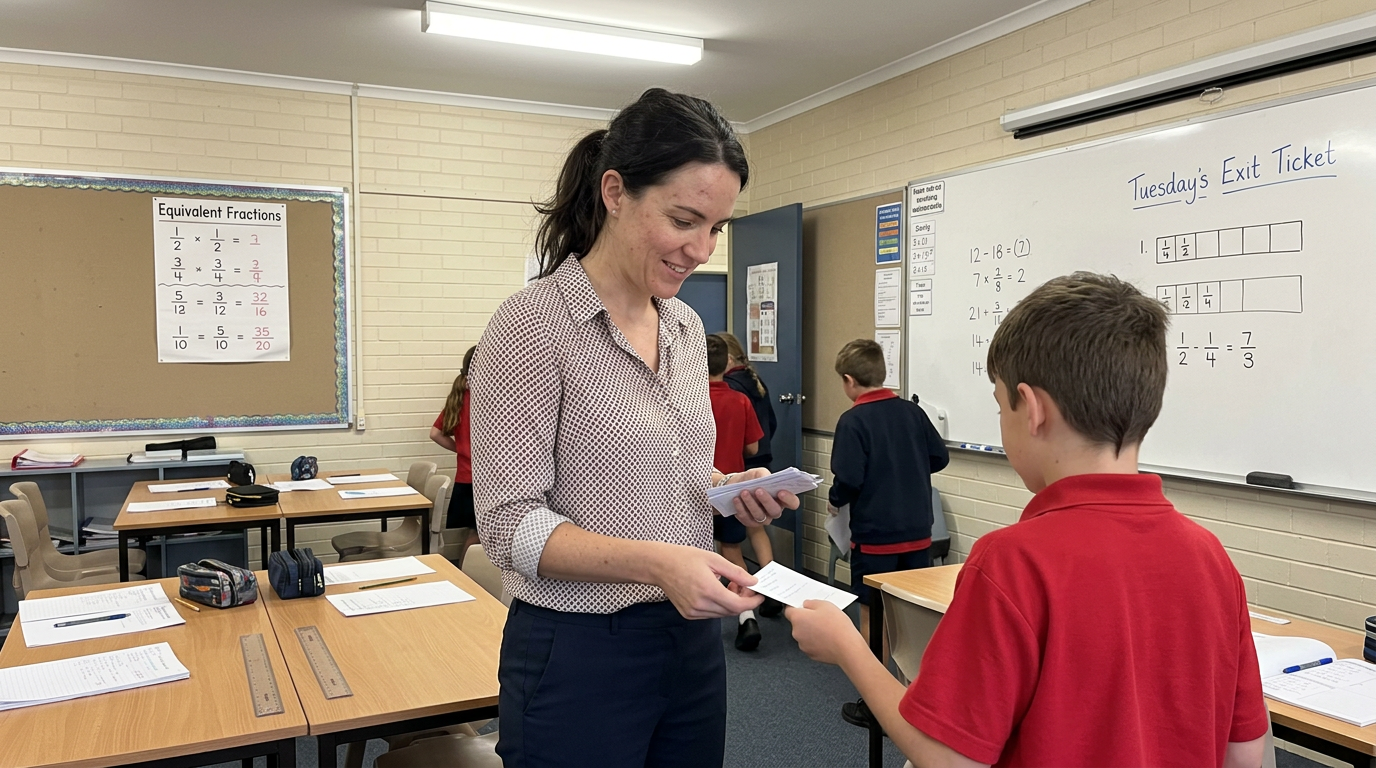
1. Exit tickets
At the end of a math lesson, students answer one carefully chosen question on a slip of paper or a digital form. One question, not five. The question must be aligned to the lesson's learning intention and chosen to discriminate — meaning a student who got the lesson will answer it correctly, and a student who didn't will fail it in a diagnostic way.
What it tells you: who is ready to move on, who needs a re-explanation, and who has a specific bug you can name and fix tomorrow. Sort the slips into three piles in 60 seconds — got it, partial, missed it — and tomorrow's starter writes itself.
Tutero's teaching platform generates exit tickets automatically aligned to the standards strand you taught, so the diagnostic-question design is done for you.
2. Mini-whiteboards
Every student has a small whiteboard and marker. You pose a question — "Show me a fraction equivalent to two-thirds" — and on your cue every student holds up their answer simultaneously. You see the spread of the class in five seconds.
What it tells you: the live distribution of understanding. If 90% are correct, move on. If half the class shows the same wrong answer, you have a shared misconception to address before another minute passes. Mini-whiteboards produce 100% participation — no student can hide behind a confident neighbor — and the erasable surface lowers the cost of being wrong, so students risk thinking out loud.
3. Number talks
Write one mental-math problem on the board — for example, 38 + 25, or 1/4 + 2/3, or 15% of 80, depending on the grade level. Students solve it silently and signal when they have an answer (a thumb against the chest is the convention, so quick students don't broadcast). You then collect three or four different strategies aloud and write each one on the board.
What it tells you: not just whether students got the answer, but how they're thinking. Hearing compensation (40 + 25 − 2), partitioning (30 + 20, then 8 + 5), and bridging (move 2 from 25 to make 40 + 23) side by side builds flexible number sense across the class and tells you which strategies your students already own and which they need exposure to.
4. Targeted questioning
Replace "Does everyone understand?" — which gathers no useful information — with questions that make thinking visible. The four highest-yield questions in math are:
- "How did you get that?"
- "Why does that method work?"
- "What would change if this number were different?"
- "Can you solve it another way?"
Pair each question with three to five seconds of wait time. The research on wait time is consistent: extending the pause from one second to three or more increases the length, accuracy, and confidence of student responses, and pulls in students who would otherwise stay silent.
What it tells you: whether a correct answer was reasoned or guessed, and whether a wrong answer is a slip or a bug. "53" as the answer to 38 + 25 is wrong; "How did you get that?" tells you whether the student forgot to carry the ten or genuinely doesn't understand place value.
5. Self-assessment and confidence rating
At the end of a problem set or worked example, students rate their own understanding. Three formats work reliably:
- 1–5 confidence scale: 1 = I'm lost, 5 = I could teach this to someone else.
- Traffic lights: green = got it, amber = unsure, red = need help.
- Three stars and a wish: students identify three things their peer did well and one thing to improve, which forces them to internalize the success criteria.
What it tells you: the gap between performance and confidence. A student rating themselves 5/5 on a problem they got wrong needs different intervention from one rating themselves 2/5 on a problem they got right. Self-assessment also builds the metacognitive habits the NCTM and the Common Core both call out as core to becoming a confident mathematician.

Best low-effort formative assessment for elementary math?
For elementary math classrooms, mini-whiteboards and a one-question exit ticket cover most of the ground with the least preparation. Mini-whiteboards work in 1st through 5th grade because they remove the writing-as-barrier problem — every student can hold up a number, a tens-frame drawing, or a quick sketch of a fraction without having to write a sentence first.
For exit tickets in elementary, keep the question concrete and tied to one specific skill. "Show me 3/4 on this number line" tells you more than "How did today's lesson go?". Three or four exit-ticket slots a week — not every lesson — is enough to map who needs what without burying you in grading. The Education Endowment Foundation's guidance on formative assessment in elementary math consistently lands on this point: short, frequent, focused beats long, occasional, and broad. Our money worksheets for elementary grades are one source of concrete, single-skill questions for those slots.
How does mini-whiteboarding work for formative assessment?
Mini-whiteboarding works on three mechanics: simultaneity, visibility, and low cost of error. Simultaneity means every student answers at the same time, so quicker students can't anchor the rest of the class. Visibility means every answer is held up at once, so you can scan the room and see the whole distribution in seconds. Low cost of error means the surface erases instantly, so students will risk an answer rather than wait for someone else's.
The routine is short: pose one question, give thinking time, count down ("3, 2, 1, show me"), scan the boards, decide your next move. The decision is the part that turns the routine from a participation trick into formative assessment. If 90% are correct, name what you saw and move on. If a third of the class shows the same wrong answer, freeze the lesson, address the misconception with a different representation, and re-test with a parallel question on the boards.
Mini-whiteboards work from 3rd grade through 12th grade. In high school math they are the fastest way to surface algebraic-manipulation errors before students embed them across a problem set.
How often should you do formative assessment in a math class?
Every lesson should contain at least one formative check. The check does not have to be elaborate — a 30-second mini-whiteboard moment, a "show of fingers 1–5" confidence rating, or a single targeted question with three seconds of wait time all qualify. The frequency is what matters, because formative assessment is most powerful as a habit, not an event.
A reasonable weekly rhythm in elementary or secondary math: a quick whiteboard check or number talk in roughly every lesson, exit tickets two to three times a week, and a longer self-assessment routine once a week (typically Friday, looking back at the week's learning). The goal is not to assess constantly — it is to make the assessment so cheap and frequent that adjusting the lesson on Wednesday based on Tuesday's evidence becomes the normal way you teach, not an extra task.
If the rhythm starts feeling like grading, you have over-engineered it. Cut the questions per check, sort slips into three piles instead of marking them, and keep the focus on what you change tomorrow.
Can AI help with formative assessment in math?
Yes, and it changes the economics. The bottleneck on formative assessment has always been design and grading time — building a discriminating exit-ticket question takes ten minutes if you do it well, and sorting 28 responses into actionable groups takes another ten. AI removes both bottlenecks: standards-aligned tools can generate diagnostic questions in seconds, grade them automatically, and surface the misconceptions to you in plain language.
Tutero's teaching platform generates exit tickets, mini-whiteboard prompts, and number-talk problems aligned to the strand and grade level you teach, grades the responses against standards descriptors, and shows you the misconception list before the next lesson starts. The pedagogical decision is still yours — the platform tells you 60% of 8th graders confused multiplying by a fraction with multiplying by a whole number; you decide whether tomorrow opens with a CPA representation, a worked example, or a re-test with parallel numbers.
For more on what AI changes — and what it deliberately does not change — about classroom assessment, see how to use AI to enhance learning in K-12 education and how to use AI to boost engagement in your math classroom.
How do you act on what formative assessment shows you?
Gathering evidence is half the work. The other half is the response — and the response is what makes the difference between formative assessment and decorative monitoring. Three moves cover most situations:
- Drop down a representation. If the abstract symbolic representation isn't landing, step back to the pictorial (a bar model, a tens frame, a number line) or to concrete manipulatives. The Concrete-Pictorial-Abstract sequence is well-evidenced as the fastest way to repair a math misconception once you've found it.
- Use a worked example. A partially completed example reduces the cognitive load of having to do everything at once, and lets students focus on the specific step they were getting wrong. Pair it with a parallel question they then attempt independently.
- Run a small targeted group. While the rest of the class works on extension or independent practice, pull the four to six students whose exit tickets showed the same bug and reteach with a different representation.
If the formative check tells you 80% of the class is confused and you continue the lesson unchanged, you are not doing formative assessment — you are doing surveillance. Engaging math lessons are not engaging because of the activity choice; they are engaging because students experience their thinking being heard and their misconceptions being repaired in real time.
What are the common formative assessment mistakes to avoid?
Four patterns turn formative assessment into busywork:
- Checking too many concepts at once. One learning intention per check. A six-question exit ticket covering six different skills tells you nothing usable.
- Treating end-of-unit tests as formative. If the result lands after you have moved on, it is summative no matter what you call it. Move the check earlier in the unit.
- Focusing only on the right answers. The wrong answers are the data. A class with 70% correct and 30% all making the same error gives you a clearer next step than a class with 95% correct and a scattered 5%.
- Gathering evidence and not responding to it. If you see the misconception and continue unchanged, the routine has decayed into theater. The evidence has to change tomorrow's lesson.
Keep the checks short, the focus narrow, and the response visible. Students notice when their exit ticket changes the next day's starter. That is the loop you are building.
How does formative assessment fit into the bigger teaching picture?
Formative assessment is not an add-on to your math teaching — it is the engine of your math teaching. It tells you whether your explanation worked, which students need a different representation, and where the unit needs to slow down before next week's introduction of a new concept compounds the gap.
For a wider view of how the moves in this guide fit alongside lesson design, classroom routines, and standards coverage, the guide to teaching math covers the broader pedagogy. The same principle holds in either direction: small, frequent, acted-on checks beat occasional, elaborate, ignored ones.
If you want to put any of this into practice tomorrow morning without redesigning your lessons, Tutero's teaching platform generates standards-aligned exit tickets, mini-whiteboard prompts, and number-talk problems for any grade level — so you can run all five routines this week without spending the weekend writing them.
Formative assessment closes the gap between what your students understand right now and what they need to understand by the end of the lesson — and it tells you in 90 seconds, not 9 weeks.
Formative assessment closes the gap between what your students understand right now and what they need to understand by the end of the lesson — and it tells you in 90 seconds, not 9 weeks.
Formative assessment is the in-lesson check that tells you what your math students understand right now — while there is still time to do something about it.
Done well, it takes 90 seconds and changes the rest of the lesson. Done in five well-chosen routines across the week, it changes the unit. This guide walks through what formative assessment is, why it matters in math specifically, and the five strategies that consistently move learning from elementary through high school.
Quick answer
Formative assessment in math is any short, low-stakes check you do during a lesson — exit tickets, mini-whiteboards, number talks, targeted questioning, self-rating — that shows you what students understand before you move on. The five strategies in this guide work in elementary, middle, and high school math. None require new technology. Each one takes two minutes or less, gives you usable evidence, and lets you adjust teaching while the lesson is still happening rather than discovering the gap on a unit test.
What is formative assessment in math?
Formative assessment is any in-lesson check that surfaces what students understand right now, before the misconception hardens into a habit. Paul Black and Dylan Wiliam coined the working definition in their 1998 review Inside the Black Box: assessment becomes formative when the evidence is actually used to adapt teaching to meet learning needs. The check itself is not the point — the response is.
In math, formative assessment matters more than in most subjects because errors are rarely random. Mathematics-education research distinguishes between slips (a one-off arithmetic mistake) and bugs (a consistent procedural or conceptual error, like always subtracting the smaller digit from the larger one regardless of place value). A 90-second check tells you which one you are looking at, which tells you whether to keep going, slow down, or stop and reteach.
Used consistently, formative assessment turns the math classroom into something closer to one-to-one teaching scaled to a class of 28 — every student's thinking is visible, and every student gets feedback that fits where they are.
What is the difference between formative and summative assessment?
Formative assessment happens during learning to shape it; summative assessment happens after learning to measure it. A mini-whiteboard check halfway through a fractions lesson is formative — it tells you whether to keep going. A state test, a 9th-grade unit test, or an end-of-semester report is summative — it tells you what was learned by the deadline.
Both matter. Summative results are what parents and districts see. But every credible analysis of teacher impact — from Black and Wiliam through John Hattie's Visible Learning meta-synthesis to the Education Endowment Foundation's guidance — finds that the lever inside your control as a classroom teacher is the formative half. Hattie places formative evaluation among the highest-effect instructional practices, with effect sizes well above the average.
The simplest way to keep them straight: formative is feedback to the teacher, summative is feedback about the student. The first one changes what you do next; the second one records what already happened.
What are the most effective formative assessment strategies for the math classroom?
Five strategies do most of the work, across elementary, middle, and high school math. They share three properties: each one is fast (90 seconds to two minutes), each one produces evidence the whole class can see, and each one lets you adjust the lesson immediately. Use them in rotation rather than all at once — one routine per lesson, embedded as habit, beats five routines bolted on as performance.
1. Exit tickets
At the end of a math lesson, students answer one carefully chosen question on a slip of paper or a digital form. One question, not five. The question must be aligned to the lesson's learning intention and chosen to discriminate — meaning a student who got the lesson will answer it correctly, and a student who didn't will fail it in a diagnostic way.
What it tells you: who is ready to move on, who needs a re-explanation, and who has a specific bug you can name and fix tomorrow. Sort the slips into three piles in 60 seconds — got it, partial, missed it — and tomorrow's starter writes itself.
Tutero's teaching platform generates exit tickets automatically aligned to the standards strand you taught, so the diagnostic-question design is done for you.
2. Mini-whiteboards
Every student has a small whiteboard and marker. You pose a question — "Show me a fraction equivalent to two-thirds" — and on your cue every student holds up their answer simultaneously. You see the spread of the class in five seconds.
What it tells you: the live distribution of understanding. If 90% are correct, move on. If half the class shows the same wrong answer, you have a shared misconception to address before another minute passes. Mini-whiteboards produce 100% participation — no student can hide behind a confident neighbor — and the erasable surface lowers the cost of being wrong, so students risk thinking out loud.
3. Number talks
Write one mental-math problem on the board — for example, 38 + 25, or 1/4 + 2/3, or 15% of 80, depending on the grade level. Students solve it silently and signal when they have an answer (a thumb against the chest is the convention, so quick students don't broadcast). You then collect three or four different strategies aloud and write each one on the board.
What it tells you: not just whether students got the answer, but how they're thinking. Hearing compensation (40 + 25 − 2), partitioning (30 + 20, then 8 + 5), and bridging (move 2 from 25 to make 40 + 23) side by side builds flexible number sense across the class and tells you which strategies your students already own and which they need exposure to.
4. Targeted questioning
Replace "Does everyone understand?" — which gathers no useful information — with questions that make thinking visible. The four highest-yield questions in math are:
- "How did you get that?"
- "Why does that method work?"
- "What would change if this number were different?"
- "Can you solve it another way?"
Pair each question with three to five seconds of wait time. The research on wait time is consistent: extending the pause from one second to three or more increases the length, accuracy, and confidence of student responses, and pulls in students who would otherwise stay silent.
What it tells you: whether a correct answer was reasoned or guessed, and whether a wrong answer is a slip or a bug. "53" as the answer to 38 + 25 is wrong; "How did you get that?" tells you whether the student forgot to carry the ten or genuinely doesn't understand place value.
5. Self-assessment and confidence rating
At the end of a problem set or worked example, students rate their own understanding. Three formats work reliably:
- 1–5 confidence scale: 1 = I'm lost, 5 = I could teach this to someone else.
- Traffic lights: green = got it, amber = unsure, red = need help.
- Three stars and a wish: students identify three things their peer did well and one thing to improve, which forces them to internalize the success criteria.
What it tells you: the gap between performance and confidence. A student rating themselves 5/5 on a problem they got wrong needs different intervention from one rating themselves 2/5 on a problem they got right. Self-assessment also builds the metacognitive habits the NCTM and the Common Core both call out as core to becoming a confident mathematician.
Best low-effort formative assessment for elementary math?
For elementary math classrooms, mini-whiteboards and a one-question exit ticket cover most of the ground with the least preparation. Mini-whiteboards work in 1st through 5th grade because they remove the writing-as-barrier problem — every student can hold up a number, a tens-frame drawing, or a quick sketch of a fraction without having to write a sentence first.
For exit tickets in elementary, keep the question concrete and tied to one specific skill. "Show me 3/4 on this number line" tells you more than "How did today's lesson go?". Three or four exit-ticket slots a week — not every lesson — is enough to map who needs what without burying you in grading. The Education Endowment Foundation's guidance on formative assessment in elementary math consistently lands on this point: short, frequent, focused beats long, occasional, and broad. Our money worksheets for elementary grades are one source of concrete, single-skill questions for those slots.
How does mini-whiteboarding work for formative assessment?
Mini-whiteboarding works on three mechanics: simultaneity, visibility, and low cost of error. Simultaneity means every student answers at the same time, so quicker students can't anchor the rest of the class. Visibility means every answer is held up at once, so you can scan the room and see the whole distribution in seconds. Low cost of error means the surface erases instantly, so students will risk an answer rather than wait for someone else's.
The routine is short: pose one question, give thinking time, count down ("3, 2, 1, show me"), scan the boards, decide your next move. The decision is the part that turns the routine from a participation trick into formative assessment. If 90% are correct, name what you saw and move on. If a third of the class shows the same wrong answer, freeze the lesson, address the misconception with a different representation, and re-test with a parallel question on the boards.
Mini-whiteboards work from 3rd grade through 12th grade. In high school math they are the fastest way to surface algebraic-manipulation errors before students embed them across a problem set.
How often should you do formative assessment in a math class?
Every lesson should contain at least one formative check. The check does not have to be elaborate — a 30-second mini-whiteboard moment, a "show of fingers 1–5" confidence rating, or a single targeted question with three seconds of wait time all qualify. The frequency is what matters, because formative assessment is most powerful as a habit, not an event.
A reasonable weekly rhythm in elementary or secondary math: a quick whiteboard check or number talk in roughly every lesson, exit tickets two to three times a week, and a longer self-assessment routine once a week (typically Friday, looking back at the week's learning). The goal is not to assess constantly — it is to make the assessment so cheap and frequent that adjusting the lesson on Wednesday based on Tuesday's evidence becomes the normal way you teach, not an extra task.
If the rhythm starts feeling like grading, you have over-engineered it. Cut the questions per check, sort slips into three piles instead of marking them, and keep the focus on what you change tomorrow.
Can AI help with formative assessment in math?
Yes, and it changes the economics. The bottleneck on formative assessment has always been design and grading time — building a discriminating exit-ticket question takes ten minutes if you do it well, and sorting 28 responses into actionable groups takes another ten. AI removes both bottlenecks: standards-aligned tools can generate diagnostic questions in seconds, grade them automatically, and surface the misconceptions to you in plain language.
Tutero's teaching platform generates exit tickets, mini-whiteboard prompts, and number-talk problems aligned to the strand and grade level you teach, grades the responses against standards descriptors, and shows you the misconception list before the next lesson starts. The pedagogical decision is still yours — the platform tells you 60% of 8th graders confused multiplying by a fraction with multiplying by a whole number; you decide whether tomorrow opens with a CPA representation, a worked example, or a re-test with parallel numbers.
For more on what AI changes — and what it deliberately does not change — about classroom assessment, see how to use AI to enhance learning in K-12 education and how to use AI to boost engagement in your math classroom.
How do you act on what formative assessment shows you?
Gathering evidence is half the work. The other half is the response — and the response is what makes the difference between formative assessment and decorative monitoring. Three moves cover most situations:
- Drop down a representation. If the abstract symbolic representation isn't landing, step back to the pictorial (a bar model, a tens frame, a number line) or to concrete manipulatives. The Concrete-Pictorial-Abstract sequence is well-evidenced as the fastest way to repair a math misconception once you've found it.
- Use a worked example. A partially completed example reduces the cognitive load of having to do everything at once, and lets students focus on the specific step they were getting wrong. Pair it with a parallel question they then attempt independently.
- Run a small targeted group. While the rest of the class works on extension or independent practice, pull the four to six students whose exit tickets showed the same bug and reteach with a different representation.
If the formative check tells you 80% of the class is confused and you continue the lesson unchanged, you are not doing formative assessment — you are doing surveillance. Engaging math lessons are not engaging because of the activity choice; they are engaging because students experience their thinking being heard and their misconceptions being repaired in real time.
What are the common formative assessment mistakes to avoid?
Four patterns turn formative assessment into busywork:
- Checking too many concepts at once. One learning intention per check. A six-question exit ticket covering six different skills tells you nothing usable.
- Treating end-of-unit tests as formative. If the result lands after you have moved on, it is summative no matter what you call it. Move the check earlier in the unit.
- Focusing only on the right answers. The wrong answers are the data. A class with 70% correct and 30% all making the same error gives you a clearer next step than a class with 95% correct and a scattered 5%.
- Gathering evidence and not responding to it. If you see the misconception and continue unchanged, the routine has decayed into theater. The evidence has to change tomorrow's lesson.
Keep the checks short, the focus narrow, and the response visible. Students notice when their exit ticket changes the next day's starter. That is the loop you are building.
How does formative assessment fit into the bigger teaching picture?
Formative assessment is not an add-on to your math teaching — it is the engine of your math teaching. It tells you whether your explanation worked, which students need a different representation, and where the unit needs to slow down before next week's introduction of a new concept compounds the gap.
For a wider view of how the moves in this guide fit alongside lesson design, classroom routines, and standards coverage, the guide to teaching math covers the broader pedagogy. The same principle holds in either direction: small, frequent, acted-on checks beat occasional, elaborate, ignored ones.
If you want to put any of this into practice tomorrow morning without redesigning your lessons, Tutero's teaching platform generates standards-aligned exit tickets, mini-whiteboard prompts, and number-talk problems for any grade level — so you can run all five routines this week without spending the weekend writing them.
FAQ
.svg)
.svg)
Online maths tutoring at Tutero is catering to students of all year levels. We offer programs tailored to the unique learning curves of each age group.
We also have expert NAPLAN and ATAR subject tutors, ensuring students are well-equipped for these pivotal assessments.
We recommend at least two to three session per week for consistent progress. However, this can vary based on your child's needs and goals.
Our platform uses advanced security protocols to ensure the safety and privacy of all our online sessions.
Parents are welcome to observe sessions. We believe in a collaborative approach to education.
We provide regular progress reports and assessments to track your child’s academic development.
Yes, we prioritise the student-tutor relationship and can arrange a change if the need arises.
Yes, we offer a range of resources and materials, including interactive exercises and practice worksheets.
Formative assessment closes the gap between what your students understand right now and what they need to understand by the end of the lesson — and it tells you in 90 seconds, not 9 weeks.
Formative assessment closes the gap between what your students understand right now and what they need to understand by the end of the lesson — and it tells you in 90 seconds, not 9 weeks.

Formative assessment closes the gap between what your students understand right now and what they need to understand by the end of the lesson — and it tells you in 90 seconds, not 9 weeks.
Formative is feedback to the teacher; summative is feedback about the student. The first one changes what you do next; the second one records what already happened.
Formative assessment is the in-lesson check that tells you what your math students understand right now — while there is still time to do something about it.
Done well, it takes 90 seconds and changes the rest of the lesson. Done in five well-chosen routines across the week, it changes the unit. This guide walks through what formative assessment is, why it matters in math specifically, and the five strategies that consistently move learning from elementary through high school.
Quick answer
Formative assessment in math is any short, low-stakes check you do during a lesson — exit tickets, mini-whiteboards, number talks, targeted questioning, self-rating — that shows you what students understand before you move on. The five strategies in this guide work in elementary, middle, and high school math. None require new technology. Each one takes two minutes or less, gives you usable evidence, and lets you adjust teaching while the lesson is still happening rather than discovering the gap on a unit test.
What is formative assessment in math?
Formative assessment is any in-lesson check that surfaces what students understand right now, before the misconception hardens into a habit. Paul Black and Dylan Wiliam coined the working definition in their 1998 review Inside the Black Box: assessment becomes formative when the evidence is actually used to adapt teaching to meet learning needs. The check itself is not the point — the response is.
In math, formative assessment matters more than in most subjects because errors are rarely random. Mathematics-education research distinguishes between slips (a one-off arithmetic mistake) and bugs (a consistent procedural or conceptual error, like always subtracting the smaller digit from the larger one regardless of place value). A 90-second check tells you which one you are looking at, which tells you whether to keep going, slow down, or stop and reteach.
Used consistently, formative assessment turns the math classroom into something closer to one-to-one teaching scaled to a class of 28 — every student's thinking is visible, and every student gets feedback that fits where they are.
What is the difference between formative and summative assessment?
Formative assessment happens during learning to shape it; summative assessment happens after learning to measure it. A mini-whiteboard check halfway through a fractions lesson is formative — it tells you whether to keep going. A state test, a 9th-grade unit test, or an end-of-semester report is summative — it tells you what was learned by the deadline.
Both matter. Summative results are what parents and districts see. But every credible analysis of teacher impact — from Black and Wiliam through John Hattie's Visible Learning meta-synthesis to the Education Endowment Foundation's guidance — finds that the lever inside your control as a classroom teacher is the formative half. Hattie places formative evaluation among the highest-effect instructional practices, with effect sizes well above the average.
The simplest way to keep them straight: formative is feedback to the teacher, summative is feedback about the student. The first one changes what you do next; the second one records what already happened.
What are the most effective formative assessment strategies for the math classroom?
Five strategies do most of the work, across elementary, middle, and high school math. They share three properties: each one is fast (90 seconds to two minutes), each one produces evidence the whole class can see, and each one lets you adjust the lesson immediately. Use them in rotation rather than all at once — one routine per lesson, embedded as habit, beats five routines bolted on as performance.
1. Exit tickets
At the end of a math lesson, students answer one carefully chosen question on a slip of paper or a digital form. One question, not five. The question must be aligned to the lesson's learning intention and chosen to discriminate — meaning a student who got the lesson will answer it correctly, and a student who didn't will fail it in a diagnostic way.
What it tells you: who is ready to move on, who needs a re-explanation, and who has a specific bug you can name and fix tomorrow. Sort the slips into three piles in 60 seconds — got it, partial, missed it — and tomorrow's starter writes itself.
Tutero's teaching platform generates exit tickets automatically aligned to the standards strand you taught, so the diagnostic-question design is done for you.
2. Mini-whiteboards
Every student has a small whiteboard and marker. You pose a question — "Show me a fraction equivalent to two-thirds" — and on your cue every student holds up their answer simultaneously. You see the spread of the class in five seconds.
What it tells you: the live distribution of understanding. If 90% are correct, move on. If half the class shows the same wrong answer, you have a shared misconception to address before another minute passes. Mini-whiteboards produce 100% participation — no student can hide behind a confident neighbor — and the erasable surface lowers the cost of being wrong, so students risk thinking out loud.
3. Number talks
Write one mental-math problem on the board — for example, 38 + 25, or 1/4 + 2/3, or 15% of 80, depending on the grade level. Students solve it silently and signal when they have an answer (a thumb against the chest is the convention, so quick students don't broadcast). You then collect three or four different strategies aloud and write each one on the board.
What it tells you: not just whether students got the answer, but how they're thinking. Hearing compensation (40 + 25 − 2), partitioning (30 + 20, then 8 + 5), and bridging (move 2 from 25 to make 40 + 23) side by side builds flexible number sense across the class and tells you which strategies your students already own and which they need exposure to.
4. Targeted questioning
Replace "Does everyone understand?" — which gathers no useful information — with questions that make thinking visible. The four highest-yield questions in math are:
- "How did you get that?"
- "Why does that method work?"
- "What would change if this number were different?"
- "Can you solve it another way?"
Pair each question with three to five seconds of wait time. The research on wait time is consistent: extending the pause from one second to three or more increases the length, accuracy, and confidence of student responses, and pulls in students who would otherwise stay silent.
What it tells you: whether a correct answer was reasoned or guessed, and whether a wrong answer is a slip or a bug. "53" as the answer to 38 + 25 is wrong; "How did you get that?" tells you whether the student forgot to carry the ten or genuinely doesn't understand place value.
5. Self-assessment and confidence rating
At the end of a problem set or worked example, students rate their own understanding. Three formats work reliably:
- 1–5 confidence scale: 1 = I'm lost, 5 = I could teach this to someone else.
- Traffic lights: green = got it, amber = unsure, red = need help.
- Three stars and a wish: students identify three things their peer did well and one thing to improve, which forces them to internalize the success criteria.
What it tells you: the gap between performance and confidence. A student rating themselves 5/5 on a problem they got wrong needs different intervention from one rating themselves 2/5 on a problem they got right. Self-assessment also builds the metacognitive habits the NCTM and the Common Core both call out as core to becoming a confident mathematician.
Best low-effort formative assessment for elementary math?
For elementary math classrooms, mini-whiteboards and a one-question exit ticket cover most of the ground with the least preparation. Mini-whiteboards work in 1st through 5th grade because they remove the writing-as-barrier problem — every student can hold up a number, a tens-frame drawing, or a quick sketch of a fraction without having to write a sentence first.
For exit tickets in elementary, keep the question concrete and tied to one specific skill. "Show me 3/4 on this number line" tells you more than "How did today's lesson go?". Three or four exit-ticket slots a week — not every lesson — is enough to map who needs what without burying you in grading. The Education Endowment Foundation's guidance on formative assessment in elementary math consistently lands on this point: short, frequent, focused beats long, occasional, and broad. Our money worksheets for elementary grades are one source of concrete, single-skill questions for those slots.
How does mini-whiteboarding work for formative assessment?
Mini-whiteboarding works on three mechanics: simultaneity, visibility, and low cost of error. Simultaneity means every student answers at the same time, so quicker students can't anchor the rest of the class. Visibility means every answer is held up at once, so you can scan the room and see the whole distribution in seconds. Low cost of error means the surface erases instantly, so students will risk an answer rather than wait for someone else's.
The routine is short: pose one question, give thinking time, count down ("3, 2, 1, show me"), scan the boards, decide your next move. The decision is the part that turns the routine from a participation trick into formative assessment. If 90% are correct, name what you saw and move on. If a third of the class shows the same wrong answer, freeze the lesson, address the misconception with a different representation, and re-test with a parallel question on the boards.
Mini-whiteboards work from 3rd grade through 12th grade. In high school math they are the fastest way to surface algebraic-manipulation errors before students embed them across a problem set.
How often should you do formative assessment in a math class?
Every lesson should contain at least one formative check. The check does not have to be elaborate — a 30-second mini-whiteboard moment, a "show of fingers 1–5" confidence rating, or a single targeted question with three seconds of wait time all qualify. The frequency is what matters, because formative assessment is most powerful as a habit, not an event.
A reasonable weekly rhythm in elementary or secondary math: a quick whiteboard check or number talk in roughly every lesson, exit tickets two to three times a week, and a longer self-assessment routine once a week (typically Friday, looking back at the week's learning). The goal is not to assess constantly — it is to make the assessment so cheap and frequent that adjusting the lesson on Wednesday based on Tuesday's evidence becomes the normal way you teach, not an extra task.
If the rhythm starts feeling like grading, you have over-engineered it. Cut the questions per check, sort slips into three piles instead of marking them, and keep the focus on what you change tomorrow.
Can AI help with formative assessment in math?
Yes, and it changes the economics. The bottleneck on formative assessment has always been design and grading time — building a discriminating exit-ticket question takes ten minutes if you do it well, and sorting 28 responses into actionable groups takes another ten. AI removes both bottlenecks: standards-aligned tools can generate diagnostic questions in seconds, grade them automatically, and surface the misconceptions to you in plain language.
Tutero's teaching platform generates exit tickets, mini-whiteboard prompts, and number-talk problems aligned to the strand and grade level you teach, grades the responses against standards descriptors, and shows you the misconception list before the next lesson starts. The pedagogical decision is still yours — the platform tells you 60% of 8th graders confused multiplying by a fraction with multiplying by a whole number; you decide whether tomorrow opens with a CPA representation, a worked example, or a re-test with parallel numbers.
For more on what AI changes — and what it deliberately does not change — about classroom assessment, see how to use AI to enhance learning in K-12 education and how to use AI to boost engagement in your math classroom.
How do you act on what formative assessment shows you?
Gathering evidence is half the work. The other half is the response — and the response is what makes the difference between formative assessment and decorative monitoring. Three moves cover most situations:
- Drop down a representation. If the abstract symbolic representation isn't landing, step back to the pictorial (a bar model, a tens frame, a number line) or to concrete manipulatives. The Concrete-Pictorial-Abstract sequence is well-evidenced as the fastest way to repair a math misconception once you've found it.
- Use a worked example. A partially completed example reduces the cognitive load of having to do everything at once, and lets students focus on the specific step they were getting wrong. Pair it with a parallel question they then attempt independently.
- Run a small targeted group. While the rest of the class works on extension or independent practice, pull the four to six students whose exit tickets showed the same bug and reteach with a different representation.
If the formative check tells you 80% of the class is confused and you continue the lesson unchanged, you are not doing formative assessment — you are doing surveillance. Engaging math lessons are not engaging because of the activity choice; they are engaging because students experience their thinking being heard and their misconceptions being repaired in real time.
What are the common formative assessment mistakes to avoid?
Four patterns turn formative assessment into busywork:
- Checking too many concepts at once. One learning intention per check. A six-question exit ticket covering six different skills tells you nothing usable.
- Treating end-of-unit tests as formative. If the result lands after you have moved on, it is summative no matter what you call it. Move the check earlier in the unit.
- Focusing only on the right answers. The wrong answers are the data. A class with 70% correct and 30% all making the same error gives you a clearer next step than a class with 95% correct and a scattered 5%.
- Gathering evidence and not responding to it. If you see the misconception and continue unchanged, the routine has decayed into theater. The evidence has to change tomorrow's lesson.
Keep the checks short, the focus narrow, and the response visible. Students notice when their exit ticket changes the next day's starter. That is the loop you are building.
How does formative assessment fit into the bigger teaching picture?
Formative assessment is not an add-on to your math teaching — it is the engine of your math teaching. It tells you whether your explanation worked, which students need a different representation, and where the unit needs to slow down before next week's introduction of a new concept compounds the gap.
For a wider view of how the moves in this guide fit alongside lesson design, classroom routines, and standards coverage, the guide to teaching math covers the broader pedagogy. The same principle holds in either direction: small, frequent, acted-on checks beat occasional, elaborate, ignored ones.
If you want to put any of this into practice tomorrow morning without redesigning your lessons, Tutero's teaching platform generates standards-aligned exit tickets, mini-whiteboard prompts, and number-talk problems for any grade level — so you can run all five routines this week without spending the weekend writing them.
Formative assessment closes the gap between what your students understand right now and what they need to understand by the end of the lesson — and it tells you in 90 seconds, not 9 weeks.
Formative is feedback to the teacher; summative is feedback about the student. The first one changes what you do next; the second one records what already happened.
Five strategies do most of the work in elementary, middle, and high school math: exit tickets (one diagnostic question at the end of a lesson), mini-whiteboards (every student answers simultaneously), number talks (one mental-math problem with several student strategies shared), targeted questioning ("How did you get that?" not "Does everyone understand?"), and self-assessment (1–5 confidence ratings or traffic lights). Each takes two minutes or less and produces evidence you can act on before the lesson ends.
Formative assessment happens during a lesson to shape it; summative assessment happens after a lesson or unit to measure it. A mini-whiteboard check halfway through a fractions lesson is formative — it tells you whether to keep going. A state test or end-of-semester test is summative — it tells you what was learned by the deadline. Formative is feedback to the teacher; summative is feedback about the student.
An exit ticket is one carefully chosen question students answer at the end of a math lesson, on a slip of paper or a digital form. The question is aligned to the lesson's learning intention and chosen to discriminate — students who got the lesson answer it correctly; students who didn't fail it diagnostically. Sort the slips into three piles (got it, partial, missed it) in 60 seconds and tomorrow's starter writes itself.
Every lesson should contain at least one formative check, but the check does not have to be elaborate — a 30-second mini-whiteboard moment, a confidence rating, or a single targeted question with three seconds of wait time all qualify. A reasonable weekly rhythm in elementary or secondary math: a quick whiteboard check or number talk most lessons, exit tickets two to three times a week, and a longer self-assessment routine once a week.
Yes. The bottleneck on formative assessment has always been design and grading time. AI removes both: standards-aligned tools generate diagnostic exit-ticket questions in seconds, grade them automatically, and surface the misconceptions in plain language. The pedagogical decision — whether tomorrow opens with a different representation, a worked example, or a re-test — is still yours; the platform just removes the time cost of getting to it.
Mini-whiteboards and a one-question exit ticket cover most of the ground with the least preparation. Mini-whiteboards work in 1st through 5th grade because they remove the writing-as-barrier problem — students hold up a number, a tens-frame drawing, or a quick fraction sketch. Three or four exit-ticket slots a week is enough to map who needs what without burying you in grading.
Hoping to improve confidence & grades?

.png)