.svg)

Math intervention is the precision response to specific learning gaps. Effective intervention diagnoses where a student's thinking breaks down, then reteaches that exact step using small-group time, concrete representations, and frequent retrieval — not extra worksheets. Done well, intervention closes a 12–18 month gap inside a school term. Done as "more of the same", it doesn't move the dial.
If you're a classroom teacher, head of math, or learning-support lead trying to help students who are 6 months to 2+ years behind, this guide gives you the model. The Tier 1/2/3 framework, the Concrete-Representational-Abstract (CRA) sequence, the diagnostic cycle, the retrieval-practice routine, the error-pattern analysis approach, and the signal that tells you a student needs a specialist referral — pulled from the Education Endowment Foundation, the IES What Works Clearinghouse, and Hattie's Visible Learning effect sizes.

What are the best math intervention strategies?
The strategies with the strongest evidence base are explicit instruction, the Concrete-Representational-Abstract (CRA) sequence, small-group targeted teaching, retrieval practice, and structured error-pattern analysis. The EEF's Improving Mathematics in Key Stages 2 and 3 guidance and the IES What Works Clearinghouse Assisting Students Struggling with Mathematics practice guide both rank these at the top. Hattie's Visible Learning meta-analysis puts small-group tuition at d = 0.47, mastery learning at d = 0.61, and direct instruction at d = 0.59 — all well above the 0.40 threshold for a year's worth of growth.
The strategies share a single principle: respond to the specific gap, with the specific representation, in a tight feedback loop. They don't share a method — explicit instruction is teacher-led, retrieval practice is student-led, error analysis is diagnostic. What they share is precision over volume.
- Explicit instruction with worked examples — model the thinking step by step before students attempt independently (I Do / We Do / You Do)
- The CRA sequence — concrete manipulatives → visual representation → abstract symbols, in that order, especially for foundational concepts
- Small-group targeted teaching — 3–5 students with the same gap, 10–20 minute sessions, 3–4 times a week
- Retrieval practice — short low-stakes quizzes that force students to retrieve previously taught material from memory
- Error-pattern analysis — read student work for the consistent misconception, not just the mark
- Spaced and interleaved practice — mix current content with material from earlier weeks rather than blocking it by topic
The biggest mistake we see in schools is treating intervention as "more of the same content, slower." Effective intervention is different content — diagnostic, representational, and tightly responsive to what the student just got wrong.
How do I help students who are struggling with math?
Start by changing what you're trying to fix. A student who's struggling rarely needs more practice on the topic you're currently teaching — they need targeted reteaching of the foundational step that broke down two or three units ago. A 7th-grade student "behind in algebra" is almost always behind in fractions. A 5th-grade student "behind in long multiplication" is almost always behind in place value. The visible struggle and the actual gap are different things.
The cycle that works in classrooms looks like this:
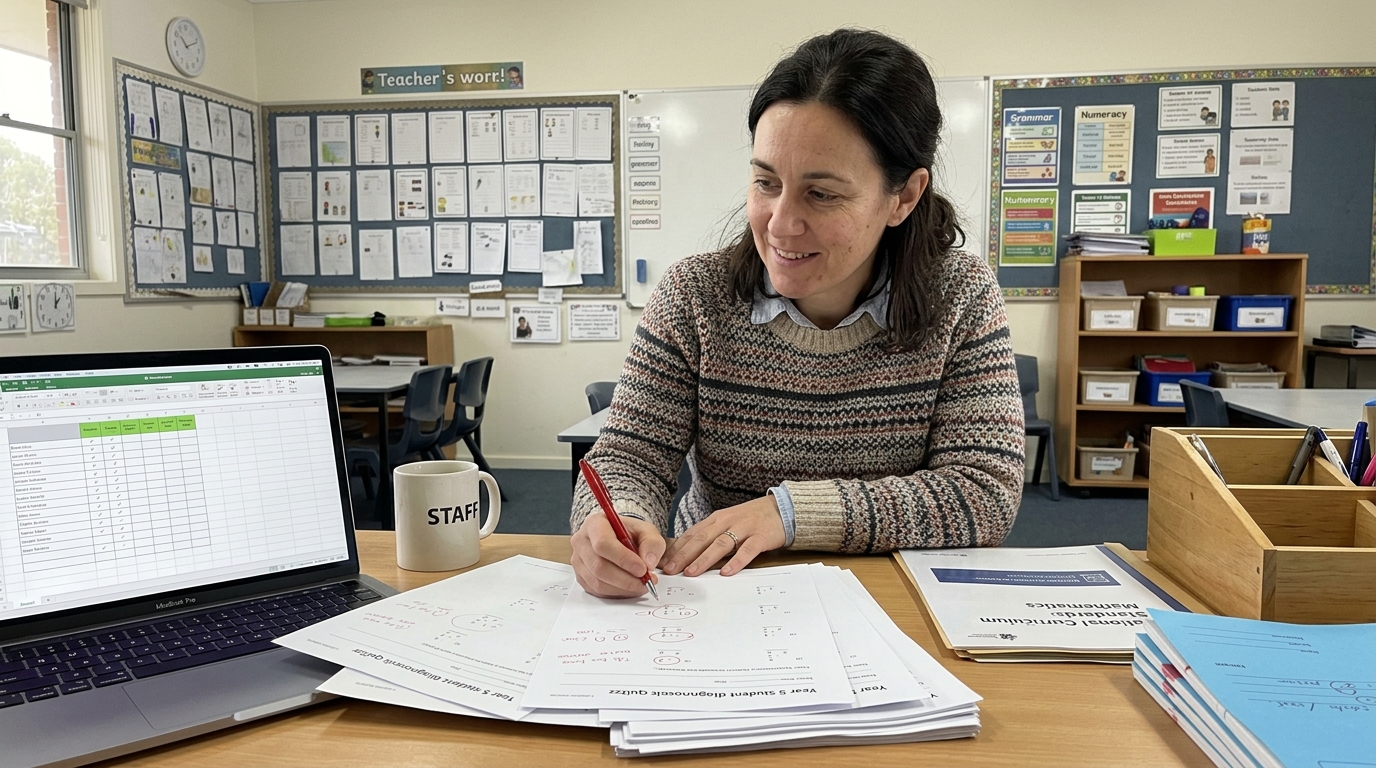
- Diagnose — give a short pre-quiz (8–12 questions) that probes the prerequisite concepts for what you're teaching, not the current topic. Mark for misconceptions, not totals.
- Identify — group students by the specific misconception that surfaced. Three students confused about regrouping is a different group from two students confused about place-value naming.
- Reteach with CRA — pull the small group for 15 minutes. Start with concrete materials (base-ten blocks, fraction tiles, counters), move to a drawn representation, then to abstract notation. Don't skip the concrete step "because they're older" — 8th-grade students benefit from algebra tiles for the same reason 2nd-grade students benefit from blocks.
- Check — finish with a 3-question exit ticket on the same misconception. If they're still wrong, the next session repeats the concrete step with a different example.
- Reintegrate — mix the reteach concept into the next week's warm-ups so retrieval keeps the new understanding active.
None of this requires a free period. The diagnostic quiz is your existing exit ticket repurposed. The reteach is 15 minutes of your existing class time while the rest of the class works on a related task. Exit tickets used as diagnostic tools give you the data without adding marking load.
Teach to the gap, not to the group. The group looks like one cohort behind; the gap is usually three different misconceptions that need three different reteaches.
What is the Concrete-Representational-Abstract (CRA) sequence?
The Concrete-Representational-Abstract (CRA) sequence is a three-stage progression for teaching any math concept: students first manipulate physical objects (concrete), then work with visual representations of those objects (representational / pictorial), and finally with abstract symbols (numerals, operators, equations). The sequence comes from Bruner's enactive-iconic-symbolic theory, was operationalized by Singapore Math, and is now the spine of evidence-based intervention guidance from the EEF and IES.
Why the order matters: math concepts are abstractions of physical relationships. A struggling student stuck on fractions usually doesn't have a flawed grasp of the symbols — they never built the underlying physical model the symbols stand for. CRA rebuilds the model.
A worked example for fractions:
- Concrete: the student physically divides a rectangle of paper into 4 equal parts and shades 3 of them. They feel the cut, the count, the shaded portion.
- Representational: the student draws a rectangle on paper, divides it into 4 equal parts, shades 3. Same operation, on the page, without the materials.
- Abstract: the student writes 3/4 and explains what each numeral represents.
Each stage takes as long as it takes. Older students often move through concrete and representational quickly, but skipping concrete entirely is the most common cause of "they get it in class but can't do it on the test" — there's no underlying mental model to retrieve.
CRA works for adding fractions, regrouping in subtraction, place value, ratio and proportion, algebra, and integer arithmetic. The materials change (Cuisenaire rods, fraction tiles, algebra tiles, two-color counters), the sequence doesn't.
How does Tier 1, Tier 2, and Tier 3 intervention work in math?
The tiered intervention model (sometimes called Response to Intervention or RTI, sometimes Multi-Tiered System of Supports) sorts math support into three intensities matched to need. Tier 1 is high-quality classroom teaching for everyone. Tier 2 is small-group targeted teaching for students with identified gaps. Tier 3 is intensive one-to-one or very-small-group support for students who haven't responded to Tier 2. The proportions in a typical school are roughly 80% / 15% / 5%.
What each tier looks like in practice:
- Tier 1 — High-quality classroom teaching. Aligned to the state K–12 standards, paced to the cohort, with visible models, retrieval starters, and short formative checks (exit tickets, mini-whiteboard responses). Strong Tier 1 reduces the demand on Tiers 2 and 3 more than any other lever in the school.
- Tier 2 — Small-group targeted intervention. 3–5 students with the same diagnosed misconception, 15–20 minute sessions, 3–4 times per week, for 8–12 weeks. Delivered by the classroom teacher, learning-support teacher, or trained teacher's aide using a structured program. Progress monitored with weekly mastery checks.
- Tier 3 — Intensive individualized intervention. 1:1 or 1:2, 30+ minutes daily, delivered by a specialist (learning-support teacher, EAL/D specialist, or external tutor with intervention training). Reserved for students who haven't responded to 8–12 weeks of well-implemented Tier 2.
The cardinal rule: a student doesn't get parked at a tier. Diagnostic checks every 2–3 weeks tell you whether to step them down (the gap closed), hold (still progressing), or step up (Tier 2 isn't enough). Tier 3 is a response to non-response, not a permanent placement.
What's the most effective intervention for math anxiety?
Math anxiety is reduced most reliably by predictable low-stakes routines that build early success: short retrieval starters with a high success rate, structured response time, no public mark-reading, and explicit "you can be wrong here" framing. Ashcraft and Krause's working-memory research (2007) shows anxiety occupies the same cognitive resources needed for problem-solving, so a student in an anxiety state literally has less working memory available for the math in front of them. Reducing anxiety isn't a soft outcome — it directly increases the cognitive resources available to learn.
What works inside a typical classroom:
- Open every lesson with retrieval the student can answer correctly. Two questions from last week's well-mastered material, then one stretch question. Success first, struggle second.
- Replace cold calling with mini-whiteboards. Everyone responds at once, the teacher scans for misconceptions, no public exposure for getting it wrong.
- Time-boxed problem-solving without a stopwatch on display. "We'll work on this for 8 minutes" lands very differently from a visible countdown timer.
- Verbal-explanation-before-written-work. Anxious students often know more than they can write down under pressure. A 30-second verbal explanation to a partner relieves the working-memory load.
- Name the anxiety without dismissing it. "Lots of people feel this in math. It's not about ability — it's about the brain trying to keep you safe. Here's the routine that helps."
What doesn't work: surprise quizzes, public score reading, "you should know this by now" framing, and time-pressure on initial learning. Anxiety responds to predictability and small wins, not exposure therapy.
How do I diagnose where a student is stuck in math?
Diagnose by reading the work, not the mark. A student who scores 4/10 on a fractions quiz could have six different underlying gaps depending on which 6 they got wrong, what the wrong answer was, and what working they showed. The mark tells you a student is struggling. The error pattern tells you what to teach next.
A 20-minute error-pattern analysis routine that works:
- Pull the work for one quiz across the class. Sort by question (not student).
- For each question, group the wrong answers by what the answer was. Three students wrote 3/7 when adding 1/3 + 2/4? They share a misconception ("add the tops, add the bottoms"). One student wrote 11/12 — they got it right but slowly. One student wrote nothing — they couldn't start.
- Name the misconception in plain language. "Treats the denominator as something to add" is more useful than "doesn't understand fractions."
- Group students by misconception, not by mark. Two students who scored 3/10 with the same misconception need the same reteach. Two students who scored 3/10 with different misconceptions need different reteaches.
- Pick the highest-leverage misconception first. Place value, regrouping, and equivalence underpin most secondary algebra struggles. If the misconception is foundational, reteach it before moving on.
The fastest tool for the diagnostic step is a short, well-designed exit ticket — three to five questions probing a specific concept, marked for the misconception, returned the same day. Formative assessment built on this rhythm turns every lesson into a diagnostic without adding to the marking load.
What's the best way to teach math to students 2+ years behind?
For students 2+ years behind, the right approach is a structured intervention program that explicitly reteaches the foundational gaps — not an attempt to "catch up" by accelerating through current curriculum. The IES What Works Clearinghouse rates structured, sequential, evidence-based programs (with explicit instruction, CRA, and frequent progress monitoring) as having the strongest evidence for students well below grade level. Acceleration without filling gaps reliably fails.
The realistic plan looks like this:
- Diagnose down to the gap. A student "2 years behind in 8th grade" needs a 5th/6th-grade diagnostic, not an 8th-grade one. Find the level at which they have 70%+ accuracy unaided — that's the entry point.
- Intervene at the gap, not the grade. Reteach 5th/6th-grade fractions and decimals with CRA, in small group or 1:1, before attempting 8th-grade algebra.
- Run two parallel tracks. The student still attends Tier 1 classroom math (with task-modified content where possible) AND receives Tier 2 or Tier 3 intervention on the foundational gap. Don't pull them out of class entirely — they lose the cohort experience and the Tier 1 modeling.
- Set realistic timelines. Closing a 2-year gap typically takes 6–12 months of well-implemented intervention. The first 8–12 weeks should show measurable movement on weekly mastery checks; if they don't, the program isn't working.
- Track progress, not just pace. A student moving from 30% to 70% mastery on 5th-grade place value in 12 weeks is succeeding even if their 8th-grade marks hasn't moved yet. The 8th-grade marks follows the closed gap by 1–2 terms.
This is also where AI-assisted differentiation earns its keep — a teacher running 4 reteach groups across one period can use AI to generate worked examples at the right level, build retrieval starters tied to each group's misconception, and surface error patterns from quiz photos. The teacher still decides; the AI handles the volume of differentiation that would otherwise crush a single human's prep time. Math teachers using AI describe the gain as "I can finally run real Tier 2."
When should I refer a math student for specialist support?
Refer when a student hasn't responded to 8–12 weeks of well-implemented Tier 2 intervention, when the gap is wider than 2–3 year levels, or when error patterns suggest a specific learning difficulty (dyscalculia, working-memory difficulties, or language-based difficulties affecting math comprehension). The threshold isn't "this student is struggling" — most struggling students respond to Tier 2. The threshold is "this student isn't responding to evidence-based intervention delivered with fidelity."
Concrete signals that warrant a referral conversation:
- No measurable progress on weekly mastery checks after 8 weeks of consistent Tier 2 intervention
- Persistent number-sense difficulties — confusion about which of two numbers is larger, difficulty subitizing small quantities, no automatic recall of single-digit number bonds by 4th grade
- Disproportionate working-memory load — student can do single-step problems but consistently breaks down on multi-step, even with prompts
- Significant gap between math and other subjects — a student who reads at age level but is 3+ years behind in math, or vice versa
- Anxiety severe enough to prevent engagement with even low-stakes tasks despite predictable routines
The referral pathway in most American schools runs through the learning-support team, then potentially to an educational psychologist for cognitive assessment. Document what you've tried (program, frequency, duration, progress data) — referrals supported by clear Tier 2 data are taken much more seriously than "I think this student needs help."
How can AI help me run math intervention at classroom scale?
AI is most useful for the parts of intervention that are high-volume and low-judgement: generating differentiated practice at three levels for the same misconception, building retrieval starters tied to each group, drafting parent-communication updates, and surfacing patterns across diagnostic quiz responses. The teacher's judgement — diagnosing the misconception, picking the representation, deciding which student needs which group — stays human. The volume of differentiation, drafting, and pattern-spotting moves to the AI. That's the trade that makes Tier 2 sustainable.
Concrete uses that classroom teachers report as time-savers:
- Differentiated worked examples — "Give me three worked examples for adding fractions with unlike denominators, at three different levels: foundation (halves and quarters only), core (denominators up to 12), stretch (mixed numbers)."
- Targeted retrieval starters — "Generate a 5-question retrieval starter for a 6th-grade group whose main misconception is treating the denominator as additive."
- Error-pattern analysis at scale — feed photos or text of student answers in; the AI surfaces the consistent misconception across the group.
- Parent-communication drafts — short, plain-language updates summarizing what the student is working on and what's progressing, ready for the teacher to review and send.
- Lesson-prep skeleton — a Tier 2 small-group plan with warm-up, CRA reteach, guided practice, exit ticket — adapted to the specific misconception, in 90 seconds.
Tutero's AI tools for teachers are built for exactly this — the teaching judgement stays with the teacher, the differentiation volume moves to the model. Used well, AI doesn't replace intervention expertise — it makes well-designed intervention practical inside a real teaching load.
Related reading
- Creating math exit tickets with AI — the diagnostic step at the heart of every intervention cycle
- Formative assessment strategies for the math classroom — exit tickets as diagnostic, mini-whiteboards as retrieval, and the rhythm that makes both stick
- Teaching math for out-of-field educators — how to build subject confidence when you're teaching math without a math background
- The guide to teaching math in the U.S. — curriculum, pedagogy, and the school context intervention sits inside
- 6 ways math teachers are using AI — practical AI integrations from American classrooms
- How to use AI to boost engagement in your math classroom — engagement strategies that complement the intervention work
- Tutoring for struggling students vs high-achievers — what changes about intervention when a parent is funding 1:1 support outside school
The bottom line for teachers
The teachers who close math gaps don't work harder than everyone else — they teach with more precision. They diagnose where each student's thinking breaks down, pick the right tier of support, sequence concrete-representational-abstract through the gap, and run a tight diagnostic loop that tells them when to step a student up, hold, or step down. Volume doesn't close gaps. Precision does.
If you're running classroom intervention right now and wondering where AI fits, the honest answer is: it fits in the prep, the differentiation, and the pattern-spotting — never in the diagnosis or the relationship. Tutero is the AI teaching platform built for this. Worked examples, retrieval starters, exit tickets, and small-group plans, generated at the level your group needs, in the time you have. The judgement stays with you; the volume moves to the model. That's what makes real Tier 2 sustainable.
Teach to the gap, not to the group. The group looks like one cohort behind; the gap is usually three different misconceptions that need three different reteaches.
Teach to the gap, not to the group. The group looks like one cohort behind; the gap is usually three different misconceptions that need three different reteaches.
Math intervention is the precision response to specific learning gaps. Effective intervention diagnoses where a student's thinking breaks down, then reteaches that exact step using small-group time, concrete representations, and frequent retrieval — not extra worksheets. Done well, intervention closes a 12–18 month gap inside a school term. Done as "more of the same", it doesn't move the dial.
If you're a classroom teacher, head of math, or learning-support lead trying to help students who are 6 months to 2+ years behind, this guide gives you the model. The Tier 1/2/3 framework, the Concrete-Representational-Abstract (CRA) sequence, the diagnostic cycle, the retrieval-practice routine, the error-pattern analysis approach, and the signal that tells you a student needs a specialist referral — pulled from the Education Endowment Foundation, the IES What Works Clearinghouse, and Hattie's Visible Learning effect sizes.
What are the best math intervention strategies?
The strategies with the strongest evidence base are explicit instruction, the Concrete-Representational-Abstract (CRA) sequence, small-group targeted teaching, retrieval practice, and structured error-pattern analysis. The EEF's Improving Mathematics in Key Stages 2 and 3 guidance and the IES What Works Clearinghouse Assisting Students Struggling with Mathematics practice guide both rank these at the top. Hattie's Visible Learning meta-analysis puts small-group tuition at d = 0.47, mastery learning at d = 0.61, and direct instruction at d = 0.59 — all well above the 0.40 threshold for a year's worth of growth.
The strategies share a single principle: respond to the specific gap, with the specific representation, in a tight feedback loop. They don't share a method — explicit instruction is teacher-led, retrieval practice is student-led, error analysis is diagnostic. What they share is precision over volume.
- Explicit instruction with worked examples — model the thinking step by step before students attempt independently (I Do / We Do / You Do)
- The CRA sequence — concrete manipulatives → visual representation → abstract symbols, in that order, especially for foundational concepts
- Small-group targeted teaching — 3–5 students with the same gap, 10–20 minute sessions, 3–4 times a week
- Retrieval practice — short low-stakes quizzes that force students to retrieve previously taught material from memory
- Error-pattern analysis — read student work for the consistent misconception, not just the mark
- Spaced and interleaved practice — mix current content with material from earlier weeks rather than blocking it by topic
The biggest mistake we see in schools is treating intervention as "more of the same content, slower." Effective intervention is different content — diagnostic, representational, and tightly responsive to what the student just got wrong.
How do I help students who are struggling with math?
Start by changing what you're trying to fix. A student who's struggling rarely needs more practice on the topic you're currently teaching — they need targeted reteaching of the foundational step that broke down two or three units ago. A 7th-grade student "behind in algebra" is almost always behind in fractions. A 5th-grade student "behind in long multiplication" is almost always behind in place value. The visible struggle and the actual gap are different things.
The cycle that works in classrooms looks like this:
- Diagnose — give a short pre-quiz (8–12 questions) that probes the prerequisite concepts for what you're teaching, not the current topic. Mark for misconceptions, not totals.
- Identify — group students by the specific misconception that surfaced. Three students confused about regrouping is a different group from two students confused about place-value naming.
- Reteach with CRA — pull the small group for 15 minutes. Start with concrete materials (base-ten blocks, fraction tiles, counters), move to a drawn representation, then to abstract notation. Don't skip the concrete step "because they're older" — 8th-grade students benefit from algebra tiles for the same reason 2nd-grade students benefit from blocks.
- Check — finish with a 3-question exit ticket on the same misconception. If they're still wrong, the next session repeats the concrete step with a different example.
- Reintegrate — mix the reteach concept into the next week's warm-ups so retrieval keeps the new understanding active.
None of this requires a free period. The diagnostic quiz is your existing exit ticket repurposed. The reteach is 15 minutes of your existing class time while the rest of the class works on a related task. Exit tickets used as diagnostic tools give you the data without adding marking load.
Teach to the gap, not to the group. The group looks like one cohort behind; the gap is usually three different misconceptions that need three different reteaches.
What is the Concrete-Representational-Abstract (CRA) sequence?
The Concrete-Representational-Abstract (CRA) sequence is a three-stage progression for teaching any math concept: students first manipulate physical objects (concrete), then work with visual representations of those objects (representational / pictorial), and finally with abstract symbols (numerals, operators, equations). The sequence comes from Bruner's enactive-iconic-symbolic theory, was operationalized by Singapore Math, and is now the spine of evidence-based intervention guidance from the EEF and IES.
Why the order matters: math concepts are abstractions of physical relationships. A struggling student stuck on fractions usually doesn't have a flawed grasp of the symbols — they never built the underlying physical model the symbols stand for. CRA rebuilds the model.
A worked example for fractions:
- Concrete: the student physically divides a rectangle of paper into 4 equal parts and shades 3 of them. They feel the cut, the count, the shaded portion.
- Representational: the student draws a rectangle on paper, divides it into 4 equal parts, shades 3. Same operation, on the page, without the materials.
- Abstract: the student writes 3/4 and explains what each numeral represents.
Each stage takes as long as it takes. Older students often move through concrete and representational quickly, but skipping concrete entirely is the most common cause of "they get it in class but can't do it on the test" — there's no underlying mental model to retrieve.
CRA works for adding fractions, regrouping in subtraction, place value, ratio and proportion, algebra, and integer arithmetic. The materials change (Cuisenaire rods, fraction tiles, algebra tiles, two-color counters), the sequence doesn't.
How does Tier 1, Tier 2, and Tier 3 intervention work in math?
The tiered intervention model (sometimes called Response to Intervention or RTI, sometimes Multi-Tiered System of Supports) sorts math support into three intensities matched to need. Tier 1 is high-quality classroom teaching for everyone. Tier 2 is small-group targeted teaching for students with identified gaps. Tier 3 is intensive one-to-one or very-small-group support for students who haven't responded to Tier 2. The proportions in a typical school are roughly 80% / 15% / 5%.
What each tier looks like in practice:
- Tier 1 — High-quality classroom teaching. Aligned to the state K–12 standards, paced to the cohort, with visible models, retrieval starters, and short formative checks (exit tickets, mini-whiteboard responses). Strong Tier 1 reduces the demand on Tiers 2 and 3 more than any other lever in the school.
- Tier 2 — Small-group targeted intervention. 3–5 students with the same diagnosed misconception, 15–20 minute sessions, 3–4 times per week, for 8–12 weeks. Delivered by the classroom teacher, learning-support teacher, or trained teacher's aide using a structured program. Progress monitored with weekly mastery checks.
- Tier 3 — Intensive individualized intervention. 1:1 or 1:2, 30+ minutes daily, delivered by a specialist (learning-support teacher, EAL/D specialist, or external tutor with intervention training). Reserved for students who haven't responded to 8–12 weeks of well-implemented Tier 2.
The cardinal rule: a student doesn't get parked at a tier. Diagnostic checks every 2–3 weeks tell you whether to step them down (the gap closed), hold (still progressing), or step up (Tier 2 isn't enough). Tier 3 is a response to non-response, not a permanent placement.
What's the most effective intervention for math anxiety?
Math anxiety is reduced most reliably by predictable low-stakes routines that build early success: short retrieval starters with a high success rate, structured response time, no public mark-reading, and explicit "you can be wrong here" framing. Ashcraft and Krause's working-memory research (2007) shows anxiety occupies the same cognitive resources needed for problem-solving, so a student in an anxiety state literally has less working memory available for the math in front of them. Reducing anxiety isn't a soft outcome — it directly increases the cognitive resources available to learn.
What works inside a typical classroom:
- Open every lesson with retrieval the student can answer correctly. Two questions from last week's well-mastered material, then one stretch question. Success first, struggle second.
- Replace cold calling with mini-whiteboards. Everyone responds at once, the teacher scans for misconceptions, no public exposure for getting it wrong.
- Time-boxed problem-solving without a stopwatch on display. "We'll work on this for 8 minutes" lands very differently from a visible countdown timer.
- Verbal-explanation-before-written-work. Anxious students often know more than they can write down under pressure. A 30-second verbal explanation to a partner relieves the working-memory load.
- Name the anxiety without dismissing it. "Lots of people feel this in math. It's not about ability — it's about the brain trying to keep you safe. Here's the routine that helps."
What doesn't work: surprise quizzes, public score reading, "you should know this by now" framing, and time-pressure on initial learning. Anxiety responds to predictability and small wins, not exposure therapy.
How do I diagnose where a student is stuck in math?
Diagnose by reading the work, not the mark. A student who scores 4/10 on a fractions quiz could have six different underlying gaps depending on which 6 they got wrong, what the wrong answer was, and what working they showed. The mark tells you a student is struggling. The error pattern tells you what to teach next.
A 20-minute error-pattern analysis routine that works:
- Pull the work for one quiz across the class. Sort by question (not student).
- For each question, group the wrong answers by what the answer was. Three students wrote 3/7 when adding 1/3 + 2/4? They share a misconception ("add the tops, add the bottoms"). One student wrote 11/12 — they got it right but slowly. One student wrote nothing — they couldn't start.
- Name the misconception in plain language. "Treats the denominator as something to add" is more useful than "doesn't understand fractions."
- Group students by misconception, not by mark. Two students who scored 3/10 with the same misconception need the same reteach. Two students who scored 3/10 with different misconceptions need different reteaches.
- Pick the highest-leverage misconception first. Place value, regrouping, and equivalence underpin most secondary algebra struggles. If the misconception is foundational, reteach it before moving on.
The fastest tool for the diagnostic step is a short, well-designed exit ticket — three to five questions probing a specific concept, marked for the misconception, returned the same day. Formative assessment built on this rhythm turns every lesson into a diagnostic without adding to the marking load.
What's the best way to teach math to students 2+ years behind?
For students 2+ years behind, the right approach is a structured intervention program that explicitly reteaches the foundational gaps — not an attempt to "catch up" by accelerating through current curriculum. The IES What Works Clearinghouse rates structured, sequential, evidence-based programs (with explicit instruction, CRA, and frequent progress monitoring) as having the strongest evidence for students well below grade level. Acceleration without filling gaps reliably fails.
The realistic plan looks like this:
- Diagnose down to the gap. A student "2 years behind in 8th grade" needs a 5th/6th-grade diagnostic, not an 8th-grade one. Find the level at which they have 70%+ accuracy unaided — that's the entry point.
- Intervene at the gap, not the grade. Reteach 5th/6th-grade fractions and decimals with CRA, in small group or 1:1, before attempting 8th-grade algebra.
- Run two parallel tracks. The student still attends Tier 1 classroom math (with task-modified content where possible) AND receives Tier 2 or Tier 3 intervention on the foundational gap. Don't pull them out of class entirely — they lose the cohort experience and the Tier 1 modeling.
- Set realistic timelines. Closing a 2-year gap typically takes 6–12 months of well-implemented intervention. The first 8–12 weeks should show measurable movement on weekly mastery checks; if they don't, the program isn't working.
- Track progress, not just pace. A student moving from 30% to 70% mastery on 5th-grade place value in 12 weeks is succeeding even if their 8th-grade marks hasn't moved yet. The 8th-grade marks follows the closed gap by 1–2 terms.
This is also where AI-assisted differentiation earns its keep — a teacher running 4 reteach groups across one period can use AI to generate worked examples at the right level, build retrieval starters tied to each group's misconception, and surface error patterns from quiz photos. The teacher still decides; the AI handles the volume of differentiation that would otherwise crush a single human's prep time. Math teachers using AI describe the gain as "I can finally run real Tier 2."
When should I refer a math student for specialist support?
Refer when a student hasn't responded to 8–12 weeks of well-implemented Tier 2 intervention, when the gap is wider than 2–3 year levels, or when error patterns suggest a specific learning difficulty (dyscalculia, working-memory difficulties, or language-based difficulties affecting math comprehension). The threshold isn't "this student is struggling" — most struggling students respond to Tier 2. The threshold is "this student isn't responding to evidence-based intervention delivered with fidelity."
Concrete signals that warrant a referral conversation:
- No measurable progress on weekly mastery checks after 8 weeks of consistent Tier 2 intervention
- Persistent number-sense difficulties — confusion about which of two numbers is larger, difficulty subitizing small quantities, no automatic recall of single-digit number bonds by 4th grade
- Disproportionate working-memory load — student can do single-step problems but consistently breaks down on multi-step, even with prompts
- Significant gap between math and other subjects — a student who reads at age level but is 3+ years behind in math, or vice versa
- Anxiety severe enough to prevent engagement with even low-stakes tasks despite predictable routines
The referral pathway in most American schools runs through the learning-support team, then potentially to an educational psychologist for cognitive assessment. Document what you've tried (program, frequency, duration, progress data) — referrals supported by clear Tier 2 data are taken much more seriously than "I think this student needs help."
How can AI help me run math intervention at classroom scale?
AI is most useful for the parts of intervention that are high-volume and low-judgement: generating differentiated practice at three levels for the same misconception, building retrieval starters tied to each group, drafting parent-communication updates, and surfacing patterns across diagnostic quiz responses. The teacher's judgement — diagnosing the misconception, picking the representation, deciding which student needs which group — stays human. The volume of differentiation, drafting, and pattern-spotting moves to the AI. That's the trade that makes Tier 2 sustainable.
Concrete uses that classroom teachers report as time-savers:
- Differentiated worked examples — "Give me three worked examples for adding fractions with unlike denominators, at three different levels: foundation (halves and quarters only), core (denominators up to 12), stretch (mixed numbers)."
- Targeted retrieval starters — "Generate a 5-question retrieval starter for a 6th-grade group whose main misconception is treating the denominator as additive."
- Error-pattern analysis at scale — feed photos or text of student answers in; the AI surfaces the consistent misconception across the group.
- Parent-communication drafts — short, plain-language updates summarizing what the student is working on and what's progressing, ready for the teacher to review and send.
- Lesson-prep skeleton — a Tier 2 small-group plan with warm-up, CRA reteach, guided practice, exit ticket — adapted to the specific misconception, in 90 seconds.
Tutero's AI tools for teachers are built for exactly this — the teaching judgement stays with the teacher, the differentiation volume moves to the model. Used well, AI doesn't replace intervention expertise — it makes well-designed intervention practical inside a real teaching load.
Related reading
- Creating math exit tickets with AI — the diagnostic step at the heart of every intervention cycle
- Formative assessment strategies for the math classroom — exit tickets as diagnostic, mini-whiteboards as retrieval, and the rhythm that makes both stick
- Teaching math for out-of-field educators — how to build subject confidence when you're teaching math without a math background
- The guide to teaching math in the U.S. — curriculum, pedagogy, and the school context intervention sits inside
- 6 ways math teachers are using AI — practical AI integrations from American classrooms
- How to use AI to boost engagement in your math classroom — engagement strategies that complement the intervention work
- Tutoring for struggling students vs high-achievers — what changes about intervention when a parent is funding 1:1 support outside school
The bottom line for teachers
The teachers who close math gaps don't work harder than everyone else — they teach with more precision. They diagnose where each student's thinking breaks down, pick the right tier of support, sequence concrete-representational-abstract through the gap, and run a tight diagnostic loop that tells them when to step a student up, hold, or step down. Volume doesn't close gaps. Precision does.
If you're running classroom intervention right now and wondering where AI fits, the honest answer is: it fits in the prep, the differentiation, and the pattern-spotting — never in the diagnosis or the relationship. Tutero is the AI teaching platform built for this. Worked examples, retrieval starters, exit tickets, and small-group plans, generated at the level your group needs, in the time you have. The judgement stays with you; the volume moves to the model. That's what makes real Tier 2 sustainable.
FAQ
.svg)
.svg)
Online maths tutoring at Tutero is catering to students of all year levels. We offer programs tailored to the unique learning curves of each age group.
We also have expert NAPLAN and ATAR subject tutors, ensuring students are well-equipped for these pivotal assessments.
We recommend at least two to three session per week for consistent progress. However, this can vary based on your child's needs and goals.
Our platform uses advanced security protocols to ensure the safety and privacy of all our online sessions.
Parents are welcome to observe sessions. We believe in a collaborative approach to education.
We provide regular progress reports and assessments to track your child’s academic development.
Yes, we prioritise the student-tutor relationship and can arrange a change if the need arises.
Yes, we offer a range of resources and materials, including interactive exercises and practice worksheets.
Teach to the gap, not to the group. The group looks like one cohort behind; the gap is usually three different misconceptions that need three different reteaches.
Teach to the gap, not to the group. The group looks like one cohort behind; the gap is usually three different misconceptions that need three different reteaches.

Teach to the gap, not to the group. The group looks like one cohort behind; the gap is usually three different misconceptions that need three different reteaches.
Volume doesn't close gaps. Precision does. The teachers who run real Tier 2 don't work harder — they diagnose more precisely, sequence concrete to abstract, and listen to the work, not the mark.
Math intervention is the precision response to specific learning gaps. Effective intervention diagnoses where a student's thinking breaks down, then reteaches that exact step using small-group time, concrete representations, and frequent retrieval — not extra worksheets. Done well, intervention closes a 12–18 month gap inside a school term. Done as "more of the same", it doesn't move the dial.
If you're a classroom teacher, head of math, or learning-support lead trying to help students who are 6 months to 2+ years behind, this guide gives you the model. The Tier 1/2/3 framework, the Concrete-Representational-Abstract (CRA) sequence, the diagnostic cycle, the retrieval-practice routine, the error-pattern analysis approach, and the signal that tells you a student needs a specialist referral — pulled from the Education Endowment Foundation, the IES What Works Clearinghouse, and Hattie's Visible Learning effect sizes.
What are the best math intervention strategies?
The strategies with the strongest evidence base are explicit instruction, the Concrete-Representational-Abstract (CRA) sequence, small-group targeted teaching, retrieval practice, and structured error-pattern analysis. The EEF's Improving Mathematics in Key Stages 2 and 3 guidance and the IES What Works Clearinghouse Assisting Students Struggling with Mathematics practice guide both rank these at the top. Hattie's Visible Learning meta-analysis puts small-group tuition at d = 0.47, mastery learning at d = 0.61, and direct instruction at d = 0.59 — all well above the 0.40 threshold for a year's worth of growth.
The strategies share a single principle: respond to the specific gap, with the specific representation, in a tight feedback loop. They don't share a method — explicit instruction is teacher-led, retrieval practice is student-led, error analysis is diagnostic. What they share is precision over volume.
- Explicit instruction with worked examples — model the thinking step by step before students attempt independently (I Do / We Do / You Do)
- The CRA sequence — concrete manipulatives → visual representation → abstract symbols, in that order, especially for foundational concepts
- Small-group targeted teaching — 3–5 students with the same gap, 10–20 minute sessions, 3–4 times a week
- Retrieval practice — short low-stakes quizzes that force students to retrieve previously taught material from memory
- Error-pattern analysis — read student work for the consistent misconception, not just the mark
- Spaced and interleaved practice — mix current content with material from earlier weeks rather than blocking it by topic
The biggest mistake we see in schools is treating intervention as "more of the same content, slower." Effective intervention is different content — diagnostic, representational, and tightly responsive to what the student just got wrong.
How do I help students who are struggling with math?
Start by changing what you're trying to fix. A student who's struggling rarely needs more practice on the topic you're currently teaching — they need targeted reteaching of the foundational step that broke down two or three units ago. A 7th-grade student "behind in algebra" is almost always behind in fractions. A 5th-grade student "behind in long multiplication" is almost always behind in place value. The visible struggle and the actual gap are different things.
The cycle that works in classrooms looks like this:
- Diagnose — give a short pre-quiz (8–12 questions) that probes the prerequisite concepts for what you're teaching, not the current topic. Mark for misconceptions, not totals.
- Identify — group students by the specific misconception that surfaced. Three students confused about regrouping is a different group from two students confused about place-value naming.
- Reteach with CRA — pull the small group for 15 minutes. Start with concrete materials (base-ten blocks, fraction tiles, counters), move to a drawn representation, then to abstract notation. Don't skip the concrete step "because they're older" — 8th-grade students benefit from algebra tiles for the same reason 2nd-grade students benefit from blocks.
- Check — finish with a 3-question exit ticket on the same misconception. If they're still wrong, the next session repeats the concrete step with a different example.
- Reintegrate — mix the reteach concept into the next week's warm-ups so retrieval keeps the new understanding active.
None of this requires a free period. The diagnostic quiz is your existing exit ticket repurposed. The reteach is 15 minutes of your existing class time while the rest of the class works on a related task. Exit tickets used as diagnostic tools give you the data without adding marking load.
Teach to the gap, not to the group. The group looks like one cohort behind; the gap is usually three different misconceptions that need three different reteaches.
What is the Concrete-Representational-Abstract (CRA) sequence?
The Concrete-Representational-Abstract (CRA) sequence is a three-stage progression for teaching any math concept: students first manipulate physical objects (concrete), then work with visual representations of those objects (representational / pictorial), and finally with abstract symbols (numerals, operators, equations). The sequence comes from Bruner's enactive-iconic-symbolic theory, was operationalized by Singapore Math, and is now the spine of evidence-based intervention guidance from the EEF and IES.
Why the order matters: math concepts are abstractions of physical relationships. A struggling student stuck on fractions usually doesn't have a flawed grasp of the symbols — they never built the underlying physical model the symbols stand for. CRA rebuilds the model.
A worked example for fractions:
- Concrete: the student physically divides a rectangle of paper into 4 equal parts and shades 3 of them. They feel the cut, the count, the shaded portion.
- Representational: the student draws a rectangle on paper, divides it into 4 equal parts, shades 3. Same operation, on the page, without the materials.
- Abstract: the student writes 3/4 and explains what each numeral represents.
Each stage takes as long as it takes. Older students often move through concrete and representational quickly, but skipping concrete entirely is the most common cause of "they get it in class but can't do it on the test" — there's no underlying mental model to retrieve.
CRA works for adding fractions, regrouping in subtraction, place value, ratio and proportion, algebra, and integer arithmetic. The materials change (Cuisenaire rods, fraction tiles, algebra tiles, two-color counters), the sequence doesn't.
How does Tier 1, Tier 2, and Tier 3 intervention work in math?
The tiered intervention model (sometimes called Response to Intervention or RTI, sometimes Multi-Tiered System of Supports) sorts math support into three intensities matched to need. Tier 1 is high-quality classroom teaching for everyone. Tier 2 is small-group targeted teaching for students with identified gaps. Tier 3 is intensive one-to-one or very-small-group support for students who haven't responded to Tier 2. The proportions in a typical school are roughly 80% / 15% / 5%.
What each tier looks like in practice:
- Tier 1 — High-quality classroom teaching. Aligned to the state K–12 standards, paced to the cohort, with visible models, retrieval starters, and short formative checks (exit tickets, mini-whiteboard responses). Strong Tier 1 reduces the demand on Tiers 2 and 3 more than any other lever in the school.
- Tier 2 — Small-group targeted intervention. 3–5 students with the same diagnosed misconception, 15–20 minute sessions, 3–4 times per week, for 8–12 weeks. Delivered by the classroom teacher, learning-support teacher, or trained teacher's aide using a structured program. Progress monitored with weekly mastery checks.
- Tier 3 — Intensive individualized intervention. 1:1 or 1:2, 30+ minutes daily, delivered by a specialist (learning-support teacher, EAL/D specialist, or external tutor with intervention training). Reserved for students who haven't responded to 8–12 weeks of well-implemented Tier 2.
The cardinal rule: a student doesn't get parked at a tier. Diagnostic checks every 2–3 weeks tell you whether to step them down (the gap closed), hold (still progressing), or step up (Tier 2 isn't enough). Tier 3 is a response to non-response, not a permanent placement.
What's the most effective intervention for math anxiety?
Math anxiety is reduced most reliably by predictable low-stakes routines that build early success: short retrieval starters with a high success rate, structured response time, no public mark-reading, and explicit "you can be wrong here" framing. Ashcraft and Krause's working-memory research (2007) shows anxiety occupies the same cognitive resources needed for problem-solving, so a student in an anxiety state literally has less working memory available for the math in front of them. Reducing anxiety isn't a soft outcome — it directly increases the cognitive resources available to learn.
What works inside a typical classroom:
- Open every lesson with retrieval the student can answer correctly. Two questions from last week's well-mastered material, then one stretch question. Success first, struggle second.
- Replace cold calling with mini-whiteboards. Everyone responds at once, the teacher scans for misconceptions, no public exposure for getting it wrong.
- Time-boxed problem-solving without a stopwatch on display. "We'll work on this for 8 minutes" lands very differently from a visible countdown timer.
- Verbal-explanation-before-written-work. Anxious students often know more than they can write down under pressure. A 30-second verbal explanation to a partner relieves the working-memory load.
- Name the anxiety without dismissing it. "Lots of people feel this in math. It's not about ability — it's about the brain trying to keep you safe. Here's the routine that helps."
What doesn't work: surprise quizzes, public score reading, "you should know this by now" framing, and time-pressure on initial learning. Anxiety responds to predictability and small wins, not exposure therapy.
How do I diagnose where a student is stuck in math?
Diagnose by reading the work, not the mark. A student who scores 4/10 on a fractions quiz could have six different underlying gaps depending on which 6 they got wrong, what the wrong answer was, and what working they showed. The mark tells you a student is struggling. The error pattern tells you what to teach next.
A 20-minute error-pattern analysis routine that works:
- Pull the work for one quiz across the class. Sort by question (not student).
- For each question, group the wrong answers by what the answer was. Three students wrote 3/7 when adding 1/3 + 2/4? They share a misconception ("add the tops, add the bottoms"). One student wrote 11/12 — they got it right but slowly. One student wrote nothing — they couldn't start.
- Name the misconception in plain language. "Treats the denominator as something to add" is more useful than "doesn't understand fractions."
- Group students by misconception, not by mark. Two students who scored 3/10 with the same misconception need the same reteach. Two students who scored 3/10 with different misconceptions need different reteaches.
- Pick the highest-leverage misconception first. Place value, regrouping, and equivalence underpin most secondary algebra struggles. If the misconception is foundational, reteach it before moving on.
The fastest tool for the diagnostic step is a short, well-designed exit ticket — three to five questions probing a specific concept, marked for the misconception, returned the same day. Formative assessment built on this rhythm turns every lesson into a diagnostic without adding to the marking load.
What's the best way to teach math to students 2+ years behind?
For students 2+ years behind, the right approach is a structured intervention program that explicitly reteaches the foundational gaps — not an attempt to "catch up" by accelerating through current curriculum. The IES What Works Clearinghouse rates structured, sequential, evidence-based programs (with explicit instruction, CRA, and frequent progress monitoring) as having the strongest evidence for students well below grade level. Acceleration without filling gaps reliably fails.
The realistic plan looks like this:
- Diagnose down to the gap. A student "2 years behind in 8th grade" needs a 5th/6th-grade diagnostic, not an 8th-grade one. Find the level at which they have 70%+ accuracy unaided — that's the entry point.
- Intervene at the gap, not the grade. Reteach 5th/6th-grade fractions and decimals with CRA, in small group or 1:1, before attempting 8th-grade algebra.
- Run two parallel tracks. The student still attends Tier 1 classroom math (with task-modified content where possible) AND receives Tier 2 or Tier 3 intervention on the foundational gap. Don't pull them out of class entirely — they lose the cohort experience and the Tier 1 modeling.
- Set realistic timelines. Closing a 2-year gap typically takes 6–12 months of well-implemented intervention. The first 8–12 weeks should show measurable movement on weekly mastery checks; if they don't, the program isn't working.
- Track progress, not just pace. A student moving from 30% to 70% mastery on 5th-grade place value in 12 weeks is succeeding even if their 8th-grade marks hasn't moved yet. The 8th-grade marks follows the closed gap by 1–2 terms.
This is also where AI-assisted differentiation earns its keep — a teacher running 4 reteach groups across one period can use AI to generate worked examples at the right level, build retrieval starters tied to each group's misconception, and surface error patterns from quiz photos. The teacher still decides; the AI handles the volume of differentiation that would otherwise crush a single human's prep time. Math teachers using AI describe the gain as "I can finally run real Tier 2."
When should I refer a math student for specialist support?
Refer when a student hasn't responded to 8–12 weeks of well-implemented Tier 2 intervention, when the gap is wider than 2–3 year levels, or when error patterns suggest a specific learning difficulty (dyscalculia, working-memory difficulties, or language-based difficulties affecting math comprehension). The threshold isn't "this student is struggling" — most struggling students respond to Tier 2. The threshold is "this student isn't responding to evidence-based intervention delivered with fidelity."
Concrete signals that warrant a referral conversation:
- No measurable progress on weekly mastery checks after 8 weeks of consistent Tier 2 intervention
- Persistent number-sense difficulties — confusion about which of two numbers is larger, difficulty subitizing small quantities, no automatic recall of single-digit number bonds by 4th grade
- Disproportionate working-memory load — student can do single-step problems but consistently breaks down on multi-step, even with prompts
- Significant gap between math and other subjects — a student who reads at age level but is 3+ years behind in math, or vice versa
- Anxiety severe enough to prevent engagement with even low-stakes tasks despite predictable routines
The referral pathway in most American schools runs through the learning-support team, then potentially to an educational psychologist for cognitive assessment. Document what you've tried (program, frequency, duration, progress data) — referrals supported by clear Tier 2 data are taken much more seriously than "I think this student needs help."
How can AI help me run math intervention at classroom scale?
AI is most useful for the parts of intervention that are high-volume and low-judgement: generating differentiated practice at three levels for the same misconception, building retrieval starters tied to each group, drafting parent-communication updates, and surfacing patterns across diagnostic quiz responses. The teacher's judgement — diagnosing the misconception, picking the representation, deciding which student needs which group — stays human. The volume of differentiation, drafting, and pattern-spotting moves to the AI. That's the trade that makes Tier 2 sustainable.
Concrete uses that classroom teachers report as time-savers:
- Differentiated worked examples — "Give me three worked examples for adding fractions with unlike denominators, at three different levels: foundation (halves and quarters only), core (denominators up to 12), stretch (mixed numbers)."
- Targeted retrieval starters — "Generate a 5-question retrieval starter for a 6th-grade group whose main misconception is treating the denominator as additive."
- Error-pattern analysis at scale — feed photos or text of student answers in; the AI surfaces the consistent misconception across the group.
- Parent-communication drafts — short, plain-language updates summarizing what the student is working on and what's progressing, ready for the teacher to review and send.
- Lesson-prep skeleton — a Tier 2 small-group plan with warm-up, CRA reteach, guided practice, exit ticket — adapted to the specific misconception, in 90 seconds.
Tutero's AI tools for teachers are built for exactly this — the teaching judgement stays with the teacher, the differentiation volume moves to the model. Used well, AI doesn't replace intervention expertise — it makes well-designed intervention practical inside a real teaching load.
Related reading
- Creating math exit tickets with AI — the diagnostic step at the heart of every intervention cycle
- Formative assessment strategies for the math classroom — exit tickets as diagnostic, mini-whiteboards as retrieval, and the rhythm that makes both stick
- Teaching math for out-of-field educators — how to build subject confidence when you're teaching math without a math background
- The guide to teaching math in the U.S. — curriculum, pedagogy, and the school context intervention sits inside
- 6 ways math teachers are using AI — practical AI integrations from American classrooms
- How to use AI to boost engagement in your math classroom — engagement strategies that complement the intervention work
- Tutoring for struggling students vs high-achievers — what changes about intervention when a parent is funding 1:1 support outside school
The bottom line for teachers
The teachers who close math gaps don't work harder than everyone else — they teach with more precision. They diagnose where each student's thinking breaks down, pick the right tier of support, sequence concrete-representational-abstract through the gap, and run a tight diagnostic loop that tells them when to step a student up, hold, or step down. Volume doesn't close gaps. Precision does.
If you're running classroom intervention right now and wondering where AI fits, the honest answer is: it fits in the prep, the differentiation, and the pattern-spotting — never in the diagnosis or the relationship. Tutero is the AI teaching platform built for this. Worked examples, retrieval starters, exit tickets, and small-group plans, generated at the level your group needs, in the time you have. The judgement stays with you; the volume moves to the model. That's what makes real Tier 2 sustainable.
Teach to the gap, not to the group. The group looks like one cohort behind; the gap is usually three different misconceptions that need three different reteaches.
Volume doesn't close gaps. Precision does. The teachers who run real Tier 2 don't work harder — they diagnose more precisely, sequence concrete to abstract, and listen to the work, not the mark.
There is no single most effective strategy — effective intervention combines explicit instruction, the Concrete-Representational-Abstract (CRA) sequence, small-group targeted teaching, retrieval practice, and error-pattern analysis. The strategies share a common principle: respond to the specific gap with the specific representation, in a tight feedback loop, rather than adding more practice on the topic the student is currently failing.
Tier 2 small-group sessions are most effective at 15–20 minutes, run 3–4 times per week for 8–12 weeks. Shorter sessions hold attention and allow frequent reteaching cycles; longer infrequent sessions consistently underperform in the evidence base. Tier 3 one-to-one support typically runs 30+ minutes daily.
General math support gives students more exposure to the same content. Intervention diagnoses the specific misconception, reteaches the foundational step using a different representation (typically Concrete-Representational-Abstract), and monitors progress on weekly mastery checks. Volume is the same with support; precision is the difference with intervention.
Students benefit most when intervention is delivered early (before gaps compound), when it's matched to the specific misconception (not just the topic), and when it's delivered with fidelity to a structured program. Students 6 months to 2 years behind typically respond well to Tier 2; students 2+ years behind usually need Tier 3 with intensive specialist support.
Track weekly mastery on the specific misconception, not term grades. A well-implemented intervention should show measurable movement on weekly checks within 4–8 weeks. If the data is flat after 8 weeks of consistent Tier 2 delivery, the program isn't working — change the representation, the grouping, or step the student up to Tier 3.
Refer when a student hasn't responded to 8–12 weeks of well-implemented Tier 2 intervention, when the math gap is significantly wider than gaps in other subjects, when number-sense difficulties persist (no automatic single-digit recall by 4th grade), or when working-memory load is disproportionate. Refer with documented Tier 2 data — it makes the conversation with the learning-support team and any external assessment far more useful.
Hoping to improve confidence & grades?

.png)