.svg)

Updated 6 May 2026. Reviewed for parents of grades 1–12 by Joey Moshinsky, Co-CEO of Tutero.
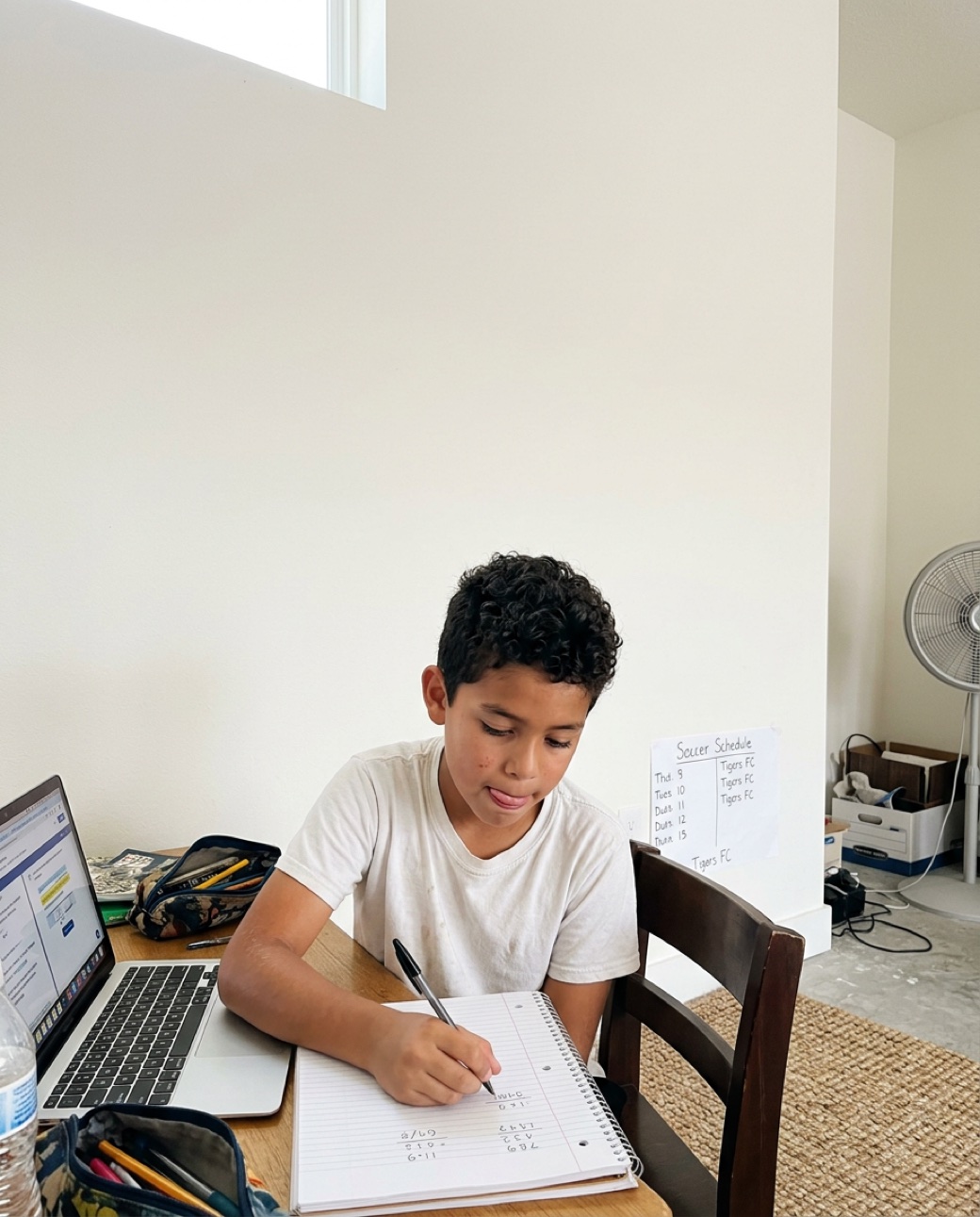
Your child is at the kitchen table, the worksheet has been open for forty minutes, and now there are tears. The math question genuinely makes no sense to them — and if you’re honest, the textbook chapter doesn’t make a lot of sense to you either. You want to help. You also want to keep the night from collapsing.
This is one of the most common moments in family life, and it isn’t a sign that anything is broken — not in your child, not in their school, not in your parenting. It’s a sign that your child has hit the edge of what they can do alone, which is exactly the moment good support actually matters.
Quick answer: how do I help my child when their homework is too hard?
Stop the spiral first, then help — don’t do the work for them. Five steps work in this order: (1) take a 10-minute break to break the frustration loop, (2) shrink the task to one specific question instead of the whole sheet, (3) ask your child to explain back what the question is actually asking, (4) find a 3–5 minute online explanation together (a Khan Academy clip, a teacher’s YouTube walkthrough, or a worked example from your child’s textbook), (5) try one similar problem on a separate page so the worksheet is still their own work. If you’ve done this for the same topic three nights in a row and they’re still stuck, the gap is bigger than tonight’s homework — that’s when a tutor pays off.
The five sections below walk through each step, plus what to do when you don’t understand the topic yourself, how long homework should actually take at each grade level, and the signal that says it’s time to bring in a tutor.
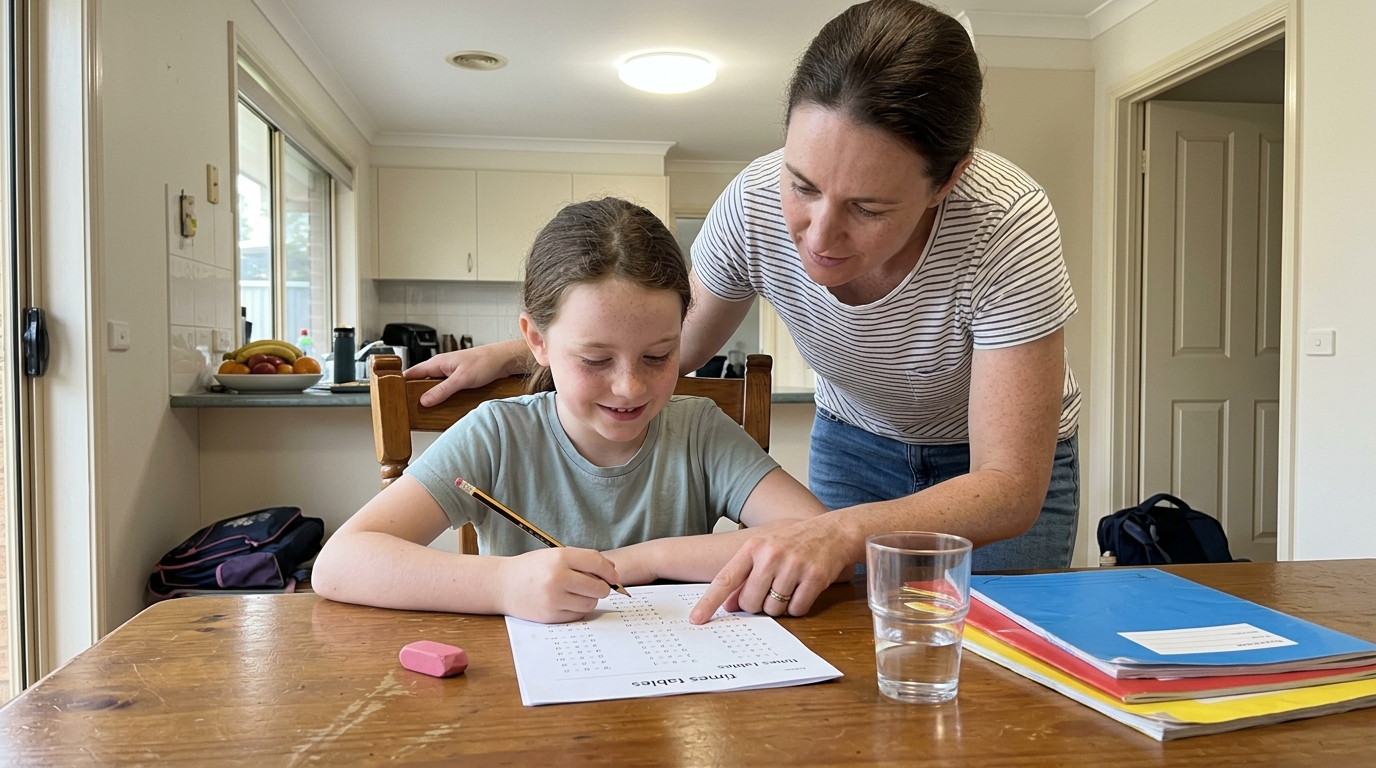
Your job is to help your child re-enter the problem, not to solve it. The pencil stays in their hand. The thinking stays in their head.
Your job is to help your child re-enter the problem, not to solve it. The pencil stays in their hand. The thinking stays in their head.
Should I help my child with homework, or let them struggle?
Help — but help with the thinking, not the answer. The research on parent involvement is clear: parents who scaffold (ask questions, point at the right step, set up the conditions for the child to do the work) lift their child’s long-term learning. Parents who do the homework themselves lift this week’s mark and lower next week’s confidence. John Hattie’s Visible Learning meta-analyses put deliberate parent-as-scaffold engagement among the higher-impact things a family can do at home; parents who simply finish the worksheet for the child show no measurable academic effect.
The practical line is: your child should be the one writing the answer in the book. You can read the question with them, ask what they already know, suggest where to look it up, draw a diagram together on a scrap piece of paper. The moment your hand picks up the pencil and writes in their workbook, you’ve crossed from coaching into doing — and the teacher loses the signal that tells them where your child actually needs more help.
If your child is genuinely melting down before they’ve tried the question, the right move isn’t to push through. Take a 10-minute break. Glass of water. Walk to the letterbox. Pat the dog. The frustration loop has to break before any kind of help lands; ten minutes of nothing usually does it. Read more about how to help your child focus and pay attention.
How do I help my child with homework when I don’t understand the topic myself?
This is the most common version of the problem, and it’s solvable. You don’t need to remember 9th grade quadratics; you need to be the person who knows how to find the right 5-minute explanation in 30 seconds. That’s a skill your child often doesn’t have yet — and it’s where most parents add the most value.
Here’s the workflow that almost always works:
- Read the question with them, out loud. Half the time, “I don’t get it” means “I don’t know what the question is asking,” not “I can’t do the math.” Reading it together names that.
- Find the topic name in their textbook or worksheet. Look at the chapter title, the worked example at the top, or the unit your child names from class. Search that exact phrase plus “explained” or “example.”
- Pick a short video, not a long one. Khan Academy clips, the teacher’s own YouTube channel if they have one, or a worked example on Khan Academy or IXL work better than a 20-minute lecture. Aim for 3–5 minutes.
- Watch it together once, then close the video. Now ask your child to explain it back. If they can, they can do the question. If they can’t, watch it once more and freeze on the worked-example slide.
- Try one similar problem on a separate page first. So the workbook stays their own work. The teacher needs to see what your child can actually do, not what your child + a YouTube video + you can do.
For high school students working on harder math topics or science, the same workflow holds, but the source needs to be a level up — past-paper worked solutions for AP test subjects, official Common Core curriculum descriptors, or a genuine teacher’s worked example, not a random TikTok.
How long should homework actually take at each grade level?
American schools generally follow what’s known as the 10-minute rule: about 10 minutes of homework per night, per grade level. That benchmark is roughly endorsed by the OECD’s PISA homework-time data and aligns with what most state education departments recommend. 3rd grade = 30 minutes a night. 7th grade = 70 minutes. 11th grade = up to 110 minutes (closer to 2 hours in heavy AP subjects). If your child is consistently spending dramatically more than this on the same task, that’s information — not failure.
Realistic ranges for an average homework night in the U.S.:
| Grade level | Typical homework per night | When to flag it |
|---|---|---|
| 1st–2nd grade | 10–20 mins (mostly reading) | Tears every night for a week |
| 3rd–4th grade | 20–40 mins | 90+ mins on a 30-min task |
| 5th–6th grade | 40–60 mins | Same topic stuck 3 nights running |
| 7th–8th grade | 60–90 mins across subjects | Whole evenings lost to one subject |
| 9th–10th grade | 90–120 mins | Marks slipping despite effort |
| 11th–12th grade | 2+ hrs (more during midterms/finals) | Falling behind a topic for 2+ weeks |
If your child is well above their grade-level range every night for the same subject, the issue isn’t their work ethic — it’s a knowledge gap. Closing that gap is faster than letting it widen.
What’s the best way to support a child who’s stuck on a math problem?
Break the problem into the smallest possible step they can do alone. Cognitive scientist John Dunlosky’s 2013 review of the most effective study techniques (the “Improving Students’ Learning” paper, used by curriculum designers worldwide) found that distributed practice and worked-example recall are among the highest-leverage strategies — both depend on the student doing the cognitive work themselves, in small repeated chunks.
The practical translation, around the kitchen table:
- Don’t let them say “I can’t do calculus.” They can. They can’t do this specific step — usually because a foundational skill (factoring, simplifying, rearranging) hasn’t fully landed. Name the missing skill, not the whole topic.
- Cover the question and ask, “What do we actually know?” Forces them to extract the given information before they panic about what to do with it.
- Draw the problem. A diagram, a number line, a box. For most math problems below 10th grade, a sketch turns an abstract block into something a child can point at.
- Use a similar but easier number first. If the problem is 7×24, do 7×20 first. If it’s a fraction with awkward numbers, redo it with halves. The math is the same — the working memory load is lower.
- Stop on a small win. Not on the worksheet finished perfectly, but on one question they got right after they were stuck. That moment is what they’ll remember tomorrow.
For ongoing math confidence, see how tutoring can improve confidence in maths — the underlying mechanic is the same as a good homework session, just sustained over weeks.
How do I keep my child motivated when homework feels impossible?
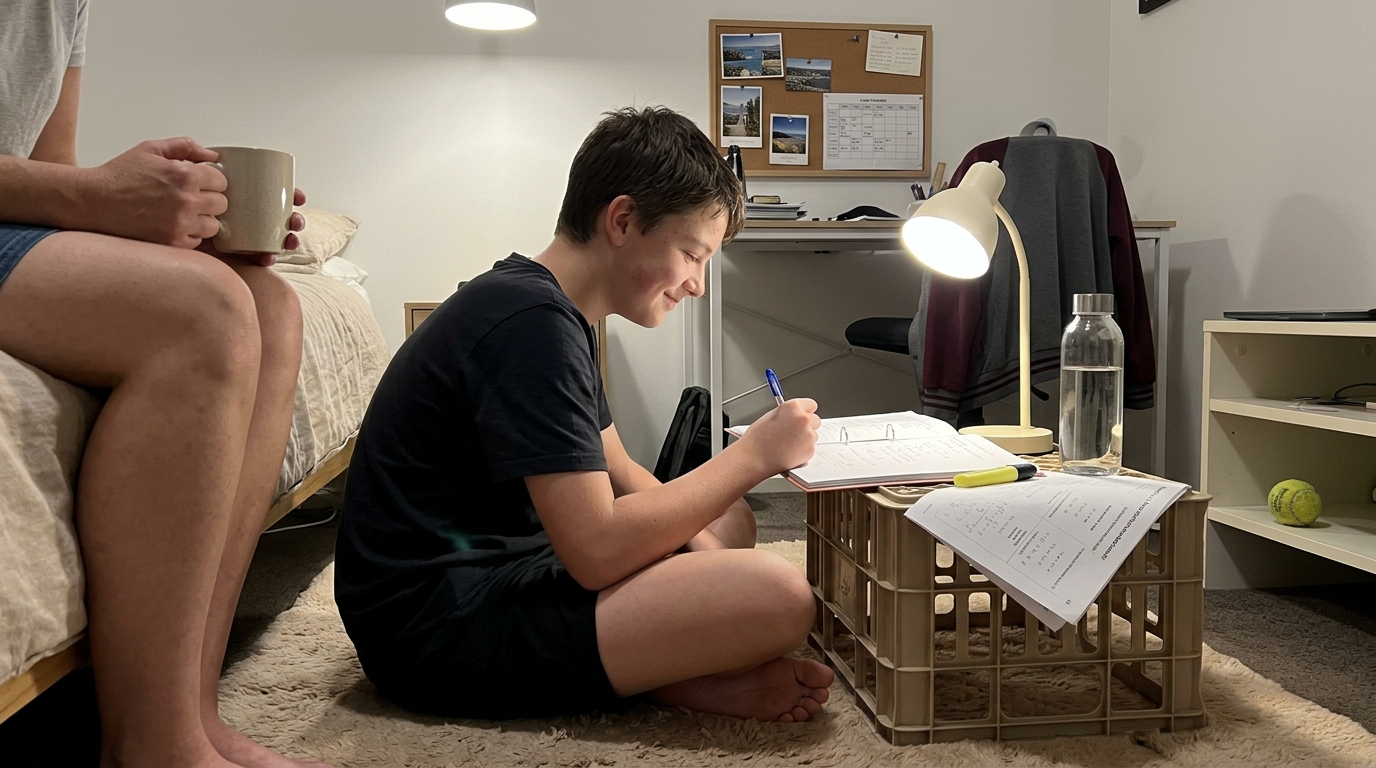
Motivation in a homework moment is fragile, and lecturing it back into existence almost never works. What does work is changing the structure of the next 30 minutes, not the speech.
Three things that genuinely move the needle:
- Make the win visible and small. Tick off each question as it’s done. Put a finished page on the fridge. Children who can see progress finish more work than children who can’t — even when the work is identical.
- Connect the topic to something they actually care about. Algebra is more interesting if you frame it as how their favorite football team’s standings are calculated. Persuasive writing is more interesting if you let them write about why their bedtime should move. The school work doesn’t change; the meaning does.
- Set a finishing line, not a finishing time. “Three more questions, then we stop” works better than “an hour more.” A finite, visible end is what makes the next ten minutes survivable when everything in their head is saying give up.
Avoid the two motivation traps that backfire. Don’t bribe per question (it teaches the child the work has no value of its own). Don’t threaten consequences mid-homework (it converts a learning problem into a behavior problem and now you’re solving the wrong one). If your child needs a confidence reset rather than a homework session, see 5 signs your child needs tutoring — sometimes the homework battle is the symptom, not the disease.
When should I get a tutor instead of helping with homework myself?
Three nights running on the same topic is the rough trigger. If your child has been stuck on the same chapter for a week — fractions, algebra, essay structure — and the workflow above isn’t closing the gap, the problem is now bigger than tonight. That’s the point a one-to-one tutor pays off, because every extra night you spend grinding without a real diagnosis widens the gap further.
Other clean signals it’s time to bring in a tutor rather than push harder yourself:
- You don’t know the topic well enough to teach it. You can supervise; you can’t diagnose. A tutor who actually knows the curriculum can spot the missing prerequisite in 15 minutes.
- The homework battle is now the relationship. When most evenings end in tears or a fight, the cost of holding the “I’ll teach them myself” line is higher than the cost of a tutor.
- An exam is 8–10 weeks out and your child is more than half a topic behind — 5th–6th grade going into high school, 7th–10th grade with a midterm, or 11th–12th grade with a midterm or final. Tutoring lifts marks fastest when there’s a concrete deliverable to work back from.
- Confidence has dropped. Not just one bad night — a sustained “I’m bad at math” story. That story hardens fast. A tutor who runs through wins one-on-one breaks it; another homework battle reinforces it.
One-to-one tutoring works for the same reason none of the strategies above are silver bullets when the gap has widened: tutoring sessions are sustained, diagnostic, and uninterrupted in a way an evening homework battle never can be. Educational researcher Benjamin Bloom famously found that students with a one-to-one tutor outperformed peers in regular classrooms by about two standard deviations — “the 2-sigma effect.” Modern tutoring doesn’t always hit Bloom’s ceiling, but the direction of the effect is real and well-replicated.
If you’re weighing it up, see how personalised tutoring can help your child and how to know if your child is getting value from their tutor.
So what should I actually do tonight when homework is too hard?
If you only remember one thing from this article: your job is to help your child re-enter the problem, not to solve it. Every strategy above — the 10-minute break, the 5-minute video, the smaller similar problem, the tick-off chart, the “explain it back to me” — is a version of that single move. The pencil stays in their hand. The thinking stays in their head. Your role is the structure that makes the thinking possible.
And if you’ve done that for three nights and the same topic is still blocking them, that’s a perfectly reasonable point to bring in extra help. Tutoring isn’t a confession that you’re failing as a parent — it’s exactly the move a parent makes when they can see the gap is bigger than the homework.
If you’d like to talk through whether a Tutero tutor is right for your child, you can explore one-to-one online tutoring from US$45 per lesson, with no contracts, and you pay after each lesson. Same rate at every grade level, elementary through 12th grade.
Updated 6 May 2026. Reviewed for parents of grades 1–12 by Joey Moshinsky, Co-CEO of Tutero.
Your child is at the kitchen table, the worksheet has been open for forty minutes, and now there are tears. The math question genuinely makes no sense to them — and if you’re honest, the textbook chapter doesn’t make a lot of sense to you either. You want to help. You also want to keep the night from collapsing.
This is one of the most common moments in family life, and it isn’t a sign that anything is broken — not in your child, not in their school, not in your parenting. It’s a sign that your child has hit the edge of what they can do alone, which is exactly the moment good support actually matters.
Quick answer: how do I help my child when their homework is too hard?
Stop the spiral first, then help — don’t do the work for them. Five steps work in this order: (1) take a 10-minute break to break the frustration loop, (2) shrink the task to one specific question instead of the whole sheet, (3) ask your child to explain back what the question is actually asking, (4) find a 3–5 minute online explanation together (a Khan Academy clip, a teacher’s YouTube walkthrough, or a worked example from your child’s textbook), (5) try one similar problem on a separate page so the worksheet is still their own work. If you’ve done this for the same topic three nights in a row and they’re still stuck, the gap is bigger than tonight’s homework — that’s when a tutor pays off.
The five sections below walk through each step, plus what to do when you don’t understand the topic yourself, how long homework should actually take at each grade level, and the signal that says it’s time to bring in a tutor.
Should I help my child with homework, or let them struggle?
Help — but help with the thinking, not the answer. The research on parent involvement is clear: parents who scaffold (ask questions, point at the right step, set up the conditions for the child to do the work) lift their child’s long-term learning. Parents who do the homework themselves lift this week’s mark and lower next week’s confidence. John Hattie’s Visible Learning meta-analyses put deliberate parent-as-scaffold engagement among the higher-impact things a family can do at home; parents who simply finish the worksheet for the child show no measurable academic effect.
The practical line is: your child should be the one writing the answer in the book. You can read the question with them, ask what they already know, suggest where to look it up, draw a diagram together on a scrap piece of paper. The moment your hand picks up the pencil and writes in their workbook, you’ve crossed from coaching into doing — and the teacher loses the signal that tells them where your child actually needs more help.
If your child is genuinely melting down before they’ve tried the question, the right move isn’t to push through. Take a 10-minute break. Glass of water. Walk to the letterbox. Pat the dog. The frustration loop has to break before any kind of help lands; ten minutes of nothing usually does it. Read more about how to help your child focus and pay attention.
How do I help my child with homework when I don’t understand the topic myself?
This is the most common version of the problem, and it’s solvable. You don’t need to remember 9th grade quadratics; you need to be the person who knows how to find the right 5-minute explanation in 30 seconds. That’s a skill your child often doesn’t have yet — and it’s where most parents add the most value.
Here’s the workflow that almost always works:
- Read the question with them, out loud. Half the time, “I don’t get it” means “I don’t know what the question is asking,” not “I can’t do the math.” Reading it together names that.
- Find the topic name in their textbook or worksheet. Look at the chapter title, the worked example at the top, or the unit your child names from class. Search that exact phrase plus “explained” or “example.”
- Pick a short video, not a long one. Khan Academy clips, the teacher’s own YouTube channel if they have one, or a worked example on Khan Academy or IXL work better than a 20-minute lecture. Aim for 3–5 minutes.
- Watch it together once, then close the video. Now ask your child to explain it back. If they can, they can do the question. If they can’t, watch it once more and freeze on the worked-example slide.
- Try one similar problem on a separate page first. So the workbook stays their own work. The teacher needs to see what your child can actually do, not what your child + a YouTube video + you can do.
For high school students working on harder math topics or science, the same workflow holds, but the source needs to be a level up — past-paper worked solutions for AP test subjects, official Common Core curriculum descriptors, or a genuine teacher’s worked example, not a random TikTok.
How long should homework actually take at each grade level?
American schools generally follow what’s known as the 10-minute rule: about 10 minutes of homework per night, per grade level. That benchmark is roughly endorsed by the OECD’s PISA homework-time data and aligns with what most state education departments recommend. 3rd grade = 30 minutes a night. 7th grade = 70 minutes. 11th grade = up to 110 minutes (closer to 2 hours in heavy AP subjects). If your child is consistently spending dramatically more than this on the same task, that’s information — not failure.
Realistic ranges for an average homework night in the U.S.:
| Grade level | Typical homework per night | When to flag it |
|---|---|---|
| 1st–2nd grade | 10–20 mins (mostly reading) | Tears every night for a week |
| 3rd–4th grade | 20–40 mins | 90+ mins on a 30-min task |
| 5th–6th grade | 40–60 mins | Same topic stuck 3 nights running |
| 7th–8th grade | 60–90 mins across subjects | Whole evenings lost to one subject |
| 9th–10th grade | 90–120 mins | Marks slipping despite effort |
| 11th–12th grade | 2+ hrs (more during midterms/finals) | Falling behind a topic for 2+ weeks |
If your child is well above their grade-level range every night for the same subject, the issue isn’t their work ethic — it’s a knowledge gap. Closing that gap is faster than letting it widen.
What’s the best way to support a child who’s stuck on a math problem?
Break the problem into the smallest possible step they can do alone. Cognitive scientist John Dunlosky’s 2013 review of the most effective study techniques (the “Improving Students’ Learning” paper, used by curriculum designers worldwide) found that distributed practice and worked-example recall are among the highest-leverage strategies — both depend on the student doing the cognitive work themselves, in small repeated chunks.
The practical translation, around the kitchen table:
- Don’t let them say “I can’t do calculus.” They can. They can’t do this specific step — usually because a foundational skill (factoring, simplifying, rearranging) hasn’t fully landed. Name the missing skill, not the whole topic.
- Cover the question and ask, “What do we actually know?” Forces them to extract the given information before they panic about what to do with it.
- Draw the problem. A diagram, a number line, a box. For most math problems below 10th grade, a sketch turns an abstract block into something a child can point at.
- Use a similar but easier number first. If the problem is 7×24, do 7×20 first. If it’s a fraction with awkward numbers, redo it with halves. The math is the same — the working memory load is lower.
- Stop on a small win. Not on the worksheet finished perfectly, but on one question they got right after they were stuck. That moment is what they’ll remember tomorrow.
For ongoing math confidence, see how tutoring can improve confidence in maths — the underlying mechanic is the same as a good homework session, just sustained over weeks.
How do I keep my child motivated when homework feels impossible?
Motivation in a homework moment is fragile, and lecturing it back into existence almost never works. What does work is changing the structure of the next 30 minutes, not the speech.
Three things that genuinely move the needle:
- Make the win visible and small. Tick off each question as it’s done. Put a finished page on the fridge. Children who can see progress finish more work than children who can’t — even when the work is identical.
- Connect the topic to something they actually care about. Algebra is more interesting if you frame it as how their favorite football team’s standings are calculated. Persuasive writing is more interesting if you let them write about why their bedtime should move. The school work doesn’t change; the meaning does.
- Set a finishing line, not a finishing time. “Three more questions, then we stop” works better than “an hour more.” A finite, visible end is what makes the next ten minutes survivable when everything in their head is saying give up.
Avoid the two motivation traps that backfire. Don’t bribe per question (it teaches the child the work has no value of its own). Don’t threaten consequences mid-homework (it converts a learning problem into a behavior problem and now you’re solving the wrong one). If your child needs a confidence reset rather than a homework session, see 5 signs your child needs tutoring — sometimes the homework battle is the symptom, not the disease.
When should I get a tutor instead of helping with homework myself?
Three nights running on the same topic is the rough trigger. If your child has been stuck on the same chapter for a week — fractions, algebra, essay structure — and the workflow above isn’t closing the gap, the problem is now bigger than tonight. That’s the point a one-to-one tutor pays off, because every extra night you spend grinding without a real diagnosis widens the gap further.
Other clean signals it’s time to bring in a tutor rather than push harder yourself:
- You don’t know the topic well enough to teach it. You can supervise; you can’t diagnose. A tutor who actually knows the curriculum can spot the missing prerequisite in 15 minutes.
- The homework battle is now the relationship. When most evenings end in tears or a fight, the cost of holding the “I’ll teach them myself” line is higher than the cost of a tutor.
- An exam is 8–10 weeks out and your child is more than half a topic behind — 5th–6th grade going into high school, 7th–10th grade with a midterm, or 11th–12th grade with a midterm or final. Tutoring lifts marks fastest when there’s a concrete deliverable to work back from.
- Confidence has dropped. Not just one bad night — a sustained “I’m bad at math” story. That story hardens fast. A tutor who runs through wins one-on-one breaks it; another homework battle reinforces it.
One-to-one tutoring works for the same reason none of the strategies above are silver bullets when the gap has widened: tutoring sessions are sustained, diagnostic, and uninterrupted in a way an evening homework battle never can be. Educational researcher Benjamin Bloom famously found that students with a one-to-one tutor outperformed peers in regular classrooms by about two standard deviations — “the 2-sigma effect.” Modern tutoring doesn’t always hit Bloom’s ceiling, but the direction of the effect is real and well-replicated.
If you’re weighing it up, see how personalised tutoring can help your child and how to know if your child is getting value from their tutor.
So what should I actually do tonight when homework is too hard?
If you only remember one thing from this article: your job is to help your child re-enter the problem, not to solve it. Every strategy above — the 10-minute break, the 5-minute video, the smaller similar problem, the tick-off chart, the “explain it back to me” — is a version of that single move. The pencil stays in their hand. The thinking stays in their head. Your role is the structure that makes the thinking possible.
And if you’ve done that for three nights and the same topic is still blocking them, that’s a perfectly reasonable point to bring in extra help. Tutoring isn’t a confession that you’re failing as a parent — it’s exactly the move a parent makes when they can see the gap is bigger than the homework.
If you’d like to talk through whether a Tutero tutor is right for your child, you can explore one-to-one online tutoring from US$45 per lesson, with no contracts, and you pay after each lesson. Same rate at every grade level, elementary through 12th grade.
Your job is to help your child re-enter the problem, not to solve it. The pencil stays in their hand. The thinking stays in their head.
Your job is to help your child re-enter the problem, not to solve it. The pencil stays in their hand. The thinking stays in their head.

Your job is to help your child re-enter the problem, not to solve it. The pencil stays in their hand. The thinking stays in their head.
Should I help my child with homework, or let them struggle?
Help — but help with the thinking, not the answer. The research on parent involvement is clear: parents who scaffold (ask questions, point at the right step, set up the conditions for the child to do the work) lift their child’s long-term learning. Parents who do the homework themselves lift this week’s mark and lower next week’s confidence. John Hattie’s Visible Learning meta-analyses put deliberate parent-as-scaffold engagement among the higher-impact things a family can do at home; parents who simply finish the worksheet for the child show no measurable academic effect.
The practical line is: your child should be the one writing the answer in the book. You can read the question with them, ask what they already know, suggest where to look it up, draw a diagram together on a scrap piece of paper. The moment your hand picks up the pencil and writes in their workbook, you’ve crossed from coaching into doing — and the teacher loses the signal that tells them where your child actually needs more help.
If your child is genuinely melting down before they’ve tried the question, the right move isn’t to push through. Take a 10-minute break. Glass of water. Walk to the letterbox. Pat the dog. The frustration loop has to break before any kind of help lands; ten minutes of nothing usually does it. Read more about how to help your child focus and pay attention.
How do I help my child with homework when I don’t understand the topic myself?
This is the most common version of the problem, and it’s solvable. You don’t need to remember 9th grade quadratics; you need to be the person who knows how to find the right 5-minute explanation in 30 seconds. That’s a skill your child often doesn’t have yet — and it’s where most parents add the most value.
Here’s the workflow that almost always works:
- Read the question with them, out loud. Half the time, “I don’t get it” means “I don’t know what the question is asking,” not “I can’t do the math.” Reading it together names that.
- Find the topic name in their textbook or worksheet. Look at the chapter title, the worked example at the top, or the unit your child names from class. Search that exact phrase plus “explained” or “example.”
- Pick a short video, not a long one. Khan Academy clips, the teacher’s own YouTube channel if they have one, or a worked example on Khan Academy or IXL work better than a 20-minute lecture. Aim for 3–5 minutes.
- Watch it together once, then close the video. Now ask your child to explain it back. If they can, they can do the question. If they can’t, watch it once more and freeze on the worked-example slide.
- Try one similar problem on a separate page first. So the workbook stays their own work. The teacher needs to see what your child can actually do, not what your child + a YouTube video + you can do.
For high school students working on harder math topics or science, the same workflow holds, but the source needs to be a level up — past-paper worked solutions for AP test subjects, official Common Core curriculum descriptors, or a genuine teacher’s worked example, not a random TikTok.
How long should homework actually take at each grade level?
American schools generally follow what’s known as the 10-minute rule: about 10 minutes of homework per night, per grade level. That benchmark is roughly endorsed by the OECD’s PISA homework-time data and aligns with what most state education departments recommend. 3rd grade = 30 minutes a night. 7th grade = 70 minutes. 11th grade = up to 110 minutes (closer to 2 hours in heavy AP subjects). If your child is consistently spending dramatically more than this on the same task, that’s information — not failure.
Realistic ranges for an average homework night in the U.S.:
| Grade level | Typical homework per night | When to flag it |
|---|---|---|
| 1st–2nd grade | 10–20 mins (mostly reading) | Tears every night for a week |
| 3rd–4th grade | 20–40 mins | 90+ mins on a 30-min task |
| 5th–6th grade | 40–60 mins | Same topic stuck 3 nights running |
| 7th–8th grade | 60–90 mins across subjects | Whole evenings lost to one subject |
| 9th–10th grade | 90–120 mins | Marks slipping despite effort |
| 11th–12th grade | 2+ hrs (more during midterms/finals) | Falling behind a topic for 2+ weeks |
If your child is well above their grade-level range every night for the same subject, the issue isn’t their work ethic — it’s a knowledge gap. Closing that gap is faster than letting it widen.
What’s the best way to support a child who’s stuck on a math problem?
Break the problem into the smallest possible step they can do alone. Cognitive scientist John Dunlosky’s 2013 review of the most effective study techniques (the “Improving Students’ Learning” paper, used by curriculum designers worldwide) found that distributed practice and worked-example recall are among the highest-leverage strategies — both depend on the student doing the cognitive work themselves, in small repeated chunks.
The practical translation, around the kitchen table:
- Don’t let them say “I can’t do calculus.” They can. They can’t do this specific step — usually because a foundational skill (factoring, simplifying, rearranging) hasn’t fully landed. Name the missing skill, not the whole topic.
- Cover the question and ask, “What do we actually know?” Forces them to extract the given information before they panic about what to do with it.
- Draw the problem. A diagram, a number line, a box. For most math problems below 10th grade, a sketch turns an abstract block into something a child can point at.
- Use a similar but easier number first. If the problem is 7×24, do 7×20 first. If it’s a fraction with awkward numbers, redo it with halves. The math is the same — the working memory load is lower.
- Stop on a small win. Not on the worksheet finished perfectly, but on one question they got right after they were stuck. That moment is what they’ll remember tomorrow.
For ongoing math confidence, see how tutoring can improve confidence in maths — the underlying mechanic is the same as a good homework session, just sustained over weeks.
How do I keep my child motivated when homework feels impossible?
Motivation in a homework moment is fragile, and lecturing it back into existence almost never works. What does work is changing the structure of the next 30 minutes, not the speech.
Three things that genuinely move the needle:
- Make the win visible and small. Tick off each question as it’s done. Put a finished page on the fridge. Children who can see progress finish more work than children who can’t — even when the work is identical.
- Connect the topic to something they actually care about. Algebra is more interesting if you frame it as how their favorite football team’s standings are calculated. Persuasive writing is more interesting if you let them write about why their bedtime should move. The school work doesn’t change; the meaning does.
- Set a finishing line, not a finishing time. “Three more questions, then we stop” works better than “an hour more.” A finite, visible end is what makes the next ten minutes survivable when everything in their head is saying give up.
Avoid the two motivation traps that backfire. Don’t bribe per question (it teaches the child the work has no value of its own). Don’t threaten consequences mid-homework (it converts a learning problem into a behavior problem and now you’re solving the wrong one). If your child needs a confidence reset rather than a homework session, see 5 signs your child needs tutoring — sometimes the homework battle is the symptom, not the disease.
When should I get a tutor instead of helping with homework myself?
Three nights running on the same topic is the rough trigger. If your child has been stuck on the same chapter for a week — fractions, algebra, essay structure — and the workflow above isn’t closing the gap, the problem is now bigger than tonight. That’s the point a one-to-one tutor pays off, because every extra night you spend grinding without a real diagnosis widens the gap further.
Other clean signals it’s time to bring in a tutor rather than push harder yourself:
- You don’t know the topic well enough to teach it. You can supervise; you can’t diagnose. A tutor who actually knows the curriculum can spot the missing prerequisite in 15 minutes.
- The homework battle is now the relationship. When most evenings end in tears or a fight, the cost of holding the “I’ll teach them myself” line is higher than the cost of a tutor.
- An exam is 8–10 weeks out and your child is more than half a topic behind — 5th–6th grade going into high school, 7th–10th grade with a midterm, or 11th–12th grade with a midterm or final. Tutoring lifts marks fastest when there’s a concrete deliverable to work back from.
- Confidence has dropped. Not just one bad night — a sustained “I’m bad at math” story. That story hardens fast. A tutor who runs through wins one-on-one breaks it; another homework battle reinforces it.
One-to-one tutoring works for the same reason none of the strategies above are silver bullets when the gap has widened: tutoring sessions are sustained, diagnostic, and uninterrupted in a way an evening homework battle never can be. Educational researcher Benjamin Bloom famously found that students with a one-to-one tutor outperformed peers in regular classrooms by about two standard deviations — “the 2-sigma effect.” Modern tutoring doesn’t always hit Bloom’s ceiling, but the direction of the effect is real and well-replicated.
If you’re weighing it up, see how personalised tutoring can help your child and how to know if your child is getting value from their tutor.
So what should I actually do tonight when homework is too hard?
If you only remember one thing from this article: your job is to help your child re-enter the problem, not to solve it. Every strategy above — the 10-minute break, the 5-minute video, the smaller similar problem, the tick-off chart, the “explain it back to me” — is a version of that single move. The pencil stays in their hand. The thinking stays in their head. Your role is the structure that makes the thinking possible.
And if you’ve done that for three nights and the same topic is still blocking them, that’s a perfectly reasonable point to bring in extra help. Tutoring isn’t a confession that you’re failing as a parent — it’s exactly the move a parent makes when they can see the gap is bigger than the homework.
If you’d like to talk through whether a Tutero tutor is right for your child, you can explore one-to-one online tutoring from US$45 per lesson, with no contracts, and you pay after each lesson. Same rate at every grade level, elementary through 12th grade.
Three nights running on the same topic is the rough trigger. Every extra night you spend grinding without a real diagnosis widens the gap further.
Updated 6 May 2026. Reviewed for parents of grades 1–12 by Joey Moshinsky, Co-CEO of Tutero.
Your child is at the kitchen table, the worksheet has been open for forty minutes, and now there are tears. The math question genuinely makes no sense to them — and if you’re honest, the textbook chapter doesn’t make a lot of sense to you either. You want to help. You also want to keep the night from collapsing.
This is one of the most common moments in family life, and it isn’t a sign that anything is broken — not in your child, not in their school, not in your parenting. It’s a sign that your child has hit the edge of what they can do alone, which is exactly the moment good support actually matters.
Quick answer: how do I help my child when their homework is too hard?
Stop the spiral first, then help — don’t do the work for them. Five steps work in this order: (1) take a 10-minute break to break the frustration loop, (2) shrink the task to one specific question instead of the whole sheet, (3) ask your child to explain back what the question is actually asking, (4) find a 3–5 minute online explanation together (a Khan Academy clip, a teacher’s YouTube walkthrough, or a worked example from your child’s textbook), (5) try one similar problem on a separate page so the worksheet is still their own work. If you’ve done this for the same topic three nights in a row and they’re still stuck, the gap is bigger than tonight’s homework — that’s when a tutor pays off.
The five sections below walk through each step, plus what to do when you don’t understand the topic yourself, how long homework should actually take at each grade level, and the signal that says it’s time to bring in a tutor.
Your job is to help your child re-enter the problem, not to solve it. The pencil stays in their hand. The thinking stays in their head.
Should I help my child with homework, or let them struggle?
Help — but help with the thinking, not the answer. The research on parent involvement is clear: parents who scaffold (ask questions, point at the right step, set up the conditions for the child to do the work) lift their child’s long-term learning. Parents who do the homework themselves lift this week’s mark and lower next week’s confidence. John Hattie’s Visible Learning meta-analyses put deliberate parent-as-scaffold engagement among the higher-impact things a family can do at home; parents who simply finish the worksheet for the child show no measurable academic effect.
The practical line is: your child should be the one writing the answer in the book. You can read the question with them, ask what they already know, suggest where to look it up, draw a diagram together on a scrap piece of paper. The moment your hand picks up the pencil and writes in their workbook, you’ve crossed from coaching into doing — and the teacher loses the signal that tells them where your child actually needs more help.
If your child is genuinely melting down before they’ve tried the question, the right move isn’t to push through. Take a 10-minute break. Glass of water. Walk to the letterbox. Pat the dog. The frustration loop has to break before any kind of help lands; ten minutes of nothing usually does it. Read more about how to help your child focus and pay attention.
How do I help my child with homework when I don’t understand the topic myself?
This is the most common version of the problem, and it’s solvable. You don’t need to remember 9th grade quadratics; you need to be the person who knows how to find the right 5-minute explanation in 30 seconds. That’s a skill your child often doesn’t have yet — and it’s where most parents add the most value.
Here’s the workflow that almost always works:
- Read the question with them, out loud. Half the time, “I don’t get it” means “I don’t know what the question is asking,” not “I can’t do the math.” Reading it together names that.
- Find the topic name in their textbook or worksheet. Look at the chapter title, the worked example at the top, or the unit your child names from class. Search that exact phrase plus “explained” or “example.”
- Pick a short video, not a long one. Khan Academy clips, the teacher’s own YouTube channel if they have one, or a worked example on Khan Academy or IXL work better than a 20-minute lecture. Aim for 3–5 minutes.
- Watch it together once, then close the video. Now ask your child to explain it back. If they can, they can do the question. If they can’t, watch it once more and freeze on the worked-example slide.
- Try one similar problem on a separate page first. So the workbook stays their own work. The teacher needs to see what your child can actually do, not what your child + a YouTube video + you can do.
For high school students working on harder math topics or science, the same workflow holds, but the source needs to be a level up — past-paper worked solutions for AP test subjects, official Common Core curriculum descriptors, or a genuine teacher’s worked example, not a random TikTok.
How long should homework actually take at each grade level?
American schools generally follow what’s known as the 10-minute rule: about 10 minutes of homework per night, per grade level. That benchmark is roughly endorsed by the OECD’s PISA homework-time data and aligns with what most state education departments recommend. 3rd grade = 30 minutes a night. 7th grade = 70 minutes. 11th grade = up to 110 minutes (closer to 2 hours in heavy AP subjects). If your child is consistently spending dramatically more than this on the same task, that’s information — not failure.
Realistic ranges for an average homework night in the U.S.:
| Grade level | Typical homework per night | When to flag it |
|---|---|---|
| 1st–2nd grade | 10–20 mins (mostly reading) | Tears every night for a week |
| 3rd–4th grade | 20–40 mins | 90+ mins on a 30-min task |
| 5th–6th grade | 40–60 mins | Same topic stuck 3 nights running |
| 7th–8th grade | 60–90 mins across subjects | Whole evenings lost to one subject |
| 9th–10th grade | 90–120 mins | Marks slipping despite effort |
| 11th–12th grade | 2+ hrs (more during midterms/finals) | Falling behind a topic for 2+ weeks |
If your child is well above their grade-level range every night for the same subject, the issue isn’t their work ethic — it’s a knowledge gap. Closing that gap is faster than letting it widen.
What’s the best way to support a child who’s stuck on a math problem?
Break the problem into the smallest possible step they can do alone. Cognitive scientist John Dunlosky’s 2013 review of the most effective study techniques (the “Improving Students’ Learning” paper, used by curriculum designers worldwide) found that distributed practice and worked-example recall are among the highest-leverage strategies — both depend on the student doing the cognitive work themselves, in small repeated chunks.
The practical translation, around the kitchen table:
- Don’t let them say “I can’t do calculus.” They can. They can’t do this specific step — usually because a foundational skill (factoring, simplifying, rearranging) hasn’t fully landed. Name the missing skill, not the whole topic.
- Cover the question and ask, “What do we actually know?” Forces them to extract the given information before they panic about what to do with it.
- Draw the problem. A diagram, a number line, a box. For most math problems below 10th grade, a sketch turns an abstract block into something a child can point at.
- Use a similar but easier number first. If the problem is 7×24, do 7×20 first. If it’s a fraction with awkward numbers, redo it with halves. The math is the same — the working memory load is lower.
- Stop on a small win. Not on the worksheet finished perfectly, but on one question they got right after they were stuck. That moment is what they’ll remember tomorrow.
For ongoing math confidence, see how tutoring can improve confidence in maths — the underlying mechanic is the same as a good homework session, just sustained over weeks.
How do I keep my child motivated when homework feels impossible?
Motivation in a homework moment is fragile, and lecturing it back into existence almost never works. What does work is changing the structure of the next 30 minutes, not the speech.
Three things that genuinely move the needle:
- Make the win visible and small. Tick off each question as it’s done. Put a finished page on the fridge. Children who can see progress finish more work than children who can’t — even when the work is identical.
- Connect the topic to something they actually care about. Algebra is more interesting if you frame it as how their favorite football team’s standings are calculated. Persuasive writing is more interesting if you let them write about why their bedtime should move. The school work doesn’t change; the meaning does.
- Set a finishing line, not a finishing time. “Three more questions, then we stop” works better than “an hour more.” A finite, visible end is what makes the next ten minutes survivable when everything in their head is saying give up.
Avoid the two motivation traps that backfire. Don’t bribe per question (it teaches the child the work has no value of its own). Don’t threaten consequences mid-homework (it converts a learning problem into a behavior problem and now you’re solving the wrong one). If your child needs a confidence reset rather than a homework session, see 5 signs your child needs tutoring — sometimes the homework battle is the symptom, not the disease.
When should I get a tutor instead of helping with homework myself?
Three nights running on the same topic is the rough trigger. If your child has been stuck on the same chapter for a week — fractions, algebra, essay structure — and the workflow above isn’t closing the gap, the problem is now bigger than tonight. That’s the point a one-to-one tutor pays off, because every extra night you spend grinding without a real diagnosis widens the gap further.
Other clean signals it’s time to bring in a tutor rather than push harder yourself:
- You don’t know the topic well enough to teach it. You can supervise; you can’t diagnose. A tutor who actually knows the curriculum can spot the missing prerequisite in 15 minutes.
- The homework battle is now the relationship. When most evenings end in tears or a fight, the cost of holding the “I’ll teach them myself” line is higher than the cost of a tutor.
- An exam is 8–10 weeks out and your child is more than half a topic behind — 5th–6th grade going into high school, 7th–10th grade with a midterm, or 11th–12th grade with a midterm or final. Tutoring lifts marks fastest when there’s a concrete deliverable to work back from.
- Confidence has dropped. Not just one bad night — a sustained “I’m bad at math” story. That story hardens fast. A tutor who runs through wins one-on-one breaks it; another homework battle reinforces it.
One-to-one tutoring works for the same reason none of the strategies above are silver bullets when the gap has widened: tutoring sessions are sustained, diagnostic, and uninterrupted in a way an evening homework battle never can be. Educational researcher Benjamin Bloom famously found that students with a one-to-one tutor outperformed peers in regular classrooms by about two standard deviations — “the 2-sigma effect.” Modern tutoring doesn’t always hit Bloom’s ceiling, but the direction of the effect is real and well-replicated.
If you’re weighing it up, see how personalised tutoring can help your child and how to know if your child is getting value from their tutor.
So what should I actually do tonight when homework is too hard?
If you only remember one thing from this article: your job is to help your child re-enter the problem, not to solve it. Every strategy above — the 10-minute break, the 5-minute video, the smaller similar problem, the tick-off chart, the “explain it back to me” — is a version of that single move. The pencil stays in their hand. The thinking stays in their head. Your role is the structure that makes the thinking possible.
And if you’ve done that for three nights and the same topic is still blocking them, that’s a perfectly reasonable point to bring in extra help. Tutoring isn’t a confession that you’re failing as a parent — it’s exactly the move a parent makes when they can see the gap is bigger than the homework.
If you’d like to talk through whether a Tutero tutor is right for your child, you can explore one-to-one online tutoring from US$45 per lesson, with no contracts, and you pay after each lesson. Same rate at every grade level, elementary through 12th grade.
Three nights running on the same topic is the rough trigger. Every extra night you spend grinding without a real diagnosis widens the gap further.
.svg)
.svg)
Help with the thinking, not the answer. Read the question together, ask what they already know, suggest where to look, and let them write the answer themselves. Parents who scaffold lift their child's long-term learning; parents who finish the worksheet for them lift this week's mark and lower next week's confidence. If your child is melting down before they've started, take a 10-minute break first — the frustration loop has to break before any kind of help lands.
You don't need to remember the topic — you need to be the person who finds the right 5-minute explanation in 30 seconds. Read the question with them, find the topic name in their textbook, search for it plus 'explained' or 'example', pick a 3–5 minute video, watch it together once, then have your child explain it back to you. Try one similar problem on a separate page so the workbook stays their own work.
The U.S. broadly follows the 10-minute rule: about 10 minutes per night per grade level. So 3rd grade ≈ 30 mins, 7th grade ≈ 70 mins, 11th grade ≈ up to 110 mins (closer to 2 hours during midterms and finals). If your child is consistently spending dramatically more than this on the same task, the issue is usually a knowledge gap, not effort. Closing the gap is faster than letting it widen.
Change the structure of the next 30 minutes, not the speech. Make wins visible (tick off each question), connect the topic to something they care about, and set a finishing line not a finishing time ('three more questions, then we stop'). Don't bribe per question — it teaches the work has no value of its own. Don't threaten consequences mid-homework — it converts a learning problem into a behavior problem.
Three nights running on the same topic is the rough trigger. Other clean signals: you don't know the topic well enough to diagnose what's missing, the homework battle is now the relationship, an exam is 8–10 weeks out and your child is more than half a topic behind, or confidence has dropped into a sustained 'I'm bad at math' story. Tutoring is most effective when started before the gap widens, not after.
Occasional frustration is normal. Tears most nights, for the same subject, for more than a week or two, is a signal — not a failure. It usually means the work has crossed beyond what your child can do alone, even with your help. The fastest way out is rarely 'push through tonight.' It's usually a 10-minute break, a smaller starting question, or — if the pattern keeps repeating — a one-to-one tutor who can diagnose the missing prerequisite in 15 minutes.
Hoping to improve confidence & grades?

.png)