.svg)

Your child gets in the car or walks through the door and you ask the most ordinary question in the world — "How was school?" — and you get back a single word, or a shrug, or "fine." It feels like a closed door. The good news is most kids open up when the conditions are right. This guide gives you eight specific questions that work, four timing windows that beat the after-school slump, and a clear sense of when silence is normal and when it's worth a closer look.
Quick answer
Most kids talk about school when they don't feel interrogated. Skip "How was your day?" and ask one specific, low-stakes question — about a person, a moment, or a small detail. Pick a time when their hands are busy and your eyes aren't on them: in the car, at a snack, on a walk, doing dishes. With teens, wait longer and accept short answers as a real start. If a normally-talkative child has gone quiet for more than two weeks, or if quiet comes with sleep, appetite, or behavior changes, that's worth a calm conversation and a check-in with their tutor or teacher.
Why won't my child tell me about their school day?
Most of the time, the silence isn't about you. By 3pm your child has been "on" for six hours — making decisions, managing friendships, sitting still, and switching subjects every 45 minutes. When you ask "How was school?" the moment they walk in, you're asking a tired brain to summarize a complex day in one word. A shrug is what you get because that's all they've got the energy for. The American Academy of Pediatrics calls this after-school restraint collapse — children hold themselves together at school and need a quiet recovery window before they can talk about it.
Add the word the question implies — "How was it?" sounds like a verdict. Kids hear the test in your voice and they hedge. The fix isn't a bigger question; it's a smaller one, asked later, in a quieter moment.
What questions should I ask my child after school?
Replace one big question with one small, specific one. The eight below work because they don't ask for a verdict — they ask about a person, a moment, or a sense. Pick one or two and rotate; using the same prompt every day turns it into another version of "How was school?"
- Who did you sit next to at lunch? Names a specific person and a specific time. Almost always answerable.
- What was the funniest thing that happened today? Lower stakes than "best" or "favorite" — kids relax around humor.
- What's something a teacher said that stuck with you? Pulls a moment, not a summary. Works well from about 3rd grade up.
- Was anything boring today? Permission to be honest. Often opens into what was actually interesting by contrast.
- Who did you help, or who helped you? Frames school as a place of people, not just lessons.
- What was the hardest moment? Names that hard is normal. Save for when you have time to listen.
- If you were the teacher, what would you have done differently today? Invites perspective. Great for 5th grade and up.
- Was there a moment you were proud of yourself? Specific, kind, and not graded.
Lisa Damour, the adolescent psychologist, has a one-line rule for parents: ask one question, then stop. Don't follow up. Don't dig. Let the answer sit, and most of the time more comes a few minutes later, unprompted.
What's the best time of day to talk to my child about school?
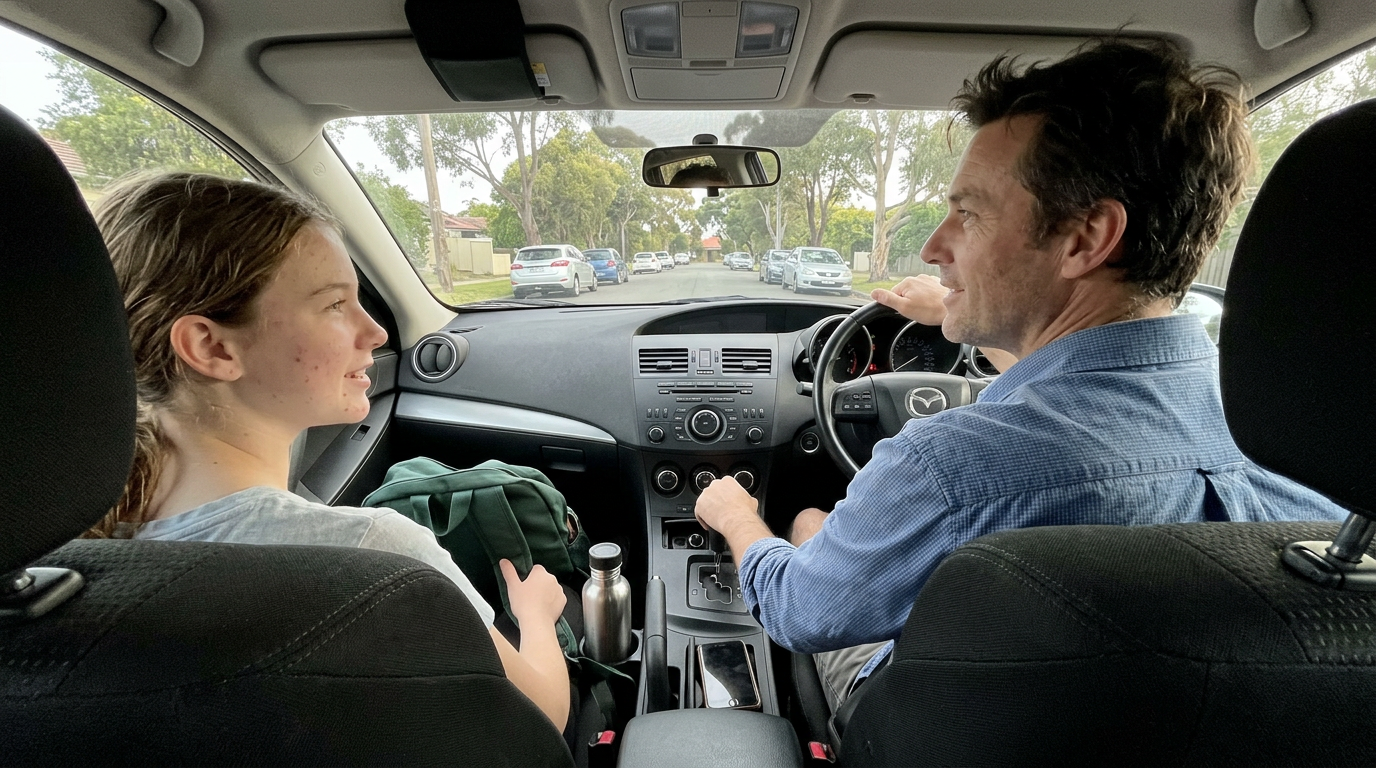
Four windows beat the doorway moment, and the right one depends on your child. In the car or on the walk home works because no one's looking at anyone — eyes on the road, side-by-side, no pressure. During a snack 20–45 minutes after they get in gives the after-school recovery time their brain needs, and food softens the conversation. At bedtime, lights off — the dark and the quiet do a lot of the work, especially with younger kids who say more in the last five minutes of the day than they did in the previous three hours. On a shared task — folding laundry, walking the dog, prepping dinner — gives both of you something to do with your hands, which is often what an older child needs to talk.
The window to avoid is the first three minutes after pickup. Their brain is still finishing the day. Wait.
Is it normal for teens to not want to talk about school?
Yes, mostly. Adolescent development pulls teens toward their peers and away from parents — that's the job, not a problem. A 14-year-old who tells you everything is unusual; a 14-year-old who tells you something, sometimes, in their own time, is on track. Harvard's Family Engagement work describes this as a shift from tell-me to let-me-tell-you — teens want to choose the moment, the topic, and the tempo.
What works with teens: ride in the car, listen to their music for the first five minutes without comment, then ask a small question and accept a short answer as the whole answer. Don't follow up that day. The next conversation comes more easily because the last one didn't feel like a debrief. If your teen flatly refuses to discuss school for weeks at a time but is otherwise themselves — eating, sleeping, seeing friends, engaged in something — you're probably fine. If the silence comes with withdrawal from things they used to enjoy, that's a different signal (see the next section).
How do I tell if my child is hiding something about school?
Hiding looks different from not-feeling-like-talking. Watch for the cluster, not any single sign:
- A specific topic they used to mention has gone silent — a friend's name, a subject, a sports team. Names disappearing is a flag.
- Reluctance to go to school on certain days — Monday mornings being hard is normal; Tuesdays being hard every week is not.
- Stomach aches, headaches, or being "tired" on school days only — somatic signs that lift on weekends.
- A change in who they sit with, eat with, or text — a sudden friendship reshuffle without explanation.
- Phone behavior shifts — flipping the screen down when you walk in, a new lock, deleted messages.
- School-work avoidance that's new — homework battles in a child who didn't have them before.
One of these in isolation is normal noise. Three or more, persisting for two weeks, is worth a calm sit-down. Lead with what you've noticed, not what you suspect: "I've noticed Tuesdays have been hard lately. What's going on?" Open the door; don't push through it.
Should I push my child to talk about school or wait?
Wait, but stay close. Pushing turns a quiet child into a defensive one, and turns a teen into a closed door. What works instead is what therapists call parallel availability — being present in the same room, doing your own thing, not asking. Most kids will talk eventually if you're around long enough without making them perform. Sit on the same couch. Cook in the same kitchen. Drive without the radio. Conversation finds the gap.
There are two situations where waiting isn't right. If you suspect bullying, self-harm, online harm, or a well-being risk, ask directly and do it today. And if you've been waiting for a few weeks and the silence is paired with the cluster of signs above, gentle directness is the right move — name what you've noticed, ask one question, listen.
When should I worry that my child won't open up?
Most quiet phases pass. The ones worth taking seriously share three patterns. First, a sustained change from their baseline — a normally-chatty child who has been monosyllabic for more than two weeks; a teen who used to share something most days now sharing nothing for a month. Second, silence paired with other shifts — sleep, appetite, mood, friendships, energy, school-refusal mornings. Third, stuck-ness — they say school is "fine" but their grades, attendance, or behavior says otherwise. If two of those three are present, a conversation with their classroom teacher and your pediatrician is the next move. A school counselor or a private psychologist isn't a big deal — it's a tool.
If the quiet seems tied to schoolwork specifically — falling behind, anxious about a subject, dreading a class — a private tutor who works one-to-one in the same subject can change the conversation faster than parents expect. We've seen kids who hadn't mentioned math in six months mention it the night after their first lesson, because someone outside the family finally made the subject feel possible. See our guide to five signs your child needs a tutor if you're weighing it up.
How do I listen so my child keeps talking?
Listening is mostly what you don't do. Don't fix. Don't moralize. Don't compare to your own school days. Don't ask three follow-up questions in a row. The listening that keeps a child talking is short acknowledgments ("That sounds hard." "Wow." "Yeah.") and a face that isn't doing anything. Most parents underrate how much of the conversation is carried by simply not interrupting.
Try this on the next conversation: count to three in your head before you respond. Most of the time, your child will fill the silence with something more honest than what they led with. The first answer is rarely the real answer; it's the one that didn't take much energy. The second answer — the one that comes after three seconds of you not jumping in — is the one worth listening to.
When should I bring in a tutor or counselor?
If schoolwork is the source of the silence — a subject they're falling behind in, a teacher they're not connecting with, a curriculum step they missed — a one-to-one private tutor is often the fastest unlock. Tutors work outside the family dynamic and outside the classroom, and they meet the child where they actually are, not where the curriculum says they should be. Tutoring with us starts at US$45/hr, the same rate from kindergarten through 12th grade, with no contracts and a tutor matched to your child specifically. Most parents see a confidence shift in the first three lessons; the talking-about-school shift usually follows.
If the source of the silence is friendships, anxiety, online harm, family change, or anything that doesn't sit cleanly inside a subject, a school counselor or a private psychologist is the right call. Your pediatrician can refer you, and most schools will help privately if you ask. Tutoring and counseling aren't either-or — children who need both often do better when both happen at once.
Related reading
- 5 signs that your child needs tutoring — when schoolwork is the source of the quiet
- 4 tips to know if your child is falling behind at school — the academic-warning-signs companion
- How to motivate your child — when "I don't want to" is the real message
- How to support your child as a busy parent — small habits that compound
- The ideal time to begin tutoring — timing if you decide to bring someone in
- 5 key benefits of private tutoring — what private one-to-one actually changes
The bottom line
Kids talk about school when the conditions are right — small specific questions, the right moment, hands busy and eyes elsewhere, and a parent who can sit with three seconds of silence without filling it. Teens go quiet because that's what teens do; that quiet only matters when it pairs with other changes. And if schoolwork is the part that's hardest to talk about, a one-to-one tutor often changes the conversation in a way the family on its own can't.
The first answer is rarely the real answer. The second answer — the one that comes after three seconds of you not jumping in — is the one worth listening to.
The first answer is rarely the real answer. The second answer — the one that comes after three seconds of you not jumping in — is the one worth listening to.
Your child gets in the car or walks through the door and you ask the most ordinary question in the world — "How was school?" — and you get back a single word, or a shrug, or "fine." It feels like a closed door. The good news is most kids open up when the conditions are right. This guide gives you eight specific questions that work, four timing windows that beat the after-school slump, and a clear sense of when silence is normal and when it's worth a closer look.
Quick answer
Most kids talk about school when they don't feel interrogated. Skip "How was your day?" and ask one specific, low-stakes question — about a person, a moment, or a small detail. Pick a time when their hands are busy and your eyes aren't on them: in the car, at a snack, on a walk, doing dishes. With teens, wait longer and accept short answers as a real start. If a normally-talkative child has gone quiet for more than two weeks, or if quiet comes with sleep, appetite, or behavior changes, that's worth a calm conversation and a check-in with their tutor or teacher.
Why won't my child tell me about their school day?
Most of the time, the silence isn't about you. By 3pm your child has been "on" for six hours — making decisions, managing friendships, sitting still, and switching subjects every 45 minutes. When you ask "How was school?" the moment they walk in, you're asking a tired brain to summarize a complex day in one word. A shrug is what you get because that's all they've got the energy for. The American Academy of Pediatrics calls this after-school restraint collapse — children hold themselves together at school and need a quiet recovery window before they can talk about it.
Add the word the question implies — "How was it?" sounds like a verdict. Kids hear the test in your voice and they hedge. The fix isn't a bigger question; it's a smaller one, asked later, in a quieter moment.
What questions should I ask my child after school?
Replace one big question with one small, specific one. The eight below work because they don't ask for a verdict — they ask about a person, a moment, or a sense. Pick one or two and rotate; using the same prompt every day turns it into another version of "How was school?"
- Who did you sit next to at lunch? Names a specific person and a specific time. Almost always answerable.
- What was the funniest thing that happened today? Lower stakes than "best" or "favorite" — kids relax around humor.
- What's something a teacher said that stuck with you? Pulls a moment, not a summary. Works well from about 3rd grade up.
- Was anything boring today? Permission to be honest. Often opens into what was actually interesting by contrast.
- Who did you help, or who helped you? Frames school as a place of people, not just lessons.
- What was the hardest moment? Names that hard is normal. Save for when you have time to listen.
- If you were the teacher, what would you have done differently today? Invites perspective. Great for 5th grade and up.
- Was there a moment you were proud of yourself? Specific, kind, and not graded.
Lisa Damour, the adolescent psychologist, has a one-line rule for parents: ask one question, then stop. Don't follow up. Don't dig. Let the answer sit, and most of the time more comes a few minutes later, unprompted.
What's the best time of day to talk to my child about school?
Four windows beat the doorway moment, and the right one depends on your child. In the car or on the walk home works because no one's looking at anyone — eyes on the road, side-by-side, no pressure. During a snack 20–45 minutes after they get in gives the after-school recovery time their brain needs, and food softens the conversation. At bedtime, lights off — the dark and the quiet do a lot of the work, especially with younger kids who say more in the last five minutes of the day than they did in the previous three hours. On a shared task — folding laundry, walking the dog, prepping dinner — gives both of you something to do with your hands, which is often what an older child needs to talk.
The window to avoid is the first three minutes after pickup. Their brain is still finishing the day. Wait.
Is it normal for teens to not want to talk about school?
Yes, mostly. Adolescent development pulls teens toward their peers and away from parents — that's the job, not a problem. A 14-year-old who tells you everything is unusual; a 14-year-old who tells you something, sometimes, in their own time, is on track. Harvard's Family Engagement work describes this as a shift from tell-me to let-me-tell-you — teens want to choose the moment, the topic, and the tempo.
What works with teens: ride in the car, listen to their music for the first five minutes without comment, then ask a small question and accept a short answer as the whole answer. Don't follow up that day. The next conversation comes more easily because the last one didn't feel like a debrief. If your teen flatly refuses to discuss school for weeks at a time but is otherwise themselves — eating, sleeping, seeing friends, engaged in something — you're probably fine. If the silence comes with withdrawal from things they used to enjoy, that's a different signal (see the next section).
How do I tell if my child is hiding something about school?
Hiding looks different from not-feeling-like-talking. Watch for the cluster, not any single sign:
- A specific topic they used to mention has gone silent — a friend's name, a subject, a sports team. Names disappearing is a flag.
- Reluctance to go to school on certain days — Monday mornings being hard is normal; Tuesdays being hard every week is not.
- Stomach aches, headaches, or being "tired" on school days only — somatic signs that lift on weekends.
- A change in who they sit with, eat with, or text — a sudden friendship reshuffle without explanation.
- Phone behavior shifts — flipping the screen down when you walk in, a new lock, deleted messages.
- School-work avoidance that's new — homework battles in a child who didn't have them before.
One of these in isolation is normal noise. Three or more, persisting for two weeks, is worth a calm sit-down. Lead with what you've noticed, not what you suspect: "I've noticed Tuesdays have been hard lately. What's going on?" Open the door; don't push through it.
Should I push my child to talk about school or wait?
Wait, but stay close. Pushing turns a quiet child into a defensive one, and turns a teen into a closed door. What works instead is what therapists call parallel availability — being present in the same room, doing your own thing, not asking. Most kids will talk eventually if you're around long enough without making them perform. Sit on the same couch. Cook in the same kitchen. Drive without the radio. Conversation finds the gap.
There are two situations where waiting isn't right. If you suspect bullying, self-harm, online harm, or a well-being risk, ask directly and do it today. And if you've been waiting for a few weeks and the silence is paired with the cluster of signs above, gentle directness is the right move — name what you've noticed, ask one question, listen.
When should I worry that my child won't open up?
Most quiet phases pass. The ones worth taking seriously share three patterns. First, a sustained change from their baseline — a normally-chatty child who has been monosyllabic for more than two weeks; a teen who used to share something most days now sharing nothing for a month. Second, silence paired with other shifts — sleep, appetite, mood, friendships, energy, school-refusal mornings. Third, stuck-ness — they say school is "fine" but their grades, attendance, or behavior says otherwise. If two of those three are present, a conversation with their classroom teacher and your pediatrician is the next move. A school counselor or a private psychologist isn't a big deal — it's a tool.
If the quiet seems tied to schoolwork specifically — falling behind, anxious about a subject, dreading a class — a private tutor who works one-to-one in the same subject can change the conversation faster than parents expect. We've seen kids who hadn't mentioned math in six months mention it the night after their first lesson, because someone outside the family finally made the subject feel possible. See our guide to five signs your child needs a tutor if you're weighing it up.
How do I listen so my child keeps talking?
Listening is mostly what you don't do. Don't fix. Don't moralize. Don't compare to your own school days. Don't ask three follow-up questions in a row. The listening that keeps a child talking is short acknowledgments ("That sounds hard." "Wow." "Yeah.") and a face that isn't doing anything. Most parents underrate how much of the conversation is carried by simply not interrupting.
Try this on the next conversation: count to three in your head before you respond. Most of the time, your child will fill the silence with something more honest than what they led with. The first answer is rarely the real answer; it's the one that didn't take much energy. The second answer — the one that comes after three seconds of you not jumping in — is the one worth listening to.
When should I bring in a tutor or counselor?
If schoolwork is the source of the silence — a subject they're falling behind in, a teacher they're not connecting with, a curriculum step they missed — a one-to-one private tutor is often the fastest unlock. Tutors work outside the family dynamic and outside the classroom, and they meet the child where they actually are, not where the curriculum says they should be. Tutoring with us starts at US$45/hr, the same rate from kindergarten through 12th grade, with no contracts and a tutor matched to your child specifically. Most parents see a confidence shift in the first three lessons; the talking-about-school shift usually follows.
If the source of the silence is friendships, anxiety, online harm, family change, or anything that doesn't sit cleanly inside a subject, a school counselor or a private psychologist is the right call. Your pediatrician can refer you, and most schools will help privately if you ask. Tutoring and counseling aren't either-or — children who need both often do better when both happen at once.
Related reading
- 5 signs that your child needs tutoring — when schoolwork is the source of the quiet
- 4 tips to know if your child is falling behind at school — the academic-warning-signs companion
- How to motivate your child — when "I don't want to" is the real message
- How to support your child as a busy parent — small habits that compound
- The ideal time to begin tutoring — timing if you decide to bring someone in
- 5 key benefits of private tutoring — what private one-to-one actually changes
The bottom line
Kids talk about school when the conditions are right — small specific questions, the right moment, hands busy and eyes elsewhere, and a parent who can sit with three seconds of silence without filling it. Teens go quiet because that's what teens do; that quiet only matters when it pairs with other changes. And if schoolwork is the part that's hardest to talk about, a one-to-one tutor often changes the conversation in a way the family on its own can't.
The first answer is rarely the real answer. The second answer — the one that comes after three seconds of you not jumping in — is the one worth listening to.
The first answer is rarely the real answer. The second answer — the one that comes after three seconds of you not jumping in — is the one worth listening to.

The first answer is rarely the real answer. The second answer — the one that comes after three seconds of you not jumping in — is the one worth listening to.
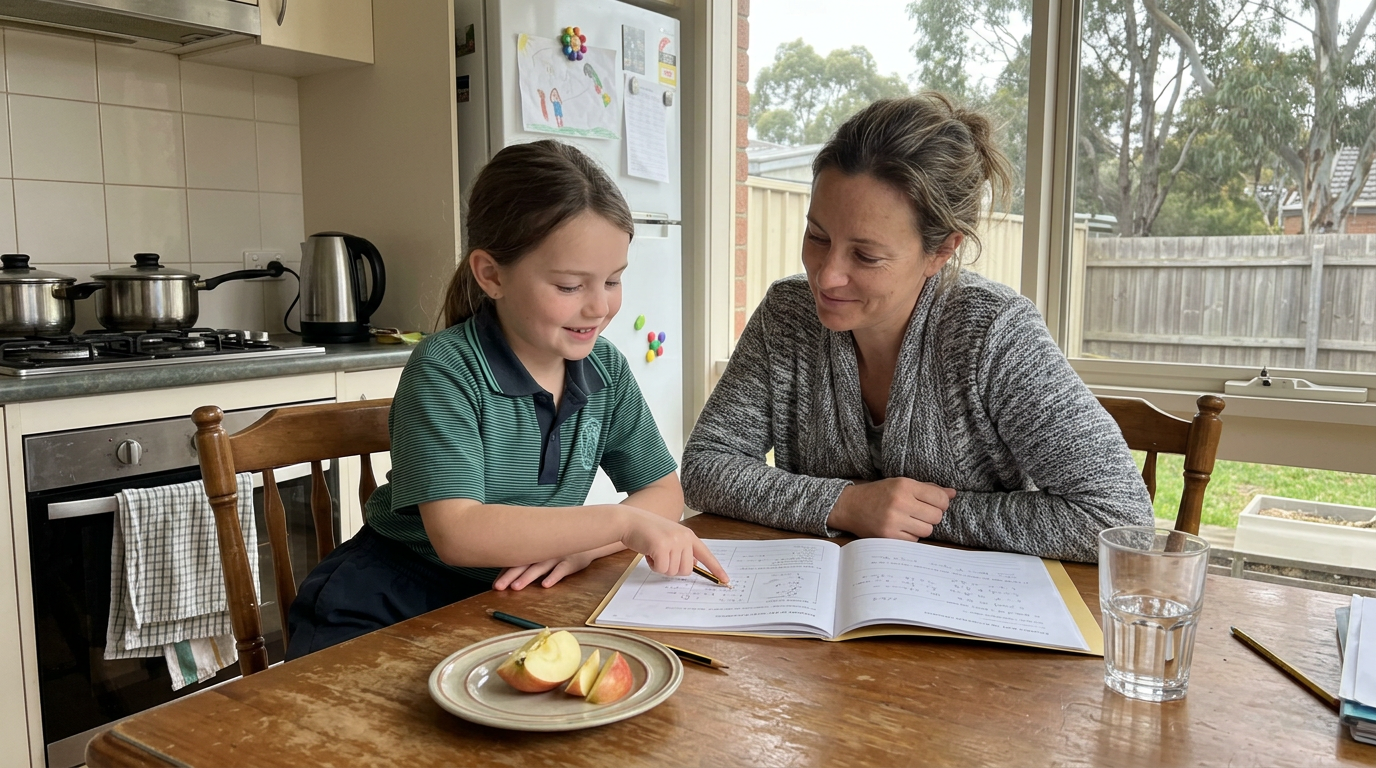
The car is the most under-rated conversation room in the house — no eye contact, no audience, hands busy.
Your child gets in the car or walks through the door and you ask the most ordinary question in the world — "How was school?" — and you get back a single word, or a shrug, or "fine." It feels like a closed door. The good news is most kids open up when the conditions are right. This guide gives you eight specific questions that work, four timing windows that beat the after-school slump, and a clear sense of when silence is normal and when it's worth a closer look.
Quick answer
Most kids talk about school when they don't feel interrogated. Skip "How was your day?" and ask one specific, low-stakes question — about a person, a moment, or a small detail. Pick a time when their hands are busy and your eyes aren't on them: in the car, at a snack, on a walk, doing dishes. With teens, wait longer and accept short answers as a real start. If a normally-talkative child has gone quiet for more than two weeks, or if quiet comes with sleep, appetite, or behavior changes, that's worth a calm conversation and a check-in with their tutor or teacher.
Why won't my child tell me about their school day?
Most of the time, the silence isn't about you. By 3pm your child has been "on" for six hours — making decisions, managing friendships, sitting still, and switching subjects every 45 minutes. When you ask "How was school?" the moment they walk in, you're asking a tired brain to summarize a complex day in one word. A shrug is what you get because that's all they've got the energy for. The American Academy of Pediatrics calls this after-school restraint collapse — children hold themselves together at school and need a quiet recovery window before they can talk about it.
Add the word the question implies — "How was it?" sounds like a verdict. Kids hear the test in your voice and they hedge. The fix isn't a bigger question; it's a smaller one, asked later, in a quieter moment.
What questions should I ask my child after school?
Replace one big question with one small, specific one. The eight below work because they don't ask for a verdict — they ask about a person, a moment, or a sense. Pick one or two and rotate; using the same prompt every day turns it into another version of "How was school?"
- Who did you sit next to at lunch? Names a specific person and a specific time. Almost always answerable.
- What was the funniest thing that happened today? Lower stakes than "best" or "favorite" — kids relax around humor.
- What's something a teacher said that stuck with you? Pulls a moment, not a summary. Works well from about 3rd grade up.
- Was anything boring today? Permission to be honest. Often opens into what was actually interesting by contrast.
- Who did you help, or who helped you? Frames school as a place of people, not just lessons.
- What was the hardest moment? Names that hard is normal. Save for when you have time to listen.
- If you were the teacher, what would you have done differently today? Invites perspective. Great for 5th grade and up.
- Was there a moment you were proud of yourself? Specific, kind, and not graded.
Lisa Damour, the adolescent psychologist, has a one-line rule for parents: ask one question, then stop. Don't follow up. Don't dig. Let the answer sit, and most of the time more comes a few minutes later, unprompted.
What's the best time of day to talk to my child about school?
Four windows beat the doorway moment, and the right one depends on your child. In the car or on the walk home works because no one's looking at anyone — eyes on the road, side-by-side, no pressure. During a snack 20–45 minutes after they get in gives the after-school recovery time their brain needs, and food softens the conversation. At bedtime, lights off — the dark and the quiet do a lot of the work, especially with younger kids who say more in the last five minutes of the day than they did in the previous three hours. On a shared task — folding laundry, walking the dog, prepping dinner — gives both of you something to do with your hands, which is often what an older child needs to talk.
The window to avoid is the first three minutes after pickup. Their brain is still finishing the day. Wait.
Is it normal for teens to not want to talk about school?
Yes, mostly. Adolescent development pulls teens toward their peers and away from parents — that's the job, not a problem. A 14-year-old who tells you everything is unusual; a 14-year-old who tells you something, sometimes, in their own time, is on track. Harvard's Family Engagement work describes this as a shift from tell-me to let-me-tell-you — teens want to choose the moment, the topic, and the tempo.
What works with teens: ride in the car, listen to their music for the first five minutes without comment, then ask a small question and accept a short answer as the whole answer. Don't follow up that day. The next conversation comes more easily because the last one didn't feel like a debrief. If your teen flatly refuses to discuss school for weeks at a time but is otherwise themselves — eating, sleeping, seeing friends, engaged in something — you're probably fine. If the silence comes with withdrawal from things they used to enjoy, that's a different signal (see the next section).
How do I tell if my child is hiding something about school?
Hiding looks different from not-feeling-like-talking. Watch for the cluster, not any single sign:
- A specific topic they used to mention has gone silent — a friend's name, a subject, a sports team. Names disappearing is a flag.
- Reluctance to go to school on certain days — Monday mornings being hard is normal; Tuesdays being hard every week is not.
- Stomach aches, headaches, or being "tired" on school days only — somatic signs that lift on weekends.
- A change in who they sit with, eat with, or text — a sudden friendship reshuffle without explanation.
- Phone behavior shifts — flipping the screen down when you walk in, a new lock, deleted messages.
- School-work avoidance that's new — homework battles in a child who didn't have them before.
One of these in isolation is normal noise. Three or more, persisting for two weeks, is worth a calm sit-down. Lead with what you've noticed, not what you suspect: "I've noticed Tuesdays have been hard lately. What's going on?" Open the door; don't push through it.
Should I push my child to talk about school or wait?
Wait, but stay close. Pushing turns a quiet child into a defensive one, and turns a teen into a closed door. What works instead is what therapists call parallel availability — being present in the same room, doing your own thing, not asking. Most kids will talk eventually if you're around long enough without making them perform. Sit on the same couch. Cook in the same kitchen. Drive without the radio. Conversation finds the gap.
There are two situations where waiting isn't right. If you suspect bullying, self-harm, online harm, or a well-being risk, ask directly and do it today. And if you've been waiting for a few weeks and the silence is paired with the cluster of signs above, gentle directness is the right move — name what you've noticed, ask one question, listen.
When should I worry that my child won't open up?
Most quiet phases pass. The ones worth taking seriously share three patterns. First, a sustained change from their baseline — a normally-chatty child who has been monosyllabic for more than two weeks; a teen who used to share something most days now sharing nothing for a month. Second, silence paired with other shifts — sleep, appetite, mood, friendships, energy, school-refusal mornings. Third, stuck-ness — they say school is "fine" but their grades, attendance, or behavior says otherwise. If two of those three are present, a conversation with their classroom teacher and your pediatrician is the next move. A school counselor or a private psychologist isn't a big deal — it's a tool.
If the quiet seems tied to schoolwork specifically — falling behind, anxious about a subject, dreading a class — a private tutor who works one-to-one in the same subject can change the conversation faster than parents expect. We've seen kids who hadn't mentioned math in six months mention it the night after their first lesson, because someone outside the family finally made the subject feel possible. See our guide to five signs your child needs a tutor if you're weighing it up.
How do I listen so my child keeps talking?
Listening is mostly what you don't do. Don't fix. Don't moralize. Don't compare to your own school days. Don't ask three follow-up questions in a row. The listening that keeps a child talking is short acknowledgments ("That sounds hard." "Wow." "Yeah.") and a face that isn't doing anything. Most parents underrate how much of the conversation is carried by simply not interrupting.
Try this on the next conversation: count to three in your head before you respond. Most of the time, your child will fill the silence with something more honest than what they led with. The first answer is rarely the real answer; it's the one that didn't take much energy. The second answer — the one that comes after three seconds of you not jumping in — is the one worth listening to.
When should I bring in a tutor or counselor?
If schoolwork is the source of the silence — a subject they're falling behind in, a teacher they're not connecting with, a curriculum step they missed — a one-to-one private tutor is often the fastest unlock. Tutors work outside the family dynamic and outside the classroom, and they meet the child where they actually are, not where the curriculum says they should be. Tutoring with us starts at US$45/hr, the same rate from kindergarten through 12th grade, with no contracts and a tutor matched to your child specifically. Most parents see a confidence shift in the first three lessons; the talking-about-school shift usually follows.
If the source of the silence is friendships, anxiety, online harm, family change, or anything that doesn't sit cleanly inside a subject, a school counselor or a private psychologist is the right call. Your pediatrician can refer you, and most schools will help privately if you ask. Tutoring and counseling aren't either-or — children who need both often do better when both happen at once.
Related reading
- 5 signs that your child needs tutoring — when schoolwork is the source of the quiet
- 4 tips to know if your child is falling behind at school — the academic-warning-signs companion
- How to motivate your child — when "I don't want to" is the real message
- How to support your child as a busy parent — small habits that compound
- The ideal time to begin tutoring — timing if you decide to bring someone in
- 5 key benefits of private tutoring — what private one-to-one actually changes
The bottom line
Kids talk about school when the conditions are right — small specific questions, the right moment, hands busy and eyes elsewhere, and a parent who can sit with three seconds of silence without filling it. Teens go quiet because that's what teens do; that quiet only matters when it pairs with other changes. And if schoolwork is the part that's hardest to talk about, a one-to-one tutor often changes the conversation in a way the family on its own can't.
The first answer is rarely the real answer. The second answer — the one that comes after three seconds of you not jumping in — is the one worth listening to.
The car is the most under-rated conversation room in the house — no eye contact, no audience, hands busy.
.svg)
.svg)
Most kids walk in tired and need 20–45 minutes of quiet recovery before they can talk. The American Academy of Pediatrics calls it after-school restraint collapse — children hold it together at school and need to decompress before they can summarize the day. Asking 'How was school?' the moment they walk in asks a tired brain to do something hard. Wait for the snack, the car, or bedtime, and ask one specific question instead.
Pick one small specific question and rotate. 'Who did you sit next to at lunch?' almost always works. Other reliable starters: 'What was the funniest thing today?' 'Was anything boring?' 'Who did you help, or who helped you?' The trick is asking about a person, a moment, or a feeling — not asking for a verdict on the whole day. Don't ask the same one every day; rotation keeps it real.
Yes. Pulling away from parents is a developmental task in adolescence — that shift is the work, not a problem. A 14-year-old who shares something some days, in their own time, is on track. Worry kicks in when silence pairs with other changes: withdrawal from friends or activities they used to enjoy, sleep or appetite shifts, or school refusal. Quiet alone is normal; quiet plus something else is a signal.
Watch the cluster, not the single sign. A specific topic gone silent (a friend's name, a subject), reluctance on certain days only, somatic complaints that lift on weekends, a sudden friendship reshuffle, or new phone-flip-down behavior all matter more in combination than alone. Three or more for two weeks is worth a calm sit-down. Lead with what you've noticed — 'I've noticed Tuesdays have been hard' — not what you suspect.
Generally no — push and they close further. Be present without asking: same room, same task, no pressure. Most kids talk when the gap appears. Two exceptions: if you suspect bullying, self-harm, online harm, or a well-being risk, ask directly today; and if quiet has paired with other changes for more than two weeks, name what you've noticed and ask one question.
If schoolwork is the source of the silence, a one-to-one private tutor is often the fastest unlock — they work outside the family dynamic and meet the child where they actually are. If the silence is about friendships, anxiety, online harm, or a family change, a school counselor or private psychologist is the right call. Your pediatrician can refer you. The two aren't mutually exclusive — many children do better when both happen at once.
Hoping to improve confidence & grades?

.png)