.svg)

If you work full-time, the guilt of not being the parent who's home for homework is real. The good news from forty years of education research: how much time you have matters far less than how you use it. A consistent 10-minute daily check-in, plus one weekend ritual, plus knowing when to bring in outside help, beats two hours of well-meaning but resentful supervision every time. This guide is the 80/20 of academic support for time-pressed parents — the small, high-impact moves that actually move the needle.
What's the most important thing a busy parent can do for a child's schoolwork?
Show steady, low-pressure interest in their learning — every day, even briefly. Education researcher John Hattie's Visible Learning meta-analysis ranks parental expectations and interest as having one of the largest effect sizes on a child's academic outcomes (around 0.50, well above the 0.40 threshold for "above-average impact"). Crucially, it's not the hours of supervision that move that number — it's the consistency of interest. A 10-minute conversation about what they learned today, three or four nights a week, beats a frantic Sunday-night homework marathon. Your child needs to know their schoolwork matters to you. They don't need you to be their teacher.
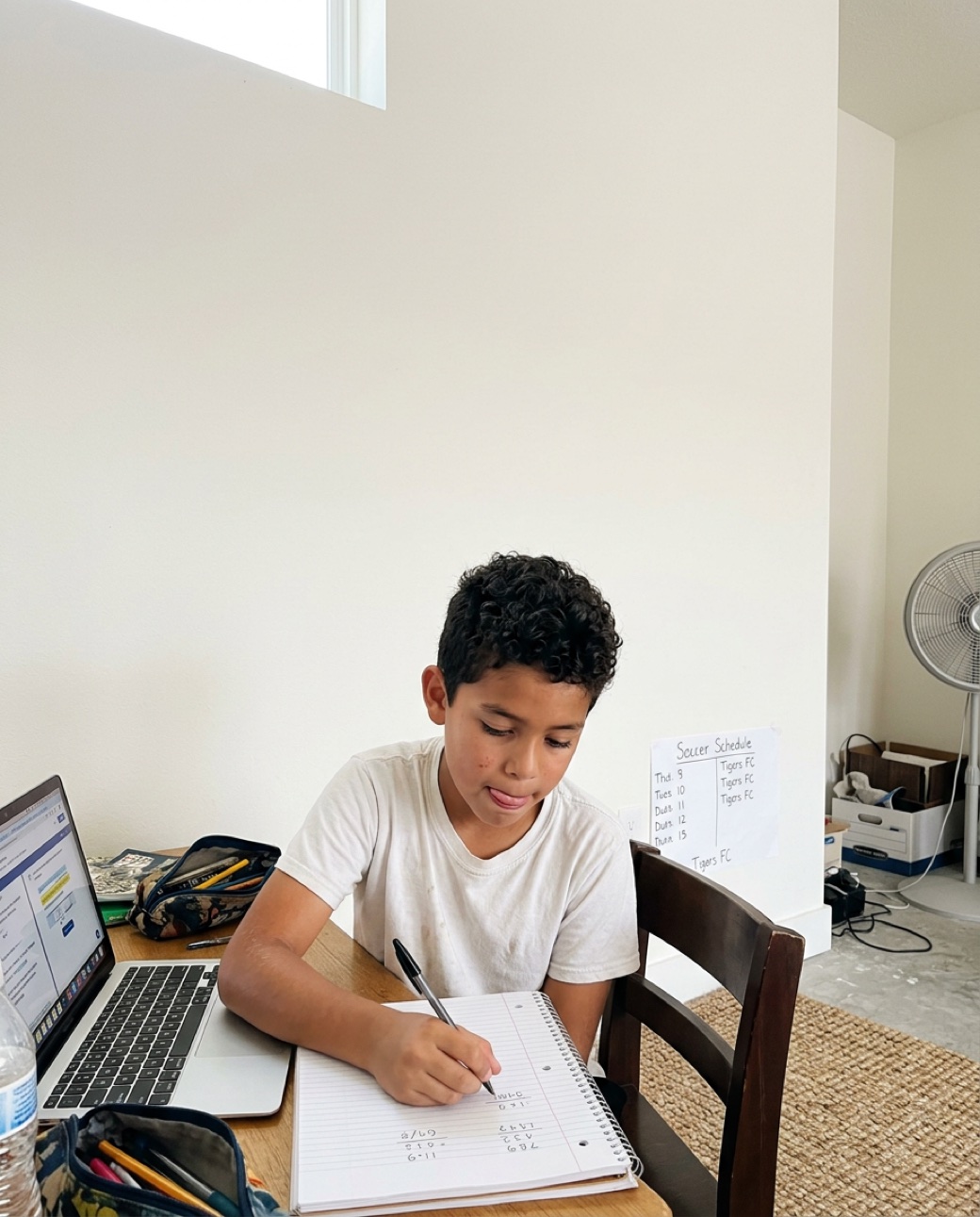
Is it bad if I can't help my child with homework?
No — and the research actually supports stepping back, especially as kids get older. Studies in the Journal of Experimental Education and a widely-cited 2014 Duke University analysis found that direct parent involvement in homework has near-zero or even slightly negative effects past elementary school, particularly when the parent doesn't know the current curriculum. What does help: setting up the conditions for homework (a quiet spot, a regular time, the phone in another room), asking how it's going, and not rescuing your child from struggle. If you've ever watched a tutor work with your child and thought "I could never explain it that way" — you're right, and that's fine. Different roles. You're the parent.
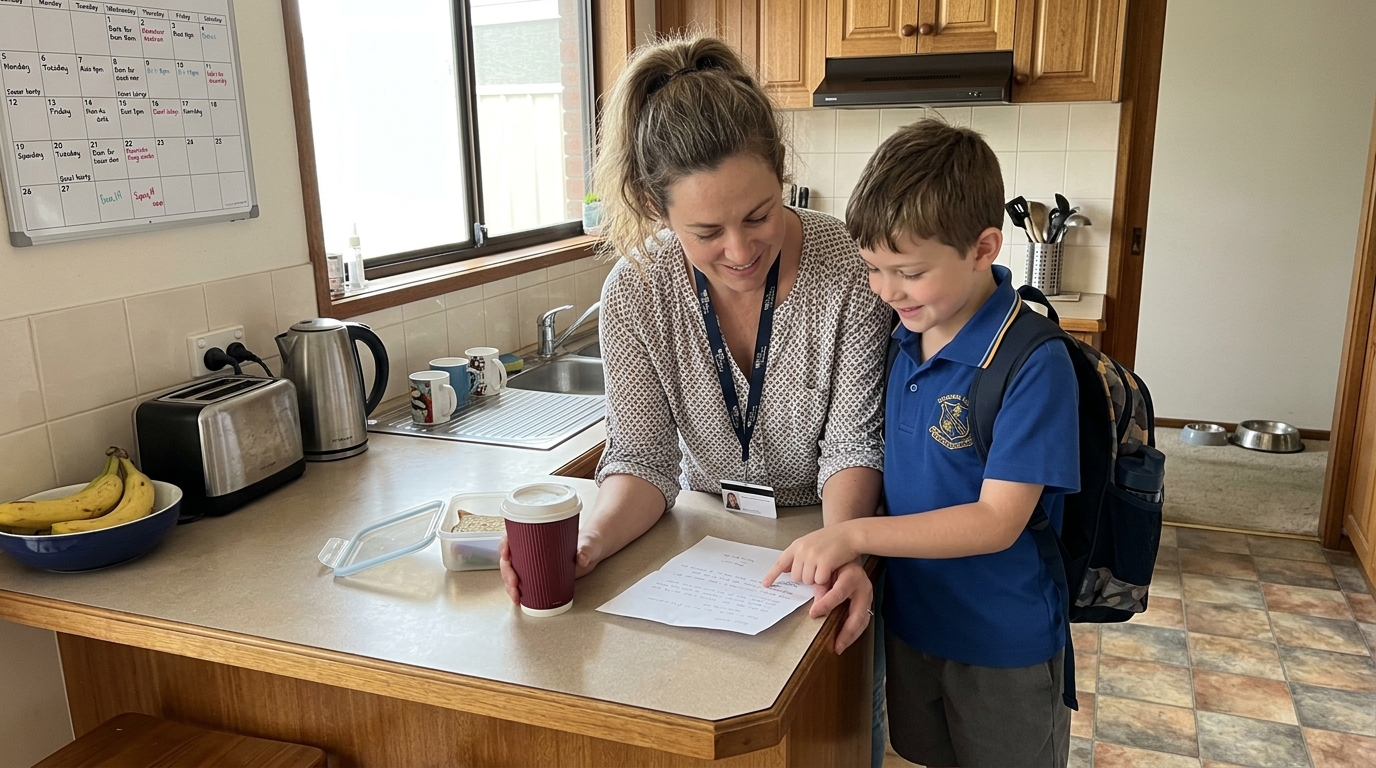
How do I check in with my child's school when I'm at work all day?
Almost every U.S. school now runs on email, a parent app (Schoology, PowerSchool, ClassDojo, Seesaw, Canvas), or a class newsletter. Pick the one channel your child's school actually uses, set a 10-minute slot in your calendar each Sunday evening, and read what came in that week. Reply to the teacher's emails — even a one-line "thanks for the update, we'll work on the multiplication tables this week" is enough to mark you as an engaged parent. For parent-teacher conferences, request an after-hours phone or video slot rather than skipping; most teachers will accommodate working parents if you ask. The teacher doesn't need to see you on school grounds. They need to know you're paying attention.
What's the 10-minute daily routine that works for working parents?
The version that survives a packed week has three parts and fits in the cracks of an existing routine — usually the drive home, dinner, or the wind-down before bed.
- Two minutes — the open question. "What did you actually learn today?" not "How was school?" The first gets a real answer; the second gets "fine." Save it for the car or the dinner table.
- Five minutes — look at one thing. One worksheet, one paragraph of writing, one math question they got wrong. Not the whole bag. Ask them to walk you through it. You're not grading it — you're listening to them think out loud, which is exactly the cognitive move that builds learning.
- Three minutes — name the next step. "What are you going to work on tomorrow?" Putting it in their words puts the responsibility back where it belongs. If they don't know, that's the signal to email the teacher.
Three nights out of five is enough. Miss two and you haven't broken anything; the consistency over a semester is what counts.
How do I make weekends count for my child's education?
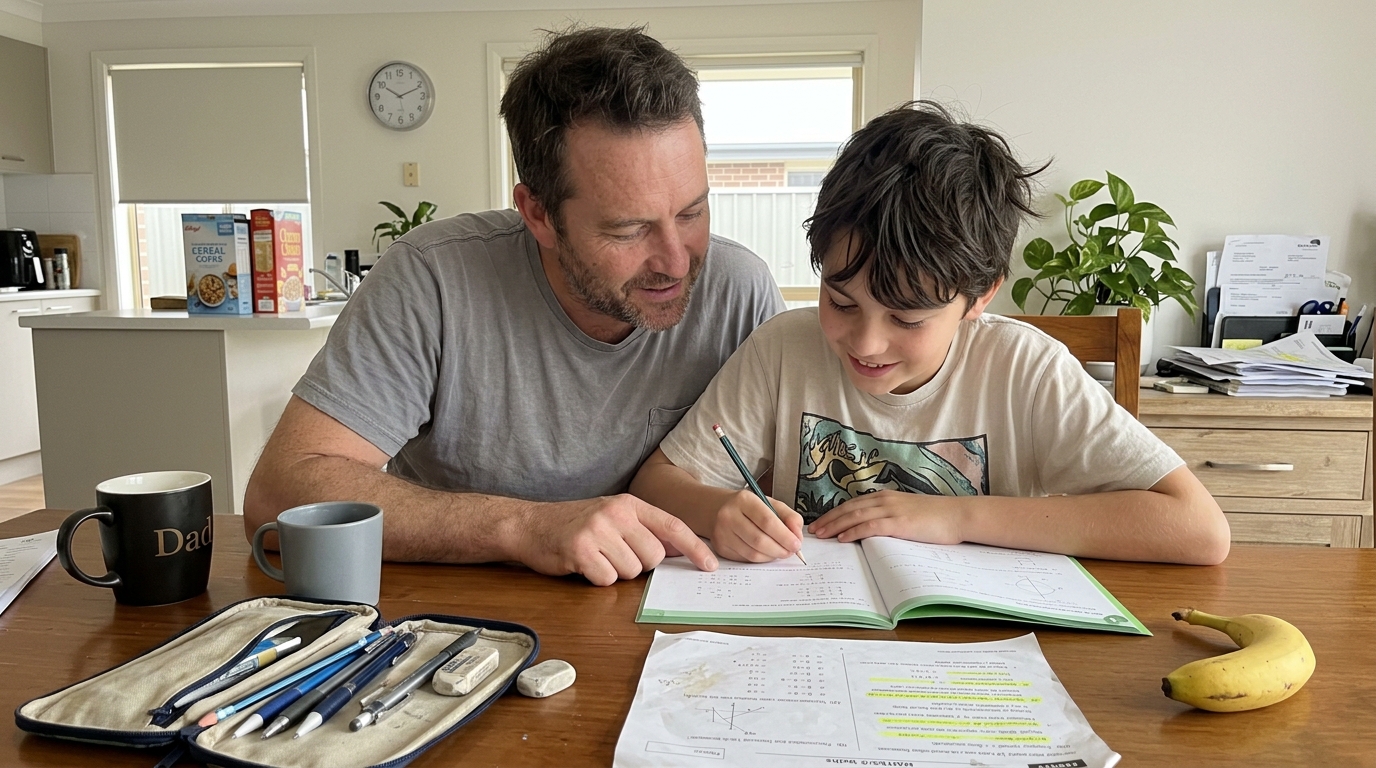
One ritual, repeated. The weekend is where working parents have time but spend it badly — over-scheduling sports, errands, and screens, then collapsing into Sunday-night-homework panic. Pick one 60-90 minute slot, the same time each weekend, and protect it. Saturday morning at the kitchen table with a hot drink works for most families. The point isn't to blast through homework — it's to sit alongside your child while they do their own work, available for questions, present without hovering. Harvard's Family Engagement research consistently finds that the environment a parent sets up — protected time, low distraction, predictable rhythm — drives more academic gain than any specific subject help.
Should I get a tutor if I can't help with homework myself?
For a lot of working parents, this is the smartest single trade-off you can make. A tutor costs in money what you'd otherwise spend in evening hours and family friction — and a good one explains the current curriculum (Common Core, state-standard, AP-aware) far better than a parent who last sat that subject twenty years ago. Tutero's online tutoring starts at US$45/hr with no contracts — same rate from kindergarten through 12th grade, no senior premium. One session a week is the most common pattern; for high-schoolers with a specific exam in view, two sessions can be worth it. The right way to think about a tutor isn't "I failed as a parent" — it's "I bought back two weeknights and gave my child a specialist."
When outsourcing makes sense
If homework is becoming an evening battle, if your child is hiding their work from you, if you're explaining the same concept three nights running, or if you don't know the curriculum well enough to spot what they're getting wrong — you've already paid the cost in stress. A weekly tutor is usually the cheaper option.
How do I stop feeling guilty about not being there for school?
Guilt doesn't make you a better parent — it makes you a more anxious one, and your child reads that anxiety. Two reframes that help:
- Quality of attention beats quantity. Twenty minutes of full attention — phone away, eyes on your child, asking real questions about what they did — is worth more than two hours of half-distracted hovering. Time-strapped parents often outperform stay-at-home parents on this metric, because their attention is concentrated.
- You're modeling what work looks like. Children of working parents see effort, persistence, and how an adult handles a hard week. That's a curriculum too. The kids who watch a parent come home tired and still ask about their day learn that work and care can coexist — which is most of adult life.
You don't need to be the parent at every assembly. You need to be the parent who knows what's going on, sets up the conditions for learning, shows up for the moments that matter, and brings in help where it's worth it.
Related reading
For working parents going deeper:
- When homework gets too hard: three strategies that don't require you to know the answer
- How to help your child manage exam stress
- How to motivate your child without becoming the bad cop
- How to help your child focus when you're not in the room
- Five signs your child needs a tutor
- The ideal time to begin tutoring
- How personalised tutoring can help your child
- Five key benefits of private tutoring
The bottom line
Being a busy working parent is not a barrier to academic support. Ten minutes a day, one protected weekend ritual, a Sunday-night sweep of the school's parent app, and outsourcing the explaining to a tutor when it stops being your job — that's the 80/20 that actually shifts a child's outcomes. None of it requires you to know algebra. All of it requires you to show up, predictably, and care visibly.
Want to give your child a specialist without giving up your weeknights?
Tutero matches your child with a tutor who knows the Common Core and the exam your child is sitting — same US$45/hr rate from kindergarten through 12th grade, no contracts, weekly online sessions that fit around work. See how Tutero online tutoring works for busy families.
If you work full-time, the guilt of not being the parent who's home for homework is real. The good news from forty years of education research: how much time you have matters far less than how you use it. A consistent 10-minute daily check-in, plus one weekend ritual, plus knowing when to bring in outside help, beats two hours of well-meaning but resentful supervision every time. This guide is the 80/20 of academic support for time-pressed parents — the small, high-impact moves that actually move the needle.
What's the most important thing a busy parent can do for a child's schoolwork?
Show steady, low-pressure interest in their learning — every day, even briefly. Education researcher John Hattie's Visible Learning meta-analysis ranks parental expectations and interest as having one of the largest effect sizes on a child's academic outcomes (around 0.50, well above the 0.40 threshold for "above-average impact"). Crucially, it's not the hours of supervision that move that number — it's the consistency of interest. A 10-minute conversation about what they learned today, three or four nights a week, beats a frantic Sunday-night homework marathon. Your child needs to know their schoolwork matters to you. They don't need you to be their teacher.
Is it bad if I can't help my child with homework?
No — and the research actually supports stepping back, especially as kids get older. Studies in the Journal of Experimental Education and a widely-cited 2014 Duke University analysis found that direct parent involvement in homework has near-zero or even slightly negative effects past elementary school, particularly when the parent doesn't know the current curriculum. What does help: setting up the conditions for homework (a quiet spot, a regular time, the phone in another room), asking how it's going, and not rescuing your child from struggle. If you've ever watched a tutor work with your child and thought "I could never explain it that way" — you're right, and that's fine. Different roles. You're the parent.
How do I check in with my child's school when I'm at work all day?
Almost every U.S. school now runs on email, a parent app (Schoology, PowerSchool, ClassDojo, Seesaw, Canvas), or a class newsletter. Pick the one channel your child's school actually uses, set a 10-minute slot in your calendar each Sunday evening, and read what came in that week. Reply to the teacher's emails — even a one-line "thanks for the update, we'll work on the multiplication tables this week" is enough to mark you as an engaged parent. For parent-teacher conferences, request an after-hours phone or video slot rather than skipping; most teachers will accommodate working parents if you ask. The teacher doesn't need to see you on school grounds. They need to know you're paying attention.
What's the 10-minute daily routine that works for working parents?
The version that survives a packed week has three parts and fits in the cracks of an existing routine — usually the drive home, dinner, or the wind-down before bed.
- Two minutes — the open question. "What did you actually learn today?" not "How was school?" The first gets a real answer; the second gets "fine." Save it for the car or the dinner table.
- Five minutes — look at one thing. One worksheet, one paragraph of writing, one math question they got wrong. Not the whole bag. Ask them to walk you through it. You're not grading it — you're listening to them think out loud, which is exactly the cognitive move that builds learning.
- Three minutes — name the next step. "What are you going to work on tomorrow?" Putting it in their words puts the responsibility back where it belongs. If they don't know, that's the signal to email the teacher.
Three nights out of five is enough. Miss two and you haven't broken anything; the consistency over a semester is what counts.
How do I make weekends count for my child's education?
One ritual, repeated. The weekend is where working parents have time but spend it badly — over-scheduling sports, errands, and screens, then collapsing into Sunday-night-homework panic. Pick one 60-90 minute slot, the same time each weekend, and protect it. Saturday morning at the kitchen table with a hot drink works for most families. The point isn't to blast through homework — it's to sit alongside your child while they do their own work, available for questions, present without hovering. Harvard's Family Engagement research consistently finds that the environment a parent sets up — protected time, low distraction, predictable rhythm — drives more academic gain than any specific subject help.
Should I get a tutor if I can't help with homework myself?
For a lot of working parents, this is the smartest single trade-off you can make. A tutor costs in money what you'd otherwise spend in evening hours and family friction — and a good one explains the current curriculum (Common Core, state-standard, AP-aware) far better than a parent who last sat that subject twenty years ago. Tutero's online tutoring starts at US$45/hr with no contracts — same rate from kindergarten through 12th grade, no senior premium. One session a week is the most common pattern; for high-schoolers with a specific exam in view, two sessions can be worth it. The right way to think about a tutor isn't "I failed as a parent" — it's "I bought back two weeknights and gave my child a specialist."
When outsourcing makes sense
If homework is becoming an evening battle, if your child is hiding their work from you, if you're explaining the same concept three nights running, or if you don't know the curriculum well enough to spot what they're getting wrong — you've already paid the cost in stress. A weekly tutor is usually the cheaper option.
How do I stop feeling guilty about not being there for school?
Guilt doesn't make you a better parent — it makes you a more anxious one, and your child reads that anxiety. Two reframes that help:
- Quality of attention beats quantity. Twenty minutes of full attention — phone away, eyes on your child, asking real questions about what they did — is worth more than two hours of half-distracted hovering. Time-strapped parents often outperform stay-at-home parents on this metric, because their attention is concentrated.
- You're modeling what work looks like. Children of working parents see effort, persistence, and how an adult handles a hard week. That's a curriculum too. The kids who watch a parent come home tired and still ask about their day learn that work and care can coexist — which is most of adult life.
You don't need to be the parent at every assembly. You need to be the parent who knows what's going on, sets up the conditions for learning, shows up for the moments that matter, and brings in help where it's worth it.
Related reading
For working parents going deeper:
- When homework gets too hard: three strategies that don't require you to know the answer
- How to help your child manage exam stress
- How to motivate your child without becoming the bad cop
- How to help your child focus when you're not in the room
- Five signs your child needs a tutor
- The ideal time to begin tutoring
- How personalised tutoring can help your child
- Five key benefits of private tutoring
The bottom line
Being a busy working parent is not a barrier to academic support. Ten minutes a day, one protected weekend ritual, a Sunday-night sweep of the school's parent app, and outsourcing the explaining to a tutor when it stops being your job — that's the 80/20 that actually shifts a child's outcomes. None of it requires you to know algebra. All of it requires you to show up, predictably, and care visibly.
Want to give your child a specialist without giving up your weeknights?
Tutero matches your child with a tutor who knows the Common Core and the exam your child is sitting — same US$45/hr rate from kindergarten through 12th grade, no contracts, weekly online sessions that fit around work. See how Tutero online tutoring works for busy families.

If you work full-time, the guilt of not being the parent who's home for homework is real. The good news from forty years of education research: how much time you have matters far less than how you use it. A consistent 10-minute daily check-in, plus one weekend ritual, plus knowing when to bring in outside help, beats two hours of well-meaning but resentful supervision every time. This guide is the 80/20 of academic support for time-pressed parents — the small, high-impact moves that actually move the needle.
What's the most important thing a busy parent can do for a child's schoolwork?
Show steady, low-pressure interest in their learning — every day, even briefly. Education researcher John Hattie's Visible Learning meta-analysis ranks parental expectations and interest as having one of the largest effect sizes on a child's academic outcomes (around 0.50, well above the 0.40 threshold for "above-average impact"). Crucially, it's not the hours of supervision that move that number — it's the consistency of interest. A 10-minute conversation about what they learned today, three or four nights a week, beats a frantic Sunday-night homework marathon. Your child needs to know their schoolwork matters to you. They don't need you to be their teacher.
Is it bad if I can't help my child with homework?
No — and the research actually supports stepping back, especially as kids get older. Studies in the Journal of Experimental Education and a widely-cited 2014 Duke University analysis found that direct parent involvement in homework has near-zero or even slightly negative effects past elementary school, particularly when the parent doesn't know the current curriculum. What does help: setting up the conditions for homework (a quiet spot, a regular time, the phone in another room), asking how it's going, and not rescuing your child from struggle. If you've ever watched a tutor work with your child and thought "I could never explain it that way" — you're right, and that's fine. Different roles. You're the parent.
How do I check in with my child's school when I'm at work all day?
Almost every U.S. school now runs on email, a parent app (Schoology, PowerSchool, ClassDojo, Seesaw, Canvas), or a class newsletter. Pick the one channel your child's school actually uses, set a 10-minute slot in your calendar each Sunday evening, and read what came in that week. Reply to the teacher's emails — even a one-line "thanks for the update, we'll work on the multiplication tables this week" is enough to mark you as an engaged parent. For parent-teacher conferences, request an after-hours phone or video slot rather than skipping; most teachers will accommodate working parents if you ask. The teacher doesn't need to see you on school grounds. They need to know you're paying attention.
What's the 10-minute daily routine that works for working parents?
The version that survives a packed week has three parts and fits in the cracks of an existing routine — usually the drive home, dinner, or the wind-down before bed.
- Two minutes — the open question. "What did you actually learn today?" not "How was school?" The first gets a real answer; the second gets "fine." Save it for the car or the dinner table.
- Five minutes — look at one thing. One worksheet, one paragraph of writing, one math question they got wrong. Not the whole bag. Ask them to walk you through it. You're not grading it — you're listening to them think out loud, which is exactly the cognitive move that builds learning.
- Three minutes — name the next step. "What are you going to work on tomorrow?" Putting it in their words puts the responsibility back where it belongs. If they don't know, that's the signal to email the teacher.
Three nights out of five is enough. Miss two and you haven't broken anything; the consistency over a semester is what counts.
How do I make weekends count for my child's education?
One ritual, repeated. The weekend is where working parents have time but spend it badly — over-scheduling sports, errands, and screens, then collapsing into Sunday-night-homework panic. Pick one 60-90 minute slot, the same time each weekend, and protect it. Saturday morning at the kitchen table with a hot drink works for most families. The point isn't to blast through homework — it's to sit alongside your child while they do their own work, available for questions, present without hovering. Harvard's Family Engagement research consistently finds that the environment a parent sets up — protected time, low distraction, predictable rhythm — drives more academic gain than any specific subject help.
Should I get a tutor if I can't help with homework myself?
For a lot of working parents, this is the smartest single trade-off you can make. A tutor costs in money what you'd otherwise spend in evening hours and family friction — and a good one explains the current curriculum (Common Core, state-standard, AP-aware) far better than a parent who last sat that subject twenty years ago. Tutero's online tutoring starts at US$45/hr with no contracts — same rate from kindergarten through 12th grade, no senior premium. One session a week is the most common pattern; for high-schoolers with a specific exam in view, two sessions can be worth it. The right way to think about a tutor isn't "I failed as a parent" — it's "I bought back two weeknights and gave my child a specialist."
When outsourcing makes sense
If homework is becoming an evening battle, if your child is hiding their work from you, if you're explaining the same concept three nights running, or if you don't know the curriculum well enough to spot what they're getting wrong — you've already paid the cost in stress. A weekly tutor is usually the cheaper option.
How do I stop feeling guilty about not being there for school?
Guilt doesn't make you a better parent — it makes you a more anxious one, and your child reads that anxiety. Two reframes that help:
- Quality of attention beats quantity. Twenty minutes of full attention — phone away, eyes on your child, asking real questions about what they did — is worth more than two hours of half-distracted hovering. Time-strapped parents often outperform stay-at-home parents on this metric, because their attention is concentrated.
- You're modeling what work looks like. Children of working parents see effort, persistence, and how an adult handles a hard week. That's a curriculum too. The kids who watch a parent come home tired and still ask about their day learn that work and care can coexist — which is most of adult life.
You don't need to be the parent at every assembly. You need to be the parent who knows what's going on, sets up the conditions for learning, shows up for the moments that matter, and brings in help where it's worth it.
Related reading
For working parents going deeper:
- When homework gets too hard: three strategies that don't require you to know the answer
- How to help your child manage exam stress
- How to motivate your child without becoming the bad cop
- How to help your child focus when you're not in the room
- Five signs your child needs a tutor
- The ideal time to begin tutoring
- How personalised tutoring can help your child
- Five key benefits of private tutoring
The bottom line
Being a busy working parent is not a barrier to academic support. Ten minutes a day, one protected weekend ritual, a Sunday-night sweep of the school's parent app, and outsourcing the explaining to a tutor when it stops being your job — that's the 80/20 that actually shifts a child's outcomes. None of it requires you to know algebra. All of it requires you to show up, predictably, and care visibly.
Want to give your child a specialist without giving up your weeknights?
Tutero matches your child with a tutor who knows the Common Core and the exam your child is sitting — same US$45/hr rate from kindergarten through 12th grade, no contracts, weekly online sessions that fit around work. See how Tutero online tutoring works for busy families.
.svg)
.svg)
Show steady, low-pressure interest in your child's learning — every day, even briefly. The research (John Hattie's Visible Learning, Harvard Family Engagement) is consistent that parental interest carries a larger effect size than parental supervision. A 10-minute conversation three or four nights a week, plus a protected weekend ritual, beats a Sunday-night homework marathon every time.
No. A 2014 Duke University analysis and follow-up studies in the Journal of Experimental Education found that direct parental involvement in homework has near-zero or slightly negative effects past elementary school, especially when the parent doesn't know the current curriculum. What does help: a quiet spot, a regular time, asking how it's going, and not rescuing your child from struggle.
Pick the single channel the school actually uses (Schoology, PowerSchool, ClassDojo, Seesaw, Canvas, or email) and book a 10-minute slot in your calendar each Sunday evening to read it. Reply to teacher emails. Request after-hours video parent-teacher conferences rather than skipping. Engagement is about consistency of attention, not physical presence on school grounds.
Two minutes asking what they actually learned today. Five minutes looking at one piece of work — a worksheet, a paragraph, one math question — and asking them to walk you through it. Three minutes naming what they'll work on tomorrow. Three nights out of five is enough; consistency over a semester beats intensity.
For a lot of working parents, yes — it's the smartest trade-off available. A weekly tutor explains the current curriculum (Common Core, state-standard, AP-aware) far better than a parent who last sat that subject twenty years ago. Tutero starts at US$45/hr with no contracts, same rate from kindergarten through 12th grade. The right framing isn't "I failed" — it's "I bought back two weeknights and gave my child a specialist."
Guilt makes you anxious, and your child reads that anxiety. Two reframes: quality of attention beats quantity (twenty minutes of phone-away presence outperforms two hours of half-distracted hovering), and working parents are modeling effort, persistence, and how an adult handles a hard week — which is its own curriculum. You don't need to be at every assembly. You need to be the parent who's paying attention.
Hoping to improve confidence & grades?

.png)