.svg)

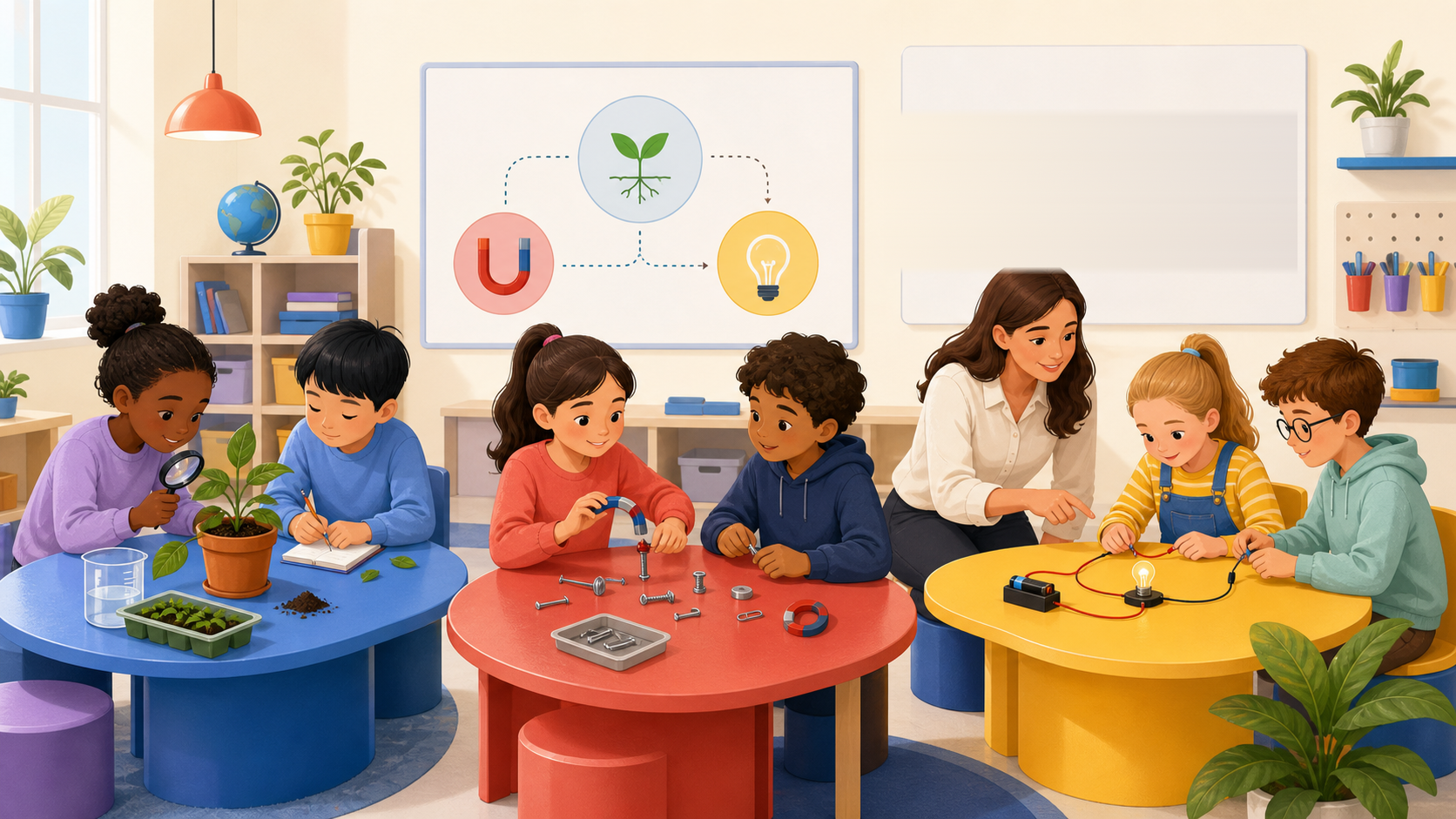
If you're a teacher or school leader trying to make sense of "AI in education" in 2026, you're drowning in two things: hype and tool sprawl. This guide cuts both. It tells you which categories of AI tools actually matter in classrooms today, the three honest risks you're right to worry about, and where the teacher's role is shifting (and where it isn't).
Quick answer: what does "AI in education" actually mean in 2026?
Quick answer: in 2026, "AI in education" means five categories of tools that save teachers planning time, differentiate work for students at three levels in one lesson, and surface formative-assessment patterns in real time. The technology has matured past chatbots — the productive uses are lesson-prep co-pilots, differentiation engines, feedback drafters, marking assistants, and student self-tutors used inside teacher-set guardrails.
Why does AI in classrooms matter more in 2026 than it did a year ago?
2025 to 2026 was the inflection. Two things changed: the tools moved from generic chatbots to teacher-specific products with curriculum context, and adoption inside American schools crossed the threshold where it stopped being a side experiment and started being part of how planning happens. Teachers who used AI for at least 5 hours a week reported reclaiming 5–10 hours of planning time, according to internal data we see across teachers using tutero.ai. The math is simple — that's a full school day every two weeks given back to differentiation, feedback, and being present with students.
What are the five categories of AI tools that actually matter for teachers?
Strip away the hype and there are five categories doing real work. Lesson-prep co-pilots draft lesson outlines, slides, and worksheets from a syllabus reference. Differentiation engines generate three difficulty tiers of the same activity in one click. Feedback drafters produce first-pass written feedback on student work that teachers refine in 30 seconds rather than 5 minutes. Formative-assessment tools watch class responses in real time and surface who needs intervention. Student self-tutors let students ask questions to a tutor-bot inside the teacher's scope and pacing. The teachers getting most leverage use 2-3 categories deeply, not all five superficially.
What are the three honest risks of AI in education and how do you manage them?
The three risks worth taking seriously are (1) students offloading thinking, (2) teachers losing pedagogical instinct, and (3) data and privacy for student work. Manage risk 1 with clear in-class rules: AI for getting unstuck and self-checking, never for first-draft generation that students don't then critique. Manage risk 2 by treating AI output as draft material — your job is still to teach, not to ship the AI's lesson plan unread. Manage risk 3 by checking your tool's privacy posture: does student work train the model? is it stored on American servers? is the school's consent in place? Tutero.ai answers all three explicitly in writing for school IT teams.
How is the teacher's role shifting in an AI-enabled classroom?
The teacher role is getting more selective and more leveraged, not smaller. Tasks AI handles well — initial worksheet drafting, mark-scheme application, generating practice variants, drafting parent-letter wording — get pushed down. Tasks AI handles poorly — reading the room, modeling thinking out loud, holding the moral arc of a classroom, intervening with the kid who's having a bad week — become the center of the role. Teachers who described their work as "delivery" struggle in this shift; teachers who described their work as "diagnosis and decision" thrive. The pedagogical brain is the bottleneck — AI just removes the admin tax around it.
How should you start using AI in your classroom this term?
Don't roll the whole list out. Pick one bottleneck — usually planning a single weekly lesson or generating differentiated worksheets — and use AI for that bottleneck for four weeks. Measure two things: hours saved, and student work quality. If both improve, expand. If only hours saved improves, you've probably reduced rigour without noticing — pull back, re-establish your standard manually, then re-introduce the tool with tighter prompts. Teachers using tutero.ai who follow this start-small protocol report higher satisfaction at month three than teachers who tried to "go all in" from week one.
So what does AI in education actually look like in 2026?
It looks like a teacher with a co-pilot, not a teacher being replaced. The five categories of tools matter; the three risks are manageable with explicit guardrails; the teacher role becomes more leveraged. Schools that get this right move planning hours into pedagogy hours, differentiation moves from "good intent" to "every-lesson default", and student self-direction grows because the teacher has more bandwidth for it. See how Tutero.ai pairs with teacher planning if you're ready to put the principles into practice.
Ready to use AI in your math classroom? Tutero.ai is built for teachers — lesson prep, three-tier differentiation, and formative-assessment all in one tool, with American privacy controls and school admin integration.
AI is a co-pilot for teachers — not a replacement for the planning brain.
AI is a co-pilot for teachers — not a replacement for the planning brain.
Best AI Products for Education

ChatGPT
ChatGPT is an AI tool teachers can use for lesson planning, report writing, question generation, idea brainstorming, and feedback. For a full list of ChatGPT applications, see 6 Strategies: How Teachers Can Use ChatGPT.
Google's Bard
Bard is an AI chatbot from Google that helps students learn Shakespeare by chatting in Shakespearean language. It can engage students in Shakespearean literature, facilitate communication and interaction, and simulate scenarios from the plays.
Bing Chat
An AI-powered chatbot that helps with web search, content creation, vacation ideas, and more. Use Microsoft Edge to access Bing Chat, which benefits from up-to-date information available online. In a classroom setting, students can chat with Bing Chat on a topic like history, science, or literature, and then reflect on the conversation's quality and accuracy.
Microsoft 365 Co-Pilot
Microsoft 365 Co-Pilot is an AI-powered assistant that helps with various tasks in Microsoft 365 apps, such as Word, Excel, PowerPoint, Outlook, Teams, and more. Educators can use Microsoft 365 Co-Pilot to produce resources, plan lessons, build content, write reports, and produce writing from Word and PowerPoint.
Risks of AI in Education
What are the dangers of using AI in education? What do educators and parents need to know as AI becomes more and more common in our society and education system? Although AI can be useful in education, there are also risks. Some risks include:
False or Misleading Information
AI can generate false or misleading information or content that can affect the quality and credibility of education, such as plagiarizing or fabricating sources, facts, or arguments
Collecting Student Data Without Consent
AI can also infringe on the privacy or security of students and teachers by collecting, processing, or sharing their personal or sensitive data without their consent or knowledge.
Hindering Social Connection
AI can negatively affect social aspects of education, such as reducing opportunities for human interaction, communication, and collaboration. For example, AI can replace or diminish the role of human teachers or peers in the learning process, making students more isolated, passive, or dependent on technology.
AI Information Bias
AI can also limit or influence the choices or actions of students and teachers by providing predetermined or persuasive information, answers, or solutions.
Inhibiting Desire To Learn
AI can also discourage or inhibit the development of human skills or talents by providing easy or automated learning or creation methods.
Legal Risks
AI can pose legal risks to education, such as violating laws, regulations, or standards related to data protection, intellectual property, consumer protection, or education standards.
While AI offers significant benefits to education, it also presents risks and challenges that cannot be ignored. Therefore, we must thoughtfully and ethically address these potential problems by carefully implementing AI in education, recognizing both its capabilities and limitations.
Ethics of AI in Education
Given the risks mentioned, the education industry should follow a strict ethical code when using AI in education.. Fortunately, emerging organizations like the Institute for Ethical AI in Education are creating guidelines and standards for use. Some of the ethical use standards include:
Data Privacy and Security
AI involves collecting and analyzing vast amounts of data. Ensuring the privacy and security of this data is of utmost importance to protect the rights of learners and educators.
Bias and Fairness
AI algorithms must be developed and trained to be free from bias, ensuring fair treatment and equal opportunities for all learners.
Human-AI Collaboration
Finding the right balance between AI-driven automation and human interaction is crucial. Educators and AI systems must work collaboratively to create a holistic learning experience.
Transparency and Explainability
AI decision-making processes must be transparent and explainable to gain the trust of educators, students, and parents.
For a full list, see the Institute of Ethical AI in Education’s framework report:
.avif)
The Future of AI in Education
AI in education is evolving, and it holds the potential to foster greater equity within the educational system. Here are some important areas where AI is expected to be important in the future:
Personal Learning Pathways
AI will continue to refine personalized learning pathways, taking into account individual learning styles, preferences, and progress. This will lead to even greater efficiency and better learning outcomes for students.
AI-Enhanced Assessment Systems
AI will improve assessment systems and give comprehensive feedback to students and educators. It will evaluate factual knowledge, critical thinking, and problem-solving skills. This will act as a 24/7 teaching assistant for educators.
Ai-Driven Curriculum Design & Resources
Artificial intelligence (AI) will be very important in creating and updating study plans to keep up with a rapidly changing world. By looking at the job market and new technologies, AI can help adjust educational materials to fit what employers are looking for.
AI-Tutors
The end state of AI for education could involve a personalized AI tutor for every student, acting as an assistant to teachers. This solves the education challenge of Bloom’s Two Sigma Problem and could deliver on the promise of 100% personalized education adapted to every student.
Conclusion
The use of AI in education is an exciting development. AI can help customize learning, automate tasks, and improve educational content. This opens up new possibilities for both teachers and students. By addressing challenges and following best practices, schools and individuals can make the most of AI and create a better future for education.
So, are you ready to embrace the AI-driven future of education and unlock its boundless potential? The journey begins with embracing the transformative power of AI in education!
If you're a teacher or school leader trying to make sense of "AI in education" in 2026, you're drowning in two things: hype and tool sprawl. This guide cuts both. It tells you which categories of AI tools actually matter in classrooms today, the three honest risks you're right to worry about, and where the teacher's role is shifting (and where it isn't).
Quick answer: what does "AI in education" actually mean in 2026?
Quick answer: in 2026, "AI in education" means five categories of tools that save teachers planning time, differentiate work for students at three levels in one lesson, and surface formative-assessment patterns in real time. The technology has matured past chatbots — the productive uses are lesson-prep co-pilots, differentiation engines, feedback drafters, marking assistants, and student self-tutors used inside teacher-set guardrails.
Why does AI in classrooms matter more in 2026 than it did a year ago?
2025 to 2026 was the inflection. Two things changed: the tools moved from generic chatbots to teacher-specific products with curriculum context, and adoption inside American schools crossed the threshold where it stopped being a side experiment and started being part of how planning happens. Teachers who used AI for at least 5 hours a week reported reclaiming 5–10 hours of planning time, according to internal data we see across teachers using tutero.ai. The math is simple — that's a full school day every two weeks given back to differentiation, feedback, and being present with students.
What are the five categories of AI tools that actually matter for teachers?
Strip away the hype and there are five categories doing real work. Lesson-prep co-pilots draft lesson outlines, slides, and worksheets from a syllabus reference. Differentiation engines generate three difficulty tiers of the same activity in one click. Feedback drafters produce first-pass written feedback on student work that teachers refine in 30 seconds rather than 5 minutes. Formative-assessment tools watch class responses in real time and surface who needs intervention. Student self-tutors let students ask questions to a tutor-bot inside the teacher's scope and pacing. The teachers getting most leverage use 2-3 categories deeply, not all five superficially.
What are the three honest risks of AI in education and how do you manage them?
The three risks worth taking seriously are (1) students offloading thinking, (2) teachers losing pedagogical instinct, and (3) data and privacy for student work. Manage risk 1 with clear in-class rules: AI for getting unstuck and self-checking, never for first-draft generation that students don't then critique. Manage risk 2 by treating AI output as draft material — your job is still to teach, not to ship the AI's lesson plan unread. Manage risk 3 by checking your tool's privacy posture: does student work train the model? is it stored on American servers? is the school's consent in place? Tutero.ai answers all three explicitly in writing for school IT teams.
How is the teacher's role shifting in an AI-enabled classroom?
The teacher role is getting more selective and more leveraged, not smaller. Tasks AI handles well — initial worksheet drafting, mark-scheme application, generating practice variants, drafting parent-letter wording — get pushed down. Tasks AI handles poorly — reading the room, modeling thinking out loud, holding the moral arc of a classroom, intervening with the kid who's having a bad week — become the center of the role. Teachers who described their work as "delivery" struggle in this shift; teachers who described their work as "diagnosis and decision" thrive. The pedagogical brain is the bottleneck — AI just removes the admin tax around it.
How should you start using AI in your classroom this term?
Don't roll the whole list out. Pick one bottleneck — usually planning a single weekly lesson or generating differentiated worksheets — and use AI for that bottleneck for four weeks. Measure two things: hours saved, and student work quality. If both improve, expand. If only hours saved improves, you've probably reduced rigour without noticing — pull back, re-establish your standard manually, then re-introduce the tool with tighter prompts. Teachers using tutero.ai who follow this start-small protocol report higher satisfaction at month three than teachers who tried to "go all in" from week one.
So what does AI in education actually look like in 2026?
It looks like a teacher with a co-pilot, not a teacher being replaced. The five categories of tools matter; the three risks are manageable with explicit guardrails; the teacher role becomes more leveraged. Schools that get this right move planning hours into pedagogy hours, differentiation moves from "good intent" to "every-lesson default", and student self-direction grows because the teacher has more bandwidth for it. See how Tutero.ai pairs with teacher planning if you're ready to put the principles into practice.
Ready to use AI in your math classroom? Tutero.ai is built for teachers — lesson prep, three-tier differentiation, and formative-assessment all in one tool, with American privacy controls and school admin integration.
Best AI Products for Education
ChatGPT
ChatGPT is an AI tool teachers can use for lesson planning, report writing, question generation, idea brainstorming, and feedback. For a full list of ChatGPT applications, see 6 Strategies: How Teachers Can Use ChatGPT.
Google's Bard
Bard is an AI chatbot from Google that helps students learn Shakespeare by chatting in Shakespearean language. It can engage students in Shakespearean literature, facilitate communication and interaction, and simulate scenarios from the plays.
Bing Chat
An AI-powered chatbot that helps with web search, content creation, vacation ideas, and more. Use Microsoft Edge to access Bing Chat, which benefits from up-to-date information available online. In a classroom setting, students can chat with Bing Chat on a topic like history, science, or literature, and then reflect on the conversation's quality and accuracy.
Microsoft 365 Co-Pilot
Microsoft 365 Co-Pilot is an AI-powered assistant that helps with various tasks in Microsoft 365 apps, such as Word, Excel, PowerPoint, Outlook, Teams, and more. Educators can use Microsoft 365 Co-Pilot to produce resources, plan lessons, build content, write reports, and produce writing from Word and PowerPoint.
Risks of AI in Education
What are the dangers of using AI in education? What do educators and parents need to know as AI becomes more and more common in our society and education system? Although AI can be useful in education, there are also risks. Some risks include:
False or Misleading Information
AI can generate false or misleading information or content that can affect the quality and credibility of education, such as plagiarizing or fabricating sources, facts, or arguments
Collecting Student Data Without Consent
AI can also infringe on the privacy or security of students and teachers by collecting, processing, or sharing their personal or sensitive data without their consent or knowledge.
Hindering Social Connection
AI can negatively affect social aspects of education, such as reducing opportunities for human interaction, communication, and collaboration. For example, AI can replace or diminish the role of human teachers or peers in the learning process, making students more isolated, passive, or dependent on technology.
AI Information Bias
AI can also limit or influence the choices or actions of students and teachers by providing predetermined or persuasive information, answers, or solutions.
Inhibiting Desire To Learn
AI can also discourage or inhibit the development of human skills or talents by providing easy or automated learning or creation methods.
Legal Risks
AI can pose legal risks to education, such as violating laws, regulations, or standards related to data protection, intellectual property, consumer protection, or education standards.
While AI offers significant benefits to education, it also presents risks and challenges that cannot be ignored. Therefore, we must thoughtfully and ethically address these potential problems by carefully implementing AI in education, recognizing both its capabilities and limitations.
Ethics of AI in Education
Given the risks mentioned, the education industry should follow a strict ethical code when using AI in education.. Fortunately, emerging organizations like the Institute for Ethical AI in Education are creating guidelines and standards for use. Some of the ethical use standards include:
Data Privacy and Security
AI involves collecting and analyzing vast amounts of data. Ensuring the privacy and security of this data is of utmost importance to protect the rights of learners and educators.
Bias and Fairness
AI algorithms must be developed and trained to be free from bias, ensuring fair treatment and equal opportunities for all learners.
Human-AI Collaboration
Finding the right balance between AI-driven automation and human interaction is crucial. Educators and AI systems must work collaboratively to create a holistic learning experience.
Transparency and Explainability
AI decision-making processes must be transparent and explainable to gain the trust of educators, students, and parents.
For a full list, see the Institute of Ethical AI in Education’s framework report:
The Future of AI in Education
AI in education is evolving, and it holds the potential to foster greater equity within the educational system. Here are some important areas where AI is expected to be important in the future:
Personal Learning Pathways
AI will continue to refine personalized learning pathways, taking into account individual learning styles, preferences, and progress. This will lead to even greater efficiency and better learning outcomes for students.
AI-Enhanced Assessment Systems
AI will improve assessment systems and give comprehensive feedback to students and educators. It will evaluate factual knowledge, critical thinking, and problem-solving skills. This will act as a 24/7 teaching assistant for educators.
Ai-Driven Curriculum Design & Resources
Artificial intelligence (AI) will be very important in creating and updating study plans to keep up with a rapidly changing world. By looking at the job market and new technologies, AI can help adjust educational materials to fit what employers are looking for.
AI-Tutors
The end state of AI for education could involve a personalized AI tutor for every student, acting as an assistant to teachers. This solves the education challenge of Bloom’s Two Sigma Problem and could deliver on the promise of 100% personalized education adapted to every student.
Conclusion
The use of AI in education is an exciting development. AI can help customize learning, automate tasks, and improve educational content. This opens up new possibilities for both teachers and students. By addressing challenges and following best practices, schools and individuals can make the most of AI and create a better future for education.
So, are you ready to embrace the AI-driven future of education and unlock its boundless potential? The journey begins with embracing the transformative power of AI in education!
AI is a co-pilot for teachers — not a replacement for the planning brain.
AI is a co-pilot for teachers — not a replacement for the planning brain.

AI is a co-pilot for teachers — not a replacement for the planning brain.
Best AI Products for Education
ChatGPT
ChatGPT is an AI tool teachers can use for lesson planning, report writing, question generation, idea brainstorming, and feedback. For a full list of ChatGPT applications, see 6 Strategies: How Teachers Can Use ChatGPT.
Google's Bard
Bard is an AI chatbot from Google that helps students learn Shakespeare by chatting in Shakespearean language. It can engage students in Shakespearean literature, facilitate communication and interaction, and simulate scenarios from the plays.
Bing Chat
An AI-powered chatbot that helps with web search, content creation, vacation ideas, and more. Use Microsoft Edge to access Bing Chat, which benefits from up-to-date information available online. In a classroom setting, students can chat with Bing Chat on a topic like history, science, or literature, and then reflect on the conversation's quality and accuracy.
Microsoft 365 Co-Pilot
Microsoft 365 Co-Pilot is an AI-powered assistant that helps with various tasks in Microsoft 365 apps, such as Word, Excel, PowerPoint, Outlook, Teams, and more. Educators can use Microsoft 365 Co-Pilot to produce resources, plan lessons, build content, write reports, and produce writing from Word and PowerPoint.
Risks of AI in Education
What are the dangers of using AI in education? What do educators and parents need to know as AI becomes more and more common in our society and education system? Although AI can be useful in education, there are also risks. Some risks include:
False or Misleading Information
AI can generate false or misleading information or content that can affect the quality and credibility of education, such as plagiarizing or fabricating sources, facts, or arguments
Collecting Student Data Without Consent
AI can also infringe on the privacy or security of students and teachers by collecting, processing, or sharing their personal or sensitive data without their consent or knowledge.
Hindering Social Connection
AI can negatively affect social aspects of education, such as reducing opportunities for human interaction, communication, and collaboration. For example, AI can replace or diminish the role of human teachers or peers in the learning process, making students more isolated, passive, or dependent on technology.
AI Information Bias
AI can also limit or influence the choices or actions of students and teachers by providing predetermined or persuasive information, answers, or solutions.
Inhibiting Desire To Learn
AI can also discourage or inhibit the development of human skills or talents by providing easy or automated learning or creation methods.
Legal Risks
AI can pose legal risks to education, such as violating laws, regulations, or standards related to data protection, intellectual property, consumer protection, or education standards.
While AI offers significant benefits to education, it also presents risks and challenges that cannot be ignored. Therefore, we must thoughtfully and ethically address these potential problems by carefully implementing AI in education, recognizing both its capabilities and limitations.
Ethics of AI in Education
Given the risks mentioned, the education industry should follow a strict ethical code when using AI in education.. Fortunately, emerging organizations like the Institute for Ethical AI in Education are creating guidelines and standards for use. Some of the ethical use standards include:
Data Privacy and Security
AI involves collecting and analyzing vast amounts of data. Ensuring the privacy and security of this data is of utmost importance to protect the rights of learners and educators.
Bias and Fairness
AI algorithms must be developed and trained to be free from bias, ensuring fair treatment and equal opportunities for all learners.
Human-AI Collaboration
Finding the right balance between AI-driven automation and human interaction is crucial. Educators and AI systems must work collaboratively to create a holistic learning experience.
Transparency and Explainability
AI decision-making processes must be transparent and explainable to gain the trust of educators, students, and parents.
For a full list, see the Institute of Ethical AI in Education’s framework report:
The Future of AI in Education
AI in education is evolving, and it holds the potential to foster greater equity within the educational system. Here are some important areas where AI is expected to be important in the future:
Personal Learning Pathways
AI will continue to refine personalized learning pathways, taking into account individual learning styles, preferences, and progress. This will lead to even greater efficiency and better learning outcomes for students.
AI-Enhanced Assessment Systems
AI will improve assessment systems and give comprehensive feedback to students and educators. It will evaluate factual knowledge, critical thinking, and problem-solving skills. This will act as a 24/7 teaching assistant for educators.
Ai-Driven Curriculum Design & Resources
Artificial intelligence (AI) will be very important in creating and updating study plans to keep up with a rapidly changing world. By looking at the job market and new technologies, AI can help adjust educational materials to fit what employers are looking for.
AI-Tutors
The end state of AI for education could involve a personalized AI tutor for every student, acting as an assistant to teachers. This solves the education challenge of Bloom’s Two Sigma Problem and could deliver on the promise of 100% personalized education adapted to every student.
Conclusion
The use of AI in education is an exciting development. AI can help customize learning, automate tasks, and improve educational content. This opens up new possibilities for both teachers and students. By addressing challenges and following best practices, schools and individuals can make the most of AI and create a better future for education.
So, are you ready to embrace the AI-driven future of education and unlock its boundless potential? The journey begins with embracing the transformative power of AI in education!
Teachers using AI for at least 5 hours a week reclaim 5–10 hours of planning time.
If you're a teacher or school leader trying to make sense of "AI in education" in 2026, you're drowning in two things: hype and tool sprawl. This guide cuts both. It tells you which categories of AI tools actually matter in classrooms today, the three honest risks you're right to worry about, and where the teacher's role is shifting (and where it isn't).
Quick answer: what does "AI in education" actually mean in 2026?
Quick answer: in 2026, "AI in education" means five categories of tools that save teachers planning time, differentiate work for students at three levels in one lesson, and surface formative-assessment patterns in real time. The technology has matured past chatbots — the productive uses are lesson-prep co-pilots, differentiation engines, feedback drafters, marking assistants, and student self-tutors used inside teacher-set guardrails.
Why does AI in classrooms matter more in 2026 than it did a year ago?
2025 to 2026 was the inflection. Two things changed: the tools moved from generic chatbots to teacher-specific products with curriculum context, and adoption inside American schools crossed the threshold where it stopped being a side experiment and started being part of how planning happens. Teachers who used AI for at least 5 hours a week reported reclaiming 5–10 hours of planning time, according to internal data we see across teachers using tutero.ai. The math is simple — that's a full school day every two weeks given back to differentiation, feedback, and being present with students.
What are the five categories of AI tools that actually matter for teachers?
Strip away the hype and there are five categories doing real work. Lesson-prep co-pilots draft lesson outlines, slides, and worksheets from a syllabus reference. Differentiation engines generate three difficulty tiers of the same activity in one click. Feedback drafters produce first-pass written feedback on student work that teachers refine in 30 seconds rather than 5 minutes. Formative-assessment tools watch class responses in real time and surface who needs intervention. Student self-tutors let students ask questions to a tutor-bot inside the teacher's scope and pacing. The teachers getting most leverage use 2-3 categories deeply, not all five superficially.
What are the three honest risks of AI in education and how do you manage them?
The three risks worth taking seriously are (1) students offloading thinking, (2) teachers losing pedagogical instinct, and (3) data and privacy for student work. Manage risk 1 with clear in-class rules: AI for getting unstuck and self-checking, never for first-draft generation that students don't then critique. Manage risk 2 by treating AI output as draft material — your job is still to teach, not to ship the AI's lesson plan unread. Manage risk 3 by checking your tool's privacy posture: does student work train the model? is it stored on American servers? is the school's consent in place? Tutero.ai answers all three explicitly in writing for school IT teams.
How is the teacher's role shifting in an AI-enabled classroom?
The teacher role is getting more selective and more leveraged, not smaller. Tasks AI handles well — initial worksheet drafting, mark-scheme application, generating practice variants, drafting parent-letter wording — get pushed down. Tasks AI handles poorly — reading the room, modeling thinking out loud, holding the moral arc of a classroom, intervening with the kid who's having a bad week — become the center of the role. Teachers who described their work as "delivery" struggle in this shift; teachers who described their work as "diagnosis and decision" thrive. The pedagogical brain is the bottleneck — AI just removes the admin tax around it.
How should you start using AI in your classroom this term?
Don't roll the whole list out. Pick one bottleneck — usually planning a single weekly lesson or generating differentiated worksheets — and use AI for that bottleneck for four weeks. Measure two things: hours saved, and student work quality. If both improve, expand. If only hours saved improves, you've probably reduced rigour without noticing — pull back, re-establish your standard manually, then re-introduce the tool with tighter prompts. Teachers using tutero.ai who follow this start-small protocol report higher satisfaction at month three than teachers who tried to "go all in" from week one.
So what does AI in education actually look like in 2026?
It looks like a teacher with a co-pilot, not a teacher being replaced. The five categories of tools matter; the three risks are manageable with explicit guardrails; the teacher role becomes more leveraged. Schools that get this right move planning hours into pedagogy hours, differentiation moves from "good intent" to "every-lesson default", and student self-direction grows because the teacher has more bandwidth for it. See how Tutero.ai pairs with teacher planning if you're ready to put the principles into practice.
Ready to use AI in your math classroom? Tutero.ai is built for teachers — lesson prep, three-tier differentiation, and formative-assessment all in one tool, with American privacy controls and school admin integration.
AI is a co-pilot for teachers — not a replacement for the planning brain.
Best AI Products for Education
ChatGPT
ChatGPT is an AI tool teachers can use for lesson planning, report writing, question generation, idea brainstorming, and feedback. For a full list of ChatGPT applications, see 6 Strategies: How Teachers Can Use ChatGPT.
Google's Bard
Bard is an AI chatbot from Google that helps students learn Shakespeare by chatting in Shakespearean language. It can engage students in Shakespearean literature, facilitate communication and interaction, and simulate scenarios from the plays.
Bing Chat
An AI-powered chatbot that helps with web search, content creation, vacation ideas, and more. Use Microsoft Edge to access Bing Chat, which benefits from up-to-date information available online. In a classroom setting, students can chat with Bing Chat on a topic like history, science, or literature, and then reflect on the conversation's quality and accuracy.
Microsoft 365 Co-Pilot
Microsoft 365 Co-Pilot is an AI-powered assistant that helps with various tasks in Microsoft 365 apps, such as Word, Excel, PowerPoint, Outlook, Teams, and more. Educators can use Microsoft 365 Co-Pilot to produce resources, plan lessons, build content, write reports, and produce writing from Word and PowerPoint.
Risks of AI in Education
What are the dangers of using AI in education? What do educators and parents need to know as AI becomes more and more common in our society and education system? Although AI can be useful in education, there are also risks. Some risks include:
False or Misleading Information
AI can generate false or misleading information or content that can affect the quality and credibility of education, such as plagiarizing or fabricating sources, facts, or arguments
Collecting Student Data Without Consent
AI can also infringe on the privacy or security of students and teachers by collecting, processing, or sharing their personal or sensitive data without their consent or knowledge.
Hindering Social Connection
AI can negatively affect social aspects of education, such as reducing opportunities for human interaction, communication, and collaboration. For example, AI can replace or diminish the role of human teachers or peers in the learning process, making students more isolated, passive, or dependent on technology.
AI Information Bias
AI can also limit or influence the choices or actions of students and teachers by providing predetermined or persuasive information, answers, or solutions.
Inhibiting Desire To Learn
AI can also discourage or inhibit the development of human skills or talents by providing easy or automated learning or creation methods.
Legal Risks
AI can pose legal risks to education, such as violating laws, regulations, or standards related to data protection, intellectual property, consumer protection, or education standards.
While AI offers significant benefits to education, it also presents risks and challenges that cannot be ignored. Therefore, we must thoughtfully and ethically address these potential problems by carefully implementing AI in education, recognizing both its capabilities and limitations.
Ethics of AI in Education
Given the risks mentioned, the education industry should follow a strict ethical code when using AI in education.. Fortunately, emerging organizations like the Institute for Ethical AI in Education are creating guidelines and standards for use. Some of the ethical use standards include:
Data Privacy and Security
AI involves collecting and analyzing vast amounts of data. Ensuring the privacy and security of this data is of utmost importance to protect the rights of learners and educators.
Bias and Fairness
AI algorithms must be developed and trained to be free from bias, ensuring fair treatment and equal opportunities for all learners.
Human-AI Collaboration
Finding the right balance between AI-driven automation and human interaction is crucial. Educators and AI systems must work collaboratively to create a holistic learning experience.
Transparency and Explainability
AI decision-making processes must be transparent and explainable to gain the trust of educators, students, and parents.
For a full list, see the Institute of Ethical AI in Education’s framework report:
The Future of AI in Education
AI in education is evolving, and it holds the potential to foster greater equity within the educational system. Here are some important areas where AI is expected to be important in the future:
Personal Learning Pathways
AI will continue to refine personalized learning pathways, taking into account individual learning styles, preferences, and progress. This will lead to even greater efficiency and better learning outcomes for students.
AI-Enhanced Assessment Systems
AI will improve assessment systems and give comprehensive feedback to students and educators. It will evaluate factual knowledge, critical thinking, and problem-solving skills. This will act as a 24/7 teaching assistant for educators.
Ai-Driven Curriculum Design & Resources
Artificial intelligence (AI) will be very important in creating and updating study plans to keep up with a rapidly changing world. By looking at the job market and new technologies, AI can help adjust educational materials to fit what employers are looking for.
AI-Tutors
The end state of AI for education could involve a personalized AI tutor for every student, acting as an assistant to teachers. This solves the education challenge of Bloom’s Two Sigma Problem and could deliver on the promise of 100% personalized education adapted to every student.
Conclusion
The use of AI in education is an exciting development. AI can help customize learning, automate tasks, and improve educational content. This opens up new possibilities for both teachers and students. By addressing challenges and following best practices, schools and individuals can make the most of AI and create a better future for education.
So, are you ready to embrace the AI-driven future of education and unlock its boundless potential? The journey begins with embracing the transformative power of AI in education!
Teachers using AI for at least 5 hours a week reclaim 5–10 hours of planning time.
.svg)
.svg)
AI in education is the use of artificial intelligence — primarily large language models and adaptive-learning systems — to handle parts of teaching and learning that previously required either large amounts of teacher time or one-to-one human attention. The five categories that matter most: lesson planning and content generation, personalized practice and adaptive learning, assessment and feedback tools, teacher-admin and classroom-management tools, and student-facing tutoring assistants.
No. The 2025 Stanford HAI K-12 summit and a growing research base confirm what teachers experience daily: AI handles the parts of teaching that drained energy without adding much value (slide formatting, differentiation grunt work, admin drafting). The parts AI can't do are the parts that make teaching meaningful — reading the room, redirecting mid-lesson when a student asks an unexpected question, noticing the student who's struggling silently, the small-group conversation that unlocks a stuck concept. The teaching profession isn't getting smaller; the prep workload is.
Three honest risks: generic content drift (managed by always treating AI output as a first draft, never a final lesson, and adding theme/context/student-specific reference); student skill atrophy if AI is used to outsource every assignment (managed by assessment design — in-class problem solving, oral checks, structured assignments that require the student's reasoning); and AI being wrong on arithmetic and factual specifics more often than expected (managed by checking worked examples and choosing subject-specific tools that validate before generating).
It depends on the job. For lesson generation and themed content, ChatGPT, Claude, MagicSchool, and subject-specific tools like Tutero each fit different needs — Tutero ships curriculum-aligned differentiated math lessons in roughly 90 seconds; the general-purpose chatbots are more flexible but require more curation. For adaptive practice, Khanmigo, Mathspace, and Math Pathway are strong. For teacher admin, Brisk Teaching and Canva for Education remove high-volume low-judgment tasks. Most teachers end up using two or three tools, not one.
Three low-risk starting moves: pick one upcoming lesson and use ChatGPT to add a real-world theme to existing worked examples (10 minutes, meaningful engagement gain); trial a subject-specific lesson generator like Tutero for one weekly slide deck and compare time saved to your current build process (most math teachers report 60+ minutes back per week); set an explicit AI-use policy for your class (one paragraph naming where students can and can't use AI, and what citation looks like). Iterate from there.
AI is safe for students when the classroom policy is explicit and the assessment design assumes students will use it. The unsafe version is ambiguous policy plus traditional take-home assessments that AI can complete easily — that's the worst-of-both-worlds combination that erodes student skills and rewards the wrong behavior. The safe version is a clear allowed/disallowed list, in-class problem solving and oral checks for the foundational skill-building, and using AI deliberately for the parts where it genuinely accelerates learning (research summaries, draft critique, language practice).
Hoping to improve confidence & grades?

.png)