


Most parents weighing up a tuition centre against a private tutor are not really asking which one is "best" in the abstract. They are asking a more specific question: which format will actually help my child, given the gap they have, the budget we have and how they like to learn. Tuition centre classes and 1-to-1 tuition both work, but they work in different ways and for different children.
Tuition centre or 1-to-1 tuition: which is better for your child?
Short answer: neither format is better for every child. The right one depends on the size of your child's gap and how they learn best.
1-to-1 tuition suits a child with a specific gap, an exam to prepare for, or anxiety that makes speaking up in class hard, because the lesson adapts fully to them. That holds whether your child is in P5 facing the PSLE, in Sec 4 preparing for the Singapore-Cambridge Secondary Education Certificate (SEC), which is first sat in 2027, or in JC2 preparing for A-Levels. A tuition centre or small-group class suits a reasonably confident learner who enjoys working alongside peers and wants a more affordable option. Either can work well, but only when the fit is right.
The table below sets the two formats side by side on the points parents ask about most.
| Dimension | 1-to-1 tuition | Tuition centre class |
|---|---|---|
| Attention | Fully on your child | Shared across the class |
| Pace and personalisation | Fully adapts to your child | Set to the class |
| Peer interaction | None | Learns with peers, can build motivation |
| Typical cost | Higher per hour | Lower per hour |
| Best for | A specific gap, exam focus, anxiety, or a learner who needs their own pace | Confident students who like peers and want a budget-friendly option |
Attention, pace and cost reflect how each format is typically delivered.
What is the difference between 1-to-1 tuition and a tuition centre class?
The core difference is how the tutor's attention is divided.
In 1-to-1 tuition, one tutor works with one student, so every minute of the lesson responds to that child. In a tuition centre class, one tutor teaches several students at once, following a plan pitched at the class rather than at any one learner. The smaller the class, the more the lesson can bend towards each child.
In Singapore, group options range from small-group classes of a handful of students to larger tuition centre classes. A class of ten or more students is a different product again. It is closer to a second classroom than to tuition, and the personalisation advantages of a genuinely small group start to disappear once numbers climb. Before you enrol, ask the centre how many students sit in your child's class.
How much progress does each format actually deliver?
Short answer: 1-to-1 tuition usually moves faster on a specific gap, while a good tuition centre class gives steady progress for a child who is already on track.
Progress comes from time spent on the right thing. In a 1-to-1 lesson, the whole hour goes on your child's weak spots, and the tutor sees straight away when an idea has not landed. In a centre class, part of each lesson goes on topics your child already knows or on questions from other students, so progress on any one gap is slower.
Two details matter for parents. First, the fit matters more than the format, so a well-run small-group class can do better than a poorly matched 1-to-1 tutor. Second, class size changes the picture: a class of four behaves very differently from a class of fifteen.
That is why it pays to match the format to the specific subject and gap rather than to a blanket rule. A P4 child who needs steady English practice, a Sec 2 student shaky on algebra and a JC1 student lost in H2 Chemistry each need something different from their tuition. For real examples, read our student case studies.

Is 1-to-1 tuition worth the higher cost?
Short answer: it is worth it when your child has a specific gap, needs their own pace, or finds speaking up in class hard.
1-to-1 tuition costs more per hour because your child has the tutor to themselves. That premium buys three things a class cannot: a lesson built around your child's exact gaps, a pace that speeds up or slows down in real time, and a low-pressure setting where a nervous student will actually ask the question they are stuck on. For a child who freezes in a group or who is a term or two behind, that focus is usually where the extra spend earns its keep.
If cost is the deciding factor, compare structures rather than assuming 1-to-1 is out of reach. Tutero offers 1-to-1 online tuition from S$65 an hour, or from S$75 an hour with a qualified teacher, and the rate is the same at every level from P1 to JC2. There are no contracts and no sign-up fee, you pay after each lesson, and you can cancel any time. You can see the full tuition rates on our pricing page.
When is a tuition centre the better choice?
Short answer: a tuition centre suits a reasonably confident child who likes learning with peers and wants a lower hourly cost.
Group classes have genuine strengths, not just a cheaper price. Working alongside other students can lift motivation, make mistakes feel normal and give a child the chance to hear a concept explained more than once. These benefits are strongest when the class stays genuinely small.
A class tends to work best when the students in it are at a similar level and share a similar goal, such as several Sec 3 students revising the same chapter of A-Math. When the levels are mixed, the pace suits some and leaves others behind, which is the main risk of the format.
Can a tuition centre help a child who has fallen behind?
Short answer: it can, but a child with a clear, specific gap usually gets there faster with 1-to-1 tuition.
A child who has fallen behind often has one missing foundation, a topic from an earlier level that never fully landed. In a class, the tutor cannot stop and rebuild that one foundation without holding up everyone else, so the gap can persist even as the class moves on. A 1-to-1 tutor can go straight to the missing piece, find where it breaks down and stay there until it is solid. Your child's school test papers and teacher comments are a useful place to start pinpointing that gap.
That said, a small class of students who are all behind on the same content, taught at a pace that suits them, can work well and costs less. The deciding question is whether the gap is shared or specific to your child.
Does class size change how much a tutor can personalise?
Short answer: yes. Personalisation drops as the class grows, so smaller classes usually suit children who need more attention.
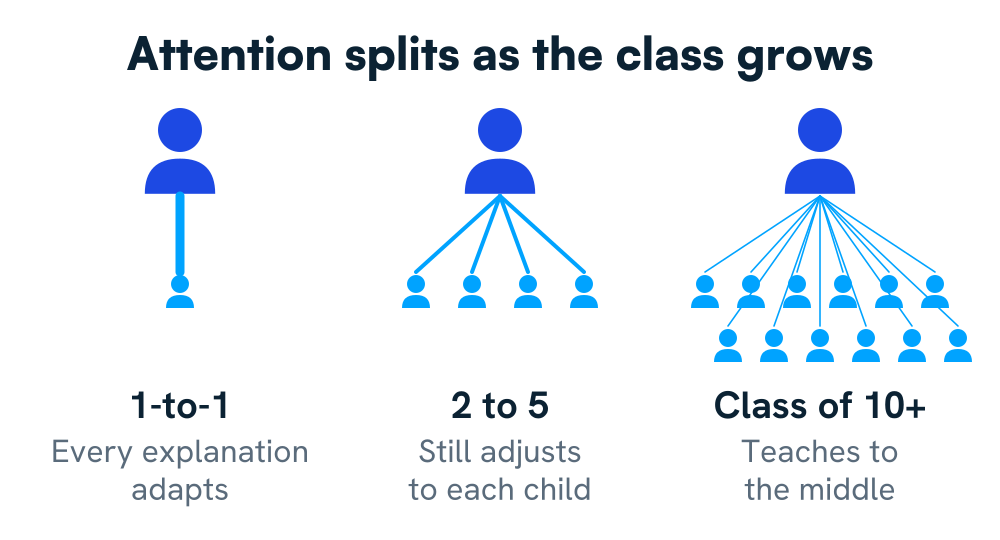
Personalisation is not all or nothing; it slides with numbers. With one student, a tutor can adapt every explanation, example and question. With two to five, they can still adjust to each learner, checking in with each child and tweaking the shared plan. Beyond that, and certainly in a centre class of ten or more, the tutor is teaching to the middle and personalisation largely disappears. If your child needs that individual attention, a small class or 1-to-1 tuition will serve them better than a large one.
How do I choose the right format for my child?
Short answer: match the format to the gap, the goal and how your child likes to learn.
Choose 1-to-1 tuition if your child has a specific gap to close, learns at a pace that differs from their class, gets anxious speaking up in front of others, or has a major exam ahead. That might be PSLE tuition in P6, SEC and O-Level tuition in upper secondary (from 2027, the SEC combines the O-Level and N-Level papers), or A-Level tuition in JC. Choose a tuition centre or small-group class if your child is broadly on track, enjoys the company of peers, stays motivated in a shared setting, and you want a more budget-friendly option.
Many families use both across a year: 1-to-1 tuition to fix a stubborn gap or prepare for a key exam, then a group class for ongoing practice once the child is back on solid ground. There is no rule that says you must pick one and stay with it. What matters is that the format fits the job you need it to do this term.
It also helps to be honest about the practical limits. A class only stays effective if the other students are genuinely at your child's level, which you cannot always control at a centre. 1-to-1 tuition removes that uncertainty, because each lesson is built around one learner and you can choose from matched tutors, Singapore-based tutors whose lessons follow the MOE syllabus. If you are unsure, ask any provider how they group students by level and how they measure progress, and let the answers guide your choice.
Related reading
- Online tuition vs home tuition in Singapore
- Signs of a good tutor
- Is Kumon worth it?
- The ideal time to begin tuition
- How much maths tuition costs in Singapore
What should you do next?
Tuition centres and 1-to-1 tuition are not rivals so much as different tools. 1-to-1 gives your child a tutor who adapts to them alone, which is why it suits specific gaps, exam focus and anxious learners. A tuition centre trades some of that personalisation for peer motivation and a lower hourly cost, which suits confident students who are broadly on track. Start from your child's actual need this term, and the right format usually becomes clear.
Most parents weighing up a tuition centre against a private tutor are not really asking which one is "best" in the abstract. They are asking a more specific question: which format will actually help my child, given the gap they have, the budget we have and how they like to learn. Tuition centre classes and 1-to-1 tuition both work, but they work in different ways and for different children.
Tuition centre or 1-to-1 tuition: which is better for your child?
Short answer: neither format is better for every child. The right one depends on the size of your child's gap and how they learn best.
1-to-1 tuition suits a child with a specific gap, an exam to prepare for, or anxiety that makes speaking up in class hard, because the lesson adapts fully to them. That holds whether your child is in P5 facing the PSLE, in Sec 4 preparing for the Singapore-Cambridge Secondary Education Certificate (SEC), which is first sat in 2027, or in JC2 preparing for A-Levels. A tuition centre or small-group class suits a reasonably confident learner who enjoys working alongside peers and wants a more affordable option. Either can work well, but only when the fit is right.
The table below sets the two formats side by side on the points parents ask about most.
| Dimension | 1-to-1 tuition | Tuition centre class |
|---|---|---|
| Attention | Fully on your child | Shared across the class |
| Pace and personalisation | Fully adapts to your child | Set to the class |
| Peer interaction | None | Learns with peers, can build motivation |
| Typical cost | Higher per hour | Lower per hour |
| Best for | A specific gap, exam focus, anxiety, or a learner who needs their own pace | Confident students who like peers and want a budget-friendly option |
Attention, pace and cost reflect how each format is typically delivered.
What is the difference between 1-to-1 tuition and a tuition centre class?
The core difference is how the tutor's attention is divided.
In 1-to-1 tuition, one tutor works with one student, so every minute of the lesson responds to that child. In a tuition centre class, one tutor teaches several students at once, following a plan pitched at the class rather than at any one learner. The smaller the class, the more the lesson can bend towards each child.
In Singapore, group options range from small-group classes of a handful of students to larger tuition centre classes. A class of ten or more students is a different product again. It is closer to a second classroom than to tuition, and the personalisation advantages of a genuinely small group start to disappear once numbers climb. Before you enrol, ask the centre how many students sit in your child's class.
How much progress does each format actually deliver?
Short answer: 1-to-1 tuition usually moves faster on a specific gap, while a good tuition centre class gives steady progress for a child who is already on track.
Progress comes from time spent on the right thing. In a 1-to-1 lesson, the whole hour goes on your child's weak spots, and the tutor sees straight away when an idea has not landed. In a centre class, part of each lesson goes on topics your child already knows or on questions from other students, so progress on any one gap is slower.
Two details matter for parents. First, the fit matters more than the format, so a well-run small-group class can do better than a poorly matched 1-to-1 tutor. Second, class size changes the picture: a class of four behaves very differently from a class of fifteen.
That is why it pays to match the format to the specific subject and gap rather than to a blanket rule. A P4 child who needs steady English practice, a Sec 2 student shaky on algebra and a JC1 student lost in H2 Chemistry each need something different from their tuition. For real examples, read our student case studies.
Is 1-to-1 tuition worth the higher cost?
Short answer: it is worth it when your child has a specific gap, needs their own pace, or finds speaking up in class hard.
1-to-1 tuition costs more per hour because your child has the tutor to themselves. That premium buys three things a class cannot: a lesson built around your child's exact gaps, a pace that speeds up or slows down in real time, and a low-pressure setting where a nervous student will actually ask the question they are stuck on. For a child who freezes in a group or who is a term or two behind, that focus is usually where the extra spend earns its keep.
If cost is the deciding factor, compare structures rather than assuming 1-to-1 is out of reach. Tutero offers 1-to-1 online tuition from S$65 an hour, or from S$75 an hour with a qualified teacher, and the rate is the same at every level from P1 to JC2. There are no contracts and no sign-up fee, you pay after each lesson, and you can cancel any time. You can see the full tuition rates on our pricing page.
When is a tuition centre the better choice?
Short answer: a tuition centre suits a reasonably confident child who likes learning with peers and wants a lower hourly cost.
Group classes have genuine strengths, not just a cheaper price. Working alongside other students can lift motivation, make mistakes feel normal and give a child the chance to hear a concept explained more than once. These benefits are strongest when the class stays genuinely small.
A class tends to work best when the students in it are at a similar level and share a similar goal, such as several Sec 3 students revising the same chapter of A-Math. When the levels are mixed, the pace suits some and leaves others behind, which is the main risk of the format.
Can a tuition centre help a child who has fallen behind?
Short answer: it can, but a child with a clear, specific gap usually gets there faster with 1-to-1 tuition.
A child who has fallen behind often has one missing foundation, a topic from an earlier level that never fully landed. In a class, the tutor cannot stop and rebuild that one foundation without holding up everyone else, so the gap can persist even as the class moves on. A 1-to-1 tutor can go straight to the missing piece, find where it breaks down and stay there until it is solid. Your child's school test papers and teacher comments are a useful place to start pinpointing that gap.
That said, a small class of students who are all behind on the same content, taught at a pace that suits them, can work well and costs less. The deciding question is whether the gap is shared or specific to your child.
Does class size change how much a tutor can personalise?
Short answer: yes. Personalisation drops as the class grows, so smaller classes usually suit children who need more attention.
Personalisation is not all or nothing; it slides with numbers. With one student, a tutor can adapt every explanation, example and question. With two to five, they can still adjust to each learner, checking in with each child and tweaking the shared plan. Beyond that, and certainly in a centre class of ten or more, the tutor is teaching to the middle and personalisation largely disappears. If your child needs that individual attention, a small class or 1-to-1 tuition will serve them better than a large one.
How do I choose the right format for my child?
Short answer: match the format to the gap, the goal and how your child likes to learn.
Choose 1-to-1 tuition if your child has a specific gap to close, learns at a pace that differs from their class, gets anxious speaking up in front of others, or has a major exam ahead. That might be PSLE tuition in P6, SEC and O-Level tuition in upper secondary (from 2027, the SEC combines the O-Level and N-Level papers), or A-Level tuition in JC. Choose a tuition centre or small-group class if your child is broadly on track, enjoys the company of peers, stays motivated in a shared setting, and you want a more budget-friendly option.
Many families use both across a year: 1-to-1 tuition to fix a stubborn gap or prepare for a key exam, then a group class for ongoing practice once the child is back on solid ground. There is no rule that says you must pick one and stay with it. What matters is that the format fits the job you need it to do this term.
It also helps to be honest about the practical limits. A class only stays effective if the other students are genuinely at your child's level, which you cannot always control at a centre. 1-to-1 tuition removes that uncertainty, because each lesson is built around one learner and you can choose from matched tutors, Singapore-based tutors whose lessons follow the MOE syllabus. If you are unsure, ask any provider how they group students by level and how they measure progress, and let the answers guide your choice.
Related reading
- Online tuition vs home tuition in Singapore
- Signs of a good tutor
- Is Kumon worth it?
- The ideal time to begin tuition
- How much maths tuition costs in Singapore
What should you do next?
Tuition centres and 1-to-1 tuition are not rivals so much as different tools. 1-to-1 gives your child a tutor who adapts to them alone, which is why it suits specific gaps, exam focus and anxious learners. A tuition centre trades some of that personalisation for peer motivation and a lower hourly cost, which suits confident students who are broadly on track. Start from your child's actual need this term, and the right format usually becomes clear.


It depends on your child. A private tutor suits a P5 or P6 child with specific weak topics, such as fractions or composition, because every lesson can target those gaps. A tuition centre suits a child who is broadly on track and does well with timed practice alongside peers. Many families use a centre for regular practice and add 1-to-1 lessons for the topics that keep costing marks.
Class sizes vary a lot between centres, from small groups of a few students to classes of ten or more, so ask before you enrol. Smaller classes let the tutor check in with each child more often. Once a class reaches ten or more, it works more like a second school lesson than personalised tuition.
Often, yes. JC content moves fast and H2 subjects build on each other, so one weak topic can affect a whole paper. A 1-to-1 tutor can go straight to the gap and work at the student's pace, which a large class cannot do. A confident JC student who mainly wants exam practice may do well in a group class instead.
Yes, and many families do. A common pattern is a centre class for steady practice and 1-to-1 tuition to close a stubborn gap or prepare for a key exam. Watch the total load, especially around CCAs and exam periods, so your child still has time to rest and do school work.
For most students from upper primary to JC, online 1-to-1 tuition works as well as in-person lessons when the tutor is a good match and lessons are regular. It saves travel time and gives you a wider choice of tutors. Younger children in P1 or P2 often do best with shorter online lessons and a parent nearby at first.
Look for a specific gap that keeps showing up in tests, a pace that is faster or slower than their class, or a child who will not ask questions in front of others. Any of these points to 1-to-1 tuition. If your child is broadly on track and enjoys learning with friends, a small group class may be enough.
Hoping to improve confidence & grades?


