


A study plan is the difference between feeling busy and actually getting somewhere. Most students do not fall behind because they are not smart enough. They fall behind because every week feels overwhelming and the same three subjects keep getting pushed to the bottom of the list. A clear plan solves that. This guide shows you how to make one that works for Primary, Secondary and JC students alike, whether the next big exam is a WA, the EOY, the PSLE, the O-Level, the SEC (which combines the O-Level and N-Level from 2027) or the A-Level.
Quick answer: how do you make a study plan that actually works?
Quick answer: a study plan that works has four ingredients. One weekly view (paper or digital, not both). Specific tasks, not subjects ("English: read chapter 4 and do 3 comprehension questions", not "English"). Realistic time blocks that fit around school and CCAs. And a 10-minute weekly review where you adjust what did not get done. The biggest mistake is making the plan too detailed. The second biggest is never reviewing it.
How do you set clear study goals before you build the plan?
Write down two kinds of goals before you open a planner. Assessment goals: what would "good" look like in each subject at the next WA, the EOY exam or the prelims? "AL3 or better for PSLE Maths" or "70 per cent or more in the Sec 3 Chemistry EOY" are concrete and checkable. Weekly goals: what does this week need to deliver toward that assessment goal? "Finish the fractions topic and 8 practice questions", not "do maths". Both kinds of goals come from your school's scheme of work, your approach to how to study maths and other subjects, and what you scored in your last test. Without goals the plan is decoration. With them it steers your week.
How should you prioritise study tasks for the week ahead?
Sort every task into three buckets: due this week (non-negotiable), due soon (build into time blocks) and revision (background). Do the due-this-week tasks first each day. Most students do their hardest work in the first 90 minutes after school, so save admin for later in the evening. Revision goes in 25-minute blocks 3 to 4 times a week, ideally on topics you covered in class that day, while they are still fresh. The subjects you find hardest get an extra 15-minute review block, not a full extra hour. Short and frequent beats long and rare for remembering what you learnt.
How do you allocate time slots realistically across subjects?
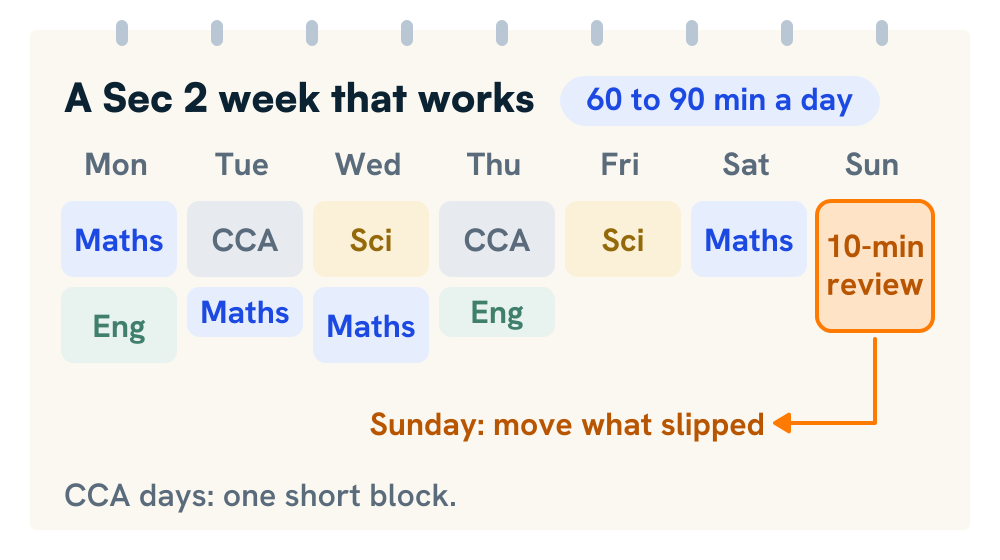
Be honest about how much study time you actually have, not how much you would like. A P4 student has maybe 30 to 45 minutes of focused study a day. A Sec 2 student has around 60 to 90. A Sec 4 or JC student has 90 to 150. Now take out CCA days. If you have training or rehearsals until 6pm on Tuesdays and Thursdays, those evenings get one short block, not three. Multiply what is left across the week, then share it between subjects by two things: how far you are from your goal, and how much the next assessment counts. The plan that assumes 3 free hours every evening gets abandoned in week 2.
| Level | Focused study on a normal school day | On a CCA day |
|---|---|---|
| P4 | 30 to 45 minutes | One 15 to 20 minute block |
| Sec 2 | 60 to 90 minutes | One 30 minute block |
| Sec 4 or JC | 90 to 150 minutes | One 45 minute block |

What study tools and apps actually help and which ones waste time?
The tools that work are simple: your school diary or a single calendar app, a 25-minute timer and one note-taking system. Anything more is procrastination dressed up as productivity. Notion and Obsidian are beautiful, but they are rabbit holes that eat your study hour. A school diary plus Google Calendar plus a timer app is enough for any student from P1 to JC2. If you want a better system for the notes themselves, start with how to take notes in class. The planner itself should be boring and reliable.
How often should you review and adjust your study plan?
Once a week, ideally Sunday evening, for 10 minutes. Look back at last week: what got done, what did not, and why. Look forward to this week: what is due, what is coming up and what gets a time block. Those 10 minutes are the most useful study time you spend all week. Skip them and the plan turns into a wish list within a fortnight. Add a 30-second check each morning to confirm today's tasks have not changed. The weekly review is what turns a plan into a habit.
What active-learning techniques should you bake into the plan?
Re-reading notes is the least useful study activity per minute and somehow the most popular. Replace it with three active techniques. Practice questions: do them, then mark them against the answer key. Ten-Year Series papers and your school's past WA and EOY papers are the best source. Self-explanation: close the book and explain a concept out loud or in writing. Spaced retrieval: test yourself on last week's topic, not just today's. Each block on your plan should name the technique, for example "Maths: 30 minutes of Ten-Year Series algebra questions", not "Maths: study".
How do you minimise distractions during study blocks?
Phone in another room, not on silent and not face down. Notifications off. A clear desk with only the materials for the current subject. If you study on a laptop, use one browser window and close the tabs you "might need later". The rule is to make starting easy, because once you are 10 minutes in, your brain settles. Most lost study time is the 8 minutes between sitting down and actually starting. Remove the friction and those 8 minutes shrink to 1.
When should you take breaks and how long?
The Pomodoro technique is popular because it works: 25 minutes focused, 5 minutes off, repeat 3 to 4 times, then a longer 15 to 20 minute break. The 5-minute break is for moving, drinking water or looking out of the window, not for your phone. The longer break is for real rest. Sec 4 students preparing for the O-Level or SEC, and JC students preparing for the A-Level, can stretch the focused block to 50 minutes once their attention is trained. Primary students should keep blocks shorter. If you read the same sentence twice without taking it in, the block is over. Take the break.
How do you plan revision for the June and year-end holidays?
Treat each long holiday as its own short plan, not as "catch up on everything". The MOE school calendar sets the dates. For Primary and Secondary students, the 2026 year-end holidays run from Saturday 21 November to Thursday 31 December 2026, and Term 1 of 2027 starts on Monday 4 January 2027. The 2027 June holidays run from Saturday 29 May to Sunday 27 June 2027.
June holidays: pick 2 or 3 weak topics from the first half of the year and give each one a week, with one practice paper at the end. P6 students heading into the PSLE and Sec 4 students heading into the prelims get the most from this month. Keep the first week light so the break is still a break.
Year-end holidays: rest first. Then, in the last two weeks of December, preview the first topics of next year and fix one gap from the EOY exam. From 2027, the O-Level and N-Level are combined into the Singapore-Cambridge Secondary Education Certificate (SEC), so students moving into Sec 4 in 2027 will sit the SEC.
When should you ask a tutor for help on top of the plan?
When the plan is honest, the tasks are clear and you are still hitting the same wall on one topic, that is the signal. A tutor does not replace your plan. They unblock the specific topic the plan cannot teach you. Tutero tutors are Singapore-based and matched to your level and subject, whether that is PSLE tuition in P6, SEC and O-Level tuition in Sec 4 or A-Level revision support in JC2. Lessons are from S$65 an hour, or from S$75 an hour with a qualified teacher, and the rate is the same from P1 to JC. If the planning itself is the hard part, study skills tuition works on exactly that. The plan is for what you can do alone. The tutor is for what you cannot.
Related reading
So what makes a study plan actually work?
Goals before tasks. Realistic time around school and CCAs. Specific, not vague. Active, not passive. Reviewed weekly. Simple tools. Distractions removed. Breaks taken. A holiday plan for June and the year-end. A tutor on standby for the real roadblocks. If the pressure is building before a big exam, read our guide to exam stress too. And if one subject keeps blocking the plan, 1-to-1 tuition with Tutero can help with maths, English or science: from S$65 an hour, pay after each lesson, no contracts, cancel any time.
A study plan is the difference between feeling busy and actually getting somewhere. Most students do not fall behind because they are not smart enough. They fall behind because every week feels overwhelming and the same three subjects keep getting pushed to the bottom of the list. A clear plan solves that. This guide shows you how to make one that works for Primary, Secondary and JC students alike, whether the next big exam is a WA, the EOY, the PSLE, the O-Level, the SEC (which combines the O-Level and N-Level from 2027) or the A-Level.
Quick answer: how do you make a study plan that actually works?
Quick answer: a study plan that works has four ingredients. One weekly view (paper or digital, not both). Specific tasks, not subjects ("English: read chapter 4 and do 3 comprehension questions", not "English"). Realistic time blocks that fit around school and CCAs. And a 10-minute weekly review where you adjust what did not get done. The biggest mistake is making the plan too detailed. The second biggest is never reviewing it.
How do you set clear study goals before you build the plan?
Write down two kinds of goals before you open a planner. Assessment goals: what would "good" look like in each subject at the next WA, the EOY exam or the prelims? "AL3 or better for PSLE Maths" or "70 per cent or more in the Sec 3 Chemistry EOY" are concrete and checkable. Weekly goals: what does this week need to deliver toward that assessment goal? "Finish the fractions topic and 8 practice questions", not "do maths". Both kinds of goals come from your school's scheme of work, your approach to how to study maths and other subjects, and what you scored in your last test. Without goals the plan is decoration. With them it steers your week.
How should you prioritise study tasks for the week ahead?
Sort every task into three buckets: due this week (non-negotiable), due soon (build into time blocks) and revision (background). Do the due-this-week tasks first each day. Most students do their hardest work in the first 90 minutes after school, so save admin for later in the evening. Revision goes in 25-minute blocks 3 to 4 times a week, ideally on topics you covered in class that day, while they are still fresh. The subjects you find hardest get an extra 15-minute review block, not a full extra hour. Short and frequent beats long and rare for remembering what you learnt.
How do you allocate time slots realistically across subjects?
Be honest about how much study time you actually have, not how much you would like. A P4 student has maybe 30 to 45 minutes of focused study a day. A Sec 2 student has around 60 to 90. A Sec 4 or JC student has 90 to 150. Now take out CCA days. If you have training or rehearsals until 6pm on Tuesdays and Thursdays, those evenings get one short block, not three. Multiply what is left across the week, then share it between subjects by two things: how far you are from your goal, and how much the next assessment counts. The plan that assumes 3 free hours every evening gets abandoned in week 2.
| Level | Focused study on a normal school day | On a CCA day |
|---|---|---|
| P4 | 30 to 45 minutes | One 15 to 20 minute block |
| Sec 2 | 60 to 90 minutes | One 30 minute block |
| Sec 4 or JC | 90 to 150 minutes | One 45 minute block |
What study tools and apps actually help and which ones waste time?
The tools that work are simple: your school diary or a single calendar app, a 25-minute timer and one note-taking system. Anything more is procrastination dressed up as productivity. Notion and Obsidian are beautiful, but they are rabbit holes that eat your study hour. A school diary plus Google Calendar plus a timer app is enough for any student from P1 to JC2. If you want a better system for the notes themselves, start with how to take notes in class. The planner itself should be boring and reliable.
How often should you review and adjust your study plan?
Once a week, ideally Sunday evening, for 10 minutes. Look back at last week: what got done, what did not, and why. Look forward to this week: what is due, what is coming up and what gets a time block. Those 10 minutes are the most useful study time you spend all week. Skip them and the plan turns into a wish list within a fortnight. Add a 30-second check each morning to confirm today's tasks have not changed. The weekly review is what turns a plan into a habit.
What active-learning techniques should you bake into the plan?
Re-reading notes is the least useful study activity per minute and somehow the most popular. Replace it with three active techniques. Practice questions: do them, then mark them against the answer key. Ten-Year Series papers and your school's past WA and EOY papers are the best source. Self-explanation: close the book and explain a concept out loud or in writing. Spaced retrieval: test yourself on last week's topic, not just today's. Each block on your plan should name the technique, for example "Maths: 30 minutes of Ten-Year Series algebra questions", not "Maths: study".
How do you minimise distractions during study blocks?
Phone in another room, not on silent and not face down. Notifications off. A clear desk with only the materials for the current subject. If you study on a laptop, use one browser window and close the tabs you "might need later". The rule is to make starting easy, because once you are 10 minutes in, your brain settles. Most lost study time is the 8 minutes between sitting down and actually starting. Remove the friction and those 8 minutes shrink to 1.
When should you take breaks and how long?
The Pomodoro technique is popular because it works: 25 minutes focused, 5 minutes off, repeat 3 to 4 times, then a longer 15 to 20 minute break. The 5-minute break is for moving, drinking water or looking out of the window, not for your phone. The longer break is for real rest. Sec 4 students preparing for the O-Level or SEC, and JC students preparing for the A-Level, can stretch the focused block to 50 minutes once their attention is trained. Primary students should keep blocks shorter. If you read the same sentence twice without taking it in, the block is over. Take the break.
How do you plan revision for the June and year-end holidays?
Treat each long holiday as its own short plan, not as "catch up on everything". The MOE school calendar sets the dates. For Primary and Secondary students, the 2026 year-end holidays run from Saturday 21 November to Thursday 31 December 2026, and Term 1 of 2027 starts on Monday 4 January 2027. The 2027 June holidays run from Saturday 29 May to Sunday 27 June 2027.
June holidays: pick 2 or 3 weak topics from the first half of the year and give each one a week, with one practice paper at the end. P6 students heading into the PSLE and Sec 4 students heading into the prelims get the most from this month. Keep the first week light so the break is still a break.
Year-end holidays: rest first. Then, in the last two weeks of December, preview the first topics of next year and fix one gap from the EOY exam. From 2027, the O-Level and N-Level are combined into the Singapore-Cambridge Secondary Education Certificate (SEC), so students moving into Sec 4 in 2027 will sit the SEC.
When should you ask a tutor for help on top of the plan?
When the plan is honest, the tasks are clear and you are still hitting the same wall on one topic, that is the signal. A tutor does not replace your plan. They unblock the specific topic the plan cannot teach you. Tutero tutors are Singapore-based and matched to your level and subject, whether that is PSLE tuition in P6, SEC and O-Level tuition in Sec 4 or A-Level revision support in JC2. Lessons are from S$65 an hour, or from S$75 an hour with a qualified teacher, and the rate is the same from P1 to JC. If the planning itself is the hard part, study skills tuition works on exactly that. The plan is for what you can do alone. The tutor is for what you cannot.
Related reading
So what makes a study plan actually work?
Goals before tasks. Realistic time around school and CCAs. Specific, not vague. Active, not passive. Reviewed weekly. Simple tools. Distractions removed. Breaks taken. A holiday plan for June and the year-end. A tutor on standby for the real roadblocks. If the pressure is building before a big exam, read our guide to exam stress too. And if one subject keeps blocking the plan, 1-to-1 tuition with Tutero can help with maths, English or science: from S$65 an hour, pay after each lesson, no contracts, cancel any time.


Start with the four PSLE subjects and write one assessment goal for each, such as an AL you are aiming for. Give each subject time in proportion to how far you are from that goal, and keep blocks to 30 to 45 minutes on school days. Use past papers in the final months and review the plan for 10 minutes every Sunday.
Around 90 to 150 minutes of focused study on a normal school day is realistic for most Sec 4 students, with less on CCA days. Longer is not better if attention has gone. Use 25 to 50 minute blocks with short breaks, and add more time in the June holidays and before the prelims.
Either works, as long as you use one, not both. Paper is easier to see and harder to ignore, while a calendar app is easier to change and sends reminders. Many students keep their school diary for homework and one calendar app for study blocks and CCAs.
Mark your CCA days first, then give those evenings one short study block instead of a full session. Move the bigger blocks to lighter days and the weekend. During competition or performance season, cut the plan back for a few weeks rather than dropping it altogether.
The Pomodoro technique is a simple timer method: 25 minutes of focused work, then a 5 minute break, repeated 3 to 4 times before a longer 15 to 20 minute break. It works well for Primary, Secondary and JC students because the blocks are short enough to start easily. Older students can stretch the focused block to 50 minutes once their attention is trained.
Pick 2 or 3 weak topics from the first half of the year and give each one about a week, ending with a practice paper. Keep the first week light so you still get a real break. In 2027 the June holidays for Primary and Secondary students run from 29 May to 27 June, according to the MOE school calendar.
Hoping to improve confidence & grades?


