


Tuition works for a child with ADHD when the tutor changes how the lesson runs, not just what it covers. Shorter blocks, visible timers, movement breaks, a calm space and rewards your child actually cares about are what turn 1-to-1 time into real progress. This guide covers the eight strategies tutors experienced with ADHD use most, what to ask before you book, and how the questions parents worry about (medication wearing off, online or home tuition, session length) play out in real lessons.
Quick answer
The best tuition strategies for a child with ADHD are: (1) short, time-boxed work blocks with a visible timer, (2) movement breaks every 10 to 15 minutes, (3) tasks broken into small numbered steps, (4) multi-sensory teaching (talk, write, draw, handle), (5) a calm, predictable lesson routine, (6) quick rewards tied to effort, (7) a short note to the parent after every lesson, and (8) a tutor experienced with ADHD. 1-to-1 is the format that lets all eight run together, from P1 to JC2. See how our ADHD tuition works.
What are the best tuition strategies for ADHD?
The eight strategies below are the ones tutors experienced with ADHD lean on most. None of them is unusual. What makes them work is doing them together, every lesson, and not dropping one when your child seems to be coping. Singapore schools use similar ideas: MOE's special educational needs support page lists ADHD among the needs mainstream primary schools can support, with in-class help and small-group skills training.
1. Short, time-boxed work blocks
For a child with ADHD, focus runs out block by block. Instead of one hour of continuous work, the tutor runs three or four work blocks of 10 to 15 minutes, with resets of 2 to 5 minutes in between. A timer on the desk (a kitchen timer, sand timer or visual countdown) makes the boundary visible, so your child is not holding the time in their head.
2. Tasks chunked into small numbered steps
A page of problem sums feels overwhelming. The same work as five numbered boxes ("Step 1: read", "Step 2: underline what you know", "Step 3: draw the model") feels doable. Tutors experienced with ADHD rewrite worksheets into steps before the lesson, so your child sees a finish line every couple of minutes.
3. Movement breaks built into the lesson plan
Short resets are part of the work, not an extra. A wall sit, a walk to get water, ten star jumps or a quick stretch before the next block helps attention settle. Movement breaks are scheduled, not earned, so your child knows the next one is coming.
4. Multi-sensory teaching
Many children with ADHD remember more when an idea arrives in more than one way. The tutor explains, your child writes, the tutor sketches a diagram, your child says it back. For maths that means models, blocks or quick drawings. For English it means reading aloud and colour-coding a composition plan.
5. A calm, predictable lesson space
A tidy desk, the phone out of sight, headphones nearby, a fidget within reach and the same start-of-lesson routine each week. Predictability lowers the effort of getting started, which is often the hardest part of the lesson for a child with ADHD.
6. Quick rewards tied to effort
Rewards work best when they are immediate, frequent and linked to effort, not only to marks. A sticker, a token, choosing the next topic or three minutes of a favourite game between blocks. The reward needs to land in the same lesson. Rewards promised for next week lose their pull.
7. A short note to the parent after every lesson
After each lesson, the tutor sends a short note: what worked, what did not, what to practise this week and anything worth raising with the form teacher. This catches drift early and lets you use the same step-by-step language at home.
8. A tutor experienced with ADHD
The biggest factor in whether tuition works is who the tutor is. A tutor who has taught children with ADHD before knows when to push, when to switch tasks, when to call a break and how to talk to your child without making them feel broken. Ask about it directly.
How does tuition help children with ADHD focus?
Tuition helps a child with ADHD focus by giving what a busy classroom cannot: instant redirection, immediate feedback and a lesson built around their attention rhythm. In a full class, a teacher cannot reset one distracted child without stopping everyone. In a 1-to-1 lesson, the tutor sees the moment focus drops and can switch the task, call a movement break or change the format on the spot. The lesson runs in blocks of 10 to 15 minutes instead of one unbroken hour. The routine itself (same tutor, same time, same structure each week) also helps, because your child is not spending energy working out what comes next. For help with planning beyond lessons, our study skills and organisation tuition works on the same habits.
Should children with ADHD have shorter or longer tuition sessions?
Most children with ADHD do best with lessons of 45 to 60 minutes, split into shorter work blocks rather than one long push. For P1 to P4, 30 to 45 minutes is usually enough. Beyond that, tiredness undoes the benefit. From P5, including PSLE preparation, a 60-minute lesson run as four 12-minute blocks with three short resets often works better than an unbroken hour. For Secondary and JC students working towards the O-Level, the SEC or the A-Levels, lessons can stretch to 75 to 90 minutes if the breaks are real and the student wants the longer session. The tutor adjusts to the student, not the other way round. The right length is the longest your child can manage with the structure intact.
How does a tutor structure a session for a child with ADHD?
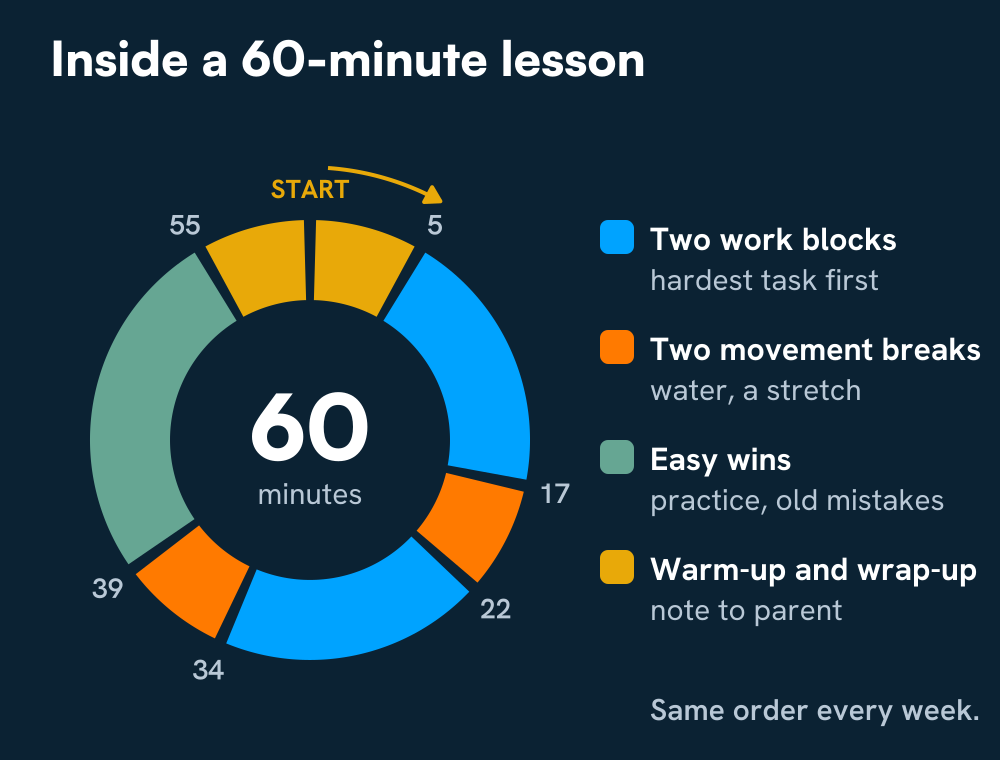
A typical 60-minute lesson for a child with ADHD runs in phases that stay the same each week. Only the content changes.
- Minutes 0 to 5: a low-stakes warm-up that signals "we are starting", such as a quick mental sums drill or a recap of last week.
- Minutes 5 to 17: the first work block, on the hardest task of the day, while attention is freshest.
- Minutes 17 to 22: a movement break, water and a stretch.
- Minutes 22 to 34: a second work block in a different format. If the first was reading, this one is problem-solving.
- Minutes 34 to 39: a second movement break.
- Minutes 39 to 55: a lighter block of practice questions, a second look at earlier mistakes and some easy wins.
- Minutes 55 to 60: wrap-up, a one-line note for the parent and a small task for the week.
What rewards work for students with ADHD?
Rewards work for children with ADHD when they are immediate, frequent and tied to effort, not saved for the end of term. A sticker after the first block beats a promised treat after two weeks of good behaviour. Useful in-lesson rewards include a small sticker chart that fills up by the end of the lesson, a token jar where each token earns a few minutes of a favourite activity, choosing the next topic or break length, or a running tally of questions answered correctly.
Avoid food-only rewards and rewards that only land at the end of the week, because the gap is too long for the reward to link to the right behaviour. The strongest reward is specific praise in the moment: "You stuck with that problem even when it got hard."
Online or home tuition for ADHD: which is better?
Both can work. The right choice depends on your child, not a rule. Online suits children who find new places unsettling, who feel safer at home or whose week is already packed with CCAs. There are fewer transitions, a parent is nearby if things get hard, and a shared whiteboard and on-screen timer are easy to use online. Home tuition suits children who need someone physically beside them, who tune out faces on a screen, or whose home is busy with siblings and TV. For many primary-age children with ADHD, online with a parent within earshot is the easiest start. Some teenagers do better with a tutor at the table. If the first format is not working after four lessons, try the other. Our guide to online or home tuition compares the two in more detail.
How do I find a tutor experienced with ADHD?
Ask any tutor or tuition service these five questions before you book:
- How many of your current students have ADHD or a similar learning need? "A few" or "many" is a good sign. "No one has asked me that" is not.
- What does a lesson look like for a student with ADHD? Listen for timed blocks, movement breaks and chunked tasks, not a vague "I make it fun".
- What do you do when a child loses focus or gets upset mid-lesson? A good answer is "I switch tasks, call a break or end early", never "I push through".
- Will you update me after each lesson? A short written note after every lesson keeps you in the loop.
- How will we know if it is working? Agree on what progress should look like after eight to ten lessons, so you can judge fit on real lessons.
At Tutero, we match your child with a tutor who has experience with their learning needs. No diagnosis is needed. Every tutor is Singapore-based, ID-verified and has signed a declaration. You can meet our tutors before you decide.
What if my child's ADHD medication wears off mid-session?
Plan lesson times around your child's medication where you can. How long a dose lasts differs from child to child and medicine to medicine, so ask your child's doctor when focus is usually best and book lessons inside that window. If a lesson falls near the end of it, tell the tutor so the structure changes: harder tasks come first, the second half moves to revision rather than new content, and breaks come sooner. If focus fades mid-lesson, the tutor can switch to something calmer, such as talking through the day's work, a recall game, or finishing early with a short written summary. The tutor does not need medical details. They only need to know roughly when focus tends to drop. Questions about the medication itself belong with your child's doctor.
How much does ADHD tuition cost in Singapore?
At Tutero, tuition starts from S$65 an hour with a private tutor, or from S$75 an hour with a qualified teacher. The rate is the same at every level, so a P3 child working on reading and a JC2 student preparing for H2 Maths pay the same, with no premium for ADHD support or exam years. See our tuition rates for details. You pay after each lesson, with no contracts and no sign-up fee, and you can cancel any time. That flexibility matters for ADHD families, because you can pause for school holidays, a hard patch or a change in medication without losing a prepaid package.
Where can Singapore parents get an ADHD assessment or support?
A doctor, not a tutor, is the right first stop for an ADHD assessment. Your family doctor or a polyclinic can talk through your concerns and advise on a referral. HealthHub describes ADHD as a pattern of inattention and/or hyperactivity and impulsivity, and notes that symptoms must have surfaced before age seven and be evident for at least six months. These public services work with children with ADHD:
- KKH Department of Child Development: the Department of Child Development at KK Women's and Children's Hospital provides diagnostic and intervention services for children with developmental, learning and behavioural difficulties, including ADHD.
- IMH Child Guidance Clinic: the Institute of Mental Health's Child Guidance Clinics support children and youths under 18, at Buangkok Green Medical Park and the Health Promotion Board building at Outram Road. Its ADHD Services offer multi-disciplinary assessment. The appointment line is 6389 2200.
- Your child's school: MOE says mainstream secondary schools and primary schools can support students with ADHD. Special Educational Needs (SEN) Officers provide in-class support and small-group skills training. Primary schools also run TRANSIT for identified P1 pupils with social and behavioural difficulties, and students can apply for access arrangements in national exams, such as extra time.
Tuition sits alongside this support, not in place of it. For other needs that often overlap with ADHD, our special needs tuition page explains how we match tutors.
Is tuition worth it for a child with ADHD?
For most families, yes, if the tutor is the right fit and the structure above is in place. It tends to work for ADHD because 1-to-1 allows instant redirection when attention drops, the lesson follows your child's attention rhythm rather than a whole class, the weekly routine makes starting easier, and the note after each lesson catches problems early. This holds from P1 phonics and model drawing to Sec 3 maths and A-Level H2 subjects.
It sometimes does not work when the tutor has no experience with ADHD, the lessons are too long, or expectations are too short-term. Give it a school term, about eight to ten lessons, before you decide. Our online tuition page explains how lessons run.
When is tuition not the right answer?
If your child is in the middle of an assessment or a change in medication, give that process time to settle before adding a tutor. If your child is very unsettled by any new adult, including online, work with the school and your child's doctor first. If the main difficulty is anxiety or another learning need alongside ADHD, tuition can still help, but the priority is a tutor who has worked with that overlap before. Our guide to common learning difficulties is a good starting point.
Related reading
- Common learning difficulties: a guide for parents
- Tips for building a weekly study planner
- Online tuition vs home tuition in Singapore
- How to help your child with maths anxiety
What should you do next?
Tuition helps a child with ADHD when the tutor changes the mechanics of the lesson: short blocks, visible timers, chunked tasks, scheduled movement, multi-sensory teaching, quick rewards and a short note to you after every lesson. The most important choice is the tutor. Experience with ADHD is what makes a lesson build confidence rather than drain it. Give it a term and watch for the small "I got it" moments. If they are showing up, the structure is working.
Tuition works for a child with ADHD when the tutor changes how the lesson runs, not just what it covers. Shorter blocks, visible timers, movement breaks, a calm space and rewards your child actually cares about are what turn 1-to-1 time into real progress. This guide covers the eight strategies tutors experienced with ADHD use most, what to ask before you book, and how the questions parents worry about (medication wearing off, online or home tuition, session length) play out in real lessons.
Quick answer
The best tuition strategies for a child with ADHD are: (1) short, time-boxed work blocks with a visible timer, (2) movement breaks every 10 to 15 minutes, (3) tasks broken into small numbered steps, (4) multi-sensory teaching (talk, write, draw, handle), (5) a calm, predictable lesson routine, (6) quick rewards tied to effort, (7) a short note to the parent after every lesson, and (8) a tutor experienced with ADHD. 1-to-1 is the format that lets all eight run together, from P1 to JC2. See how our ADHD tuition works.
What are the best tuition strategies for ADHD?
The eight strategies below are the ones tutors experienced with ADHD lean on most. None of them is unusual. What makes them work is doing them together, every lesson, and not dropping one when your child seems to be coping. Singapore schools use similar ideas: MOE's special educational needs support page lists ADHD among the needs mainstream primary schools can support, with in-class help and small-group skills training.
1. Short, time-boxed work blocks
For a child with ADHD, focus runs out block by block. Instead of one hour of continuous work, the tutor runs three or four work blocks of 10 to 15 minutes, with resets of 2 to 5 minutes in between. A timer on the desk (a kitchen timer, sand timer or visual countdown) makes the boundary visible, so your child is not holding the time in their head.
2. Tasks chunked into small numbered steps
A page of problem sums feels overwhelming. The same work as five numbered boxes ("Step 1: read", "Step 2: underline what you know", "Step 3: draw the model") feels doable. Tutors experienced with ADHD rewrite worksheets into steps before the lesson, so your child sees a finish line every couple of minutes.
3. Movement breaks built into the lesson plan
Short resets are part of the work, not an extra. A wall sit, a walk to get water, ten star jumps or a quick stretch before the next block helps attention settle. Movement breaks are scheduled, not earned, so your child knows the next one is coming.
4. Multi-sensory teaching
Many children with ADHD remember more when an idea arrives in more than one way. The tutor explains, your child writes, the tutor sketches a diagram, your child says it back. For maths that means models, blocks or quick drawings. For English it means reading aloud and colour-coding a composition plan.
5. A calm, predictable lesson space
A tidy desk, the phone out of sight, headphones nearby, a fidget within reach and the same start-of-lesson routine each week. Predictability lowers the effort of getting started, which is often the hardest part of the lesson for a child with ADHD.
6. Quick rewards tied to effort
Rewards work best when they are immediate, frequent and linked to effort, not only to marks. A sticker, a token, choosing the next topic or three minutes of a favourite game between blocks. The reward needs to land in the same lesson. Rewards promised for next week lose their pull.
7. A short note to the parent after every lesson
After each lesson, the tutor sends a short note: what worked, what did not, what to practise this week and anything worth raising with the form teacher. This catches drift early and lets you use the same step-by-step language at home.
8. A tutor experienced with ADHD
The biggest factor in whether tuition works is who the tutor is. A tutor who has taught children with ADHD before knows when to push, when to switch tasks, when to call a break and how to talk to your child without making them feel broken. Ask about it directly.
How does tuition help children with ADHD focus?
Tuition helps a child with ADHD focus by giving what a busy classroom cannot: instant redirection, immediate feedback and a lesson built around their attention rhythm. In a full class, a teacher cannot reset one distracted child without stopping everyone. In a 1-to-1 lesson, the tutor sees the moment focus drops and can switch the task, call a movement break or change the format on the spot. The lesson runs in blocks of 10 to 15 minutes instead of one unbroken hour. The routine itself (same tutor, same time, same structure each week) also helps, because your child is not spending energy working out what comes next. For help with planning beyond lessons, our study skills and organisation tuition works on the same habits.
Should children with ADHD have shorter or longer tuition sessions?
Most children with ADHD do best with lessons of 45 to 60 minutes, split into shorter work blocks rather than one long push. For P1 to P4, 30 to 45 minutes is usually enough. Beyond that, tiredness undoes the benefit. From P5, including PSLE preparation, a 60-minute lesson run as four 12-minute blocks with three short resets often works better than an unbroken hour. For Secondary and JC students working towards the O-Level, the SEC or the A-Levels, lessons can stretch to 75 to 90 minutes if the breaks are real and the student wants the longer session. The tutor adjusts to the student, not the other way round. The right length is the longest your child can manage with the structure intact.
How does a tutor structure a session for a child with ADHD?
A typical 60-minute lesson for a child with ADHD runs in phases that stay the same each week. Only the content changes.
- Minutes 0 to 5: a low-stakes warm-up that signals "we are starting", such as a quick mental sums drill or a recap of last week.
- Minutes 5 to 17: the first work block, on the hardest task of the day, while attention is freshest.
- Minutes 17 to 22: a movement break, water and a stretch.
- Minutes 22 to 34: a second work block in a different format. If the first was reading, this one is problem-solving.
- Minutes 34 to 39: a second movement break.
- Minutes 39 to 55: a lighter block of practice questions, a second look at earlier mistakes and some easy wins.
- Minutes 55 to 60: wrap-up, a one-line note for the parent and a small task for the week.
What rewards work for students with ADHD?
Rewards work for children with ADHD when they are immediate, frequent and tied to effort, not saved for the end of term. A sticker after the first block beats a promised treat after two weeks of good behaviour. Useful in-lesson rewards include a small sticker chart that fills up by the end of the lesson, a token jar where each token earns a few minutes of a favourite activity, choosing the next topic or break length, or a running tally of questions answered correctly.
Avoid food-only rewards and rewards that only land at the end of the week, because the gap is too long for the reward to link to the right behaviour. The strongest reward is specific praise in the moment: "You stuck with that problem even when it got hard."
Online or home tuition for ADHD: which is better?
Both can work. The right choice depends on your child, not a rule. Online suits children who find new places unsettling, who feel safer at home or whose week is already packed with CCAs. There are fewer transitions, a parent is nearby if things get hard, and a shared whiteboard and on-screen timer are easy to use online. Home tuition suits children who need someone physically beside them, who tune out faces on a screen, or whose home is busy with siblings and TV. For many primary-age children with ADHD, online with a parent within earshot is the easiest start. Some teenagers do better with a tutor at the table. If the first format is not working after four lessons, try the other. Our guide to online or home tuition compares the two in more detail.
How do I find a tutor experienced with ADHD?
Ask any tutor or tuition service these five questions before you book:
- How many of your current students have ADHD or a similar learning need? "A few" or "many" is a good sign. "No one has asked me that" is not.
- What does a lesson look like for a student with ADHD? Listen for timed blocks, movement breaks and chunked tasks, not a vague "I make it fun".
- What do you do when a child loses focus or gets upset mid-lesson? A good answer is "I switch tasks, call a break or end early", never "I push through".
- Will you update me after each lesson? A short written note after every lesson keeps you in the loop.
- How will we know if it is working? Agree on what progress should look like after eight to ten lessons, so you can judge fit on real lessons.
At Tutero, we match your child with a tutor who has experience with their learning needs. No diagnosis is needed. Every tutor is Singapore-based, ID-verified and has signed a declaration. You can meet our tutors before you decide.
What if my child's ADHD medication wears off mid-session?
Plan lesson times around your child's medication where you can. How long a dose lasts differs from child to child and medicine to medicine, so ask your child's doctor when focus is usually best and book lessons inside that window. If a lesson falls near the end of it, tell the tutor so the structure changes: harder tasks come first, the second half moves to revision rather than new content, and breaks come sooner. If focus fades mid-lesson, the tutor can switch to something calmer, such as talking through the day's work, a recall game, or finishing early with a short written summary. The tutor does not need medical details. They only need to know roughly when focus tends to drop. Questions about the medication itself belong with your child's doctor.
How much does ADHD tuition cost in Singapore?
At Tutero, tuition starts from S$65 an hour with a private tutor, or from S$75 an hour with a qualified teacher. The rate is the same at every level, so a P3 child working on reading and a JC2 student preparing for H2 Maths pay the same, with no premium for ADHD support or exam years. See our tuition rates for details. You pay after each lesson, with no contracts and no sign-up fee, and you can cancel any time. That flexibility matters for ADHD families, because you can pause for school holidays, a hard patch or a change in medication without losing a prepaid package.
Where can Singapore parents get an ADHD assessment or support?
A doctor, not a tutor, is the right first stop for an ADHD assessment. Your family doctor or a polyclinic can talk through your concerns and advise on a referral. HealthHub describes ADHD as a pattern of inattention and/or hyperactivity and impulsivity, and notes that symptoms must have surfaced before age seven and be evident for at least six months. These public services work with children with ADHD:
- KKH Department of Child Development: the Department of Child Development at KK Women's and Children's Hospital provides diagnostic and intervention services for children with developmental, learning and behavioural difficulties, including ADHD.
- IMH Child Guidance Clinic: the Institute of Mental Health's Child Guidance Clinics support children and youths under 18, at Buangkok Green Medical Park and the Health Promotion Board building at Outram Road. Its ADHD Services offer multi-disciplinary assessment. The appointment line is 6389 2200.
- Your child's school: MOE says mainstream secondary schools and primary schools can support students with ADHD. Special Educational Needs (SEN) Officers provide in-class support and small-group skills training. Primary schools also run TRANSIT for identified P1 pupils with social and behavioural difficulties, and students can apply for access arrangements in national exams, such as extra time.
Tuition sits alongside this support, not in place of it. For other needs that often overlap with ADHD, our special needs tuition page explains how we match tutors.
Is tuition worth it for a child with ADHD?
For most families, yes, if the tutor is the right fit and the structure above is in place. It tends to work for ADHD because 1-to-1 allows instant redirection when attention drops, the lesson follows your child's attention rhythm rather than a whole class, the weekly routine makes starting easier, and the note after each lesson catches problems early. This holds from P1 phonics and model drawing to Sec 3 maths and A-Level H2 subjects.
It sometimes does not work when the tutor has no experience with ADHD, the lessons are too long, or expectations are too short-term. Give it a school term, about eight to ten lessons, before you decide. Our online tuition page explains how lessons run.
When is tuition not the right answer?
If your child is in the middle of an assessment or a change in medication, give that process time to settle before adding a tutor. If your child is very unsettled by any new adult, including online, work with the school and your child's doctor first. If the main difficulty is anxiety or another learning need alongside ADHD, tuition can still help, but the priority is a tutor who has worked with that overlap before. Our guide to common learning difficulties is a good starting point.
Related reading
- Common learning difficulties: a guide for parents
- Tips for building a weekly study planner
- Online tuition vs home tuition in Singapore
- How to help your child with maths anxiety
What should you do next?
Tuition helps a child with ADHD when the tutor changes the mechanics of the lesson: short blocks, visible timers, chunked tasks, scheduled movement, multi-sensory teaching, quick rewards and a short note to you after every lesson. The most important choice is the tutor. Experience with ADHD is what makes a lesson build confidence rather than drain it. Give it a term and watch for the small "I got it" moments. If they are showing up, the structure is working.


Start with your family doctor or a polyclinic and ask about a referral. Public services that see children with ADHD include the KKH Department of Child Development and the IMH Child Guidance Clinics, which support children and youths under 18 at Buangkok Green Medical Park and Outram Road. The IMH appointment line is 6389 2200.
Yes. MOE says mainstream primary and secondary schools can support students with ADHD. Special Educational Needs (SEN) Officers provide in-class support and small-group skills training, and students can apply for access arrangements in national exams, such as extra time. Contact your child's school or SEN Officer to ask what is available.
For P1 to P4, 30 to 45 minutes is usually enough. From P5 to Sec 4, a 60-minute lesson split into short work blocks with movement breaks works well. JC students can manage 75 to 90 minutes if the breaks are real.
Yes. Many children with ADHD focus well online, because there is no travel, a parent is nearby and the tutor can use an on-screen timer and shared whiteboard. If your child tunes out on screens, home tuition may suit better. Try four lessons in one format before switching.
Not at Tutero. Tuition starts from S$65 an hour with a private tutor, or from S$75 an hour with a qualified teacher, at the same rate from P1 to JC. You pay after each lesson, with no contracts and no sign-up fee.
No. Tell us what your child finds hard, and we match your child with a tutor who has experience with their learning needs. No diagnosis is needed. If you think your child may have ADHD, speak to your family doctor as well.
Hoping to improve confidence & grades?


