


If your child works hard at school but reading, writing or maths feels harder for them than it should, you might be wondering whether something more is going on. The Dyslexia Association of Singapore estimates that about 30% of learners find learning challenging and need extra support. Most of these children are bright, curious kids whose brains simply process information differently. Knowing what is common, what the early signs look like and what helps is the first step towards the right support.
This guide walks through the six most common learning difficulties in children: what each one is, the early signs to watch for at home, and where to get help in Singapore. It is written for parents, not for clinicians, and uses person-first language throughout (a child with dyslexia, not a dyslexic child), though many adults in the community prefer identity-first language, and both are valid.
Quick answer
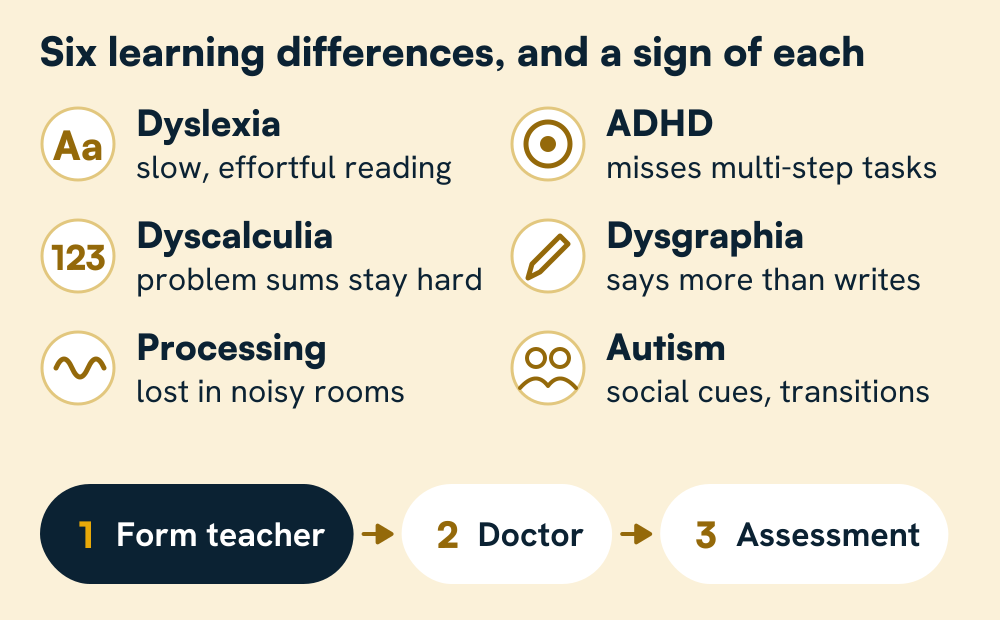
The most common learning difficulties in children are dyslexia (reading and spelling), ADHD (attention and impulse control), dyscalculia (maths), dysgraphia (writing), auditory and language processing difficulties, and autism. In Singapore, start by talking to your child’s form teacher, then ask a doctor about a referral if you want an assessment. Tuition can help alongside school support.
What are the most common learning difficulties in children?
The most common learning difficulties in children are dyslexia (reading and spelling), ADHD (attention and impulse control), dysgraphia (writing), dyscalculia (maths), auditory and language processing disorders, and autism spectrum disorder. In Singapore, schools and the Ministry of Education (MOE) group these under special educational needs, while parents and teachers often say learning difficulties. They are lifelong differences in how the brain processes language, numbers, sounds, attention or social information. They are not a reflection of a child's intelligence, effort or upbringing. Most children with a learning difference have average or above-average ability and do well with early identification, the right teaching approach and patient adults around them.
What's the difference between a learning disability and a learning difference?
Both terms describe the same thing. The choice is about tone, not diagnosis. "Learning disability" is the formal term used in diagnostic manuals (the DSM-5 calls it specific learning disorder). "Learning difference" is the framing many parents, educators and advocacy groups now prefer, because it avoids implying that the child is broken. In Singapore you will also hear "special educational needs" (the term MOE uses for school support) and "learning difficulties". The Dyslexia Association of Singapore describes dyslexia as a "specific learning difference". Whichever words you use, the practical question is the same: what is making this kind of learning hard for this child, and what teaching and support helps?
What is dyslexia, and what are the early signs?
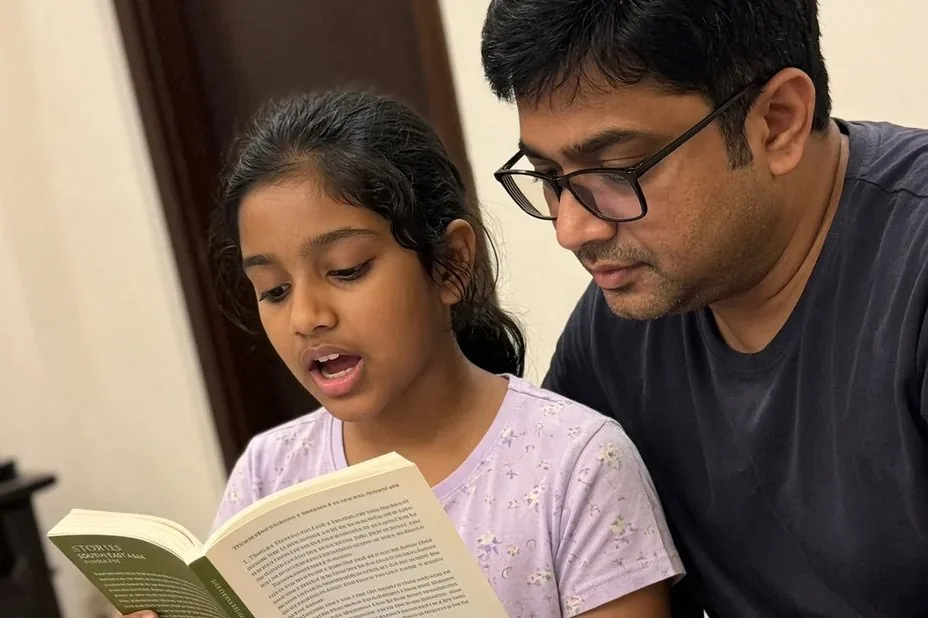
Dyslexia is a specific learning difference that mainly affects reading, spelling and writing, especially accurate and fluent word reading. The Dyslexia Association of Singapore (DAS) explains that it is linked to how the brain processes the sounds of language, often runs in families, and is lifelong. Children with dyslexia are not slow readers because they aren't trying. Their brains build the bridge between letters and sounds differently, so decoding new words takes real effort. DAS also notes that dyslexia occurs across all languages, which matters in Singapore, where children learn English and a Mother Tongue Language side by side. It is unrelated to intelligence. If reading is the specific thing that is hard, dyslexia tuition works on decoding and fluency at your child's own pace.
Early signs of dyslexia in primary school children:
- Slow, effortful reading aloud, even on familiar words, with frequent guesses based on the first letter
- Inconsistent spelling of the same word on the same page
- Avoiding reading-aloud tasks: closing the book, asking to do something else, becoming tearful
- Letter or number reversals past P2. Most children reverse letters early; reversals that last beyond about age 7 are the signal
- Trouble rhyming or breaking words into sounds ("cat" into "c-a-t") well past preschool
- A family member with dyslexia or unexplained reading struggles, one of the strongest predictors
What is ADHD, and how does it affect learning?
Attention deficit hyperactivity disorder (ADHD) is a difference in how the brain manages attention, impulse control and working memory, the mental scratchpad you use to hold a multi-step instruction in mind while you carry it out. HealthHub states that ADHD affects about 5% of children worldwide and in Singapore. ADHD is not a problem of effort or willpower. The brain's "manager" simply takes more energy to switch on and stay on. There are three main presentations: mainly inattentive (often missed in girls), mainly hyperactive-impulsive, and combined. Children with ADHD often have another learning difference alongside it, so a careful assessment matters. For the schoolwork itself, ADHD tuition built around how your child focuses keeps lessons short, structured and light on working memory.
Early signs of ADHD in children:
- Difficulty staying with a task, bouncing between activities even when interested
- Forgetting multi-step instructions halfway through ("get your shoes, your water bottle and your bag")
- Daydreaming or drifting off in class. The inattentive presentation looks like a child who is miles away
- Restlessness, fidgeting or calling out, the hyperactive presentation
- Trouble starting homework even when it is something they can do
- Strong emotional reactions to small frustrations, especially around schoolwork
If the attention pattern is what you recognise, our guide to tuition strategies for ADHD walks through what works in lessons and at home.
What is dysgraphia, and what are the early signs?
Dysgraphia is a learning difference that affects the physical and thinking side of writing. Children with dysgraphia know what they want to say, but forming letters, spacing words and getting their thoughts onto the page takes great effort, almost like writing with their other hand every time. It often appears alongside dyslexia and ADHD, and it can hide as "messy handwriting" or "careless work" until a teacher or parent looks closely at the gap between what the child can say about a topic and what they can write about it. The DSM-5 recognises it as part of specific learning disorder with impairment in written expression. In Singapore it often becomes visible in P3 to P4, when composition and longer written answers start to count for more.
Early signs of dysgraphia:
- Awkward or tight pencil grip, often with white knuckles
- Uneven letter sizing and spacing on the same line
- Mixing capitals and lowercase within words past early primary
- Spoken answers far richer than written answers. The gap is the signal
- Avoiding writing tasks, getting tired or frustrated quickly
- Slow copying from the board, finishing tasks long after classmates
What is dyscalculia, and what are the early signs?
Dyscalculia is a specific learning difficulty in maths. It affects number sense: the feel that 7 is bigger than 5, and that 6 is the same amount whether it is shown as dots, fingers or a numeral. It is not the same as being weak in maths or not practising enough. Children with dyscalculia can usually memorise number facts with effort but struggle to use them flexibly, so problem sums, mental sums and estimating stay hard. It often shows up around P2 to P3, when maths moves from counting to operations. The Dyslexia Association of Singapore assesses for dyscalculia from age 7. If maths is the sticking point, patient one-to-one maths tuition rebuilds number sense step by step.
Early signs of dyscalculia:
- Counting on fingers well past the age classmates stop
- Difficulty estimating, guessing 100 when the answer is 6
- Trouble linking numerals to quantities: knowing the symbol "5" but not the amount it stands for
- Worry or shutdown around maths: reluctance, tears or freezing at the sight of a worksheet
- Forgetting recently learned facts, even after lots of practice
- Trouble telling time on an analogue clock or reading a calendar
Dyscalculia and maths anxiety often feed each other, so it helps to look at both together.
What are auditory processing and language processing disorders?
Auditory processing disorder (APD) and language processing disorder are differences in how the brain makes sense of the sounds and meaning of spoken language, even when hearing itself is normal. A child with APD hears the words but loses some of the information between ear and meaning, especially in noisy places like a busy classroom. Language processing disorder is broader and affects how a child understands and organises language. Both are identified by an audiologist or a speech therapist, not a teacher. Both respond well to simple strategies that any classroom or tutor can use: visual instructions, written follow-ups, quiet seating and repetition.
Early signs of a processing difference:
- "Pardon?" or "What?" again and again in normal-volume conversation
- Following only the first part of a multi-step instruction
- Mishearing similar-sounding words ("seventy" and "seventeen")
- Tiring quickly in noisy classrooms or losing focus by mid-afternoon
- Struggling to follow group conversations or fast-paced videos
- Strong reading and writing despite weak listening. The gap is the clue
How does autism affect a child's learning?
Autism spectrum disorder (ASD) is a difference in social communication, sensory processing and pattern-based thinking. It is not strictly a learning disability, but it shapes how a child learns. HealthHub notes that signs often appear in early childhood and that around 1 in 127 people worldwide have ASD. Many autistic children have deep knowledge of a special interest, excellent memory and strong pattern recognition, alongside real challenges with social cues, moving between tasks, sensory load and open-ended questions. Identity-first language ("autistic child") is preferred by much of the adult autistic community; person-first language ("child with autism") is more common in clinical settings. Both are respectful when used with care.
How autism shows up at school:
- Deep focus on a specific interest (trains, dinosaurs, a particular book series) alongside trouble engaging with topics outside it
- Difficulty with open-ended questions ("write about your weekend") compared with structured ones
- Strong reactions to changes in routine, such as a relief teacher or a moved desk
- Sensory sensitivities: uniform tags, classroom noise, fluorescent lights
- Literal reading of figures of speech and instructions
- Social tiredness: meltdowns or shutdowns after school, even on good days
What are the early signs my child may have a learning difference?
The earliest signs of a learning difference usually show up at home, not in a school report. Most parents notice something is off long before an assessment confirms it: a quiet sense that the gap between effort and results is wider than it should be. None of the signs below means anything on its own. A cluster of three or more that lasts for several months, at home and at school, is reason enough to talk to your child's form teacher, your family doctor or a polyclinic doctor.
Early signs across preschool, primary and lower secondary:
- Late talking compared with siblings or classmates
- Trouble saying the sounds of certain words, animals or numbers
- Slow vocabulary growth or difficulty finding the right word
- Trouble rhyming words or remembering songs and nursery rhymes
- Difficulty learning numbers, the alphabet or the days of the week
- Reading well below the expected level by mid-P1
- Maths ideas that "won't stick" across several terms
- Avoidance, tears or stomach aches on school mornings, especially before English or maths
- Reports of "not paying attention" from more than one teacher across different years
Should I get my child assessed for a learning difficulty?
If a cluster of signs has lasted for several months across home and school, an assessment is worth it. MOE's guide to professional assessments says a qualified professional can give a clear diagnosis and recommend practical support. For children below age 7, MOE points parents to the Department of Child Development at KK Women's and Children's Hospital (KKH) and the Child Development Unit at National University Hospital (NUH). You are eligible for a subsidy if a polyclinic or a Community Health Assist Scheme (CHAS) clinic refers you. You can also see a registered Educational or Clinical Psychologist privately. A clear assessment tells the school, the family and any tutor which teaching approach and which supports will help.
Where Singapore parents usually start:
- Your child's school: the form teacher or the school's Special Educational Needs (SEN) Officer can share what they see in class
- A polyclinic or family doctor, who can rule out hearing, vision or sleep issues and refer you on
- KKH or NUH. The KKH Department of Child Development sees children with learning delays and disorders, including dyslexia, ADHD and autism
- The Dyslexia Association of Singapore, whose psychologists assess for dyslexia (from age 6), dyscalculia (from age 7), ADHD and autism
- The Institute of Mental Health (IMH). HealthHub advises that a healthcare professional can refer a child with suspected ADHD to IMH for further assessment
What support is available for children with learning needs in Singapore?
Children with learning needs in Singapore are supported through mainstream schools, special education (SPED) schools and community organisations. MOE says mainstream primary schools can support students with ADHD, dyslexia, hearing loss, mild autism spectrum disorder, physical impairment and visual impairment. Each school has Special Educational Needs (SEN) Officers, who give in-class support and small-group intervention, and Teachers Trained in Special Needs, who share strategies with colleagues. Mainstream secondary schools offer support too, including access arrangements for national exams, such as larger fonts and extra time.
MOE programmes in mainstream primary schools:
- Learning Support Programme (LSP) for P1 and P2 students with weak language and literacy skills
- Learning Support for Mathematics (LSM) for P1 to P4 students who need extra help with basic maths concepts and skills
- School-based Dyslexia Remediation for students with dyslexia in P3 and P4
- The MOE-subsidised Main Literacy Programme, run by the Dyslexia Association of Singapore for students with dyslexia who meet the subsidy criteria
For children who need a different setting, government-funded SPED schools support conditions such as autism spectrum disorder, intellectual disability, multiple disabilities and sensory impairment. Some SPED schools for autistic children without intellectual impairment offer the National Curriculum. Your child's school or SEN Officer is the best first contact for any of these.
How does tuition help a child with a learning difference?
One-to-one tuition helps a child with a learning difference because it removes the two pressures a classroom can't: pace and audience. A good tutor adjusts the rhythm to the child's working memory, breaks instructions into smaller steps, switches to visual or hands-on explanations when words stall, and lets the child make mistakes without 30 classmates watching. Children with learning differences are often behind by the time anyone notices, so steady, patient one-to-one teaching gives them room to catch up on the school syllabus without rushing.
Tuition is not a replacement for a school programme, a speech therapist or a diagnosis. It works best alongside them, covering the day-to-day MOE syllabus your child still has to learn while other support builds the underlying skill. At Tutero, we match your child with a tutor who has experience with their learning needs, and no diagnosis is needed. We match your child with a Singapore-based tutor who has experience with their learning needs. Special needs tuition costs from S$65 an hour, the same rate from P1 to JC, with no contracts and payment after each lesson. If reading and writing are the hardest part, English tuition with a patient tutor is often the best place to start.
If you are still deciding whether extra help is needed, our guide to the signs your primary school child needs a tutor is a useful next read.
Worried your child might have a learning difference? The earliest, most useful step is a conversation with your child's form teacher, your family doctor or a tutor who has worked with children in the same situation. You can also see how online tuition with Tutero works before you decide.
If your child works hard at school but reading, writing or maths feels harder for them than it should, you might be wondering whether something more is going on. The Dyslexia Association of Singapore estimates that about 30% of learners find learning challenging and need extra support. Most of these children are bright, curious kids whose brains simply process information differently. Knowing what is common, what the early signs look like and what helps is the first step towards the right support.
This guide walks through the six most common learning difficulties in children: what each one is, the early signs to watch for at home, and where to get help in Singapore. It is written for parents, not for clinicians, and uses person-first language throughout (a child with dyslexia, not a dyslexic child), though many adults in the community prefer identity-first language, and both are valid.
Quick answer
The most common learning difficulties in children are dyslexia (reading and spelling), ADHD (attention and impulse control), dyscalculia (maths), dysgraphia (writing), auditory and language processing difficulties, and autism. In Singapore, start by talking to your child’s form teacher, then ask a doctor about a referral if you want an assessment. Tuition can help alongside school support.
What are the most common learning difficulties in children?
The most common learning difficulties in children are dyslexia (reading and spelling), ADHD (attention and impulse control), dysgraphia (writing), dyscalculia (maths), auditory and language processing disorders, and autism spectrum disorder. In Singapore, schools and the Ministry of Education (MOE) group these under special educational needs, while parents and teachers often say learning difficulties. They are lifelong differences in how the brain processes language, numbers, sounds, attention or social information. They are not a reflection of a child's intelligence, effort or upbringing. Most children with a learning difference have average or above-average ability and do well with early identification, the right teaching approach and patient adults around them.
What's the difference between a learning disability and a learning difference?
Both terms describe the same thing. The choice is about tone, not diagnosis. "Learning disability" is the formal term used in diagnostic manuals (the DSM-5 calls it specific learning disorder). "Learning difference" is the framing many parents, educators and advocacy groups now prefer, because it avoids implying that the child is broken. In Singapore you will also hear "special educational needs" (the term MOE uses for school support) and "learning difficulties". The Dyslexia Association of Singapore describes dyslexia as a "specific learning difference". Whichever words you use, the practical question is the same: what is making this kind of learning hard for this child, and what teaching and support helps?
What is dyslexia, and what are the early signs?
Dyslexia is a specific learning difference that mainly affects reading, spelling and writing, especially accurate and fluent word reading. The Dyslexia Association of Singapore (DAS) explains that it is linked to how the brain processes the sounds of language, often runs in families, and is lifelong. Children with dyslexia are not slow readers because they aren't trying. Their brains build the bridge between letters and sounds differently, so decoding new words takes real effort. DAS also notes that dyslexia occurs across all languages, which matters in Singapore, where children learn English and a Mother Tongue Language side by side. It is unrelated to intelligence. If reading is the specific thing that is hard, dyslexia tuition works on decoding and fluency at your child's own pace.
Early signs of dyslexia in primary school children:
- Slow, effortful reading aloud, even on familiar words, with frequent guesses based on the first letter
- Inconsistent spelling of the same word on the same page
- Avoiding reading-aloud tasks: closing the book, asking to do something else, becoming tearful
- Letter or number reversals past P2. Most children reverse letters early; reversals that last beyond about age 7 are the signal
- Trouble rhyming or breaking words into sounds ("cat" into "c-a-t") well past preschool
- A family member with dyslexia or unexplained reading struggles, one of the strongest predictors
What is ADHD, and how does it affect learning?
Attention deficit hyperactivity disorder (ADHD) is a difference in how the brain manages attention, impulse control and working memory, the mental scratchpad you use to hold a multi-step instruction in mind while you carry it out. HealthHub states that ADHD affects about 5% of children worldwide and in Singapore. ADHD is not a problem of effort or willpower. The brain's "manager" simply takes more energy to switch on and stay on. There are three main presentations: mainly inattentive (often missed in girls), mainly hyperactive-impulsive, and combined. Children with ADHD often have another learning difference alongside it, so a careful assessment matters. For the schoolwork itself, ADHD tuition built around how your child focuses keeps lessons short, structured and light on working memory.
Early signs of ADHD in children:
- Difficulty staying with a task, bouncing between activities even when interested
- Forgetting multi-step instructions halfway through ("get your shoes, your water bottle and your bag")
- Daydreaming or drifting off in class. The inattentive presentation looks like a child who is miles away
- Restlessness, fidgeting or calling out, the hyperactive presentation
- Trouble starting homework even when it is something they can do
- Strong emotional reactions to small frustrations, especially around schoolwork
If the attention pattern is what you recognise, our guide to tuition strategies for ADHD walks through what works in lessons and at home.
What is dysgraphia, and what are the early signs?
Dysgraphia is a learning difference that affects the physical and thinking side of writing. Children with dysgraphia know what they want to say, but forming letters, spacing words and getting their thoughts onto the page takes great effort, almost like writing with their other hand every time. It often appears alongside dyslexia and ADHD, and it can hide as "messy handwriting" or "careless work" until a teacher or parent looks closely at the gap between what the child can say about a topic and what they can write about it. The DSM-5 recognises it as part of specific learning disorder with impairment in written expression. In Singapore it often becomes visible in P3 to P4, when composition and longer written answers start to count for more.
Early signs of dysgraphia:
- Awkward or tight pencil grip, often with white knuckles
- Uneven letter sizing and spacing on the same line
- Mixing capitals and lowercase within words past early primary
- Spoken answers far richer than written answers. The gap is the signal
- Avoiding writing tasks, getting tired or frustrated quickly
- Slow copying from the board, finishing tasks long after classmates
What is dyscalculia, and what are the early signs?
Dyscalculia is a specific learning difficulty in maths. It affects number sense: the feel that 7 is bigger than 5, and that 6 is the same amount whether it is shown as dots, fingers or a numeral. It is not the same as being weak in maths or not practising enough. Children with dyscalculia can usually memorise number facts with effort but struggle to use them flexibly, so problem sums, mental sums and estimating stay hard. It often shows up around P2 to P3, when maths moves from counting to operations. The Dyslexia Association of Singapore assesses for dyscalculia from age 7. If maths is the sticking point, patient one-to-one maths tuition rebuilds number sense step by step.
Early signs of dyscalculia:
- Counting on fingers well past the age classmates stop
- Difficulty estimating, guessing 100 when the answer is 6
- Trouble linking numerals to quantities: knowing the symbol "5" but not the amount it stands for
- Worry or shutdown around maths: reluctance, tears or freezing at the sight of a worksheet
- Forgetting recently learned facts, even after lots of practice
- Trouble telling time on an analogue clock or reading a calendar
Dyscalculia and maths anxiety often feed each other, so it helps to look at both together.
What are auditory processing and language processing disorders?
Auditory processing disorder (APD) and language processing disorder are differences in how the brain makes sense of the sounds and meaning of spoken language, even when hearing itself is normal. A child with APD hears the words but loses some of the information between ear and meaning, especially in noisy places like a busy classroom. Language processing disorder is broader and affects how a child understands and organises language. Both are identified by an audiologist or a speech therapist, not a teacher. Both respond well to simple strategies that any classroom or tutor can use: visual instructions, written follow-ups, quiet seating and repetition.
Early signs of a processing difference:
- "Pardon?" or "What?" again and again in normal-volume conversation
- Following only the first part of a multi-step instruction
- Mishearing similar-sounding words ("seventy" and "seventeen")
- Tiring quickly in noisy classrooms or losing focus by mid-afternoon
- Struggling to follow group conversations or fast-paced videos
- Strong reading and writing despite weak listening. The gap is the clue
How does autism affect a child's learning?
Autism spectrum disorder (ASD) is a difference in social communication, sensory processing and pattern-based thinking. It is not strictly a learning disability, but it shapes how a child learns. HealthHub notes that signs often appear in early childhood and that around 1 in 127 people worldwide have ASD. Many autistic children have deep knowledge of a special interest, excellent memory and strong pattern recognition, alongside real challenges with social cues, moving between tasks, sensory load and open-ended questions. Identity-first language ("autistic child") is preferred by much of the adult autistic community; person-first language ("child with autism") is more common in clinical settings. Both are respectful when used with care.
How autism shows up at school:
- Deep focus on a specific interest (trains, dinosaurs, a particular book series) alongside trouble engaging with topics outside it
- Difficulty with open-ended questions ("write about your weekend") compared with structured ones
- Strong reactions to changes in routine, such as a relief teacher or a moved desk
- Sensory sensitivities: uniform tags, classroom noise, fluorescent lights
- Literal reading of figures of speech and instructions
- Social tiredness: meltdowns or shutdowns after school, even on good days
What are the early signs my child may have a learning difference?
The earliest signs of a learning difference usually show up at home, not in a school report. Most parents notice something is off long before an assessment confirms it: a quiet sense that the gap between effort and results is wider than it should be. None of the signs below means anything on its own. A cluster of three or more that lasts for several months, at home and at school, is reason enough to talk to your child's form teacher, your family doctor or a polyclinic doctor.
Early signs across preschool, primary and lower secondary:
- Late talking compared with siblings or classmates
- Trouble saying the sounds of certain words, animals or numbers
- Slow vocabulary growth or difficulty finding the right word
- Trouble rhyming words or remembering songs and nursery rhymes
- Difficulty learning numbers, the alphabet or the days of the week
- Reading well below the expected level by mid-P1
- Maths ideas that "won't stick" across several terms
- Avoidance, tears or stomach aches on school mornings, especially before English or maths
- Reports of "not paying attention" from more than one teacher across different years
Should I get my child assessed for a learning difficulty?
If a cluster of signs has lasted for several months across home and school, an assessment is worth it. MOE's guide to professional assessments says a qualified professional can give a clear diagnosis and recommend practical support. For children below age 7, MOE points parents to the Department of Child Development at KK Women's and Children's Hospital (KKH) and the Child Development Unit at National University Hospital (NUH). You are eligible for a subsidy if a polyclinic or a Community Health Assist Scheme (CHAS) clinic refers you. You can also see a registered Educational or Clinical Psychologist privately. A clear assessment tells the school, the family and any tutor which teaching approach and which supports will help.
Where Singapore parents usually start:
- Your child's school: the form teacher or the school's Special Educational Needs (SEN) Officer can share what they see in class
- A polyclinic or family doctor, who can rule out hearing, vision or sleep issues and refer you on
- KKH or NUH. The KKH Department of Child Development sees children with learning delays and disorders, including dyslexia, ADHD and autism
- The Dyslexia Association of Singapore, whose psychologists assess for dyslexia (from age 6), dyscalculia (from age 7), ADHD and autism
- The Institute of Mental Health (IMH). HealthHub advises that a healthcare professional can refer a child with suspected ADHD to IMH for further assessment
What support is available for children with learning needs in Singapore?
Children with learning needs in Singapore are supported through mainstream schools, special education (SPED) schools and community organisations. MOE says mainstream primary schools can support students with ADHD, dyslexia, hearing loss, mild autism spectrum disorder, physical impairment and visual impairment. Each school has Special Educational Needs (SEN) Officers, who give in-class support and small-group intervention, and Teachers Trained in Special Needs, who share strategies with colleagues. Mainstream secondary schools offer support too, including access arrangements for national exams, such as larger fonts and extra time.
MOE programmes in mainstream primary schools:
- Learning Support Programme (LSP) for P1 and P2 students with weak language and literacy skills
- Learning Support for Mathematics (LSM) for P1 to P4 students who need extra help with basic maths concepts and skills
- School-based Dyslexia Remediation for students with dyslexia in P3 and P4
- The MOE-subsidised Main Literacy Programme, run by the Dyslexia Association of Singapore for students with dyslexia who meet the subsidy criteria
For children who need a different setting, government-funded SPED schools support conditions such as autism spectrum disorder, intellectual disability, multiple disabilities and sensory impairment. Some SPED schools for autistic children without intellectual impairment offer the National Curriculum. Your child's school or SEN Officer is the best first contact for any of these.
How does tuition help a child with a learning difference?
One-to-one tuition helps a child with a learning difference because it removes the two pressures a classroom can't: pace and audience. A good tutor adjusts the rhythm to the child's working memory, breaks instructions into smaller steps, switches to visual or hands-on explanations when words stall, and lets the child make mistakes without 30 classmates watching. Children with learning differences are often behind by the time anyone notices, so steady, patient one-to-one teaching gives them room to catch up on the school syllabus without rushing.
Tuition is not a replacement for a school programme, a speech therapist or a diagnosis. It works best alongside them, covering the day-to-day MOE syllabus your child still has to learn while other support builds the underlying skill. At Tutero, we match your child with a tutor who has experience with their learning needs, and no diagnosis is needed. We match your child with a Singapore-based tutor who has experience with their learning needs. Special needs tuition costs from S$65 an hour, the same rate from P1 to JC, with no contracts and payment after each lesson. If reading and writing are the hardest part, English tuition with a patient tutor is often the best place to start.
If you are still deciding whether extra help is needed, our guide to the signs your primary school child needs a tutor is a useful next read.
Worried your child might have a learning difference? The earliest, most useful step is a conversation with your child's form teacher, your family doctor or a tutor who has worked with children in the same situation. You can also see how online tuition with Tutero works before you decide.


Start with your child's form teacher or the school's SEN Officer, and a polyclinic or family doctor who can rule out hearing, vision or sleep issues. For children below age 7, MOE points parents to the Department of Child Development at KKH and the Child Development Unit at NUH, with a subsidy if a polyclinic or CHAS clinic refers you. You can also see a registered Educational or Clinical Psychologist privately, or book a learning assessment with the Dyslexia Association of Singapore.
Mainstream schools have SEN Officers who give in-class and small-group support, and Teachers Trained in Special Needs who share strategies with other teachers. Primary schools run the Learning Support Programme for P1 and P2 literacy, Learning Support for Mathematics for P1 to P4, and School-based Dyslexia Remediation in P3 and P4. Students can also get access arrangements for national exams, such as larger fonts and extra time.
Mainstream schools suit children who can access the national curriculum and a mainstream classroom, with extra support for needs such as ADHD, dyslexia and mild autism. SPED schools are government-funded special education schools for children with needs such as autism spectrum disorder, intellectual disability, multiple disabilities or sensory impairment. Some SPED schools for autistic children without intellectual impairment still offer the National Curriculum. Applying to a SPED school needs a professional assessment.
No. Many children find maths hard for a while and catch up with good teaching and practice. Dyscalculia is a specific learning difficulty that affects number sense itself, so problems like estimating, mental sums and linking numerals to amounts stay hard even after lots of practice. The Dyslexia Association of Singapore assesses for dyscalculia from age 7.
Yes. The Dyslexia Association of Singapore notes that dyslexia often occurs alongside other differences, including ADHD, autism, dyscalculia and developmental language disorder. When two differences overlap, each can make the other harder to spot, which is why a full assessment looks at reading, attention and other skills together.
Yes, as long as the tutor slows down and rebuilds number sense with visual and hands-on steps rather than drilling more worksheets. One-to-one maths tuition lets your child work at their own pace through the MOE syllabus. At Tutero, we match your child with a tutor who has experience with their learning needs, and no diagnosis is needed.
Hoping to improve confidence & grades?


